
Scientific Methodologies based on Histories and Expansions of Scientific Theories
The aim of this reach explores various methods for approaching scientific and propositional knowledge whose truth can be discriminated from falsehood based on History of Science. To do so, it briefly investigated the following types of arguments: (1) arguments based on formal logic which focus on the ahistorical, fixed, and static universe instead of the historical universe, and justifies previously established assertions; (2) arguments based on abduction and analogy which historically emphasize generation and discovery of a hypothesis; and (3) dialectical arguments based on non-formal logic which focus on the existing and evolving universe. Furthermore, it examined analogical and dialectical logic that is slightly reflected in the Newtonian mechanics presented after the Scientific Revolution, and the qualitative integration of essential theories on modern science represented by the theory of relativity and quantum mechanics.
Introduction
There is no doubt that scientific literacy is a ‘necessary quality as a citizen’ and ‘necessary for leading a normal life.’ In particular, considering the modern civilization built on science and technology and the increasing influence of science and technology on future society, the importance of scientific literacy becomes even greater. In order to cultivate students’ scientific literacy, basic science subjects must include not only knowledge of core scientific concepts and theories, but also training in scientific reasoning. This study explores what types of methodologies for scientific reasoning exist and how they have actually been used in the history of science.
Western thought in the Middle Ages was dominated by a teleological analysis of nature based on human intention. Modern thought, meanwhile, has examined nature from causal, deterministic, scientific, and mechanistic approaches, without considering human expectation and intention. Such philosophical approaches in medieval and modern times indicate that medieval philosophers supported teleology explanations of nature based on the metaphysical tradition developed in Ancient Greece, and that modern philosophers have supported mechanisms based on deterministic and scientific ideas.
However, the Western scientific reasoning process traditionally seeks invariance from changes, determination of the sole original form out of several different forms, completeness from incompleteness, an abstract thing from specific things, and absoluteness, eternity, and infinity from relative, temporary, and finite things. From this point of view, the process of metaphysical abstraction intends to discover the principle of dominating a certain phenomenon from things that occurred because of the corresponding phenomenon.
This abstraction process affected the understanding of Parmenides and Plato, who made remarkable contributions to Western thought; it encouraged the restoration of atomic theory and geometrical spirit that had been introduced in ancient Greece, and nourished the ideas of Enlightenment. Concepts of Enlightenment had primarily been advanced by Galileo Galilei, Johannes Kepler, and Isaac Newton, and became the fundamental framework pursued by science and philosophy. This study analyzed arguments based on formal logic, a traditional Western reasoning process that places emphasis on fixed and unchangeable substance as well as arguments based on analogical reasoning and dialectic logic, both of which seek change and idea generation. Moreover, this study investigated scientific reasoning methodologies that could be applied in scientific theories according to the following procedures.
A long-standing and continuing controversy exist regarding the role of induction and deduction in reasoning and in scientific inquiry. Given the inherent difficulty in reconstructing reasoning patterns based on personal and historical accounts, evidence about the nature of human reasoning in scientific inquiry has been sought from a controlled experiment designed to identify the role played by enumerative induction and deduction in cognition as well as from the relatively new field of neural modelling. Both experimental results and the neurological models imply that induction across a limited set of observations plays no role in task performance and in reasoning. Therefore, support has been obtained for Popper’s hypothesis that enumerative induction does not exist as a psychological process [1].
Therefore, the purpose of this study is to explore analogical reasoning and dialectical logic that pursue change and creation from the traditional Western formal argument that pursues such fixed and unchanging entities. We examine the scientific methodology of thinking in order to approach scientific theories.
Characteristics of Western Thought
Western philosophers believed that an unchangeable and immortal thing is more natural and excellent than a changing and mortal thing. Based on this belief, they sought these such unchangeable and immortal things, a process which developed into ontology in the West. According to ontology, a complete thing is better than an incomplete thing; an absolute thing is better than a relative thing; a thing beyond space and time is better than a thing depending on space and time; and a consistent and non-contradictory thing is better than a complex and contradictory thing. Hence, ancient Western philosophy informs us that an experiential being that we identify based on our daily experiences is a virtual being, not an actual one.
Western studies follow laws of thought. The following three laws of thought are regarded as the minimum and essential principles of logic [2].
Three fundamental laws of thought are:
- The law of identity: A is A. A certain thing is identical with itself.
- The law of contradiction: A is not not-A. Nothing can both be and not be.
- The law of excluded middle: X is either A or not-A.
Everything must either be or not be.
A view based on the laws of thought states that these laws are valid for the world of thoughts, and that the world where we live in exists in the same way as the laws of thought. According to this view, the world where we live corresponds to the laws of thought. Regarding the ancient Greek ideas and classical physics, the principles of dual differentiation and three laws of thought are applied to the world as the target of consciousness, which can thus be regarded as the world of formal logic and fixed substance. However, objects of the microscopic world, i.e., the world of quantum mechanics, are described only by a wave function, based on the Schrödinger equation. This function refers to the probability of detecting a particle at a specific location at a specific time. Before an observer performs an observation, the probabilities of detecting a particle are spread in the entire space in the form of waves. When the observer finds a certain probability, the corresponding probability wave disappears instantly. At the same time, a particle appears at a certain location. That is, objects of the microscopic world exist in the form of waves before an observer makes an observation. When the observer performs an observation, the wave function is destroyed and a particle appears. Characteristics of the world of quantum mechanics are as follows.
1. Duality: X can be both A and not-A. Every particle has properties of both a particle and a wave. 2. Superposition: X has both a probability of being A and a probability of being not-A. Every particle has the entire probabilities due to overlapping of several different waves.
Hence, the world of quantum mechanics is analyzed as the world, which is beyond the ideal reasoning system that operates based on the laws of identity, contradiction, and excluded middle. In this regard, it is not the world of substance based on the ancient Greek ideas, reasoning according to classical physics, and formal logic. It is the world of relations applying dialectics, dealing with existence, and abduction or inference to the best explanation (IBE), which is oriented to pragmatism. Thus, this study reviewed arguments based on formal logic, which is a traditional Western reasoning approach, and arguments based on non-formal logic, which is applied in modern science.
Deductive and Inductive Inference as Formal Argument
An argument, inference, or reasoning generally indicates a set of more than two statements (propositions) proposed to establish a consequence relation. In other words, it is the consequence of statements (prepositions) claimed to be based on premises.
An argument is also called inference or reasoning. The terms argument, inference, and reasoning have similar meanings, but an inference indicates a thinking process related to the premise and the consequence, while an argument indicates an expression of such a thinking process in verbal or written form [3]. The terms argument, inference, and reasoning can therefore be used interchangeably. Specifically, induction and deduction are valid for justify a theory rather than generating one. An argument refers to a combination of induction and deduction. Abduction and analogy stress the generation of a hypothesis, and dialectical logic emphasizes integration and change of a hypothesis.
According to the quality of arguments, a deductive argument is assessed as a good argument when it is valid, and an inductive argument is assessed as a good argument when it is strong. A deductive argument is assessed as a bad argument when it is invalid, and an inductive argument is assessed as a bad argument when it is weak. An invalid deductive argument fails in its formal relationship between premise and consequence. A valid deductive argument contains the premise that includes the consequence. As a valid deductive argument ensures conservation of knowledge, this type of an argument should be pursued.
Abduction for Discovery of Various Hypothesis
Suggestion of various hypothesis based on Abduction
Socrates died (a strange phenomenon that should be explained).
Everyone dies (a fact and a principle proposed).
Thus, Socrates is a person (a strange phenomenon proved to be reasonable by identifying the cause of a problematic situation and solving the relevant problem).
Abduction indicates a process of knowledge creation; in this study, this is also called emergence. Charles Peirce, an American logician, first argued that abduction, not deduction or induction, is the most essential intellectual process in science [4, 5].
A surprising event P was observed. If a hypothesis A is true, the consequence of P is naturally derived (the emergence process).
Thus, there is a reason for considering that a hypothesis A is true.
A surprising “historical fact that Socrates died,” which should be explained, was investigated.
If a hypothesis that Socrates is a human being is true, it leads to the fact that Socrates died (the emergence process).
Thus, there is a reason for considering that the hypothesis that Socrates is a human being is true.
A surprising “historical fact that Socrates died,” which should be explained, was investigated.
If a hypothesis that Socrates died by drinking poison in accordance with the opinion of the opposing group is true, this hypothesis leads to the fact that Socrates died (the emergence process).
Thus, there is a reason for considering that a hypothesis that Socrates died by drinking poison in accordance with the opinion of the opposing group is true.
As described above, an argument based on abduction has one or more hypotheses, unlike an inductive argument associated with formal logic. In other words, a characteristic of abduction is that various hypotheses can emerge according to background knowledge. Thus, abduction is regarded as reasoning rather than an argument.
Suggestion of a New Abduction-Based Theory that Can Explain an Astonishing Phenomenon That Occurred in the Past
Movement of the perihelion of Mercury, a surprising phenomenon that cannot be explained by Newtonian mechanics, was observed.
If the Einstein field equations introduced in the general theory of relativity as proposed by Albert Einstein are true under the condition of a strong gravitational field, movement of the perihelion of Mercury is completely explained (the emergence process).
Thus, there is a reason for considering that the Einstein field equations of the general theory of relativity are true.
Elaboration and Verification of a New Proposal Based an A Hypothesis (A Deductive Argument)
Deduction
If the Einstein field equations of the general theory of relativity are true, the corresponding star will be observed at a different location from an expected location during the solar eclipse when the direction of light is bent by a strong gravitational field of the sun.
Induction
The corresponding star was observed at an expected location during the solar eclipse.
Thus, the Einstein field equations of the general theory of relativity were found to be true A deductive inference is safer than an inductive inference because one can be certain that a true premise will lead to a true consequence in a deductive inference. On the other hand, a true premise can lead to a false consequence in an inductive reasoning. Despite this, people tend to depend on inductive inferences in their daily lives.
However, criticisms about such strict empiricism or inductivism were triggered from the following aspects in the field of philosophy of science.
Theory-ladenness of observation (dependency): According to this concept, we cannot collect completely objective data during observations of a certain phenomenon because the investigation of the phenomenon is based on our own theories and prejudices..
Underdetermination of theory: According to this theory, we cannot accept or deny a certain theory based on a certain predicted experiment. For example, if the phase change of Venus looks like a full moon, this assumption proves that Copernicus’ heliocentric theory is true, and that Ptolemy’s geocentric theory is false. However, when an auxiliary hypothesis is slightly adjusted, Tycho’s geocentric theory can be used to predict the phase change of Venus, similar to a heliocentric theory.
Scientific theories are the result of restricted generalization A theory is the result of generalizing observed facts in a form that can show laws, provide insight into regularity, and effectively explain observed facts based on collected facts and observed outcomes and the internal relationship among these data. A law is distinguished from a theory in that a theory changes and is integrated with another theory. That is, a theory is unlikely to be created by the inductive reasoning process.
When Niels Bohr proposed a profound idea called the correspondence principle in 1922, he pointed out that a new theory should include theories of classical physics. Equations based on the theory of relativity should be converted to those based on Newtonian mechanics, which are part of classical physics, when the speed of an object is significantly low. Likewise, laws of quantum mechanics become laws of classical physics when the Planck constant (h) is established as 0.
Accordingly, Albert Einstein stated: “The new theory shows the merits as well as the limitations of the old theory and allows us to regain our concepts from a higher level [6].” A scientific theory is formed based on the empirical rule of nature, which indicates regularity of nature, and is explained by causal reasons for such empirical rules. A law is a statement on a relationship between observable phenomena, whereas a theory is a system for explaining unobservable properties. A generalized hypothesis becomes a law, and an explanatory hypothesis becomes a theory when it is verified and justified. A fact and a law are found in nature, whereas a concept and a theory are developed by the reasoning process of a scientist [7]. Hence, inductive and deductive arguments based on formal logic can justify previously established scientific laws but cannot lead to generation of scientific theories. Analogical and abductive arguments are regarded as reasoning since effect of reasoning brought by these arguments is greater than that of arguments. Dialectical arguments are traditionally called dialectical logic.
Analogical Inference Accompanying Domain Transfer
Analogical inference refers to a cognitive process of using previously obtained knowledge to analyze or solve new contents or problems. For example, inference occurs when a person recalls a similar problem to a physics problem that they should solve and adjusts a solution for the recalled problem to solve the target physics problem. Inference is a critical cognitive process for learning scientific concepts, solving creative problems, and performing comparison.
People always seek a path to follow by considering a similarity between their previous experiences and a new situation that they are facing. In this process, specific words selected tend to be forgotten quickly. We describe a practical situation by using practical expressions. However, when the concept that affected the use of the selected expressions is contextually distant from the corresponding situation, concreteness meets abstraction. For example, an idiomatic expression like “their relationship became bubbles” reflects a highly abstract idea. A person using this expression does not imagine a real situation where water is flowing into a sink or bathtub.
In this regard, inference is a special sign of concreteness, which is implemented by a human capability of constantly using words and phrases to express thoughts on various subjects, and of abstraction, which is implemented by the human capability of using words that seem irrelevant to the target but are used to describe a situation.
Analogical Inference in the Philosophy
An argument based on cases establishes targets that belong to the same type as the premise. However, an argument based on analogy is a process of inference which states that one target has properties that are similar to the properties of the other target in a certain way.
Abstraction in Analogical Inference
An expression “it is impossible to catch the blade of a falling knife” has a wider range of comprehensive abstraction than an expression “it is better to avoid showers”. In other words, the abstract concept of the blade of a knife includes the specific concept of showers. Moreover, when we say that we have become an expert, we mean not only that we have obtained a wider range of knowledge than other people but also that we have established a method of implementing effective categorization according to different layers of abstraction and facilitating smooth conceptual transfer from a certain category to another category according to contextual pressure. Such conceptual transfer has significantly contributed to marvelous scientific discoveries and the introduction of historically valuable ideas.
Welling distinguishes analogical thinking from abstraction by defining abstraction as “the discovery of any structure, regularity, pattern or organization that is present in a number of different perceptions.” According to his statement, abstraction indicates not only consistency of a pattern but also creation of a new concept or new information. He presented continuity of space and time, a concept proposed by Albert Einstein, as an example of abstraction. He also stated that analogical thinking is at a higher level than abstraction. Furthermore, he defined analogical thinking by saying that it “implies the transposition of a conceptual structure from one habitual context to another innovative context.” That is, analogical thinking is a process of discovering an abstract relationship, which was found in the base domain, in an innovative target domain [8]. Ideas derived through the abstraction process are likely to be impressive and revolutionary. However, the originality of an idea in the true sense of the word increases when this idea is formed based on a higher number of analogical questions.
Nevertheless, if such idea is similar to an existing idea, is it truly original? This study leaves this question before moving to the next subject on analogical reasoning for mapping a relationship.
As philosophers generally strive to find more than what is seen, they cannot depend on only their eyes in a physical sense. In other words, they should use their “eyes of rationality” to extract important thoughts based on abstraction and analogical reasoning. Accordingly, ancient Greek natural philosophers worked to discover Arche by examining the outcomes of natural phenomena.
From a standard approach, an argument based on analogical inference is the process of inference which states that a target has properties of another target based their similarities at a certain point. If an abstraction strategy is adopted in this standard approach to analogical inference, mapping elements that are at a higher level from the base domain to the target domain can be carried out [9].
However, standard analogical reasoning, which emphasizes homogeneity, derives limited results of scientific discoveries achieved based on conceptual transfer to a new domain. Thus, this study investigated analogical reasoning for mapping a relationship based on an analogical reasoning system that was developed in the field of cognitive science and provides relevant examples indicated below.
Analogical Inference in the Field of Cognitive Psychology
The systematicity principle: A person needs to use a well- established relationship between elements in a domain to solve a certain problem or completely understand a certain concept. Significant outcomes of analogical inference can be derived when elements in the base domain or the ground domain show coherence with causal relationships or deductive reasoning. In other words, the use of such elements facilitates efficient information transfer. For example, the sentence “machines are usefully operated by us around us in the right place because we humans designed and created these machines” delivers more information than simple sentences like “it is certain that people create machines” and “machines exist to be usefully operated by us around us in the right place.” Keane MT [10] stated that a relationship between elements, such as a causal relationship, is effective for transferring information because of the law of grouping, while Gentner [11] stated that such a relationship is effective for transferring information because of the systematicity principle applied to a correspondence between the ground domain and the target domain.
The structure-correspondence principle: application of the systematicity principle (Table 1).
| Structural Relationships | Environment observation | Important Elements Abstraction | Substance or Existence | |
|---|---|---|---|---|
| Base domain | Human beings and machinery that they created | Machinery exists near us. extraction of a relationship | Human beings, who design and create machinery , and machinery | Human beings, machinery designed and created by human beings, and the world of machinery operated by an unknown artificial action |
| Target domain | God and nature that He created | Nature, which is larger than machinery, exists near us. projection and evaluation of a relationship | God who created the world of nature and nature operated by God or an unknown reason and thus similar to machinery | Thus, nature created by God is the mechanistic world causally operated by natural law designed by God |
Table 1: The simple structure-correspondence principle: a mechanistic view of nature in modern times [12].
The principle of complexity: The concept of a causal relationship or coherence should not be confused by one of correspondence. That is because the concept of complexity thinking can be used to combine coherence theories and consider the contents and focus of these theories simultaneously [13]. As indicated above, complexity theories can be connected to the systematicity principle.
Emphasis: In conclusion, development or proposal of an analogical reasoning technique should be based on structural similarity rather than superficial similarity.
2. The complex structure-correspondence principle (Structure-mapping theory, SMT, Gentner [11, 14]): application of the systematicity principle when multiple relationships exist (Figure 1).
![Figure 1: Application of the structure-correspondence principle to the Rutherford atomic model: An atom is similar to the solar system (edited based on contents provided by Oh JY [15].](/fulltextimages/13928/fig_1.png)
(a) Understanding the base domain to explain the target domain: extraction of memory from long-term memory storage First, a correspondence relationship based on a node, i.e., a point between two domains, is established based on the properties of two objects.
the sun - the nucleus the planet - the electron Second, the properties of the target objects are dismissed.
The fact that the sun is yellow, hot, and absolutely heavy is dismissed. Then, relationships in the base domain are examined. (Candidate First-Order Relations) (b) Connection of relationships according to the systematicity principle and transfer of these relationships into the target domain Third, a system of internally connected relationships is established through observation of systematicity.
Subsequently, these relationships are connected based on higher level constraints, such as a causal relationship, deduction, and coherence. Then, candidates for relationships that satisfy the aforementioned connection condition are projected. Finally, the selected relationships should be connected as a causal relationship based on laws or theories that show the highest level of abstraction. (Second-Order Relations) Delivery of a system of connected knowledge serves as the core of understanding an analogy.
For example, planets and the sun pull each other in the base domain. As the sun is exceptionally heavier than planets, the sun and planets maintain a certain distance. At the same time, planets orbit the sun. These four relationships are connected as causal relationships of a higher level.
Universal gravitation, a type of central force applied to a point between masses, is the source of power that affects the movements of the sun and planets. That is, the law of abstraction that is called universal gravitation transforms these four relationships into higher level causal relationships. Moreover, electric force between an atomic nucleus and electrons serves as central force.
(c) Restructuring of the target domain based on evaluation Fourth, the projected candidates in the base domain are evaluated and elaborated in the target domain to provide a new consistent explanation (restructuring). The four relationships correspond to the target domain of the atomic model according to the law of abstraction called universal gravitation. However, universal gravitation is converted to electric force in the target domain.
Finally, analogy is used to infer the existence of a causal relationship in a domain. However, it cannot be used to infer a causal relationship between the base domain and the target domain.
Analogy functions as a technique for facilitating conceptual transfer between domains. For example, the movement of electrons in an atom, which is the microscopic world, can be reasoned based on the aforementioned movement of planets in the solar system, which is the macroscopic world. It is considered that planets revolve around the sun. Yet, such mapping is not always complete. In some cases, two or more analogical inferences can be required to understand a complex concept. needed in a complex way to understand a certain concept. As observed in quantum mechanics, which is part of modern physics, wave- particle duality of electrons is frequently explained based on a relationship between a billiard ball and the strings of string instruments [16].
In general, analogical reasoning is recognized as an example of induction. However, conceptual interaction or transfer occurs in a domain that shows a lower similarity than that in other domains in the process of scientific discovery. For this reason, induction is analyzed as a weak argument based on analogy. Hence, causality is applied to projected relationships. The analytic result of these relationships under these conditions indicates a significantly low similarity between them. Thus, analogical reasoning is closer to an argument based on non-formal logic than to an argument based on formal logic. Since analogical reasoning shows a similarity to explanatory principles in more familiar domains, it increases our understanding of explanatory laws or theoretical principles in a new research field. As such, it can contribute to providing practical and efficient explanations.
More importantly, an appropriately selected analogical reasoning model can be effectively used to consider the context of discovery. That is, such model can efficiently guide users to help them determine new explanatory principles [17].
Dialectical Logic for Emphasizing Historical Features
Formal logic is a non-contradictory logic that excludes contradictions from our thinking activities, whereas dialectical logic is contradictory logic that tolerates contradictions. Among the three fundamental laws (the law of identity principle of identity, the law of contradiction principle of contradiction, and the law of excluded middle principle of excluded middle) of formal logic, the law of contradiction states that A is not not-P when it is P. In this respect, formal logic is evaluated as logic of discrimination that fixes and distinguishes judgments or statements. Meanwhile, dialectical logic is evaluated as logic of development that identifies everything in the process of movement [18, 19].
Georg Wilhelm Friedrich Hegel first regarded dialectics as the logic of both perception and existence. He stated that a perception or an object is developed based on dialectics and consists of three stages: a thesis, an antithesis, and a synthesis. A thesis refers to the stage where the target includes a contradiction but is not aware of it. An antithesis refers to the stage where the contradiction is detected and exposed to the outside. The stage of antithesis develops into the third stage of a synthesis through collision with the contradiction.
The stage of synthesis is the result of integration between the stages of a thesis and an antithesis. Two regulations observed in the stages of a thesis and an antithesis are rejected, restored, and united. Dialectical denial is a technique of denial which conserves positive properties of the target while rejecting negative properties of the target. In this regard, this denial technique is analyzed as an opportunity for development or aufheben. If existence is explained based on dialectical development, this approach leads to a conclusion that existence itself includes a contradiction. In this regard, dialectics is assessed as special logic for rejecting the law of contradiction. Dialectics is generally analyzed from the aforementioned approach, as shown in dialectical materialism presented by Karl Marx and Friedrich Engels.
Currently, dialectics is applied to not only materialism but also naturalism.
For example, application of dialectics to naturalism is observed in the following processes: (1) a process where the particle theory and the wave theory, which cannot be compatible with each other in the field of classical mechanics, are united based on the concept of duality in the field of quantum mechanics and (2) a process where the concepts of gravity and inertia, which cannot be compatible with each other in the field of Newtonian mechanics that belongs to classical mechanics, are unified based on the equivalence principle.
Dialectical materialism combines the essential viewpoint of materialism that physical matter is the only reality with the following three propositions based on Hegel’s philosophy: (1) Every object is interconnected; (2) every object is in the process of development; and (3) such development is performed according to dialectical rules. From the perspective of a dialectical materialist, the material world does not comprise a set of simple mechanical objects that are separated, isolated, and independent from each other. Rather, objects and phenomena are connected to each other and depend on each other under the system of matter. Moreover, the entire systems undergo constant change and development. In this regard, the viewpoint of mechanistic materialism, which was introduced earlier than dialectical materialism, cannot explain change observed in the latter viewpoint. Mechanistic materialism regards change as a status where a small static piece of matter is relocated at a new place. However, this status is not change at all. On the other hand, dialectical materialism states that change is the core of nature.
To describe dialectical development of the material world, Marx and Engels applied the following three principles proposed by Hegel: (1) transition from quantity to quality; (2) unity of opposites; and (3) denial of denial. The second principle of unity of opposites states that an object causes a contradiction by nature. This argument is the core of dialectical materialism, which is mainly analyzed in this study. In dialectical materialism, inner polarity of opposites is the premise for unity of every type of incidents and objects. Albert Einstein mentioned that modern physicians tended to be reluctant to select between the following two stances [20]. The first stance states that there is physical existence and that relevant laws on physical existence can be represented only through statistical methods. The second stance states that there is nothing that “practically” corresponds to a description of a physical situation and that only a probability (possibility) exists regarding such a description. The first stance is associated with the thermodynamic law based on statistical mechanics, while the second stance is associated with quantum mechanics.
However, Albert Einstein opposed the aforementioned stances and clearly supported an optimistic stance based on realism. According to his comments, he believed that a theory that can completely describe reality can be developed, and that a law which establishes a relationship among probabilities of objects and that among objects can also be developed [21]. As it is said that every event has a cause, it can also be said that every event has history. An event is assessed as simple when it can be understood based on a cause. An event is assessed to be not simple when its history needs to be examined to be able to understand it.
Unlike deductive logic that confirms the cause of an event, dialectic logic explains the history of an event. In this regard, dialectic logic is considered to provide a historical analysis instead of an explanation of a cause. Dialectic logic is affected by an approach of examining a direction of the synthesis of a contradiction and a conflict for sublation of these elements.
Historical possibility causes difficulties in thinking based on dialectical logic. History exists for a possible world, and historical possibilities cause differences in dialectical logic. History exists as a possible world, and a possible world cannot exist without history. Likewise, history cannot exist without a possible world.
This study analyzed dialogical logic based on history and concluded that two different opposites, which have clear boundaries in a situation accompanying environmental change in terms of science or a normal situation for human beings, are united in an extreme situation. For example, discrimination between time and space and that between mass and energy become ambiguous in a physically extreme situation where matter approaches the speed of light. Clear boundaries of objects that oppose each other become ambiguous and eventually disappear in such situation. Scientific integration undergoes the aforementioned thinking process based on dialectical logic.
A Direction for Development of Dialectical Logic [22]
There are opposites that show clear boundaries in our daily situations. We can simply consider that music is time-based art, and that architecture is space-based art.
In a certain extreme situation under the frame of modern science, two different opposites exist in the form of a continuum or in the united form.
In the space of modern science, everything is clearly united in an extreme situation. In a normal situation, everything exists as a continuum in the four dimensions, called space and time. That is why everything in the world can be developed based on space and time. Under these conditions, the integration of two opposites is a representation of beauty.
In other words, the process of adjustment or change, which occurs due to synthesis and sublation of opposites in a changing or extreme situation, can add esthetical value.
Both music and plastic arts are developed in the four dimensions of space and time. Hence, people can experience structure of architectural space according to the traffic line designed for this space from the perspective of development of dialectical logic based on space and time. People can also play and listen to music from the perspective of development of dialectical logic based on space and time. Therefore, development of dialectical logic based on space and time elevates artistic value (Figure 2).
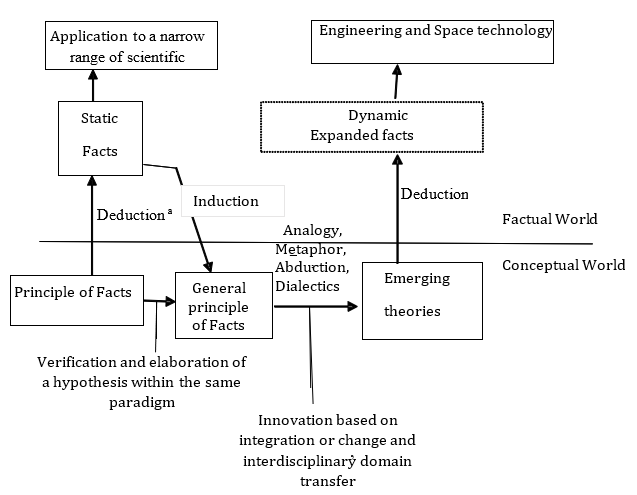
From the view of metaphysics, change and movement, which have limitations or order recognized by people, collect and integrate everything. That is, modern metaphysics regards everything as dynamic ontology, which indicates a situation of dialectical creation revealed in the evolution process of a living thing. Modern science places emphasis on change and processes rather than on unchanging and everlasting beings from an ontological approach. In terms of methodologies, it focuses on analogical reasoning, metaphor, and abductive reasoning, which are based on formal logic and dialectical logic, rather than deduction, induction, and hypothetico-deductive reasoning, which belong to formal logic. Specifically, the dialectic reasoning process is a methodology of reaching integration by expanding or weakening a boundary. As Kuhn indicated, dialectic reasoning is a strategy adopted in the process of the Scientific Revolution.
On the other hand, arguments based on deduction, induction, and hypothetico-deductive reasoning, which reflect formal logic, are used to justify, expand, and advance theories, as shown in Figure 3. Kuhn suggested that reasoning based on formal logic is a crucial strategy for expanding and elaborating a paradigm in a stage of normal science. Thus, this reasoning strategy is mainly applied in school education to help students learn existing scientific theories.
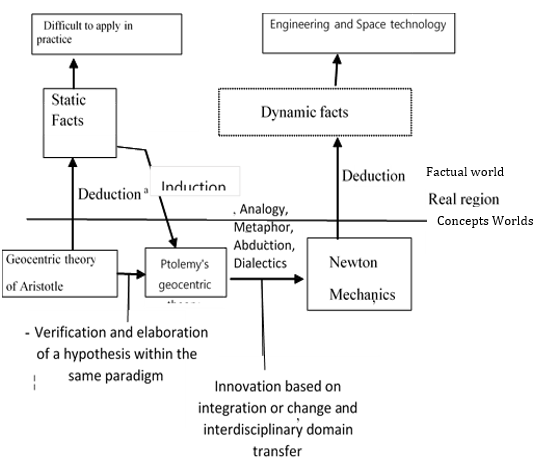
Application of dialectical logic from the perspective of history of science From the geocentric systems of Aristotle and Ptolemy to Newton’s system of mechanics It is obvious that objects that belong to hierarchically higher celestial sphere and objects that belong to the hierarchically lower earthly sphere tend to maintain their unique location according to the hierarchical and intrinsically teleological world view.
These objects have clear boundaries against other objects that belong to a completely different sphere.
Opposites that have clear boundaries in a daily situation.
However, objects do not have intrinsic purposes and are passively moved and changed by external force. As horizontal velocity of a certain object increases on the ground of the round Earth, the target object falls at a higher distance from the ground of the round Earth and requires a longer travel time. When the object is placed in a certain extreme situation, it does not fall onto the ground of the Earth, and instead becomes an object (a celestial body or a satellite) which performs a rotational motion according to the force of gravity. This condition shows the integration of two opposing relationships.
Sublation of opposing contents through integration in a situation of a certain change or an extreme situation In Ptolemy’s geocentric model based on Aristotle’s thoughts, celestial bodies on the celestial sphere are made of ether, the fifth element, and do not show any change. The celestial sphere is completely formed based on these celestial bodies, which perform constant and identical circular motions. Thus, Ptolemy’s geocentric model is thought to pursue a teleological and metaphysical world consisting of the bounded and static universe that aims to accomplish a certain form of goodness.
At the same time, Newtonian mechanics regard that the entire objects do not include the inner mind, a concept introduced by Descartes, and are passively and mechanistically moved and changed by the influence of external force. Particularly, a dialectical approach is adopted to integrate the celestial sphere with the earthly sphere. Accordingly, the law of causality and the law of universal gravity, which is associated with an interaction between objects, are applied to integration of the two worlds. Newton’s laws of motion are also supported by Kepler’s laws of planetary motion. Newton inferred that laws applied to the celestial sphere are applied to the earthly sphere in the same way. This inference leads to the creation of a universal law. Stating that he does not construct a cosmological hypothesis, Newton actively applied abductive reasoning, analogical reasoning, and dialectical logic to integration of two different worlds.
However, everything has boundaries and is conserved in his metaphysical and mechanistic world view. Time and space are absolutely and ontologically fixed and independent to each other. In other words, Newton introduced the mechanical and static universe where mass and energy are conserved respectively instead of the teleological and bounded universe. Particularly, Newtonian mechanics states that the total energy is invariant despite conversion of various types of energy. Subsequently, Maxwell’s electromagnetic theory provided a complete description of electric or magnetic phenomena. With the advent of Newtonian mechanics and Maxwell’s electromagnetic theory, most people thought that classical physics completely explained the entire physical phenomena. Under these circumstances, Albert Einstein sought a scientific way to achieve more essential integration of worlds than that based on weak dialectical logic.
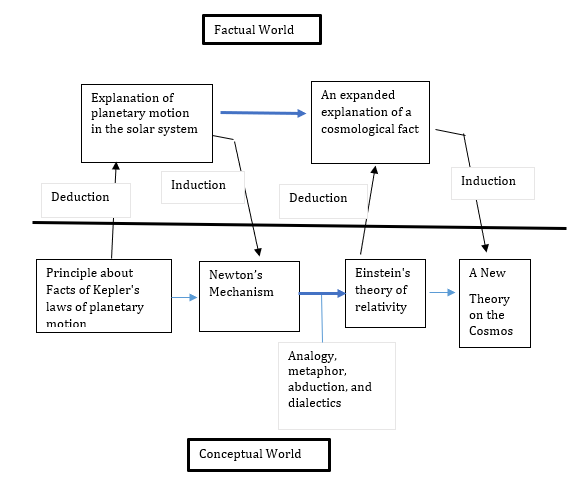
The process of obtaining scientific knowledge is equivalent to the process of solving a problem in a problematic situation. The application of deductive reasoning, inductive reasoning, and abduction as a technique of introducing a hypothesis contributes to practical acquisition of scientific knowledge more significantly than application of only deductive and inductive reasoning (Figure 4).
When we face a certain problematic situation, we generally conceive a hypothesis for solving a problem that caused the situation. To test an abductive reasoning technique based on the created hypothesis, we should infer several possible consequences by establishing this hypothesis as the premise. Deduction is the process of inferring several consequences as indicated above. Induction is the process of verifying whether a hypothesis is true based on an experiment. In other words, induction and deduction are systematically connected and used to perform scientific research. Pragmatism, as proposed by Charles S. Peirce clearly backs up the significance of abduction as a scientific research methodology. Like dialectical inference, abductive inference also leads a situation of a contradiction and a conflict to a new situation of integration by lowering and deconstructing a boundary in the initial situation. This study intensively reviewed the process of integration of dialectical reasoning applied in Newtonian mechanics with dialectical reasoning applied in the theory of relativity proposed by Einstein.
Application of dialectical logic in the history of science
From the Geocentric Systems of Aristotle and Ptolemy to Newton’s System of Mechanics
Emergence and Suggestion of a New Theory Based on Dialectical Logic
A range of application of dialectical logic differs even in modern laws such as Kepler’s laws of planetary motion applied to the celestial world and Galileo’s law of fall applied to the earthly world. Integration of dialectical logic applied in these theories with that applied in Newtonian mechanics indicates not qualitative change but quantitative change. Yet, as such integration shows dynamic change, Newtonian mechanics is evaluated as a law based on weak dialectical logic.
The Stage of Normal Science of Newtonian Mechanics
After trials and errors, Newton formulated the law of universal gravitation, which states that the force is proportional to the product of the two masses and inversely proportional to the square of the distance between them.
This combined Newton’s second and third laws of motion and Kepler’s third law of planetary motion, all of which were formed based on inductive or abductive reasoning.
In constructing this law, Newton encountered a question of whether the force of universal gravitation, which is inversely proportional to the square of distance between two masses, could satisfy Kepler’s first and second laws of planetary motion under the condition of a single elliptical orbit. To solve this problem, he applied the law of universal gravitation from a deductive approach and verified Kepler’s first and second laws (use of inductive and deductive arguments based on formal logic). After verifying the law of universal gravitation, scientists calculated the orbits of Neptune and Pluto, which are each part of the solar system. People were interested in the fact that planetary orbits can be accurately calculated based on the law of universal gravitation. They began believing that all of the objects in the world moved according to this law. Scientists were also confident that they could understand the laws of motion of the sun, stars, and universe on their own, without depending on God.
However, the law of universal gravitation is ultimately limited, as is everything in the world. In the process of analyzing the universe or Mother Nature, people realized existence of an area that was not affected by the law of universal gravitation. The existence of such area increased the significance of dialectical logic, which is applied in an extreme situation.
From the system of Newtonian mechanics to that of Einstein’s special theory of relativity Emergence and suggestion of a new theory based on dialectical logic Humans live in a world of comparatively low velocity where the concept of absolute time and space is applied according to Newtonian mechanics, and where mass and energy are qualitatively independent to each other <opposites with clear boundaries in a daily situation affected by previous metaphysical beliefs and laws>. However, in an extreme situation where an object approaches the speed of light, mass and energy cannot be independent from each other, as Newtonian mechanics suggests (a problem of existing theories). In such a situation, a relationship between time and space and a relationship between mass and energy reaches a status of mutual integration. When the principle of constancy of speed of light is accepted, Newtonian mechanics and Maxwell’s electromagnetic theory, i.e., theories from classical physics which are independently applied to the world, undergo mutual integration and qualitative change. <suggestion of a new theory followed by sublation of opposing contents through integration in a situation of a certain change or an extreme situation> From the system of Newtonian mechanics to the system of Einstein’s general theory of relativity Emergence and suggestion of a new theory based on dialectical logic Under the condition where absolute space is considered according to Newtonian mechanics, gravity and inertial force are qualitatively distinguished from each other (opposites with clear boundaries in a daily situation affected by previous metaphysical beliefs and laws). On the other hand, under the condition of non-inertial frames, where relative space exists instead of absolute space, gravity and inertial force are unlikely to be distinguished from each other. For this reason, qualitative change of gravity and inertial force occurs (a problem of existing theories). If an observer accelerates and approaches the speed of light in the aforementioned condition, the observer will find that a reflection of light is applied in a direction of inertial force, i.e., the opposite direction from that of acceleration. Similarly, the observer can observe the reflection of light in the direction in which the strong gravity is applied.
Thus, gravity and inertial force exert the same effect in the condition of non-inertial frames. In an extreme situation where strong gravity and great energy exist, space and time, where light can be bent, can be established in a significantly distorted form. These relationships interact with each other as both the cause and the result (suggestion of a new theory followed by sublation of opposing contents through integration in a situation of a certain change or an extreme situation).
Moreover, dialectical logic significantly contributed to the discovery of quantum mechanics, which stands at the core of modern physics.
<From the system of classical physics to the system of quantum mechanics >
Emergence and suggestion of a new theory based on dialectical logic In the macroscopic world that we human beings can observe, a wave and a particle have a qualitatively exclusive relationship with each other (opposites with clear boundaries under previous metaphysical beliefs and laws). On the contrary, in the microscopic world accompanying extreme situations such as existence of an elementary particle that we cannot directly observe, a wave and a particle show not only their own properties but also properties of each other at the same time (a problem of existing theories). The process of solving this problem led to the introduction of quantum mechanics, a theory accompanying qualitative change to exhibit complementarity of properties of a wave and a particle (suggestion of a new theory followed by sublation of opposing contents through qualitative integration in a situation of a certain change or an extreme situation).
Conclusions and Discussions
Teleology, which states that truth is already fixed (invariance of truth) and that everything strives to achieve certain goals in the natural world, reflects a metaphysical belief or world view developed during the medieval times in the Western world. However, a metaphysical or mechanistic materialism that reflects a deterministic and mechanistic world view and accepts that truth is already fixed (invariance of truth) rejects the idea that everything strives to achieve certain goals in the natural world, and states that everything does not have spirit.
Darwin, who proposed the theory of evolution, presented a viewpoint that changes within nature are normal and lead to creation and the possibility of creation. Based on this perspective, which is opposite to the metaphysical perspective of Plato, Darwin described a mechanism based on physical science where species can change over time without being limited to teleological plans of the intelligent designer. In this regard, a world view based on the theory of evolution and physical science reflects dialectical materialism in modern science, which emphasizes conflicts and symmetry in the historical process and stresses creation and destruction. According to Darwin’s explanation, numerous perturbations or accidents have occurred constantly and unexpectedly in a certain structure that reflects invariance, conserves accidents, and allows results of accidents to be determined by natural selection. Thus, Darwin’s theory of evolution corresponds to modern physics. Dialectical materialism exceeds materialism introduced in the 18th century in that the former emphasizes the evolutionary essence of the universal structure. Materialism of the 18th century stressed only mechanistic interactions between invariant objects that exist without undergoing any change simply according to traditional logics. This philosophical view has a limitation in that it did not have a room for investigating evolution.
In conclusion, this study found that abductive, analogical, and dialectical reasoning, which emphasize change and generation, contributed to the discovery of scientific theories more significantly than inductive, deductive, and hypothetico-deductive [23] reasoning based on formal logic, which presumes that truth is unchanging and fixed, regarding creation and suggestion of a hypothesis.
Formal logic is called the logic of non-contradiction or logic of thinking, while dialectical logic is called either the logic of contradiction or logic of existence. Dialectical logic is generally used to identify social or historical development. However, it is used to develop theories in the field of natural science.
Dialectical thinking takes root more deeply in the theory of evolution, the theory of relativity, and quantum mechanics, all of which assume that everything is integrated with each other, than in classical science dealing with fixed substance. Therefore, it is evaluated that dialectical thinking leads to theoretical interaction [23, 24].
References
-
Lawson AE (2005) What is the role of induction and deduction in reasoning and scientific inquiry? Journal of Research in Science Teaching 42(6): 716-740.
-
Han JK (2021) How the Mind Generates the World. Gimm-Young Publishers, Seoul.
-
Kim DH (2017) Logical Thinking (Impression 2). Hanol, Seoul.
-
Oh JY (2010) Defending Problems with Peirce’s Concept of Abduction. Journal of Korea Philosophical Society, Research on Philosophy 113: 15-255.
-
Oh JY (2012) Understanding scientific inference in the natural sciences based on abductive inference strategies. In: Magnani L, et al. (Eds.), Philosophy and cognitive science: Western & Eastern studies. Springer, pp. 221– 237.
-
Baghaban RS (1987) An Introduction to the Hilosophy of Marxism Part I Socialist Platform,
-
McComas W (2000) A Thematic Introduction to the Nature of Science: The Rationale and Content of a Course for Science Education. In: McComas W (Ed.), The Nature in Science Education Rationale and Strategies. Kluwer Academic Publication, New York.
-
Runco MA (2007) Creativity: Theories and themes: Research, development, and practice. Elsevier Academic Press, Amsterdam.
-
Oh JY, Jeon EC (2017) Greenhouse Effect in Global Warming based on Analogical Reasoning. Foundations of Science 22(4): 827-847.
-
Keane MT (1988) Analogical mechanisms. Artificial Intelligence Review 2: 229-250
-
Gentner D (1989) The Mechanisms of analogical learning. In: Vosniadou S, et al. (Eds.), Similarity and analogical reasoning. Cambridge University Press, New York, pp: 199-241.
-
Oh JY (2019) The Philosophical Worldview of Ancient Western Greece and the Middle Ages, and the Scientific Worldview. Yonsei University Press, South Korea.
-
Davis B (2008) Inventions of Teaching: A genealogy. Routledge, UK.
-
Gentner D (1983) Structure-mapping: A theoretical framework for analogy. Cognitive Science 7: 155-170.
-
Oh JY (2016) Understanding Galileo’s dynamics through Free Falling Motion. Foundations of Science 21(4): 567- 578.
-
Brown TL (2003) Making Truth: Metaphor in Science. The University of Illinois Press, USA.
-
Hempel CG (1965) Aspects of Scientific Explanation and other Essays in the Philosophy of Science. The Free Press, New York.
-
Ahn GH (2001) Science, Technology, and Philosophy. Cheolhakgwa Hyeonsilsam, Seoul.
-
Ahn GH (2008) The Problems of Philosophy. Saemoonbook, Seoul.
-
Brennan JG (1966) The Meaning of Philosophy. 2nd(Edn.), Harper & Row.
-
Samuel HL (1952) Essay in Physics. Harcourt, Brace & World, New York.
-
So HR (2005) Smooth Logic and Elegant Thoughts (Impression 2). Ewha Womans University Press, Seoul.
-
Oh JY (2007) Proposing Enhanced Hypothetico-deductive Program of a Scientific Inquiry Process. Institute for the Humanities at Sungkyunkwan University, Journal of Humanities 39: 215-242.
-
Oh JY (2009) The Advocation and Educational Application about Toulmin’s Argument Model. Pan- Korean Philosophical Society 55: 379-425.
- Digital Hermeneutics Embodied in Brian Kim Stefans’ “The Dreamlife of Letters,” and Memory: Analog to Flash Interface in the Light of Ecofeminism
- Using C-Tables to Teach Class Logic
- The Ideology of Education’s Postponed Fantasies: Deepenings on a Pressing Problematic
- Phantasia and Perceptual Realism in Aristotle
- The Pleasures of Solitude
- Super Science