
The Growing Threat of Antimicrobial Resistance in India: Challenges and Solutions
Antimicrobial resistance (AMR) is a global issue causing increased illness, death, and medical costs. India, with its high population density and diverse healthcare landscape, is particularly vulnerable. AMR threatens advancements in medicine, increases the risk of certain procedures, and makes infections more difficult to treat. India's fragmented healthcare system and weak regulatory oversight hinder effective monitoring and response. The consequences of AMR in India include treatment failures, prolonged hospital stays, and increased mortality rates. Strategies to combat AMR include strengthening surveillance, promoting rational antibiotic use, improving infection control, encouraging research and development, and participating in international collaboration.
Introduction
Antimicrobial resistance occurs when microorganisms (bacteria, viruses, fungi, and parasites) evolve mechanisms to resist the effects of antimicrobial drugs. This phenomenon significantly hampers the treatment of infectious diseases, posing a critical challenge to public health globally. Antimicrobial resistance diminishes the efficacy of these medications, resulting in higher rates of illness, death, and medical costs [1]leading to increased morbidity, mortality, and health care expenditure. Because globalization increases the vulnerability of any country to diseases occurring in other countries, resistance presents a major threat to global public health, and no country acting on its own can adequately protect the health of its population against it. International collective action is therefore essential. Nevertheless, responsibility for health remains predominantly national. Consequently, there is a potentially significant disparity between the problems and solutions related to antimicrobial resistance and the institutions and mechanisms that are available to deal with them. This paper considers the capacity of national and international institutions and mechanisms to generate a collective response to antimicrobial resistance. Strategies for containing resistance are outlined, with particular reference to globally coordinated activities of countries. The adequacy of national and international responses to resistance is assessed, and the actions that international bodies could take to solve difficulties associated with present responses are highlighted. Approaches are suggested for securing international collective action for the containment of antimicrobial resistance.
India, with its high population density, diverse healthcare landscape, and varying levels of medical infrastructure, is particularly vulnerable to the spread of AMR. Many of the advancements in contemporary medicine are jeopardized by AMR [2]. It increases the danger of certain medical procedures and treatments, including cancer chemotherapy, cesarean sections, and surgery, and makes infections more difficult to treat. There is a crisis in the world’s access to and pipeline for antibiotics [3]. In light of the rising levels of resistance, there is a deficiency in the channel for research and development, and further steps are urgently needed to guarantee equal access to both new and current vaccinations, diagnostics, and medications. Preventing all infections, which may lead to the improper use of antibiotics, guaranteeing universal access to high-quality diagnosis and appropriate treatment of infections, and providing strategic information and innovation—such as surveillance of antimicrobial consumption and use and research and development for novel vaccines, diagnostics, and medications—are priorities in addressing antimicrobial resistance (AMR) in human health [4]the World Health Assembly has adopted the Global Action Plan on AMR in the year 2015 as a part of the tripartite collaboration with World Health Organization, Food and Agricultural Organization, and World Organization for Animal Health. India’s National Action Plan (NAP. The WHO states that people hospitalized with COVID-19 frequently abuse antibiotics. The widespread abuse of antibiotics during the COVID-19 pandemic, as documented by new data from the World Health Organization (WHO), may have contributed to the “silent” spread of antimicrobial resistance (AMR) [5, 6, 7]. This article pitches light on the occurrence, causes, and consequences of AMR in India, and to recommend measures for its mitigation.
Prevalence of AMR in India
Bacterial Resistance
India has reported high levels of resistance in several key bacterial pathogens. For example, Escherichia coli and Klebsiella pneumoniae, which are common causes of bloodstream infections, exhibit resistance rates exceeding 70% for third-generation cephalosporins. Methicillin- resistant Staphylococcus aureus (MRSA) and multidrug- resistant tuberculosis (MDR-TB) are also significant concerns, with the latter affecting over 130,000 people annually. Given how widespread and readily spread these diseases can be, community-acquired AMR is especially concerning [8]which has accelerated by the overuse of antibiotics worldwide. Increased antimicrobial resistance is the cause of severe infections, complications, longer hospital stays and increased mortality. Overprescribing of antibiotics is associated with an increased risk of adverse effects, more frequent re-attendance and increased medicalization of self-limiting conditions. Antibiotic overprescribing is a particular problem in primary care, where viruses cause most infections. About 90% of all antibiotic prescriptions are issued by general practitioners, and respiratory tract infections are the leading reason for prescribing. Multifaceted interventions to reduce overuse of antibiotics have been found to be effective and better than single initiatives. Interventions should encompass the enforcement of the policy of prohibiting the over-the-counter sale of antibiotics, the use of antimicrobial stewardship programmes, the active participation of clinicians in audits, the utilization of valid rapid point-of-care tests, the promotion of delayed antibiotic prescribing strategies, the enhancement of communication skills with patients with the aid of information brochures and the performance of more pragmatic studies in primary care with outcomes that are of clinicians’ interest, such as complications and clinical outcomes. .
Viral, Fungal, and Parasitic Resistance
While bacterial resistance is more extensively studied, resistance among viral, fungal, and parasitic pathogens is also emerging. The increasing resistance to antiviral drugs in HIV, antifungal drugs in Candida species, and antimalarial drugs in Plasmodium falciparum highlights the need for comprehensive surveillance across all types of pathogens [9].
Causes of AMR in India
Overuse and Misuse of Antibiotics
Antibiotic overuse and misuse contribute to the development and spread of antimicrobial resistance (AMR). This is due to selective pressure, incomplete treatment courses, inappropriate prescribing, agricultural use, self-medication, poor infection control and hygiene, environmental contamination, and transmission of resistant bacteria. Antibiotics are used to kill susceptible bacteria but may leave behind those with resistance genes, allowing them to multiply rapidly. Incomplete treatment courses can leave some bacteria alive, increasing the likelihood of resistant strains. Inappropriate prescribing, such as broad-spectrum antibiotics, can also promote resistance. Agricultural use can also lead to the development of resistant bacteria in animals, which can be transferred to humans through direct contact, the environment, or consumption of contaminated meat. Reducing unnecessary antibiotic use, following prescribing guidelines, and implementing robust infection control measures are critical steps in combating AMR [9].
Poor Infection Control Practices
Inadequate infection control practices contribute to the spread of antimicrobial resistance (AMR) by allowing resistant bacteria to proliferate and transmit between individuals. In hospitals and healthcare settings, inadequate hand hygiene, improper equipment sterilization, and insufficient cleaning can facilitate the spread of multidrug-resistant organisms (MDROs) like MRSA and VRE. In community settings, inadequate sanitation and hygiene can also lead to the spread of resistant bacteria. Infected patients should be isolated or cohorted to prevent cross-infection. Improper use of personal protective equipment (PPE) and suboptimal cleaning and disinfection can also contribute to the spread of resistant bacteria. Lack of antimicrobial stewardship programs, inadequate training and awareness, and overcrowding in healthcare facilities can also contribute to the spread of resistant bacteria. Poor sanitation in both healthcare and community settings can also contribute to the spread of AMR.
Lack of Surveillance and Regulation
Lack of surveillance is a major factor in the spread of antimicrobial resistance (AMR), as it allows resistant bacteria to proliferate undetected and unchecked. This includes delayed detection of resistant strains, inadequate antibiotic stewardship, inadequate response to outbreaks, lack of data for policy development, and misallocation of resources. Inadequate surveillance also contributes to the global spread of AMR, as resistant pathogens can easily cross borders. Incomplete global data on AMR is essential for understanding and tackling the problem, and gaps in surveillance, particularly in low-resource settings, hinder coordinated efforts. Furthermore, surveillance systems fail to monitor environmental and agricultural sources of resistance, leading to unrecognized reservoirs of resistance. Strengthening surveillance systems is crucial for controlling the spread of AMR and protecting public health. Strengthening surveillance systems is essential for controlling the spread of AMR and protecting public health [10].
Impact on Public Health
The consequences of AMR in India are severe. Treatment failures, prolonged hospital stays, and increased mortality rates are common outcomes. Economically, the burden of AMR is substantial, with higher healthcare costs due to the need for more expensive and intensive treatments. The loss of productivity and increased financial strain on families further exacerbate the impact on society. 1.27 million fatalities worldwide in 2019 were directly linked to drug-resistant illnesses, according to current estimates [11]in developing countries like India, recent hospital and some community based data showed increase in burden of antimicrobial resistance. Research related to antimicrobial use, determinants and development of antimicrobial resistance, regional variation and interventional strategies according to the existing health care situation in each country is a big challenge. This paper discusses the situational analysis of antimicrobial resistance with respect to its problem, determinants and challenges ahead with strategies required in future to reduce the burden in India. Recent data from Google search, Medline and other sources were collected which was reviewed and analyzed by the authors. Hospital based studies showed higher and varied spectrum of resistance in different regions while there are limited number of community based studies at country level. There exists lacunae in the structure and functioning of public health care delivery system with regard to quantification of the problem and various determining factors related to antimicrobial resistance. There is an urgent need to develop and strengthen antimicrobial policy, standard treatment guidelines, national plan for containment of AMR and research related to public health aspects of AMR at community and hospital level in India. Up to 10 million fatalities a year could happen by 2050 (Figure 1).
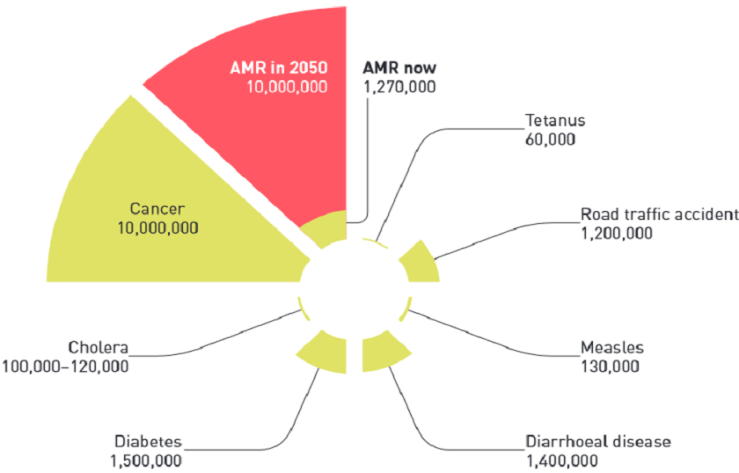
(AMR) in relation to current common causes of death.
$$ \begin{array}{l} \mathrm {p n g? _ {g a} = 2. 1 5 7 1 3 6 5 7 1 .} 1 2 9 6 0 5 6 6 1 1. 1 7 2 1 2 4 4 9 3 0 - 6 9 8 1 2 1 4 8 9. 1 7 2 1 2 4 4 9 3 0. \\ \end{array} $$ In the next ten years, AMR could push 24 million more people into extreme poverty and slash US $3.4 trillion off the GDP yearly if left unchecked. Antimicrobial resistance in HIV, malaria parasites, mycobacterium TB, and viruses is emerging and has the potential to worsen human suffering [12, 13]. A surge in poverty, higher healthcare costs, and lost productivity could all have a devastating effect on the global economy. AMR is made worse by poverty, poor hygiene, and a lack of sanitation, even though it is a worldwide concern [12, 14, 15]. Furthermore, Lower-Middle-Class and Low- Income Countries are disproportionately affected by AMR. Thus, equity also affects AMR.
Strategies to Combat AMR
Strengthening Surveillance
Antibiotics are often prescribed without professional supervision and misused in both humans and animals. Common examples of this misuse include the administration of antibiotics to individuals with common viral infections or as growth promoters to fish or livestock raised on farms. Establishing a comprehensive, nationwide AMR surveillance network is crucial. This would involve regular collection and analysis of data on antibiotic use and resistance patterns from both public and private healthcare sectors [5, 16].
Promoting Rational Antibiotic Use
Implementing strict regulations on antibiotic sales, encouraging prescription-only policies, and educating healthcare professionals and the public on the rational use of antibiotics are essential steps. The adoption of antimicrobial stewardship programs in hospitals can also help optimize antibiotic use. It has been discovered that comprehensive treatments work better than isolated ones at reducing antibiotic misuse [8]which has accelerated by the overuse of antibiotics worldwide. Increased antimicrobial resistance is the cause of severe infections, complications, longer hospital stays and increased mortality. Overprescribing of antibiotics is associated with an increased risk of adverse effects, more frequent re-attendance and increased medicalization of self-limiting conditions. Antibiotic overprescribing is a particular problem in primary care, where viruses cause most infections. About 90% of all antibiotic prescriptions are issued by general practitioners, and respiratory tract infections are the leading reason for prescribing. Multifaceted interventions to reduce overuse of antibiotics have been found to be effective and better than single initiatives. Interventions should encompass the enforcement of the policy of prohibiting the over-the-counter sale of antibiotics, the use of antimicrobial stewardship programmes, the active participation of clinicians in audits, the utilization of valid rapid point-of-care tests, the promotion of delayed antibiotic prescribing strategies, the enhancement of communication skills with patients with the aid of information brochures and the performance of more pragmatic studies in primary care with outcomes that are of clinicians’ interest, such as complications and clinical outcomes. Additionally, Antibiotic usage in a sensible way will lessen the selection pressure on resistant bacteria [6, 17].
Enhancing Infection Control
By stopping the transmission of illnesses and reducing the use of antibiotics, infection control plays a critical role in lowering the risk of antimicrobial resistance (AMR). Important precautions include hand washing, immunization, disinfecting the environment, isolating and cohorting patients, monitoring, antibiotic stewardship, and using personal protective equipment as directed. Additionally helpful are instruction and training on antibiotic use, infection prevention, and the risks associated with AMR. Uniform infection control procedures provide uniformity in averting illnesses and managing the proliferation of resistant microorganisms. Infection management strategies immediately lessen the selection pressure by reducing the need for antibiotics and halting the emergence of AMR [18].
Encouraging Research and Development
Research and development (R&D) is crucial in combating antimicrobial resistance (AMR) by developing new antibiotics, diagnostic tools, alternative therapies, antibiotic stewardship and surveillance, understanding resistance mechanisms, public health and policy research, and behavioral and social research. New antibiotics can target resistant bacteria that current drugs cannot treat, while diagnostic tools can help identify infections and reduce prescriptions. Alternative therapies include phage therapy, antimicrobial peptides, and immunotherapies and vaccines. Big data and AI can be used to monitor antibiotic use and resistance patterns, while genomic studies can identify new targets for antibiotics. Public health and policy research can incentivize the development of new antibiotics and alternative therapies. Behavioral and social research can inform public education campaigns and healthcare practices. Overall, R&D is essential in reducing AMR’s spread [19, 20]and continues to be on the rise. Basic microbiological research is the foundation for addressing knowledge gaps both for the development of new antibiotics, diagnostics and preventives but also to inform strategies to mitigate the transmission of resistance and drug resistant microorganisms. Translating this research into new products to reinvigorate dwindling pipelines, especially for new antibiotics, is one of the main challenges faced in addressing AMR. The scientific complexity is compounded by the market uncertainty of any new products leading to a large proportion of pharmaceutical companies exiting the market. Consequently, a number of initiatives were developed to reinvigorate the AMR research and development (R&D.
International Collaboration
AMR is a global issue that requires coordinated international efforts. India should actively participate in global initiatives and partnerships to share knowledge, resources, and strategies for combating AMR.
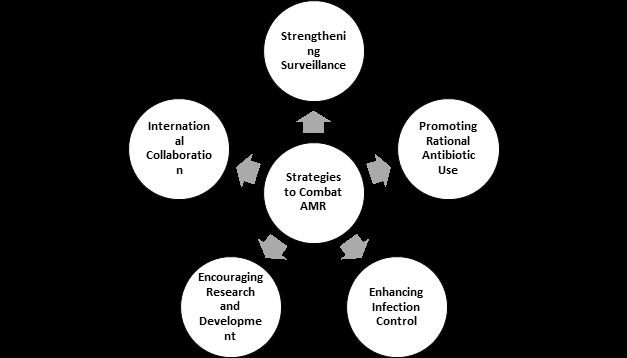
Creating structures, developing incentives, and organizing interests are some strategies for advancing international cooperation on antibiotic access and efficacy. There isn’t a single solution that can address every issue related to antibiotic resistance [21, 22].
Monitoring and Responding to AMR Strategies to Combat AMR
The environment is crucial to the emergence, propagation, and management of antimicrobial resistance (AMR). As a result, the solution needs to be based on a One Health approach, which acknowledges the interdependence and indivisible nature of people, animals, plants, and the environment at all scales and including all sectors, stakeholders, and institutions. The environment plays a critical role in the solution, and prevention is at the heart of the action required to stop the formation of AMR (figure 2).
In order to advance international cooperation for a One Health response on AMR, four leading organizations working in the multilateral system on human, animal, plant, and environmental health—the UN Environment Programme (UNEP), Food and Agriculture Organization of the United Nations (FAO), World Health Organization (WHO), and World Organization for Animal Health (WOAH)—joined forces. A shared work plan that outlines how the four organizations will cooperate to realize the Framework’s vision and outlines the workstreams that will be jointly implemented by the four organizations over the next years was developed by the four organizations as part of their joint strategic framework for AMR collaboration [13, 14]. They committed to stepping up their cooperation and completely incorporating environmental factors into One Health initiatives, particularly AMR-related ones [5, 6, 7, 15, 22, 23]efforts to address this issue have been isolated and uncoordinated, with little focus on sustainable and international solutions. Global collective action is necessary to improve access to life-saving antimicrobials, conserving them, and ensuring continued innovation. Access, conservation, and innovation are beneficial when achieved independently, but much more effective and sustainable if implemented in concert within and across countries. WHO alone will not be able to drive these actions. It will require a multisector response (including the health, agriculture, and veterinary sectors.
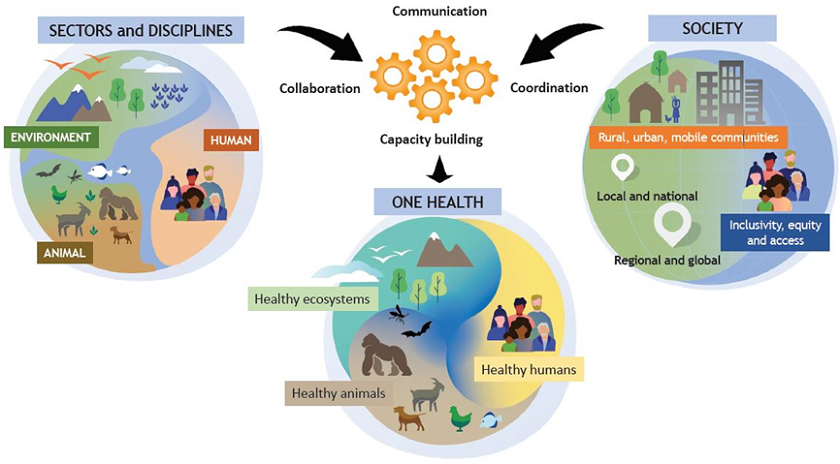
Figure 3: The One Health High-Level Expert Panel created the definition of One Health. The triple planetary crises-the crisis of pollution and waste, the crisis of nature and biodiversity loss, and the crisis of climate change-cannot be understood or addressed in isolation from one another because they are all caused by unsustainable patterns of consumption and production, according to UNEP Executive Director Inger Andersen. Source: https://cdn.unenvironment.org/s3fs-public/inline-images/One-Health.png.
Conclusion
Antimicrobial resistance is a pressing public health issue in India, driven by factors such as antibiotic misuse, poor infection control, and inadequate surveillance. Addressing this challenge requires a multifaceted approach, including strengthening surveillance systems, promoting rational antibiotic use, enhancing infection control measures, and encouraging research and development. With concerted efforts from the government, healthcare providers, and the public, India can mitigate the impact of AMR and safeguard the efficacy of antimicrobial agents for future generations.
Data Availability: All datasets generated or analysed during this study are included in the manuscript.
Declaration of Competing Interest: The authors declare that they have no known competing financial interests or personal relationships that could have appeared to influence the work reported in this paper.
Financial Support: None
References
-
Smith RD, Coast J (2002) Antimicrobial resistance: a global response. Bull World Health Organ 80(2): 126- 133.
-
Laxminarayan R, Chaudhury RR (2016) Antibiotic Resistance in India: Drivers and Opportunities for Action. PLOS Med 13(3): e1001974.
-
Poudel AN, Zhu S, Cooper N, Little P, Tarrant C, et al. (2023) The economic burden of antibiotic resistance: A systematic review and meta-analysis. PLOS ONE 18(5): e0285170.
-
Ranjalkar J, Chandy SJ (2019) India’s National Action Plan for antimicrobial resistance – An overview of the context, status, and way ahead. J Fam Med Prim Care 8(6): 1828-1834.
-
Singh N, Sherwani N, Jaiswal J, Nagaria T, Neral T, et al. (2022) Vertical virus transmission from SARS–CoV–2– positive mothers to neonates: A Tertiary Care Hospital Experience. J Microbiol Infect Dis 12(1): 1-5.
-
Sherwani N, Singh N, Verma N, Jain K, Neral A, et al. (2021) Clinico–epidemiological profile of SARS–CoV–2 infection in individuals investigated at tertiary care hospital. J Med Sci Res 9(4): 187-191.
-
Singh N, Jaiswal J, Sherwani N, Nagaria T, Khandwal O, et al. (2023) Maternal and neonatal outcomes associated with Covid–19 infection in pregnant mothers admitted in tertiary care hospital in central state of India. Cureus 15(4): e38235.
-
Llor C, Bjerrum L (2014) Antimicrobial resistance: risk associated with antibiotic overuse and initiatives to reduce the problem. Ther Adv Drug Saf 5(6): 229-241.
-
Chokshi A, Sifri Z, Cennimo D, Horng H (2019) Global Contributors to Antibiotic Resistance. J Glob Infect Dis 11(1): 36-42.
-
Walia K, Madhumathi J, Veeraraghavan B, Chakrabarti A, Kapil A, et al. (2019) Establishing Antimicrobial Resistance Surveillance & Research Network in India: Journey so far. Indian J Med Res 149(2): 164-179.
-
Kumar SG, Adithan C, Harish BN, Sujatha S, Roy G, et al. (2013) Antimicrobial resistance in India: A review. J Nat Sci Biol Med 4(2): 286-291.
-
Founou RC, Founou LL, Essack SY (2017) Clinical and economic impact of antibiotic resistance in developing countries: A systematic review and meta-analysis. PLOS ONE 12(12): e0189621.
-
Bhange K, Singh N (2023) Rising antibiotic resistance: growing concern. J Bacteriol Mycol Open Access 11(2): 110-112.
-
Patil A, Singh N, Bhange K (2023) Antiviral pathogenesis and interventions: new understandings and developments. Acta Scientific Microbiol 6(8): 2-14.
-
Singh N, Rai V (2012) Improved antimicrobial compound production by a new isolate Streptomyces hygroscopicus MTCC 4003 using plackett–burman design and response surface methodology. Bioinformation 8(21): 1021-1025.
-
Fletcher S (2015) Understanding the contribution of environmental factors in the spread of antimicrobial resistance. Environ Health Prev Med 20(4): 243-252.
-
de Kraker MEA, Lipsitch M (2022) Burden of Antimicrobial Resistance: Compared to What?. Epidemiol Rev 43(1): 53-64.
-
Kamara IF, Fofanah DB, Nuwagira I, Kamara KN, Tengbe SM, et al. (2024) Assessment of antimicrobial stewardship programmes and antibiotic use among children admitted to two hospitals in Sierra Leone: a cross-sectional study. Antimicrob Resist Infect Control 13(1): 80.
-
Mattar C, Edwards S, Baraldi E, Hood J (2020) An overview of the global antimicrobial resistance research and development hub and the current landscape. Curr Opin Microbiol 57: 56-61.
-
Singh N, Rai V, Tripathi CKM (2012) Production and optimization of oxytetracycline by a new isolate Streptomyces rimosus using response surface methodology. Med Chem Res 21(10): 3140-3145.
-
Hoffman SJ, Caleo GM, Daulaire N, Elbe S, Matsoso P, et al. (2015) Strategies for achieving global collective action on antimicrobial resistance. Bull World Health Organ 93(12): 867-876.
-
Singh N, Rai V, Tripathi CKM (2013) Purification and chemical characterization of antimicrobial compounds from a new soil isolate Streptomyces rimosus MTCC 10792. Prikl Biokhim Mikrobiol 49(5): 467-475.
-
Årdal C, Outterson K, Hoffman SJ, Ghafur A, Sharland M, et al. (2016) International cooperation to improve access to and sustain effectiveness of antimicrobials. Lancet 387(10015): 296-307.
- hMPV: Is It Another Covid-19 Like Situation?
- Streptomyces: Sources of Novel Discoveries in Antibiotic Research to Combat Antimicrobial Resistance
- A Review of Mosquitoes (Diptera: Culicidae) and Their Biodiversity, Medical and Veterinary Importance
- Past and Current Immunotherapy in Cancer
- Hematological Cancer and Viral Infection
- The Role of NEU1 in Coronavirus Infection and Pathogenesis