
Mathematical Modeling of Dengue Virus Control and Vaccination Method
Numerical modeling of communicable disease is a device to grow the instrument in what way syndrome pushovers and in what way stately. we have studied numerically the dengue virus. We frame an entirely endless Non-Standard Finite Difference (NSFD) structure for a mathematical model of dengue virus. The familiarize numerical array is bounded, dynamically designate and contain the positivity of the solution, which is one of the important requirements when modeling a prevalent contagious. The comparison between the innovative Non-Standard Finite Alteration structure, Euler method and Runge-Kutta scheme of order four (RK-4) displays the usefulness of the suggested Non-Standard Finite Alteration scheme. NSFD scheme shows convergence to the exact equilibrium facts of the model for any time steps used but Euler and RK-4 fail for large time steps.
Introduction
The mathematical modeling for dengue skilled insolence to produce the behavior of condition peoples and the basis, nearly talented hearings of the shown to the stop infection [1, 2, 3, 4, 5]. Dynamical models for the spread of ailment objects in a public people, recognized the Kermack and McKendrick SEIR traditional endemic model of suggested [6, 7, 8, 9] (Figure 1). Now models bring assessments aimed at consecutive progression of verminous lumps in a people [10–14]. Present day build completely convergent to the algebraic model for the broadcast diminuendos for Dengue who saves the dangerous monies of the relentless model [15, 16, 17].
Mathematical Model
Variables and Parameters
s(t): Susceptible entities class at time t. e(t): Exposed individuals’ class at time t. i(t): Infected individuals’ class at time t. r(t): Recover individuals’ class at time t. : Rates per-capita mortality human. : Force of infection human susceptible. : Period of virus rate in human.
: Recover period rate in human. ( ): Ovipositional Rate of treatment. ( ) Ovipositional induced mortality rate.
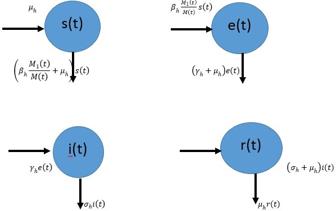
The Scheme of Nonlinear Differential Equations (DE) on behalf of the Typical remains specified by:
( ) ( ) ( ( ) ) ( )
( ) ( ) ( ) ( ) ( ) ( ) (1)
( ) ( ) ( ) ( ) ( ) ( ) ( )
Analysis of the Model
We describe two equilibrium points of system i.e Disease free equilibrium(DFE) and Endemic equilibrium(EE).
( ) ( ) ) and ( ) are stability (
facts of scheme (1), where ( )
( ) ( ) ( ( ) )(
( ) )( ) ( )
( ) )( ( ( ) )(
( ) )( ) ( )
( ) )( ) ( ( ) )(
( ) )( ( ) Where
( ) recognized as Procreative integer who describes the usual number of inferior impurities introduced of the main impurity. is a beginning influence who describe the disease of the exit or persist? If we say that the scheme will be observed disease Free Razzaq A, et al. Mathematical Modeling of Dengue Virus Control and Vaccination Method. Vaccines Vacccin 2019, 4(1): 000126.
Equilibrium (DFE) and iff the scheme to involvement Endemic Equilibrium (EE).
Numerical Modeling
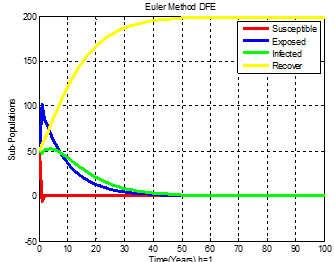
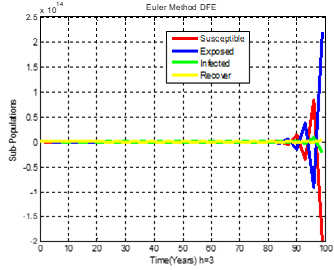
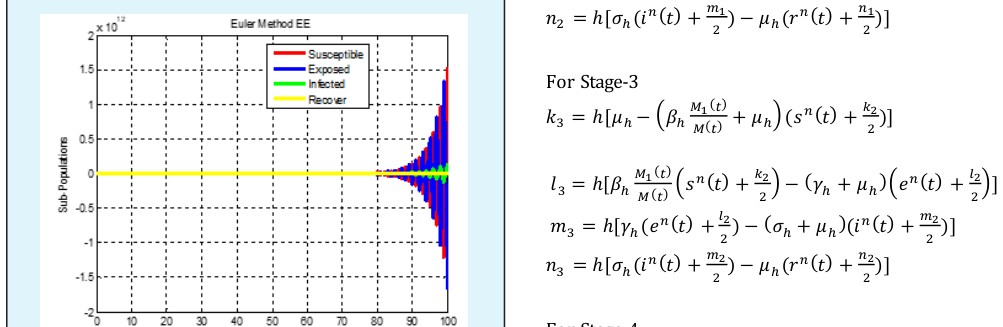
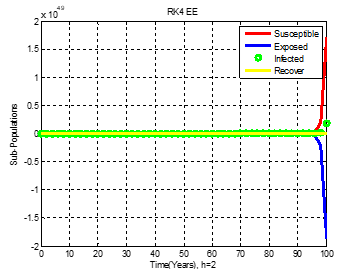
Now we have conferred two standard finite difference structures to unravel the endless dynamical scheme (1) i.e. Euler’s Method and Runge-Kutta Method of Order 4 (Figures 2-5).
Characterization of the Euler Technique
The Forward Euler’s Structure for the unceasing model (1) certain through: ( ) ( ) ( ( ) ( ) ) ( ) ( ) ( ) ( ) ( ) ( ) ( ) ( ) (2) ( ) ( ) ( ) ( ) ( ) ( ) ( ) ( ) ( ) Numerical Experiments Now solve numerical tryouts by expending the values of given parameters Table 1 [6].
| Values | ||||||||
|---|---|---|---|---|---|---|---|---|
| Parameters | ||||||||
| DFE | EE | |||||||
| μ h | 4.2E-05 | 0.0004 | ||||||
| β h | 0.375 | 0.75 | ||||||
| γ h | 0.1 | 0.2 | ||||||
| σ h | 0.143 | 0.14 | ||||||
| M (t) 1 | 1 | 1 | ||||||
| M(t) | 0.33 | 0.33 |
Table 1: Numerical tryouts
Characterization of the Fourth Order Runge- Kutta Technique
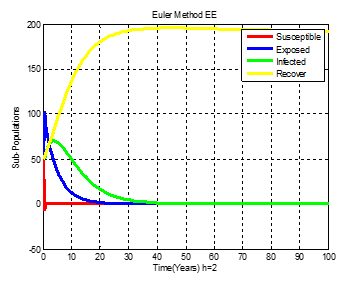
Razzaq A, et al. Mathematical Modeling of Dengue Virus Control and Vaccination Method. Vaccines Vacccin 2019, 4(1): 000126.
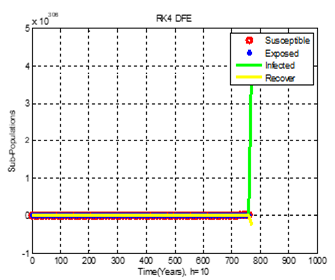
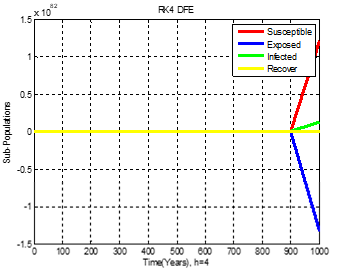
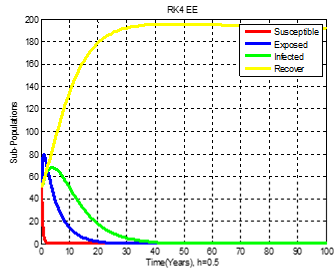
Razzaq A, et al. Mathematical Modeling of Dengue Virus Control and Vaccination Method. Vaccines Vacccin 2019, 4(1): 000126.
Non-Standard Finite Difference Model
We display absolutely convergent non-standard finite difference (NSFD). So that the covergenence learning of the recommended building. So ( ) ( ) ) ( ) ( ( ) ( ) ( ) ( ) ( ) ( ) ( ) ( ) ( ) ( )
Convergence Analysis of NSFD Scheme
Let us define
( ) ) ( ) (
( ) ( ) ( )
( ) Now the Jacobian Matrix is given by [ ]
At DiseaseFree Equilibrium (
( ) ( ) ) At Endemic Equilibrium
( ) ( ) ) (
) ( ( ) ( )) (
)( ) ( ) ( ) (
) ( ( ( ) ( )
( ) ( ) ( )
( ) )( ) ) (
( ) )( ( ) )(
( )
Numerical Experiments
Razzaq A, et al. Mathematical Modeling of Dengue Virus Control and Vaccination Method. Vaccines Vacccin 2019, 4(1): 000126.
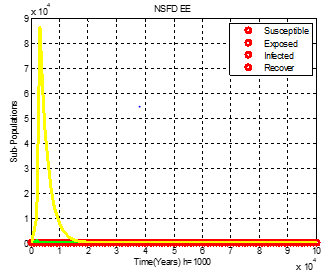
Comparison Analysis
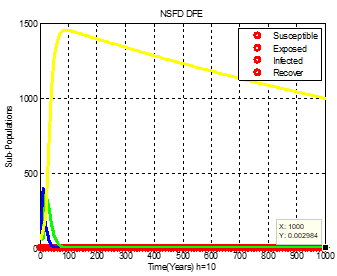
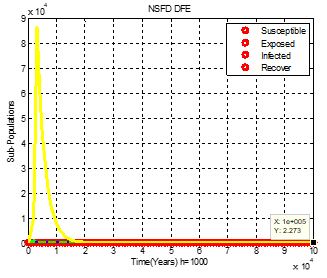
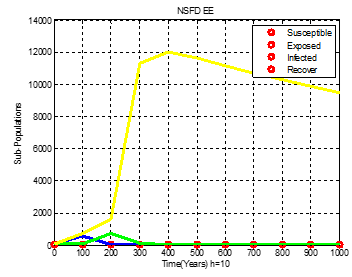
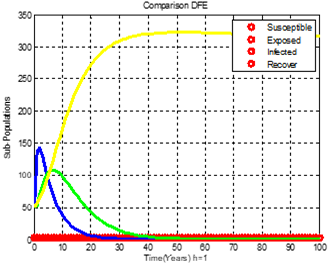
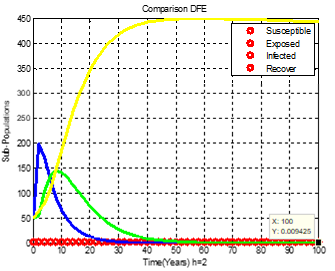
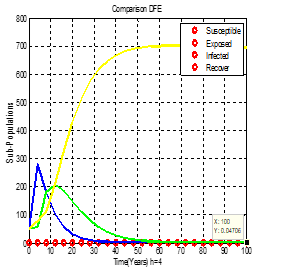
In this section, we see the comparison among of two standard difference schemes and non-standard difference scheme in epidemiology (Figures 14-19).
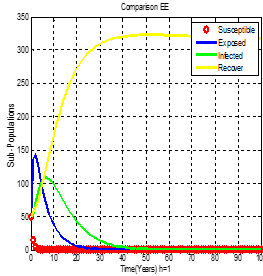
Razzaq A, et al. Mathematical Modeling of Dengue Virus Control and Vaccination Method. Vaccines Vacccin 2019, 4(1): 000126.
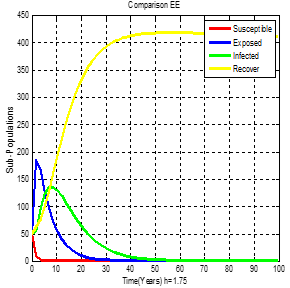
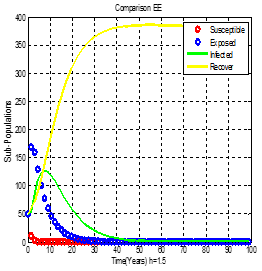
Results and Discussion
The model of dengue consumes introduced expending SEIT Model. (i.e Susceptible, Exposed, Infected and Treated). The loyalty of firm spots i.e the Disease free equilibrium(DFE) and Endemic equilibrium truths(EE) thought arithmetically. So label an unqualifiedly endless Non-Standard Finite Difference (NSFD) arrangement the continual dynamical scheme.The optional construction happens dynamical consistant, arithmetically secure and grips athentic possessions of the relentless model. The outcomes equaled well known standard finite difference schemes i.e Euler’s and Runge-Kutta method of order 4 (RK-4). The Euler and RK-4 be influenced by step size ‘h’ while the constructed NSFD scheme for every assessment used to scums convergent.
Deduction
The Non-Standard Finite Difference Scheme shaped aimed at dengue Euler and RK-4 are failed because they be depend value h. So Euler and RK-4 are temporarily convergent. Euler and RK-4 are divergent and change answer via value of h. But Non Standard Finite Difference Scheme is independent on value h. Improbability the step size in hundreds and thousands then NSFD still convergent. NSFD Scehme satisfy all convergent properties. The graphical behaviour Euler, RK-4 and NSFD schemes are in Figureure no.1 to 19. The compassion of differences the condensed amount of than the other assemblies. So sign that NSFD is unswerving.
References
-
Yang HM, Ferreira CP (2008) Assessing the effects of the vector control on dengue transmission. Appl Math Comput 198(1): 401-413.
-
Burattini MN, Chen M, Chow A, Coutinho FA, Goh KT, et al. (2008) Modelling the control strategies against dengue in Singapure. Epidemiol Infect 136(3): 309- 319.
-
Luz PM, Codeço CT, Medlock J, Struchiner CJ, Valle D, et al. (2009) Impact of insecticide interventions on the abundance and resistence profile ofAedes aegypti. Epidemiol Infect 137(8): 1203-1215.
-
Maidana NA, Yang Hm (2009) Spatial spreading of West Nile Virus described by traveling waves. J Theor Biol 258(3): 403-417.
-
Korobeinicov (2009) Global properties of SIR and SEIR epidemic models with multiple parallel interactions stages. Bull Math Bio 71(1): 75-83.
-
Kurane I, Takasaki T (2001) Dengue fever and dengue hemorrhagic fever: challenges of contolling an enemy still at large. Rev Med Virol 11(5): 301-311. Razzaq A, et al. Mathematical Modeling of Dengue Virus Control and Vaccination Method. Vaccines Vacccin 2019, 4(1): 000126.
-
Gubler DJ (2002) The global emergence/resurgence of arboviral disease as public health problems. Arc Med 33(4): 330-342.
-
Ghosh M, Chandra P, Sinha P, Shukla JB (2005) Modelling the spread of bacterial disease: effect of service providers from an environmentally degraded region. Appl Math Comput 160(3): 615-647.
-
Singh S, Shukla JB, Chandra P (2005) Modelling and analysis of the spread of malaria: Environmental and ecological effects. J Bio Syst 13(1): 111.
-
Wilson EB, Woecester J (1945) The law of mass action in epidemiology. Proc Natl Acad Sci USA 31(1): 24-34.
-
Wilson EB, Woecester J (1945) The law of mass action in epidemiology: II. Proc Natl Acad Sci USA 31(1): 109-116.
-
Macdonald G (1957) The Epidemiology and Control of Malaria. London: Oxford University Press pp: 201- 211.
-
Esteva L, Vargas C (1998) Analysis of a dengue disease transmission model. Math Biosci 150(2): 131- 151.
-
Johnson J, Roehring JT (1999) New mouse model for dengue virus vaccine testing. J Virol 73(1): 783-786.
-
Julander G, Perry GT, Shresta S (2011) Important advances in the field of anti-dengue virus research. Antivir Chem Chemother 21(3): 105-116.
-
Johansson MA, Hombach J, Cummings DA (2011) Models of the impact of dengue vaccines: a review of current research and potential approaches. Vaccine 29(35): 5860-5868.
-
Arduino MB (2014) Assessment of Aedes aegypti pupal productivity during the dengue vector control program in a costal urban centre of S£o Paulo state, Brazil. J Insec 301083.
- Update on Malariology and Malaria Vaccines
- Addressing Vaccine Hesitancy in the Age of Measles Resurgence: A Mini-Review
- Exploring Barriers and Facilitators of Group Antenatal Care Implementation in Kaduna State, Nigeria: A Qualitative Evaluation
- The Role of IL-11 in Regenerative Medicine and Tissue Engineering
- New Prediction of Mortality rate of Covid -19 According to WHO Estimation
- Measles Vaccine in Kano, Northern Nigeria: Past, Present and Future