
In Vitro Antihyperglycemic Activity, Free Radical Scavenging Activity, and Ftir of Syzygium Cumini Linn Pulp Dried Extract
Free radicals are implicated in several metabolic diseases and the medicinal properties of plants have been explored for their potent antioxidant activities to counteract metabolic disorders. In the present study the extract subjected to phytochemical analysis, antioxidant activities, in-vitro antihypetglycemic activity and additionaly function groups identification of pulp extracts of Syzygium cumini. We were using diphenylpicrylhydrazyl (DPPH) and ABTS scavenging assay to determine the amount of antioxidant activity. Secondary metabolites such as flavonoids and polyphenols prove its antioxidant potential. However antidiabetic potential of S. cumini pulp against alpha glucosidase, alpha amylase and beta glucosidase, interestingly and it has potent antidiabetic inhibition as compared to acarbose. We also performed IR to confirm presence of phenolics and flavonoids which is good antioxidant potent compounds that can utilize as traditional medicine.
Introduction
Medicinal plants well known used in primary health care over many centuries before discover of synthetic drugs. Medicinal plants are the richest bio-resource of drugs of traditional systems of medicine, modern medicines, neutraceuticals, food supplements, folk medicines, pharmaceutical intermediates and chemical entities for synthetic drugs [1]. Syzygium cumini Linn (family Myrtaceae) commonly known as ‘‘Jamun” is widely distributed in tropical and subtropical regions. S. cumini has been valued in ayurveda and unani system of medication for possessing variety of therapeutic properties, which is widely used in folk medicine for the treatment of various diseases. S. cumini leaf galls, commonly known as “Karkatshringi” in sanskrit, are extensively used in ayurveda and several scholars of Indian like Charak, Sushrutha, Bagvatta and many others have explained in literature about various Indian medicinal plants. Charak Samhita has used more than 1000 such plants and provided their scientific classification, properties, habitat and medicinal uses. Subsequently, Acharyas inculcated many more drugs in the same way. Rig-Veda, the oldest document (4500- 1600 B. C.) of Indian wisdom, includes material which depicts the important face towards plant kingdom and its exploitation for the benefit of [2].
Indian traditional medicine Karkatshringi is used in indigenous system of medicine (ayurveda, unani and siddha) as a remedy for cough, asthma, fever, respiratory and liver disorders. In these aspects, all around the world, the medicinal properties of plants have been investigated and explored for their potential antioxidant activities to counteract metabolic disorders, which are of high economically viable, with no side effects.
Several researches reported S. cumini showed reactive oxygen species (ROS) including singlet oxygen (1O2), superoxide ion (O2 -), hydroxyl ion (OH-), and hydrogen peroxide (H2O2) are highly reactive and toxic molecules generated in cells under normal metabolic activities. High levels of ROS can cause oxidative damage to proteins, lipids, enzymes and DNA molecules [3]. Living cells possess powerful scavenging mechanisms to avoid excess ROS- induced cellular injury, but with aging and under influence of external stress, these mechanisms become inefficient leading to metabolic distress [3].
The phytochemicals of Syzygium cumini levaes, roots, bark parts extracts having the active phytoconstituents. Solvent which have been used the ethyl acetate, hexane and water for determination of alkaloids, tannins, glycosides, flavonoids, saponins, phenols, proteins, triterpenoids, steroids and fatty acids etc. These active compound have the potential antioxidant, anti-diabetic and among other therapeutic uses [4]. S. cumini or Eugenia jambolana used in various alternative medicine of diabetes before discover of insulin [5, 6].
Many reserchers reported syzygium cumini has active phytochemicals but there are no much research paper found about its functional groups identification [7, 8, 9]. Therefore, in this study we were identified the functional groups that associated with catechol standard, its phytoconstituents, antioxidant activity and antidiabetic activity of dried pulp of S. cumini.
Materials and Methods
Preparation of Plant Extracts
Plant material S.cumini seed pulp of family Myrtacae were collected from different regions of Chitrakoot, and washed with 70% methanol. These were shade dried in room temperature and grinded using a grinder. Powdered sample was kept in air tight container.
The plant material was manually screened for any impurities and dried in shade, followed by drying in hot air oven at 30˚C and grinded (electric grinder) to fine powder (40 mesh). The powdered sample, 10 gm leaves (Lf.) was treated with petroleum ether for removal of fatty impurity and then subjected for extraction in methanol. Samples were continuously stirred for 6 hrs, followed by standing time of 18 hrs at room temperature and then filtered (Whatman No. 1 filter paper). The extraction process was repeated, till complete extraction and the pooled extract were concentrated under vacuum in a rotatory evaporator (Buchi rotavpour, Switzerland) at 40°C. Some modifications [10, 11].
Phytochemical Analysis
Phytochemical analysis i.e Alkaloids, saponin, tannin phenolic content, flavonoid content was done11.
Determination of Total Polyphenolic Content
Total polyphenolic content of plant leaves extracts was measured by using Folin-Ciocalteu reagent 12. The 25 μl of plant extract diluted with 125 μl water followed by addition of 150 μl of Folin-Ciocalteu reagent (1N) & 25 μl of Na2CO3 (20%w/v) and incubated at 45oC for 60 min then absorbance was measured spectrophotometrically at 765nm (Bio TeksynergyH4 multi-mode micro plates reader, Bio Tek Instruments, Instruments, Inc Winooski, VT, USA). Absorbance was recorded triplicates. Quantification was performed with respect to the standard curve of Catechol (y= 0.004x+0.086; R2 =0.985). Result was expressed as milligram of Catechol equivalent per ml of extract.
Determination of Flavonoid Content
Total flavonoid content in the plant extracts, in brief, 100μl of sample (100 times diluted the original sample with methanol) followed by 100μl 2% AlCl3.6H2O in ethanol and 150 μl sodium acetate (50g/L) solution were added. The absorbance at 420 nm monitored (Bio TeksynergyH4 multi-mode micro plate’s reader, Bio Tek Instruments, Instruments, Inc Winooski, VT, USA) after 2.5 h of incubation at 200C. Total flavonoid content was calculated with respect to the standard curve of the flavonoids quercetin dihydrate. Quantification was performed with respect to the standard curve of Quercetin (y= 0.007x+0.096; R2 =0.997). Results were expressed as micrograms of quercetin dehydrated equivalents (QE) per ml of the extract.
Instrumentations (FTIR Spectrometer)
The samples were analysed to get FTIR spectra using FTIR Spectrometer (Thermo Nicolet, USA) equipped with software BRUKER version 6.0 a. The FTIR spectra of the fruit of different batches were analysed by chemo- metrics, principle component analysis (PCA), to evaluate identification, classification and differentiation using Perkin Elmer application software [10, 11, 12, 13, 14].
In-vitro Antioxidant Activity
DPPH assay: Total flavonoid and phenolic content was estimated and, expressed in terms of mg/g of QE (Quercetin Equivalent) and mg/g GAE (Gallic Acid Equivalent) based on calibration curve of standard(s) viz. Quercetin and Gallic acid respectively. The radical scavenging potential was analyzed via DPPH radical scavenging assay [15].
ABTS assay: Method of ABTS was adopted with some modification this assay is based on the ability of different substances to scavenge 2-2’ azinobis (ethylbenzthiazoline-6- sulfonic acid) or ABTS+ radical cation. In its radical form, ABTS has a characteristic absorbance at 734nm which disappears after its reduction by an antiradical compound. Reduction of blue-green ABTS radical coloured solution by hydrogen donating antioxidant is measured by the suppression of its characteristic long wave (734nm) absorption spectrum [16].
In-vitro Antidiabetic Assay
Alpha glucosidase assay: The α-glucosidase inhibitory activity assay was performed by following the method of Tripathi, et al. [17]. In brief, Rat-intestinal acetone powder was dissolved in 100 ml of saline water and sonicated properly at 4°C. After sonication, the suspension was centrifuged (3,000 rpm, 4°C, 30 minutes) and the resulting supernatant was used for the assay. A reaction mixture containing 50 µl of phosphate buffer (50 mM; pH 6.8), 50 µl of rat α-glucosidase and 50 µl sample of varying concentrations (100-800 µg/ml) was pre-incubated for 5 min at 37°C, and then 50 µl of 3 mM PNPG was added to the mixture as a substrate. After incubation at 37°C for 30 min, enzymatic activity was quantified by measuring the absorbance at 405 nm in a micro titer plate reader (Bio Teksynergy H4 multi- mode micro plate’s reader, Bio Tek Instruments, Instruments, Inc Winooski, VT, USA). Acarbose was used as standard and experiments were done in triplicates.
Alpha amylase assay: Pancreatic α-amylase assay was adopted from Apostolidis, et al. [18] 50 µl of different dilutions of test compounds and 50 µl of 0.02 M sodium phosphate buffer (pH 6.9 with 0.006 M sodium chloride) containing α-amylase solution (0.5 mg/ mL) were incubated at 25°C for 10 min. Afterpre incubation, 50 µl of 1% starch solution in 0.02 M sodium phosphate buffer (pH 6.9 with 0.006 M sodium chloride) was added to each tube. The reaction was incubated at 25°C for 10 min. The reaction was stopped with 100 µl of DNS color reagent. Microplate were incubated (85-90°C) for 10 min to develop color and left to cool room temperature. Reaction mixture was diluted with 105 µl of distilled water. Enzymatic activity was quantified by measuring the absorbance at 540 nm in a micro titer plate reader (Bio Teksynergy H4 multi-mode micro plate’s reader, Bio Tek Instruments, Instruments, Inc Winooski, VT, USA).
Acarbose was used as standard and experiments were done in triplicates [19].
β-glucosidase activity: Bhat MK [20] & Al-Zuhair S [21]
methods were used with some modification for the β- glucosidase inhibition activity. In brief, Beta glucosidase ex sweet almonds lyophilized powder for extra pure powder was dissolved in 100 ml assay buffer (pH 7.0) and sonicated properly at 4°C. After sonication, the suspension was centrifuged (4,000 rpm, 4°C, 30 minutes) and the resulting supernatant was used for the assay. Transfer 20 μL distilled water (H2O) to two wells of a clear bottom 96-well plate. A reaction mixture containing 50 µl of buffer (50 mM; pH 6.8), 50 µl of P-Nitrophenyl-β-D-Glucopyranodide extra pure and 50 µl sample of varying concentrations (100-800 µg/ ml) was pre-incubated for 20 min at 37°C, and then 50 µl of 3 mM β-PNPG was added to the mixture as a substrate. After incubation at 37°C for 30 min, enzymatic activity was quantified by measuring the absorbance at 405 nm in a micro titer plate reader (Bio Teksynergy H4 multi-mode micro plate’s reader, Bio Tek Instruments, Instruments, Inc Winooski, VT, USA)[22].
Results and Discussion
Phytochemical Analysis
Qualitative and quantitative phytochemical screening of the plant results were given in Table 1 and Table 2. Qualitative estimation of plant extract which have been used diffrent Solent methanol, water, petroleum ether, and ethanol results indicated that the Syzygium cumini plants are rich in diverse advantageous phytoconstituents, like phenols, flavonoids, alkaloids, anthocyanins, rasins, saponin, steroids, tannins, starch, glycosides, phlobatannins, terpenoids as well as proteins and carbohydrates. Quantitative phytochemical analysis were revealed that different phytochemica viz, alkaloids (8.082±0.005 μg/ml), Saponin (3.008±0.004μg/ ml), Tannin (5.544±0.001 μg/ml) and Flavanoids (2.757±0.45) and TPC (2.98±0.004 μg/ml) were present in as significant amount on S. cumini pulp.
| Phytochemical | Methanol | Petroleum ether | Water | Ethanol | |
|---|---|---|---|---|---|
| 1. | Carbohydrate | + | + | + | + |
| 2. | Alkaloid | + | + | + | + |
| 3. | Flavonoid | + | + | + | + |
| 4. | Protein | + | + | + | + |
| 5. | Resin | + | + | + | + |
| 6. | Anthocyanin | + | + | + | + |
| 7. | Saponin | + | + | + | + |
| 8. | Steroid | + | + | + | + |
| 9. | Tannin | + | + | + | + |
| 10. | Starch | + | + | + | + |
| 11. | Glycoside | + | + | + | + |
| 12. | Phenol | + | + | + | + |
| 13. | Phlobatanin | + | + | + | + |
| 14. | Terpenoid | + | + | + | + |
Table 1: Some studies have demonstrated a correlation between antioxidant and phenolic content and reported concentration dependa
Table1: Phytochemical qualitative analysis of Syzygium cumini pulp.
| S.N. | Alkaloids | Saponin | Tannin | Flavanoids | TPC in µg/ml equivalent to catechol |
|---|---|---|---|---|---|
| 1 | 8.082±005 | 3.008±0.004 | 5.544±0.001 | 4.757±0.45 | 2.98 ±0.0046 |
Table 2: Some studies have demonstrated a correlation between antioxidant and phenolic content and reported concentration dependa
Table2: Phytochemical quantitative analysis of Syzygium cumini pulp.
In- vitro Antioxidant Activities
The scavenging effect of DPPH radical by methanolic extract of Syzygium cumini has IC50 value 4.39±0.011µg/ ml. Free radical scavenging activity of DPPH is most widely used for screening of medicinal plants having anti oxidant activity. The mechanism however well evident is due to de-colorization of DPPH through electron donated by antioxidant compound.
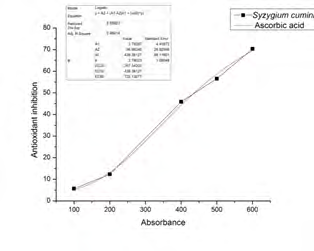
ABTS radical by methanolic extract of Syzygium cumini has found IC50 value 25.76±0.001 µg/ml. Polyphenolic content viz. total phenolic and flavonoid were estimated and results given in Table-1. Free radical scavenging activity of DPPH is most widely used for screening of medicinal plants having anti oxidant activity. The mechanism well evident is due to de-colorization of DPPH through electron donated by anti oxidant compound. The scavenging effect of DPPH radical in methanolic extract Syzygium cumini was concentration dependant and potentially varied for samples and standards (Ascorbic acid) has IC50 value 4.39±0.011mg/ ml Table 3. Some studies have demonstrated a correlation between antioxidant and phenolic content and reported concentration dependant activity. Antioxidant activities of plant were calculated by ORGIN pro software. The results of in-vitro antioxidant activities were shown in Table 4, Figure 1.
| Peak value | Functional Group | Bond | |
|---|---|---|---|
| 1 | 1619 | Aromatic | C=C stretch |
| 2 | 1629 | Aromatic | C=C stretch |
| 3 | 2358 | Phosphine | P-H stretch |
| 4 | 1629 | Amines | C-N Stretch |
| 5 | 1078 | Alekens | C-H-stretch |
| 6 | 1635 | Cynognic | C-N stretch |
| 7 | 817 | Alkenes | C-H stretch |
Table 3: IC50 value of in vitro assay.
| Method | IC50 values (μg/ml)* | |
|---|---|---|
| 1. | DPPH | 4.39±0.01 |
| 2. | ABTS Assay | 25.76±0.01 |
| 3. | Alpha Glucosidase assay | 32.896±0.005 |
| 4. | Alpha amylase assay | 257.493±0.002 |
| 5. | Beta glucosidase | 228.493±0.005 |
Table 4: IC50 value of in vitro assay.
In vitro Hypoglycemic Activity
This enzyme is responsible for the catalytic cleavage of a glycosidic bond in the digestive process of carbohydrates[23, 24, 25]. It is produced in the small intestine, so the way to work from the inhibitor is delay intestinal absorption of glucose into the blood, this prevention will decreased the glucose range in blood [24].
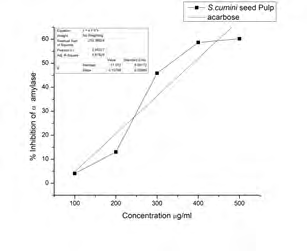
α-glucosidase, α-amylase, β-glycosidase activity of S. cumni pulp was carried out and their IC50 value was recorded 32.896±0.005, 257.493±0.002, 228.477±.0005 µg/ ml respectively. Among them alpha glucosidase showed best activity, β-glucosidase moderate activity and amylase given significant antihyperglycemic activity. Therefore, here we can conclude that the all samples give good inhibition and showed concentration dependent activities. The results of invitro hypoglycemic activities were shown in Table 4, Figure 2.
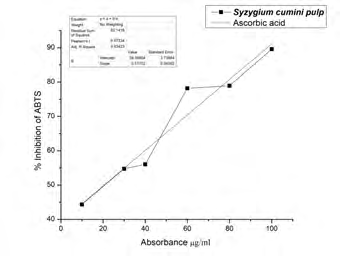
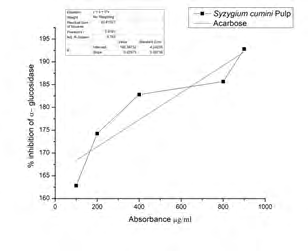
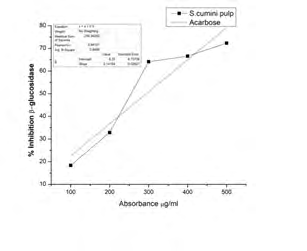
Figures 2: Syzygium cumini pulp in alpha glucosidase, alpha amylase and beta glucosidase inhibition.
FTIR
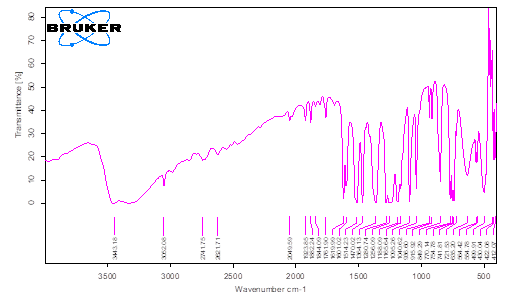
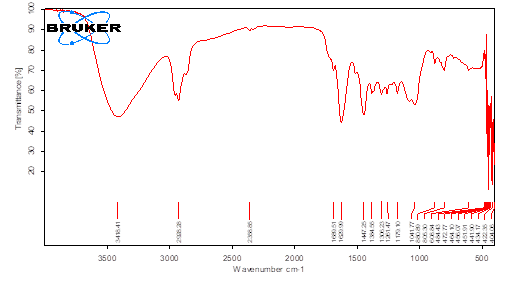
FTIR profiles are important in quality assessment of herbal materials. FT-IR spectroscopic Study reveals the presence of various functional groups present in Jamun pulp. FTIR spectra of catechol and S. cumini pulp were shown in Figure 3 & Figure 4 and results were given in Table-3. The presence of characteristic functional groups bands of Alkyl Halides, Aromatic rings, Phosphine, Carboxylic acids, Alkenese, Phenyl ring, Thicarbonyl is found in cathechol and S. cumini pulp,similarly C-N strech present in alkaloids.
Conclusion
S. cumini pulp associated with phytocemical which are mailnly responsible for antioxidant activity and those compound have potential to reduce diabetes. The scavenging effect of DPPH radical by methanolic extract of S. Cumini dried pulp was concentration dependant and potentially significant. alpha glucosidase, alpha amylase and beta glycosidase are currently the most common use drug for improve post prandial hyperglycemia. Among all assay of S.cumini pulp extract alpha glucosidase significantly inhibit the active site of enzyme and reduce the blood glucose level (IC50 - 32.896 µg/ml).
References
-
Jain SK (1991) Dictionary of Indian folk medicine and ethanobotany. Deep publications, paschim vihar, New delhi, India, pp: 24.
-
Kirtikar KR, Basu BD (1975) Indian medicinal plants. Periodical experts 2: 1052-1053
-
Ajai IA, Oderinde RA (2011) Preliminary phytochemicals analysis of some plant seed. Research journal of chemical science 1(3): 58-62.
-
Imelda Ramos LK, Teresa M, Bandiola B (2017) Phytochemical Screening of _Syzygium_ _cumini_ (Myrtaceae) leaf extracts using different solvents of extraction. Scholar research library 9(2): 74-78.
-
Tripathi IP, Namrata D, Ravindra S (2017) phytochemical studies on syzygium cumini: traditional drugs for diabetes. paripex - Indian journal of research 6(6).
-
Halliwell B (1997) Antioxidants and human disease: a general introduction. Nut Rev 55: 44-52.
-
Raut YW, More AM, Bhosale MS (2015) Antibacterial and anticancer activity of bioactive fraction of Syzygium cumini. International Journal of Informative and Futuristic Research 2(10): 3655-3663.
-
Namrata D, Aakansha T, Ravindra S, Tripathi IP (2018) Evaluation of plant secondary metabolites composition and antimicrobial activities of Eucalyptus globules extracts. Int J microbial app sci 7: 4517-4527.
-
Dwivedi N, Trivedi K, Tripathi IP (2019) pharmacological and phytomedicine assessment of withania somnifera. Indian journal of applied research 2(2).
-
Reginold Jebitta S, Jeyanth Allwin SI, Ramanathan M (2015) Functional group analysis of Jamun (_Szygium_ _cumini_) pulp dried in cross flow dryer. Int Res J Pharm 6(2): 111-113.
-
Tripathi IP, Aparna D (2016) Synthesis, Characterization and α-glucosidase inhibition of some Cu, Co, Ni and Zn complexes with Methyl ethylethylenediamine. British Journal of Medicine & Medical Research 16(6): 1-11.
-
Chinmayi M, Tripathi IP (2016) In vitro antioxidant activities of methanolic extracts of 12 plants of Chitrakoot region. The Journal of Free Radicals and Antioxidants Photon 143: 466-478.
-
Bhatia IS, Bajaj KL (1975) Chemical constituents of the seeds and bark of Syzygium cumini. Planta Medica 28: 346-352.
-
Bhargava R, Dayal TR, Seshadri (1974) Chemical components of Eugenian Jambolana stem bark. Curr Sci 43: 645-646.
-
Nair ARG, Subramanian SS (1962) Chemical examination of the owers of Eugenia jambolana. J Sci Ind Res 21B: 457-458.
-
Singleton VL, Orthofer R, Lamuela- Raventos RM (1999) Analysis of totalphenols and oxidation substances and antioxidents by means of Folin-Ciocalteureagent. Methods Enzymol 299: 152-178.
-
Mc Donald S, Prenzler PD, Autolovich M, Robards K (2001) Phenolic content and antioxidant activity of olive oil extracts. Food Chem 73: 73-84.
-
AYUSH (2008) Anonymous Quality Control Manual for Ayurvedic, Siddha and Unani medicines, Government of India, (2008)Department of AYUSH, Ministry of Health and Family Welfare, PLIM, Ghaziabad, pp: 1-99.
-
Lohar DR (2007) Protocol for Testing Ayurvedic, Siddha and Unanimedicines, Govt of India. Department of AYUSH, Ministry of Health and Family Welfare, PLIM, Ghaziabad, pp: 40-108.
-
Lowry OH, Rosebrough NJ, Farr AL, Randall RJJ (1951) Protein measurement with the Folin phenol reagent. Biochem 193(1): 265-275.
-
Khandelwal KR (2003) Practical Pharmacognosy Techniques and Experiments, 9th (Edn.), Nirali Prakashan, Pune.
-
Bhat MK, Chadha BS, Kumar BA, Kaur GS (1993) urification and characterization of an extracellular β-glucosidase from the thermophilic fungusSporotrichum thermophile and its influence on cellulase activity. J Gen Microbiol 139(11): 2825-2832.
-
Al-Zuhair S, Dowaidar A, Kamal H (2010) 158-160 Kokate CK (2008) Practical Pharmacognosy, 4th (Edn.), Vallabh Prakashan, New Delhi, pp: 107-111.
-
Baliga G, Manjeshwar S (2013) Scientific validation of the antidiabetic Effects of _Syzygium jambolanum_ DC (Black Plum), a traditional medicinal plant of India. The Journal of Alternative and Complementary Medicine 19(3): 191- 197.
-
Bhuyan MA, Mia MY, Rashid MA (1996) Antibacterial principles of the seed of Eugenia jambolana. Bangladesh J Botany 25: 239-241.
- Update on Malariology and Malaria Vaccines
- Addressing Vaccine Hesitancy in the Age of Measles Resurgence: A Mini-Review
- Exploring Barriers and Facilitators of Group Antenatal Care Implementation in Kaduna State, Nigeria: A Qualitative Evaluation
- The Role of IL-11 in Regenerative Medicine and Tissue Engineering
- New Prediction of Mortality rate of Covid -19 According to WHO Estimation
- Measles Vaccine in Kano, Northern Nigeria: Past, Present and Future