
Bridging the Gap: Mosquito Nets, Malaria Vaccines, and Effective Public Health Initiatives for Malaria Control and Prevention
Do the authorities in Uganda responsible for mosquito distributions understand the disconnect between their generous efforts and the actual needs of the community regarding malaria prevention? Does the community value mosquito nets in the prevention of malaria?
Concern
Do the authorities in Uganda responsible for mosquito distributions understand the disconnect between their generous efforts and the actual needs of the community regarding malaria prevention? Does the community value mosquito nets in the prevention of malaria?
Introduction
Malaria remains a major public health problem [1], with an estimated 241 million cases and 627,000 deaths worldwide in 2020 [2, 3]. The disease is most common in sub- Saharan Africa with an estimated 95% of cases and 96% of deaths [3]. Uganda has the highest global burden of malaria cases and deaths, with over 90 percent of its population being at risk Kigozi, et al. [4], accounting for 25% of hospital admissions and 14% clinic deaths across the country, and the leading killer diseases among children below 5 years [5]. Busoga sub-region, where the above concern was noticed (Kamuli district) is one of the most affected regions with malaria in the country with 250-450 incidences per 1000 population.
According to the World Health Organization, one of the effective ways to prevent malaria is the consistent use of long-lasting insecticidal mosquito nets (LLINs) [6]. Different research studies have indicated that consistent proper use of LLINs reduces the risk of malaria infection by up to 70%. According to the Malaria Indicator Survey 2018-19, 83% of Opinion Ugandans own mosquito nets, the majority of which (93%) are received through mass distribution campaigns; nonetheless, only 59% use mosquito nets. In 2022, Uganda experienced a 50% increase in the cases of malaria reported in health facilities in most districts in the country including Kamuli district [7]. Consequently, on August 2, 2023, the Ugandan Ministry of Health with support from the Global Fund and Against Malaria Foundation launched the provision of 28.5 million LLINs to Ugandans as a malaria control program [8]. The Village Health Team members (VHTs) went door-to- door recording the number of individuals in each household and conveying essential information about the distribution day and pickup locations.
Heart-Melting Observation
What was witnessed on September 9, 2023, was heart- melting as many people seem not to know the value and intended benefits of mosquito nets despite the enormous efforts made to provide them at free cost. On the 9th of September 2023, as the lead author headed to his garden in Buwoya village in Bugulumbya sub-county, Kamuli district, witnessed a commendable effort by the Ugandan government and partners to distribute LLINs to the community to prevent Malaria.
However, what unfolded before the lead author’s eyes left him deeply perplexed and concerned about the efficacy of such initiatives on Malaria prevention. The VHTs together with the local council leaders led the LLINs distribution process at Buwoya Primary School where people converged to receive. Many people gathered at the school to receive mosquito nets, as someone who was going to the garden, what made me get closer was the two fights that happened, first was a woman fighting with VHTs because she was given fewer mosquito nets than her registered number of people at household. Another woman intervened to stop the fight, the woman who was fighting instead fought the rescuer, the men also later fought as they wanted to take more nets than the two they were given initially. As the women were fighting one community member uttered this:
“Imagine they are fighting yet they will not even sleep under these mosquito nets that are making them fight”. Another one added. “Some of them don’t even have beds to put the mosquito nets and are busy fighting”.
The lead author, a social and behavioral scientist with a background in doing ethnographic studies, gained more interest in knowing whether the community understood why they were receiving the LLINs.
When the above statements were heard, a question was paused, if they will not sleep in them (LLINs) then what will they use them for? It was disheartening to hear that some recipients of mosquito nets were unaware of their intended purpose. One of the youths remarked that:
“They are going to use mosquito nets to make ropes for their animals (pigs, goats and cows)” And another added that there going to use them in rearing of chicks. (They tie the LLINs outside the house and put chicks to avoid them being eaten by birds. One of them added that:
“a rope made from a mosquito net is stronger than the ones they buy from shops.” The fourth person added...
“If you do not have money to buy a rope, why not utilize these mosquito nets that are for free”.
While interacting with the community members, more voices continued to come out as one of them spoke of repurposing them for nursery beds. I further heard them saying, “If it wasn’t a rainy season, they would use them to fish mudfish”.
One old man also commented...
“Some people especially the youths will just sell them”.
When all this was heard, I wondered, selling! and one youth said even if you sell at 5000shs (1 and a half dollars) you will have made money from these free things, he further noted that that is how they are also benefiting from the government.
When you hear about this, you might ponder the situation, so you sell a mosquito net you have received at no cost to protect you from malaria, and you sell it, then get malaria and spend over 30,000shs to treat it? This matter was raised to the community leaders who responded, ‘those are our people’. Remarkably, one community member admitted they intended to use the mosquito nets for capturing white ants (Figure 1). Indeed, as when traversing the community that day, encountered a person using a mosquito net for trapping white ants. Although the net appeared aged, it validated the concerns expressed during the net distribution”
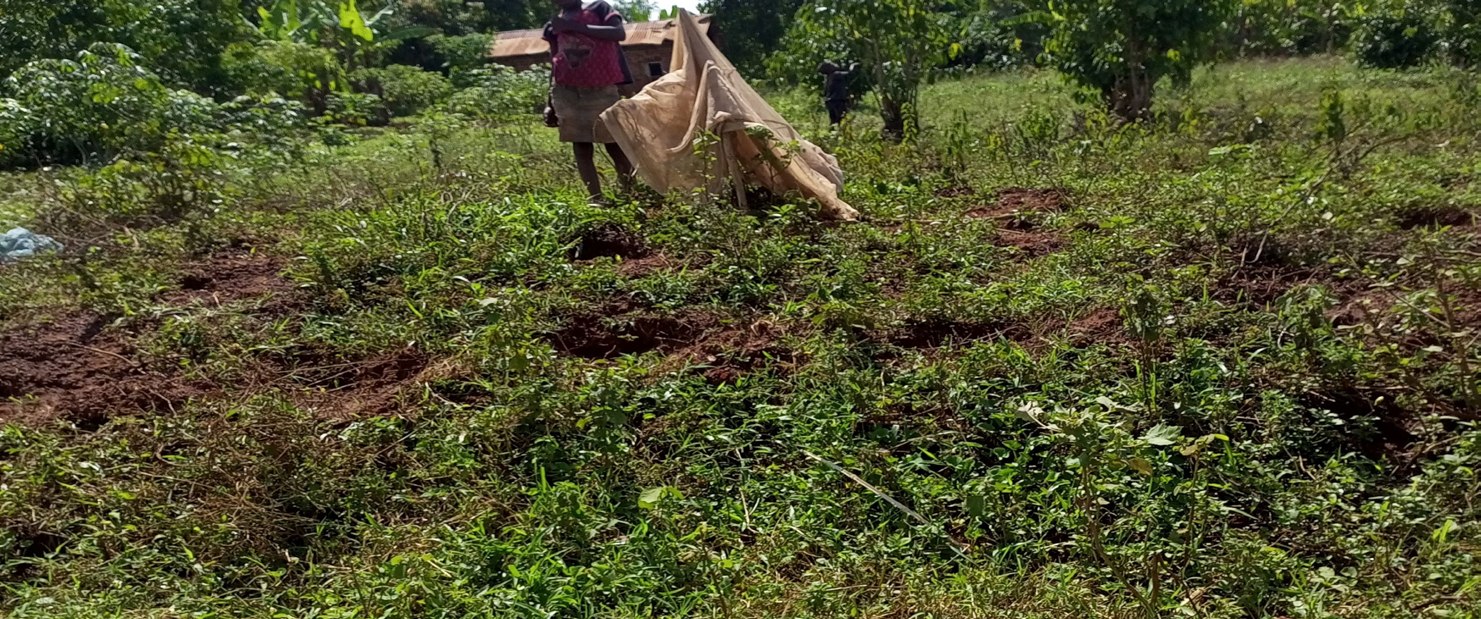
This incident prompted a reflection on the larger issue at hand, the battle against malaria, the Malaria vaccines that are planned to start in Uganda in April 2024 [9] on the way, the wasted resources, the value attached to mosquito nets, and the pressing need for comprehensive community engagement.
This indicated three things, first, the community not considering malaria as such a big problem and how dangerous it is. Secondly, lack of awareness and knowledge on the intended benefits of consistent use of LLINs in Malaria prevention and lastly, an issue of poverty as poverty creates an environment where the risk of malaria transmission is higher and where individuals may face barriers to prevention, early detection, and effective treatment. This revelation prompts an important question: Do the authorities in Uganda responsible for these distributions understand the disconnect between their generous efforts and the actual needs of the community regarding malaria prevention? And as well does the community value mosquito nets in the prevention of malaria?
Then What about the Malaria Vaccines, a Viable Solution?
The approvals of malaria vaccines holds promise in the battle against this formidable disease globally. However, the vaccine impact could be severely hampered if the fundamental understanding of preventive tools like mosquito nets is lacking. This situation raises a pertinent concern about the acceptability or uptake and feasibility of introducing the newly approved malaria vaccines in communities where the utilization of even basic preventive measures like mosquito nets remains a challenge, more so at a time when we just faced vaccine hesitancy for COVID-19 [10, 11].
Then what about malaria that is not thought to be a serious disease? Although vaccinations are a very promising innovation in the fight against malaria, their potential impact could be considerably hindered if the basic principles of preventative measures like use of mosquito nets are not understood. It is imperative that vaccine rollout strategies are accompanied by robust education and awareness campaigns, ensuring that communities are equipped with the knowledge to complement vaccination efforts.
So, What Should be Done? (The Need for Further Community Engagement and Health Education)
The success of any public health initiative depends on community education and engagement. It is not enough to merely distribute resources; we must ensure that recipients understand their significance and how to use them effectively. To address this issue, it is imperative that public health initiatives be coupled with comprehensive educational and community engagement campaigns.
These campaigns should not only focus on the benefits of mosquito nets but also provide practical demonstrations of their proper use, the malaria risk factor, keeping in mind the drivers and barriers to effective use of the available malaria preventive strategies. Additionally, community engagement and participation must be central to these efforts. By involving the community, local leaders, health workers, and educators, can foster a collective responsibility for health and well-being by involving all stakeholders [12] and by education campaigns, we recommend using social and behavioral change communication, this approach is being used by LM and partners who are developing education messages using approaches like videos to do health education on schistosomiasis in endemic communities of Mayuge District Uganda, where videos are shown to illustrate how Schistosomiasis destroys the internal body organs if untreated and it has been well embraced by the community to trigger behavioral change [12].
It is crucial that the LLINs distribution efforts are conducted in a manner that ensures the recipients are not only equipped with preventive tools but are also informed and empowered to use them effectively. A holistic approach that combines provision with education is the key to bridging the gap between good intentions and meaningful impact.
Most importantly, the government also need to work to address the root causes of malaria, such as poverty and lack of access to healthcare. By addressing these underlying issues, we can create a more sustainable solution to the malaria problem.
Conclusion
As we strive to combat malaria and meet the recently launched U.S. President’s Malaria Initiative (PMI) [13] Uganda Malaria Operational Plan FY 2023 with the target of reducing malaria infections by 50% and malaria-related deaths by 75% in Uganda’s endemic regions, we must recognize that true success lies in more than just the provision of resources. It lies in the knowledge, understanding, and active participation of the communities we aim to serve. Let us envision a future where preventive tools like mosquito nets are not only distributed but are also valued, utilized, and upheld as vital instruments in safeguarding lives. It is my hope that this incident serves as a catalyst for change, sparking a renewed commitment to comprehensive community engagement in our collective fight against malaria [14].
Conflict of Interest Statement
We declare that we have no conflicts of interest to disclose related to this opinion.
Acknowledgement
The Authors would like to thank Andrea Leslie assistant Managing Editor for publication guidance.
Funding
This publication did not receive any funding.
References
-
World Health Organization (2023) Malaria.
-
World Health Organization (2023) Updates recommendation for malaria-preventing mosquito nets based on new research.
-
World Health Organization (2021) The Global Health Observatory. Explore a world of health data.
-
Kigozi SP, Kigozi RN, Sebuguzi CM, Rutazaana D, Cano J, et al. (2020) Spatial-temporal patterns of malaria incidence in Uganda using HMIS data from 2015 to 2019. BMC Public Health 20: 1913.
-
World Health Organization (2023) Malaria.
-
World Health Organization (2023) Recommends new malaria nets based on research by LSHTM and partners.
-
The Independent (2022) Ministry of Health: Malaria cases shoot up across Uganda.
-
Daily Monitor (2023) Health Ministry starts nationwide distribution of mosquito nets.
-
New Vision (2023) Uganda to receive malaria vaccine in April 2024.
-
Kabagenyi A, Wasswa R, Nannyonga BK, Nyachwo EB, Kagirita A, et al. (2022) Factors Associated with COVID-19 Vaccine Hesitancy in Uganda: A Population- Based Cross-Sectional Survey. International Journal of General Medicine 15: 6837-6847.
-
Kabakama S, Konje ET, Dinga JN, Kishamawe C, Morhason- Bello I, et al. (2022) Commentary on COVID-19 vaccine hesitancy in sub-Saharan Africa. Tropical medicine and infectious disease 7(7): 130.
-
Mujumbusi L, Nalwadda E, Ssali A, Pickering L, Seeley J, et al. (2023) Understanding perceptions of schistosomiasis and its control among highly endemic lakeshore communities in Mayuge, Uganda. PLoS Negl Trop Dis 17(1): e0010687.
-
U.S. President’s Malaria Initiative Uganda Malaria Operational Plan FY 2023.
-
Uganda National Malaria Control Division (NMCD), Uganda Bureau of Statistics (UBOS), and ICF (2020) Uganda Malaria Indicator Survey 2018-19. Kampala, Uganda, and Rockville, Maryland, USA.
- Update on Malariology and Malaria Vaccines
- Addressing Vaccine Hesitancy in the Age of Measles Resurgence: A Mini-Review
- Exploring Barriers and Facilitators of Group Antenatal Care Implementation in Kaduna State, Nigeria: A Qualitative Evaluation
- The Role of IL-11 in Regenerative Medicine and Tissue Engineering
- New Prediction of Mortality rate of Covid -19 According to WHO Estimation
- Measles Vaccine in Kano, Northern Nigeria: Past, Present and Future