
Lifestyles are a Lot Greater Tough to Manage during Periods: Autistic Reports of Menstruation
Menstruation is an everyday organic process known to individuals as being female at the beginning, but it is an affair that has been underrepresented in the circumstances of neuro diversity, specifically within the autistic society. This study explores the occurrences and challenges confronted by autistic people in directing their menstrual cycles. Through concerning qualities, not quantities, interviews, and surveys, we composed dossiers from a variety of autistic shareholders, aiming to clear up their singular outlooks on period. The findings of our study imply that many autistic people encounter important troubles during their menstrual eras that can infuriate the challenges that guide their daily lives. These challenges are versatile and involve sensual feelings, troubles in communication, and executive functioning issues. Participants repeatedly stated profound tactile sensitivities superior to raised discomfort and olfactory encumber during periods. Additionally, ideas and challenges preclude their ability to seek support and express their needs efficiently. In answer to these challenges, partners join a variety of management actions, stressing the significance of routine, visual virus, and aural boardinghouse to help bureaucracy better navigate their menstrual periods. They again stressed the need for increased knowledge and support within the autistic community and with healthcare professionals. This study climaxes on the significance of recognizing the crossroads of autism and period, contributing understanding to the experiences and needs of autistic people, and this unrefined organic process. Promoting inclusive, patient focused care and support tailor made to the particular challenges met by autistic people during their period is important. Further research and instruction in this field are essential to advance the features of the history and health of autistic individuals and guarantee their singular needs are discussed, accompanied by empathy and understanding.
Introduction
The onset of menses (menarche) is a critical and regular hard [1] transition in women’s lifestyles. That is especially the case of developmentally disabled girls, who may enjoy menarche and menstruation differently and greater negatively compared to non-disabled ladies [2, 3]. These include common reports of dysmenorrhea (painful duration), menorrhagia (heavy intervals), menstrual hygiene problems, cyclical temper, and behavioral modifications, comparable to premenstrual syndrome (PMS) [and its more severe form, premenstrual dysphoric disorder [4, 5, 6, 7, 8]. Remarkably, little is thought, but, about the menstrual experiences of Ladies in the autism spectrum. This paucity of studies may be unsurprising given the male predominance in autism [9]. However the few present studies in this place deliver motive for difficulty. Even though there are no substantial differences in the age of menarche among autistic ladies and women with other developmental situations [5], there are numerous reports (along with case studies) of marked changes related to menarche and menstruation in autistic ladies and girls (the general public with extra highbrow disabilities), consisting of cyclical self-injurious behaviors [10], temper symptoms and emotional dysregulation [11, 12] and amplification of autistic signs (sensory problems and repetitive behaviors [10, 11].
A concerning finding was reported in an observational study conducted in England that focused on women with intellectual disabilities residing in residential homes and care units. Of the 26 autistic women included in the sample, 92% (n = 24) met the DSM-IV (APA 2000) criteria for late luteal phase dysphoric disorder, a severe form of premenstrual syndrome (PMS). In contrast, only four (11%) of the 36 non- autistic women fulfilled the criteria. The lack of research and awareness regarding these higher rates of premenstrual symptoms in women with autism means that the underlying causes remain unknown, and there is concern that women with autism may not receive the necessary gynecological care they require. Furthermore, to the best of our knowledge, no existing study has directly explored whether these apparent premenstrual symptoms are problematic for individuals themselves.
To address this research gap, an initial study was conducted in collaboration with an autistic woman (RS) and non-autistic female researchers (LC, ER, AR, and LP). This study aimed to rebalance the research by gathering insights from both autistic and non-autistic individuals through an online survey, specifically focusing on their experiences with menstruation. The study sought to understand the type of information they would have preferred to know at the onset of their menstrual cycles and whether being autistic had an impact on or was affected by menstruation and its associated manifestations.
Methods
The survey commenced by offering ancient history records, such as age, gender, and autism associations of individuals. Sooner or later, they were asked about their testimonies of menstruation and everyday development. This has a look at makes a specialty of three key questions:
- “How did you first have a look at periods?” (Closed question).
- “What information do you recollect is vital to recognize earlier than starting your length?” (Open question) and
- “Do you believe you studied you have skilled period related troubles associated with autism?” (Open query). Members were recruited through convenience sampling strategies using Internet posts and social media. A total of 459 individuals participated in this survey. People were allowed to discover a couple of roles, including being autistic, discretionary, professional, or sibling, to account for one of a kind views. However, they were also requested to specify their primary perspective while responding to the survey (e.g., as an autistic character). For this file, the point of interest is on individuals who are self-recognized as either “officially recognized as autistic” (n = 140-four) or “non-autistic” (n = 132). Of those 276 people, 39 stated that they did not experience durations (n = 11) or did not clear all relevant questions (n = 28) and were excluded from the dataset. The subsequent analyses were primarily based on responses from 237 contributors (autistic: n = 123; non- autistic: n = 114) within the age range of 16 to over 60 years (consult (Table 1) (one for player information).
Data Analysis
First, the descriptive effects for the initial closed questions were supplied. Subsequently, we analyzed the qualitative responses to the two open-ended questions using thematic analysis. We used an inductive (“bottom-up”) method, offering descriptive overviews of the key capabilities of the semantic content of statistics inside an essential framework (Table 2). We independently familiarized ourselves with the statistics and met several instances to agree on: the preliminary codes, evaluate the results, solve discrepancies, and determine the final themes and subthemes.
| Autistic (n= 123) | Non-autistic (n= 114) | |
|---|---|---|
| Age Range (in years) | ||
| 16-18 | 9 | 6 |
| 19-25 | 33 | 26 |
| 26-31 | 33 | 20 |
| 32-45 | 36 | 44 |
| 46-59 | 12 | 13 |
| 60+ | 0 | 5 |
| Gender | ||
| Female (including transgender women) | 83 | 96 |
| Male (including transgender men) | 7 | 0 |
| Non-binary | 26 | 15 |
| Other | 6 | 3 |
| Prefer not to say | 1 | 0 |
| Also identified as a: | ||
| Parent | 14 | 18 |
| Professional | 14 | 16 |
| Sibling | 13 | 5 |
| The Internet | 3 | 3 |
| Friends | 13 | 26 |
| Parents | 70 | 66 |
| School | 55 | 46 |
| Doctor or other medical professional | 1 | 5 |
| I don’t know | 6 | 6 |
| Other | 19 | 25 |
Table 1: Background information for respondents to the online survey for each (autistic, non-autistic) group.
Participants’ responses to the question, “How did you first learn about periods?”
Most of the responses in the ‘other’ category related to printed material (books, magazines or leaflets), “my sister” or “when it happened” Credit: Robyn Steward, Laura Crane, Eilish Mairi Roy, Anna Remington, and Elizabeth Pellicano.
Quantitative Results
The public individuals first acquired data in approximately durations via both their dad and mom or through faculty, with some locating out about menstruation from pals and published cloth, and, for a handful of people, from clinical specialists or the Internet. This pattern became similar across agencies, except that fewer autistic girls came across facts from pals than did non-autistic women.
Qualitative Results
The qualitative analysis identified various themes and subthemes, which are summarized in Figure 1. To maintain brevity, we present the themes below, combining responses from both autistic and non-autistic groups. The subthemes are indicated in italics. When quoting participants, ‘A’ represents autistic respondents, ‘NA’ represents non-autistic respondents, and participant numbers are included to demonstrate a wide range of responses.
It’s a Normal and Natural Part of Life
Participants discussed the societal taboo surrounding menstruation and emphasized the importance of reassuring young individuals that periods are not dirty, something to be feared, or a source of shame. Instead, they emphasized that periods are a natural and normal part of growing up and a healthy aspect of life. It was also noted that it is crucial for everyone, including those who have not experienced periods, to understand this, to empathize with, and support individuals going through menstruation, such as their mothers or sisters. Both autistic and non-autistic respondents agreed that young people should have an understanding of how their bodies function and the reasons behind menstruation, including knowledge about the menstrual cycle; reproductive organs such as the vagina, vulva, and uterus; and the purpose of periods.
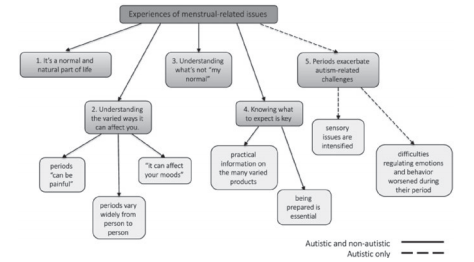
Understanding the Various Approaches can Affect You
Respondents highlighted the want for young people to realize “what takes place earlier than their first length” (A8) so that it “doesn’t come as a terrifying surprise” (NA16). Particularly, they must take into account that the cramps that come with periods “can be painful” (NA48), and that there can be different physical symptoms, too, consisting of bloating (water retention), “smooth breasts” (A22), “skin changes” (A110) or pimples, adjustments to consumer behavior, constipation, and “the manner it impacts your weight” (NA60). Several autistic repayments stated specifically that “it was useful to realize in advance that I wasn’t demise’ (A7) from bleeding and/or ache. Respondents also noted the many ways that “it can affect your moods” (NA60) “earlier than and probably after your duration, no longer simply for the duration of” (A29) and that these adjustments “are normal” (A66). Some respondents referred to the importance of providing proof of those “temper swings” (A78) and “the purpose one is acting in a selected way” (NA52). Indeed, one autistic player-defined, “About as soon as a month, I am getting irritated and melancholic for no motive. This temper lasts for a day or two, at which factor my duration arrives, and my ‘regular’ mood resumes. Know- how that approximately myself makes that melancholy lots more endurable/manageable and helps my companion understand my behavior/temper” (A52).
Both autistic and non-autistic contributors emphasized the need to improve information on “how long it lasts, how regularly it happens, how heavy/light it will be” (A84) but, severely, that intervals range extensively from character to individual. Indeed, they felt that understanding that “all and sundry get them differently” (A85) would have been helpful for them to apprehend “that what’s every day for me isn’t always what’s regular for anybody else” (NA41). One autistic respondent summed it up: “A few human beings get them heavy, a few human beings get them mild, not all and sundry receive them regularly, not anyone receives them exactly 28 days aside, some human beings get pains, a few people get moody, on occasion clinical conditions cause them to abnormal, a few human beings get them for extra than per week at a time, some humans get them for handiest a couple of days” (A85).
Understanding What’s Not “My Normal”
Respondents felt that it changed into critical to “be aware of what regular are for me, and to realize a way to react if my ordinary modifications” (NA41). They spoke of the need for younger people to “know a way to music their cycles correctly so that they may be aware of how their frame is … and be prepared for any irregularities that could occur” (A22), inclusive of the quantity of pain, the amount of blood, and the frequency between intervals. They burdened the need to recognize how to distinguish between, for instance, “regular duration cramps and unusually painful intervals” (NA60) to pick out “how lots are suitable before you need to fear” (NA71) and “what could be a caution signal of a scientific hassle” (A65).
Knowing What to Expect is Key
Respondents stated that young human beings needed sensible facts on the many varied merchandises to use, including a “risk to familiarize themselves with a variety of merchandise before they begin” (A50), facts on “a way to pick out menstrual hygiene products” (NA19), wherein to get them, and “disposal techniques” disposal techniques’(A28). They burdened that introductory facts ought to be handy, “breaking down preliminary principles” (A15) with a “step by using-step ‘that is how you deal’ instructions and tips” (A42), in particular for younger autistic human beings. In addition, they wanted younger people to know approximately the distinct techniques available to relieve aches (along with medicinal drugs), and the way to deal with temper swings and other signs and symptoms or troubles like “acne, cramps, bloating, nausea” (NA35).
The respondents also noted that being prepared was important. This instruction should include a “script for what to say to a nurse or figure whilst you begin your first one or are unprepared” (A50), understanding “what to do at college, if you are out in a public region, if you are on an excursion” (NA113), and having an “action plan for mishaps (stains, stains in public locations, forgot substances, and many others.)” (NA50). They also desired to reassure them that “it’s good enough to tell your instructors in case you want extra time for the restroom” (NA38) and that it was important to perceive “who to invite questions about periods” (NA13) and who to show to for assistance, in particular, “if you would possibly feel there is a trouble” (A104). Intervals Exacerbate Autism-associated demanding situations although a few participants had been unsure whether their menstrual studies were associated with being autistic (“I’ve simplest ever been an autistic character having a length!” A80), many autistic contributors felt that their “signs get worse dramatically” (A47), often making “life tons greater difficult to guy age in the course of durations” (A93). One participant said,’ Autism does play a position. It can grow to be a lot greater, overwhelming, and tougher to maintain and manage the things that already take several attempts for us to maintain on top of, for the duration of a duration” (A13). Individuals highlighted sensory and self- regulatory difficulties.
The respondents felt that sensory troubles intensified throughout menstruation, as defined above. For most components, those associated with pre-current hypersensitivities become “more sensitive during my duration” (A107), such that “everything is magnified while it’s that time of the month” (A78). Contributors described “being sensitive to the odor of the blood” (A17), “funding my skin and body more touchy in popular” (A43), being “more sensitive and reactive to noise, touch, and visible stimuli” (A99), and “struggling to the maximum with the physical pain from cramps” (A22). Ache will be mainly difficult to undergo: “While it’s at its worst, I find myself unable to focus well because all I will consciousness about is the pain and the experience of wherein in my frame that pain lives” (A44). Individuals additionally mentioned how those hyper sen activities and the “sensory overload [that] takes place some distance extra often just earlier than and for the duration of a duration” (A103) in addition exacerbated other autistic experiences, including “handling unrelated issues because of my autism (harder to filter noise and so on.)” (A28) and being “more prone to self-injurious conduct” (A94).
Individuals additionally highlighted how difficulties regulating emotions and conduct worsened throughout their length. a few cited that “government dysfunction gets worse whilst I have cramps” (A98), which “made dealing with intervals difficult maintaining easy and converting pads” (A74). In addition, they highlighted difficulties in “recognizing and handling my emotions, which is amplified simply earlier than and for the duration of my periods” (A45) or even “an inability to describe my emotions whilst experiencing PMS” (A41). One participant defined: “Knowledge of my own emotions has continually been difficult for me, so any mood swings made lifestyles even more difficult” (A17). Additionally, they mentioned that exaggerated difficulties frequently caused “heightened tension” (A99) and, most typically, meltdowns: “I have greater meltdowns, and worse meltdowns, simply before my length” (A30). One player additionally cited that their epilepsy become affected, with multiplied seizures in the course of menstruation. These Cyclical signs and symptoms are often so extreme that members seek (normally hormonal) medicinal drugs for their management.
Research Method
In this study, our objective search considers the impact of public media on teenagers’ insane energy. We inducted 300 players, aged 13-18, from local schools. Data was collected through an internet survey planned to evaluate social publishing custom patterns and insane fitness indicators. The survey agent was suitable for the approved scales, including the Patient Health Questionnaire (PHQ-9) for depression and the Generalized Anxiety Disorder (GAD-7) scale. A data study was conducted utilizing SPSS, containing correlation and reversion reasoning. Ethical concerns were raised by getting informed consent from players and guaranteeing dossier solitude. Limitations include potential self-report bias and the cross divided design.
Results
Our study revealed various key findings. First, skilled was a meaningful helpful equating between routine public news habits and self-reported syndromes of tension (r = 0.35, p < 0.001) and despair (r = 0.28, p < 0.001). A regression study showed that public television custom was a meaningful prophet of anxiety (β = 0.21, p < 0.01) and concavity (β = 0.17, p < 0.05). These results support our theory that raising public media habits leads to greater levels of tension and depression in teenagers.
Discussion
The results concerning this study emphasize the potential negative effects of thorough social media use on the insane fitness of teenagers. These verdicts align with accompanying former research that has emphasized the link between screen time and cognitive welfare. However, it’s important to favor the limitations of our study, including the lack of confidence in the self-report dossier and the lack of a lengthwise design. Future research will explore the systems by which public television impacts mental strength and deal with potential invasions to check the negative effects. Additionally, our study stresses the need for instructional programs and paternal counseling to promote active connected ness to the internet and supply support for adolescents facing insane strength challenges that have a connection with social television habits.
Conclusion
This preliminary examination elicited, for the first time, views and studies on menarche and menstruation. Extensively, autistic and non-autistic respondents mentioned many comparable troubles, which include trying to comprehend what becomes “ordinary” in phrases of menstrual cycle duration and quantity. The duration of flow, the often dramatic outcomes that menstruation may additionally have on mood, behavior, and bodily symptoms, and importantly, what is changed every day for them. The significance of training younger people and their dads and mom what to expect at menarche has been emphasized previously [13] know how hardly ever so for greater youthful autistic human beings, who are probably at elevated risk for excessive premenstrual related problems [12]. The current day looks at understanding them every day. Albeit
constrained research [5, 10, 11], autistic human menstrual reviews are splendid from those of non-autistic humans, placing more pressure on what can be already-tough lives. Honestly, menstruation became visible for the autistic people sampled here. Is a mainly hard and distressing event (just like women with different Developmental disabilities [2], at some unspecified time in the future, in which there are pre-existing worrying situations in particular, regarding sensory hypersensitivities and difficulties with regulating emotions and behavior become exacerbated in advance, within the path of, and after menses. The amplification of pre-contemporary autistic capabilities has been previously advised [10, 11], understanding every knowledge no this check sought to understand the effect of menstruation on human beings. The ones sampled here described overwhelmingly horrible studies, especially, exaggerated sensory problems and intensified govt and Emotion- regulation troubles, which had regularly excessive effects, which encompass “shutdown,” withdrawal, and heightened tension and consequently reduced. Participation in paintings and social and network lifestyles. Expertise in the prevalence of premenstrual related signs and symptoms in humans during the autism spectrum, the reasons for such signs (which may be associated with higher ranges of hormonal fluctuations; [12], and their related impact (along with the potential to treat aspect results of cyclical adjustments) are critical for similar research.
One crucial step to mitigate functionality problems within the following menarche is to grow expertise in menstrual-associated troubles in extra youthful human beings and their dads and mother [13], particularly within the Form of available, step-through-step courses and strategies for the way to deal with Ache and temper change in particular [14]. This is especially crucial for more youthful autistic human beings, who may be much less likely to build up records of approximately sexual subjects from casual social settings (with pals, as shown in Table 55). 2), whose parents are likely reticent to talk about puberty and sexual fitness, and may begin conversations later [15, 16, 17] and 55 “existence is a top-notch deal that is difficult to govern 759. Whose clinicians may additionally moreover pass over (or prioritize) any hyperlink between menstruation and temper or behavior-associated abilities. The present day absence of this know-how alternatively means that the specific excessive symptoms and signs and symptoms and signs and symptoms recommended using a few women and women may be going unrecognized by clinicians and, consequently, are not handled efficiently.
Given the nature of the current methodology, it has become viable neither to verify, for self-declared autistic respondents, in which they lie about the autism spectrum nor to make certain that we no longer over sample people with especially complex menstrual tales. However, these preliminary findings serve to pressure the significance of those troubles for autistic people and contact for introduced hobbies on ladies’ health problems in the course of their lifespan, which include systematic investigations of the motives, correlates, and outcomes of fellows’ saturation (especially approximately highbrow health) for autistic younger people and adults.
Acknowledgment
The completion of this research assignment was not possible without the contributions and assistance of many individuals and groups. We’re. We would like to thank all those who played a role in the success of this project. I would also like to thank My Mentor [Dr. Naweed Imam Syed Prof branch of mobile Biology at the University of Calgary for their useful input and guidance regarding the duration of the research system. Their insights and understanding are instrumental in shaping the path of this undertaking. Authors’ Contributions I would like to increase our sincere way to all the members of our take a look at, who generously shared their time, studies, and insights with us. Their willingness to interact with our studies became essential to the success of this assignment and we are deeply thankful for their participation.
References
-
Burrows A, Johnson S (2005) Girls’ Experiences with Menarche and Menstruation. Journal of Reproductive and Infant Psychology 23(3): 235-249.
-
Ditchfeld H, Burns J (2004) Understanding our Bodies, Understanding Ourselves: The Menstrual Cycle, Mental Health and Women with Learning Disabilities. Tizard Learning Disability Review 9(4): 24-32.
-
Rodgers J, Lipscombe J (2005) The Nature and Extent of Help Given to Women with Intellectual Disabilities to Manage Menstruation. Journal of Intellectual and Developmental Disability 30(1): 45-52.
-
American Psychiatric Association (2013) Diagnostic and Statistical Manual of Mental Disorders (revised 5th Edn.) Washington DC: American Psychiatric Association.
-
Burke LM, Kalpakjian CZ, Smith YR, Quint EH (2010) Gynecologic Issues with Down Syndrome, Autism and Cerebral Palsy. J Pediatr Adolesc Gynecol 23(1): 11-15.
-
Jeffery E, Kayani S, Garden A (2013) Management of Menstrual Problems in Adolescents with Learning and Physical Disabilities. The Obstetrician & Gynaecologist 15: 106-112.
-
Mason L, Cunningham C (2008) An Exploration of Issues around Menstruation for Women with Down Syndrome and their Caregivers, Respectively. Journal of Applied Research in Intellectual Disabilities 21(3): 257-267.
-
Rodgers J, Lipscombe J, Santer M (2006) Menstrual Problems Experienced for Women with Learning Disabilities. Journal of Applied Research in Intellectual Disabilities 19(4): 364-373.
-
Loomes R, Hill L, Mandy W (2017) What is the Male- to-Female Ratio of Patients with Autism? Spectrum Disorder? Systematic Review and Meta-analysis. J Am Acad Child Adolesc Psychiatry 56(6): 466-474.
-
Lee DO (2004) Menstrually Related Self-Injurious Behavior in Adolescents with Autism. J Am Acad Child Adolesc Psychiatry 43(10): 1193.
-
Hamilton A, Marshal MP, Murray PJ (2011) Autism Spectrum Disorders and Menstruation. J Adolesc Health 49(4): 443-445.
-
Obaydi H, Puri BK (2008) Prevalence of Premenstrual Syndrome in Patients with Autism A Prospective Observer-rated Study. J Int Med Res 36(2): 268-272.
-
American Academy of Pediatrics (2006) Menstruation in Girls and Adolescents: Using the Menstrual Cycle as a Vital Sign. Pediatrics 118(5): 2245-2250.
-
Steward R (2019) Autism-friendly Guide for Periods. London: Jessica Kings ley Publishers.
-
Pownall JD, Jahoda A, Hastings PR (2012) Sexuality and Sex Education of Adolescents with Intellectual Disability: Mothers’ Attitudes, Experiences and Support Needs. Intellect Dev Disabil 50(2): 140-154.
-
Sedgewick F, Hill V, Pellicano E (2018) Parent Perspectives on Autistic Girls’ Friendships and their Futures. Autism & Developmental Language Impairments.
-
Cridland EK, Jones SC, Caputi P, Magee CA (2014) Being a Girl in Boys’ World: Investigating the Experiences of Girls with Autism Spectrum Disorders during Adolescence. J Autism Dev Disord 44(6): 1261-1274.
- The Need for Partner Education and Mental Health Support During Pregnancy and the Postpartum Period
- Application of Combined PGT-A and PGT-M for Reproductive Management in a Couple Carrying GCDH Mutations with Prior Affected Offspring: A Rare Case Report
- The Effect of Using a New Technique Karman Injector (Elif Technique) on the Healing Process of Wound Infection-Case Series
- GSM: Counseling Points to Discuss with Women Fearful of Vaginal Estrogen
- Antenatal Diagnosis of Meckel Syndrome: A Case Report
- Discrimination and Workplace Harassment (Mobbing) against Women in the Post-Pandemic Era