
Anesthesia on the Battlefields with the Esmarch Set
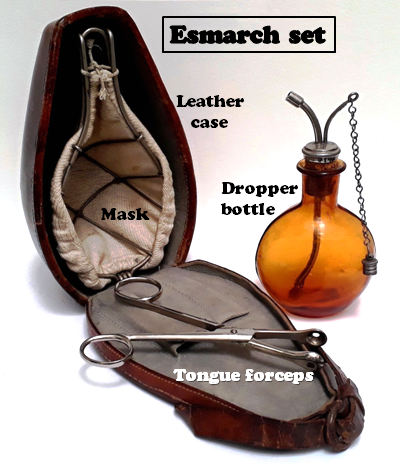
The Esmarch set was created by the German surgeon Johannes F. A. von Esmarch in 1877 for use on the battlefield. It included a transportable leather case that contained a metal mask, a dropper bottle where the chloroform was placed and a tongue forceps to be used when the patient’s tongue obstructed the pharynx. It was used successfully for decades until World War II.
Short Communication
The 1840s was one of the most important and significant, not only in the History of Medicine but also in Universal History.
Between the years 1842-47 relevant events occurred in the USA and Scotland regarding the treatment of surgical pain. In a five-year period, what could not be done in millennia was achieved. Anesthesia, a neologism created in 1846 by the American physician and writer Oliver Wendell Holmes, had become a reality.
In the beginning, ether and chloroform were dripped onto gauze pads, compresses, and handkerchiefs. Renowned European doctors created inhaler devices that were not widely used, such as those of John Snow in 1850, Joseph Clover in 1862 and Ferdinand A. Junker in 1865 [1, 2].
On the other hand, masks such as those by Skinner (Scotland, 1862), Julliard (Switzerland, 1877), Esmarch (Germany, 1877) and Schimmelbusch (Germany, 1890) were practical and easy to handle, especially the last two that were used for decades around the world.
The prestigious German surgeon Johannes Friedrich August von Esmarch (1823-1908) [3] created a set to administer anesthesia on the battlefields, because Germany had wars against Denmark (1864), Austria (1866) and France (1870), publishing it in 1877 in his book “Handbuch der Kriegschirurgischen Technik”.
Esmarch is considered one of the great German surgeons of the 19th century and was the first to introduce a first-aid kit on the battlefield and a bandage to prevent bleeding during limb amputation, which he describes in the aforementioned 1877 book.
The set consisted of a small easily transportable leather case, which contained a metal mask covered with gauze that was applied to the mouth and nose of the soldier to be operated on, a dropper bottle to administer the chloroform that was allowed to drip on the mask and a tongue forceps that could avoid pharyngeal obstruction [4, 5].
This set was very popular in Europe and was later used for chloroform and ether on battlefields until the 1940s.
The Wood Library-Museum of Anesthesiology (WLM), Schaumburg, Illinois, USA, on its official website, referring to the “Esmarch inhaler”, wrote: “Esmarch kits are believed to have been used by German military forces as late as World War II”.
The mask was used for decades in most hospitals around the world [6], appearing in catalogs in the USA until the 1950s and in Latin America until the 1960s.
The Museum of the Association of Anesthesia, Analgesia and Resuscitation of Buenos Aires (AAARBA) preserves the complete set and exhibits it in one of its showcases [7].
References
-
Hügin W (1989) Anestesia Ediciones Roche. Basilea, pp: 52-53.
-
Thomas BK (1980) The Development of Anaesthetic Apparatus. Blackwell Scientific Publications, London, UK, pp: 10-68.
-
Rutkow IM (1996) Illustrated history of surgery. Antonio Delfino, Roma, pp: 394-396.
-
Ball CM, Westhorpe RN (2012) Historical Notes on Anaesthesia and Intensive Care. Australian Society of Anaesthetists, Edgecliff, pp: 64-65.
-
Auvard A, Caubet E (1893) Anesthesie chirurgicale et obstetricale. Rueff et Cie, Paris, France, pp: 127.
-
Eger E, Saidman LJ, Westhorpe RN (2014) The Wondrous Story of Anesthesia. Springer, New York, USA, pp: 42.
-
Gonzalez AV (2011) Museum and historical library. Association of anesthesia, analgesia and resuscitation of Buenos Aires, Argentina.
- Editorial on Multimodal Analgesia
- Surgical Incision Site Local Anaesthetic Infiltration and Superior Hypogastric Plexus Block in Total Abdominal Hysterectomy Under General Anaesthesia- A Placebo-Controlled, Randomized Clinical Trial
- Supraglottic Airway Insertion in Semi Fowler Position Due to Severe Thoracic Hyperkyphosis: A Case Report
- Anaesthetic Management of Cardiac Myxoma Patient with Systemic Involvement: A Case Report
- Current Problems in Pulmonary Respiratory Distress Syndrome (Literature Review)
- Evolution of Perioperative Hemodynamic Monitoring from the Hand on Pulse to Hypotension Prediction Index