
Prehistoric Tools from Misimagre, Northeast India: A Typo-Technological Study
The northeastern region of India houses many archaeological sites – much of them going back to prehistory. One of the well-known regions is the Garo Hills from where over 35-40 sites have been reported since 1960s. These sites are predominantly Neolithic in nature (on the basis of tool typology), with a few pre-Neolithic ones (which have been highly debated). This paper deals with the lithics found in one site, Misimagre, in the Rongram-Ganol valley where over 240+ tools were recovered from exploration, and 6900+ artifacts collected from a 1x1 test pit. The paper details the type of tools recovered and makes an attempt to analyse the techniques involved in making them. What was found interesting was the coming together of two different early Holocene traditions at Misimagre – a microlithic tradition and a Hoabinhian tradition at the same location. The former is a pan-Indian / world phenomenon while the latter is a typical Southeast Asian phenomenon.
Introduction
One of the most prolific areas for prehistoric archaeology (with regards to finds of stone tools) in India’s northeast, has been from the region known as the Garo Hills. The earliest publication referring to stone artifacts from the region is G. D. Walker’s paper which appeared in the journal Man in the year 1931. The lead in research work in this area was undertaken by researchers from the Department of Anthropology, Gauhati University (Assam) since its inception in 1948, who annually explored different sites and documented the finds therein. Mention may be made of Professors Goswami MC, Bhagabati AC, Sharma TC, Sharma HC, Roy SK and Ashraf AA. In all, a total of thirty sites were reported from West Garo Hills and four from East Garo Hills. Not only for its prolificacy, but also for the wide variation in tool typology it is likely that Garo Hills could hold the key, if a systematic study is carried out, for prehistoric migrations, into and out of the region.
The presence of Palaeolithic tools in Garo Hills reported by authors such as TC Sharma [1, 2], Sharma HC [3, 4], Sharma HC & Roy SK [5], Sonowal M [6], was strongly contested by Ghosh AK [7] and others. Ghosh dubbed them as ‘Neolithic debitage’, and Medhi [8, 9] as ‘Pre-Neolithic equivalent to Palaeolithic elsewhere’. However, a close scrutiny of these tools and tool-making sites reveals that they are not Neolithic debitage, but were purposefully knapped.
Ashraf AA [10, 11], Sharma HC [3, 4], Sharma S [12] and Marak Q, et al. [13] state that a pre-Neolithic phase exists in Garo Hills, which is the Hoabinhian phase. So far, the first author’s researches have also supported the Hoabinhian phase – which is a typical epi-Palaeolithic Southeast Asian techno-complex but our recent findings have suggested another cultural tradition possibly co- existing at the same time [13, 14]. This paper discusses the diverse cultural traditions that were found side by side in Garo Hills, with special reference to the site of Misimagre. Additionally, this site being a tool-making site, an elaborate tool-kit is witnessed that the prehistoric people of the region not only knapped but also possibly used.
The Site of Misimagre
Misimagre is located in West Garo Hills district of Meghalaya at a distance of 30 kms from the district headquarter Tura, in the Rongram-Ganol river valley. It is one of the oldest villages in the region and is an extension of Selbalgre village. The site of Misimagre was first discovered in the year 1968, when Goswami MC, Sharma TC [1], Sharma HC and Roy SK [5] from the Department of Anthropology, Gauhati University first explored the area, which was continued in the subsequent years [15]. In the year 1974, a trial excavation was conducted (5.00 x 3.50m) upto 76cms, and revealed highly patinated tools made on dolerite [16]. A geo-archaeological research carried out indicated the presence of Upper Palaeolithic and pre- Neolithic industry and factory sites in Misimagre hills [17].
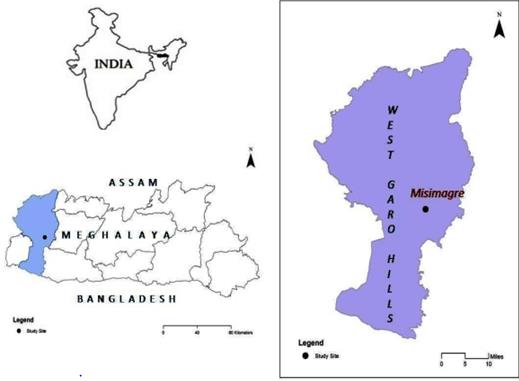
Source: authors
After a lull of almost four decades, a systematic exploration was conducted in the region by a team headed by the first author of this paper, Q. Marak from the Department of Anthropology, North-Eastern Hill University, Shillong in the year 2017. The objective behind this exploration was to systematically identify archaeological sites in the region.
The exploration by the Present team was conducted in January-February 2017. In Misimagre alone, a total of 13 sites were identified within a radius of approximately 1km, indicating prolificacy in site and site occupation. These sites include the following: 1. MSG-I (25°33ʹ12.55ʺ N, 90°17ʹ02.34ʺ E, 650m amsl) – Road leading to village Bibragre, 2. MSG-IIA (25°33ʹ55.11ʺ N, 90°17ʹ00.57ʺ E, 564m amsl):
Near Makbil bisik (bisik = water source),
3. MSG-IIB (25°33ʹ57.77ʺ N, 90°17ʹ05.59ʺ E, 559m amsl):
Between Makbil bisik and Selbal stream, 4. MSG-III (25°33ʹ44.78ʺ N, 90°16ʹ40.98ʺ E, 670m amsl):
Jhum field overlooking Angalnang stream, 5. MSG-IV (25°33ʹ16.84ʺN, 90°16ʹ53.39ʺE, 646m amsl):
Near a house overlooking Misima stream, 10. MSG-IX (25°33ʹ07.58ʺN, 90°17ʹ27.22ʺE, 660m amsl): Hillock overlooking Didami stream, 11. MSG-X (25°33ʹ18.54ʺN, 90°17ʹ06.69ʺE, 603m amsl): Hillock overlooking Masigingsep stream, 12. MSG-XI (25°33ʹ18.75ʺN, 90°17ʹ05.26ʺE, 603m amsl): Near the Masigingsep bisik, and 13. MSG-XII (25°33ʹ22.05ʺN, 90°17ʹ14.66ʺE, 596m amsl): Jhum field overlooking Selbal bisik.
Approach road to a house overlooking Waksambo stream, 6. MSG-V (25°33ʹ11.70ʺN, 90°17ʹ03.25ʺE, 637m amsl):
Junction of Bibragre and Watregre, 7. MSG-VI (25°33ʹ32.33ʺN, 90°16ʹ56.35ʺE, 654m amsl):
Road leading to a house adjacent to Misimagre L P School,
8. MSG-VII (25°33ʹ24.91ʺN, 90°16ʹ56.83ʺE, 658m amsl):
Road leading to Bibragre near the village shop, 9. MSG-VIII (25°33ʹ23.79ʺN, 90°16ʹ57.21ʺE, 648m amsl):
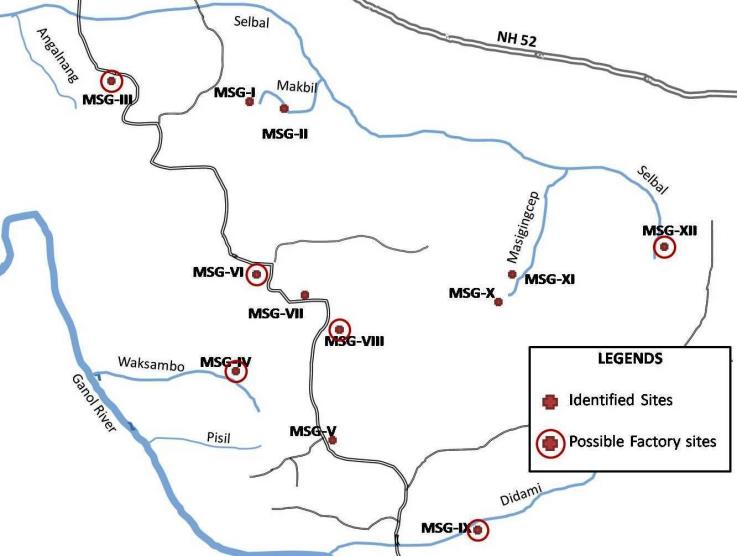
Map 2: The explored sites in Misimagre.
Source: authors
A number of artifacts were collected in the exploration, given in Table 1. A quick appraisal of tools found in the sites clearly revealed that they belonged to different tool traditions and were rather diverse. On one hand, tools like chipped axes and short axes were found; on the other hand blade tools were seen. Of great interest was the finds of cores and debitage (i.e., waste flakes) from six sites – MSG-III, MSG-IV, MSG-VI, MSG-VIII, MSG-IX and MSG-XII – which indicated that possibly tool knapping took place in these sites.
| Sl. No | Types of Artifacts | No | % | ||||||||
|---|---|---|---|---|---|---|---|---|---|---|---|
| Tools | |||||||||||
| 1 | Chipped axe | 28 | 11.38 | ||||||||
| 2 | Short axe | 11 | 4.47 | ||||||||
| 3 | Blade tool | 34 | 13.82 | ||||||||
| 4 | Burin | 1 | 0.41 | ||||||||
| 5 | Point | 4 | 1.63 | ||||||||
| 6 | Borer | 2 | 0.81 | ||||||||
| 7 | Scraper | 65 | 26.42 | ||||||||
| 8 | Flake | 5 | 2.03 | ||||||||
| 9 | Indeterminate | 20 | 8.13 |
Table 1: Distribution of artifacts found in exploration. Source: Fieldwork 2017
| Total | 170 | 69.11 | |
|---|---|---|---|
| Cores | |||
| 10 | Core | 7 | 2.85 |
| Debitage and TMT | |||
| 11 | Blank | 1 | 0.41 |
| 12 | Stone hammer | 2 | 0.81 |
| 13 | Waste flake | 66 | 26.83 |
| Total | 69 | 28.05 | |
| Grand Total | 246 | 100 |
Table 2: Distribution of artifacts found in exploration. Source: Fieldwork 2017
The test dig conducted at MSG-IX revealed approx. 7000 artifacts (Table 2). The finds from the 1x1 test pit were rather revealing since these tools were found in association with each other. The artifacts were collected from a single habitation layer composed of brown silty soil up to a level of 67cms when the non- implementiferous layer was breached. Table 2 showed the type of artifacts found from the excavation. Maximum amount of waste flakes, small chips etc. were collected from the excavated area, which along with the cores, blanks and broken tools point towards the fact that indeed the site of MSG-IX was a factory site where mass tool manufacturing took place.
| Sl No | Types of Artifacts | No | % | ||||||||
|---|---|---|---|---|---|---|---|---|---|---|---|
| Tools | |||||||||||
| 1 | Chipped axes | 23 | 1.66 | ||||||||
| 2 | Short axes | 23 | 1.66 | ||||||||
| 3 | Microlith | 207 | 14.9 | ||||||||
| 4 | Blade | 409 | 29.45 | ||||||||
| 5 | Burin | 16 | 1.14 | ||||||||
| 6 | Point | 5 | 0.36 | ||||||||
| 7 | Pick | 9 | 0.65 | ||||||||
| 8 | Borer | 15 | 1.08 | ||||||||
| 9 | Scraper | 336 | 24.19 | ||||||||
| 10 | Indeterminate | 346 | 24.91 | ||||||||
| Total | 1389 | 100 | |||||||||
| Cores | |||||||||||
| 11 | Broken | 27 | 26.73 | ||||||||
| 12 | Core | 60 | 59.41 | ||||||||
| 13 | Fluted | 14 | 13.86 | ||||||||
| Total | 101 | 100 | |||||||||
| Debitage and TMT | |||||||||||
| 14 | Blank | 67 | 1.26 | ||||||||
| 15 | Waste Flakes | 683 | 12.5 | ||||||||
| 16 | Small Chips | 4710 | 86.24 | ||||||||
| Total | 5460 | 100 | |||||||||
| Grand Total | 6950 | 100 |
Table 3: Stone artifacts from MSG-IX. Source: Fieldwork 2017
A total of 5 potsherds were also recovered from the test pit as shown in Table 3. These sherds can be grouped into two main types – plain red ware and plain brown ware – both handmade. However, the size of the broken sherds was too small to be sent for chronometric dating.

- Type
- Type of Clay
- Portion of Pot
- Where
- Neck; appears to be a pot with medium-long
- Type 1
- Plain red ware
- Fire clay; coarse and lots of sandy grits; ill-levigated neck
- Fire clay; less coarse and lots of sandy grits; ill-levigated; appears
- Type 2
- Plain brown ware
- Rim; appears to be a more compact than Type 1
Table 4: Types of potsherds from MSG-IX.
Following are the types of artifacts found in Misimagre from the exploration as well as the test excavation.
Stone Tools
Chipped Axe: 51 chipped axes of varying dimensions (shape and size) were collected from the site. Over 50% appear to be unfinished and broken. In terms of workmanship they are all fully chipped with no signs of grinding and polishing technique. At this juncture we would like to state that even though earlier authors have mentioned edge ground or fully ground in the Garo Hills tool kit, we have not encountered any in Misimagre so far – rather due to high patination and weathering, the sharpness of the flaked edges get smudged and gives a misleading picture of rudimentary grinding which is not the case. From excavation, only 4 unbroken and fully intact ones were found, but the final product seems to be unfinished since flake scars appear to be rudimentary; the rudimentary nature could be intentional or point towards a process of tool making. The rest of the chipped axes from excavation appear to be broken and form different parts of the axe – tip, butt, broken longitudinally, tip / butt partially broken. Short Axe: An interesting tool type found include the short axe, which look like the broken butt or tip of a chipped axe, but is not the case. Short axes found were all chipped (or flaked) bifacially, with a strong truncation feature. The latter indicates that the short axes were intentionally broken, and not a result of any accidental breakage. The largest short axe found was almost 1½ kilogram while the smallest one was just over 100 grams, clearly showing a wide variation that exists within the short axe category – possibly indicating a difference in functionality. Some of these tools, rather than appearing finished, appear to be rudimentary in nature. But this in no way indicates that they were unfinished or discarded.
In fact, rudimentary or minimum flaking is a feature that is successively witnessed in the Garo Hills tool kit. Microlith: Microliths refers to very small flakes that have been retouched to produce a working end. The Misimagre tool kit comprised of both the laminar as well as the geometric types. Some of the common laminar types include micro scrapers (with cutting edges on different parts of the periphery), micro-blades (with two longitudinal cutting edges), micro burins and micro borers; on the other hand we have also identified triangles and trapezes in our tool kit. Pick: 9 picks with tapering pointed working ends were also identified from the excavation. All of the picks appear to be heavy-duty tools with a thick, tapering and projecting tip. They appear to be bifacially worked, but with low intensity of reduction flaking. Blade: Blade flakes show characteristic parallel sides with elongated flake scars. It is not clear whether all of them were finished tools, but majority of them appear to be finished with sharp cutting edges on either one or both lateral borders. In some, a back or a rudimentary back is also witnessed. Understandably, there is a wide variation in the types of tools that we categorize as blade tools – blade flakes, knives, and scrapers on blade. One of the knife blades found at the test pit has a back which appear to have been intentionally retouched (for better grip). Borer and Burin: The tool kit interestingly comprises of borers and burins as well, which are tools made with blade technology with retouches done at specific locations in order to procure a sharp pointed working end. These are all on blade flakes – some showing larger morphological dimensions than others. Some of the burins appear to have the working end prepared by detaching two small flakes at one end from both the sides, while in some only one small flake appear to have been detached.
Scraper: One of the largest categories of tools appears to be scrapers. A possible explanation could be the ease with which a detached flake can be used as a scraper by using minimum retouches. Scrapers could have been used for multiple scraping purposes, and the variety of scrapers on the basis of the cutting or scraping edge is rather interesting and indicative of the purposes. Scrapers could have been conveniently carried along over long distances for use in different domestic purposes. Again, if one of the scraping edges got blunt, it is only a matter of a few minutes, when after retouching, it could be used again. Point: Comparatively points are less in number. Even the 1x1 test excavation stresses the fact that scrapers were overwhelmingly preferred, while points were neglected. This supports Ashraf’s [10, 11] theory that hunting played a less important role in Garo Hills in the prehistoric period. Points, even though they could have been used for other purposes, more likely were used as projectile weapons in the past for a variety of subsistence economies like hunting and fishing. The less number of such projectile weapons indicates that possibly stone tools were rarely used as spear points or lance points in the Garo Hills context. This in no way indicates that prehistoric people did not hunt or fish. Rather, when we look at ethnographic parallels, we realise that there is an abundance of other materials (besides stone) which could have been more conveniently used for hunting and fishing. For example, bamboo – either split or dressed – could have been used as a spear or a lance. Additionally, we see a large number of trapping devices made from bamboo and cane both for hunting and fishing in the region even today [18].
Core, Blank, Waste Flake and Chip
It is interesting to note, that out of the total number of artifacts collected majority comprised of unfinished tools, cores, blanks, broken chunks, waste flakes and small chips. Cores collected from the excavation revealed small to large cores with single / double / multiple flake removals as well as fluted cores. In terms of size specifics, the cores ranged from 15gm to 851gm. Cylindrical cores range from the number of flutes seen – from two grooves upto ten grooves. Cores of irregular shapes were also recovered showing single and multiple flake removal. The blanks recovered appear to be of contrasting dimensions – some are miniscule, while others are large. It is clear, just based on the size of the blanks, that the technology applied is different on different sized-blanks – in order to produce different types of tools. A large number of waste flakes and chips were also recovered.
Pottery
The two types of pottery found in MSG-IX showed differing characteristics. In terms of the raw material, both are made of fire clay, commonly found in the region. But in terms of typology they appear to be broken parts of two different types of pot – one with a neck, and the other without a neck. In terms of dimensions too, Type 1 is thinner (0.2 – 0.6cm) than Type 2 (0.6 -1cm). The former type possibly has a neck with a thin lipped rim and rounded body; while the latter has a slanting lipped rim, no neck and hemispherical body (from ethnographic context). A reconstruction of Type 1 and 2 from the archaeological context are clearly comparable to ethnographic pottery [13]. Thus, continuity can be seen in the type of pottery from the past to the present.
Tool Technology
It is clear that site MSG-IX is a factory site. What kind of tools were manufactured is clear – but what remains indistinguishable is the method of manufacture. From the presence of a large number of blanks in the site, we know that pieces of raw material of convenient sizes were brought into the site and shaped into tools. Again from the different sizes of the blanks as well as the diversity of the tools themselves, it is clear that the techniques used were not one-but multiple in nature.
Presence of chipped axes and short axes reveals that at one level, large bifacial tools were being manufactured by direct percussion method following possibly the stone / cylinder hammer technique to give the initial shape to the tool. At another level, a flake tool tradition also persisted as clear from the scrapers, blades and microliths recovered. It is unclear whether chipped axes were made on cores, or on flakes removed from cores – though it would be safe to say that large chipped axes were possibly core tools, while small to medium chipped axes could have been made on large flakes. Some of the chipped axes are rather thin with refined flaking techniques that only an expert tool maker can make; and a single immature or inexperienced blow could break the tool and it possibly would have to be discarded. What it indicates is that the tool maker using direct percussion (in the manufacture of chipped axes) was very experienced, since the flakes removed for making the chipped axes appear to be refined and shallow.
The presence of blade cores along with different sized fluted cores reveal that the prehistoric people in Garo Hills knew the method of fluting and used it to the optimum. Thus, it is not surprising that a large number of small sized blade flakes have been recovered (possibly made by fluting technique). The presence of cylindrical and fluted cores also makes it possible for us to conjecture that the tool maker in Misimagre might have known and extensively used the punching method. This would indicate the use of a medium (punch) in order to remove a flake from a core for details see Marak, et al. [13]. This would help remove smaller and elongated flakes from a medium to small sized core.
The technique of backing / blunting / truncation appears to be well-known. A backing technique was seen in some of the blade tools- some rudimentary, others developed. This could be done by retouching along one border, and necessitated by the need to grip the tool in hand when using it. Additionally, there is evidence of intentional truncation seen at the proximal end of the short axes. The presence of this truncation clearly reveals that the tool would have been hafted onto a wooden handle and used. Retouches have been seen in most of the tools-chipped axes, short axes, scrapers as well as burins. This is required in order to make the tool sharper for use, as well as in opposition to make a border blunter for easy grip.
What is intriguing is the coming together of two diverging tool traditions. Firstly, we see a very popular blade tool technology along with fluting technique– possibly in the manufacture of the blade tools and microliths. Blade flakes can be produced by both percussion and pressure, and evidence suggests that most of the tools in Misimagre were produced by percussion method. Additionally, the hardness of the rock, i.e., dolerite (5.5-6.5 on the Mohs scale) indirectly suggests the use of percussion method. The presence of hammer stones lends support to this theory as well. It is also likely that on medium to small-sized fluted cores, punching technique might have been applied in order to remove flakes. Secondly, a large number of short axes, characteristic of Hoabinhian culture, have been found both in the excavation and exploration (in adjacent Bibragre as well). This indicates that the finds are not accidental – but deliberate and a popular tool in the past. Here, the tools appear to have been flaked by percussion intentionally all over by bringing a converging point towards one end, while at the other end, an intentional blow was given to truncate it and use it as a gripping end (the butt end). The presence of the truncation at the butt end clearly reveals that the people knew the technology to do so. This feature also leads to four possible uses–(a) for help in gripping, (b) for hafting to a wooden handle, (c) as a wedge for splitting tree trunks, and (e) judicious use of resources.
The preceding paragraph reveals two early Holocene traditions, both pre-Neolithic in nature–a microlithic and Hoabinhian tradition. The microlithic tradition is a pan- Indian phenomena witnessed in the Mesolithic period in India as well as across the world (Africa, Southwest Asia, India and Europe). On the other hand, the Hoabinhian tradition is a typical Southeast Asian phenomenon, and marked not by small tools (like the microliths) but by large sized tools showing minimum flaking. Rudimentary grinding is also reported in Hoabinhian tools. Not only do the products of these two traditions differ in terms of shapes and sizes, but they also differ in terms of ecological adaptations.
The findings (of tools and pottery) reveal that the sites possibly belong to the early stage of Neolithic with a popular usage of pre-Neolithic tools–microliths and Hoabins. It is likely that these two traditions (belonging to two different ecologies across the world), in Garo Hills might have adapted to the local traditions–therefore, there is one single raw material (for tools of both traditions), and occupation of contiguous sites.
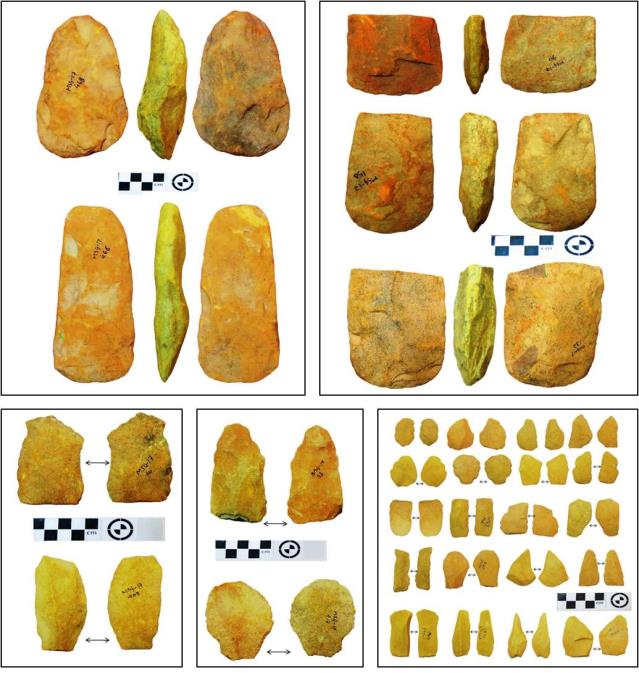
Source: authors
From top left: (a) Chipped axes, (b) Short axes, (c) Blade tools, (d) Scrapers, and (e) Microliths
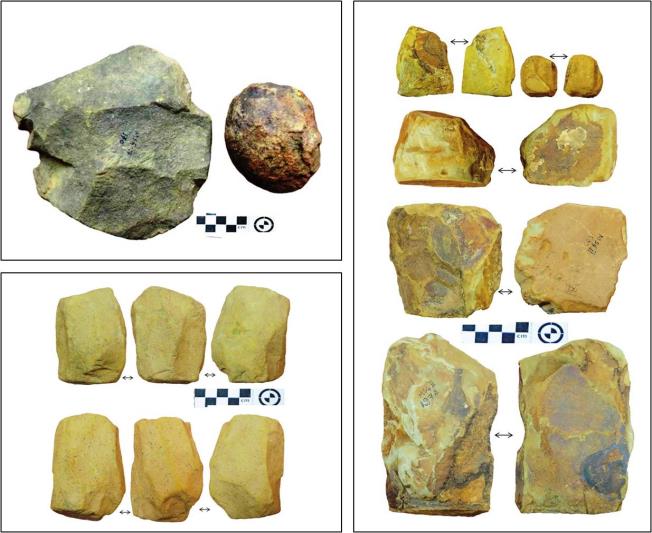
Source: authors
From top left: (a) Multi-platform core and hammerstone, (b) Different sizes of blanks, (c) Cylindrical cores
Conclusion
Undoubtedly, prehistoric people of present day Misimagre were tool knappers – who gave shape to a variety of artifacts and possibly traded it out elsewhere. It is likely that due to the same raw material (dolerite) being used to make tools in other places of Garo Hills–which is a rather difficult material to quarry–it is possible that the knapper in Misimagre either sent his/her products to far- off places, or belonged to the same cultural group using the same raw material. This statement finds support from the fact that other raw materials like quartz and sandstone are found plenty in the village, but were not used by Misimagre people. The dense concentration in MSG-IX of 10.45 specimens in a space of 1cm3 is too dense for a part-time activity–possibly pointing towards a large scale production, or a place where they were passing on the tradition. The latter statement appears to be supported by the presence of six possible factory sites, making us conclude that the knappers of Misimagre were possibly passing on the technology and art within the family/clan/band.
From the kinds of tools that they were making in MSG- IX, it appears that they were focussing on cutting implements-like axes, blades, and scrapers-rather than on piercing implements like points and arrowheads. This suggests an interesting socio-economic situation in the past. The presence of cutting tools indicates that they were used for domestic reasons like cutting up meat, vegetables, trees etc. However, the absence of points (or any projectile weapons) does not in any way indicate that the people did not hunt or fish. They might have hunted less than in other regions, but it could also indicate that they might have used other materials like bamboo for the purpose. When we look at the present day occupants of the village, we realise that the prehistoric people might also have used a variety of traps for the purpose (like the present day Garos).
Placing the Misimagre finds into a particular time- frame is difficult, but from the kind of artifacts found (stone tools and pottery), it is likely that they were a people who lived years ago possibly at the early stages of the Neolithic period. But if they did live in the Neolithic period, then they were a people who were culturally disinclined to use Neolithic tools and technology (ground and polished) and preferred to use non-Neolithic or proto-Neolithic tools and technology; or were yet to discover grinding and polishing technology.
References
-
Sharma TC (1974) Recent archaeological discoveries in Northeastern India, Puratattva 7: 1-20.
-
Sharma TC (1985) Problems of the Upper Palaeolithic in Northeast India’. In: Misra VN, Bellwood P, (Eds.), Recent Advances in Indo-Pacific Prehistory, oxford and IBH Publishing Co, New Delhi, pp: 171-173.
-
Sharma HC (1975) Archaeological Findings in Meghalaya’. Bulletin of the Department of Anthropology, Gauhati University, pp: 20-25.
-
Sharma HC (2003) Prehistoric Archaeology of North- East’. In: Subba TB, Ghosh GC, (Eds.), The Anthropology of North-east India, New Delhi, Orient Longman, India, pp: 11-30.
-
Sharma HC, SK Roy (1985) On the discovery of a pebble-tool industry in the Garo Hills, Meghalaya. In: Misra VN, Bellwood P, (Eds.), Recent Advances in Indo-Pacific Prehistory, Oxford and IBH Publishing Co, New Delhi.
-
Sonowal M (1987) Studies on the Flake and Blade Industries of the Garo Hills, Meghalaya. PhD Thesis, Gauhati University.
-
Ghosh AK (1978) What happens when Cultural and Biological Adaptability of Man fails? A case study with the Palaeolithic Period in the Garo Hills. In: Kar RK, (Ed.), Cultural and Biological Adaptability of Man with special reference to North-east. Department of Anthropology, Dibrugarh University, India.
-
Medhi DK (1988) Palaeolithic remains from the Garo Hills, Meghalaya. In: Chatterjee B, (Ed.), History and Archaeology, Ramanand, Vidya Bhavan, Delhi, pp: 346-350.
-
Medhi DK (1990) Prehistory of Assam. Asian Perspective 29(1): 37-44.
-
Ashraf AA (2010) Stone Age Traditions of Meghalaya: A study of variation and continuity. South Asian Archaeology Series 12. BAR International Series, pp: 2176.
-
Ashraf AA (2006) Autochthons of Meghalaya in Anthropo-Archaeological Perspectives. Humankind 2: 31-36.
-
Sharma S (2007) Celts, flakes and bifaces the Garo Hills story. Archaeopress, Oxford.
-
Mark Q, Bhuyan G, Meitei AM, Sangma TD (2017) Misimagre: A prehistoric factory site from Garo Hills. RIP, New Delhi.
-
Marak Q (2013) Prehistoric Migrations and India’s North-East: The Garo and Khasi Hills Dilemma. Journal of Asiatic Society, LV 3(4): 71-94.
-
(1969-1970) Indian Archaeology: A Review.
-
(1975-1976) Indian Archaeology: A Review.
-
(1978-1979)Indian Archaeology: A Review.
-
Marak Q (2014) Food Politics: Studying Food, Identity and Differences among the Garos. Cambridge Scholars Publishing, UK.
- The Indispensable Role of Informal Caregivers in Supporting the Aging Population
- Socio-Religious Significance of Kamakhya Temple in Guwahati, Assam
- Is Anthropology Possible?
- A Contribution to the History and Paleobiology of Harput/Elazığ Türkiye and Its Surroundings
- A Study on the Cowrie Shells of the Dimasas in Assam
- The Significance of International Organizations Cooperation in the Efficient Resolution of Global Conflict