
Indigenous Knowledge System and Traditional Medicinal Practitioner
Knowledge is widely recognized as the key resource for development. The basic component of any country’s knowledge system is its Indigenous Knowledge (IK). Over millennia, indigenous peoples have developed and sustained extremely practical systems of knowledge and behavior. Indigenous knowledge is not just confined to indigenous peoples, but all communities have developed their own body of knowledge over generations. The Tagin tribe is an indigenous group of people living at upper Subansiri district of Arunachal Pradesh. A study on practice of Traditional Medicine (TM) was carried out among these people based on the secondary literature collected from different libraries tribal research centers of India. The result documented 10 medicinal plants used by the Traditional Medicinal Practitioner (TMS) of Tagin tribe for use in traditional medicine. Fresh leaves, fruits, bark and stems are reported be used in TM for treatment of ailments like diarrhoea, jaundice, wound healing, fever, etc.
Introduction
Over the ages, indigenous peoples have developed innumerable technologies and arts. They have devised ways to farm deserts without irrigation and produce abundance from the rain forest without destroying the delicate balance that maintains the ecosystem: they have learned how to navigate vast distances in the Pacific using their knowledge of currents and the feel of intermittent waves that bounce off distant islands: they have explored the medicinal properties of plants: and they have acquired an understanding of the basic ecology of flora and fauna. If this knowledge had to be duplicated from scratch, it would beggar the scientific resources of the West. Much of this expertise and wisdom has already disappeared, and if neglected, most of the remainder could be gone within the next generation.
Knowledge is widely recognized as the key resource for development. The basic component of any country’s knowledge system is its Indigenous Knowledge (IK). IK is also referred as traditional or local knowledge and encompasses the skills, experiences and insights of people, applied to maintain or improve their livelihood. Indigenous peoples consists of some 5000 diverse and distinct groups, represent about 4 percent of world’s population, about one third of world’s 900 million extremely poor rural people, and live in more than 70 countries and 70 per cent of them live in Asia [1].
Anthropology and Ethnology Open Access Journal
Over millennia, indigenous peoples have developed and sustained extremely practical systems of knowledge and behavior. For a host of political and historical reasons, indigenous peoples tend to suffer from neglect and discrimination: many do not have legal right to live on the lands they depend on for survival, or use the resources they have managed sustainably for thousands of years; pushed onto least fertile and most fragile lands, harsh environments, they find it difficult to grow enough food to eat; earn a living; receive education; receive medical care; living far from centers of commerce and power; find it hard to influence the policies, laws and institutions that would improve their circumstances and shape their futures. Any effort to eradicate poverty must address the special needs of these minority ethnic groups [2].
Interestingly, there is no standard definition of indigenous knowledge. However, there is a general understanding of what it means. Some people define indigenous knowledge as the local knowledge that is unique to a given culture or society. Some have defined it simply as "local knowledge", while others have expressed it as "folk knowledge", "information base for a society", "traditional wisdom" or, when it applies to the physical environment, as "traditional ecological knowledge".
Regardless of the definition, there is a consensus that various communities, cultures and societies have indigenous knowledge systems. We can define it as the "knowledge acquired over generations by communities as they interact with their environment". It mainly refers to a system of understanding one's environment in the broadest sense.
Indigenous knowledge is the basis for local-level decision making in agriculture, health care, food preparation, education, natural resource management, and a host of other activities in communities.
Primarily traditional knowledge differs from modern knowledge in the manner of creation i.e. traditional knowledge is normally empirically validated therefore it is said that Modern Knowledge has been validated in laboratory of brick and mortar whereas traditional knowledge has been validated in the laboratory of life.
Types of Indigenous Knowledge
Indigenous knowledge is more than just technologies and practices. It can be grouped as follows:
- Information (trees and plants that grow well together; indicator plants-plants that show soil salinity or known as flower at the beginning of rains)
- Practices and technologies (seed treatment and storage methods; bone-setting methods; disease treatments)
- Beliefs play a fundamental role in people's livelihood and in maintaining their health and environment (holy forests are protected for religious reasons and maintain a vital watershed; religious festivals can be an important source of food for people who otherwise have little to eat)
- Tools (equipment for planting and harvesting; cooking pots and implements)
- Materials (house construction materials; materials for basketry and other craft industries)
- Experimentation (farmers' integration of new tree species into existing farming systems; healers' tests of new plant medicines)
- Biological resources (animal breeds, local crop and tree species)
- Human resources (specialists such as healers and blacksmiths; local organizations such as kinship group, councils of elders, or groups that share and exchange labour)
- Education (traditional instruction methods; apprenticeships; learning through observation)
- Communication (stories and messages carved on palm leaves; folk media).
Special Features of Indigenous Knowledge
Some of the features relevant to Indigenous Traditional Knowledge are:
- Locally appropriate and specifically adapted as per the requirement of local conditions.
- Restraint in resources exploitation needed for immediate survival.
- Having diversified production system without overexploitation of a single resource.
- Symbolizes the respect towards nature.
- Flexible for new interventions and integration of green technological advances.
- Inspires the social responsibilities.
Area and People
Arunachal Pradesh is one of the North eastern provinces of India bordering Tibet, Bhutan, China and Myanmar. It is situated on the Great Eastern Himalayan Mountain range and recognized as one of the Mega Biodiversity hot spots of the world [3]. More than 25 different group of tribal population are living in this hill state from time immemorial. Each of the tribes has a unique tradition of culture and lifestyle occupying different geographical regions [4].
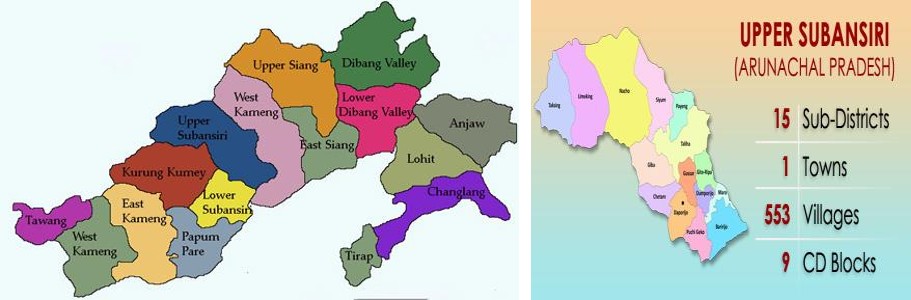
Tagin is one of such indigenous group of people inhabited in the bank of Subansiri river of Arunachal Pradesh. Tagin, which refers to as a member of larger designation of Tani tribes are concentrated in Daparijo of upper Subansiri district and also found sparsely distributed in adjoining West Siang district of Arunachal Pradesh. The Upper Subansiri district provides shelters to some other tribes like Hill Miri and Gallo. The district lies in the central part of the state in between 28.5 degree and 28.25 degree latitudeand 93.15º and 94.20º longitudes covering a geographical area of 7,032 Sq km. The area consists of chains of rugged hills and mountains, the altitude of which varies from 1,524-2,835 m. The high mountain region of the northern boundary of the district is extremely cold and large tracts remain covered with snows almost throughout the year. The plain areas in foothills are intersected by innumerable fast flowing rivers and water courses and covered by dense forests. Dense forest area of the district harnesses the rich bio resource of both flora and fauna.
The Tagin people are of Mongoloid origin, who
Area and People
District upper Subansiri
migrated from Tibet in different times and settled in their present home land of Subansiri valley [5, 6]. As early as 1971, about 20,000 claimed to be of Tagin ethnicity [7]. People living in this area lead a rural life and dependent mostly on the forest resources available in their surroundings.
The Tagin tribe of Arunachal Pradesh has been practicing the use of medicinal plants available in local forests for curing common illness. Utilization of this traditional knowledge of medicinal plants is not only useful for conservation of cultural traditions and biodiversity but also for community healthcare and drug development [8]. Therefore, documentation of this traditional knowledge is inevitable to throw light into the field of herbal research and to improve socioeconomic development of the people. The work is based secondary resources available related to the indigenous knowledge on medicinal plants and methods of treatment against common ailments prevails among the Tagin tribe of Arunachal Pradesh. Figure 1.
Arunachal Pradesh, India
Material and Method
The present study was based on the secondary literature on Tagin tribe collected from different libraries tribal research centers of India. In this review work researcher collect information on the traditional medicinal plant and practice, especially Ethnomedicinal information. Important given even on information on Traditional Medicine (TM) preparation, application and associated social belief prevailed among the Tagin Traditional Medicine Practitioners
Results and Discussion
The Tagin ethnicity comprises of 39,000 individuals scattered in different pockets of upper Subansiri and adjacent districts [9]. The study among the Tagin people revealed practice of an age old tradition of herbal medicine for cure and prevention of diseases/ ailments. A total of 10 medicinal plants used for TM preparation were recorded amongst the Tagin people. All the medicinal plants recorded are used in human healthcare as well as for animal disease.
Freshly collected leaves are the major components of their TM preparation. While some of this indigenous preparation is used for topical application for wound healing, burn injuries, skin diseases etc, others are used for oral administration for health problems like stomach disorder, diarrhea, joints pain, blood clotting, fever, tonsillitis, blood pressures, gastritis and jaundice (Table 1). Tagin peoples of Arunachal Pradesh still conserved their indigenous knowledge on traditional medicine and its practice.
| Plant Name | Local Name | Part Used | Uses | ||||||||
|---|---|---|---|---|---|---|---|---|---|---|---|
| Ageratum conizoid L. | Eh gaar | Fresh leaves | Wounds healing, Blood clotting | ||||||||
| Bryophyllum calycinum Salisb | Eh yadap | Fresh leaves | Jaundice Gastritis | ||||||||
| Clerodendrum serratum (L) Moonb | Tapin | Fresh tender leaves | Blood pressure | ||||||||
| Embelia ribes Burm. (f) | Onior | Fresh, fruits | Diarrhoea | ||||||||
| Ficus hispida (Blanco) | Cheyum | Sap of stem | Burn injury | ||||||||
| Gynocardia odorata (R. Br.) | Tiku | Leaves | Tooth decay | ||||||||
| Pederia foetida L | Uppe tire | Leaves | Gastritis | ||||||||
| Piper longum L. | Satu rikki | Leaves, stem | Joints pain, arthritis | ||||||||
| Piper nigrum L. | Rari | leaves, fruits. | Fever, tonsillitis | ||||||||
| Tinospora cordifalia (Miers) eae | Sayen kiji | Leaves | Scabies/others kin disease |
Table 1: List of plants used by Tagin tribe for preparation of Traditional Medicine.
The different parts of these plants are used as a medicine. The use of above ground plant parts is higher than the below ground plant parts. Of the above ground plant parts, leaf is used in the majority of the cases followed by roots, fruit, Stem, seed, rhizome, bark, flower, berries, shoots and branches, buds, dried leaves, dried plants, flower buds, flower pulp, pods, tubers, young seedlings, young shoots less than 1% respectively and about 16% from whole plant (Table 2).
| S | cientific Name o | f | L | ocal Name o | f | ||||||
|---|---|---|---|---|---|---|---|---|---|---|---|
| Ethno-Medicinal Uses | P | lant Parts Use | d | ||||||||
| the Plant | Plant | ||||||||||
| Ageratum conyzoides | Pashpaya | Wound healing, antihelmintic | Leaf, stem | ||||||||
| Alstonia scholaris | Tayesangne | Treatment of ulcer, swelling, latex is given during abdominal pain after delivery | Leaves, root, bark, latex | ||||||||
| Artemesia nilagirica | Tipintarin | In headache and stomach pain, used as vegetable, to get relief from asthma | Leaves | ||||||||
| Cassia alata | Kra-pat | Leaf juice is applied in eczema and itching | Leaves and roots | ||||||||
| Centella asiatica | Barang | Fresh plant juice with honey is given in stomach ulcer, leprosy | Whole plant | ||||||||
| Clerodendron glandulosum | Pattoi | For treatment of high blood pressure and bowel troubles, obesity | Fruits and leaves | ||||||||
| Colocasia esculenta | Yaksar | Fever and cough,petiole juice is used as styptic and stimulant | Leaves, stem and rhizome | ||||||||
| Curcurma longa | Longobom | Used in bone fracture, anti tumour, in cardiovascular disease, anti bacterial | Leave, rhizome |
Table 2: Some of Important Plants used by the Indigenous people in the traditional healthcare Practices in Arunachal Pradesh, Ind
| Dillenia indica | Ahutenga | Fruit decoction is applied to scalp for curing dandruff wound healing bone fracture, anti diarrhoea | Fruit pulp and leaves |
|---|---|---|---|
| Moringaoleife ra | Sajana | In liver disorder, water purification etc | Pods, leaves |
| Musa sapientum | Nyorokopa | Boiled unripe fruits are given during dysentery, diabetes, in anaemia | Fruits and leaves |
| Piper bete | Ritikrhinik | Leaf after rubbing with mustard oil and warming over burning charcoal is applied to belly during stomach ache of children | Leaf |
| Solanum khasianum | Thitbya-ke | Root decoction is used to treat malaria,antifertilitypropert y,anti- inflammator | Seeds, berries and roots |
| Spilanthus acmella | Mershang | Antimalarial, antipyretic, analgesic, flowers are chewed during toothache | Flower bud, stem, roots, leaves |
| Swertia chirayita | Chirata | Plant decoction is taken in fever, anti- hepatitis B | Whole plant |
| Terminalia myriocarpa | Hilika | Bark extract is given in chest pain and as cardiac stumulant | Fruit, leaves, bark |
| Zanthoxylum armatum | Honyur | Seed and bark are used as tonic during fever and cholera, stomach disorde | Fruit, seed, bark |
| Zingiber officinale | Kekir | Stomach pain, carminative, stimulant, rhizome juice mixed with honey is used for cough | Rhizome |
| Tacca integrifolia | Tagoon | skin disease, leprosy, wound healing, stomach pain,dysentry | Rhizomes, tubers |
| Solanum nigrum | Byako | Vomiting, diarrhoea,also used to cure tuberculosis,reduce mild abdominal pain | Berries, leaves, shoots |
| Erigeron bonariensis | Daglentao | Vapour of leaves is inhaled in sinus problem | Leaves |
| Chromolaena odoratu | Telimbabo | Wound healing, skin diseases, diuretic, analgesic, anti-microbial, relieve pain | Roots and leave |
| Artemisia indica | Laglin | For skin allergy,believe to be effective in breast cancer | Leaves, young seedling |
| Cyclosorus parasiticus | Rukdik | Gout and rheumatism , anthihelmintic, antifungal and antibacteria | Leaves, rhizome |
| Piper longum | Saturikki | Treat joints pain, gout, paralysis, improve immune and digestive system, arthritis | Leaves, stem |
| Gerbera piloselloide | Pangnesir | Treat cold, fever, acute conjunctivitis, rheumatic pain | Leaves and rhizomes |
| Oxyspora paniculata | Porkijale | Treatment of various liver disorder, stomachic, antidote against snake poisioning | Leave, whole plant |
| Perilla ocymoide | Namdung | Locally used as spices or as a curry, in treatment of asthma, also used for nausea, sunstroke, reduce muscle spasms | Seeds, leaves |
| Plantago erosa | Donihanakang | Constipation, improvesdigestion, astringent, demulcent, diuretic, expectorant, antiinflammatory | Seeds, leaves |
| Rubia manjith Roxb. | Tamin | Used to cure headache, cough, cold, locally used as a textile dye | Roots, fruits and leaves |
| Ricinus communis | Miggim | Orthopaedic, intestinal worms, in piles, glandular tumours | Whole plant |
| Scoparia dulcis | Mithipatti | Jaundice, diabetes, anti - oxidant, diuretic, analgesic, antiinflammatory | Roots, leaves, all parts |
| Embelia ribes | Onior | Anti-diarrhoea, also used against intestinal worm infection | Leaves and fruits |
| Clerodendrum serratum | Bortapipik | Diabetes, obesity, hypertension, locally it is also used as a vegetable | Whole plants |
| Gynocardia odorata | Teeksin | In treatment of leprosy, toothache, lupus, scrofula and many skin diseases | Seeds and fruit |
| Hedychium coccineum | Uii-telli | Cure asthma and indigestion, anti microbial, also used for local ornamental purposes | Whole plant |
| Laggera pterodonta | Dindo eh h | Antihelmintic, treatment in inflammation and swelling | Whole plant |
| Phrynium capitatum | Ekkam | Anti-diabetic, analgesic, antih-yperglycemic, locally used as wrapping and packaging materials | Leaves |
| Alnus nepalensi | Taram sin | Disinfectant, diuretic, reduce swelling, prevent excessive sweating, also used for carpentry | Branches , bark, leaves |
| Aconitum ferox | Omli | Underground roots and tubers are used in arrow poisoning by local hunters | Roots and tubers |
| Arisaema consanguineum | Biram sing | Locally used for arrow poisoning for hunting | Rhizome |
| Alpinia nigra | Bugbii-talli | Analgesic, appetizer, antifungal, jaundice, gastric ulcer, diuretic, expectorant, antiinflamma- tory, flavouring agent, leaves are used in beer preparation | Rhizome, fruits and leaves |
| Baliospermum calycinum | Gilagal | Purgative, stimulant, antidote in snake bite, asthma,jaundice, gastric problem, gout and rheumatism, toothache | Whole plant |
| Asplenium phyllitidis | Patalak | Anti-oxidant, anti – microbial, locally used for decoration in local festival | Leaves, aerial parts of plant |
| Bambusa tulde | Eng | Bamboo shoot are consumed as integral part of diet, | Stem, shoots |
| Bauhinia variegata | Pacham | Asthma, ulcer, digestive problem, anti oxidant, locally also used as spies | Flowers, leaves, root and buds |
| Callicarpa arborea | Tato, yahorin | Insect repellant, skin diseases, scorpion sting, also used in toothache | Branch, bark and leaves |
| Carica papaya | Omiir | Anti-malarial, treatment of cuts, rashes, burns, stings, digestive problem, improve hearing capacity and improve lactation. | Whole plant |
| Chenopodium album | Taye | Locally used in preparing local wine and also eat as a vegetable | Leaves, seed, young shoots |
| Chromolaena odoratum | Telimbabo | Wound healing, relieve pain, anti-gonorrhoeal, diuretic,skin disease | Leaf and root |
| Citrus medica | Jipin | Treatment of scurvy, intestinal ailments, antidote, anti cancer, weak eyesight, vomiting , skin diseases, haemorrhoids | Leaves and fruit |
| Crassocephalum crepidioides | Hogegain | Anti malarial, analgesic, epileptic, wound bleeding, headache | Whole plant |
| Drymaria diandra | Kadokairo | Anti-HIV ,anti-tumours, malnutrition in infants, anti-malarial, edema, rheumatism | Whole plant |
| Debregeasia longifolia | Jirepole | Anti-tumours, rheumatism , juice is applied to the areas of the skin affected by scabies | Fruits, leaves |
| Elensine coracana | Tami | Cough, cold, congestion, antimicrobial, antiinflammatory, food preservative | Whole plant |
| Eryngium foetidum | Hariyo | Anti-epileptic, headache, scorpion sting, antidiabetic, anti- bacterial, analgesic, fever, arthritis | Leaves, seed |
| Fagopyrum esculantum | Amintatek | To control high blood pressure, anti-diabetic, pain relief, anti- oxidant | Whole plant |
Table 3: Some of Important Plants used by the Indigenous people in the traditional healthcare Practices in Arunachal Pradesh, Ind
The method of preparation was mostly a paste or juice form followed by decoction and raw and vegetable, or sometime eaten raw. Doses were mainly taken twice a day and the dosage depends on the age and physical appearance of the individual and children’s are given less than adults which approximate to 100-150 ml twice daily depending on the type of illness and treatment [10].
The present review study showed high diversity of plant used by the ethnic communities of Arunachal Pradesh in treating different types of ailments. This can be an indication of the significant role of phytotherapy based traditional medicine in meeting the basic healthcare needs of the people. The frequent use of herbaceous species among the tribal communities could be a result of their relative abundance as compared to trees and shrubs as also witnessed by investigators of this study. The study area experiences tropical, sub-tropical and temperate humidity for most months of the year creating favorable condition for the growth of herbs.
Due to lack of adequate communication, remoteness of the villages and unavailability of modern health care facilities the local people use traditional medicine for their common ailments. This traditional knowledge system among the tribes is a complete system of theory and practice that have been evolved through ages of human experiences and independent of conventional biomedicine. Similar to the Tagin tribe, practice of herbal medicine among other tribes Arunachal Pradesh like Apatani, Adi, Monpas, etc. have been reported [11, 12, 13, 14].
The Convention of Biological Diversity (CBD) has put much emphasis on conservation of this indigenous knowledge invariably in different parts of the world [15, 16]. India has a great history of ancient medical systems such as Ayurveda and other similar repositories of knowledge, which represent valuable resource of medicinal plants [17]. The study shall help the indigenous Tagin people of Arunachal Pradesh in getting necessary attention from the world communities for conservation of these TM. Practice of herbal medicine for curing various ailments has been reported from other countries of the world.
Several such medicinal plant species has been reported to use for fertility control by the people of Trinidad and Tobago and Vietnam for treatment of ailments like influenza, cough, malaria, dysentery, and helminthes parasites [18, 19]. Some of the plants used by Tagin people for TM preparation are also used by some other tribal population of Northeastern states as well as some other parts of India. The use of Paedaria foetida L. for stomach disorder by the Tagin people is also reported from the Apatani tribe of Arunachal Pradesh [20]. The leaves of Ageratum conizoid L. and Bryophyllum calycinum Salisb are used by the Jaintia tribes of north Cachar hills district of Assam for burn injury and wounds [21]. The medicinal value of Piper nigrum (L) was reported from the Madurai district of Tamil Nadu [22].
Similarly, the Tinospora cordifolia used for curing scabies by the Tagin tribe of Arunachal Pradesh is used for treating wound healing in Kancheepuram district of Tamil Nadu [23]. The linkage of use of similar plants by different group of people across India remains to be investigated. Whatever may be the reason, the information suggests that the epistemology of the TM used by these tribal people needs to be reviewed by the epistemology of scientific knowledge. Use of Embelia ribes Burm by the Tagin people for stomach disorder has gained importance in research and development for curing skin diseases and leprosy [24]. Availability of a large number of medicinal plants made Arunachal Pradesh one of the global biodiversity hot spot. The documentation on the traditional medicine of the Tagin tribe of Arunachal Pradesh illustrates the wide range of application of the traditional knowledge of medicinal plants for wellbeing of the human society.
Many people of this region still depend upon herbal medicine for the treatment of some common diseases. Thorough biochemical investigation along with clinical trials of these locally available herbal TM may provide new leads for human health care system. In addition, it will pave the way in creating the mass awareness regarding the need for conservation and economic empowerment of the local tribal people and also the efficacy and safety of all the claimed medicinal plants need to be evaluated through pharmaco-chemical studies.
Suggestions
The suggested measures to extend protection to knowledge, innovations and practices in India are documentation of Indigenous knowledge, registration and innovation patent system, and development of a sui generis system
Acknowledgement
Author is grateful to all the researcher who worked on Traditional or Indigenous people or whose information was used in the article. The author also likes to express our deepest appreciation to Prof. A.K. Kapoor and Prof. Satwanti Kapoor for their help in the study. An author is also thankful to the other traditional health expert and librarian of different university and tribal research centers for giving me proper facility to collect appropriate information in order to give final shape to the present work.
References
-
Emery AR (2000) Integrating indigenous knowledge in project planning and implementation. International Labour Organization, World Bank. The Canadian International Development Agency and KIVU Nature Inc, pp: 1-164.
-
IFAD (2004) Fact sheet on indigenous peoples.
-
Myers N, Mittermeier RA, Mittermeier CG, Fonseca GAB da, Kent J, et al. (2001) Biodiversity hotspots for conservation priorities. Nature 403: 853-858.
-
Solanki GS (2000) Socio-cultural and faunal diversity of Arunachal Pradesh. Him J Env Zool 15(4): 251-254.
-
Roy S (1966) Aspects of Padam-Minyong culture. Itanagar.
-
Mitkong N, Chapter I (2006) Customary laws of the Tagins: Arunachal Pradesh. Himalayan Publishers.
-
George van Driem (2001) Languages of the Himalayas: An Ethnolinguistic Handbook of the Greater Himalayan Region, containing an Introduction to the Symbiotic Theory of Language 2: 489.
-
Pei SJ (2001) Ethnobotanical approaches of traditional medicine studies: some experiences from Asia. Pharmacol Biol 39(1): 74-79.
-
Goswami P, Dudam S, Anju J, Moushumi D, Hirendra NS, et al. (2009) Traditional healthcare practices among the Tagin tribe of Arunachal Pradesh. Indian Journal of Traditional Knowledge 8(1): 127-130.
-
Perme N, Swarnali NC, Ratna C, Taking N, Biplab D, et al. (2015) Medicinal Plants in Traditional use at Arunachal Pradesh India. International Journal of Phytopharmacy 5(5): 86-98.
-
Kala CP (2005) Ethnomedicinal botany of the Apatani in the Eastern Himalayan region of India. J Ethnobiol Ethnomed 1(11): 1-8.
-
Gangwar AK, Ramakrishnan PS (1990) Ethnobotanical notes of some tribes of Arunachal Pradesh, Northeast India. Econ Bot 44(1): 94-105.
-
Dam DP, Hajra PK (1981) Observations on Ethnobotany of Monpas of Kameng district, Arunachal Pradesh. In: Jain SK, (Ed.), Glimpses of Indian Ethnobotany, Oxford IBH, New Delhi, pp: 107- 144.
-
Nath SC, Bordoloi DN (1989) Ethnobotanical observation on some medicinal folklore of Tirap district, Arunachal Pradesh. J Econ Tax Bot 13: 321- 325.
-
World Health Organization (1999) Regional consultation on development of Traditional medicine in South-East Asia Region. WHO Regional Office for South-East Asia, New Delhi, pp: 1-43.
-
UNCTAD (2000) Expert meeting Anonymous, Note by the Executive secretary, Secretariat of the Convention on Biological Diversity, UNCTAD Expert meeting on Systems and National experience for protecting traditional knowledge, Innovations and practices of Indigenous and local communities. Geneva, pp: 1-27.
-
Dev S (1999) Ancient-Modern Concordance in Ayurvedic Plant: some examples. Environ Hlth Persp 107(10): 783-789.
-
Lans C (2007) Ethnomedicines used in Trinidad and Tobago for reproductive problems. J Ethnobiol Ethnomed 3: 13.
-
Reddy YY (2005) A glimpse of Vietnam’s forest wealth and medicinal plants-based traditional medicine. J Hum Ecol 17(4): 293-299.
-
Kala CP (2005) Ethnomedicinal botany of the Apatani in the Eastern Himalayan region of India. J Ethnobiol Ethnomed 1: 11.
-
Sajem AL, Gosai K (2006) Traditional use of medicinal plants by the Jaintia tribes in North Cachar Hills district of Assam, Northeast India. J Ethnobiol Ethnomed 2: 33.
-
Ignacimuthu S, Ayyanar M, Sivaraman KS (2006) Ethnobotanical investigations among tribes in Madurai district of Tamil Nadu (India). J Ethnobiol Ethnomed 2: 25.
-
Muthu C, Ayyanar M, Raja N, Igniacimuthu S (2006) Medicinal plants used by traditional healers in Kancheepuram district of Tamil Nadu, India. J Ethnobiol Ethnomed 2: 43.
-
Kala CP, Dhyni PP, Sajwan BS (2006) Developing the medicinal plants sector in northern India. J Ethnobiol Ethnomed 2: 32.
- The Indispensable Role of Informal Caregivers in Supporting the Aging Population
- Socio-Religious Significance of Kamakhya Temple in Guwahati, Assam
- Is Anthropology Possible?
- A Contribution to the History and Paleobiology of Harput/Elazığ Türkiye and Its Surroundings
- A Study on the Cowrie Shells of the Dimasas in Assam
- The Significance of International Organizations Cooperation in the Efficient Resolution of Global Conflict