
Assessing the Impacts and Challenges of Deployed Community Development Workers: The Case of Bishoftu Community Development Workers Training College Graduates
Community development is about placing individuals at the centre of the development process and helping them realize their potential. Community Development Workers (CDWs) are community-based resource persons who collaborate with other community activists to help fellow community members. The objective of this study is to assess factors that challenge the roles of CDWs. The study used both quantitative and qualitative study designs. Data were gathered through questionnaires, in-depth interviews and personal observation. The collected data was analyzed using mixed method of analysis of both quantitative and qualitative data. The study revealed that CDWs have proved to be key and important local actors and facilitators in bringing about attitudinal change among the communities they work with, are attracting the trust and confidence of the people they work with, have revitalized local social organizations as instruments of development, have tabled the agendas of the socially marginalized community groups, working on the principle of matching community inputs with resources, and their role approved to be well aligned with Development Policy as it fosters ‘community participation, promotes self-reliance, and is strategically fasten at the grass roots level. The study concludes that CDWs are facing challenges in contextualizing their role and institutional factors are discovered to be impeding the roles of CDWs. The study recommends a multi-disciplinary research involving educationalists, and social anthropologists could perhaps develop a more thorough of investigation and be more conclusive on the factors that influence CDWs performance initiated by this research.
Introduction
The concern of community development has indeed been characterized by a diversity of approaches, paradigms, and programs over the past several decades [1, 2]. Some of the key trends and actors in this field include: The rise of participatory and bottom-up approaches: Starting in the 1970s, there was a shift away from top-down, expert-driven development models towards more participatory approaches that emphasized the active involvement of local communities in identifying and addressing their own need [3, 4].
The focus on capacity-building and empowerment: Community development initiatives increasingly emphasized the importance of building the capacities and agency of local communities, rather than simply delivering services or resources [5, 6]. The role of Community Development Workers (CDWs): The Community Development Workers program, as discussed by Burkey [5], has been an important strategy for fostering development in many developing countries. CDWs often act as intermediaries between communities and external development actors, facilitating the identification of local needs and the implementation of community-led initiatives.
The evolution of development paradigms: Over time, the predominant development paradigms have shifted from modernization theory, to dependency theory, to more holistic and sustainable models of development, such as the human development approach [7]. These trends and actors have had significant policy and action implications for future development interventions, particularly in terms of: Emphasizing the importance of local participation and ownership in development processes [3, 4], Recognizing the need for capacity-building and empowerment of marginalized communities [5, 6], Valuing the role of intermediaries, such as CDWs, in facilitating community engagement and development [5]. Adopting more holistic and sustainable development approaches that focus on human well-being and environmental considerations [7].
Since the early 1990s, Ethiopia has undergone a significant shift in its development policy approach, moving towards a greater emphasis on macroeconomic growth, employment, and redistribution. This shift is reflected in the implementation of the Macro-Economic Growth, Employment and Redistribution (GEAR) policy framework [8].
The GEAR policy specifically targets economic growth and job creation as key priorities [8, 9]. This has led to a greater emphasis on fiscal discipline and more rigorous cost recovery measures in the provision of social services and economic infrastructure, in an effort to ensure financial sustainability [8, 10].
However, the GEAR strategy has also called for a strengthening of redistributive efforts and improved service delivery [11, 12]. This has included reprioritizing spending to historically disadvantaged communities and focusing welfare spending on assistance to the poor and marginalized social groups [11, 13]. The rationale behind this approach is to strike a balance between promoting macroeconomic growth and ensuring that the benefits of such growth are equitably distributed across the population [8, 12]. This is seen as a critical component of Ethiopia’s overall development strategy, aimed at reducing poverty and improving the living standards of its citizens [9, 14].
The shift towards the GEAR policy framework in Ethiopia has involved a complex interplay between macroeconomic objectives, fiscal discipline, and targeted efforts to address socioeconomic inequalities and improve service delivery to the most vulnerable communities [10, 13].
The success of any development process is intrinsically linked to the social, economic, and political environment within which it operates [15]. In the case of Ethiopia’s Community Development Work (CDW) program, this contextual environment has played a crucial role in shaping its evolution and impact. The CDW program was first introduced in Ethiopia in 1962 during the reign of Emperor Haile Selassie I, with the establishment of short-term training centers and even a diploma-level program at Hawassa [16]. However, the program was later terminated with the advent of the Dergue regime. It was not until the mid-1990s, under the Developmental Social Welfare Policy (DSWP), that the CDW program was relaunched in Bishoftu Town by the Oromia Labor and Social Affairs Bureau [16].
The revived CDW program has been managed by the Oromia Labor and Social Affairs Agency (OLSAA), now the executive Department of Labor and Social Affairs, which is legally mandated to promote the social welfare and development of vulnerable community members [16, 17]. One of the key strengths of the CDW program has been its adoption of participatory approaches, which empower “social facilitators” to listen to the problems and aspirations of communities and build on their existing capacities [18]. This approach aligns with the Ethiopian government’s policy of decentralized service delivery and local government accountability, which offers a favorable environment for the CDW program [16].
However, studies have also identified challenges and gaps in the integration of national and regional social development and welfare programs with the day-to-day work of the CDWs [16]. Additionally, while the training materials and objectives of the DSWP are generally consistent, the overall impact of the graduated CDWs has not been studied in detail [17].
The rationale for conducting an impact analysis of the CDW program is to assess its contributions and challenges in meeting the needs of the right-holders through the implementation of social protection policy (Firdissa, 2003) [17]. This analysis will help identify the factors that nurture or hinder the development of the CDW program, and inform actions to remove or mitigate these constraints [15].
Study Design and Methodology
Study Design
The study design for this research is a combination of descriptive and explanatory approaches. The descriptive aspect focuses on examining the impact of Community Development Workers (CDWs) on the lives of the community, particularly vulnerable groups. The explanatory component seeks to identify the variables that affect the performance and contributions of the CDWs.
Regarding the research approach, the study employs a mixed method, utilizing both qualitative and quantitative techniques. This mixed approach allows the research to leverage the complementary strengths of qualitative data in generating breadth and depth, and quantitative data in providing independent numerical evidence to statistically understand the social phenomenon.
Data Collection Tools
This mixed-methods approach allowed the study to collect both qualitative and quantitative data, providing a more comprehensive understanding of the impact and challenges facing the CSWs. Accordingly, simple observation were conducted to collect information about the services provided by the Community Service Workers (CSWs). A questionnaire with both closed-ended and open-ended questions was used to gather relevant data, primarily from the CSWs. In-depth, semi-structured interviews were conducted with various stakeholders, including sector heads, team leaders, representatives from women’s, youth, and children’s affairs, the justice office, CSWs, key individuals, and members and leaders of community structures such as CCCs, organizations for persons with disabilities, Idirs, and elders’ associations.
Sample Size Determination and Sampling Procedure
From the 20 zones of the Oromia Regional National State, 7 zones were selected and classified into 5 clusters based on geographical differences. From each cluster, a maximum of 5 districts/woredas were purposively selected, considering factors such as spatial differences, the number of Community Service Workers (CSWs) deployed, and proximity to the zonal capital.
The selected districts/woredas were:
- West cluster (Jimma zone): Seka Chekorsa, Shebe, Dedo, and Kersa
- South cluster (East and West Arsi zones): Dugda, Kofale, Arsi Negele, and Shashemene
- North cluster (North Shoa zone): Degem, Girar Jarso, Debre Libanos, and Wuchale
- East and Central cluster (East Shoa zone): Bishoftu, Dukem, and Fantale
- Southeast cluster (Arsi zone): Dodota, Lode Hexosa, Bokoji, and Asella town On average, there were 3 CSWs in each of the selected districts/woredas, and all of them were included in the study. From the community, targeted vulnerable groups were selected purposively. In total, the study involved 96 face-to- face surveys and 20 semi-structured interviews across the 24 districts/woredas.
Method of Data Analysis
The quantitative data was analyzed by using simple descriptive and inferential statistics and the qualitative data was analyzed thematically by following the steps of data analysis developed by Cresswell.
Data Presentation and Analysis
This part presents analysis of the collected data. The quantitative part is analyzed by using descriptive and inferential statistics.
Demographic Information of the Respondents
The demographic information of the sample units is summarized using simple cross tabulation method as follows:
| Variable 18-24 | Age CSWs | Total | |||
|---|---|---|---|---|---|
| 25-34 | 35-44 | ||||
| Sex of CSWs | Male | 13 | 18 | 8 | 39 |
| Female | 24 | 25 | 8 | 57 | |
| Total | 37 | 43 | 16 | 96 |
Table 1: Sex of CSWs * Age CSWs Cross tabulation.
The above table indicates that with regard to sex majority (57) of the respondents are females. Whereas, the remaining (39) of the total respondents are males. In terms of age the majority are between 25-34 years old. This implies that many of the community development workers on job are female youths capable of bringing change in their community and have passion to provide humanitarian services for vulnerable groups.
Central and South eastern and western cluster had the highest number of deployed CSWs (40 and 18 respectively) while Northern and Southern cluster has relatively lower number of CSWs. The table also shows that Central and South Eastern and Eastern cluster has also remarkable number of CSWs who have achieved degree level (7 and 3 CSWs respectively). This indicates that majority of the deployed CSWs have achieved Level -IV (60 CSW).
| Level-III | Educational level of CSWs | Total | |||
|---|---|---|---|---|---|
| Level-IV | Degree | ||||
| Zone of CSWs | Eastern cluster | 8 | 5 | 3 | 16 |
| Southern cluster | 2 | 8 | 2 | 12 | |
| Northern Cluster | 2 | 7 | 1 | 10 | |
| Western Cluster | 1 | 15 | 2 | 18 | |
| Central and South Eastern | 8 | 25 | 7 | 40 | |
| Total | 21 | 60 | 15 | 96 |
Table 2: Distribution of respondents with regard to Zone and Educational level.
| Variable Below two years | Work experience of CSWs | Total | |||
|---|---|---|---|---|---|
| From three-four years | Above five years | ||||
| Employer organization | Government | 12 | 31 | 25 | 68 |
| Non-governmental Organization | 3 | 15 | 10 | 28 | |
| Total | 15 | 46 | 35 | 96 |
Table 3: Employer organization * Work experience of CSWs Cross tabulation.
Government organization accommodates the majority of study units (68 CSWs). While 28 CSWs are employed by Non- governmental Organizations. This implies that CSWs are trained by government; they have been employed by non-government organizations.
The Extent to which Cdws are Implementing the Training Provided by BCDTC
This part of the study focused on assessing to what extent the community development workers are implementing the competencies they trained in the college. The collected data was analyzed by using tables, and histogram.
| Frequency | Percent | Valid Percent | Cumulative Percent | |||
|---|---|---|---|---|---|---|
| Valid | Always | 18 | 18.8 | 18.8 | 18.8 | 18.8 |
| Valid | Often | 30 | 31.2 | 31.2 | 50 | |
| Valid | Sometimes | 48 | 50 | 50 | 100 | |
| Valid | Total | 96 | 100 | 100 |
Table 4: Distribution of respondents in respect to Identifying, mobilizing, linking and support vulnerable.
The table shows that the majority of the deployed CSWs 48(50%) ‘Sometimes’ engages in identifying, mobilizing, linking and supporting vulnerable groups. While 30(31.2 %) ‘Often’ take part in the work, and the remaining 18(18.8 %) of them ‘always’ participate in the activity. This implies that most of CDWs are engaging in identifying, mobilizing, linking and supporting vulnerable groups.
In addition the finding of qualitative data also portrayed that CSWs are actively engage in linking the needy groups with the resources and services available in the community. A CSW from Dodota woreda explains their duty as follows: My role also involves acting as a link between the community and professionals within education, health services and the police. I keep community members informed of what support these services provide, while also raising awareness of issues among professionals who serve them.
In support of this finding, team leader and key individuals selected from the community in Chiro town said:
Community Development Workers are the civil servants who facilitate contact between government departments and communities. Communities have access to relevant information pertaining to service delivery and other government programmes. Communities are able to identify and prioritize their needs easily because of their existence.
| Frequency | Percent | Valid Percent | Cumulative Percent | ||
|---|---|---|---|---|---|
| Valid | Always | 36 | 37.5 | 37.5 | 37.5 |
| Often | 54 | 56.3 | 56.3 | 93.8 | |
| Sometimes | 6 | 6.2 | 6.3 | 100 | |
| Total | 96 | 100 | 100 |
Table 5: Respondents reaction in respect to Coordinating volunteer activities.
The above table describes that, from the total respondents, 36 (37.5 %) and 54 (56.3 %) of them coordinate volunteer activities ‘always’ and ‘often’ respectively. The remaining 6 (6.2 %), respondents ‘sometimes’ play the responsibilities of coordinating volunteer activities some. The above figure revealed that, the deployed CDWs/SW at woreda level take coordinating and enhancing volunteer activities in the community as good mechanisms to mobilize available local potentials to provide services for the identified needy groups from the community. The data also shows as a culture of voluntarism are showing progress in the community.
Community service workers are inspiring volunteers in engaging community activities. For instance, they are helping marginalized groups in constructing houses, collecting resources (books, educational materials, cloth, soap etc). We have observed that while volunteers are constructing outdated house of destitute old woman in Itaya town (Arsi Zone) during the survey period (photo showing this is attached under appendices). This implies how community service workers are effectively coordinating the newly proclamation of “free citizen’s service”. In interview with the beneficiary described as follows:
Thanks to these children my home was improved. I have spent long period of time in home that leak. When the rain rains I spent all night without sleeping caring equipments from one place to another. But, now thanks to these children (community service workers) I am sleeping a good sleep. They have renovated my home by organizing local youths and mobilizing resources from the community. God bless them…..God bless them…..
In explaining the source of budget for the construction, the community service workers responded that they have mobilized the necessary resources for the construction of the house from the community. Besides, the labor cost was not paid because construction undertaken by voluntary youths. In support the above argument the data collected from Bishoftu city also portrays that the community service workers are playing a remarkable role in helping the poorest of the poor. One of the respondents from Kudada kebele stated:
We have supported one family having six children on street to get home and educational opportunity for their children by working actively with different government and non –government organization. In collaboration with the kebele and municipality administration, we have facilitated for the family to get 200 meter square of land and one non- government organization has built home for the family.
In approval to this, we have gone to the family to whom home was constructed and when we interview the family, they described their condition before and after the support in the as follows:
We were living in rent house. We cannot afford to pay the rent as living cost is increasing. The house owners told us to left their home. Even though, we have searched to rent a house everyone refuse us. Thus, we are forced to live on the street with our six children. We continued this life for three years. Life on the street was tough especially when rain falls there is no any place to sleep. All of our children were not attending school. But, now thanks to these workers our life is dramatically changed. We are changed from homeless to house owner. Our children are attending school. Our life is improved. They (CSWs) are messengers from God!
Furthermore, one of the community development workers working in Bishoftu city, Calalaqa kebele stated:
We have organized 62 volunteers in the kebele and the basic roles of the volunteers is identification of Vulnerable
groups in the community and determining support they need in collaboration with concerned stakeholders . Each of the volunteer will have 10 families and 20 children under his supervision.
| Frequency | Percent | Valid Percent | Cumulative Percent | ||
|---|---|---|---|---|---|
| Valid | Often | 78 | 81.3 | 81.3 | 81.3 |
| Some times | 18 | 18.7 | 18.8 | 100 | |
| Total | 96 | 100 | 100 |
Table 6: Distribution of respondents in respect to assessing and map services.
The above table shows that 78(81.3 %) of the respondents engaged ‘often’ in assessing and mapping services in the community. The rest 18 (18.8 %) of the total respondents’ state that they ‘sometimes’ engaged in assessing and mapping services in the community. This indicates that, the majority of CDWs practically participate in assessing and mapping services in the community.
| Frequency | Percent | Valid Percent | Cumulative Percent | ||
|---|---|---|---|---|---|
| Valid | Always | 18 | 18.8 | 18.8 | 18.8 |
| Often | 60 | 62.4 | 62.5 | 81.3 | |
| Some times | 18 | 18.8 | 18.8 | 100 | |
| Total | 96 | 100 | 100 |
Table 7: Reaction of CDWs in awareness creation on Gender Based Violence and Domestic Violence.
As it is depicted in the above table, 60(62.4%) of the total respondents ‘often’ engaged in awareness creation on GBV and domestic violence in community, while 18 (18.8 %) of them ‘always’ deal with the issues. The rest 18 (18.8) of the total respondents ‘sometimes’ engaged in implementing the activities of awareness creation on GBV and domestic violence. This implies that, CDWs are understood and engaged in awareness creation for the community regarding the effect of Gender Based Violence and ways to reduce it. Besides, the data collected through interview revealed that the CSWs are actively engaging in provision of training and awareness creation for the community on impacts of GBV, ways to reduce GBV,
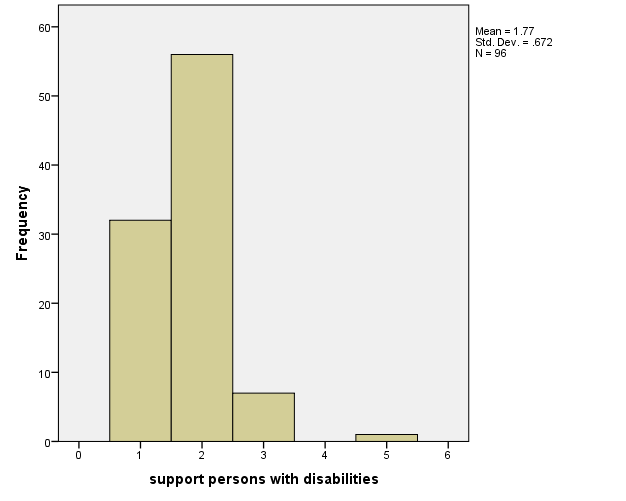
Graph 2.1: Distribution of respondents in respect to supporting persons with disabilities. Figure 1=Always, 2= Often, 3= Some times, 4= rarely, 5= Never Supporting person with disabilities is one of the main roles of CSWs. In confirming with this functional statement, the above graph illustrates that, about 59 (58.3%) said that they ‘’often support person with disabilities in their day to day activities. While, 33.3% of the total respondents agreed as CDWs/SWs engaged ‘always’ in supporting person with disabilities. This shows the majority takes the issues of person with disabilities as their core mandate. The rest 7.3 % responded that they ‘sometimes’ engage in serving person with disabilities.
In line with the above finding, CSWs are working in raising awareness of the community towards people with disability and other marginalized groups in the community. One study participant explained that:
I am actively supporting person with disability. Due to my activities the attitude of the community regarding person with disability and elders without care is changed. Besides, the vulnerable groups have changed (CDW interviewee in Qarsa Woreda Jimma Zone; August, 2019).
| Frequency | Percent | Valid Percent | Cumulative Percent | ||
|---|---|---|---|---|---|
| Valid | Often | 42 | 43.8 | 43.8 | 43.8 |
| Some times | 42 | 43.8 | 43.8 | 87.5 | |
| Rarely | 12 | 12.4 | 12.5 | 100 | |
| Total | 96 | 100 | 100 |
Table 8: Distribution of respondents in respect to provision of information for the community about sexual and reproduction healt
The above table depicts that 42 (43.8 %) of the respondents ‘often’ provide information for community about sexual and reproduction health. In similar manner 42 (43.8 %) ‘Sometimes ‘provide information on the issue. The rest 12 (12.4 %) of the total respondents said that they rarely provide information for the community on sexual and reproductive health. From this we can infer that, trained and deployed CSWs are contributing their share in raising awareness of the community concerning sexual and reproductive health.
The interview finding also revealed that CSWs actively participate in helping HIV vulnerable groups to be tested and to know their status, focusing on commercial sex workers and their children and linking those who are living with the virus to access different available services.
| Frequency | Percent | Valid Percent | Cumulative Percent | ||
|---|---|---|---|---|---|
| Valid | Always | 48 | 50 | 50 | 50 |
| Often | 42 | 43.8 | 43.8 | 93.8 | |
| Some times | 6 | 6.2 | 6.2 | 100 | |
| Total | 96 | 100 | 100 |
Table 9: Analysis of response in respect to working in reducing youth unemployment.
As stated on the above table, half of the respondents 48(50 %) of them have been ‘always ‘working in reducing youth unemployment. The second majority of respondents 42 (43.8 %) of them play ‘often’ this duty. The remaining 6.2 % responded that they ‘sometimes’ deal with it. The above result portrayed that, issues of reducing youth unemployment also taken as other major activities in their intervention areas to solve the social problems.
The data gathered through interview also confirmed that community development workers are playing the role of supporting youths to utilize their potential and to be productive citizens. One of the participants from Arsi Negele stated that: I support members of the community in a variety of ways. I encourage community members especially youths to access services, particularly education and training, which can aid them in gaining employment, learning new skills and gaining confidence.
Add to this CSWs are providing life skill training to children, youth and to some extent to destitute family in coordination with Oromia Development Association in Bishoftu city and Dukem town
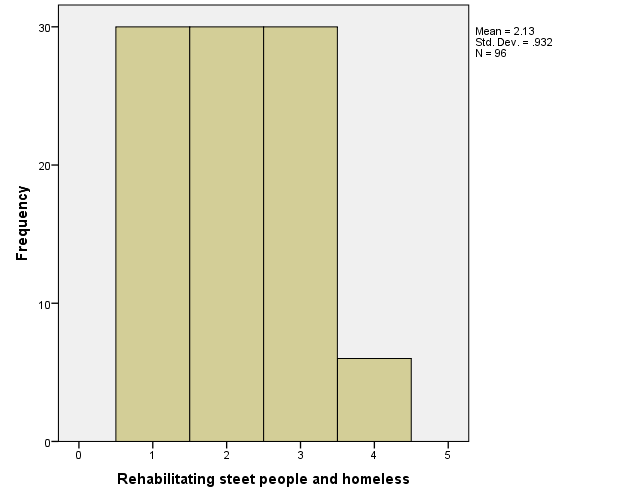
The above graph indicates that, 31.3 % of the respondents engaged ‘always’ in rehabilitating street people and homelessness. Similar to the above result, (31.3 %) of respondents ‘often’ engaged in activities of rehabilitating street people and homelessness. Those selected ‘sometimes’ also 31.3 % of the total respondents. Only 6.1 % of them responded that they ‘rarely’ engaged in rehabilitating street people and homeless. Thus, we can understand that, rehabilitating street people and homeless is a major focus area of community service workers. This confirms that CSWs are supposed to work in the changing life of vulnerable social group.
| Frequency | Percent | Valid Percent | Cumulative Percent | ||
|---|---|---|---|---|---|
| Valid | Always | 24 | 25 | 25 | 25 |
| Often | 48 | 50 | 50 | 75 | |
| Some times | 12 | 12.5 | 12.5 | 87.5 | |
| Rarely | 12 | 12.5 | 12.5 | 100 | |
| Total | 96 | 100 | 100 |
Table 10: Distribution of responses on providing Psycho-social support for vulnerable groups.
The above table revealed that, 48 (50%) of respondents said that they ‘often’ work in providing psycho-social support for vulnerable groups. The response shows that, 24 (25%) of respondents are ‘always’ providing this service for vulnerable groups. The remaining 12 (12.5 %) of the respondents equally participate ‘sometimes’ in the duty. In sum, the result shows that, provision of psycho-social support for vulnerable groups considered as a good way to rehabilitate vulnerable groups and make them start a new way of life.
The interview conducted with key informants also revealed that the CDWs are providing guidance for vulnerable groups including families in crisis and people facing discrimination and stigmatization because of health related problems.
| Frequency | Percent | Valid Percent | Cumulative Percent | |||
|---|---|---|---|---|---|---|
| Valid | Always | 12 | 12.5 | 12.5 | 12.5 | |
| Valid | Often | 60 | 62.5 | 62.5 | 75 | |
| Valid | Some times | 18 | 18.8 | 18.8 | 93.8 | |
| Valid | Rarely | 6 | 6.2 | 6.3 | 100 | |
| Valid | Total | 96 | 100 | 100 |
Table 11: Analysis of the extent to which CDWs working with community based organization.
The data in the above table indicates that 12.5 % of the respondents responded they ‘always’ work with community based organizations. While, the majority of respondents (62.5%), ‘often’ work with community based organizations. The remaining 18.8 % and 6.2 % of the respondents said that they ‘sometimes’ and ‘rarely’ implement this activity respectively. In strengthening this finding, CSWs are working in organizing community structures towards living the standards of community. Our finding comes up with the following specific activities:
Coordinating safety net programs: in some woredas (Fantale, Ciro, Dodeta, Gamachis, Arsi Negele) the CSWs are involved in coordination of safety net programs. The basic roles they are playing in relation to safety net are selection of the clients; participate and develop support plan; social service linkage; complain handling; facilitate resource mobilization and preparation of necessary documents.
Organize saving Associations: organizing the needy group in associations and providing technical support is another duty they are playing. According to the interview with key informant in Kudada kebele of Bishoftu city, there are nine groups of saving association having one hundred seventy three members.
Support CCC in documentation, reporting, local resource mobilization, service coordination and the use and Case management: The participants from different areas stated that one of the primary roles of the community service workers is facilitating establishment and functioning of community care coalition in each kebele. Since CCCs are considered as important means to meet the needs of the vulnerable groups and to bring change in the community, the CSWs are mainly focusing on helping the CCCs to be functional.
Preparation of Reports: Preparation of monthly and quarterly reports and submitting it to her/his supervisor, as needed is another role of the CSWs working in their respective woreda. Provide maximum support to economic strengthening groups to become viable economic projects.
Moreover, they also play the role of organizing and facilitating different capacity building trainings for community leaders, Idir, target OVCs and their families, Commercial Sex Workers, Community Committees etc as per the Program plan. The key informants from the community stated that they get important support from the CSWs. One interviewee from Fantale woreda stated: They enable the community by establishing different social structures to scrap the problem of the community by themselves. …They establish idir in our kebele which is not known in the culture and history of the Karrayu tribe.
| Frequency | Percent | Valid Percent | Cumulative Percent | ||
|---|---|---|---|---|---|
| Valid | Always | 24 | 25 | 25 | 25 |
| Often | 42 | 43.7 | 43.7 | 68.8 | |
| Some times | 16 | 16.7 | 16.7 | 85.4 | |
| Rarely | 14 | 14.6 | 14.6 | 100 | |
| Total | 96 | 100 | 100 |
Table 12: Support people in emergency situation.
Concerning supporting people in emergency situation, 24 (25 %) of the respondents said that they ‘always’ engage in this role. In the other case, 42 (43.7 %) of them responded that they ‘often’ work in supporting people in emergency. Those of CDWs/SWs responded ‘sometimes’ and ‘rarely’ to peoples in emergency situations are 16(16.7 %) and 14 (14.6%) respectively. The above result indicated that, supporting people in emergency case is the other concentration areas in which community development workers are dealing with as their fundamental responsibilities. The study shows trained and deployed CSWs are acting accordingly.
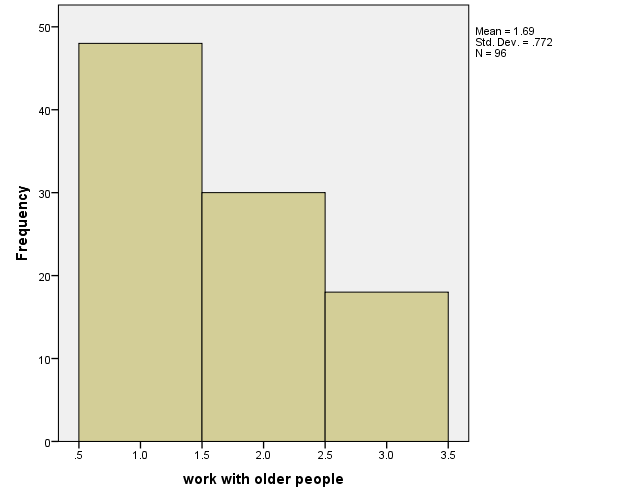
The above table indicates that, half of the respondents; that are 50 % of the respondents said that they ‘always’ deal with issues of working with older peoples. While 31.2 % of the respondents said that they often work in serving older peoples. The remaining 18.8 % of them responded ‘sometimes’ engage in helping older people. The result of the study exposed that, elders are among the vulnerable groups that need attention and CDWs/SWs understand as working with older peoples is the core areas in which community development workers are showing vivid progress.
| Frequency | Percent | Valid Percent | Cumulative Percent | ||
|---|---|---|---|---|---|
| Valid | Always | 66 | 68.8 | 68.8 | 68.8 |
| Often | 30 | 31.2 | 31.2 | 100 | |
| Total | 96 | 100 | 100 |
Table 13: Distribution of respondents on Collecting, organizing and documenting basic data.
We can understand from the above table that, the majority 66 (68.8 %) of respondents said that they ‘always’ work in collecting, organizing and documenting basic data on several social issues. This is a majority. The other 30(31.3 %) of them responded as ‘often’ engaged in this activity. All the above result portrayed that, the trained and deployed CSWs at lower woreda structures highly engaging in collecting and organizing all round basic data from lower kebele level. In a similar way the study shows that, they are documenting up to date data on all existing social issues as well as existing resources to facilitate further intervention by all concerned and interested stakeholders.
In support of the above finding, the data gathered through interview and observation also indicated that one of the basic roles the community development workers are playing in their respective woredas is collecting, and organizing basic data. One of the key informants stated that: Before we are employed in this organization there was no organized data of vulnerable groups in the woreda but now there is organized data. So, any one we need to support and empower the vulnerable groups can easily access the necessary information. (Interviewee from Hetosa woreda) In line with these findings, in Bishoftu city we have got a well-organized data of the vulnerable groups. For instance, “in Kudada Kebele of Bishoftu city, they have identified and organized one thousand three hundred and nineteen target children; and seven hundred families.”
| Frequency | Percent | Valid Percent | Cumulative Percent | ||
|---|---|---|---|---|---|
| Valid | Often | 18 | 18.8 | 18.8 | 18.8 |
| Some times | 24 | 25 | 25 | 43.8 | |
| Rarely | 36 | 37.4 | 37.4 | 81.3 | |
| Never | 18 | 18.8 | 18.8 | 100 | |
| Total | 96 | 100 | 100 |
Table 14: Undertake simple Research and project works.
The above table indicates the level at which community development workers undertaking simple research and project works. Accordingly, out of total respondents, 18.8 %, 25% and 37.4 % of them responded as implementing research and project works ‘often’, ‘sometimes’ and ‘rarely’ respectively. The last 18.8 % of them responded as ‘never’ implementing this activity. The result shows, as some of the community development workers are engaging in simple research and project works to raise resources available. The result calls for further improvement needed in this area.
Analysis of the Changes Achieved Because of Deployment of Cdws/SW
This part of the study focused on assessing the changes achieved because of deployment of CDWs/SW implementing the competencies they trained in the college. The collected data was analyzed by using tables, and histogram.
| Frequency | Percent | Valid Percent | Cumulative Percent | ||
|---|---|---|---|---|---|
| Valid | Strongly agree | 36 | 37.5 | 37.5 | 37.5 |
| Agree | 54 | 56.3 | 56.3 | 93.8 | |
| Neutral | 6 | 6.3 | 6.3 | 100 | |
| Total | 96 | 100 | 100 |
Table 15: Distribution of respondents in respect to the extent to which living Situation of vulnerable groups is improved.
The table above revealed that, from the total 36 (37.5 %) ‘Strongly agrees’ as the living situation of vulnerable groups is improved due to community development workers interventions. Majority of respondents; that is 54 (56.3 %) of them responded as ‘agreed’ on the improved living situations of vulnerable groups. Only the remaining 6(6.3 %) of them are ‘neutral’ in their responses. The result of the study revealed that, the intervention by CDWs/SWs brings visible changes on the lives of vulnerable groups.
| Frequency | Percent | Valid Percent | Cumulative Percent | |||
|---|---|---|---|---|---|---|
| Valid | Strongly agree | 36 | 37.5 | 37.5 | 37.5 | |
| Valid | Agree | 60 | 62.5 | 62.5 | 100 | |
| Valid | Total | 96 | 100 | 100 |
Table 16: Response of CDWs in respect to how resource is identified and better mobilized.
The statistics on the above table shows that 36 (37.5 %) of community development works/ social workers/ ‘strongly agreed’ as resources in the community are better mobilized to solve the existing social problems. The majority of respondents; that is 60 (62.5 %) of them on the other case responded by choosing ‘agree’ on searching and mobilizing the existing local resources. The above data indicated that, deployed community development workers are implementing the principles of resource and strength based intervention to solve problems in the community rather than depending on external resources.
| Frequency | Percent | Valid Percent | Cumulative Percent | ||
|---|---|---|---|---|---|
| Valid | Strongly agree | 48 | 50 | 50 | 50 |
| Agree | 48 | 50 | 50 | 100 | |
| Total | 96 | 100 | 100 |
Table 17: Vulnerable groups are benefited from volunteerism.
The figure on the above table illustrates that, due to the activities implemented by community development workers in introducing volunteerism in the community, vulnerable groups are benefited. The improvement on the life of vulnerable groups responded ‘strongly agree’ by 48(50 %) of the respondents. The responses of the remaining 48 (50 %) of the respondents also fall under the category of ‘agree’ as the above table shows. The above result shows, CDWs/ SWs are taking voluntarism as a good strategy to deal with problems of needy groups and they are successful.
| Frequency | Percent | Valid Percent | Cumulative Percent | |||
|---|---|---|---|---|---|---|
| Valid | Strongly agree | 24 | 25 | 25 | 25 | |
| Valid | Agree | 48 | 50 | 50 | 75 | |
| Valid | Neutral | 24 | 25 | 25 | 100 | |
| Valid | Total | 96 | 100 | 100 |
Table 18: GBV and Domestic violence is reduced.
The improvement recorded in reducing GBV and Domestic violence is also great as the table above states. From the total respondents, 24(25 %) and 48 (50 %) of the respondents said that they ‘strongly agree’ and ‘agree’ respectively. The remaining 24(25 %) of the respondents prefer ‘neutrality’ on the success in reducing GBV and domestic violence through community awareness creations. The result shows that, community development workers understand domestic and GBV is one of the problems that affect women and children that need community development workers interventions. We can also understand from the above result that, CDWs/ SWs are considering GBV and domestic violence as a source for social problems and they are struggling to reduce it.
| Frequency | Percent | Valid Percent | Cumulative Percent | ||
|---|---|---|---|---|---|
| Valid | Strongly agree | 48 | 50 | 50 | 50 |
| Agree | 48 | 50 | 50 | 100 | |
| Total | 96 | 100 | 100 |
Table 19: Diversity is acknowledged and inclusiveness is enhanced.
As indicated on the above table, community development workers are acknowledging diversity and enhancing inclusiveness in their services to bring the needed impacts. From the total respondents 48 (50%) of them ‘strongly agreed’ as they acknowledged diversity and inclusiveness in service delivery. In similar situations, the left 48(50 %) of the respondents ‘agreed’ on the impact brought in the community by acknowledging diversity and enhancing inclusiveness. The result shows that, CDWs/SWs are respecting the principles of acknowledging diversity and enhancing inclusiveness in all service delivery system.
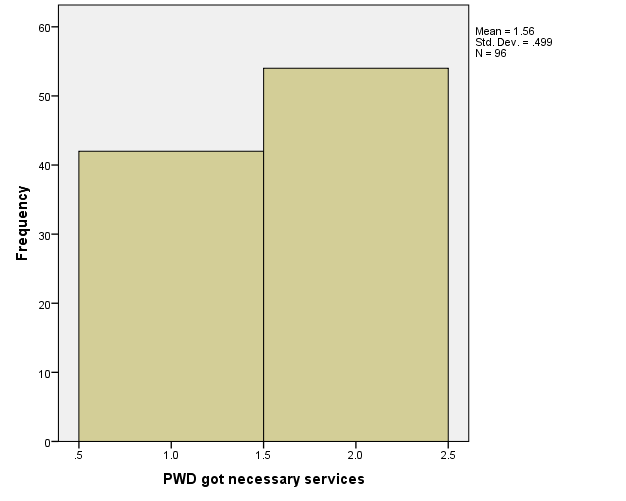
The response of community development workers indicates as they bring changes on the life of person with disabilities. From the total respondents, 43.8 % of them ‘strongly agreed’ on the necessary services provided for person with disabilities. The remaining majority of respondents; that is 56.3 % of them ‘agreed’ on the serviced delivered for person with disabilities to improve their life situations. The result portrayed that, CDWs/SWs are successful in implementing the activities that bring change on the lives of person with disabilities.
| Frequency | Percent | Valid Percent | Cumulative Percent | ||
|---|---|---|---|---|---|
| Valid | Strongly agree | 36 | 37.5 | 37.5 | 37.5 |
| Agree | 60 | 62.5 | 62.5 | 100 | |
| Total | 96 | 100 | 100 |
Table 20: Job seekers are linked to job opportunities.
The above table also shows as there are successes in linking job seekers with the existing job opportunities. From the total respondents, 36(37.5 %) of them said as ‘strongly agreed’ in linking youth with job opportunities. In the other case, 60 (62.5 %) of them said ‘agreed’ in job creation for the youth. This result indicates as there are changes brought in linking job seekers with the available job opportunities after the intervention made by community development workers in collaboration with other concerned stakeholder sectors.
| Frequency | Percent | Valid Percent | Cumulative Percent | |||
|---|---|---|---|---|---|---|
| Valid | Strongly agree | 48 | 50 | 50 | 50 | |
| Valid | Agree | 12 | 12.5 | 12.5 | 62.5 | |
| Valid | Neutral | 24 | 25 | 25 | 87.5 | |
| Valid | Disagree | 12 | 12.5 | 12.5 | 100 | |
| Valid | Total | 96 | 100 | 100 |
Table 21: Street persons and homeless are supported and rehabilitated.
The table shows that, 48 (50 %) of the respondents are e ‘strongly agreed’ as they are supporting street persons and rehabilitated homelessness. The second response is those said ‘neutral’; that is 24(25 %) of them. Those selected ‘agree’ are 12 (12.5) % and the remaining 12 (12.5 %) of them ‘disagreed’ on the impact they bring on street persons and homelessness. This result implies as there is great attention given for this activities to bring change on the life of homeless peoples.
| Frequency | Percent | Valid Percent | Cumulative Percent | |||
|---|---|---|---|---|---|---|
| Valid | Strongly agree | 36 | 37.5 | 37.5 | 37.5 | |
| Valid | Agree | 48 | 50 | 50 | 87.5 | |
| Valid | Neutral | 12 | 12.5 | 12.5 | 100 | |
| Valid | Total | 96 | 100 | 100 |
Table 22: Vulnerable groups accessed Guidance and Psycho-social support.
In accessing psycho-social support for vulnerable groups, 36(50 %) and 36(37.5%) of the total respondents said ‘agree’ and ‘strongly agree’ respectively. The remaining 12 (12.5 %) of the respondents responded ‘neutral’ on the psycho- social services provided for these vulnerable groups.
This data implies as there are great changes in accessing vulnerable groups to psycho- Social services to rehabilitate them by deployed community development workers/ social workers.
| Frequency | Percent | Valid Percent | Cumulative Percent | ||
|---|---|---|---|---|---|
| Valid | Often | 18 | 18.8 | 18.8 | 18.8 |
| Some times | 24 | 25 | 25 | 43.8 | |
| Rarely | 36 | 37.5 | 37.5 | 81.3 | |
| Never | 18 | 18.8 | 18.8 | 100 | |
| Total | 96 | 100 | 100 |
Table 23: Undertake simple research and project works.
(37.5 %) of them said rarely undertaking simple research and project works. In opposite way, 18 (18.8 %) of them responded as ‘never’ engaging in such activity.
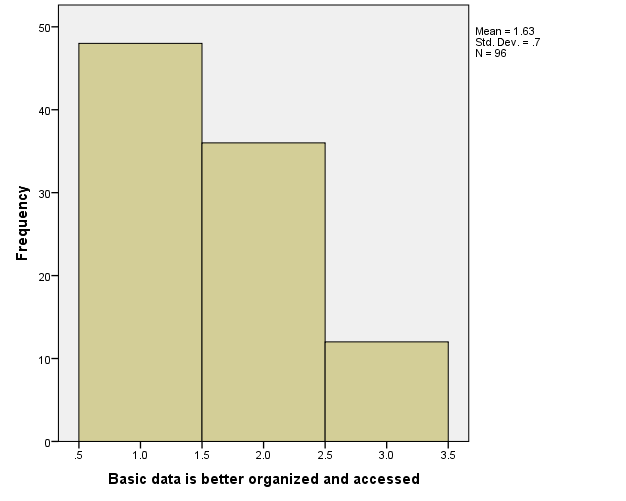
Figure 1: 1=strongly agree, 2= Agree, 3= Neutral, 4=Disagree, 5=strongly disagree Graph 3.2: Basic data is better organized and accessed According to the above table, the other area changed due to community development/SW interventions are in organizing basic data and accessing to all stakeholders. Half of the respondents; that are 50 % of them said ‘strongly agreed’ on how far basic data organized and accessed by all interested groups. In similar case 37.5 % of the respondents said as ‘agreed’ on the organization of relevant data. Those selected ‘neutral’ are the remaining 12.5 % of the respondents. This data shows that, the great concern given by community development workers given for organizing all round data on all social issues as well as providing for other bodies need to use it.
| Frequency | Percent | Valid Percent | Cumulative Percent | |||
|---|---|---|---|---|---|---|
| Valid | Strongly agree | 54 | 56.3 | 56.3 | 56.3 | |
| Valid | Agree | 42 | 43.8 | 43.8 | 100 | |
| Valid | Total | 96 | 100 | 100 |
Table 24: Older people are organized and accessed necessary services. The above table shows that issues of older people are concer
Table 24: Older people are organized and accessed necessary services. The above table shows that issues of older people are concern areas for community development workers. From the total respondents, 54 (56.3 %) of them ‘strongly agree’ as older people are organized and accessed to necessary services after CDW/ SW interventions. Those responded ‘agree’ also cover 42 (43.8 %) of the total. This indicates as there are changes in the area of caring for older peoples and community development workers are successful in implementing activities that being changes on the lives of elderly peoples.
| Frequency | Percent | Valid Percent | Cumulative Percent | |||
|---|---|---|---|---|---|---|
| Valid | Strongly agree | 24 | 25 | 25 | 25 | |
| Valid | Agree | 54 | 56.3 | 56.3 | 81.3 | |
| Valid | Neutral | 12 | 12.5 | 12.5 | 93.8 | |
| Valid | Disagree | 6 | 6.3 | 6.3 | 100 | |
| Valid | Total | 96 | 100 | 100 |
Table 25: People in emergency situations are supported.
This table shows changes in supporting peoples in emergency situations. Among the total respondents, 24 (25 %) responded as ‘strongly agreed’ as the peoples in emergency situations are supported. In the other case, 54 (56.3 %) said as agreed on the extent to which peoples in emergency time supported. The remaining 12 (12.5 %) and 6 (6.3 %) responded ‘neutral’ and ‘disagree’ on the impacts in supporting people during emergency situations by community development workers.
Generally, the study result indicates that, there is a change in the lives of the community resulted from the intervention of CDW/SW in the community. Some of the impact they have brought in the community include:
The mandate of Labor and Social affairs office is known by many stakeholders and government structures where community service workers are working. They are succeeded in facilitating the resource mobilization process by organizing volunteers and working in collaboration with CBOs and FBOs.
Different associations like association of people with disabilities, elders association, HIV associations, saving associations, including community care coalitions are established in many woredas to kebele level. In Addition to this, vulnerable peoples especially people with disability have get access to engage in other livelihood activities rather than begging and staying at home.
community, especially on vulnerable groups. The following are some changes observed because of works performed by the CSWs/CDWs:
CSW have made significant progress with improving awareness with communities but have struggled to influence strategic change. ‘[The] strategic element of the role was lost in the process of delivery. They appeared to be set to deliver a bottom up approach with no clear path for top down delivery which institutions needs in order to effect changes in service delivery.
In summary, even if there are several activities left unimplemented due to several internal and external constraints, the result of the assessment indicate there are successful interventions in reduction of GBV, assessment of different social problems and potentials in the community and collection and documenting basic data.
Analysis of correlations between the interventions and changes brought by the works of CSWs.
CSWs were requested to think specifically about the combination of the theoretical and practical training, and how this was applied in the workplace. The impact analysis concerns what changes have been seen because of the works of CSWs in community. In order to spot what practical changes was seen; we have used correlation.
- Moreover, the data from process owners and leaders also portrays that they are observing great changes on the lives of
- Identify, mobilize, link and support Vulnerable groups
- Living Situation of vulnerable groups is improved
- Pearson Correlation
- 1
- .777**
- Identify, mobilize, link and support Vulnerable groups
- Sig. (2-tailed)
- 0
- N
- 96
- 96
- Pearson Correlation
- .777**
- 1
- Living Situation of vulnerable groups is improved
- Sig. (2-tailed)
- 0
- N
- 96
- 96
Table 26: The Pearson correlation between identification, mobilize, link and support Vulnerable groups and the change in life
As it is indicated from the correlation table the consistence between identifying, mobilizing, link and support vulnerable groups and the change in living situation of the group is statistically significant(P= 0.78). This implies that there is strong relationship between the activities performed and the changes brought.
collect, organize and document basic data Basic data is better organized and accessed
- Pearson Correlation
- 1
- .751** collect, organize and document basic data
- Sig. (2-tailed)
- 0
- N
- 96
- 96
- Pearson Correlation
- .751**
- 1
- Basic data is better organized and accessed
- Sig. (2-tailed)
- 0
- N
- 96
- 96
Table 27: Correlations between data collected and better access of basic data.
This table demonstrates the relation between basic data collection and making it accessible is statistically significant (P=.75). This basic data includes number of PWD, older persons without support, destitute families, and other vulnerable groups. This implies that CSWs are collecting, organizing and documenting data and thus basic data are easily accessible to anybody who wants the data.
The two consecutive tables below(tables 4.3 and 4.4) specify due to the fact that basic data is better organized and accessed; PWD got necessary services (P=0.58) and Older people are organized and accessed necessary services(P=0.85). Whilst basic data collection and making it accessible is crucial, the CSWs’ role is broad and critical, particularly as it relates to ensuring that the ability of communities to access services is enhanced. The correlation tables indicates that CSWs are: Ensuring that poor people are accessing the vital information they need , Providing information about government services, Providing information to the most disadvantaged and vulnerable so that they rapidly access services designed for their benefit,
| Support persons with disabilities | PWD got necessary services | ||
|---|---|---|---|
| support persons with disabilities | Pearson Correlation | 1 | .577** |
| support persons with disabilities | Sig. (2-tailed) | 0 | |
| support persons with disabilities | N | 96 | 96 |
| PWD got necessary services | Pearson Correlation | .577** | 1 |
| PWD got necessary services | Sig. (2-tailed) | 0 | |
| PWD got necessary services | N | 96 | 96 |
Table 28: The Pearson correlations between supporting persons with disabilities and PWD got necessary services. **. Correlation is
| Work with older people | Older people are organized and accessed necessary services | |||
|---|---|---|---|---|
| work with older people | Pearson Correlation | 1 | .851** | |
| work with older people | Sig. (2-tailed) | 0 | ||
| work with older people | N | 96 | 96 | |
| Older people are organized and accessed necessary services | Pearson Correlation | .851** | 1 | |
| Older people are organized and accessed necessary services | Sig. (2-tailed) | 0 | ||
| Older people are organized and accessed necessary services | N | 96 | 96 |
Table 29: The Pearson correlations between working with elders and elders are organized and accessed necessary services. **. Corre
- Awareness creation on GBV and domestic violence
- GBV and Domestic violence is reduced
- Pearson Correlation
- 1
- .866**
- Awareness creation on GBV and domestic violence
- Sig. (2-tailed)
- 0
- N
- 96
- 96
- Pearson Correlation
- .866**
- 1
- GBV and Domestic violence is reduced
- Sig. (2-tailed)
- 0
- N
- 96
- 96
Table 30: The Pearson correlations between awareness creation on GBV and domestic violence and reduction of GBV and
In the table above the relationship between the two variables is statistically significant (P=0.87). The table indicates that there is relationship between the theoretical or classroom trainings and practical works.
| Working with community based organization | CCCs, FBOs, CBOs, CSOs, NGOs, and GOs coordination is strengthened | ||
|---|---|---|---|
| Working with community based organization | Pearson Correlation | 1 | .852** |
| Working with community based organization | Sig. (2-tailed) | 0 | |
| Working with community based organization | N | 96 | 96 |
| CCCs, FBOs, CBOs, CSOs, NGOs, and GOs coordination is strengthened | Pearson Correlation | .852** | 1 |
| CCCs, FBOs, CBOs, CSOs, NGOs, and GOs coordination is strengthened | Sig. (2-tailed) | 0 | |
| CCCs, FBOs, CBOs, CSOs, NGOs, and GOs coordination is strengthened | N | 96 | 96 |
Table 31: The Pearson correlations between Working with community based organization and coordination and strengthening of CCCs, F
This table indicates there is statistically significant relations between community based organization and CCCs, FBOs, CBOs, CSOs, NGOs, and GOs coordination’s (P=.85). In other words it indicates CSWs have developed skills in identifying and analyzing the issues and problems that confront the communities and mobilize the community based organizations in order to solve the problems of communities. In other words CSWs have developed understanding of the connections between local community structures and problems both at the micro and macro-level and linking them with community based organizations.
| Work in reducing youth unemployment | Job seekers are linked to job opportunities | |||
|---|---|---|---|---|
| Work in reducing youth unemployment | Pearson Correlation | 1 | .715** | |
| Work in reducing youth unemployment | Sig. (2-tailed) | 0 | ||
| Work in reducing youth unemployment | N | 96 | 96 | |
| Job seekers are linked to job opportunities | Pearson Correlation | .715** | 1 | |
| Job seekers are linked to job opportunities | Sig. (2-tailed) | 0 | ||
| Job seekers are linked to job opportunities | N | 96 | 96 |
Table 32: The Pearson correlations between Working Work in reducing youth unemployment and Job seekers are linked to job opportuni
This relational table indicates the positive relations between the variables; work in reducing youth unemployment and job seekers are linked to job opportunities (P=0.72).This reminds that the training approach in the college makes them to thoroughly understand the ever changing dynamics within a community, and respond in a manner that takes development forward. It indicates that CSWs have able to harness different approaches in such a way that all parties within a community may have a sense of having a stake in and fully get in into the whole development process. It is, therefore, possible to ensure that the type and training process makes them an all-round worker and an activist who is able to nurture and consolidate all views in a holistic approach.
In general, all scores were significantly positive, and there were no significant variances in terms of understanding and implementing the theory and practice. The assumption is if the trainees were well understand the concepts and processes of community service work in the beginning, they will be effective in their later roles. This is just shown in the analysis tables above that almost all of the deployed CSWs are implementing all the theoretical competences and therefore, they easily simulate what they have trained in the college and the workplace.
Challenges Facing Cdws /Csws
The finding reveals that community development workers face many challenges in undertaking their role. Some of the challenges are discussed as follows:
Lack of Standards
The number of clients that social workers are expected to support in the woreda is not specified. This creates difficulty for community workers to function effectively and successfully No CDWs at kebele level. CDWs are few in number at woreda level (two to three only). While, their main work is with grass root community level. In large woredas it is impossible to outreach all.
Low Payment (Salary)
The interviewed community development workers reported that their salary scale is the lowest structure compared with other community level workers.
Lack of Alignment and Insufficient Budgets
Resource issues were also identified by CDWs in the interview. In relation to meeting the ambitions set out for the role, a number of resource factors impeded the work.
Lack of Opportunity to Improve Their Level of Education
The respondents stated that they are facing extreme difficulty due to the fact that the college does not upgrade the level of education. One of the participant from Shabe woreda of Jimma Zone stated that he has completed community service work in level III before five years but until now I haven’t get the chance to learn.
Gap between Vulnerable Groups and Available Support
The numbers of vulnerable group in each kebele are many in number but the service we provide and the number of the workers are insignificant in number.
Lack of Transportation Facility
They stated that even the office at woreda level have no motorcycle. From the observation and interview conducted with key individuals many of the offices are facing transportation problems to provide consistent services for community far from centre
Lack of Clear Understanding from Leading Government Structures on the Mandates and Activities Performed By Labor and Social Affairs Office
CDWs work in a space where there are other officials or field workers from government departments and civil society, and CDWs are expected to coordinate activities at community level. The interest and commitment of kebele leaders is not strong as expected. They have no clear understanding regarding the importance of the sector in general and community development workers in particular.
Weak Coordination among Stakeholders (Gos, Ngos, CBS, FBO….)
Another challenge the community development workers are facing is related to lack of strong coordination between different sectors in supporting the vulnerable groups. In addition to these challenges, there are misunderstandings of their roles. The most common issues identified in the interview were grouped under ‘role definition and recognition’: difficulties that were linked to how the CDW role was prioritized, applied and valued in different areas. This was sometimes cited as a problem with how the CDW was valued by others, for instance one interviewee reveals;
The kebele managers have not understood the value in the work and have prevented staff from attending training... [Due to] small number in [the area] they think there is no need to deliver a different type of service. I feel that, the organization has not been clear or had the knowledge of what the role was supposed to be...no clear guidelines to workers or recognition (CDW interviewee in Qarsa woreda of Jimma Zone) In support of the above argument one of the respondents stated that:
At times, I feel so lonely, isolated and burnt out by just making the case to do what I was intended to do all along. People do not understand the role. Or some jock on me, ignorance, so they don’t have to do what is required. You have to keep explaining the Rationale and need and they want you to prove the need all the time when this has already been done exhaustively...At times I have been demoralized and it has been a battle (CDWs in Itaya town).
Furthermore the finding of the study also indicates that the community development workers also face the following challenges:
Coping Strategies and the Way Forward
- The challenges are soaring, but still the community development workers are performing their duties as much as possible. They raised the following as a mechanism they used to overcome those challenges:
- Strong commitment and motivation among deployed CDW/SW to overcome any challenges,
- continuously working on awareness creations to change the assumptions towards the office and their activities,
- Detail explanation to the community about their mandates and the importance of their interventions,
- Most of CDW/SW performing double roles and responsibilities to cover the gaps exist in the area of human resources,
- Using of available opportunities to overcome the challenges related with budget and logistics,
- Working in collaboration with different stakeholders to support the vulnerable groups and to reduce the challenges
Conclusion and Recommendation
Many of the community development workers graduated from the college are employed by Non-Governmental organizations in addition to government organizations. From this we can conclude that CSWs can be employed by non-governmental organizations add to that of government responsibilities.The assessment result on extent to which CDWs/SW are implementing the training provided by BCDTC shows better/progressive/ performance. Almost all of the trained and deployed CDW/SWs are implementing the same roles and responsibilities to bring changes in the community. This indicates the relevance of occupational standard and competencies on which the students are trained for their roles and responsibilities they are assigned to implement.
There are great connections, especially on the linkages between the competency trained and their current work related with vulnerable groups (people with disability, children, Women, and elderly), mobilize resource in the community, ways to encourage and facilitate volunteerism, skills to work with others in cooperation, and how to conduct assessments in the community. This revealed the relevance of training delivered (competencies CDW/SW trained) in the college and their role.
There is a remarkable change in the lives of vulnerable groups after intervention of CDW/SW in the community. For instance commitment and readiness to help vulnerable groups through volunteerism; psycho social support; working with community based organization and mobilization and linking of the need groups with the resources was improved; the vulnerable groups have got better access to houses and different material. Awareness of the community regarding sexual and reproductive health, person with disability, commercial sex workers was enhanced. Generally, the correlation analysis revealed there is significant relationship between the roles CSWs are undertaking and the changes observed in the community.
While undertaking their role community development workers are facing many challenges. Some of the challenges are lack of standard, transportation facility, and structures at kebele level; insufficient budget; limited opportunity to improve their level of education; gap between available groups and available support; and weak coordination among stakeholders. This shows interventions are needed to tackle the challenges and to better serve the community or to reach unreached areas.
To overcome the challenges the community development workers are using different coping strategies. Some of the coping strategies are working on awareness creation; using available opportunities, and developing collaborative relationship with different sector. This efforts made by CDW/ SWs indicates it is possible to eradicate any challenges exist in this area through continuous and structured interventions.
Recommendations
Base on the result of the study, the following recommendations are forwarded for different concerned bodies to serve their community with full potentials and to reach the unreached areas:
For BOLSA
- It needs to work to bring change on the attitude of stake holders on mandates of Labor and Social affairs Office, importance of voluntarism and humanitarian services through mass media like TV, newspaper and radio,
- Without having concerned structure at kebele level bringing required change is tough. Thus, the structure of Labor and Social Affairs office should be decentralized until kebele level. To reach marginalized groups and implement the social protection policy at grass root level at least there should be one community service worker at kebele level,
- It needs to work with lower zonal and woreda administrations to give appropriate leadership; this is especially true by assigning appropriate professional leaders to the office at lower structure,
- On job training and off job training should be facilitated for community service worker to improve their skills and knowledge,
- The community service workers can bring required change if a standard that indicates workers vs. its client’s ratio is set out,
- Since it’s difficult to reduce social problems in the community without involvement of all concerned stakeholders, the coordination between different stakeholders should be boosted up,
- Need for redesigning its social services access to pastoral society (considering the issues of pastoral society),
- Administrators and employing agencies should need to ensure that adequate resources have to made available to develop CDWs roles,
- Employing organizations should need to commit themselves to supporting the professional development of CDWS through an appropriate programme of training and access to other forms of continuous professional development,
- The need for monitoring and evaluation cannot be over emphasized; this is necessary so that data can be obtained that could inform the improvement of the roles of CDWs over time,
- Transportation should be facilitated for the community service workers.
For BCDTC
- Facilitating accessibility of further education for CDW/ SW to improve their academic level and to improve their life. The chance for community development workers to upgrade their training up to level IV and level V should be facilitated,
- The college should regularly provide on job training for the employed SW together with BoLSA and other interested stakeholders,
- The annual intake capacity of the college should increase to reach unreachable areas of the region.
For WOLSA
- Working with woreda administrations to allocate necessary budget for the office and equipping the office with logistics like the other office relatively and providing equal attentions for the mandates and responsibilities of the office,
- The humanitarian services and voluntarism activities that culturally exist in the community needs to be organized and lead by plan to bring change on life of vulnerable peoples. It needs strong intervention to bring attitudinal change on the current giving/donation/ culture of our society,
- Further intervention on vulnerable groups, rather than always provision of immediate materials and immediate assistance, they recommended to focus on rehabilitation and working on provision of assistance that brings fundamental change on their life,
- Should give appropriate leadership; this is especially true by assigning appropriate professional leaders to the office.
For Stakeholders
Should recognize and support this working force in providing training, logistic and budget.
For CDW/SW
- Should know their missions/purpose of assisting individuals and groups in identifying and resolving problems,
- Should enhance the people’s capacity of problem solving and development,
- Should provide appropriate link between needs and resources,
- Should supervise all programs and services in the community if they are accessible, inclusive, humane and adequate,
- Should collect, organize and analyze social protection data direct social policies of the region accordance with identified needs and deficiencies,
- Should conducts need assessments to enhance social protection schemes,
- Should follow their professional principles of social workers.
References
-
Midgley J (1986) Community participation, social development and the state. Community Development Center 22(4): 351-353.
-
Rubin HJ, Rubin IS (2008) Community organizing and development. Pearson.
-
Chambers R (1983) rural development: Putting the last first. Routledge.
-
Korten DC (1990) getting to the 21st century: Voluntary action and the global agenda. Kumarian Press.
-
Burkey S (1993) People’s participation in development. Zed Books.
-
Kenny S (2011) Developing communities for the future. Cengage Learning.
-
Todaro MP, Smith SC (2015) Economic development. Pearson.
-
MoFED (Ministry of Finance and Economic Development) (1996) Macro-Economic Growth, Employment and Redistribution (GEAR) Policy. Addis Ababa, Ethiopia.
-
World Bank (2019) Ethiopia’s Homegrown Economic Reform Agenda. World Bank Group, Washington DC.
-
Alebachew A (2014) Health Policy Reform in Ethiopia: Institutional Perspectives. Ethiopian Journal of Health Development 28(1): 1-10.
-
MoLSA (Ministry of Labor and Social Affairs) (1995) National Social Welfare Policy. Addis Ababa, Ethiopia.
-
Chole E (2004) under development in Ethiopia. Organization for Social Science Research in Eastern and Southern Africa.
-
World Bank (2015) Ethiopia Poverty Assessment 2014. World Bank Group, Washington DC.
-
UNDP (United Nations Development Programme) (2018) Human Development Report Ethiopia. New York, USA.
-
OBOLSA-PCF (Oromia Bureau of Labor and Social Affairs - Policy, Coordination and Follow-up) (1999) Developmental Social Welfare Policy. Addis Ababa, Ethiopia.
-
Workineh Deneke (2006) Change Agents Training and Deployment Program. Addis Ababa, Ethiopia.
-
Firdissa J (2003) The Effectiveness of Bishoftu CDWs Training Center Curricular Materials to Achieve the Intents of Developmental Social Welfare Policy. Addis Ababa University, Ethiopia.
-
Stan Burkey. (1993) People First: A Guide to Self-Reliant, Participatory Rural Development. Zed Books, London, UK.
- The Indispensable Role of Informal Caregivers in Supporting the Aging Population
- Socio-Religious Significance of Kamakhya Temple in Guwahati, Assam
- Is Anthropology Possible?
- A Contribution to the History and Paleobiology of Harput/Elazığ Türkiye and Its Surroundings
- A Study on the Cowrie Shells of the Dimasas in Assam
- The Significance of International Organizations Cooperation in the Efficient Resolution of Global Conflict