
A Study on the Ethnic Games of the Dimasas in Assam
Games and sports are an essential part of human life. It can be considered as an intangible cultural heritage of a community. The field of sport and culture refers to the values, ceremonies and way of life characteristics of a given group and the place of sport within that way of life. Like the concept of society, the notion of culture is widely used in the sociological, anthropological and historical study of sport. It encourages the researcher and student to consider the meanings, symbols, rituals and power relations at play within any particular cultural setting. Traditional sports and games as a specific part of the global sport system may engender the notion of old, exotic and endangered cultural manifestations, but to some extent that is only the outsider´s view on an extremely widespread and interesting sub-group of sports, which can be analyzed from different perspectives relating to sociological, anthropological or cultural sciences. Different tribal groups of India also have some of their own traditional games and sports, which reflect their cultural identity and means of recreation and entertainment in leisure time. In Assam the cultural heritage of the Dimasa Tribe has its own resemblance. They are primarily dwelling in the Karbi Anglong and Dima Hasao district of Assam. They are autochthones of the region and they have multiple traditional cultures of their own and some unique ethnic games and sports as well. In this paper an attempt has been made to focus on the various ethnic games of the Dimasas. The studied people of these villages are very much aware of their folk cultural traditions, particularly of their ethnic games and sports. This paper is an attempt to discuss about their different ethnic games; as well as the significance of such ethnic games among the concerned people, with a special reference to their emerging problems and prospects.
Introduction
Games and sports are an essential part of human life. It can be considered as an intangible cultural heritage of a community. The field of sport and culture “refers to the values, ceremonies and way of characteristics of a given group and the place of sport within the way of life. Traditional sports and games as a specific part of the global sport system may engender the notion of old, exotic and endangered cultural manifestations, but to some extent that is only the outsider’s view on an extremely widespread and interesting sub-group of sports, which can be analysed from different perspectives relating to sociological, anthropological or cultural sciences [1]. According to Linaza [2], “Sport is the most universal of cultural pursuits-it is accessible and of interest to all. It is a key part of cultural identity, and a mechanism for the protection and promotion of cultural diversity.” Traditional games are an integral part of one’s heritage and cultural tradition. They have a great significance in entire life of a person and have left a mark in the childhood of every human being who played them. Research endorses that play is the best form of physical activity for children and through traditional game playing children learn about the rules and values of their cultures [3]. Regarding the importance of playing games, on the other hand Kovacevic [4] mentioned that, “Play can be considered a form of behavior, which takes place according to rules, in a specific space and time. Due to its features, play has become the subject of study in different sciences. The interest in the study of play arises in pedagogy, psychology, sociology, ethnology, philosophy, but is also an important segment of art, economy and other areas. That fact confirms the importance of play as a unique phenomenon which accompanies as throughout our lives, from early childhood. There are a large number of games which are meant for different age groups of children and adults. Play gives the child a possibility of active participation and enables development, achieving self-confidence and better relations within the group.” Kovacevic [4] noted that, “Through play, a child develops and communicates with its surroundings. Play is the activity which is different for a child and for adults, because adults consider it as fun in their free time. A child makes its first social contacts by playing with other children and, because of that, play is an important in realizing relations of individuals within a certain group.” Traditional sports and games (TSG) can form the backbone of a community, and UNESCO is driven to protect and promote these sports to further community spirit, bring peoples together and install a sense of pride in a society’s cultural roots. Traditional sports and games are part of intangible heritage and a symbol of the cultural diversity of our societies. They are also an efficient means to convey values of solidarity, diversity, inclusiveness and cultural awareness [5].
Present Study- Its Objective and Methodology
Studied Area and The People: The study was done in the Karbi Anglong and Dima Hasao district of Assam to know about the different ethnic games of the Dimasa people. Total 150 families were studied. The total population was 612 out of which the population of male was 319 and female was 293. The studied areas were particularly inhabited by the concerned ethnic groups. In their daily livelihood still they try to follow certain traditional customs and practices. Different ethnic games bear a special resemblance in their life and among the studied families youths and adults used to play a number of such ethnic games [6].
Objectives of the Study: The prime objectives of the study are-
- To know about the various ethnic games of the Dimasas.
- To understand the significance of ethnic games as a means of recreation and entertainment among the studied people.
Methodology
The study was conducted in Karbi Anglong and Dima Hasao districts of Assam. The studied people were belonging to the Dimasa tribal group which was the numerically dominant people of the concerned districts respectively. A pilot survey in the studied area was done during May 2023. Further during the pilot survey it was noticed that, in this settlement the concerned people were associated with their traditional cultural practices and social norms, in the context of their livelihood. These two major criteria provided the prime emphasis to select the said village as the studied area. The study was conducted among 150 families, where most of the members were associated with the practices and participation in their different ethnic games. In this regard, primary data were collected through field work, which was conducted from June 2023 to November 2023. There were three divisions of the total field work as follows- Division-1: In this part, the general observation of the village was done along with the completion of Preliminary Census Schedule (PCS). It was applied to collect the basic demographic aspects of the studied people. Division-2: Case studies were taken on the concerned families. It was focused on the issues of the origin of their ethnic games, their methods to get played and importance in the livelihood of people. Division-3: Detailed open structured interviews were taken from the key informant, eldest person of the settlement to know in detail about their ethnic games.
Findings and Discussions
Ethnic Games and Sports of the Dimasas
Since time immemorial, the Dimasas have some Traditional games and sports and recreation centres with their own methods. They played them to forget their tired and too busy for next works, and to enjoy in their busy life. There are so many traditional games and sports in Dimasas which are played for their recreations some of them are played by the boys, some of them are played by the girls only, and some of them are played by both the girls and the boys and some of them are for aged male and female. It can be noted that, the studied people are much interested to play their ethnic games as it is a part of their cultural tradition. They have a strong feeling that such games are an integral part of their community sentiment, common sharing of values and social solidarity. It is a fact that, at present a number of youths are migrating in search of education, job from their ancestral villages. However, it can be noted that, mostly they are visiting during their annual festivals. During this time they also equally participate in such games with their friends and family members. The Dimasas have been playing different kinds of indigenous games and sports. The Games like -
- Douyong Siklaiba
- Rimin Nihlaiba
- Harong Baiba
- Suthai Malaoba
- Longkhaidu Shigba
- Samtoh Suguba
- Longthai Lemba These are the most popular Games and Sports among the Dimasa. Due to various reasons, many of the indigeous games played by the Dimasas were abandoned in the recent years and the games started disappearing from the society. However, the chances for revival and revitalization of the said games have appeared again due to the efforts being made by the organizing these games [7]. The games are played with locally available materials. Rules are oral and flexible. Competitions are held by mutual invitation between the villages to show the superiority, skills, strength, pride, etc. Matches have neither financial arrangement nor committee or formalities. Disputes are removed through mutual understanding and if required elder of the villages who come to witness the game are called for. The indigenous games are precisely connected with the way of living conceding with the surrounding of natural character. Some of the most important games and sports of the Dimasa are classifically given below:
Rimin Nihlaiba
Rimin Nihlaiba is a Traditional game of the Dimasa. Rimin means a Dimasa traditional rice pounding tools. It is made up of logs. Where Nihlaiba means pushing. This game is played between the two males at a time. There is no taboo related to this game. A circle is made with the help of the logs (Rimin) on the ground. The two competitor are placed inside the circle in opposite direction facing each other than the log (Rimin) are given to them to hold with their bare hands from both the sides and make them push each other. The one who can push his opponent out of the circle is declared as the winner of the game [8].
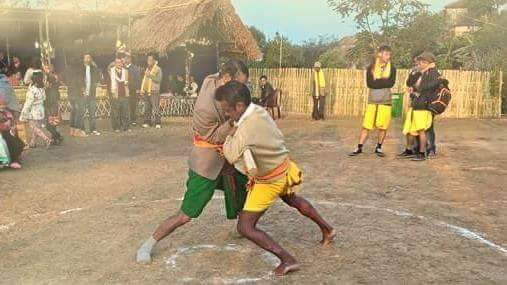
This game is conducted on the third day of the dimasa traditional festival called Bishu Dima. The third day of the festival is named as Jidab Bishu. The rules of the game is simple, one cannot cross the circle during the game. The one who crossed the circle could loss the game. The game is judge by elder person or the head of the village that had come to witness the festival.
Longkhaidu Shigba
Longkhaidu Shigba is also a Dimasa traditional games played by the males only. It is similar to tug of war played in different way. This game is played between the two male. A line is made with a white powder or sand available. The rope is wrapped around their shoulder and placed the two competitors on the opposite direction, one on the other side and another on the opposite side of the line. Then the competitor are made to bow down and pulled each other. The one who can pull his opponent inside the line is declared as the winner.
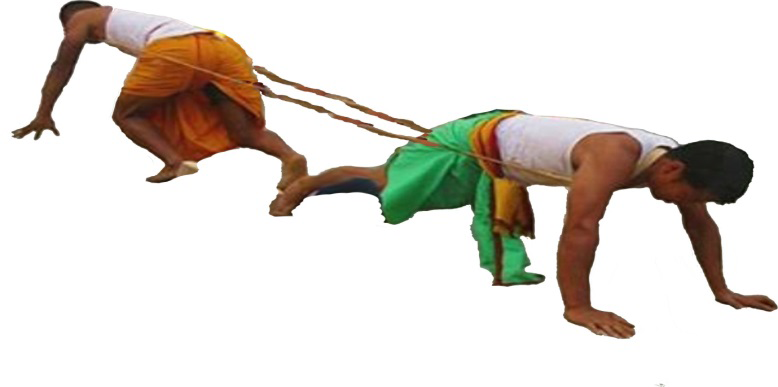
There is no taboo related to this game. This game is played in occasion like festivals and other ceremonies to show their strength, skills etc. The rules are simple in this game one cannot take the help of their hands to pull. The game is judge by the elder person.
Samtoh Suguba
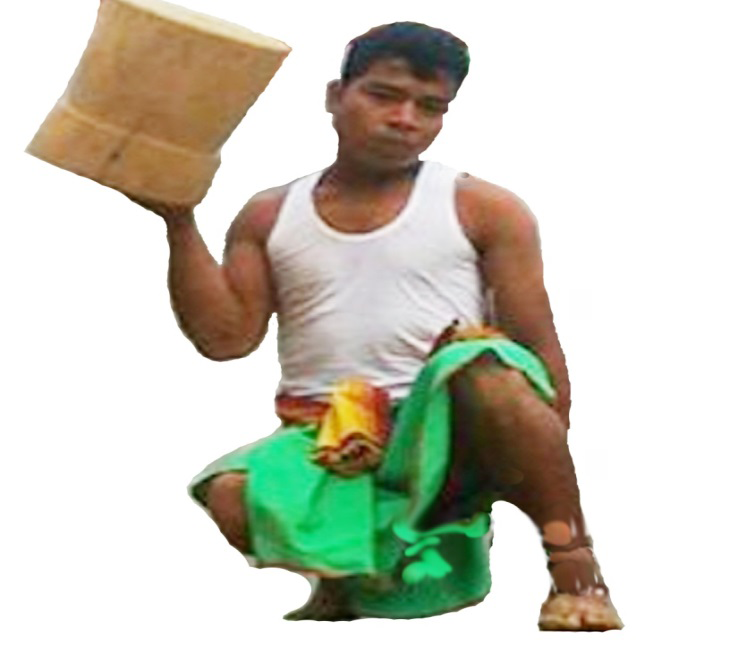
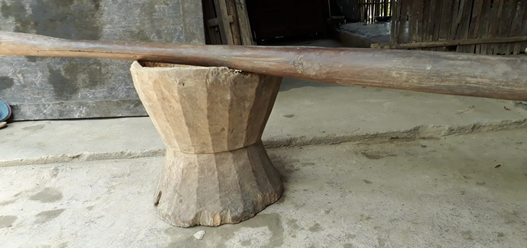
Samtoh Suguba is a dimasa traditional sport similar to shot put throw but played in different way. It is played only by the adult males. Samtoh is a traditional rice pounding tools in which the rice is kept to pound. In these games Samtoh is used to play the game. It is an individual game. In this game the person is made to throw the samtoh with his one hand either left or right hand. The person cannot cross the line the line while throwing the samtoh. The one who can throw the samtoh from the line to the furthest is declared as the winner of the game. The first drop of the samtoh is spot to measure. There is no taboo related to the game.
Harong Baiba
Harong Baiba is another Dimasa traditional sport. On the third and last day of three-day Jidab Bishu, traditional games Harong Baiba are held among the married males and unmarried males at the bachelor’s dormitory field.
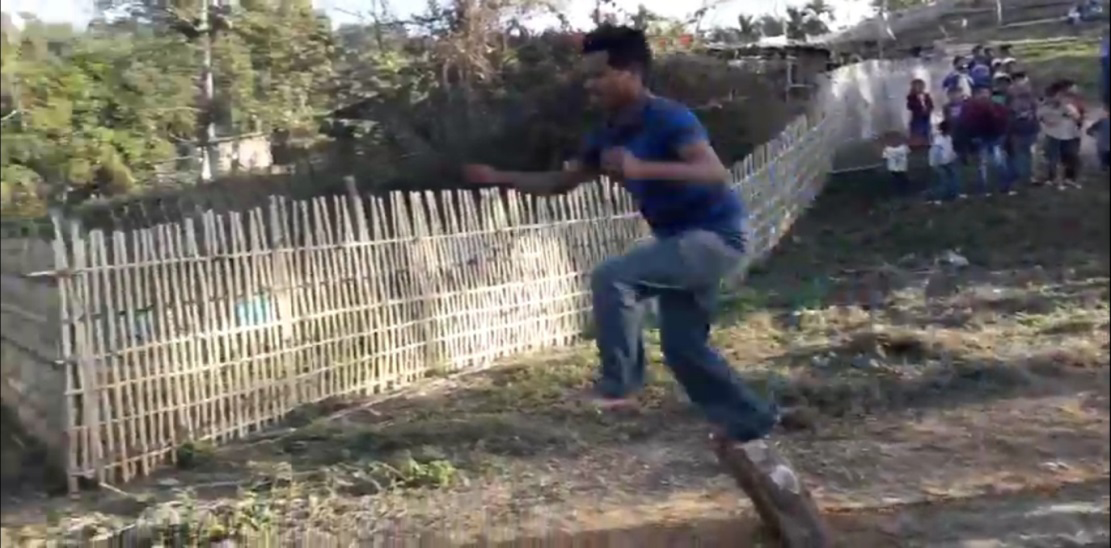
Harong Baiba is a game where bar of log (Harong) is fixed on the ground, which acts as the takeoff point from which the competitor has to leap as far as possible. This is a form of long / broad jump game. The one who can jump longer is declared as the winner. Interestingly the declared hero or winner has to entertain the villagers with rice beer and meat.
Longthai Lemba
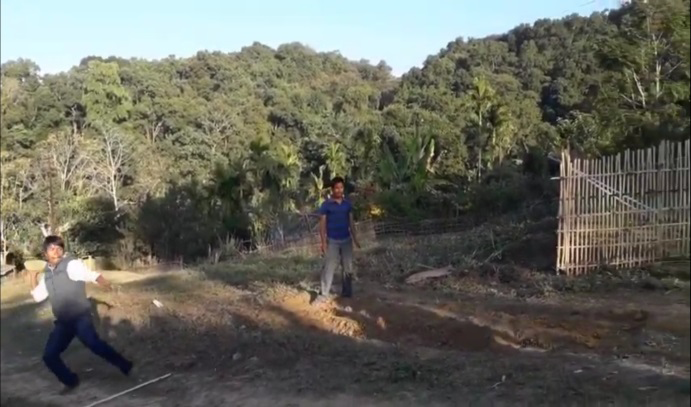
Longthai Lemba is another traditional sport of the dimasa. It is similar to shotput and discus throw, where a heavy spherical object, generally a block of stone (Longthai) acts as the shot, which the competitor is supposed to throw in a pushing motion as far as possible, in an attempt to mark a farther distance than his or her competitors. This game is only for the senior married persons only. The one who can throw the block of stone to a farther distance is declared as the winner. After offering meat and rice beer to their ultimate deity ‘Shibarai’, the same are offered to the winners of Longthai Lemba. Besides, the village headman rewards them with due prize (Blaisandi).
Douyong Siklaiba
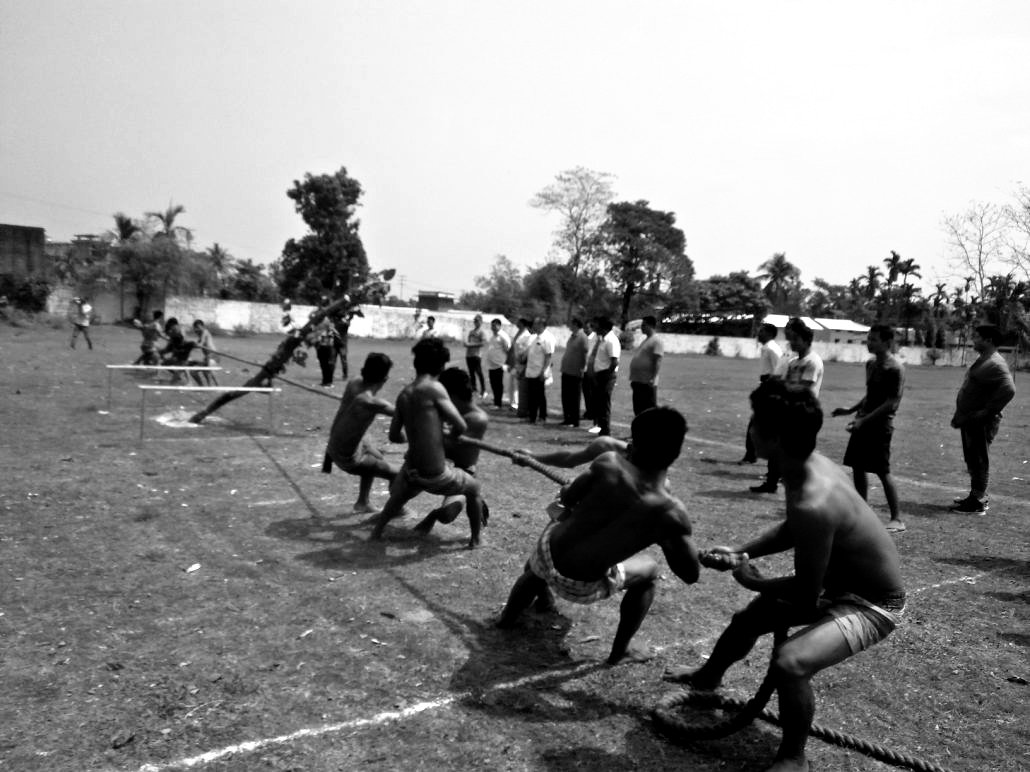
Douyong Siklaiba is also another traditional game of the dimasa. It is played between the married and unmarried men and also between the married and unmarried women. It is very similar to tug of war. Equal numbers of players on either side of the rope. A flag is tied on the centre of the rope. There is no taboo related to this game. In this game, the opposing player or teams will pull on a rope until one of the teams or players succeeds at pulling the majority of the rope and lay it out in a straight line on the ground. The winners are sometimes given prizes. Traditionally, it is expected that the donations whether in cash or in kind may be used for the feast.
These games are played with locally available material. Materials like block of stones, rope, bar of logs, etc. are used in the games. Competitions are held by mutual invitation between the villages to show their skills and strength. Meanwhile instead of winning superiority the collective solidarity is more noticeable here. The indigenous games are played with a number of material cultural implements according to the rule and nature of a particular game.
These games are held during the festivals and in other occasion. Among the festivals of Dimasa, Bishu is the most joyous and important community festival. Bishu is an occasion for relaxation from hard toils. It can therefore be termed as harvesting festivals or festivals of rejoicing and merry making. Hence the participation in this celebration is not restricted to anyone. One the third day of the Bishu Dima festival the Traditional games are played in a particular selected area. The other community people also participate in the games during the festivals. The declared Hero or winner has to entertain the villagers with rich beer and meet. The judgement is made by the elder person or the Head of the village.
Conclusion
Play is an expressive behavior common among all human beings and manifested overtly in all cultures. Different cultures or communities have different types of traditional games of their own. Traditional games of the studied people are designed in such a way that one can develop lot of skills like logical thinking, mental ability, concentration, cooperation, team work and lot more. Especially for children traditional games are useful to improve their learning skill and creativity, hand-eye co-ordination, confidence and finally to have fun and utilization of free time. For adult also traditional or ethnic games play an effective role in maintaining their physical fitness and as a recreational activity or entertainment in their busy life schedule. Though the modernization and advent of modern technology has brought a lot of change and impact on traditional cultures of the society however, the people continue to pass their ethnic games and sports and other traditional cultures to the next generation. It has been found that, among the studied people, different ethnic games are still well popular and much accepted even by their younger generations. Such games are a very crucial part in their social festivals or in certain religious occasions. It is a community matter for them and both males, females can participate in it according to the specified rules of it. It is rather a combination of both tangible and intangible cultural heritage among them. However, there are some emerging consequences, where the concerned players are not getting enough recognition. On the other hand the youths are out migrating from the ancestral villages for their jobs and in this way they are getting detached from their very crucial ethnic tradition. It is expected that, the state government will seriously look into the matter to protect and preserve this rich ethnic heritage of the state and concerned ethnic group [9].
References
-
Michael G, Malgorzata B, Jorma S (2015) Cultural Aspects of Traditional Sports and Games. International Journal of physical Education 52(3): 1-13.
-
Linaza M, Kieran M, Noel C (2013) Traditional Sports and Games: A New Opportunity for Personalized Access to Cultural Heritage. Electronic document.
-
Khalid S (2008) Value of traditional games. Nurture (5):19-21.
-
Kovacevic T, Sinisa O (2014) Contribution of Traditional Games to the Quality of Students’ Relations and Frequency of Students’ Socialization in Primary Education. Croatian Journal of Education 16(1): 95-112.
-
Boro J, Rita D, Bhupen N (2015) Impact of Globalisation to Traditional Games and Recrearion of the Bodos. IOSR Journal of Humanities and Social Sciences 20(3): 87-91.
-
Boro A (2010) Folk literature of Bodos. Guwahati: NL Publication.
-
Endle S (1975) the Kachari. Delhi: Cosmo Publication
-
Jarvie G (2006) Sports, Culture and Society: An Introduction. Routledge.
-
Sands R (1999) Anthropology, Sport and Culture. Westport, CT: Bergin & Gaevey.
- The Indispensable Role of Informal Caregivers in Supporting the Aging Population
- Socio-Religious Significance of Kamakhya Temple in Guwahati, Assam
- Is Anthropology Possible?
- A Contribution to the History and Paleobiology of Harput/Elazığ Türkiye and Its Surroundings
- A Study on the Cowrie Shells of the Dimasas in Assam
- The Significance of International Organizations Cooperation in the Efficient Resolution of Global Conflict