
Zanthoxylum Armatum: A Systemic Review of its EthnoMedicinal Properties, Phytochemistry, Pharmacology and Toxicology
Background: Zanthoxylum armatum DC., a popular spice and traditional medicine is widely distributed throughout North Eastern region of India. The plant has been used in different indigenous medicinal practices to cure several diseases associated with digestive and nervous system. Aim: The aim of this paper is to provide a systematic review on taxonomy, ethnomedicinal properties, phytochemistry, pharmacology, and toxicology of this plant. Furthermore, the possible development and perspectives for future research on this plant are also discussed.Materials and methods: Upto date information was gathered through a search of different books, journals, articles, annual reports, proceedings and web-based materials. Result: The different plant parts like leaves, fruits, stem, bark, seeds and roots are enriched with various secondary metabolites viz. alkaloids, sterols, phenolics, lignins, coumarins, terpenoids and flavonoids. It is considered as one of the most valued commercial trade medicinal plant due to its multidirectional therapeutic applications in Ayurveda and other traditional system of medicine. Pharmacological findings revealed its potential as nootropic, antioxidant, antiinflammatory, cytotoxic, insecticidal/larvicidal drug. Conclusion: Zanthoxylum armatum is one of the important folklore medicinal plants cultivated in North Eastern region of India. Its diverse therapeutic applications can be associated with the presence of various secondary metabolites. The various ethno-pharmacological applications of Zanthoxylum armatum have been verified by several related researches. More extensive study on the individual specific phyto-component can lead to novel innovations for the well-being of mankind.
Introduction
Medicinal plants represent a great deal of untapped reservoir of natural medicines. The structural diversity of their phytoconstituents makes them a valuable source of novel lead compounds for the quest of drugs to treat acute and chronic diseases. Indian subcontinent has richest plant based medicinal traditional system because of its rich biodiversity [1]. These herbal medicines are mainly used for health care due to their better economy and lesser side effects on human body. The Indian Himalayan region contains about 1,748 different species of medicinal plants [2].
Among them Zanthoxylum armatum DC (Z armatum) (Family: Rutaceace) is regarded as an important medicinal plant due to its immense therapeutic efficacy. It is commonly known as Indian Prickly Ash, Nepal Pepper or Toothache tree. It is widely distributed in India, from Kashmir to Bhutan at altitudes up to 2,500 m, also occurs throughout North East India [3]. It is also found throughout most of China, Taiwan, Nepal, Philippines, Malaysia, Pakistan and Japan at altitudes of 1,300-1,500 m. Valleys and thickets in the mountains, wasteland and the under-storey of mixed forest are customary locations of the species [4].
It is a small tree or large spiny shrub. Leaves are distinctively trifoliolate with the leaf-stalk winged. Leaflets are stalk less, 2.0-7.5 × 1.0-1.7 cm, elliptic to ovate-lace like, entire to slightly toothed, sharp tipped, base sometimes oblique. Minute yellow flowers arise in leaf axils. Flowers have 6-8 acute sepals. Petals are absent. Male flowers have 68 stamens and large anthers because of which the flowers look yellow. Female flowers have 1-3 celled ovary, pale red, splitting into two when ripe. Seeds are round 3 mm in diameter with shining black color. The plant is adapted to subtropical climate of lower warm valleys of the Himalayas with sufficient rainfall [5]. The flowering period is from March to April (Figure 1). The taxonomical profile is detailed below (Table 1).
| Kingdom: | Plantae |
| Class: | Angiosperms |
| Order: | Sapindales |
| Family: | Rutaceae |
| Genus: | Zanthoxylum |
| Species: | Z. armatum |
| Binomial name | |
|---|---|
| Zanthoxylum armatum | |
Table 1: Taxonomy of _Z. armatum._
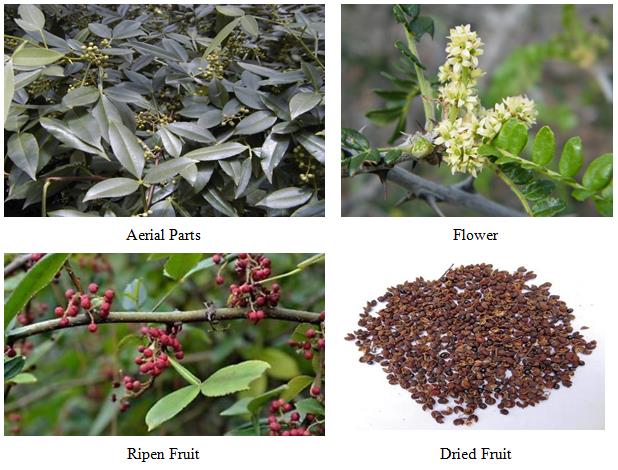
Figure: Parts of Z. armatum
Traditional Uses
The bark, fruits and seeds of Zanthoxylum armatum are extensively used in indigenous system of medicine as a carminative, stomachic and anthelmintic drug. The fruit and seeds are employed as an aromatic tonic in fever and dyspepsia [6]. An extract of the fruits is reported to be effective in expelling round worms. Because of their deodorant, disinfectant and antiseptic properties, the fruits are used in oral hygienic preparations, and their lotion for scabies [7]. They are also used to insect repellant agent. The natives of North America crush the bark and apply on their gums for relief hence it is known as the toothache tree. It is used in China and India as snake bite remedy. In China the dried fruits are marketed, and appear as small red carpels containing the black, shinning, pungent and somewhat acrid-tasting seeds, which are about 3.1 mm across [8]. The fruits have also been used, since classical times, for pickling. The traditional uses of Z. armatum are listed in Table 2.
| Sl No. | Country | Parts of plant | Traditional Uses | Reference | ||||||||||
|---|---|---|---|---|---|---|---|---|---|---|---|---|---|---|
| 1 | India | Seeds and bark | fever, dyspepsia cholera. | 6 | ||||||||||
| Aerial parts | Insecticidal | 6 | ||||||||||||
| 2 | Japan | Seed | GIT problems and depression. | 9 | ||||||||||
| 3 | Nepal | Fruit | Decoction is used for abdominal pain. | 8 | ||||||||||
| Berries | Carminative, antispasmodic, anti-rheumatic and skin diseases. | 8 | ||||||||||||
| Bark | Cholera, diabetes and asthma. | 8 | ||||||||||||
| fruits | Pickles are useful for cold & cough, tonsillitis, high altitude sickness, limbs numbness, vertigo/dizziness. Dried powdered decoction against diarrhoea, dysentery and stomachache. | 8 | ||||||||||||
| 4 | Pakistan | Fruit | Spice and condiment. Powder of its dried fruit along with Mentha longifolia dried leaves, Trachyspermum ammi seeds and black salt is taken with water during cholera and indigestion. Twigs are used as toothbrush during gum problems and toothache. | 9 8 | ||||||||||
| 5 | China | Aerial plant | An infusion in vinegar is used to expel bugs or worms infecting ear. Scabies is treated by the plant, using a lotion applied to the skin. | 10 | ||||||||||
| 6. | Malaysia, Thailand | Branches and stems | Stomach tonic, to treat snake bites | 11 |
Table 2: The traditional uses of _Z. armatum_.
Phytochemistry
Various phytochemical constituents like terpenoids, flavonoids, alkaloids, phenolics, lignins, coumarins, glycosides have been extracted from different parts of the plant. Monoterpenes like linalool and limonene are the major constituents of the essential oil. Seeds contain hydroxylic (4Z) enolic acid and various volatile compounds. GC-MS analysis of essential oil revealed presence of Linalool (53.05%), Bergamot mint oil (12.73%), Limonene di epoxide (11.39%) , α-pinene (4.08%), β-Myrcene (3.69%)and β-Limonene (3.10%) as major constituents [12, 13, 14]. A number of alkaloids and coumarins viz. berberine, fagarine, magnoflorine, laurifoline, nitidine, chelerythrine, tambetarine and candicine, and coumarins viz. xanthyletin, zanthoxyletin, alloxanthyletin has been isolated and reported have been isolated and reported from different parts of the plant [15]. A new amide designated as armatamide along with two lignans, asarinin and fargesin, have been isolated from the bark extract [16]. From the alcoholic extract of the stem bark, a new flavonoid glycoside has also been isolated [17]. The main components of the oil are oleic acid, palmitic acid, linoleic acid methyl ester, limonene and linalool [18]. The carpels yield a volatile oil, resin, yellow acid principle, and crystalline solid body, xanthoxylin [19]. Various types of phytoconstituents and their structures are summarized in Table 3 & 4 respectively.
| Sl. No. | Class | Compound | Plant parts | References | ||||||||||
|---|---|---|---|---|---|---|---|---|---|---|---|---|---|---|
| A. Terpenoids | ||||||||||||||
| 1 | α-Fenchol | Seed | 12 | |||||||||||
| 2 | α-Terpinene | Seed | 12 | |||||||||||
| 3 | α-Thujene | Seed | 12 | |||||||||||
| 4 | α-Thujone | Seed | 12 | |||||||||||
| 5 | α-Pinene | Seed | 12 | |||||||||||
| 6 | α-copaene | Leaf oil | 12 | |||||||||||
| 7 | α-Terpineol | Seed | 12 | |||||||||||
| 8 | alpha-phellandrene | Leaf oil | 12 | |||||||||||
| 9 | β-Pinene | Seed | 12 | |||||||||||
| 10 | beta- Myrcene | Leaf oil | 12 | |||||||||||
| 11 | β -Cymene | Leaf oil | 12 | |||||||||||
| 12 | β-Phellandrene | Seed | 12 | |||||||||||
| 13 | β-Terpeneol | Leaf oil | 12 | |||||||||||
| 14 | Camphene | Seed, leaf oil | 12 | |||||||||||
| 15 | Carvone | Seed | 12 | |||||||||||
| 16 | Citral | Dry fruit | 12 | |||||||||||
| 17 | Citronellol | Seed | 12 | |||||||||||
| 18 | Citronellal | Seed | 12 | |||||||||||
| 19 | 1,8-Cineole | Seed | 12 | |||||||||||
| 20 | β-ocimene | Leaf oil | 12 | |||||||||||
| 21 | Trans-beta-Ocimene | Leaf oil | 12 | |||||||||||
| 22 | cis-beta-Ocimene | Seed, leaf oil | 12 | |||||||||||
| 23 | Geraniol | Dry fruit | 12 | |||||||||||
| 24 | γ-terpinene | Seed/leaf oil | 12 | |||||||||||
| 25 | (E)-Carveol | Seed | 12 | |||||||||||
| 26 | (E)-Linalool oxide | Seed | 12 | |||||||||||
| 27 | Limonene | Seed/leaf | 12 | |||||||||||
| 28 | D-Limonene | Leaf oil | 12 | |||||||||||
| 29 | Limonene | Seed/leaf oil | 12 | |||||||||||
| 30 | Bornyl acetate | Leaf oil | 12 | |||||||||||
| 31 | Linanyl acetate | Dry fruit | 12 | |||||||||||
| 32 | Myrcene | Seed | 12 | |||||||||||
| 33 | Terpinolene | Leaf oil | 12 | |||||||||||
| 34 | α-terpinolene | Leaf oil | 12 | |||||||||||
| 35 | Nerol | Seed | 12 | |||||||||||
| 36 | 1-α-Phellandrene | Seed | 12 | |||||||||||
| 37 | cymene | Leaf oil | 12 | |||||||||||
| 38 | p-Cymene | Seed | 12 | |||||||||||
| 39 | Piperitone | Seed | 12 | |||||||||||
| 40 | Sabinene | Seed | 12 | |||||||||||
| 41 | Tagetonol | Seed | 12 | |||||||||||
| 42 | Terpinen−4-ol | Seed | 12 | |||||||||||
| 43 | (Z)-Sabinene hydrate | Seed | 12 | |||||||||||
| 44 | (Z)-Linalool oxide | Seed | 12 |
Table 3: Structures of isolated phytoconstituents from Z. armatum.
| 45 | (Z)-Pinene hydrate | Seed | 12 | |
|---|---|---|---|---|
| 46 | allo-Aromadendrene | Seed | 12 | |
| 47 | α-Caryophyllene | Seed | 12 | |
| 48 | trans-caryophyllene | Leaf oil | 12 | |
| 49 | (E)-Nerolidol | Seed | 12 | |
| 50 | α-Amyrins | Bark | 12 | |
| 51 | β-Amyrone | Bark | 12 | |
| 52 | β-Amyrins | Bark | 12 | |
| 53 | Lupeol | Bark | 12 | |
| 54 | Eucalyptol | fruit | 12 | |
| B. Flavonoid | ||||
| 55 | Catechin | Leaf | 13 | |
| 56 | Hesperidine | Leaf | 13 | |
| 57 | Vitexin | Leaf | 13 | |
| 58 | Isovitexin | Leaf | 13 | |
| 59 | 3,5-Diactyltambulin | Bark | 13 | |
| 60 | Kaempferol | Bark | 13 | |
| 61 | Tambulin | Bark | 13 | |
| 62 | 3,5,3′-Trihydroxy−6,7- dimethoxy− 4′- (7″-hydroxygeranyl−1″-ether) flavone | Seed | 14 | |
| 63 | 3,5,3′,4′-Tetrahydroxy−7,8-dimethoxy flavone | Seed | 14 | |
| 64 | Tambuletin | Seed | 14 | |
| C. Alkaloids | ||||
| 65 | Berberine | Bark | 15 | |
| 66 | Dictamnine | Root | 15 | |
| 67 | -fagarine | Bark | 15 | |
| 68 | -fagarine | Bark | 15 | |
| 69 | Chelerythrine | Bark | 15 | |
| 70 | Magnoflorine | Root | 15 | |
| 71 | Nevadensin | Seed oil | 15 | |
| 72 | Skimmianine | Bark | 15 | |
| 73 | Zanthonitrile | Bark | 15 | |
| D. Lignins | ||||
| 74 | Asarinin | Bark leaf | 15 | |
| 75 | Eudesmin | Leaf | 15 | |
| 76 | Epieudesmin | Leaf | 15 | |
| 77 | Fargesin | Bark leaf | 15 | |
| 78 | Kobusin | Leaf | 15 | |
| 79 | Planispine-A | Leaf | 15 | |
| 80 | L-Asarinin | Bark | 15 | |
| 81 | L-Sesamin | Bark | 15 | |
| 82 | L-Planinin | Bark | 15 | |
| 83 | Magnolin | Bark | 15 | |
| 84 | Phylligenin | Bark | 15 | |
| 85 | Planinin | Bark | 15 | |
| 86 | Sesamin | Leaf/Bark | 15 | |
| E. Sterols & Steroids | ||||
| 87 | β-Daucosterol | Bark | 12 | |
| 88 | β-Sitosterol | Bark | 12 | |
| 89 | Stigmasta−5-en−3β-Dglucopyranoside | Seed | 12 | |
| 90 | β-Sitosterol-β-D-glucoside | Bark | 12 | |
| F. Amides | ||||
| 91 | Armatamide | Bark | 15 | |
| 92 | α-Sanshool | Leaf | 15 | |
| 93 | Hydroxyl-α-sanshooil | Pericarp | 15 | |
| G. Coumarins | ||||
| 94 | xanthyletin | Bark | 16 | |
| 95 | zanthoxyletin | Bark | 16 | |
| 96 | alloxanthtin | Bark | 16 | |
| 97 | Bergapten | Bark | 16 | |
| 98 | Umbelliferone | Bark | 16 | |
| 99 | psoralen | Leaf | 16 | |
| 100 | Cuminol | Bark/Fruit | 15 | |
| 101 | Cuminaldehyde | Seed | 15 | |
| 102 | Phellandral | Seed | 15 | |
| 103 | 2-Tridecanone | Leaf-oil | 16 | |
| 104 | Undecan−2-one | Aerial parts | 12 | |
| H. Aromatic compounds | ||||
| 105 | 1-Hydroxy−6,13-anthraquinone | Seed | 17 | |
| 106 | 2-Hydroxybenzoic acid | Seed | 17 | |
| 107 | 2-Hydroxy−4-methoxy benzoic acid | Seed | 17 | |
| 108 | trans-Cinnamic acid | Seed oil | 17 | |
| 109 | Vanillic acid | Bark | 17 | |
| 110 | (E)-Methyl cinnamate | Seed | 17 | |
| 111 | Methyl cinnamate | Seed/fruit | 17 | |
| 112 | (Z)-Methyl cinnamate | Seed | 17 | |
| 113 | 3-Methoxy−11-hydroxy −6,8- dimethylcarboxylate biphenyl | Seed | 17 | |
| 114 | 3,5,6,7-Tetrahydroxy−3′,4′-dimethoxy flavone−5-β-D-xylopyranoside | Seed | 17 | |
| 115 | Monoterpenetriol−3,7- dimethyl−1- octane−3,6,7-triol | Seed oil | 17 | |
| 116 | 1-Methoxy−1,6,3-anthraquinone | Seed | 17 |
Table 4: Structures of isolated phytoconstituents from Z. armatum.
| phellandrene | Nerol | Myrecene |
| Linalool | Piperitone | D-Limonene |
| -Ocimene | Cis- Ocimene | 1,8-Cineole |
| Carvone | -Terpineol | -Phellandrene |
| Catechin | Vitexin | Hesperidin |
Table 5: Structures of isolated phytoconstituents from Z. armatum.
| Berberine | Dictamnine | Chelerythrine |
| Asarinin | Eudesmin | Kobusin |
| Daucosterol | β-Sitosterol | α-Sanshool |
Table 6: Structures of isolated phytoconstituents from Z. armatum.
Pharmacology
Antioxidant Activity
Leaves extract of Z. armatum showed potent antioxidant activity in in-vivo models. Administration of the extract (100, 200 mg/kg b.w.) significantly enhanced the activities of antioxidant enzymes (SOD, CAT and GSH) in the treated animals. Both the doses showed increase in SOD, CAT and GSH level significantly (p < 0.05 and p < 0.01 respectively), whereas lipid peroxidation level was decreased in dose dependent manner [18].
Hepatoprotective Activities
In another experiment, hepatoprotective activity of ethanolic extract of Z. armatum bark against CCl4 induced hepatotoxicity was evaluated in-vivo. CCl4 and olive oil (1:1) administration caused a significant increase in the serum activities of ALT, AST, ALP, direct billirubin and total billirubin. Ethanolic extract (100, 200, and 400 mg/kg once daily for7days) significantly reduced the above elevated parameters in dose dependant manner and was comparable to silymarin (25mg/kg) [20].
Antispasmodic Effect
The crude extract of Z. armatum (100 and 300 mg/kg; p.o.) showed 20% and 60% protection from against castor-oil-induced diarrhea in mice and was comparable with standard drug Loperamide (10 mg/kg) (21). In another experiment, essential oil of Z. armatum leaves was evaluated for possible anti-diarrheal activity on spontaneous and potassium chloride induced contracted smooth muscle of the isolated rabbit jejunum. The spasmolytic effect of volatile oil started from 0.03 mg/ ml and showed 100% effect at10 mg/ml dose. The extracts relaxed the contracted muscle which may be due to calcium channel blocking from the sarcoplasmic reticulum [22].
Keratinocyte Inhibition
Anti-proliferative activity of methanolic extract of Z. armatum bark (concentrations between 0.008 and 0.4 mg/ml) was evaluated against the growth of rapidly multiplying human keratinocytes (HaCaT cells). The extract significantly inhibited the growth of keratinocytes and highly active with an IC50 value of 11 mg/ml [23].
Larvicidal Activities
Essential oil of the seeds of Z. armatum (dose: 200, 150, 100, 50, 25 and 10 ppm) was evaluated in-vitro for larvicidal activities against three mosquitoes species: Aedes aegypti, Anopheles stephensi and Culex quinquefasciatus. Results indicated that essential oil was most sensitive against Culex quinquefasciatus was the with LC50 and LC95 values of 49 and 146 ppm respectively compared to other species. Temephos, a synthetic larvicidal agent (dose: 0.005-0.1 ppm) was used as positive control [24].
Anti-Inflammatory
Bergapten, a coumarin extracted from the plant exhibited significant inhibition of pro-inflammatory cytokine viz. tumor necrotic factor-α (TNF-α) and interleukin-6 (IL-6) in a concentration dependent manner [25].
Antibacterial, Antifungal Activities
3,5-diacetyltambulin an isolated Flavonoid from Z. armatum showed significant antibacterial activity against Gram positive bacteria (Bacillus subtilis, B. megaterium, Staphylococcus aureus) and Gram negative bacteria (Escherichia coli, Shigella dysenteriae, S. sonnei, S. flexneri, Pseudomonus aeruginosa, Salmonella typhi). The MIC values against these bacteria ranged from 8-64 µg/ml. However, this flavonoid and monoterpenoid (geraniol) shows weak antifungal activity [26].
Toxicology and Side Effects
Zanthozyllum species volatile oil showed insecticidal activity which may be associated with its acetylcholinesterase activity. Potent fumigant toxicity was observed with cuminaldehyde, thymol, (1S)-(-)- verbenone, (-)-myrtenal, carvacrol, (S)-(Z)-verbenol, Z. piperitum steam distillate, cuminyl alcohol, Zanthoxylum armatum seed oil, piperitone, (-)-(Z)-myrtanol, and citronellal (LC50, 0.075-0.456 μg/cm3). An in-vitro bioassay using female fly heads indicates that strong acetylcholinesterase inhibition was produced by citronellyl acetate, α-pinene, thymol, carvacrol, and α- terpineol (1.20-2.73 mM), but no direct correlation between fly toxicity and AChE inhibition by the test compounds was observed [27, 28].
Conclusion
Zanthoxylum armatum is one of the important medicinal plants having a wide array of household, commercial and ethno-medicinal applications. The fruits, leaves, seeds and stem bark are used in head-ache, fever, toothache, tonsillitis, diarrhea, dysentery, altitude sickness. The fruits contain essential oil that possesses antiseptic, disinfectant properties so it has its wide application in pharmaceuticals and flavoring industries. The main constituents of the essential oil are limonene and linalool. Different chemical compounds like alkaloids, flavonoids, terpenoids, phenols, coumarins etc present in different parts of the plants have attributed to several biological activities like antimicrobial, anti- viral, hepatoprotective, larvicidal, antioxidant etc. The different traditional ethno-medicinal practices have been validated by several in vitro and in vivo ethno-pharmacological studies, as evidenced in this review, suggesting for further potential biological applications of Zanthoxylum armatum. Many active components have been identified from the plant that might be developed into novel drugs. Therefore further emphasis Z. armatum is one of the diverse medicinal plants having a wide range of therapeutic applications among the tribes of North Eastern region of India. Owing to its diverse applications, the species can be developed as an important commodity for alleviation of poverty in rural areas. The extracts, volatile oil and lead molecules are traditionally utilized in cerebral pain along with other disorders. Volatile oil is mainly used as fumigant and disinfectant. Various secondary metabolites like alkaloids, flavonoids, terpenoids, etc. are responsible for its pharmacological properties. The different customary ethno-therapeutic practices have been validated by modern in-vitro and in-vivo assays to support the scientific basis of uses of Z. armatum. Numerous active components have been distinguished from the plant that may be formed into novel medications. Along these lines further accentuation ought to be on screening, isolation and characterization of bioactive phytoconstituents along with their mechanism based study will be essential. The correlation between ethnopharmacological, phytochemical and pharmacological examinations could set up a solid linkage between the ages old indigenous restorative practices and present day scientific inquires about that could unearth the enormous hidden abilities of medicinal plants and their applicable folklore uses. Zanthoxylum armatum is one of the important medicinal plants having a wide array of household, commercial and ethno-medicinal applications. The fruits, leaves, seeds and stem bark are used in headache, fever, toothache, tonsillitis, diarrhea, dysentery, altitude sickness. The fruits contain essential oil that possesses antiseptic, disinfectant properties so it has its wide application in pharmaceuticals and flavoring industries. The main constituents of the essential oil are limonene and linalool. Different chemical compounds like alkaloids, flavonoids, terpenoids, phenols, coumarins etc present in different parts of the plants have attributed to several biological activities like antimicrobial, anti- viral, hepatoprotective, larvicidal, antioxidant etc. The different traditional ethno medicinal practices have been validated by several in vitro and in vivo ethno-pharmacological studies, as evidenced in this review, suggesting for further potential biological applications of Zanthoxylum armatum. Many active components have been identified from the plant that might be developed into novel drugs. Therefore further emphasis Zanthoxylum armatum is one of the important medicinal plants having a wide array of household, commercial and ethno-medicinal applications. The fruits, leaves, seeds and stem bark are used in headache, fever, toothache, tonsillitis, diarrhea, dysentery, altitude sickness. The fruits contain essential oil that possesses antiseptic, disinfectant properties so it has its wide application in pharmaceuticals and flavoring industries. The main constituents of the essential oil are limo- nene and linalool. Different chemical compounds like alkaloids, flavonoids, terpenoids, phenols, coumarins etc present in different parts of the plants have attributed to several biological activities like antimicrobial, anti- viral, hepatoprotective, larvicidal, antioxidant etc. The different traditional ethno-medicinal practices have been validated by several in vitro and in vivo ethno- pharmacological studies, as evidenced in this review, suggesting for further potential biological applications of Zanthoxylum armatum. Many active components have been identified from the plant that might be developed into novel drugs. Therefore further emphasis.
Acknowledgement
We sincerely acknowledge faculty of pharmaceutical science, Assam down Town University, Gandhi Nagar, Panikhaiti, Guwahati-26; for providing the basic infrastructure to prepare this manuscript.
Conflict of Interest Statement
The authors declare no conflict of interest.
References
-
Chopra RN, Nayar SL and Chopra IC (1986) Glossary of Indian Medicinal Plants (Including the Supplement), Council of Scientific and Industrial Research, New Delhi.
-
Mathur AC, Srivastava JB and Chopra IC (1961) Insecticidal properties of _Zanthoxylum_ _alatum_ Linn, Curr Sci 30: 223-224.
-
Geweli MB and Awale S (2008) Aspects of Traditional Medicine in Nepal, Institute of Natural Medicine University of Toyama, Japan. pp: 140-142.
-
Barkatullah, Ibrar M and Hussain F (2009) Ethnobotanical studies of plants of Charkotli Hills, Batkhela District, Malakand, Pakistan, Front Biol China 4: 539-548.
-
Abbasi AM, Khan MA, Ahmed M and Zafar M (2010) Herbal medicines used to cure various ailments by the inhibitants of Abbottabad district, North West Frontier Province, Pakistan, Indian J Trad Know 9: 175-183.
-
Thokchom PS, Okram MS (2011) Phytochemical and pharmacological profile of _Zanthoxylum armatum_ DC- An overview. Indian Journal of Natural Products and Resources 2(3): 275-285.
-
Ahmad A, Misra LN, Gupta MM (1993) Hydroxyalk- (4z)-Enoic acids and volatile components from the seeds of _Zanthoxylum armatum_. J Nat Prod 56(4): 456-460.
-
Barkatullah M , Muhammad N , Rehman I, Rehman M U, Khan A (2013) Chemical composition and biological screening of essential oils of _Zanthoxylum_ _armatum_ DC leaves. J Clin Toxicol 3(5): 1-6.
-
Negi JS, Bisht VK, Bhandari AK, Singh P, Sundriyah RC (2011) Chemical constituents and biological activities of the genus _Zanthoxylum_: a review. Afr J Pure Appl Chem 5(12): 412-416.
-
Singh G, Kapoor IPS, Singh P, Carola SH, Lampasona MP, et al. (2013) Chemistry and antioxidant properties of essential oil and oleoresins extracted from the seeds of tomer (_Zanthoxylum armatum_ DC). Int J Food Prop 16(2): 288-300.
-
Tiwary M , Naik S N, Tewary D K, Mittal P K, Yadav S (2007) Chemical composition and larvicidal activities of the essential oil of _Zanthoxylum armatum_ DC (Rutaceae) against three mosquito vector J Vector Borne Dis 44(3): 198-204.
-
Kokate SD, Venkatachalam SR, Hassarajani SA (2001) _Zanthoxylum alatum_ extract as mosquito larvicide. Proc. Nat. Acad. Sci., India Sect. B-Biol. Sci. India, pp: 229-232.
-
Yoshihito U, Yuriko N, Masayoshi H, Shuichi H , Seiji H (2000) Essential oil constituents of fuyu-sanshoo (_Zanthoxylum armatum_ DC.) in Nepal. Koryo, Terupen oyobi Seiyu Kagakuni kansuru Toronkai Koen Yoshishu 44: 59-61.
-
Neetu J, Srivastava SK, Aggarwal KK, Ramesh S, Sushil K (2001) Essential oil composition of _Zanthoxylum_ _alatum_ seeds from northernIndia. Flavor Fragr J 16(6): 408-410.
-
Luong NX, Hac L V, Dung NX (2003) Chemical composition of the leaf oil of _Zanthoxylum alatum_ Roxb. from Vietnam. J Essent Oil Bear Plants 6: 179- 184.
-
Perry LM (1980) Medicinal Plants of East and Southeast Asia. Massachusetts Institute of Technology, USA.
-
Li H, Li P, Zhu L, Xie M, Wu Z (2006) Studies on the chemical constituents of Zanthoxylum armatum DC. Zhongguo Yaofang. Chin Pharm 17: 1035-1037.
-
Li X, L Z, Zheng Q, Cui T, Zhu W, et al. (1996) Studies on the chemical constituents of Zanthoxylum armatum DC. Nat Prod Res Dev 8: 24-27.
-
Kalia NK , Singh B, Sood P (1999) A new amide from _Zanthoxylum armatum_. J Nat Prod 62(6): 311-312.
-
Bhatt V, Sharma S, Kumar N, Sharma U, Singh B (2016) Simultaneous quantification and identification of flavonoids, lignans, coumarins and amides in leaves of _Zanthoxylum_ _armatum_ using UPLC-DAD-ESI-QTOF- MS/MS. J Pharm Biomed Anal 132: 46-55.
-
Ramidi R, Ali M (1999) Two new flavonoids from the seeds of _Zanthoxylum alatum_ Roxb. Pharmazie 54 (10): 781-782.
-
Kayat HP, Gautam SD, Jha RN (2016) GC-MS Analysis of hexane extract of _Zanthoxylum armatum_ DC fruits. J Pharm Phytochem 5(2): 58-62.
-
Ranawat LS, Bhatt J, Patel J (2010) Hepatoprotective activity of ethanolic extracts of bark of _Zanthoxylum_ _armatum_ DC in CCl4 induced hepatic damage in rats. J Ethnopharmacol 127(3): 777-780.
-
Vashist H , Sharma RB, Sharma D, Upmanyu N (2016) Pharmacological activities on _Zanthoxylum armatum_- a review. World J Pharm Pharm Sci 5(12): 408-423.
-
Akhtar N, Ali M, Alam MS (2009) Chemical constituents from the seeds of _Zanthoxylum alatum_. J. Asian Nat Prod Res 11(1): 91-95.
-
Venkatachalam SR, Hassrajani SA, Rane SS (1996) Cis- 10-Octadecenoic acid, component of _Zanthoxylum_ _alatum_ seed oil. Indian J Chem 35(5): 514-517.
-
Hieu TT, Kim SI, Ahn YJ (2012) Toxicity of Zanthoxylum piperitum and Zanthoxylum armatum oil constituents and related compounds to Stomoxys calcitrans (Diptera: Muscidae). J Med Entomol 49(5): 1084-1091.
-
Nirmala P, Pramod KJ, Pankaj PR, Sangeeta R (2018) Zanthoxylum armatum DC: Current knowledge, gaps and opportunities in Nepal. J Ethnopharcol 32(4): 84- 96.
- Gallic and Citric Acid Present in the Peels of Tropical Fruits as an Alternative in the Fight against Cancer
- Treating the Forehead Lines with Combination of Forehead and Glabellar Botulinum Toxin Among Japanese Patients
- Clinical Evaluation of Patients Suffering from Breast Cancer & Determination of Treatment Therapies and Better Strategies Related to Breast Cancer
- Medieval Recipes by Al-Zahrāwī for Heart Palpitations Treatment
- Etiology and Prescription Errors of Myocardial Infarction in Different Health Care Systems of Azad Kashmir
- Early Diagnosis and Multidisciplinary Management of Turner Syndrome: A Paediatric Case Study