
Alzheimer’s Disease: Invisible Friend of Old People
Alzheimer’s disease is a fatal type of dementia. It is a disease that progresses from mild memory loss to loss of ability to converse and respond to the environment. Alzheimer’s disease is an incurable disease that affects brain regions that control thought, memory, and language. The disease symptoms may include: increased memory loss and confusion, the inability to pick up new skills, language difficulties, as well as difficulties in reading, writing, and working with numbers, difficulty organizing thoughts and reasoning, reduced attention span, and coping difficulties in new situations. Although it is still unknown what causes Alzheimer’s disease, several significant risk factors have been identified, including age, family history, Down’s syndrome, head injuries, and cardiovascular disease. Eating a healthy, balanced diet, maintaining a healthy weight, exercising regularly, staying within recommended alcohol limits, quitting smoking, and maintaining a healthy blood pressure are all ways to reduce the risk of Alzheimer’s disease. In a summary, it can be said that the signs, stages, causes, risk factors, and prevention strategies of the disease are mentioned in this article, along with recent literature. Because this is a mini-review article, the main idea is to go through recent literature and discuss all aspects of Alzheimer’s disease.
Introduction
Dementia refers to a set of symptoms associated with a progressive decline in brain function [1]. It has the potential to impair memory, thinking skills, and other mental abilities. The exact cause of Alzheimer’s disease is unknown, but some factors are thought to increase the risk of developing the condition. Alzheimer’s disease is a neurological disorder. It gradually erodes memory and thinking abilities, as well as the ability to complete even the most basic tasks. The brain is damaged for a decade or more before memory and other cognitive problems appear. During the preclinical stage of Alzheimer’s disease, people experience no symptoms and are unaware of toxic changes in the brain. Damage to the brain of someone with Alzheimer’s disease shows signs of early-onset symptoms between the 30s and the mid-60s and late-onset symptoms in the mid-60s [2]. Memory issues are frequently one of the first signs of cognitive impairment associated with Alzheimer’s disease. Non-memory aspects of cognition, such as word-finding, vision/spatial issues, and impaired reasoning or judgment, may also indicate Alzheimer’s disease in its early stages. In addition, some individuals may be diagnosed with mild cognitive impairment. People with Alzheimer’s disease experience more memory loss and other cognitive difficulties as the disease progresses. Alzheimer’s disease progresses through four stages: preclinical, mild, moderate, and severe.
Signs of Alzheimer’s Disease
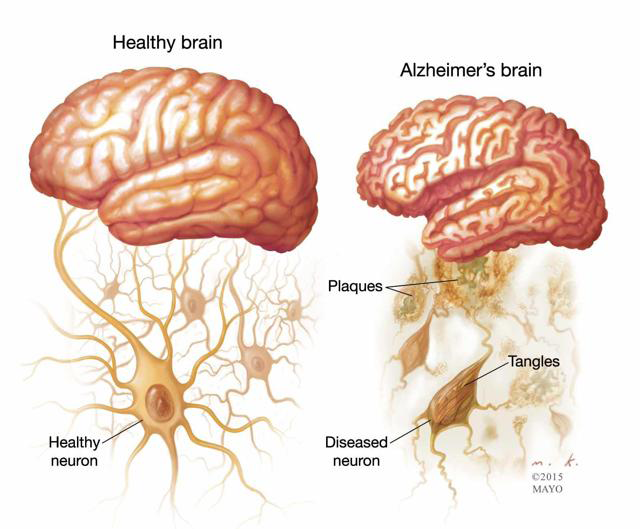
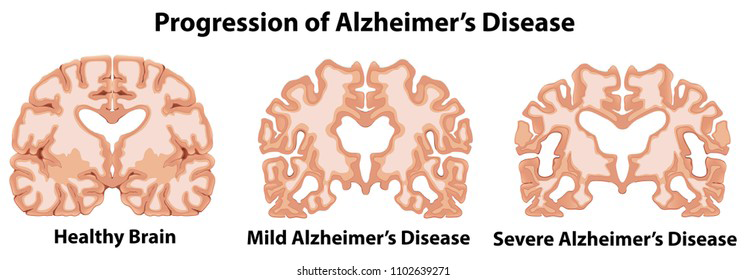
As neurons are injured and die throughout the brain in Alzheimer’s disease, connections between networks of neurons may break down, and many brain regions begin to shrink (Figures 1 & 2). This process, known as brain atrophy, is widespread by the end stages of Alzheimer’s disease, resulting in significant loss of brain volume. Alzheimer’s disease has different stages such as
- Initial
- Moderate
- Severe
Initial Stage of the Alzheimer’s Disease
The following are the initial symptoms of the disease [3]
Memory Loss: Everyone has occasional memory lapses, but Alzheimer’s disease memory loss persists and worsens, impairing the ability to function at work or home. Alzheimer’s patients may: a. Repeat statements and questions several times, b. Forget about conversations, appointments, and events, and won’t remember them later, c. Misplace possessions regularly, frequently putting them in illogical locations, d. Get lost in familiar surroundings, e. Forget the names of family members and commonplace objects, f. Have difficulty identifying objects, expressing thoughts, or participating in conversations. Reasoning and Thinking: Alzheimer’s disease impairs concentration and thinking, particularly when it comes to abstract concepts like numbers. Multitasking is especially difficult, and managing finances, balancing checkbooks, and paying bills on time may be difficult. A person suffering from Alzheimer’s disease may eventually be unable to recognize and deal with numbers.
Making Decisions and Judgments: Alzheimer’s disease impairs one’s ability to make sound decisions and judgments in everyday situations. For example, a person may make poor or unusual choices in social interactions or dress inappropriately for the weather. It may be more difficult to effectively respond to everyday problems.
Planning and Carrying out Routine Tasks: Activities that used to be routine, such as driving a car, become difficult as the disease progresses. People with advanced Alzheimer’s disease frequently lose the ability to perform basic tasks such as dressing, cooking, etc.
Personality and Behavioral Changes: Alzheimer’s disease- related brain changes can have an impact on moods and behaviors. The following are examples of potential issues: a. Swings in mood, b. Depression, c. Boredom, d. Withdrawal from social activities, e. Sleeping habits are changing, f. Untrustworthiness in others, g. Irritability and aggression, h. Wandering, i. Absence of inhibitions, j. Delusions.
Skills that were Preserved: Many important skills are retained for longer periods even as symptoms worsen. Reading or listening to books, telling stories, singing, listening to music, dancing, drawing, or doing crafts are all examples of skills that can be preserved. These abilities may be preserved for a longer period because they are controlled by parts of the brain that are affected later in the disease’s progression.
Mild Stage of the Alzheimer’s Disease
Moderate Alzheimer’s disease symptoms (Gardner A) [4] include memory loss and confusion; difficulties with language, reading, writing, and working with numbers; difficulties in organizing thoughts and reasoning logically; reduced attention span and new learning; difficulty performing multistep tasks; inappropriate emotional behaviors; problems recognizing family and friends; inappropriate views hallucinations, delusions, and paranoia; repetitive statements or movement; trouble making plans or organizing; struggle to use the telephone and occasional muscle twitches.
Severe Stage of the Alzheimer’s Disease
People with severe Alzheimer’s disease are unable to communicate and are completely reliant on others for care [5]. As the body shuts down, the person may spend most or all of the time in bed near the end. During this time, a person with Alzheimer’s loses many basic abilities, such as eating, walking, and sitting up. You can help by feeding your loved ones, easy-to-swallow food, teaching them how to use a spoon, and making sure they drink. This is significant because many people at this stage can’t tell when they’re thirsty. People with Alzheimer’s disease require a great deal of assistance from caregivers at this stage. Many families discover that, no matter how hard they try, they are unable to care for their beloved ones.
Hospice may be a good option for someone who is nearing the end of their life. This does not necessarily imply that they should be relocated. Hospice care can be provided anywhere. It is a team approach that focuses on the person’s and their family’s comfort, pain management and other medical needs, emotional concerns, and spiritual support. The symptoms at this stage often include; loss of weight, communication impediment, seizures, infections of the skin, swallowing difficulties, groaning or moaning, sleeping more than usual, and deficiency in bowel and bladder control.
Alzheimer’s Disease Causes, Risk Factors, and the Most Common Cause of Death
Alzheimer’s disease does not have a single cause [6, 7]. It is most likely caused by a combination of factors, including genetics, lifestyle, and environment. Scientists have identified risk factors for Alzheimer’s disease. While some risk factors, such as age, family history, and heredity, cannot be changed, new evidence suggests that there may be others that can. For example, the majority of those affected by the disease are over the age of 65. Every five years after the age of 65, the risk of Alzheimer’s doubles. After the age of 85, the risk rises to nearly one-third. Scientists Norton A, et al. [8, 9] have discovered that genes play a role in Alzheimer’s disease. Risk genes and deterministic genes are two types of genes that influence whether a person develops a disease. Alzheimer’s genes have been discovered in both groups. It is estimated that deterministic genes cause less than 1% of Alzheimer’s cases. For example, older Latinos are about one-and-a-half times more likely than older whites to have Alzheimer’s and other dementias, while older African-Americans are about twice as likely as older whites. The cause of these disparities is unknown, but it is believed that higher rates of vascular disease in these groups may put them at a higher risk of developing Alzheimer’s. It is also believed that those who have an Alzheimer’s parent, brother, or sister are more likely to develop the disease. If more than one family member has the illness, the risk rises.
There is also a link between head injury and the risk of dementia. The other point is the heart-head connection. Some of the most compelling evidence connects brain health to heart health. This connection makes sense because the brain is nourished by one of the body’s most extensive networks of blood vessels, and the heart is in charge of pumping blood through these blood vessels to the brain. Donated brain tissue adds more notification to the evidence for the heart-head connection. There are studies NIH, Mayo Clinic [10, 11] indicating that plaques and tangles are more likely to cause Alzheimer’s symptoms with the presence of strokes or damage to the brain’s blood vessels.
In summary, the main accelerators of Alzheimer’s disease are decreased blood flow, Down’s syndrome, abnormal brain protein accumulation, toxins, brain injury, infection, inflammation, or malnutrition. It is well-known that aspiration pneumonia is a common cause of death in people with Alzheimer’s disease. This type of pneumonia occurs when a person is unable to swallow properly, allowing food or liquids to enter the lungs instead of air.
Alzheimer’s Disease Prevention Strategies
Since there is no cure for Alzheimer’s disease (there is the medication that can temporarily alleviate the symptoms), it is critical to adopt a more brain-healthy lifestyle that can help to prevent the disease. Maintaining control of diabetes, heart disease, high blood pressure, blood lipid levels, sleep apnea, and other conditions that impair blood circulation, which transports oxygen and nutrients to the brain, is also important for this. Adequate physical activity boosts blood flow, energy metabolism, cholesterol control, and immune system regulation. Diet is another important aspect of Alzheimer’s disease prevention. Mediterranean diets, for example, emphasize fresh fruits and vegetables, healthy fats rather than saturated fats, and a high fiber intake, which help to sustain a healthy life and improve health conditions with adequate exercise based on age. Anti- inflammatory and antioxidant foods such as omega-3 fatty acids, dark chocolate, green tea, and curcumin, according to current research Stromsnes, et al. [12] help to maintain and improve a healthy lifestyle. Brain games may help to prevent Alzheimer’s disease, but there is no doubt that an active mind with a sense of purpose and meaningful social connections encourages a healthier brain. Adequate stress management and restorative sleep are also essential for brain fitness. Aside from that, it is best to quit smoking and drink alcohol in moderation.
Conclusion
Alzheimer’s disease is a brain disorder that gradually destroys memory and thinking skills, as well as the ability to perform the most basic tasks. Most people with the disease experience symptoms in their mid-60s. The most common early Alzheimer’s symptom is difficulty remembering new information. Our brains, like the rest of our bodies, change as we age. Most of us eventually notice slowed thinking and occasional difficulties remembering specific things. Memory loss, difficulty performing familiar tasks, language problems, disorientation to time and place, poor or decreased judgment, problems with abstract thinking, misplacing things, and changes in mood or behavior are all warning signs of Alzheimer’s. Alzheimer’s disease can be avoided by quitting smoking, limiting alcohol consumption, eating a healthy, balanced diet that includes fruits and vegetables every day, and exercising.
I’d like to dedicate this mini-review article to my mother Cemaliye (Günay) Benar, who has been suffered from Alzheimer’s disease for nearly 20 years.
References
-
Clemson L, Laver K, Rahja M, Culph J, Scanlan JN, et al. (2021) Implementing a Reablement Intervention, “Care of People With Dementia in Their Environments (COPE)”: A Hybrid Implementation-Effectiveness Study. Gerontologist 61(6): 965-976.
-
Prince M, Wimo A, Guerchet M, Ali GC, Wu YT, et al. (2015) World Alzheimer Report. The Global Impact of Dementia. An Analysis of Prevalence, Incidence, Cost, and Trends. Alzheimer’s Disease International, UK.
-
Dementia Australia (2019) Our Solution: Quality Care For People Living With Dementia. Dementia Australia, pp: 1-12.
-
Gardner A (2021) 7 Stages of Alzheimer’s Disease.
-
Haque RU, Levey AI (2019) Alzheimer’s disease: A clinical perspective and future nonhuman primate research opportunities. PNAS 116(52): 26224-26229.
-
Breijyeh Z, Karaman R (2020) Comprehensive Review on Alzheimer’s Disease: Causes and Treatment. Molecules 25(24): 5789.
-
Paris Brain Institute (2022) Identification of New Risk Factors or Early Signs Of Alzheimer’s Disease.
-
Norton A (2022) Race Plays Huge Role in Dementia Risk.
-
Nedelec T, Duchesne BC, Monnet F, Daly T, Ansart M, et al. (2022) Identifying health conditions associated with Alzheimer’s disease up to 15 years before diagnosis: an agnostic study of French and British health records. Lancet Digit Health 4: e169-e178.
-
National Institute on Aging (2022) Alzheimer’s Disease and Related Dementias, Basics of Alzheimer’s Disease and Dementia, Alzheimer’s Disease Fact Sheet.
-
Mayo Clinic (2021) Vascular dementia.
-
Stromsnes K, Correas AG, Lehmann J, Gambini J, Gonzalez GO (2021) Anti-Inflammatory Properties of Diet: Role in Healthy Aging. Biomedicines 9(8): 922.
- Grandma, Don’t Forget How Much I Love You: A Teaching and Learning Resource Embedded in the Rich Jamaican Culture
- Advancements in Neurological Gene Therapy
- Current Pharmacotherapeutic Approaches for Management of Alzheimer’s Disease
- Evidence-Based Guideline: Individualized Music for Persons with Dementia (7th Edition) — Non-Pharmacological Intervention for Agitation
- Psychological Needs of the Population in Saint Petersburg in Time of the Covid-19 Pandemic
- Amyloid B-Protein Aggregation at Physiologically Relevant Concentrations. A Critical Role of Membranes