
In Silico Analysis of ADME-T Properties of Amentoflavone
<p>Bioflavonoid, amentoflavone proven strong pharmacological properties. Prediction of in silico ADME-T properties by using PreADMET program. The result showed that amentoflavonehas good bioactivity, flexibility andpermeabilitywhich indicates that amentoflavone has potential to act as good drug.</p>
Introduction
Bioflavonoid is one of unique classes of naturally- occurring flavonoids. The bioflavonoids particularly amentoflavone were previously reported in 127 plants [1] and has variety of bioactiveproperties such asantioxidant, anti-inflammatory, antisenescence, antitumor, antivirus, antimicrobial, central nervous system disorder, cardioprotective property, antimalarial activity, anti- ulcerogenic, analgesic, anti angiogenic, radioprotective and cytotoxic activity [2, 3, 4, 5, 6, 7, 8, 9, 10]. The World Drug Index (WDI) based on ‘‘rule-of-five’’ to identification of several critical properties of molecules that must to be considered as drug for oral administration [11]. The assessment of drug metabolism, pharmacokinetics, and toxicity in the early stage of drug development before proceedings to evaluate a compound in clinical studies. Number of tools available to predict absorption, distribution, metabolism, excretion, and toxicity (ADME-T) property.The various studies have been carried out to know the potential in vitro and in vivo property of Amentoflavone. Previously isolation methods of amentoflavone from Semecarpusanacardium have been reported (unpublished). But in the present study focused on in silico prediction of ADME-T properties of Amentoflavone.
Materials and Methods
Physicochemical and Insilico ADME-T studies
The MOL file and ‘SMILES’ of amentoflavone was procured from ChemSpider database (http://chemspider.com/). They are used as an input for in silico analysis. Physicochemical properties of compound were calculated using online Molinspiration cheminformatics server (http://www.molinspiration.com/). Insilico ADME-T property of Amentoflavone molecule was calculated by using a web-based application PreADME-T program (https://preadmet.bmdrc.kr/adme/ and https://preadmet.bmdrc.kr/toxicity/) [12].
Results and Discussion
The present study demonstrates the physiochemical and ADME-T properties of amentoflavone.
Bioinformatics & Proteomics Open Access Journal
IUPAC Name : 8-[5-(5,7-dihydroxy-4-oxochromen-2- yl)-2-hydroxyphenyl]-5,7-dihydroxy-2-(4- hydroxyphenyl) chromen-4-one SMILES:C1=CC(=CC=C1C2=CC(=O)C3=C(O2)C(=C(C=C3O) O)C4=C(C=CC(=C4)C5=CC(=O)C6=C(C=C(C=C6O5)O)O)O) O
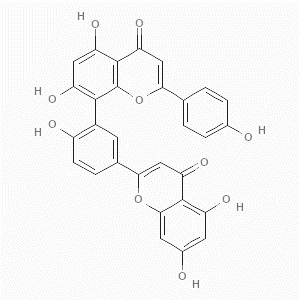
Physicochemical Properties
The physicochemical properties such as lipophilicity (clogP), polar surface area, molecular weight (MW) and aqueous solubility (logS), these properties affect absorption and bioavailability of drug molecule. According to the predicted data, two violations of Lipinskis Rule (Rule of Five) were identified (MW>500 and NHorOH>5). The TPSA (Topological Polar Surface Area) is another important physicochemical property used to predict drug distribution attributes based on sum of all polar atoms such as oxygen, nitrogen and attached hydrogen value and number of rotatable bonds indicate good bioavailability [13]. The TPSA value is 181.79 Å and number of rotatable bonds found to be 3. Rotatable polar atomic bonds increase the flexibility of molecules for more adaptable and efficient interaction with the enzyme active site and the value of TPSA of amentoflavone indicates good oral bioavailability (Table 1).
| S | l. No | . | Compound (Chemspider ID) | Physicochemical properties | ||||||||||
|---|---|---|---|---|---|---|---|---|---|---|---|---|---|---|
| 1 | Amentoflavone (4444919) | MW | miLogP | TPSA (Å) | nON | nOHNH | nrotb | Volume | ||||||
| 538.46 | 5.16 | 181.79 | 10 | 6 | 3 | 435.46 |
Table 1: Physicochemical properties of Amentoflavone MW- Molecular Weight, miLogP -Octanol-water partition coefficient logP devel
protein binding compounds exist freely for transport across the cell membrane and also for interaction with target. In addition, BBB (Blood Brain Barrier) penetration revealed that the compound showed low absorption in CNS (predicted value 1.49973) and showed least skin permeability (-1.86648). In toxicity phase, the carcinogenic and mutagenic effects of compound were evaluated. Ames test is a simple method to test mutagenicity, amentoflavone had shown positive result indicating that the compound act as mutagen. It also showed negative carcinogenicity for mice and positive carcinogenicity for rats (Table 2).
In silico ADME-T studies
The HIA (human intestinal absorption) value is 100%. This indicates that amentoflavone can be well absorbed via intestinal tract. In addition, amentoflavone shows good permeability to Caco2 cell (22.2815) (heterogeneous human epithelial colorectal adenocarcinoma cells) and to MDCK cell (Madin-Darby Canine Kidney) model 204.401. In distribution phase, the PPB (Plasma Protein Barrier) binding assessment of amentoflavone exhibit strong binding energy with plasma proteins (predicted value -1). Generally weak plasma
| ADME | Toxicity | |||||||||||||||||||||||||||
|---|---|---|---|---|---|---|---|---|---|---|---|---|---|---|---|---|---|---|---|---|---|---|---|---|---|---|---|---|
| Rodent | ||||||||||||||||||||||||||||
| C | hemspide | r | ( | HIA | ) | PPB | BBB | Cacok2 | Skin | ( | MDCK | ) | Carcinogenicity | |||||||||||||||
| Mutagenicity | ||||||||||||||||||||||||||||
| ID | % | (%) | (%) | (nm/sec) | Permeability | nm/sec | Carcino | Carcino | ||||||||||||||||||||
| Mouse | Rat | |||||||||||||||||||||||||||
| 4444919 | 100 | -1.#IND00 | 1.49973 | 22.2815 | -1.8665 | 204.401 | Mutagen | Negative | Positive |
Table 2: ADME-Toxic properties of Amentoflavone
Bioinformatics & Proteomics Open Access Journal
Conclusion
The amentoflavone have been shown to have a wide range of biological and pharmacological activities. Present study also predicted that amentoflavone is a potential bioactive compound and this predicted data may help for further research analysis of drug development.
Acknowledgement
The authors are thankful to DBT, New Delhi, India for providing financial support through DBT- BUILDER program (Order No.BT/PR9128/INF/22/190/2013, Dated: 30/06/2015) and the Kuvempu University administrative authority for offering the facility to carry out the work.
References
-
Yu S, Yan H, Zhang L, Shan M, Chen P, et al. (2017) A Review on the Phytochemistry, Pharmacology, and Pharmacokinetics of Amentoflavone, a Naturally- Occurring Biflavonoid. Molecules 22(2): 299.
-
Okigawa M, Hwa CW, Kawano N, Rahman W (1971) Biflavones in Selaginella species. Phytochemistry 10: 3286-3287.
-
Saroni Arwa P, Zeraik ML, Ximenes VF, da Fonseca LM, Bolzani Vda S, et al. (2015) Redox-active biflavonoids from Garciniabrasiliensis as inhibitors of neutrophil oxidative burst and human erythrocyte membrane damage. Journal of Ethnopharmacology 174: 410-418.
-
Abdallah HM, Almowallad FM, Esmat A, Shehata IA, Abdel-Sattar EA (2015) Anti-inflammatory activity of flavonoids from Chrozophoratinctoria. Phytochemistry Letter 13: 74-80.
-
Park NH, Lee CW, Bae JH, Na YJ (2011) Protective effects of amentoflavone on Lamin A-dependent UVB- induced nuclear aberration in normal human fibroblasts. Bioorganic & Medicinal Chemistry Letters 21: 6482-6484.
-
Ndongo JT, Issa ME, Messi AN, Mbing JN, Cuendet M, et al. (2015) Cytotoxic flavonoids and other constituents from the stem bark of Ochnaschweinfurthiana. Natural Product Research 29(17): 1684-1687.
-
Coulerie P, Nour M, Maciuk A, Eydoux C, Guillemot JC, et al. (2013) Structure-activity relationship study of biflavonoids on the Dengue virus polymerase DENV- NS5 RdRp. Planta Medica 79(14): 1313-1318.
-
Hwang IS, Lee J, Jin HG, Woo ER, Lee DG (2012) Amentoflavone stimulates mitochondrial dysfunction and induces apoptotic cell death in Candida albicans. Mycopathologia 173(4): 207-218.
-
Zhang Z, Sun T, Niu JG, He ZQ, Liu Y, et al. (2015) Amentoflavone protects hippocampal neurons: Anti- inflammatory, antioxidative, and antiapoptotic effects. Neural Regeneration Research 10(7): 1125- 1133.
-
Zheng XK, Liu CX, Zhai YY, Li LL, Wang XL, et al. (2013) Protection effect of amentoflavone in Selaginella tamariscina against TNF-alpha-induced vascular injury of endothelial cells Acta Pharmacologica Sinica 48(9): 1503-1509.
-
Lipinski CA, Lombardo F, Dominy BW, Feeney PJ (1997) Experimental and computational approaches to estimate solubility and permeability in drug discovery and development settings. Advanced Drug Delivery Reviews 23: 3-25
-
Kandagalla S, Sharath BS, Bharath BR, Manjunatha H (2017) Molecular docking analysis of curcumin analogues against kinase domain of ALK5. In Silico Pharmacology 5: 15.
-
Clark DE (1999) Rapid Calculation of Polar Molecular Surface Area and Its Application to the Prediction of Transport Phenomena. 2. Prediction of Blood–brain Barrier Penetration. Journal of Pharmaceutical Sciences 88(8): 815-821.
- Carbon Code for Analysis of Protein Stability in Protein Mutation
- Number of Contiguous Amino Acids in Nanon of 16A Diameter
- Identification of Hub Genes and Pathways in Cervical Cancer by Statistical and Bioinformatics Analysis
- Effect of Dietary Inclusion Levels of Moringa Olerifera Oil on the Growth Performance and Nutrient Retention of Broiler Starter Chicks
- Proteomics Loans in Kinetoplastids during the Last Decade
- “Identification of SARS-CoV-2 in Human Genome based on Protein Dynamics Conversion and Target Genes Marking via Bioinformatics Approaches”