
Effects of Catholyte Water on the Development of Experimental Graffi Tumor on Hamsters
The paper describes the results of a pilot study aimed at the investigation of the influence of catholyte (electrolyzed alkaline water) on the development of tumors. In the experiments solid Graffi tumor was transplanted subcutaneously in the back of the experimental group of Golden Syrian hamsters. Tumor appearance and growth were registered every day. Blood parameters were measured on the 10th and 25th day after transplantation and blood smears were prepared. Hamsters treated with catholyte developed tumor with some delay compared to untreated (drinking tap water) ones. Also, the tumor growth was slow and the survival rate was increased. The analysis of blood parameters and cell morphology has shown significant differences in the value of some hematometric parameters and morphological changes of some blood cells. The obtained results suggest about the beneficial influence of catholyte and the possible use of it as a supporting non-invasive therapy of cancer diseases.
Reneta Toshkova1, Elissaveta Zvetkova1, Ignat Ignatov2* and Georgi
Gluhchev1
Biophysics (SRCMB), Bulgaria, Email: mbioph@dir.bg
supporting non-invasive therapy of cancer diseases.
Lymphocyte Ratio; NLR: Neutrophil to Lymphocyte Ratio; TILs: Tumor-Infiltration Cells
Introduction
Water is a natural and necessary medium for many biological molecules. Changes in its composition and structure can produce stimulating or inhibitory effects on the processes in the living things. Influenced by different factors water can change its acidity pH, ORP (Oxidation Reduction Potential), and its physical structure. When electrochemical activation or electrolysis is applied the obtained catholyte receives high level of pH and negative ORP which leads to increased antioxidant effect [1]. Due to this reason it could be expected that the catholyte would have protective and positive effect for oxidative stress-related diseases like diabetes and cancer.
Clinical examinations carried out by different scientists have demonstrated positive effect in case of diabetes type 2, telomere shortening in cancer cells and inhibition of their growth, suppression of side effects caused by the use of anticancer medications, favorable influence on the blood cells [2, 3, 4, 5, 6]. Along with this it was proved that the activated water was not toxic for cells and tissues, and did not have mutagenic, cancerogenic, embryotoxic or immunotoxic effects [7, 8].
For the evaluation of the influence of some medicine or therapy on tumor malignancies different parameters are used based on measurements of tumor development, survival rate, mortality, blood cells changes and others. In the last decade, the main hematometric indices (biomarkers) have been evaluated as diagnostic tools and prognostic parameters in patients with malignancies – cancer and leukemia [9, 10, 11].
Recent data from the scientific oncological literature evaluated that the NLR (neutrophil to lymphocyte ratio) is superior for predicting the long term survival of cancer patients [12, 13, 14]. E.g., lower NLR (≤ 2.0) is associated with good prognosis for breast cancer patients; a higher peripheral blood NLR (≧5) was considered to indicate – significantly and independently, a poor prognosis for breast cancer patients, gastric cancer patients, etc. Simultaneously, the total WBC count, absolute neutrophil- and lymphocyte counts alone, could be also statistically significant predictors of 5-year cancer patients’ mortality [10].
At present, the data about the effects of electrolyzed alkaline water (catholyte) on tumor growth and hematological parameters in experimental tumor-bearing animals are absent.
The aim of this study is to examine the biological effects of catholyte on the tumor growth parameters, hematometric biomarkers (including main WBC count; absolute granulocyte; lymphocyte count; granulocyte; lymphocyte % (percent), GLR (granulocyte to lymphocyte ratio), and blood cell morphology in hamsters with experimental Graffi myeloid tumor.
The authors have research of the project for influence with electromagnetic fields and infrared thermal fields on Graffi tumor [15, 16].
Materials and Methods
Experimental Animals
In the trials hamsters, breed “Golden Syrian”, aged 2-4 months, male and female, with weight around 100g, grown in individual plastic cages with free access to food and water were used.
Experimental Tumor
The experimental Graffi solid tumor is maintained on a monthly basis in vivo in hamsters from the research team at IEMPAM-BAS [17] via subcutaneous (s.c.) transplantation of live tumor cells ((1-2.106) in the area of the back. Between days 7 and 15 in the spot of injection appear tumors, which grow progressively, and the hamsters die aproximately 30-35 days after the injection of tumor cells. In such a tumor model it is observed 100% attachment/appearance (transplantability) of umor and 100% mortality rate. Spontaneous regression, i.e. spontaneous shrinking and disappearance of the tumor is not observed.
Catholyte Water
During the experiment catholyte water was produced every day using the Actvator-2 device, developed in the Institute of Information and Communication Technologies at the Bulgarian Academy of Sciences. In this way acidity pH of the water was kept between 9.0 and 9.5.
Experimental Design
All the animals were divided into 4 groups as follows. Group 1: The hamsters from this group started drinking catholyte water 10 days before the injection with 5х104 Graffi tumor cells per hamster in the back area, and continued drinking it until the end of the experiment. Group 2: This group was used as a control. The hamsters from it were s.c. injected with the same amount of tumor cells on the 10th day of the experiment as the hamsters from Gr.1, and were receiving tap water all the time. Group 3: consisted of healthy hamsters drinking catholyte water during the experiment. Group 4: consisted of healthy hamsters drinking tap water all the time. The first two groups have to reveal the influence of the catholyte water on the appearance and growth of transplanted tumor compared to the tap water, as well as for evaluation of haematological parameters and peripheral blood cell morphology. The last two groups were used as control for hematological research.
Measured Parameters
The following parameters of tumor development are determined:
- tumor transplantability success (% of hamsters with tumor to the total number of injected ones),
- tumor size (the average diameter of tumor measured with caliper in mm),
- survival and average survival (calculated for the respective group in days),
- lethality (% of dead animals in the group).
Animals from each group were sacrificed preserving the ethical aspects of the European convention for protection of vertebrate animals, used for experimental and other scientific purposes (OJ L 222), and approved by the National Veterinary Medical Office in Bulgaria, and blood samples have been prepared at different time periods: on days 10 and 25 after Graffi tumor implantation. Hematological/hematometric parameters and indices as shown in Figure1 were measured on the automated hematological analyzer BC-2800 Vet (Mindray, China).
Catholyte water was used as experimental therapy during two months. Animals have been examined every day until tumor detection and 2 times per week until 30 days after tumor transplantation. The tumor growth parameters have been registered regularly. The differences between the two groups are shown on Figure 1.
The WBC/LR (White blood cells to Lymphocyte ratio and NLR (Neutrophil to lymphocyte ratio) were calculated.
Statistical Analysis
For the evaluation of the significance of the differences between the average values of a specific parameter t-test was used at levels of significance α = 0.10 and α = 0.05, respectively.
Results
Parameters of tumor growth for Group 1 and Group 2.
MST
Gr 1 -with CW Gr 2 -control (tap W) 0 5 10 15 20 25 30 35 40 45 50 55
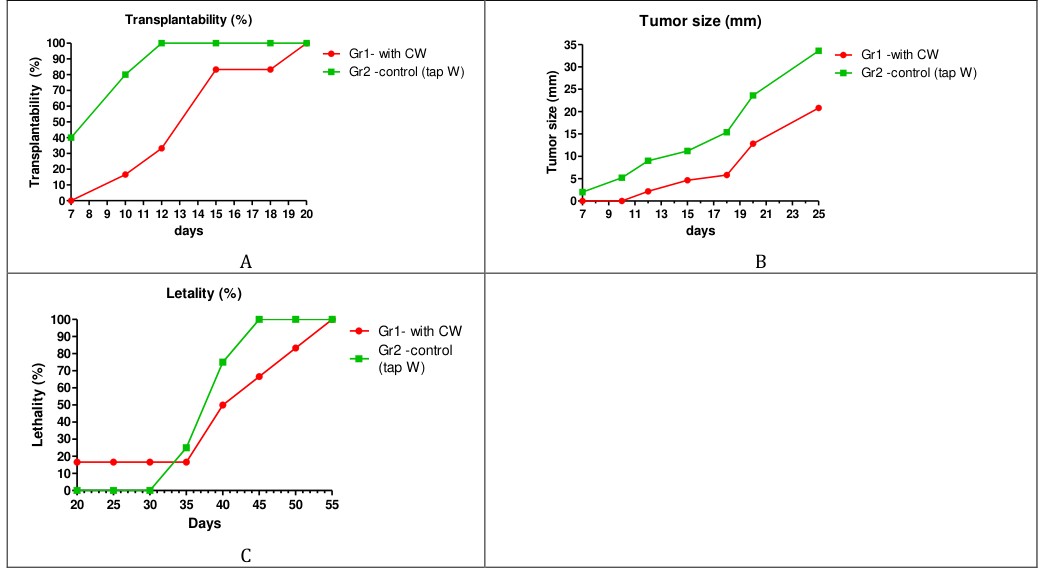
As can be seen from the graph on (Figure 1A) the tumor transplantation was delayed for the hamsters taking catholyte. While all the hamsters from Group 2 developed tumor on the 12th day this happened only for 1/3 of hamsters from Group 1. In the hamsters receiving catholite, tumors were detected at 100% on day 20.
Similar effect is observed for the tumor size (Figure 1B). Until the 10th day was not established subcutaneous firmness in none of the hamsters drinking catholyte. This group showed an inhibition in tumor growth rate as compared to control throughout the study period.
The increased lethality for the hamsters (Figure 1C) shows from Group 2 after 35 days, compared with the hamsters from Group 1. The control Group 2 had a 100% mortality on day 41, while in the group 1-on the 53rd day of the study.
The evaluated average survival for Group 1 is 43.4±6.9 days, while it is 37.5±4.5 days for Group 2. Same conclusion could be taken from (Figure 1E).
These data suggest that the catholyte water slows down tumor development and as a result increases survival rate.
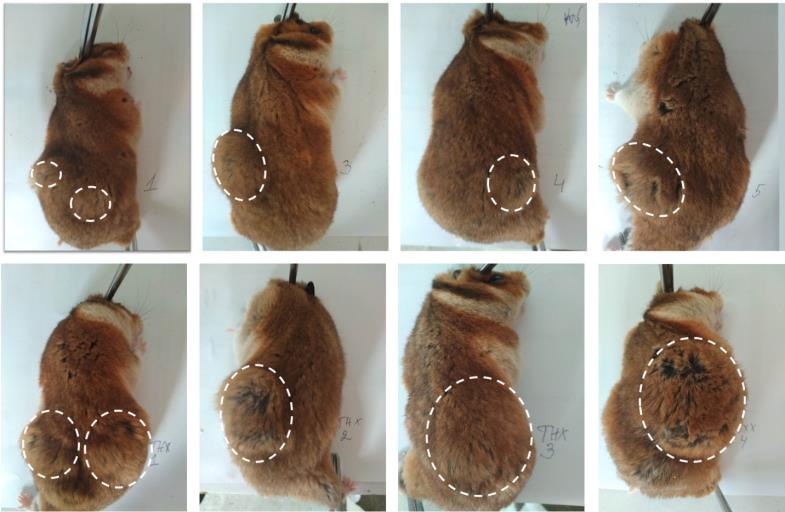
The illustrations on Figure 2 give visual impresion for the tumor development in Group 1 and Group 2.
Hematological Parameters
Hamsters from the trial and control groups were euthanised after the application of deep anaesthesia on the 10th and 25th day after tumor transplanting. The obtained blood was used to report hematological parameters, for serum and preparation of blood smears.
The evaluated parameters for all groups are displayed in Table 1.
| Tumor | Tumor | Healthy | Healthy | ||||||||||||||
|---|---|---|---|---|---|---|---|---|---|---|---|---|---|---|---|---|---|
| Parameters | Units | ||||||||||||||||
| (Catholyte) | (Tap water) | (Catholyte) | (Tap water) | ||||||||||||||
| WBC (Leukocytes) | x109/L | 3.8/47.9 | 5.7/2.9 | 6.8/5.8 | 2.4/2.1 | ||||||||||||
| Lymph | x109/L | 2.2/38.1 | 0.7/0.5 | 5.6/2.1 | 1.4/1.2 | ||||||||||||
| Mon | x109/L | 0.2/2.3 | 0.5/0.2 | 0.2/0.3 | 0.1/0.1 | ||||||||||||
| Gran | x109/L | 1.4/7.5 | 4.5/2.2 | 1.0/3.4 | 0.9/0.8 | ||||||||||||
| Lymph % | % | 58.3/79.5 | 12.8/16.5 | 81.4/35.5 | 58.8/56.3 | ||||||||||||
| Mon % | % | 6.0/4.9 | 8.5/7.3 | 3.3/5.2 | 5.7/5.1 | ||||||||||||
| Gran % | % | 35.7/15.6 | 78.7/76.2 | 15.3/59.3 | 35.5/38.6 | ||||||||||||
| RBC (Erythrocytes) | x1012/L | 3.05/2.95 | 4.77/5.58 | 4.7/7.98 | 4.25/5.36 | ||||||||||||
| HGB (Haemoglobin) | g/ L | 67/83 | 80/104 | 85/137 | 89/92 | ||||||||||||
| HCT (Hematocrit) | fI | 0.165/0.204 | 0.231/0.325 | 0.267/0.445 | 0.226/0.304 | ||||||||||||
| MCV (Mean red blood cell volume) | pg | 54.2/69.2 | 48.5/58.3 | 57.0/55.8 | 53.4/56.9 | ||||||||||||
| MCH (Average HGB content in erythr) | g/ L | 21.9/28.1 | 16.7/18.6 | 18.1/17.1 | 20.9/17.1 | ||||||||||||
| RDW | % | 406/406 | 346/320 | 318/307 | 393/302 | ||||||||||||
| PLT (platelets) | x109/L | 132/491 | 883/537 | 250/488 | 306/456 | ||||||||||||
| MPV(mean volume of platelets) | f/L | 6.1/7.2 | 4.9/5.6 | 5.4/4.5 | 5.1/5.7 | ||||||||||||
| PDW | % | 19.8/19.8 | 17.9/18.3 | 18.9/17.0 | 17.7/19.3 | ||||||||||||
| PCT | % | 0.080/0.353 | 0.432/0.300 | 0.135/0.219 | 0.156/0.259 |
Table 1: Blood parameters of 10th/25th day of study.
The developing experimental Graffi myloid tumor in hamsters influenced diversely the two main WBC subpopulations-neutrophil granulocytes and lymphocytes (column 4). Significantly elevated WBC, granulocyte count and granulocyte number (%) as well as significant reduction of absolute lymphocyte count and lymphocyte number (%) were observed in the Graffi myeloid tumor- bearing hamsters (Group 2, column 4) and (Figure 3). These effects are well expressed on the day 15-th, and are profound on the 25-th day in our experimental model. The treatment of tumor bearing animals with catholyte as drinking water improved the values of same parameters during the investigation (Group 1, column 3) and Figure 3.
Results from the comparison of the blood parameters for which significant difference between Group 1 and Group 2 was obtained are shown in Table 2.
| Parameter | Lymp% | Mon% | Gran% | RBC | MCHC | PDW |
|---|---|---|---|---|---|---|
| α | 0.05 | 0.1 | 0.05 | 0.05 | 0.05 | 0.05 |
Table 2: Significant difference between blood parameters of Group 1 and Group 2.
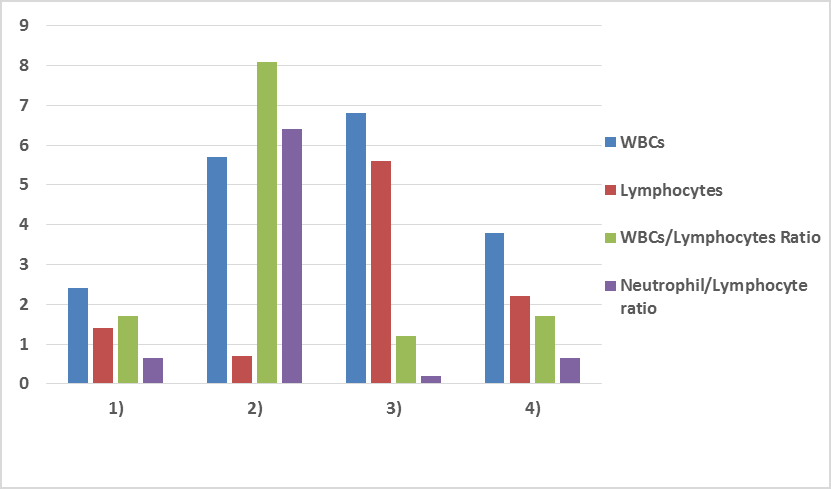
Significantly elevated WBC count and total granulocyte/neutrophil ratio were obtained in the untreated Graffi myeloid tumor-bearing hamsters (Group 2).
Simultaneously, a significant reduction of the lymphocyte number was evaluated in the same animals. Additionally, we obtained that catolyte water influenced (elevated) some main PLT-hematometric values in both - control and experimental animals (Table 1, PLT, MPV and and PDW). The hematometrical results obtained were confirmed by our cytological studies on PLTs (thrombocytes) in the peripheral blood smears of hamsters where one could see clusters of activated thrombocytes-more pronounced in the blood of tumor- bearing animals (Figure 4i).
Cytological Study
Images from blood smears are shown on Figure 4.
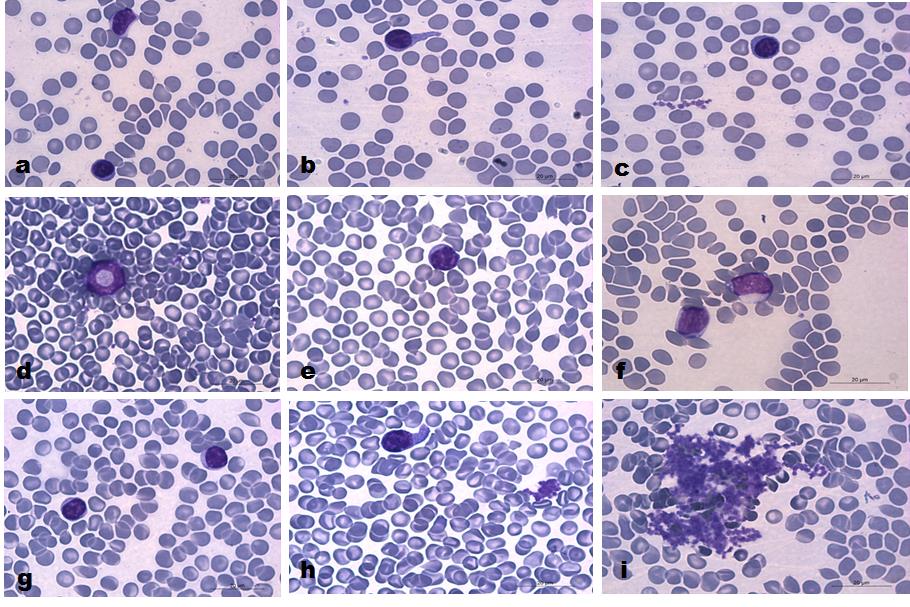
In the peripheral blood of healthy hamster, taking electrolyzed alkaline water (catholyte) activated lymphocytes with a large cytoplasmic pseudopode (ptotrusion), monocytes and platelets were observed (Figures 4a-4c) upper line.
Atypical myeloid cells and blast-like cells from the peripheral blood of Graffi myeloid tumor-bearing hamsters, at the day 10th from tumor inoculation were observed. One could see atypical immature granulocyte with peripherally localized ring-shaped nucleus and eosinophile granules - in the central part of cytoplasm (Figures 4d-4f) middle line.
In Graffi tumor bearing hamsters, treated with electrolyzed alkaline water (catholyte) atypical activated lymphocytes and cluster of PLTs in the peripheral blood smear were noticed. Lymphocytes from these hamsters, although atypical, show characteristic signs of activation as in healthy ones (Figures 4g-4i) bottom line.
Conclusion
The influence of catholyte water on the development of Graffi tumor implanted in hamsters was assessed. Some delay in tumor growth and increased survival rate were observed. Significant differences in some of the blood parameters were noticed.
We obtained activated (small and medium-size) lymphocytes in the peripheral blood smears of healthy hamsters - treated with catholyte, instead of tap-water (Figures 4a-4c). The same biological phenomenon was also evaluated partially in the peripheral blood of tumor- bearing animals, under the influence of catholyte (Figures 4g & 4h). But in comparison to the activated immunocytes in healthy hamsters, the tumor-infiltration cells (TILs) in the tumor-bearing animals are soon atypical and insufficiently activated (or deactivated - in the preapoptotic or apoptosis states).
The appearance of the so-called blast-like cells (Figure 4f) has been related to dissemination of the neoplastic disease and could be earlier obtained in the peripheral blood smears of untreated tumor-bearing animals [18]. The results correlated also with changes in WBCs/LR and NLR hematometric indices obtained in the two experimental groups of treated and untreated tumor- bearing hamsters.
The elevated thrombocytes total count could be unfavorable predictor in cancer patients, having in view high risk of thrombogenesis and embolism. On the other hand, the catholyte water could be useful in cases with thrombocytopenia, but not in thrombocytoses, when application of electrolyzed water would be not recommended.
This study also further strengthens the role of WBC- hematometric indices in diagnosis and prognosis of cancer.
Catholyte water (investigated in vivo - in our experimental model of Graffi tumor-bearing hamsters), could improve TILs cellular immunity (immunomodulating, immunostimulating influence).
The first conclusion is that the developing experimental Graffi myloid tumor in hamsters influenced diversely the two main WBC subpopulations (predominantly neutrophils) and lymphocytes. These diverse effects – well expressed on the 10th day, are profound on the last (25th) day in our experimental model.
Our experimental results suggested that in the same model, the treatment of tumor-bearing animals with catholyte, as drinking water, improved the same hematometric indices to the normal values.
Thus, our second conclusion is that the catholyte water – employed instead of tap water in our experimental model with tumor-bearing hamsters, has a positive impact on the main hematometric indices e.g. WBCs/LR and NLR - neutrophil to lymphocyte ratio on day 10 (Table 1) was: for WBCs/LR- 1.71 for a healthy hamster, 1.72 for a tumor-bearing, treated with catholyte and 8.14 for a tumor-bearing, untreated animal, and for NRL - 0.64 for a healthy hamster, 0.64 for a tumor-bearing, treated with catholyte and 6.42 for a tumor-bearing, untreated animal, respectively.
All these points at a favorable influence of catholyte on the hematopoiesis both in case of tumor–bearing animals, and healthy ones.
The obtained results lead to the general conclusion that catholyte could be used as a supporting non-invasive therapy to other cancer therapies as radiotherapy and chemotherapy. However, our pioneer study in this field needs further experimental and clinical confirmation.
Acknowledgements
The authors express thankful for the support for the project with influence of different types of water on hamsters of Lieselotte Eder, Heide Trautwein, Gergana Genova, Paul N. Kleindienst, Borislav Kaleychev, Ivan Garabitov.
References
-
Prilutsky VI, Bakhir VM (1997) Electrochemically Activated Water: Anomalous Properties, Mechanism of Biological Action, All Russian Scientific Research and Experimental Institude of Medical Engineering (VNIIIMT) 1: 124.
-
Hayashi H, Kawamura M (2002) Clinical Improvements Obtained from the Intake of Reduced Water. Animal Cell Technology & Applied Aspect 12: 31-36.
-
Shirahata S (2000) Reduced Water for Prevention of Diseases, Animal Cell Technology: Basic & Applied Aspects, pp: 25-30.
-
Ignatov I, Karadzhov S, Gluhchev G, Yakimov I (2018) Electromagnetically Activated Water - Properties and Effects, Bulgarian Journal of Public Health 10(4): 63- 69.
-
Ignatov I, Gluhchev G (2019) Effects of Electrochemically Activated Water Catholyte and Anolyte on Human Health 8th World Congress on Immunology, Pulsus London 3: 12-13.
-
Gluhchev G, Ignatov I, Karadzhov S, Miloshev G, Ivanov N, et al. (2015) Electrochemically Activited Water: Biophysical and Biological Effects of Anolyte and Catholyte Types of Water, European Journal of Molecular Biotechnology 7(1): 12-26.
-
Shirahata S, Hamasaki T, Teruya K (2012) Advanced Research on the Health Benefit of Reduced Water, Trends in Food Science & Technology 23(2): 124-131.
-
Ignatov I, Gluhchev G, Karadzhov S, Miloshev G, Ivanov N, et al. (2015)Preparation of Electrochemically Activated Water Solutions (Catholyte/Anolyte) and Studying of their Physical- Chemical Properties, Journal of Medicine, Physiology and Biophysics 13: 18-38.
-
Zvetkova E, Fuchs D (2017) Medical Significance of Simultaneous Application of Red Blood Cell Distribution Width (RDW) and Neopterin as Diagnostic Biomarkers in Clinical Practice, Pteridines 28(3-4): 133-140.
-
Azab B, Shah N, Radbel J, Tan P, Bhatt V, et al. (2013) Pretreatment Neurophil/lymphocyte Ratio is Superior to Platelet/lymphocyte Ratio as a Predictor of Long-term Mortality in Breast Cancer Patients, Med Oncol 30(1): 432.
-
Hirahara N, Matsubara T, Kawahara D, Mizota Y, Ishibashi S, et al. (2016) Prognostic Values of Hematological Parameters in Patients with Esophageal Squamous Carcinoma, Int J Clin Oncology 21(5): 909-919.
-
Dezayee ZMI, Al-Nimer MSM (2016) The Clinical Importance of Measurement of Hematological Indices in the Breast Cancer Survival. A Comparison Between Premenopausal and Postmenopausal Women. World J Onco 7(1): 1-4.
-
Jia W, Wu J, Jia H, Yang Y, Zhang X, et al. (2015) The Peripheral Blood Neutrophil-to-lymphocyte Ratio is Superior to the Lymphocyte –to-Monocyte Ratio for Predicting the Long Term Survival of Triple Negative Breast Cancer Patients, Plos One 10(11).
-
Qin YY, Wu YY, Xian XY, Qin JQ, Lai ZF, et al. (2018) Single and combined use of Red Blood Cell Distribution Width, Mean Platelet Volume and Cancer Antigen-125 as Inflammatory Markers in Differential Diagnosis of Ovarian Cancer. J Ovarian Res 11(1): 10.
-
Drossinakis Ch, Toshkova R, Zvetkova E, Ignatov I, Gluhchev G (2019) Methods of Research in Vivo Research of Therapeutical Effect in Hamsters with Experimental Myeloid Tumor of Graffi, 8th World Congress on Immunology, Pulsus, London 3: 21.
-
Toshkova R, Ignatov I, Zvetkova E, Gluhchev G, Drossinakis Ch (2019) Bioinfluence with Infrared Thermal and Electromagnetic Fields as a Therapeutic Approach of Hamsters with Experimental Graffi Myeloid Tumor, Journal of Natural Sciences Research 9(4): 1-11.
-
Toshkova R (1995) Attemps for Immunomodulation in Hamsters with Transplanted Myeloid Tumor, Previously Induced by Graffi Virus, Bulgarian Academy of Sciences, PhD Dissertation, Sofia.
-
Zvetkova E (2006) Quantitative Reduction in the RNP-Contents of Peripheral Blood Lymphocytes in Cancer Patients. Conference: 6th Annual Meeting of the Federation-of-Clinical-Immunology-Societies Location, Clinical Immunology, San Francisco.
- The Muculent Bleb-Mucinous Cystic Neoplasm-Hepatobiliary Region
- Insulin Sensitizers as Anti-Aging Agents: Unveiling Synergies with Albumin, GLP-1RA, Klotho Protein, and Metformin in the Quest to Combat Aging
- Reprogramming of GLP-1 Response at Prediabetes for the Prevention of Type 2 Diabetes: The Role of Albumin and GLP-1 Receptor Agonists
- The Mingled Allies-Combined Hepatocellular Carcinoma and Cholangiocarcinoma
- Compilation and Embodiment-Leydig Cell Tumour Testis
- Glucolipotoxicity: A Novel Different Perspective on the Causes of Cancer