
A Study on Smart Irrigation Using Machine Learning
Smart irrigation system in agriculture is the combination of various hardware equipment and software applications with different technology. Among those the machine learning technology plays important role. It is a data analytic technique which has different types of algorithms and models to learn information directly from data. Machine learning application helps to maintain proper irrigation system. For example optimizes water usage and provides essential amount of water and fertility to field improves yield production, reduces manual intervention, and diminish crop diseases. The survey measures the impact of applied techniques and how to improve the productivity using those techniques and it helps the farmers to adapt suitable system according to their requirements.
Introduction of Irrigation System
The proper growth of plants depends on water. The artificial way of distributing water in agriculture field is called irrigation system. The irrigation system applied mainly in arid area and less rainfall area to maintain soil moisture. It helps to reduce the weeds growing in field. It has two types. Those are Conventional irrigation and modern irrigation. The conventional irrigation methods are check basin, furrow irrigation, basin irrigation and strip irrigation. It used watering cans, buckets, pumps, and canals etc. The system needs drastic use of labour for weeding, irrigation, and fertilizing but it is not knowledge based [1]. To enhance the irrigation system modern irrigation has introduced. It has three types such as drip irrigation, sprinkler irrigation and pot irrigation. Components used in modern irrigation are sprinkler, drip tubes and pots. Compared to conventional irrigation the usage of water efficiency is improved and achieved less manual intervention in modern irrigation. But partially it is knowledge intensive for system deployment and maintenance [2].
The existing modern irrigation system without the help of technology not able to predict actual amount of water required for crops. It may causes under irrigation or over irrigation. Under irrigation will affect the soil moisture and crop may get destroyed. Over irrigation leads to crop diseases and clogging problem.it will affect the yield production. To avoid these problems there was a need for enhancement in existing modern irrigation system too. According to the consideration the automatic irrigation system or smart irrigation developed using various technologies. Such as machine learning [3], wireless sensor network [4], big data [5], cloud computing [6] and internet of things [7]. These technologies help for efficient usage of water, water conservation and to improve the quality and quantity of production. Depends on environment condition one or more attributes are considered in irrigation system [3, 7].
Irrigation Controllers
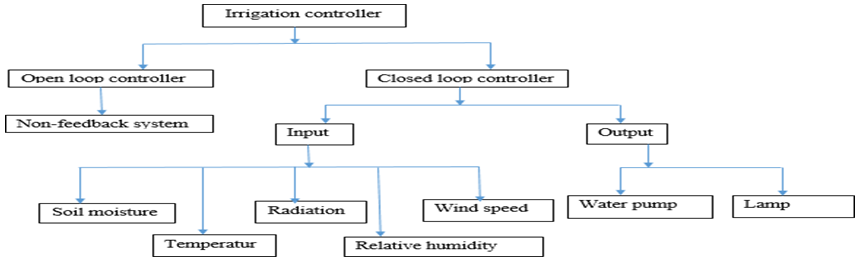
Irrigation controller is mainly classified into two types, namely open loop controller and closed loop controller. Varies types of irrigation controller are listed in Figure 1. Open loop controller means pre-set the condition like irrigation period, irrigation frequency and required amount of water that is needed in irrigation. Closed loop controller is automatically feed forward system from the controlled object. System itself will take decisions based on the comparison between pre-processed data and real time parameters measurements.
Sensor Devices
Different types of Sensor devices used to measure the environment condition such as soil moisture, soil temperature, humidity, weather condition, leaf sensing, and canopy temperature [1]. The real time values are measured by the deployed environmental sensors in irrigation. Spyridon N, et al. [9] considered parameters are low-cost and low-power in leaf sensing system using a backscatter sensor node/tag implemented to monitor the temperature difference between leaf and air. Yunseop, et al. [10] described a system using wireless sensor network in distributed environment. The second generation soil sensor deployment time is less than four minutes and it is
Smart Devices and Hardware Equipment
Smart devices like smart phone laptop and tabs are used for remote monitoring purpose through internet and used as a user interface. Joaquín Gutiérrez, et al. [12] smart phone used to capture and process digital images of the soil close by root zone of the plant. The CPU (Center pivot units) is remotely monitored by the remote pivot control system. It is time saving and efficient fuel usage. In this system monitoring range through smart device is fifteen to twenty miles [13].
Hardware devices such as pumps, solar system device, and web camera are most commonly used. The images taken by web cam are compared with machine learning data to irrigate field based on the parameters for e.g. climatic condition. Some other hardware devices are big gun sprinkler, rotator sprinkler, irrigation control valves, pressure regulator, sprinkler takes and tube assemblies, twig wireless control system, spinner and sprays, MP rotator sprinklers, and impact sprinklers. The performance of these devices depends on the various location. So farmer should be careful to select the device based on their different environment condition. The center pivot corner arm irrigation equipment is introduced by Trimble to apply consistent amount of water in large area [14]. In PMDI (precision mobile drip irrigation) system hoses are made by netafim. It is a combination of drip and center pivot irrigation system. Rodent damage is a big issue in surface drip irrigation system [15]. The thin walled tubing shows less rodent damage compared to thick walled tubing. Further the tubing buried slightly, sprayed with an animal repellent and edible rodenticides placed are showed less rodent damage compared to untreated drip tubing [16].
All devices connected through micro controller to perform automatic irrigation. Sleep mode option is programmed in some devices to save the usage of energy. Irrigation challenges like power consumption, water consumption, health of field worker and plants, cost and internet security are not solved completely. But partially some challenges are solved in smart irrigation. For communication purpose different wireless communication technologies are applied between field and farmer. Those are zigbee module, GPRS communication and backscatter communication. It consists of components like sender, receiver, antenna, external timer with different networking architecture [9, 17]. The next section discussed the machine learning technique applied in irrigation system.
Machine Learning Technique Used in Smart Irrigation
Machine learning technology plays important role in smart irrigation system. It uses computational method to learn agriculture data. The focus of the learning process is to learn from training data to perform a given task. Set of examples in data which is described by set of features. That feature can be a nominal, binary or numeric. Irrigation system uses machine learning for water management, plant growth, and soil management. Also in agriculture it uses for crop management, yield prediction, weed detection, diseases detection, species recognition and crop quality [3].
Learning Process in Machine Learning
The learning process classified into two types to do task in machine learning. Those are supervised learning and unsupervised learning. Irrigation system uses both of the learning process. But most used learning process is supervised learning, it uses labelled data used as an input data for training purpose. It consists of both input factors and required output. Unlabelled data used for training purpose under unsupervised learning. The clustering of training data into a particular group will be done on the basis of the similar nature between the variables. The following section will discuss some applied irrigation technique using machine learning. Figure 2 is showing the machine learning algorithm applied in existing irrigation system.
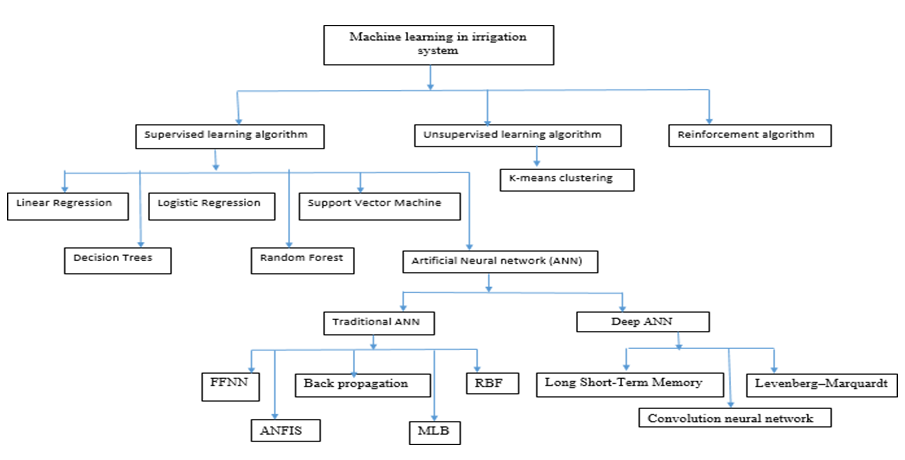
Neural network techniques are applied widely in irrigation systems using machine learning. It has different types and it uses different principles. Multiple parameters are given as inputs in input layer. The input layer contains more than one node or neuron for better result. It may be the stages of plant’s growth or different types of environmental characteristics. Then the hidden layer is placed after input layer. It accesses the data from input layer’s each node. Then the output layer is placed after hidden layer. Which shows the desired output or expected output according to the trained data in hidden layer [8, 18, 19]. Many algorithms are proposed for irrigation system, each algorithm are discussed in Tables 1 & 2 with its various parameters, observed characteristics, and functionalities.
| S | .no | . | Parameter | Observed Characteristics | Functionality | Algorithm | ||||||||
| 1 | Soil moisture | stochastic behaviour of forces on a no- till chisel | Estimation of soil moisture | MLP& RBF | ||||||||||
| 2 | Soil temperature | Air temperature, global solar radiation, and atmospheric pressure. | Estimation of soil temperature | ELM, & SaE- ELM | ||||||||||
| 3 | Condition of soil | Top soil layer – soil samples (140) in cultivable field. | Determining soil’s Organic carbon, Moisture content & and Total nitrogen | LS-SVM &Cubist | ||||||||||
| 4 | Dryness of soil | Potential evapotranspiration data and precipitation. | Evaluating the process of soil dryness and wetness in binary classification. | KNN, BP,&CT |
Table 1: Soil management using machine learning [20,21].
| S.no. | Parameter | Observed characteristics | Functionality | Algorithm | ||||||||||
| 1 | Dew point temperature | Air temperature, relative humidity, atmospheric pressure, vapours pressure, and horizontal global solar radiation. | Prediction of daily dew point temperature | ELM &ANN | ||||||||||
| 2 | Evapotranspiration | Air temperature, radiation, evapotranspiration | Prediction of weekly evapotranspiration based on two weather stations data. | ELM & ANN | ||||||||||
| 3 | Evapotranspiration | Air temperature, relative humidity, wind speed and sunshine duration | Estimation of daily evapotranspiration for local and pooled scenario. | ANN, ELM&G RNN |
Table 2: Water management using machine learning [22,23].
Soil management is the important process in irrigation system for sustainable agriculture. It is the source of mineral nutrient for plants. The crop productivity, human health, and environmental sustainability are directly or indirectly depend on soil management [24]. Some of the applied machine learning algorithms for soil management and water management are MLP-Multilayer perceptron, RBF-Radial basis function, ELM- Extreme learning machine, SaEELM - self-adaptive evolutionary extreme learning machine, GP-Genetic programming, ANN- artificial neural network, LSSVM - Least squares support vector machine, Cubist, GRNN-General Regression neural networks, KNN - K nearest neighbors, BP - Back propagation algorithm, and CT- Classification tree.
Genetic Algorithm and Back Propagation (GABP) Neural Network Algorithm
Jian Gu, et al. [18] proposed GABP to control the irrigation system. The real time field experiment is done in china for corn production. The system classified into four phases in GABP, the first one is seedling; next phase is jointing, tasseling and filling. The Sub surface trickle irrigation deployed with an improved algorithm named as GABP. GABP means combination of Genetic algorithm and back propagation neural network prediction algorithm.

GABP created to portray the connection between the yield and irrigation system under sub surface trickle water system more precisely. GABP likewise enhanced the convergence of the system, improved the exactness of the prediction, and portrays the connection between the yield and irrigation water. The outcomes shows that GA- BP algorithm is superior compared to ordinary BP (Back propagation) algorithm in the convergence speed and the prediction error. The data used in the experiment is relatively short, there is no extra data available on the predicted outcomes for the test. The drawback of GABP is various factors of the yield have not been examined. So, it may affect the system, therefore further examination on these factors is required to improve the system.
Levenberg–Marquardt (LM) and Back Propagation (BP) Algorithm
An ANN model is proposed by Naim Karasekreter, et al. [25] to determine the irrigation amount by using LM and BP. The reasons used for artificial neural network technique in LM and BP are discussed below. The main one is evapotranspiration issue, it increasing due to day time irrigation and there is no information available according to the irrigation time and period. In Turkey strawberry orchard of 1000 m2 field were tested using artificial neural network technique, where soil moisture, type of soil, irrigation duration, and type of plant were considered as input factors.

The system was trained through the Levenberg– Marquardt (LM) and back propagation (BP) algorithms using MATLAB R2007b program. This system achieved 23.9% energy saving and 20.46% water saving during night-time irrigation and by supplying water to the plant as required. Water saving are shows the extraordinary potential for preserving worldwide water resources.
Artificial Neural Network Algorithm
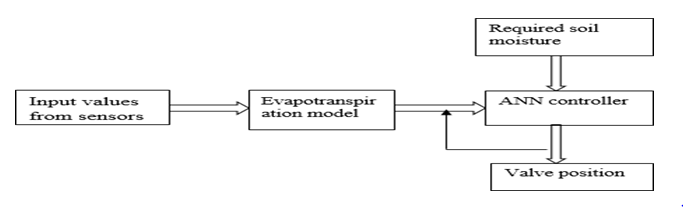
The lack of Proper timing in irrigation is an important production factor and that delaying irrigation may result in loss of water and crop yield. Muhammad Umair S proposed an ANN based controller. The prototype made with the use of MATLAB tool. The input attributes such as soil moisture, air temperature, humidity and radiations are demonstrated. Four interconnected stages in that system are input values from sensors, evapotranspiration model, desired soil moisture and ANN controller [8].
Recurrent Neural Network Algorithm
Potato crop and that growing season were considered in the Olutobi Adeyemi, et al. [26] system to find the temporal soil moisture variability. Speciality of the system is one day before the volumetric soil moisture content is forecasted using the cosmic-ray soil moisture sensor. Parameters used as inputs are predicted soil moisture measurement, climatic measurements, precipitation and irrigation. For training purpose LSTM (Long Short-Term Memory) network model under RNN (recurrent neural network) were implemented using the Keras Deep Learning library on the Python programming platform. It is a dynamic system like FFNN (Feed forward neural network) system except that there is a self-feedback of nodes in the hidden layers. The network loss was decreased using the ADAM (adaptive moment estimation.) optimization algorithm. The developed models are capable to generate robust soil moisture predictions for independent sites without the help of trained models. The AQUACROP tool is used as a simulation tool in this model. The determined soil moisture content is then used in conjunction with information on crop and soil to predict the irrigation period and amount. The achieved water saving range is between 20 and 46% compared to rule based system. But rainfall forecasting parameter not considered as an input.
Multivariate Relevance Vector Machine Algorithm
Alfonso F. Torres et al. [27] two forecasting methodologies were tested using the MRVM (Multivariate Relevance Vector Machine) algorithm and Hargreaves evapotranspiration equation. The first one is direct method, to estimate the future Evapotranspiration time series from historical evapotranspiration data. Another one is indirect method, considers to predict the needed climatic data. Day by day most extreme and least air temperatures predicted using the learning machine. Using these predicted data future evapotranspiration values are determined. For execution comparison purposes and determines the advantage of the used algorithm, an Artificial Neural Network based model MLP (Multi-layer Perceptron) applied to both of the evapotranspiration determining methods. The computational time in indirect approach is highly excessive but it provides better evapotranspiration estimation result. The stability and robustness of the proposed methods are tested by the use of the bootstrap analysis.
PLSR and ANFIS
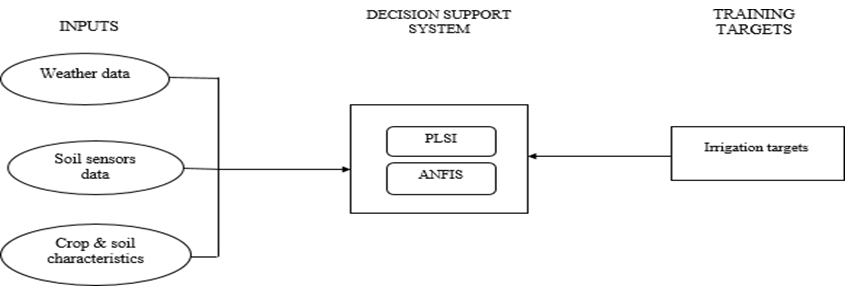
SIDSS (Smart Irrigation Decision Support System) is deployed for irrigation water management in farming. A few independent nodes are deployed in the field to improve the plantation; the both soil estimations and climatic factors are used to determine the weekly irrigation. DSS enabled closed loop control scheme for local area and estimation error. Two AI methods, PLSR (Partial Least Square Regression) and ANFIS (Adaptive Neuro Fuzzy Inference Systems) are used in SIDSS [28].
Three business manors of citrus trees are calculated located in the South-East of Spain.
Conclusion
According to this study by applying machine learning in agriculture it enhances the irrigation system. It helps to use the water in efficient manner and reduces water wastage. This integration process of automated data analysis, data recording, and decision making with the machine learning implementation is completely knowledge based system. It increases the production level and quality of crops. This survey may helpful to provide prior knowledge for the farmers to adopt the machine learning techniques with irrigation system based on their requirements and improves the productivity [29, 30].
References
-
Munoth P, Goyal R, Tiwari K (2016) Sensor based Irrigation System: A Review. International Journal of Engineering Research & Technology (IJERT) 4(23): 1- 5.
-
Megersa G, Abdulahi J (2015) Irrigation system in Israel: A review. International journal of water resource and environment engineering 17(3): 29-37.
-
Liakos KG, Busato P, Moshou D, Pearson S, Bochtis D (2018) Machine Learning in Agriculture: A Review. Sensors (Basel) 18(8): 2674.
-
Viani F, Bertolli MG, Salucci M, Polo A (2017) Low- Cost Wireless Monitoring and Decision Support for Water Saving in Agriculture. IEEE Sensors Journal.
-
Nick Piette (2018) How Big Data is Growing Agriculture.
-
Radadiya BL, Thakkar RG, Thumar VM, Chaudhari BD (2016) Cloud computing and agriculture, International Journal of Agriculture Sciences 8(22): 1429-1431.
-
Gupta A, Krishna V, Gupta S, Aggarwal J (2016) Android based Solar Powered Automatic Irrigation System. Indian Journal of Science and Technology 9(47).
-
Izzuddin TA, Johari MA, Rashid MZA, Jali MH (2018) Smart irrigation using fuzzy logic method. ARPN Journal of Engineering and Applied Sciences 13(2): 517-522.
-
Spyridon N, Goussetis G, Stylianos DA, Manos MT, Georgiadis A (2018) A uW Backscatter-Morse-Leaf Sensor for Low-Power Agricultural Wireless Sensor Networks. IEEE Sensors Journal 18(19): 7889-78989.
-
Yunseop Kim, Robert G Evans, William M Iversen (2008) Remote Sensing and Control of an Irrigation System Using a Distributed Wireless Sensor Network. IEEE Transactions on Instrumentation and Measurement 57(7): 1379-1387.
-
Jodie Wehrspann (2016) 5 new irrigation technologies aim for precision.
-
Gutiérrez J, Villa-Medina JF, López-Guzmán A, Porta- Gándara MA (2015) smartphone irrigation sensor, IEEE Sensors Journal 15(9): 5122-5127.
-
Dave Mowitz (2016) Wagnet Helps Kansas Operation learning machine and generalized regression neural network only with temperature data. Computers Electronics and Agriculture 136: 71-78.
-
Mohammadi K, Shamshirband S, Motamedi S, Manage Center Pivots.
-
Trimble Precision irrigation for corner arms.
-
Anna McConnell (2018) An Overview of Irrigation Techniques & Technology.
-
Ronald B Sorensen, Russell C Nuti, Marshall C Lamb (2007) Rodent Management for Surface Drip Irrigation Tubing in Corn, Cotton, and Peanut. Peanut Science 34: 32-37.
-
Gutiérrez J, Villa-Medina JF, Nieto-Garibay A, Porta- Gándara MA (2014) Automated Irrigation System Using a Wireless Sensor Network and GPRS Module. IEEE Transactions on Instrumentation and Measurement 63(1): 166-176.
-
Gu J, Yin G, Huang P, Guo J, Chen L (2007) An improved back propagation neural network prediction model for subsurface drip irrigation system. Computers & Electrical Engineering 60: 58- 65.
-
Navarro-Hellín H, Martínez-del-Rincon J, Domingo- Miguel R, Soto-Valles F, Torres-Sánchez R (2016) A decision support system for managing irrigation in agriculture. Computers and Electronics in Agriculture 124: 121-131.
-
Coopersmith EJ, Minsker BS, Wenzel CE, Gilmore BJ (2014) Machine learning assessments of soil drying for agricultural planning. Computers and Electronics Agriculture 104: 93-104.
-
Johann AL, de Araújo AG, Delalibera HC, Hirakawa AR (2016) Soil moisture modeling based on stochastic behavior of forces on a no-till chisel opener. Computers and Electronic Agriculture 121: 420-428.
-
Feng Y, Peng Y, Cui N, Gong D, Zhang K (2017) Modeling reference evapotranspiration using extreme
-
Philip J White, John W Crawford, María Cruz Díaz Álvarez, Rosario García Moreno (2012) Soil Management for Sustainable Agriculture. Applied and Environmental Soil Science, pp: 1-3.
-
Karasekretera N, Basiftci F, Fidanc U (2013) A new suggestion for an irrigation schedule with an artificial neural network. Journal of Experimental & Theoretical Artificial Intelligence 25(1): 93-104.
-
Adeyemi O, Grove I, Peets S, Domun Y, Norton T (2018) Dynamic Neural Network Modelling of Soil Moisture Content for Predictive Irrigation Scheduling. Sensors (Basel) 18(10): 3408.
-
Alfonso F Torresa, Wynn R Walkerb, Mac McKeea (2011) Forecasting daily potential evapotranspiration using machine learning and limited climatic data. Agricultural Water Management 98(4): 553-562.
-
Patil AP, Deka PC (2016) An extreme learning machine approach for modeling evapotranspiration using extrinsic inputs. Computres and Electronics Agriculture 121: 385-392.
-
Morellos A, Pantazi XE, Moshou D, Alexandridis T, Whetton R, et al. (2016) Machine learning based prediction of soil total nitrogen, organic carbon and moisture content by using VIS-NIR spectroscopy. Biosystems Engineering 152: 104-116.
-
Nahvi B, Habibi J, Mohammadi K, Shamshirband S, Al Razgan OS (2016) Using self-adaptive evolutionary algorithm to improve the performance of an extreme learning machine for estimating soil temperature. Computers and Electronics Agriculture 124: 150-160.
- The Muculent Bleb-Mucinous Cystic Neoplasm-Hepatobiliary Region
- Insulin Sensitizers as Anti-Aging Agents: Unveiling Synergies with Albumin, GLP-1RA, Klotho Protein, and Metformin in the Quest to Combat Aging
- Reprogramming of GLP-1 Response at Prediabetes for the Prevention of Type 2 Diabetes: The Role of Albumin and GLP-1 Receptor Agonists
- The Mingled Allies-Combined Hepatocellular Carcinoma and Cholangiocarcinoma
- Compilation and Embodiment-Leydig Cell Tumour Testis
- Glucolipotoxicity: A Novel Different Perspective on the Causes of Cancer