
Clinical Pathology (CP) or Laboratory Medicine (LM): What is there in the Name?
Are Clinical Pathology and Laboratory Medicine synonymous? What is hidden in the name? By making a Department of Laboratory Medicine administratively and financially independent of Pathology, and opening a three-year residency program leading to a postgraduate MD degree, All India Institute of Medical Science, New Delhi has taken the lead in this subject. National Medical Commission of India, following the Government of India’s approval, recommends this course in the draft of Postgraduate Medical Education Regulation-2021. How does the rest of the world responds to this event would be interesting to follow.
Introduction
All India Institute of Medical Science (AIIMS), Delhi, created by a special act of Indian Parliament in 1956, has been empowered with opening up of any new course in medical education and training, as and when felt necessary for the nation. Long before the two competitive Worldviews, “Pathology and Laboratory Medicine” in the United States of America, and “Biochemistry and Laboratory Medicine” in some of the European countries came into present existence, India in this premier medical Institute in 1988, had established a department of Laboratory Medicine (LM), administratively and financially independent of other laboratory-related departments such as Pathology, Microbiology and Biochemistry. There Perspective had been no compromise with interdependent academic activities between this new department and other existing departments. The department of LM established its own dynamics of patient care, academics and research by opening in 1997 a three-year residency program for MBBS degree- holder Indian Medical Graduates (IMG) leading to a medical postgraduate degree, MD in Laboratory Medicine. Nearly 24 years later, in 2020 and 2021, the Medical Council of India (MCI), now National Medical Commission (NMC), with the approval of the Government of India, recommends this postgraduate course for the nation. Following a Government of India Gazette notification in 2020 [1], NMC on its website has published MD in Laboratory Medicine in its Postgraduate Medical Education Regulation-2021draft [2], the guidelines for the Competency-based Curriculum [3], and the Standard Assessment Form (SAF) [4] for the NMC- recognised institutions and medical colleges in India who all wish to open this training program. India has taken the lead in competitive academics of Medical Diagnostic Laboratory training.
The History
Naming a new department, carved out of centralized laboratories of AIIMS hospital, primarily depended on who was on the ground and who was at the helm. In 1988, this went out smoothly with the present author on the ground and the Director of AIIMS from the Department of Radiology, another diagnostic Department, at the helm. The present author suggested the name and the Director got it approved through required committees. Thus, during the pre-computer, pre-web and pre-email era, AIIMS, Delhi could conceive the idea of the Laboratory Medicine discipline and established a new department with this name.
Response from Other Departments at AIIMS
The responses from other departments were strong and this was because of LM department’s financial and administrative independence, and also the utility. The immediate response from Hospital Administration was that the Faculties there are nothing but glorified technicians! The departments of Pathology, Biochemistry, and Microbiology kept their fingers crossed maintaining silence, with a policy of wait and watch. Medical disciplines such as Medicine and Paediatrics gradually developed trust in LM discipline. Surgical disciplines continued to love the Department of Pathology for their Anatomic Pathology diagnosis. Other diagnostic department such as Radiology started dreaming for a combined diagnostic centre at AIIMS in near future. Amidst such a varied environment and neighbours the Department, nine years following its inception, started a medical postgraduate MD course in 1997. In the same year, the faculties started taking their students under the PhD program as well. Structured research activities began.
From AIIMS to National Fruition
Many ups and downs punctuated the course of LM discipline at AIIMS. Five consecutive Directors following its inception were from surgical disciplines. The growth curve of the department maintained a plateau and often with many dips. However, the third of the five such Directors who was a cardiac surgeon and of national repute for the first heart transplantation in India, realized the relevance and growth potential of the discipline and put the proposal for a Diagnostic Centre in the 12th five-year plan of the Institute for Govt. of India. In this period, the residents suffered from uncertainties of their future and were worried about their careers. Being inducted from different disciplines, faculties had their feeling of stagnation and often suffocation with its behavioural consequences. The dawn of National fruition of the discipline was, however, ushered when a Director from the Medicine discipline took over as AIIMS chief, and a Paediatrician took over the charge of MCI (with another paediatrician as his chief assistant and in-charge of postgraduate section). Any cognizable programmed change requires the “critical mass” of the medical community for its acceptance by the Nation. During 2018-19, the present author organized support letters from 40 odd eminent Medical Academicians and Laboratory Professionals across the North, South, East and West of India, including Professors of Biochemistry, Pathology, Haematology, and Microbiology of reputed Medical College and Institutes, and submitted to MCI. The result was obvious. The discipline and the postgraduate training program got recommended for the Nation by the MCI.
What Is In a Name?
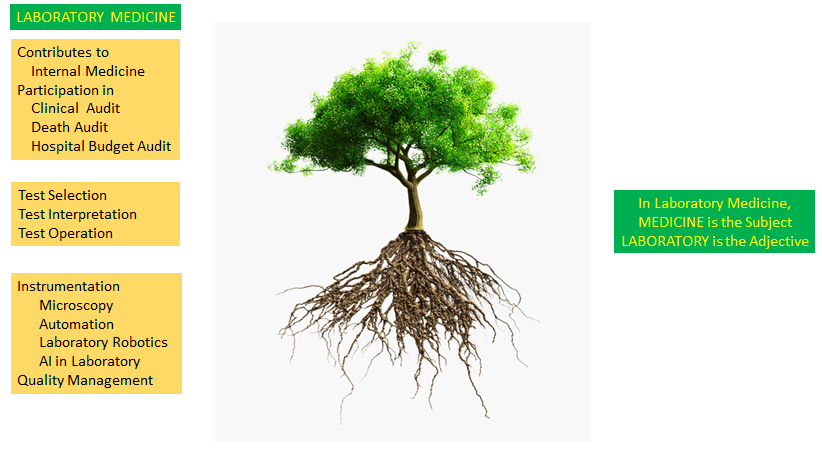
What nomenclature one can opt for, Clinical Pathology (CP) or Laboratory Medicine (LM)? Is anything hidden in the name? Since when were the two nomenclatures found being used almost synonymously? Are two names caught in competitive laboratory academics? We do not have definite answers to those questions. The earliest literature available on the use of nomenclature of laboratory medicine as synonymous to clinical pathology has been found in the scanned copy of a hand-written note of a meeting (April 1965) of six concerned clinical pathologists of American Society of Clinical Pathologists, who organized a conference (November 1966) of the American and Canadian clinical pathologists from more than 50 Universities for the expansion of the discipline, quoted in a paper published in January 1989 in the Academy of Clinical Laboratory Physicians and Scientists Newsletter [5]. However, neither the United States of America nor Canada run any course with the title of Laboratory Medicine, The logic behind adapting this nomenclature of Laboratory Medicine at AIIMS Delhi appeared much later. In the nomenclature Clinical Pathology, “pathology” is the noun; “clinical” is its adjective. In Laboratory Medicine, “medicine” is the noun and laboratory is its adjective. In Clinical Pathology, one learns pathology in the context of the clinical conditions of the patient. In Laboratory Medicine, one learns medicine in the context of laboratory test procedures, results and quality management. In this sense, internal medicine has a major overlap with and is in fact rooted in laboratory medicine. This changes the whole dynamics of the department and interaction with clinical departments, hospital administration, and all other laboratory-related departments.
The residents of LM participate in the ward-rounds of the clinical colleagues, and actively contribute in test selection and test interpretation. To enlighten their clinical colleagues on the sensitivity, specificity, positive and negative predictive value of any laboratory test is a prerogative of LM
residents. They are thus laboratory consultants of the clinical consultants. Another example of clinical reach is their active contribution in the clinical audit of death and budget audit of the hospital administration.
The tasks of LM residents are grounded in laboratory instrumentation, all kinds of diagnostic microscopy, laboratory robotics and the application of Artificial Intelligence. Operationally their basic job is quality laboratory management to produce reliable results. Unlike most biochemists who advocate for Biochemistry and Laboratory Medicine Worldview, LM postgraduates are trained and become experts in microscopy too. Unlike most pathologists who advocate for Pathology and Laboratory Medicine Worldview, LM postgraduates are trained and become experts also in laboratory robotics, Artificial Intelligence in the laboratory and quality management of laboratory procedures. Thus, conceptually the organics of Clinical Pathology and Laboratory Medicine are different and so are their dynamics and growth potential. The organics and the operational dynamics of Laboratory Medicine has been shown in (Figure 1).
Laboratory Medicine: Prevalent Definitions
Laboratory Medicine is a medical field that encompasses the selection, operation and interpretation of diagnostic testing that uses primarily the specimens from patients and contributes to clinical management [6]. The emphasis is more on the application and the service aspects rather than on the conceptual aspects of the pathological, biochemical and microbiological basis of the disease. Recently the definition of Laboratory Medicine has been revised as “a clinical science and discipline, devoted to the quantitative measurement, or qualitative assessment, of any substance which can be assayed in any type of biological fluid of any animal species, thus including humans, for either medical or research purposes. The results of these measurements are translated into actionable information for improving the care and/or maintaining the wellness of both a single individual and an entire population” [7]. The definition uses Laboratory Medicine as the umbrella discipline under which all laboratory-related departments function.
The Initial Own Niche of Laboratory Medicine
The routine laboratory investigations in most of the hospitals and teaching institutions comprising of hematological, biochemical, microbiological, and body fluid tests constitute about 70-80% of all laboratory investigations. However, this is considered as no laboratory physician’s land, or every laboratory physician’s land, and is practically given over to laboratory technologists on the ground to look into. In the first step of formulation of LM, this area becomes the central core niche appended with the centralized common specimen collection centre [8]. The boundary makes the Tier-I of all medical laboratories in a teaching institute. To put it in a proper perspective in the total scheme of hospital laboratories in a tertiary care hospital and teaching medical institution, the Laboratory Medicine department belongs to Tier I, the departments of Pathology, Microbiology, and Biochemistry make Tier II, and the common centralized research facility laboratory with high-end costly equipment forms Tier III [9]. Once Tier I takes a definite shape, the next step to progress is to bring all claimant specialists as the faculty in Tier-I, and administratively declare the area as a department, independent of other specialty laboratories like Anatomic Pathology, Biochemistry, and Microbiology. No medical department in a teaching hospital can survive without a residency program and a sustainable fruitful course. Therefore, in step three, starting a medical postgraduate course with a residency program leading to a medical postgraduate degree is the most desired and sensible deed.
The Gains and the Long Term Perspectives
Immediate gains from a department of LM are the one- window solution for patients, minimum turn-around time in the investigation, and combined integrated interpretative reporting of biochemical, hematological, and microbiological investigations. Subsequent gain with the postgraduate training program is the development of the expert resources of laboratory quality managers, and a pool of laboratory educators and trainers. Since reliable laboratory results are the hard evidence for the practice of evidence-based medicine, this area becomes the research and publication hub. Internal Medicine gets strengthened by the effective dynamics of Laboratory Medicine. In the long run, diagnostic service for the nation becomes cost-effective for both patients and the nation. This is in terms of the knowledge-economy, manpower-economy, infrastructure-economy, and health- economy. This new course can offer an additional option for postgraduate-aspirants in the country. The scheme opens job opportunities for faculties and new specialist experts. Because of cost-effectiveness, this enterprise is sustainable from the city to countryside hospitals and for running the Point-of-Care during pandemics and national disasters through an inflatable lab or the ‘lab on a wheel’.
Laboratory Medicine at AIIMS, Delhi
Any postgraduate course requires a Foundational Framework. Following several ups and downs, the Foundational Framework of LM has been laid down [10]. The expected skills to be learned during three-year residency program have been defined by the department [11] as well as by NMC [3]. The goal of the course is to produce the ‘Laboratory physicians of first contact’, with desirable postgraduate competency in knowledge skill and attitude; the first contact for both clinicians and patients. During clinical rounds, LM residents help clinical colleagues in test selection and test interpretation. They help patients in the pre-test and post-test counselling, and post-test referral. The operational training for the residents are on most of the tests included as WHO’s higher-priority Essential Diagnostic List, and the tests listed in the National Diagnostic Essential List of the Indian Council of Medical Research, which is based on the global and national needs respectively [12]. The one- fourth of the total curriculum of LM consists of Laboratory Management and Quality Assurance.
The training in Laboratory Medicine has been institutionalized at AIIMS, Delhi. At the beginning of every postgraduate semester, the LM department runs an orientation program for the newly appointed residents of all clinical departments. The residents from some of the clinical departments (e.g., Paediatrics) are posted for a specified period in the laboratory medicine to strengthen their skill of how to utilize the laboratory for best clinical management. The residents from Pathology and Biochemistry departments also have their rotational posting in the Laboratory Medicine department. The combined seminars with the department of Pathology have been running since the time of inception of the LM department. In order to increase the awareness towards the current-day-laboratories and its functioning, the undergraduates at AIIMS are sensitized on ‘Pre-Analytical Variables Influencing the Laboratory Results’ and different ‘Organ Function Tests’ by the Laboratory Medicine faculties in terms of a large group and small group teaching.
Laboratory Medicine: The Global Aspect
In the United States of America, the specialty of Laboratory Medicine functions as a branch of Pathology (where Pathology is the generic name for all diagnostic laboratories). There is 3-year Anatomic Pathology (AP), 3-year Clinical Pathology (AP) and a 4-year AP-CP combined training course. In many European countries, Laboratory Medicine is considered as an extension of Clinical Biochemistry. Global bodies on Laboratory Medicine such as the European Federation of Clinical Chemistry and Laboratory Medicine (EFLM), the Academy of Clinical Laboratory Physicians and Scientists (ACLPS), and the International Federation of Clinical Chemistry (IFCC) [13, 14, 15] have proposed different training programs in LM. However, the courses are yet to receive global acceptance, except the CP and AP-CP courses of the USA. Further, medical undergraduates remain almost completely unaware of Laboratory Medicine as a department or as a postgraduate discipline. In this context, the World Health Organization has set guidelines for the final year medical students [16] to develop knowledge and skills for running the medical laboratory.
Concluding Remarks
Clinical Pathology and Laboratory Medicine cannot be considered synonymous. There is a difference in their organics, and so in their dynamics and growth potential.
In the cycle of time, India has chosen the terminology of Laboratory Medicine decisively over Clinical Pathology. In this paper, the story of AIIMS Delhi creating the Department of Laboratory Medicine, independent of other laboratory related-departments, such as Pathology, Biochemistry, and Microbiology, and its fruition has been described over the years. Laboratory Medicine department and three- year residency program leading to a medical postgraduate degree is a made-in-India gift to the world in training of the discipline of Laboratory Medicine. In consequence, Laboratory Medicine as a discipline is on the threshold of several challenges, expectations, and changes. This movement will not leave existing laboratory disciplines such as Pathology, Microbiology, and Biochemistry untouched! The discipline is expected to improve the dynamics with the clinical departments and is sure to strengthen the roots of Internal Medicine. India, by forming a separate discipline of Laboratory Medicine, has taken the lead for structural reorganization, academic reform [9], and redefinition of the boundary of various medical laboratories vis-a-vis the dynamics with the clinical departments and hospital administration. Since 2014, Bangladesh as a nation has adapted the Indian model of Laboratory Medicine and has been gradually replacing its clinical pathology courses. The United States of America has its own excellent training program on the subject as CP and combined AP-CP courses. However, the rest of the USA in the world is larger than the USA. How the rest of the Nations respond to this new formation in India will be worthwhile to follow!
References
-
Postgraduate Medical Education Regulations (2000) Addition of MD (Laboratory Medicine) in Clause A under the heading MD (Doctor of Medicine).
-
Postgraduate Medical Education Regulation Draft, Accessed on 14th Oct 2021.
-
Guidelines for Competency Based Postgraduate Training Programme for MD in Laboratory Medicine.
-
Standard Assessment Form for PG Courses Subject – Laboratory Medicine.
-
History of ACPLS.
-
Burtis CA, Ashwood ER, Bruns DE (2012) Tietz textbook of clinical chemistry and molecular diagnostics. 5th (Edn.), Elsevier Health Sciences.
-
Lippi G, Plebani M (2020) A modern and pragmatic defi- nition of Laboratory Medicine, Clinical Chemistry and Laboratory Medicine 58(8): 1171.
-
Robinson AT (2021) Pathology-The Beginnings of Labo- ratory Medicine. Laboratory Medicine 52(4): 66-82.
-
Mukhopadhyay AK (2017) Medical Laboratory Disci- plines: Time for Academic Reform and Structural Orga- nization. Journal of Applied Clinical Pathology 1(1): 2
-
The Foundational Framework of Lab Medicine.
-
Mukhopadhyay AK Skills as expected from a Postgraduate in Laboratory Medicine.
-
National Essential Diagnostics List (2019) Indian Council of Medical Research.
-
Smith BR, Wells A, Alexander CB, Bovill E, Campbell S, et al. (2006) Curriculum content and evaluation of compe- tency in clinical pathology (laboratory medicine): a pro- posal. Clin Chem 52(6): 917-949.
-
Smith JM, Greaves R (2017) The IFCC curriculum.
-
Jassam N, Lake J, Dabrowska M, Queralto J, Rizos D, et al. (2018) The European Federation of Clinical Chemistry and Laboratory Medicine syllabus for postgraduate education and training for Specialists in Laboratory Medicine: version 5 –2018. Clinical Chemistry and Laboratory Medicine (CCLM) 56(11): 1846-1863.
-
WHO (1988) Regional Office for the Eastern Mediterranean Laboratory medicine education in medical schools: guidelines for courses on the effective use of clinical laboratory tests.
- Genomic Landscape of Aggressive Penile Squamous Cell Carcinoma including TERT-p and NOTCH1 Mutations – An Institutional Experience
- Establishment of Baseline Haematological Values for Canine Population in North-Central Nigeria: A Cross-Sectional Study in the Federal Capital Territory
- Biochemical Assessment of Uroliths Extracted in Patients with Urolithiasis in a Tertiary Health Institution
- Update on Gastrointestinal Pecomas: Molecular Pathogenesis and Risk Stratification
- A Comparative Study of Serum C-reactive Protein Level Between Pre-eclampsia and Normal Pregnancy in Tertiary Level Hospital
- From Deformity to Alignment: Clinical Outcomes of the Schnepp Osteotomy in Hallux Valgus in 47 Feet