
Prevalence, Awareness and Risk Factor of Diabetes in the Northern Region of Bangladesh
Background: This survey study was undertaken to investigate the prevalence and awareness of diabetes, and to identify its potential risk factors and complications in five districts of the Northern region of Bangladesh. Methods: Total 202 diabetes patients were directly interviewed using a standard questionnaire from February, 2016 to January, 2017. The data was analyzed by using Microsoft Excel 2010. Results: Among the study subjects, 55.45% were males and 44.55% were females. 47.53% of the subjects had the family history of diabetes. 74.26% of the subjects were suffered from type-2 diabetes and 23.76% were suffered from type-1 diabetes. Diabetes patients participated in our research also experienced hypertension (20.79%), kidney complication (8.91%) and vision complication (81.19%). Conclusion: In the northern region of Bangladesh, diabetes has recently become a major public health issue. Immediate action is required to counter the rise in diabetes through better detection, awareness, prevention and treatment.
Jannatul Farhana1*, Anup Kumar2, Mehedi Hasan1 and Najem Uddin1
its potential risk factors and complications in five districts of the Northern region of Bangladesh.
January, 2017. The data was analyzed by using Microsoft Excel 2010.
(8.91%) and vision complication (81.19%).
Keywords: Diabetes; Prevalence; Awareness; Risk Factors; Northern region of Bangladesh
Introduction
Especially in the developed and developing countries, diabetes poses a major global health threat [1]. It is a principle cause of death and disability worldwide [2, 3]. The rising tendency of diabetes is common in the developing nations and most common in Southeast Asian countries [1]. Its worldwide prevalence was about 8% in 2011 and is predicted to increase to 10% by 2030 [3]. In 2010, an approximated140 million people living in Asia had diabetes and globally 60% of the people with diabetes were of Asian region [4]. Recent epidemiological studies have shown an increased prevalence of DM in Hawaii (20.4%), India (12.1%), Pakistan (11.1%), Turkey (7.2%) and China (6.1%) [5, 6, 7, 8, 9]. It has been suggested that the increase in prevalence of diabetes among Asian Americans is due to ageing of the population, urbanization and increasing prevalence of obesity and physical inactivity [10]. Bangladesh had a population of 149.8 million in 2011 [11]. A current meta-analysis indicated that the prevalence of diabetes among adults had risen substantially, from 4% in 1995 to 2000 and 5% in 2001 to 2005 to 9% in 2006 to 2010 [12]. According to the International Diabetes Federation, the prevalence will be
13% by 2030 [13]. In Bangladesh, it was reported that prevalence of type 2 diabetes is on the rise more in urban areas compared to rural population [14, 15]. Bangladesh is one of the developing countries in the world and facing rapid urbanization in current time [16]. The country is also in the phase of demographic transition with an expanding proportion of older population. Urbanization was found to be related with a sedentary lifestyle, higher calorie food intake and stressful condition, which might have contributed to the increasing prevalence of diabetes [1, 17]. The literature review has shown that there are no enough reports about the prevalence of diabetes and its risk factor in the northern region of Bangladesh. The overall aim of this paper is to find out a more complete picture of the distribution of diabetes related behavioral and biological risk factors by social group. We have collected data in order to describe the distribution of diabetes related risk factors in the population of the northern part in Bangladesh by sex, education and occupation.
Materials and Methods
Study Site
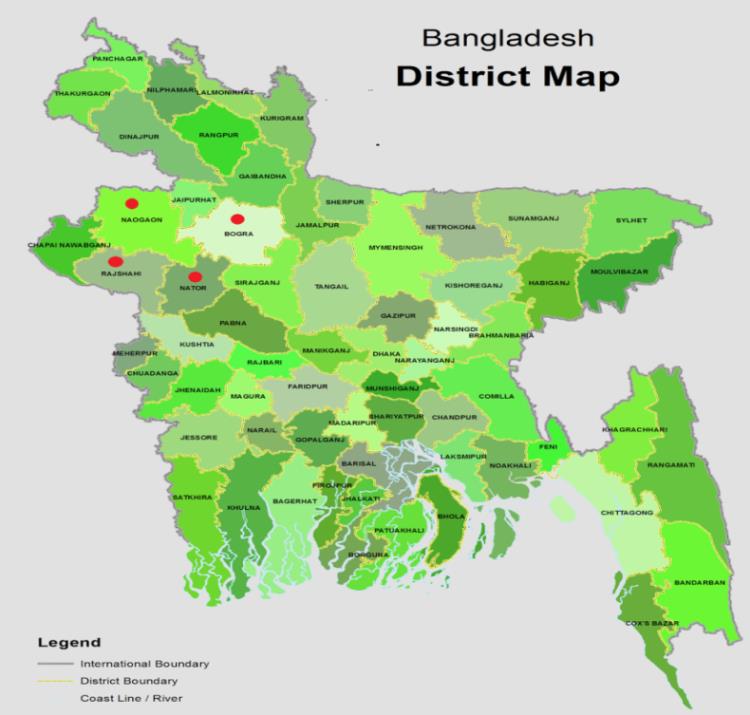
This cross-sectional study was carried out using a self- designed standard questionnaire following WHO guidelines from February, 2016 to January, 2017. Five cities from the northern region of Bangladesh namely Rajshahi, Chapainawabganj, Natore, Bogra and Naogaon pointed in the country map (Figure 1) were selected for collecting the data.
In this study, we enrolled 202 patients randomly from different diabetes centers who came for the treatment of diabetes and also by home visit. Fourth year pharmacy students of Varendra University were assigned and instructed for conducting the survey. The data was collected from the patients by direct interview and the statistics were made by their answers. The questionnaire was prepared in English which is then translated to Bengali language by the data collectors to the participants Jannatul Farhana, et al. Prevalence, Awareness and Risk Factor of Diabetes in the Northern Region of Bangladesh. Diabetes Obes Int J 2018, 3(3): 000181.
Data Analysis
Descriptive statistics were applied to analyze the collected data using Microsoft Excel Software 2010. The data was calculated using simple statistical methods. The results were finally expressed in percentages and shown in Column, Line, Bar, Pie chat.
Ethical Statement
This survey based research was conducted following the general guidelines (section 12) of WMA declaration of Helsinki [18] and also logistically supported by the Department of Pharmacy, Varendra University, Bangladesh. The human subjects involved in this research did not use any lethal agents and samples were not taken from them. During the study, the human subjects only participated in the interview. Therefore, for conducting the study, it was not a prerequisite to take any further permission from institutional ethics committee.
Results
Prevalence and Socio-demographic Characteristics
Table 1 shows the prevalence of diabetes and socio- demographic characteristics of the study subjects. Among the 202 study population, 55.45% were males and 44.55% were females. During this study we observed that, the majority of the subjects were of age 51-60 years (24.75%). This is followed by 23.76% in the aged between 41-50 years and 20.8% in the aged group 31-40 years. Regarding marital status most of the participants were married (98.02%) and only a few were unmarried (1.98%). Another surprising fact that most of the patients participated in our study were housewife (42.57%) whereas only 0.99% of the participants were students.
| Variables | Feedback | Frequency | Percentage (%) | ||||||||
|---|---|---|---|---|---|---|---|---|---|---|---|
| Sex | Male | 112 | 55.45 | ||||||||
| Female | 90 | 44.55 | |||||||||
| Age | 21-30 | 16 | 7.92 | ||||||||
| 31-40 | 42 | 20.8 | |||||||||
| 41-50 | 48 | 23.76 | |||||||||
| 51-60 | 50 | 24.75 | |||||||||
| 61-70 | 38 | 18.81 | |||||||||
| >70 | 8 | 3.96 | |||||||||
| Marital status | Married | 198 | 98.02 | ||||||||
| Unmarried | 4 | 1.98 | |||||||||
| Occupation | Student | 2 | 0.99 | ||||||||
| Businessman | 22 | 10.89 | |||||||||
| Govt. job | 4 | 1.98 | |||||||||
| Non-govt. job | 14 | 6.93 | |||||||||
| Day Laborer | 8 | 3.96 | |||||||||
| Shopkeeper | 12 | 5.94 | |||||||||
| Retired person | 10 | 4.95 | |||||||||
| Teacher | 24 | 11.89 | |||||||||
| House wife | 86 | 42.57 | |||||||||
| Others | 20 | 9.90 |
Table 1: Prevalence of Diabetes and Socio-demographic Characteristics of the Study Population (N=202).
Table 2 shows the anthropometric and clinical variables. In this study, only 25.74% of the study population had normal blood pressure. The majority of the populations were with body weight range 61-70 kg (38.62%), on the other hand the minority of the populations were with body weight over 80 kg (2.97%).
Jannatul Farhana, et al. Prevalence, Awareness and Risk Factor of Diabetes in the Northern Region of Bangladesh. Diabetes Obes Int J 2018, 3(3): 000181.
| Variables | Feedback | Frequency | Percentage (%) | ||||||||
|---|---|---|---|---|---|---|---|---|---|---|---|
| Blood pressure | Normal (120/80 mm Hg) | 52 | 25.74 | ||||||||
| Systolic high | 56 | 27.72 | |||||||||
| Diastolic high | 28 | 13.86 | |||||||||
| Systolic low | 42 | 20.8 | |||||||||
| Diastolic low | 24 | 11.88 | |||||||||
| Body weight (Kg) | ≤50 | 22 | 10.89 | ||||||||
| 51-60 | 74 | 36.63 | |||||||||
| 61-70 | 78 | 38.62 | |||||||||
| 71-80 | 22 | 10.89 | |||||||||
| >80 | 6 | 2.97 | |||||||||
| Height (Feet) | 4.5-5.0 | 30 | 14.85 | ||||||||
| 5.1-5.5 | 106 | 52.48 | |||||||||
| 5.6-6.0 | 50 | 24.75 | |||||||||
| 6.1-6.5 | 16 | 7.92 |
Table 2: Anthropometric and Clinical Characteristics of the Study Subjects.
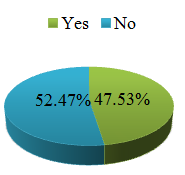
Among the study subjects, 47.53% had the family history of diabetes (Figure 2).
Types of Diabetes
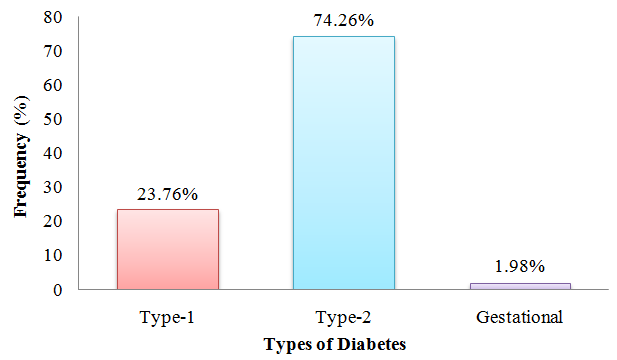
Most of the patients were suffered from type 2 diabetes (74.26%) and only a few were suffered from type 1 diabetes (23.76%), shown in Figure.
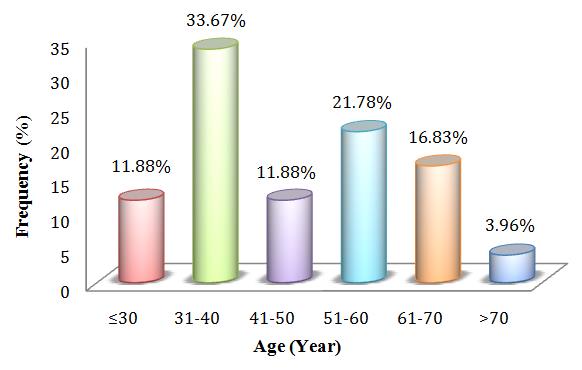
As we found in this study, 33.67% of the patients were experiencing diabetes from the age 31-40 years which followed by 21.78% from the age 51-60 years and 16.83% from the age 61-70 years indicated by Figure.
Life Style
As shown in Figure, 11.88% of the patients were habituated with cigarette smoking and 88.12% of them were non-smoker.
Jannatul Farhana, et al. Prevalence, Awareness and Risk Factor of Diabetes in the Northern Region of Bangladesh. Diabetes Obes Int J 2018, 3(3): 000181.
Awareness for Diabetes
Awareness of diabetes includes checking of blood glucose level regularly, taking of physical exercise regularly etc. In our study we observed that 89.11% of the patients checked their blood glucose level regularly. We also observed that 80.2% of the participants in our study took physical exercise on regular basis. The type physical exercise taken by the participants includes walking, jogging, free hand exercise, instrumental exercise. During this study, 88.89% of the study subjects gave positive answer about the improvement of diabetes by taking physical exercise. Table 3 will show the details.
| Variables | Feedback | Frequency | Percentage (%) | ||||||||
|---|---|---|---|---|---|---|---|---|---|---|---|
| Checking of glucose level regularly | Yes | 180 | 89.11 | ||||||||
| No | 22 | 10.89 | |||||||||
| Regular physical exercise | Yes | 162 | 80.2 | ||||||||
| No | 40 | 19.8 | |||||||||
| Type of physical exercise taken by the participants (N=162) | Walking | 112 | 69.14 | ||||||||
| Jogging | 42 | 25.93 | |||||||||
| Free hand exercise | 5 | 3.08 | |||||||||
| Instrumental exercise | 3 | 1.85 | |||||||||
| Does exercise improve the diabetes? (N=162) | Yes | 144 | 88.89 | ||||||||
| No | 18 | 11.11 |
Table 3: Awareness for Diabetes among the Study Population (N=202).
Risk Factors of Diabetes
Table 4 illustrates our finding about the risk factors of diabetes. Diabetes patients participated in our research also experienced hypertension (20.79%), kidney complication (8.91%) and vision complication (81.19%).
| Percentage | |||||||||||
|---|---|---|---|---|---|---|---|---|---|---|---|
| Variables | F | eedbac | k | Frequency | |||||||
| (%) | |||||||||||
| Hypertension | Yes | 42 | 20.79 | ||||||||
| No | 160 | 79.21 | |||||||||
| Have any kidney complication? | Yes | 18 | 8.91 | ||||||||
| No | 184 | 91.09 | |||||||||
| Have any vision complication? | Yes | 164 | 81.19 | ||||||||
| No | 38 | 18.81 |
Table 4: Risk Factors of Diabetes among the Study Population (N=202).
Discussion
Our study’s findings are consistent with the increasing prevalence of diabetes in Bangladesh. Similar figures have been noted recently in most Asian countries: 10% in China, [19] 9% in India, [13] 8% in the Islamic Republic of Iran, [20] 11% in Pakistan6 and 8% in the Republic of Korea [21]. The associations we found between diabetes and age and body weight are similar to those observed around the world. However, associations with educational level and household socioeconomic status vary internationally.
In our study, 55.45% of the participants were males. This rate is greater than the result found by a study conducted in Tanzania (25.6%). In case of female patients our finding (44.55%) is less than the same study conducted in Tanzania (74.4%) [22]. We found different risk factors like obesity, physical inactivity, higher socioeconomic status, increased age, hypertension and positive family history. Higher BMI and WHR were also recognized as the independent risk factors for diabetes. Most of the risk factors found in the present study were almost same as reported in the community based study in India [23]. Apart from these conventional risk factors, smoking, short height and literacy were also identified as risk factors. In our study, 56% of diabetics were not aware they had the disease and only 40% were receiving treatment regularly. Similarly, the International Diabetes Federation reported recently that over 50% of people with diabetes in south Asia were unaware of their condition [13]. The physical activity has important impact on the prevalence of obesity. It is noticed that the people in high socio economic class and sedentary life style are more prone to develop diabetes. Physical inactivity increases the occurrence of diabetes. Contrary to this, the absence of obesity and more physical activity is related to low prevalence of diabetes, 0.95% in the study of Danish, et al. [24]. This scenario also found same with our study.
Jannatul Farhana, et al. Prevalence, Awareness and Risk Factor of Diabetes in the Northern Region of Bangladesh. Diabetes Obes Int J 2018, 3(3): 000181.
Although diabetes and other chronic diseases are serious public health problems in Bangladesh, they are given only a low priority by the health-care system.
Conclusion
The prevalence of diabetes has continued to rise in the population of northern region of Bangladesh. The raised prevalence of risk factors for diabetes, among the study populations includes family history, hypertension, overweight etc. Kidney disease, vision problem are common complications of diabetes among study subjects. Management of its modifiable risk factors might help in reducing its incidence in the near future.
Competing Interest
The authors declare that they have no competing interests.
Acknowledgement
We acknowledge the contribution of our survey team members for their continuous effort in the collection of data. We are also grateful to all participants in the study for their active co-operation.
References
-
Wild H, Roglic G, Green A, Sicree R, King H (2004) Global prevalence of diabetes, estimates for the year 2000 and projections for 2030. Diabetes Care 27(5): 1047-1053.
-
Lozano R, Naghavi M, Foreman K, Lim S, Shibuya K, et al. (2012) Global and regional mortality from 235 causes of death for 20 age groups in 1990 and 2010: a systematic analysis for the Global Burden of Disease Study 2010. Lancet 380(9859): 2095-2128.
-
Murray CJ, Vos T, Lozano R, Naghavi M, Flaxman AD, et al. (2012) Disability-adjusted life years (DALYs) for 291 diseases and injuries in 21 regions, 1990-2010: a systematic analysis for the Global Burden of Disease Study 2010. Lancet 380(9859): 2197-2223.
-
International Diabetes Federation: Diabetes atlas.
-
Grandinetti A, Chang HK, Mau MK, Curb JD, Kenny EK, et al. (1998) Prevalence of glucose intolerance among Native Hawaiians in two rural communities. Native Hawaiian Health Research (NHHR) Project. Diabetes Care 21(4): 549-554.
-
Ramachandran A, Snehalatha C, Kapur A, Vijay V, Mohan V, et al. (2001) High prevalence of diabetes and impaired glucose tolerance in India: National Urban Diabetes Survey. Diabetologia 44(9): 1094- 1101.
-
Shera AS, Rafique G, Khwaja IA, Baqai S, Khan IA, et al. (1999) Pakistan National Diabetes Survey prevalence of glucose intolerance and associated factors in North West at Frontier Province (NWFP) of Pakistan. J Pak Med Assoc 49(9): 206-211.
-
Satman I, Yilmaz T, Sengul A, Salman S, Salman F, et al. (2002) Population based study of diabetes and risk characteristics in Turkey: Results of the Turkish Diabetes Epidemiology Study (TURDEP). Diabetes Care 25(9): 1515-1556.
-
Dong Y, Gao W, Nan H, Yu H, Li F, et al. (2005) Prevalence of type 2 diabetes in urban and rural Chinese populations in Qingdao, China. Diabet Med 22(10): 1427-1433.
-
Marguerite J, McNeely, Edward J (2004) Type 2 diabetes prevalence in Asian Americans. Diabetes Care 27(1): 66-69.
-
(2014) Bangladesh population and housing census 2011. Dhaka: Bangladesh Bureau of Statistics, Government of the People’s Republic of Bangladesh.
-
Saquib N, Saquib J, Ahmed T, Khanam MA, Cullen MR (2012) Cardiovascular diseases and type 2 diabetes in Bangladesh: a systematic review and meta-analysis of studies between 1995 and 2010. BMC Public Health 12: 434.
-
International Diabetes Federation (IDF) (2013) IDF diabetes atlas 6th Edition.
-
Sayeed MA, Mahtab H, Khanum PA, Latif ZA, Ali SMK, et al. (2003) Diabetes and Impaired fasting glycaemia in rural population of Bangladesh. Diabetes Care 26(4): 1034-1039.
-
Hussain A, Rahim MA, Azad Khan AK, Ali SMK (2005) Type 2 diabetes in rural and urban population: Diverse prevalence and associated risk factors in Bangladesh. Diabet Med 22(7): 931-937.
-
Laskar SI (1996) Urbanization in Bangladesh: Some contemporary observations. Bangladesh Dev Stud 24(1-2): 207-216. Jannatul Farhana, et al. Prevalence, Awareness and Risk Factor of Diabetes in the Northern Region of Bangladesh. Diabetes Obes Int J 2018, 3(3): 000181.
-
Ramachandran A, Snehalatha C, Latha E, Vijay V, Vishanathan M (1999) Impacts of urbanization on life style and on the prevalence of diabetes in native Asian Indian population. Diabet Res Clin Pract 44(3): 207-213.
-
WMA declaration of Helsinki: Ethical principles for medical research involving human subjects.
-
Yang W, Lu J, Weng J, Jia W, Ji L, et al. (2010)Prevalence of diabetes among men and women in China. N Engl J Med 362(12): 1090-1101.
-
Esteghamati A, Gouya MM, Abbasi M, Delavari A, Alikhani S, et al. (2008) Prevalence of diabetes and impaired fasting glucose in the adult population of Iran: National Survey of Risk Factors for Non- Communicable Diseases of Iran. Diabetes Care 31(1): 96-98.
-
Kim SM, Lee JS, Lee J, Na JK, Han JH, et al. (2006) Prevalence of diabetes and impaired fasting glucose in Korea: Korean National Health and Nutrition Survey 2001. Diabetes Care 29(2): 226-231
-
Stanifer JW, Cleland CR, Makuka GJ, Egger JR, Maro V, et al. (2016) Prevalence, Risk Factors, and Complications of Diabetes in the Kilimanjaro Region: A Population-Based Study from Tanzania. PLoS ONE 11(10): e0164428.
-
Sadikot SM, Nigam A, Das S, Bajaj S, Zargar AH, et al. (2004) The burden of diabetes and impaired fasting glucose in India using the ADA 1997 criteria: Prevalence of diabetes in India study (PODIS). Diabetes Research and Clinical Practice 66(3): 293- 300.
-
Danish FA, Khan A, Khattak MMAK (2002) Prevalence of diabetes mellitus and its relation to diet and physical work in Azad Jammu and Kashmir. Pakistan Journal of Nutrition 1(5): 217-222. Jannatul Farhana, et al. Prevalence, Awareness and Risk Factor of Diabetes in the Northern Region of Bangladesh. Diabetes Obes Int J 2018, 3(3): 000181.
- Investigation of Polymorphisms in PPAR-Ɣ and TRHR Genes and their Impact on Turkish Diabetic and Obese Individuals
- The Impact of Aircraft Noise Exposure on the Efficacy of Empagliflozin Therapy in an Animal Model of Obesity
- Rooibos Mitigates Metabolic and Inflammatory Dysfunctions in Mice Fed a High-Carbohydrate Diet
- Synergistic Effect of Combined Leaf Extract of Vernonia amygdalina, Ocimum gratissimum, and Zingiber officinale Tuber on Phytochemical Profile, Antioxidant Activity, Serum Insulin, and Biochemical Parameters in Streptozotocin-Induced Diabetic Rats
- Investigation of Cardiovascular Responses to Aerobic Exercise in Obese University Students
- A Look at the Phase Angle Obtained by Electrical Bioimpedance