
Upshot of Epigenetics and Famine on Metabolic Syndrome
Chronic diseases are stimulated in the womb through adaptations acquired by the fetus in response to malnutrition. Maternal malnutrition during early pregnancy, in relation to low birth weight as well as uterine growth restriction, may adversely influence offspring metabolism and health. Parental nutritional imbalance, either through global nutritional manipulation or deficiencies in specific nutrients, predisposes the offspring to metabolic disease. Exposure to environmental factors in early life can influence the developmental process as well as long-term health in humans. The famine affected fertility, weight gain during pregnancy, maternal blood pressure, infant size at birth and development of the central nervous system, are associated with an increased risk of adult-onset metabolic syndrome. The point to ponder over here is how these risk factors interact at the cellular level so as to cause disease? Here, epigenetic epidemiology enables researchers to explore critical links between genomic coding, modifiable exposures and the manifestation of the disease phenotype. Extensive epidemiologic studies have suggested that adult disease risk is associated with adverse environmental conditions (famines) to which the mother is exposed to early in development.
Introduction
It is now widely acknowledged that the jeopardy of chronic diseases in adulthood may have their origins in the womb through adaptations made by the fetus in response to under-nutrition [1]. The effects of under- nutrition depend upon the time of its occurrence during gestation and the organs as well as the systems that develop during that critical time window. The fetus being vulnerable to various factors like the physical and mental stress of the mother, environmental exposure, physical activity and nutrition becomes susceptible to long term health risks which develop after birth [2]. The impact of maternal nutrition on the etiology of chronic diseases in offspring in their adult life has been well established by various epidemiological studies [3]. Nutritional imbalances, such as under and over-nutrition during critical periods of gestation, induce persistent physiological alterations.
Metabolic disorders such as obesity and type 2 diabetes have reached epidemic rates in most developed and developing countries, but little is known about the role of DNA methylation in metabolic disease pathogenesis [4, 5]. The Syndrome X or Metabolic Syndrome (MetS), is a cluster of phenotypes that include increased abdominal fat mass, impaired insulin responsiveness, dyslipidemia with increased plasma triglycerides and decreased HDL-cholesterol increased blood pressure and elevated circulating cytokines and adipokines [6]. The mechanisms by which Syndrome X leads to the development of insulin resistance, dyslipidemia and associated phenotypes are poorly understood in molecular level, but necessarily involve long-term changes in gene regulation and gene expression. Earlier studies reported that the prevalence of MetS or Syndrome X associated factors are relatively low during early childhood but increases during adolescence and thereafter tends to persist into adulthood [7, 8, 9, 10, 11]. Several lines of evidence support a role for non-genetic factors in the development of insulin-resistance and indicate that epigenetic factors, possibly through DNA methylation, may play a role in metabolic diseases. Epigenetics literally means "above" or "on top of" genetics. These modifications do not change the DNA sequence, but they affect how cells "read" genes. Epigenetics is the study of mitotically heritable alterations in gene expression potential that are not mediated by changes in DNA sequence and it is in the field of genetics of cellular and physiological phenotypic trait variations that are caused by external or environmental factors that switch genes on and off [12, 13].
Epigenetic and Metabolic Syndrome
In the past decade, there has been a significant increase in the number of epidemiological studies investigating metabolic risk factors and outcomes in relation to DNA methylation, but many gaps stay behind in our understanding of the underlying cause. Previous studies reported that environmental factors can alter epigenetic features and change the future behavior of target cells and may play a role in susceptibility to MetS as well as other chronic diseases [14, 15, 16]. In humans this non genetic influences to change the pattern of gene expression are heritable across more than one generation and such transgenerational tradition of epigenetic states may contribute to the hereditary risk of various metabolic disorders [17, 18, 19, 20, 21]. DNA methylation is one of the most extensively studied epigenetic mechanisms and plays an important role in the process of development and differentiation [22]. It is also known that DNA methylation patterns continue to change after birth, at least partly in response to environmental influences [23, 24, 25]. There is evidence from both animal and human studies that prenatal alimentary impairment can perpetually modify DNA methylation at several loci and these modifications have a pivotal role in the observed alteration of imminent risk of chronic diseases like obesity, insulin resistance and diabetes [26, 27, 28, 29, 30, 31, 32].
A family cohort study of Northern European descent, observed a significant portion of the epigenome is heritable, including genes known to play roles in obesity and Met S [33]. Increasing evidence shows that environment-induced genetic effects can pass transgenerationally without changes occurring in the primary DNA sequence and this epigenetic trait can be transmitted up to the fifth generation or more [34, 35, 36]. Some of the familial risks of MetS may be epigenetic in origin. One of the best-characterized epigenetically regulated loci is insulin-like growth factor II (IGF2) gene; is characterized by alabel methylation pattern dependent on the nutritional stimuli received by the growing organism during early life development [37, 38]. IGF2 is a key factor in human growth and development and is maternally imprinted [39]. Further, childhood diet could contribute to IGF2 loss of imprinting in individuals [38]. Imprinting is preserved by the hypomethylation of differentially methylated region (DMR) of IGF2, which ultimately progress for bi-allelic expression of that gene [26, 40]. A recent investigation disclosed that paternal pre- conceptual obesity was associated with hypomethylation of IGF2 in newborns [19].
There are several studies on humans and animals which suggest that the early nutrition and poor growth in- utero is associated with an increased risk of coronary disease, hypertension, type 2 diabetes and obesity in adulthood [41, 42]. Maternal nutritional imbalance was shown to exhibit transgenerational effects through epigenetic and metabolic changes [43, 44] and the most consistently-observed epigenetic association with adiposity has been with that of methylation at the IGF2/H19 imprinting region [45, 46]. Higher methylation levels at specific genes, including IL10, LEP, ABCA1, GNASAS and MEG3, were closely linked with nutrition metabolism, cardiovascular function and inflammation [47].
Famine and Metabolic Syndrome
The hardships of war (World War II) invoked thought that the body's reaction to starvation could be genetic.
Pulakes P, et al. Upshot of Epigenetics and Famine on Metabolic Syndrome. Diabetes Obes Int J 2019, 4(3): 000207.
However, at that time, it was not known that starvation of pregnant women affected their children. At present, with advanced technological aids as well as extensive knowledge, researchers have delved into the secrecy of inheriting life experiences. A panel of investigators discovered that the mothers who have experienced famine conditions undergo a change in their DNA, which passes on for up to three generations. It has been further speculated that the mechanism functions as a way for parents to "prepare their progeny for hardships similar to the ones that they have experienced”, which would give them a better chance of survival. The first study about the possible association between prenatal exposure to famine and health reported during 1972-1975 used the “Dutch Famine 1943” to analyze adult health outcomes in relation to specific periods of gestation [48, 49]. However, another study reported that exposure to famine in early and mid-gestation was associated with the prevalence of obesity [50]. Findings of The Dutch Hunger Winter Family Study suggest that the effects of famine can be observed some sixty years later [51].
The famine affected fertility, weight gain during pregnancy, maternal blood pressure, infant size at birth and central nervous system development are associated with an increased risk of adult-onset metabolic syndrome post birth [49, 52, 53, 54, 55, 56]. It can be took into consideration that the famine condition composes a ‘natural experiment’ in which outpouring to famine was attributed based upon an individual’s birth place and time.51 This design was used to investigate how maternal undernutrition during specific gestational time windows may affect the subsequent life course of the offspring who has experienced the famine in-utero and their next generation. One of the most significant studies was conducted on children who were born to women exposed to severe undernutrition during pregnancy as a result of the Dutch Hunger Winter during World War II. The study reported reduced methylation of the imprinted gene IGF2 in these individuals during adulthood [26]. Two well-cited human population studies are those of the Dutch Famine cohort [57, 58, 59] and Overkalix cohorts [60], where both cohorts have been linked to transmission of ill-health into the F2 generation and the fetal origins hypothesis is broadly supported by the findings of the Dutch Famine birth cohort study. Another study from Northern Europe proposed that poor social conditions during childhood may become potent risk factors for obesity, diabetes and The "Barker hypothesis” [65] or "developmental programming hypothesis” has opened up a new research paradigm for understanding chronic disease risk that has moved beyond the simplistic explanations based on genetic and lifestyle influences. A more integrated approach has developed which examines the relations between genetic inheritance and lifestyle factors, thereby incorporating the role of developmental plasticity i.e., the ability of changes in gene function to generate a range of phenotypic outcomes based on environmental exposures [66]. The hypothesis suggests that the influences of environment during early life of the offspring may induce susceptibility to the onset of obesity and related metabolic disorders during subsequent life post birth.
other cardiovascular diseases (CVDs) in later life [61].
Upshot
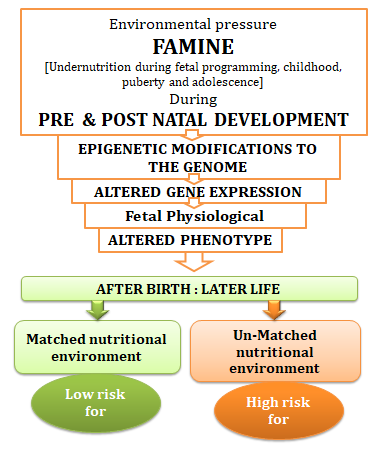
Maternal under-nutrition during early pregnancy, in relation to low birth weight and uterine growth restriction, may adversely influence offspring metabolic health and are associated with an increased risk of adult- onset metabolic syndrome. On the other hand poor nutrition during pregnancy or post natal development may be a risk factor for irreversible health issues including obesity, type 2 diabetes, hypertension hypercholesterolemia and other metabolic diseases in adult life (Figure 1). To evaluate the function of maternal health and nourishment in the instigation and advancement of ailments in childhood as well as adulthood, it is necessary to identify the physiological and pathological roles of specific nutrients on the epigenome. An increased insight into dietary interventions in-utero as well as early life could modulate risk of diseases through epigenomic alteration. Early embryonic development is of special interest in this respect because it is a crucial period for establishing and maintaining epigenetic marks [62]. Gene-gene and gene-environment interaction are important processes for initiation of particular symptoms associated with metabolic syndrome and its progression. Mainly the explanation for the adaptation to the environment could be used as an example for epigenetics, especially, if epigenetic trans-generational inheritance exists [63, 64]. However, a study systematically explained with the schematic diagram relating the genome, epigenome and environment with respect to trans- generational phenotypic characters [36].
Pulakes P, et al. Upshot of Epigenetics and Famine on Metabolic Syndrome. Diabetes Obes Int J 2019, 4(3): 000207.
Financial Support and Sponsorship
Dr. Pulakes Purkait received financial assistance in the form of Post Doctoral Fellowship from University Grants Commission, Government of India (UGC- ref. No. F./31- 1/2017/PDFSS-2017-18-WES-14115) dated 19th June 2017.
Acknowledgment
We wish to express our deep gratitude to the Vice Chancellor, Panjab University Chandigarh, for logistic support as access the facility in the department, library, internet and laboratory.We would also like to thank to Ms. Abhinandana and Ms. Shomya, Dept. of Zoology, Panjab University, Chandigarh for kind cooperation.
Conflicts of Interest
The authors declare that they have no competing interests.
References
-
[INLINE_TABLE:3:0]
-
Marciniak S, Perry GH (2017) Harnessing ancient genomes to study the history of human adaptation. Nat Rev Genet 18(11): 659-674.
-
Jang H, Serra C (2014) Nutrition, epigenetics, and diseases. Clinic Nut Res 3(1): 1-8.
-
Diamond J (2003) The double puzzle of diabetes. Nature 423: 599-602.
-
Zimmet P, Alberti KGMM, Shaw J (2001) Global and societal implications of the diabetes epidemic. Nature 414: 782-787.
-
Grundy SM, Brewer HB, Cleeman JI, Smith SC, Lenfant C, et al. (2004) Definition of Metabolic Syndrome Report of the National Heart, Lung, and Blood Institute/ American Heart Association Conference on Pulakes P, et al. Upshot of Epigenetics and Famine on Metabolic Syndrome. Diabetes Obes Int J 2019, 4(3): 000207. Scientific Issues Related to Definition. Circulation 109(3): 433-438.
-
Steinberger J, Moran A, Hong CP, Jacobs Jr, Sinaiko AR (2001) Adiposity in childhood predicts obesity and insulin resistance in young adulthood. J Pediatr 138(4): 469-473.
-
Brufani C, Ciampalini P, Grossi A, Fiori R, Fintini D, et al. (2010) Glucose tolerance status in 510 children and adolescents attending an obesity clinic in Central Italy. Pediatr Diabetes 11(1): 47-54.
-
Juhola J, Magnussen CG, Viikari JS, Kähönen M, Hutri- Kähönen N, et al. (2011) Tracking of serum lipid levels, blood pressure, and body mass index from childhood to adulthood: the Cardiovascular Risk in Young Finns Study. J Pediatr 159(4): 584-590.
-
Park MH, Falconer C, Viner RM, Kinra S (2012) The impact of childhood obesity on morbidity and mortality in adulthood: a systematic review. Obesity Rev 13(11): 985-1000.
-
Zhang Y, Cerjak D, Ali O (2014) Finding Epigenetic Determinants of the Metabolic Syndrome. Austin J Endocrinol Diabetes 1(6): 1029.
-
Jaenisch R, Bird A (2003) Epigenetic regulation of gene expression: How the genome integrates intrinsic and environmental signals. Nat Genet 33: 245-254.
-
Moore David S (2015) The Developing Genome: An Introduction to Behavioral Epigenetics, 1st (Edn.), Oxford University Press.
-
Sun H, Kennedy PJ, NestlerEJ (2013) Epigenetics of the depressed brain: role of histone acetylation and methylation. Neuro Psycho Pharmacol 38(1): 124- 137.
-
Gapp K, von Ziegler L, Tweedie-Cullen RY, Mansuy IM (2014) Early life epigenetic programming and transmission of stress-induced traits in mammals: How and when can environmental factors influence traits and their transgenerational inheritance?. Bioessays 36(5): 491-502.
-
Portha B, Fournier A, Kioon MD, Mezger V, Movassat J (2014) Early environmental factors, alteration of epigenetic marks and metabolic disease susceptibility. Biochimie 97: 1-15.
-
Heard E, Martienssen RA (2014) Transgenerational epigenetic inheritance: myths and mechanisms. Cell 157(1): 95-109.
-
Hocher B (2014) More than genes: the advanced fetal programming hypothesis. J Reprod Immunol 104- 105: 8-11.
-
Soubry A, Hoyo C, Jirtle RL, Murphy SK (2014) A paternal environmental legacy: evidence for epigenetic inheritance through the male germ line. Bioessays 36(4): 359-371.
-
McRae AF, Powell JE, Henders AK, Bowdler L, Hemani G, et al. (2014) Contribution of genetic variation to transgenerational inheritance of DNA methylation. Genome Biol 15: R73.
-
Ng SF, Lin RC, Laybutt DR, Barres R, Owens JA, et al. (2010) Chronic high-fat diet in fathers programs β- cell dysfunction in female rat offspring. Nature 467(7318): 963-966.
-
Smith ZD, MeissnerA (2013) DNA methylation: roles in mammalian development. Nat Rev Genet 14(3): 204-220.
-
Bell JT, Tsai PC, Yang TP, Pidsley R, Nisbet J, et al. (2012) Epigenome-wide scans identify differentially methylated regions for age and age-related phenotypes in a healthy ageing population. PLoS Genet 8: e1002629.
-
Alisch RS, Barwick BG, Chopra P, Myrick LK, Satten GA, et al. (2012) Age-associated DNA methylation in pediatric populations. Genome Res 22(4): 623-632.
-
Ziller MJ, Gu H, Müller F, Donaghey J, Tsai LT, et al. (2013) Charting a dynamic DNA methylation landscape of the human genome. Nature 500: 477- 481.
-
Heijmans BT, Tobi EW, Stein AD, Putter H, Blauw GJ, et al. (2008) Persistent epigenetic differences associated with prenatal exposure to famine in humans. Proceedings Nat Academy Sci 105(44): 17046-17049.
-
Tobi EW, Lumey LH, Talens RP, Kremer D, Putter H, et al. (2009) DNA methylation differences after exposure to prenatal famine are common and timing- and sex-specific. Hum Mol Genet 18(21): 4046-4053. Pulakes P, et al. Upshot of Epigenetics and Famine on Metabolic Syndrome. Diabetes Obes Int J 2019, 4(3): 000207.
-
Godfrey KM, Sheppard A, Gluckman PD, Lillycrop KA, Burdge GC, et al. (2011) Epigenetic gene promoter methylation at birth is associated with child’s later adiposity. Diabetes 60(5): 1528-1534.
-
Drake AJ, McPherson RC, Godfrey KM, Cooper C, Lillycrop KA, et al. (2012) An unbalanced maternal diet in pregnancy associated with offspring epigenetic changes in genes controlling glucocorticoid action and fetal growth. Clin Endocrinol (Oxf) 77(6): 808- 815.
-
Reynolds RM, Jacobsen GH, Drake AJ (2013) What is the evidence in humans that DNA methylation changes link events in utero and later life disease? Clin Endocrinol (Oxf) 78(6): 814-822.
-
Szyf M, Bick J (2013) DNA methylation: a mechanism for embedding early life experiences in the genome. Child Dev 84(1): 49-57.
-
Gomes MV, Pelosi GG (2013) Epigenetic vulnerability and the environmental influence on health. ExpBiol Med (Maywood) 238(8): 859-865.
-
Ali O, Cerjak D, Kent JW, James R, Blangero J, et al. (2015) An epigenetic map of age-associated autosomal loci in northern European families at high risk for the metabolic syndrome. Clinic Epigenet 7(1): 12.
-
Nadeau JH (2009) Transgenerational genetic effects on phenotypic variation and disease risk. Hum Mol Genet 18(R2): R202-210.
-
Anway MD, Cupp AS, Uzumcu M, Skinner MK (2005) Epigenetic transgenerational actions of endocrine disruptors and male fertility. Sci 308(5727): 1466- 1469.
-
Ho DH, Burggren WW (2010) Epigenetics and transgenerational transfer: a physiological perspective. J Exp Biol 213(1): 3-16.
-
Murphy SK, Jirtle RL (2003) Imprinting evolution and the price of silence. Bioessays 25(6): 577-588.
-
Waterland RA, Lin JR, Smith CA, Jirtle RL (2006) Post- weaning diet affects genomic imprinting at the insulin-like growth factor 2 (IGF2) locus. Hum Mol Genet 15(5): 705-716.
-
Smith FM, Garfield AS, Ward A (2006) Regulation of growth and metabolism by imprinted genes. Cytogenet Genome Res 113(1-4): 279-291.
-
Cui H, Cruz-Correa M, Giardiello FM, Hutcheon DF, Kafonek DR, et al. (2003) Loss of IGF2 imprinting: A potential marker of colorectal cancer risk. Sci 299(5613): 1753-1755.
-
Barker DJ, Forsen T, Eriksson JG, Osmond C (2002) Growth and living conditions in childhood and hypertension in adult life: A longitudinal study. J Hypertens 20(10): 1951-1956.
-
Forsen T, Eriksson JG, Tuomilehto J, Osmond C, Barker DJ (1999) Growth in utero and during childhood among women who develop coronary heart disease: Longitudinal study. BMJ 319(7222): 1403-1407.
-
Burdge GC, Hoile SP, Uller T, Thomas NA, Gluckman PD, et al. (2011) Progressive, transgenerational changes in offspring phenotype and epigenotype following nutritional transition. PLoS One 6(11): e28282.
-
Radford EJ, Isganaitis E, Jimenez-Chillaron J, Schroeder J, Molla M, et al. (2012) An unbiased assessment of the role of imprinted genes in an intergenerational model of developmental programming. PLoS Gen 8(4): e1002605.
-
Hernandez-Valero MA, Rother J, Gorlov I, Frazier M, Gorlova O (2013) Interplay between polymorphisms and methylation in the H19/ IGF2 gene region may contribute to obesity in Mexican-American children. J Dev Orig Health Dis 4(6): 499-506.
-
Williams-Wyss O, Zhang S, MacLaughlin SM, Kleemann D, Walker SK, et al. (2014) Embryo number and periconceptional undernutrition in the sheep have differential effects on adrenal epigenotype, growth, and development. Am J Physiol Endocrinol Metab 307(2): 141-150.
-
Tobi EW, LumeyL, Talens RP, Kremer D, Putter H, et al. (2009) DNA methylation differences after exposure to prenatal famine are common and timing- and sex-specific. Hum Mol Genet 18(21): 4046-4053.
-
Stein ZA, Susser M, Saenger G, Marolla F (1972) Nutrition and mental performance. Sci 178 (4062): 708-713. Pulakes P, et al. Upshot of Epigenetics and Famine on Metabolic Syndrome. Diabetes Obes Int J 2019, 4(3): 000207.
-
Stein ZA, Susser M, Saenger G, Marolla F (1975) Famine and Human Development: The Dutch Hunger Winter of 1944-1945. Oxford University Press, New York.
-
Ravelli GP, Stein ZA, Susser MW (1976) Obesity in young men after famine exposure in utero and early infancy. N Engl J Med 295(7): 349-353.
-
LumeyLH, Stein AD, Kahn HS, van der Pal-de Bruin KM, BlauwGJ, et al. (2007) Cohort Profile: The Dutch Hunger Winter Families Study. Int J Epidemiol 36(6): 1196-1204.
-
Smith CA (1947a) The effect of wartime starvation in Holland upon pregnancy and its product. Am J Obstet Gynecol 53(4): 599-608.
-
Smith CA (1947b) Effects of maternal undernutrition upon the newborn infant in Holland (1944–1945). J Pediatr 30(3): 229-243.
-
Sindram IS (1953) De invloed van ondervoeding op de groei van de vrucht. Ned Tijdschr Verloskd Gynaecol 53(1): 30-48.
-
Lumey LH, Ravelli AC, Wiessing LG, Koppe JG, Treffers PE, et al. (1993) The Dutch famine birth cohort study: design, validation of exposure, and selected characteristics of subjects after 43 years follow-up. Paediatr Perinat Epidemiol 7(4): 354-367.
-
Stein AD, Ravelli AC, Lumey LH (1995) Famine, third- trimester pregnancy weight gain, and intrauterine growth: the Dutch Famine Birth Cohort Study. Hum Biol 67(1): 135-150.
-
Painter RC, Osmond C, Gluckman P, Hanson M, Philips DI, et al. (2008) Transgenerational effects of prenatal exposure to the Dutch famine on neonatal adiposity and health in later life. BJOG 115(10): 1243-1249.
-
Veenendaal MV, Painter RC, de Rooij SR, Bossuyt PM, van der Post JA, et al. (2013) Transgenerational effects of prenatal exposure to the 1944–45 Dutch famine. BJOG 120(5): 548-553.
-
Lumey LH (1992) Decreased birthweights in infants after maternal in utero exposure to the Dutch famine of 1944-1945. Paediatr Perinat Epidemiol 6(2): 240- 253.
-
Pembrey ME, Bygren LO, Kaati G, Edvinsson S, Northstone K, et al. (2006) Sex specific, male-line transgenerational responses in humans. Eur J Hum Genet 14(2): 159-166.
-
Singh RB, Saboo B, Maheshwari A, Singh P, Verma NS, et al. (2015) Can Prevention of Low Birth Weight in Newborn may be Associated with Primordial Prevention of Cardiovascular Diseases and Type 2 Diabetes in Adult Life?. Jour Cardi Therap 2(5): 425- 429.
-
Reik W, Dean W, Walter J (2001) Epigenetic reprogramming in mammalian development. Sci 293(5532): 1089-1093.
-
Skinner MK, Manikkam M, Guerrero-Bosagna C (2010) Epigenetic transgenerational actions of environmental factors in disease etiology. Trends Endocrinol Metab 21(4): 214-222.
-
Skinner MK (2011) Role of epigenetics in developmental biology and transgenerational inheritance. Birth Defects Res C Embryo Today 93(1): 51-55.
-
Barker DJ (1998) In utero programming of chronic disease. Clin Sci (Lond) 95(2): 115-128.
-
Benyshek DC (2013) The ‘early life’ origins of obesity- related health disorders: new discoveries regarding the intergenerational transmission of developmentally programmed traits in the global cardiometabolic health crisis. Am J Phys Anthropol 152(57): 79-93. Pulakes P, et al. Upshot of Epigenetics and Famine on Metabolic Syndrome. Diabetes Obes Int J 2019, 4(3): 000207.
- Investigation of Polymorphisms in PPAR-Ɣ and TRHR Genes and their Impact on Turkish Diabetic and Obese Individuals
- The Impact of Aircraft Noise Exposure on the Efficacy of Empagliflozin Therapy in an Animal Model of Obesity
- Rooibos Mitigates Metabolic and Inflammatory Dysfunctions in Mice Fed a High-Carbohydrate Diet
- Synergistic Effect of Combined Leaf Extract of Vernonia amygdalina, Ocimum gratissimum, and Zingiber officinale Tuber on Phytochemical Profile, Antioxidant Activity, Serum Insulin, and Biochemical Parameters in Streptozotocin-Induced Diabetic Rats
- Investigation of Cardiovascular Responses to Aerobic Exercise in Obese University Students
- A Look at the Phase Angle Obtained by Electrical Bioimpedance