
Development of a Bread Product for Coeliac People Made form Rice, ChÃa and Amaranth Flour, by Mean of a Mixture Design
It was developed a bread for celiac people, based on a mixture of rice flour, burry amaranth and chÃa seed, as well as, hydrocolloids (alginate, guar and xantana gums) and sodium caseinate. Using the methodology of Mix Design. It was evaluated the volume and texture of the loaf, as well as, the quality of the crumb and the crust of the loaves and the taste of the loaves like response variables. The flours used were tested by immunological assays to ensure the absence of gluten in them. By means of the numerical optimization process, (Design Expert 5 statistical program) the best formula was obtained. The best result was obtained with the use of 9% sodium caseinate (based on% baker) and 2% guar gum, and it was possible to develop bread with good physical and sensory characteristics, safe for the consumption of celiac people.
Introduction
Celiac disease [1, 2] consists in the development of a genetic and permanent intolerance to gluten and more specifically to the prolamin of wheat, as well as, to the prolamines of rye and barley, which involves the mucosa of the small intestine [2, 3]. It is estimated that the prevalence of the population of people with celiac disease in México is 4.3% of the population, which means that 4.8 Development of a Bread Product for Coeliac People Made form Rice, Chía and Amaranth Flour, by Mean of a Mixture Design million people could suffer from the disease [4, 5]. For the preparation of gluten-free breads, corn flour, rice, soybeans, flaxseed, sorghum, amaranth [6] have been used, particularly rice flour since its prolamine is not toxic for coeliac people [7]. Baking doughs prepared without gluten do not have the characteristics of gluten-containing doughs: the properties of viscoelasticity, the retention of carbon dioxide produced during the fermentation of bread, which results in unappetizing, very dense breads Food Sci Nutr Technol
[8], with crumb little cohesive, brittle; the gumsiness during mastication is usuallyanother problem [9, 10, 11], in order to replace the function of gluten it can be used hydrocolloids. The amaranth (A. hypochondriacus L.) belongs to the family Amaranthaceae, the main component of this grain is the starch, which represents between 50% and 60% of its weight; its protein content ranges from 10 to 15%, which it is rich in lysine; its fat content is between 7% and 8%, the main fatty acids found in amaranth oil are palmitic, in an average percentage of 18%, oleic acid, which together with linoleic acid make a total of 75% of total fatty acids, and linoleic acid present in 3% of total fatty acids [12]. Chia seed (Salvia hispanica L.) is the largest vegetable source of fatty acids of the omega-3 series, its oil has α-linolenic content between 60 to 63% [13, 14], and it has a high antioxidant capacity due mainly to the phenolic compounds present in it [15, 16, 17]. In the present work, the effect of the use of hydrocolloids on some physical and sensory characteristics of a loaf of bread made from a mixture of rice flour, popped amaranth and chia seed was tested.
Materials and Methods
Raw Material
The seeds of chia and amaranth busted were acquired in a local market. The hydrocolloids that were tested were: guar gum, xanthan gum, alginate and a commercial mixture of hydrocolloids. The burst amaranth seed flour was prepared by grinding the trapped amaranth in a Skymsen brand industrial blender and passing it through a 30 sieve. The chia flour was prepared from clean seeds, toasted for 2 min in an oven at 180°C, and ground in an industrial blender, sieved in a sieve of 1 mm in diameter.
Proximal Analysis
It was done by the methods described in the Official Methods of Analysis of AOAC [18].
Gluten Detection Tests
Rice, amaranth, chia flours and corn starch were analyzed with immunoreactive strips for gluten detection: BIOKITS RAPID 3-DTM GLUTEN Test Cat. No. 901031P, which have a detection level of 4 ppm of gluten, in order to ensure its safety for the consumption of people with celiac disease.
Design Of Mixtures to Obtain the Base Formula
With the Design Expert 5 [19] program, a "simplex centroid" mix design was developed, which allows for a central point, where the components of the mixture were rice flour, chia seed, amaranth and corn starch, which gave as a result, a matrix of 28 experiments performed with 6 repetitions. The experimental variables were the proportion of chia flour and amaranth and corn starch, Table 1 and the responses to be measured were: the volume and hardness of the loaf, the crumb quality, the quality of the crust and flavor.
| Component | Name | Tipo | Low value | High value | ||||||||||
|---|---|---|---|---|---|---|---|---|---|---|---|---|---|---|
| A | Amaranth flour | Mixture | 0 | 1 | ||||||||||
| B | Chía seed flour | Mixture | 0 | 1 | ||||||||||
| C | Corn starch | Mixture | 0 | 1 | ||||||||||
| Total = | 1 |
Table 1: Components and limits used to establish the Mixture Design [17].
| Components | Quality | ||||
|---|---|---|---|---|---|
| Rice flour | 100 g | ||||
| Dry yeast | 3.4 g | ||||
| Sugar | 13.6 g | ||||
| Vegetal oil | 6.8 g | ||||
| Salt | 3.4 g | ||||
| Milk poder | 5.1 g | ||||
| Water | 100 mL |
Table 2: Formulation of the free gluten bread.
(70% baker) are added, formed by chia flour, amaranth flour and / or corn starch.
b) The sum of these 3 components (70 g) is equivalent in the design of mixtures to a value of 1, as shown in Table 1.
Table 3 shows the experimental runs that must be carried out to obtain the optimum base formula,
| Run Number | Amaranth Flour | Chía Seed Flour | Corn Starch | ||||||||
|---|---|---|---|---|---|---|---|---|---|---|---|
| 1 | 1.000 | 0.000 | 0.000 | ||||||||
| 2 | 0.500 | 0.500 | 0.000 | ||||||||
| 3 | 0.000 | 0.000 | 1.000 | ||||||||
| 4 | 0.167 | 0.667 | 0.167 | ||||||||
| 5 | 1.000 | 0.000 | 0.000 | ||||||||
| 6 | 0.500 | 0.500 | 0.000 | ||||||||
| 7 | 0.667 | 0.167 | 0.167 | ||||||||
| 8 | 0.000 | 0.500 | 0.500 | ||||||||
| 9 | 0.167 | 0.167 | 0.667 | ||||||||
| 10 | 0.000 | 1.000 | 0.000 | ||||||||
| 11 | 0.500 | 0.000 | 0.500 | ||||||||
| 12 | 0.333 | 0.333 | 0.333 | ||||||||
| 13 | 0.000 | 0.000 | 1.000 | ||||||||
| 14 | 0.000 | 1.000 | 0.000 | ||||||||
| 15 | 1.000 | 0.000 | 0.000 | ||||||||
| 16 | 0.500 | 0.500 | 0.000 | ||||||||
| 17 | 0.000 | 0.000 | 1.000 | ||||||||
| 18 | 0.167 | 0.667 | 0.167 | ||||||||
| 19 | 1.000 | 0.000 | 0.000 | ||||||||
| 20 | 0.500 | 0.500 | 0.000 | ||||||||
| 21 | 0.667 | 0.167 | 0.167 | ||||||||
| 22 | 0.000 | 0.500 | 0.500 | ||||||||
| 23 | 0.167 | 0.167 | 0.667 | ||||||||
| 24 | 0.000 | 1.000 | 0.000 | ||||||||
| 25 | 0.500 | 0.000 | 0.500 | ||||||||
| 26 | 0.333 | 0.333 | 0.333 | ||||||||
| 27 | 0.000 | 0.000 | 1.000 | ||||||||
| 28 | 0.000 | 1.000 | 0.000 |
Table 3: Experimental runs according with the Mixture Design.
Methodology Used to Elaborate the Formulas of the Loaves Established by the Mixture Design
For the manufacture of the loaves the sponge mass method was used. To form the sponge, a part of the ingredients (rice flour, yeast, water and sugar) were mixed in a Kitchen Aid model KSM 90 mixer, the mixture was fermented for 3 h at 30°C in a Lab Line Instruments model 417 camera. Once the sponge is formed the rest of the ingredients were added to the formed sponge: salt, milk powder, vegetable fat, rice, amaranth and chia flours, as well as, corn starch, the mixture obtained was needed to form a dough that was fermented for 30 min at 30°C.
The dough was cut into portions of 100 g each, molded and fermented at 30°C for another 30 min. Finally it was baked for 25 min in a Hamilton Beach convection oven, Model 31199, at 180°C.
Determination of the Physical and Physicochemical Characteristics of Bread
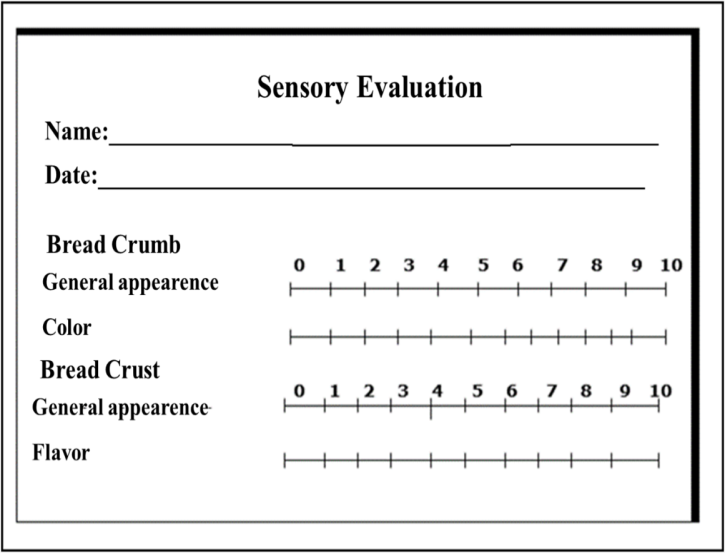
The loaves volume was made by the method of seed displacement [20]. The quality of the bread crumb, the bread crust, the color of the crumb and the crust, were evaluated by judges trained on a continuous scale from 0 to 10 (Figure 1).
The hardness of the bread was measured as the force required compressing 50% of the bread, by means of a Universal Texturometer brand Instron model 5565 using a cylindrical plunger of 25.5 mm of dynamometer as compression device, which moved into the loaf to a speed of 100 mm / min with penetration of 50%.
Aging of the Bread
The proximal composition of the rice, amaranth and chia flours is shown in Table 4. Amaranth and chia flours have a high protein content, which can help to strengthen the networks that trap the gas generated during the fermentation of the loaves. The high fiber content of the chia contributes to obtain a product rich in this component. In addition the high content in fats of chía seed are excellent sources of omega 3fatty acids, and in second place of omega 6 fatty acids [14].
The aging of the bread was measured as the increase in hardness of the loaf, after baking, the loaves were allowed to cool for 1 h at room temperature, stored in polyethylene bags and placed on a shelf at room temperature: For the determination of hardness samples were taken at different times after baking: 1, 24 and 96 h.
Obtaining the Base Formula through the Design Expert 5 Program
Bread formulas proposed by the Mixture Design Table 3 were prepared as described and each one was evaluated in accordance with its physical and physicochemical characteristics. The results were analyzed statistically using the Design Expert 5 [19] program: with the results of the statistical analysis, the mathematical optimization was carried out to obtain the Optimum Base Formula, using the same software.
Incorporation of Gums to the Base Formula
Once the base formula was established, the hydrocolloid incorporation was evaluated: xanthan gum, guar, alginate, a mixture of hydrocolloids in a proportion of 1 and 2% [8, 9, 21, 22, 23] in a system with cabinet from sodium to 9% baker [8].
Statistical Analysis
The effect of the addition of hydrocolloids on the quality of the loaf of the base formula was determined with analysis of variance, with a confidence level of 95% [24].
Results and Discussion
Proximal Analysis
| Proximal Chemical Analysis * (%) | Rice Flour | Chía Seed | Amaranth Seed | |||||||
|---|---|---|---|---|---|---|---|---|---|---|
| Ethereal Extract | 0.64 | 32.89 | 9.10 | |||||||
| Proteíns | 8.91 | 21.31 | 18.29 | |||||||
| Ashes | 0.54 | 4.62 | 2.49 | |||||||
| Fibre | 2.00 | 26.27 | 4.42 | |||||||
| Carbohydrates | 87.90 | 14.91 | 65.69 |
Table 4: Proximal composition of the flours used in this research.
Detection of the Presence of Gluten in Raw Materials
Table 5 shows the result of the detection of the presence of gluten in the raw materials, using wheat flour as a positive control. In all cases a negative result was obtained, which means that they have less than 4 ppm of gluten, so the raw materials are considered safe for use in this study, according to the Codex Alimentarius, which states that a food naturally Gluten Free must contain less than 20 ppm of it [25].
| Raw Material | Result | ||||
|---|---|---|---|---|---|
| Rice flour | Negative | ||||
| Amaranth flour | Negative | ||||
| Chía seed | Negative | ||||
| Corn starch | Negative | ||||
| Optimal formula | Negative | ||||
| Wheat flour | Positive |
Table 5: Detection of gluten content in raw materials, through the use of immune-chromatographic strips.
Development of the Base Formula, Through the Analysis of Statistical Optimization DX5 Softwear [19]
| Mixture | |||||||||||||||||||||||
|---|---|---|---|---|---|---|---|---|---|---|---|---|---|---|---|---|---|---|---|---|---|---|---|
| R | esponse variable | s | Units | Low value | High value | P | R2 | ||||||||||||||||
| Model | |||||||||||||||||||||||
| Y1 | Loaf volume | cm3 | 100 | 180 | Special Qubic | ≤ 0.0001 | 0.8817 | ||||||||||||||||
| Y2 | Bread crust quality | - | 0 | 9 | Special Qubic | ≤0.0001 | 0.9708 | ||||||||||||||||
| Y3 | Bread crust color | - | 0 | 8.5 | Special Qubic | ≤0.0001 | 0.9282 | ||||||||||||||||
| Y4 | Bread crumb quality | - | 0 | 8.4 | Special Qubic | ≤ 0.0001 | 0.9403 | ||||||||||||||||
| Y5 | Bread crumb color | - | 1 | 8.0 | Special Qubic | ≤ 0.0001 | 0.9461 | ||||||||||||||||
| Y6 | Flavor | - | 1 | 7.4 | Special Qubic | ≤ 0.0001 | 0.9217 | ||||||||||||||||
| Y7 | Hardness | Kgf | 1.833 | 19.934 | Special Qubic | ≤ 0.0001 | 0.8933 |
Table 6: Analysis of variance of each of the evaluated responses *(DX5).
168 experimental runs were made, Mixture Design: Model Simplex Centroide Table 6: Analysis of variance of each of the evaluated responses *(DX5).
Optimization of the Results of the Experimental Variables Studied, to Obtain the Base Formula [19]
The optimization serves to find the answer that provides the best result; for this, it was necessary to enter the program the desired limits for each of the variables studied as it is shown in Table 7.
| Response variables | Low limit | High límit | ||||||
|---|---|---|---|---|---|---|---|---|
| Loaf volume (cm3) | 160 | 168 | ||||||
| Hardness (kgf) | 1.8 | 2.5 | ||||||
| Crust quality | 8 | 8.4 | ||||||
| Crust color | 7.5 | 8 | ||||||
| Crumb quality | 8 | 8.2 | ||||||
| Crumb color | 7.5 | 8.1 | ||||||
| Flavor | 7 | 7.3 | ||||||
| Responses | Predicted value | S | tandard deviatio | n | ||||
| Loaf volume (cm3) | 167.35 | ±1.83 | ||||||
| Crust quality | 8.6 | ±0.096 | ||||||
| Crust color | 8.1 | ±0.136 | ||||||
| Crumb quality | 8.3 | ±0.130 | ||||||
| Crumb color | 8.3 | ±0.120 | ||||||
| Flavor | 8.3 | ±0.110 | ||||||
| Hardness (kgf) | 2.51 | ±0.385 |
Table 7: Limit values of the variables used to obtain the base formula through the numerical optimization of the model used (DX5)
The suggested proportions of amaranth (X1), chia (X2) and corn starch (X3), with a prediction of 0.966 are shown in Figure 2.
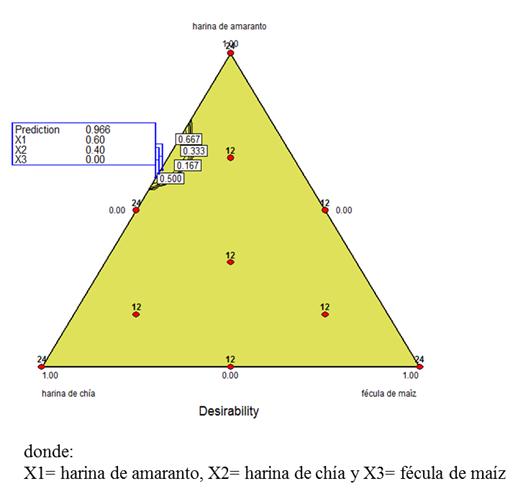
Table 8 shows the predicted values of the evaluated responses: flavor, loaf volume (cm3), quality and color of the crust, quality and color of the crumb, hardness of the loaves (kgf).
The optimum base formula was made with amaranth and chia flour in a ratio of 72 and 43baker percentage respectively, it should be mentioned that the volume of breads made with the optimal formula was increased by 40.6% compared to those made with rice flour only, as it is shown in Table 9.
| Formula: | Loaf volumen* cm3 | ||||
|---|---|---|---|---|---|
| Base formula | 163.3±5.2 | ||||
| Bread made from rice flour (control) | 141.7±4.1 |
Table 8: Volume of the loaf of the loaves made with the base formula (optimum) compared to those made with rice flour.
*Average of 6 repetitions Table 9: Volume of the loaf of the loaves made with the base formula (optimum) compared to those made with rice flour.
Incorporation of Gums and Sodium Caseinate in to the Base Formula
To improve the characteristics of the breads made with the base formula, the incorporation of gums and protein concentrates was tried since they have been used by other authors to mimic the viscoelastic properties of gluten, as well as to improve sensory characteristics and shelf life. of gluten-free breads [7, 8, 22]. It has been reported that sodium caseinate strengthens the ability to trap water when adding gums, Lazaridou A, et al. [22] incorporated sodium caseinate-carboxymethylcellulose and sodium caseinate-xanthan, achieving an increase in the volume of the loaf in comparison of the control elaborated without gums at 6%. McCarthy, et al. [26] reported an increase in volume in bread made from potato starch, rice flour and protein concentrates using hydroxypropyl methylcellulose.
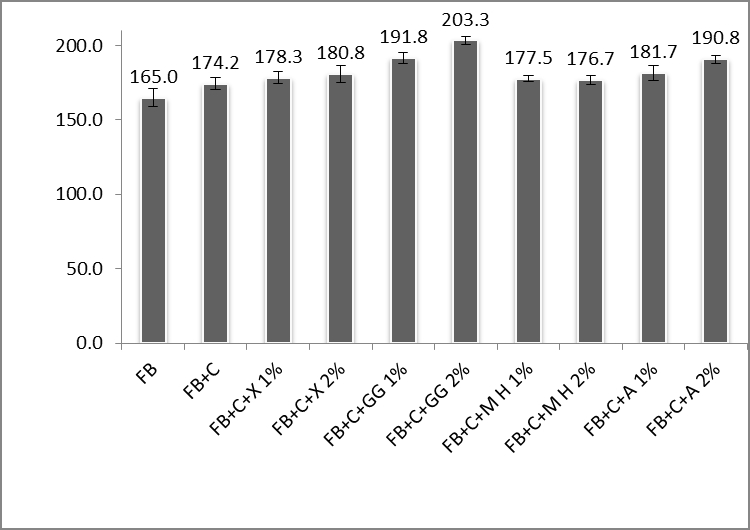
The effect of the use of sodium caseinate and the gums on the loaf volume of the loaves is shown in Figure 4.The addition of 9% calcium caseinate to the base formula (FB + C) produced an increase in the volume of the loaf of the same, from a value of 165 cm3 to 174.2 cm3, which is equivalent to a 5.4% increase of the volume. The addition of 2% guar gum to the base formula added with caseinate (FB + C + GG2%), caused an increase in the volume of the loaf from 174.2 to 203.3 cm3, which is equivalent to an increase in volume of the same. 23% with respect to the base formula.
Effect of The Use of Gums on the Texture of the Loaves at Different Times
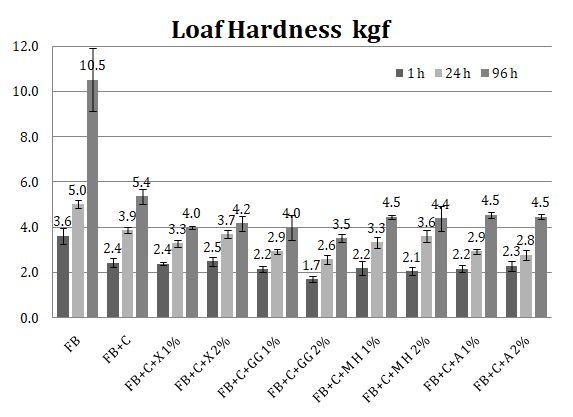
The average hardness of the loaves made with the base formula: 3.621 ± 0.36 kgf after 1 h after leaving the oven, the addition of calcium caseinate to the base formula allowed obtaining softer loaves with a hardness of 2.43 ± 0.2 kgf (p≤0.05) (24) are shown in Figure 4. The addition of the gums in general improved the texture of the loaves making them softer; the best result was obtained with the addition of 2% guar gum (p≤0.05), with a hardness of 1.71 ± 0.15 kgf. These results coincide with some studies that propose that gums improve the texture of gluten-free breads [8, 11, 16, 17, 20, 22, 23]. Gambus, et al. [27] Incorporated guar gum into a bread made with potato starch, corn starch improving the texture of the same. Lazaridou, et al. [24] evaluated the effect of pectin, carboxymethylcellulose, agarose, xanthan and β-glucan in a bread made from rice flour, finding that the loaves to which agarose was incorporated showed a lower hardness compared to added with carboxymethylcellulose. Pedrosa, et al. [11] developed gluten-free breads from extruded rice flour incorporating guar gum, which had a lower hardness than those made only with extruded rice flour. Korus, et al. & Wang et al. [28&29],[30] found that guar gum Increased volume, sensory acceptance, and slow the staling of bread.
Another advantage of the use of gums is that they increase the shelf life of gluten-free breads [Korus y Wang]. In Figure 5 it can be seen that the addition of sodium caseinate to the base formula significantly decreases the hardness of the loaves at all times tested [23].The addition of the gums to the formula added with caseinate, increases the softness of the loaves at all times tested and improves the shelf life of the same, the best result was obtained with the addition of 2% guar gum (p≤ 0.05) [24].
where:
FB = base formula, FB + C = base formula added sodium caseinate, FB + C + X 1% = base formula added of caseinate and 1% xanthan gum, FB + C + X 2% = base formula added of caseinate and 2% xanthan gum, FB + C + GG 1% = base formula added of caseinate and 1% guar gum, FB + C + GG 2% = base formula added of caseinate and 2% guar gum, FB + C + MH 1% = base formula added of caseinate and 1% hydrocolloid mixture, FB + C + MH 2% = base formula added of caseinate and 2% hydrocolloid mixture, FB + C + A 1% = base formula added of caseinate and 1% alginate, FB + C + A 2% = base formula added of caseinate and 2% alginate.
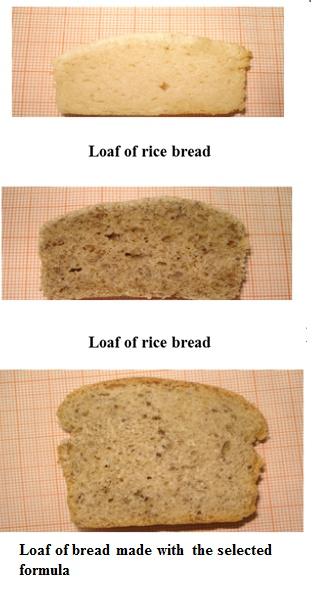
The use of gums and sodium caseinate also improved the volume of the loaf and the structure of the crumb as it is shown in Figure 5, which it can see the cut the loaves of the bread made with rice flour only, the base formula without caseinate and without gums, and the selected formula added with 9% sodium caseinate and 2% baker guar gum, where it is evident, as already mentioned, a greater volume of the loaf prepared with the selected formula, as well as, a better structure of the crumb.
Conclusions
The incorporation of amaranth and chia seed improves the nutritional quality of the bread due to the properties of each of these. Regularly gluten-free breads usually have poor amounts of fiber. Gallagher, et al. [5] incorporated 8 g / 100 g of inulin into a bread based on wheat starch, increasing the fiber content 0.4 to 3.5 g / 100 g. Gambus, et al. [6] replaced corn starch with amaranth flour to increase fiber and protein content, replacement of 10%, increased protein and fiber levels by 31% and 152%, respectively, while sensory quality was not It was affected. The present work fiber increased by 3.6g/100g compared with rice bread with 0.7 g/100 and 0.9 g/100 of a wheat bread.
The addition of caseinate and gums especially guar gum allowed to obtain gluten-free breads with good physical and sensory characteristics, with a considerable contribution of fiber and safe for the consumption of people with celiac disease.
Thanks
The present work was carried out with the financial support of the Research and Postgraduate Secretariat (SIP) of the National Polytechnic Institute of Mexico, within the research project: "Development of a functional food aimed at people with restriction of gluten consumption, using seed of chia as a source of fiber ".
References
-
Mahan K, Escott-Stump S (2001) Nutrición y Dietoterapia de Krause. 10th (Edn.), Editorial Mc Graw Hill, México, pp: 1274.
-
Ludvigsson JF, Ludvigsson J, Anders E, Montgomery S (2006) Celiac Disease and Risk of Subsequent Type 1 Diabetes. Diabetes Care 29(4): 2483-2488.
-
Fasano A, Catassi C (2001) Current approaches to diagnosis and treatment of celiac disease**.** Gastroenterology 120(3): 636-651.
-
INEGI (2010) Instituto Nacional de Estadística y Geografía (INEGI), II Conteo de Población y Vivienda, México.
-
http://www.celiacosdemexico.org.mx/post-blog/en- mexico-43-por-ciento-de-su poblacion-es-celiaca.
-
Gallagher E, Gormley TR, Arendt EK (2004) Recent advances in the formulation of gluten-free cereal- based products. Trends in Food Science & Technology 15(3): 143-152.
-
Schuppan D (2000) Current concepts of celiac disease pathogenesis. Gastroenterology 119(1): 234-242.
-
Gallagher E, Gormley TR, Arendt EK (2003) Crust and crumb characteristics of gluten free breads. Journal of Food Engineering 56(2): 153-161.
-
Sánchez HD, Osella CA, De la Torre MA (2002) Optimization of gluten-free bread prepared from cornstarch, rice flour and cassava starch. Journal of Food Science 67(1): 416-419.
-
Schober T, Messerschmidt M, Bean S, Park SH, Arendt EK (2005) Gluten free from sorghum: quality differences among hybrics. Cereal Chemistry 82(4): 394-404.
-
Pedrosa SM, Airoldi C, Attia EA (2008) Production of acidic extruded rice flour and its influence on the qualities of gluten-free bread. Journal Food Science and Technology 42(2): 618-623.
-
Rodas B, Bressani R (2009) Contenido de aceite, ácidos grasos y escualeno en variedades crudas y procesadas de grano de amaranto. Archivos Latinoamericanos de Nutrición mar 59(1): 82-87.
-
Ayerza R (1995) Oil Content and Fatty Acid Composition of Chia (Salvia hispanica L.) from Five Northwestern Locations in Argentina. Journal of the American Oil Chemists Society 72(9): 1079-1081.
-
Beltrán-Orozco María del Carmen and Vargas- Martínez María Gabriela (2011) Pharmacological activity of the chía seeds (Salvia hispanica L.). Pérez Gutiérrez RM (Ed.), in Edible Plants in Traditional Medicine, India, pp: 151-178.
-
González J Erik, Beltrán-Orozco MC, Vargas RMG (2010) Evaliación de la capacidad antioxidante y determinación de fenoles totales presente en la semilla y aceite de chía (_Salvia hispanica_ L.) Memoria XVII Congreso Nacional y VII Congreso Internacional de Ingeniería Bioquímica. Colegio Mexicano de Ingenieros Bioquímicos, Acapulco, Guerrero, México.
-
Salazar-Vega MI, Rosado-Rubio JG, Chel-Guerrero LA, Betancur-Ancona DA, Castellanos-Ruelas YAF (2009) Composición en ácido graso alfa linolénico (w3) en huevo y carne de aves empleando chia (salvia hispánica l.) En el alimento. Interciencia 34(3): 209- 213.
-
Reyes-Caudillo E, Tecante A, Valdivia-López MA (2008) Dietary fibre content and antioxidant activity of phenolic compounds present in Mexican chia (Salvia hispanica L.) seeds. Food Chemistry 107(2): 656-663.
-
AOAC (1995) Official Methods of Analysis. 15th(Edn.), Association of Official Analytical Chemists, Washington D.C.
-
Design Expert 5.0; Copyright (1996) Stat-Ease, Inc. 2021. E. Hennepin Avenue, Suite 480 Minneapolis MN.
-
ACCC 10-05 (1987) Approved methods of the American Association of Cereal Chemists.
-
Duska C, Dubravka N, Dubravka T, Bauman I, Gabric D (2007) Gluten- Free production by the corn meal and soybean flour extruded blend usage. Agriculturae Conspectus Scientificus 72(3): 227-232.
-
Kiskini A, Argiri K, Kalogeropoulos M, Komaitis AK, Mandala I, et al. (2007) Sensory characteristics and iron dialyzability of gluten-free bread fortified with iron. Journal Food Chemistry 102(1): 309-316.
-
Sabanis D, Lebesia D, Tzia C (2009) Effect of dietary fiber enrichment on selected properties of gluten-free bread. Journal Food Science and Technology 42(2): 1380-1389.
-
Minitab Release 13.1 Minitab Inc. Copyright 2000. BCIS Lab. Cloud State University. Analysis Easier Making. Data.
-
McCarthy H, Heinbockel M , Dockery P, Ulmer H (2006) Network formation in gluten-free bread with application of transglutaminase. Cereal Chem 83(1): 28-36.
-
Wang K, Fei LU, Zhe LI, Lichun ZHAO, Chunyang HAN (2017) Recent developments in gluten-free bread baking approaches: a review. Food Science and Technology 37(Suppl 1): 1-9.
-
Gambus H, Sikora M, Ziobro R (2007) The effects of composition of hydrocolloids on properties of gluten- free bread. Acta Sci Pol Technol Aliment 6(3): 61-74.
-
Lazaridou A, Duta D, Papageorgiou M, Belc N, Biliaderis CG (2007) Effects of hydrocolloids on dough rheology and bread quality parameters in gluten-free formulations. Journal of Food Engineering 79(3): 1033-1047.
-
Korus J, Witczak M, Ziobro R, Juszczak L (2015) The influence of acorn flour on rheological properties of gluten-free dough and physical characteristics of the bread. European Food Research and Technology 240(6): 1135-1143.
-
Codex Alimentarius Commission (2000) Food and Agriculture Organization of the United Nations. World Health Organization. Draft revised standard for gluten foods (CX/NFSDU 98/4). In Codex Committee on Nutrition and Food Special Dietary Uses, 22nd session Berlin, Germany.
- The Role of Podocyte Apoptosis and the Involvement of SIRT1 in Diabetic Nephropathy
- Dealcoholization of Beer by Osmotic Distillation for the Beverage Industry
- Biopolymer-Based Edible Packaging- Biomaterials, Methods, and Applications in Food Industry: An Updated Review
- Influence of Bioprocessing Methods on 'China Rice' (Gawal R1), and Soyabean Supplementation on the Quality of Complementary Food
- Cassava (Manihot esculenta) Varietal Growth, Yield and Cyanide Content Performance in Three Sites in the South- Eastern Semi Arid Regions of Kenya
- Food Waste Treatment, Recycling, Management and Production of Value-Products-An Update on Methodologies and Current Trends