
Sustainability of African Oil Palm Agriculture in a Changing Climatic Environment
Non-governmental organizations often claim that those countries growing oil palm are responsible for deforestation, biodiversity loss, and climate change. Nevertheless, demand for palm oil has kept on growing in Africa and worldwide due to the ever-growing populations and to the high demand for palm oil numerous food and non-food uses. In 2018, African demands for oils and fats are estimated at 30.64 million tonnes. Assuming that 50% of the continent’s demands were to be satisfied with palm oil, mature oil palm areas would have to be 7.547 million hectares at the current palm oil yield of 2.03 t/ha. Growing demand for palm oil will result in expansion of oil palm plantation in new forest areas. In Africa, further challenges facing oil palm agriculture are poor yields of oil palm resulting from (i) limited technical knowhow on the establishment and management of plantations, (ii) a marked dry season of 2-5 months per year, and (iii) unambitious oil palm development programmes. Fortunately, oil palm ranked first in oil production per unit area with a high theoretical oil yield potential (18 t/ha). High-yield oil palm agriculture could be harnessed to meet the growing demand for food without destroying more natural habitat. In 2016, 609 000 ha would have been enough for the 9 recorded African oil palm-growing countries to produce their 2.434 million tonnes of palm oil production at 4 t/ha against 1.198 million hectares effectively harvested with an average yield of 2.031 t/ha. High-yield on-farm activities are recommended, from the site selection to the harvest of ripe fresh fruit bunch to (i) ensure economic and environmental sustainability of oil palm fields, (ii) consolidate the African oil palm sector, and (iii) prepare its shift to an African oil palm industry, an ambitious vision on which sustainability of the palm oil business depends.
Introduction
The oil palm draws its importance from the oil contents of its mesocarp (palm oil) and kernel (palm kernel oil). Initially, these oils were considered sources of coronary heart disease and therefore unsuitable for human consumption. Fortunately, intensive and independent researches in European and American
laboratories have agreed on the beneficial nutritive and health attributes of palm oil and palm kernel oil. Palm oil contains tocopherols (vitamin E), tocotrienols, carotenoids, isoflavonoids and polyphenol extracts that possess cardiovascular health benefits, rending it suitable for human consumption [1, 2]. The merits of food and non- food uses of palm oil and palm kernel oils are finally undisputed. It can be assumed that the accusations formulated against palm oil were not founded because while palm oil was criticized, oil palm development was being undertaken across the world’s humid tropics (i) of Asia, including Indonesia, Malaysia, Thailand, China, and India, (ii) of Latin America, where Mexico is the new country of attraction, and (iii) of Oceania, represented by Papua New Guinea. The oil is versatile and is cheaper to produce than such plant oils such as canola or sunflower. Therefore, it is not surprising that investment in palm oil is climbing [3]. There is a constant increase in world mature area even after taking into account the replanting of old areas and the drop of the price of palm oil in the world market. Mature areas have increased from 16.550 million ha in 2014 to 18.114 million ha in 2016, representing 5% yearly increase [4].
Critics from non-governmental organisations (NGOs) on oil palm development are very dynamic. They have extended their concerns about the preservation of high conservation value (HCV) forests and customary heritage areas to include deforestation. Deforestation has also evolved from the classification of forests into degraded forest devoted to oil palm development and primary forest (to be preserved) to high carbon stock forest area; notably, the first two classifications are not to be used for oil palm cultivation. Oil palm expansion damages and destroys biodiversity. Peat soils are also excluded from oil palm development areas because of greenhouse gas emissions (GHG) and because of peat oxidation.
We believe that further development of oleaginous crops including oil palm is a function of the sustainability of world demand for oils and fats. The score cards of civil society and of NGOs would just represent indicators and measures to gauge how oil palm growers fare in terms of their public commitment and of their practice implementation for uncoupling their production and supply chain from deforestation, peat land development and worker exploitation The Planter [5] to satisfy the demand. Therefore, the objectives of this paper are (i) to identify indicators of the long-term ascending trend of world and African demands for palm oil, (ii) to evaluate the contribution of oil palm development to satisfying continent and world demands for oils and fats, and (iii) to propose ways and means of developing oil palm in a sustainable manner.
Dynamic of the Demand for Oil Palm Products
Sustainability of palm oil production as well as of oil palm agriculture is strongly connected to the sustainability of the demand for palm oil, palm oil products, and oil palm-derived products. Whatever their diversity may be, the demand for oils and products from oil palm evolves merely in tandem with the population. This raises the importance of studying trends in population growth.
Population and Demand for Palm Oil
Continents and world populations have been increasing since 2001, the starting point considered in this paper. The world population has grown from 6.195 billion in 2001 to 7.433 billion in 2016, representing a 20% increase over 16 years corresponding to 1.22% increase annually. In the same period, the African population reached 1.215 billion after a net increase of 45% over these 16 years at a rate of 2.5% yearly. Asia’s populations recorded a 18% increase from 3.670 billion in 2001 to 4.331 in 2016, accounting for 58.4% of the world population with a mean annual increase of 1.11% (Figure 1).
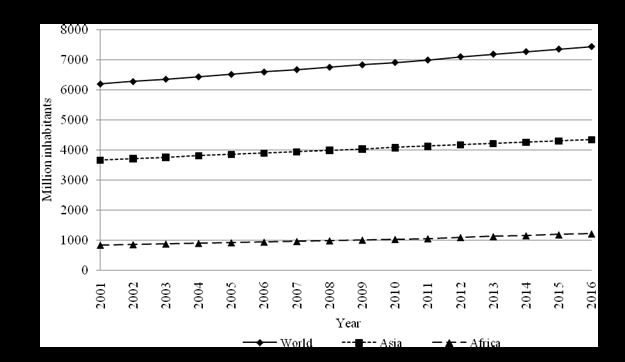
One of the factors that will contribute to sustainable increment of African population is the considerable control of prevailing and endemic diseases. In Africa, better preventive measures are being developed to limit the incidence of HIV and malaria, intended to lead to a long-lasting augmentation of the continent’s population.
In the case of HIV, UNAIDS [6] has evaluated world prevalence at 0.8% among adults. Since the start of the epidemics, 78 million people have been infected with HIV and 38 million died of AIDS-related disease including 1 million people in 2016. A total of 25 million cases were detected in Africa, including 19.4 million in East and Southern Africa. New infections among adults are estimated to have declined by 11% and 16% for the general population between 2010 and 2016 whereas there was only 8% decline between 2010 and 2015. Furthermore, new HIV infections among children globally have halved, from 300,000 in 2010 to 160,000 in 2016. Considerable efforts are being made in recent years to provide HIV treatment, particularly in resource-poor countries. In 2016, for the first time, more than half of the people living with HIV (53%) got access to life-saving treatment (Table 1). In 2016, 76% of all pregnant women living with HIV accessed treatment to prevent HIV transmission to their babies; this was up from 47% in 2010. Most countries are generally providing a strong domestic investment, increasing on average 11% from 2006 to 2016. Most importantly, the United Nations general assembly maintains its suggested commitment that 23.9 billion USD will be required for the response to the epidemic in 2020.
| Year | |||||||||||||||||||||||||
|---|---|---|---|---|---|---|---|---|---|---|---|---|---|---|---|---|---|---|---|---|---|---|---|---|---|
| 2000 | 2005 | 2010 | 2012 | 2013 | 2014 | 2015 | 2016 | ||||||||||||||||||
| People living with HIV (million) | 28.9 | 31.8 | 33.3 | 34.5 | 35.2 | 35.9 | 36.7 | 36.7 | |||||||||||||||||
| People receiving treatment (million) | 0.770 (2.66%) | 2.2 (6.92%) | 7.5 (22.52%) | 11 (31.88%) | 13 (36.93%) | 15 (41.78%) | 17 (46.32%) | 19.5 (53.13%) |
Table 1: Number of people living with HIV and accessing treatment globally (adapted from UNAIDS 2017).
There is also an increased control of malaria mortality. In 2015, roughly 212 million malaria cases and an estimated 429,000 malaria deaths were recorded. Increased prevention and control measures have led to a 29% reduction in mortality rates globally since 2010. According to the WHO [7], the African region carries a disproportionately high share of the global malaria burden. In 2016, the region was home to 90% of malaria cases and 91% of malaria deaths. Children under 5 years are most susceptible to infection and illness, and 70% of all malaria deaths occur in this age group. The number of under-5 malaria deaths has declined from 440,000 in 2010 to 285,000 in 2016. Preventive control includes (i) insecticide-treated mosquito nets, (ii) indoor residual spraying, (iii) vaccines (Mosquirix) against malaria in young children, and (iv) in Africa, preventive medicine for women during pregnancy. The total funding for malaria control and elimination reached an estimated 2.7 billion USD in 2016. Contributions from governments of countries where malaria is endemic amounted to 800 million USD, representing 13% of the funding. WHO’s targets for 2030 are to (a) reduce malaria case incidence by at least 90%, (b) reduce malaria mortality by at least 90%, (c) eliminate malaria in at least 35 countries of the 91 where malaria is endemic, and (d) prevent resurgence of malaria in all countries that are malaria-free.
With a 1.22% annual increase of world population and a 2.5% in African and an individual consumption of oils and fats averaging 24 kg per year, it can be projected that world and Africa demands in 2018 for oils and fats for food uses will be 184 million and 31 million tons, respectively.
Uses of Palm Oil and Demand for the Commodity
The demand for palm oil is a function of the continuously ascending trend of food and non-food uses of the commodity. This section does not intend to provide a complete list of uses made of palm oil and palm oil products. Instead, it is limited to some main features believed to be key drivers of the sustainability of the demand for palm oil that are illustrative of the diversity of its uses.
Friends of the Earth [8] has reported, after an assessment of worldwide palm oil consumption by use, that 71% of palm oil goes to foods (e.g. margarine, processed foods, chocolate), 24% to consumer products (e.g. cosmetics, detergents, candles), and 5% to energy (electricity, heating, fuels.). The ONG provides an impressive list of brand owners and palm oil-containing products (Table 2). In the United States, Balmford, et al. [9] noted that around 50% of the goods used every day contain palm oil. They also remarked that palm oil is often hidden behind other ingredient names or labeled generically as “vegetable oil”. In 2015, the MPOC (Malaysian Palm Oil Council) noticed that about 50% of all products found on supermarket shelves in the EU contain is essentially consumed in the form of red palm oil (Figure 2).
| Brand owner | Consumer products | |||||
|---|---|---|---|---|---|---|
| General Mills | Old el Paso tacos, dips and tortillas Betty Crocker products Cheerios | Nature Valley granola bars Fruit roll-ups Olay cosmetics | ||||
| Kraft | Easy mac Deluxe macaroni and cheese Peanut butter | Velveeta Cool whip | ||||
| Nabisco | Oreos Chips ahoy! Wheat Thins | |||||
| Heinz | Beans Spaghetti sauce Sauces and dressings | Soups Frozen meals Weight Watchers products | ||||
| Mars and Wrigley’s | M&M’s Snickers Mars bars Milky Way Starburst Skittles | Twix Bounty Double mint gum Juicy fruit gum Hubba bubba gum Dove (soap) | ||||
| Sara Lee | Bavarians Cakes & cheesecakes Chocolate pies & fruit pies Croissants &danishes | Crumbles & puddings Ice creams Lasagna Quiches | ||||
| Colgate-Palmolive | Shampoos Conditioners Body wash | Soaps Liquid hand-soap Shower gel | ||||
| Colgate | Toothpastes Mouthwash Shaving cream |
Table 2: Common consumer products containing palm oil by brand owner in the US.
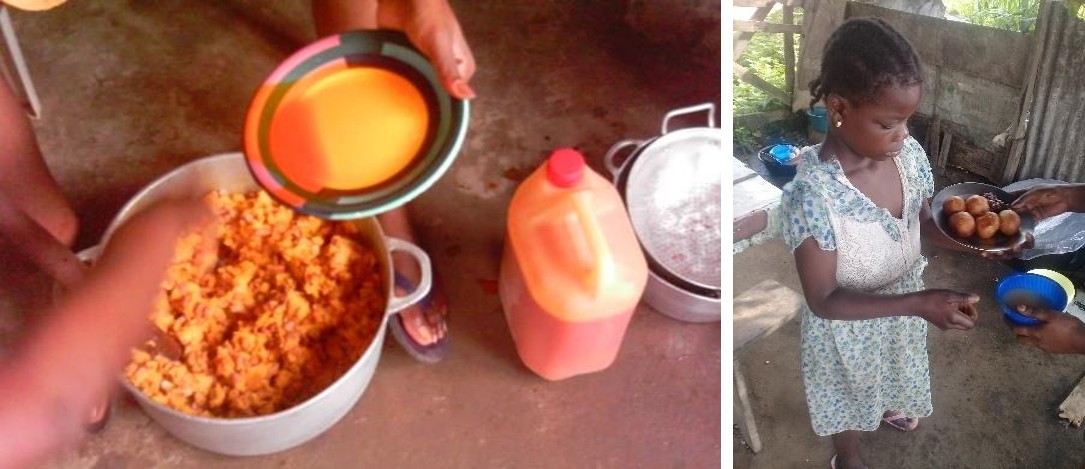
Preparation of voandzou (Bambara nuts) cake.
Donuts for breakfast.
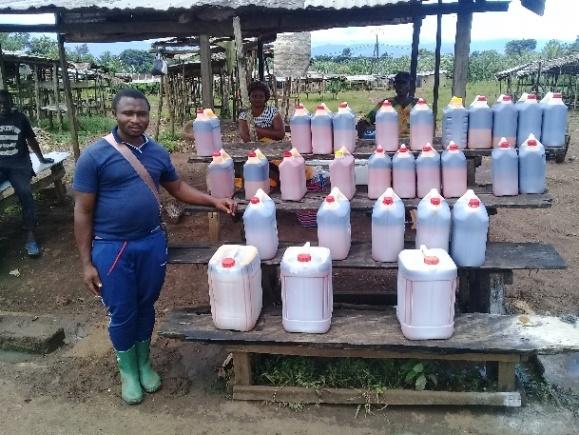
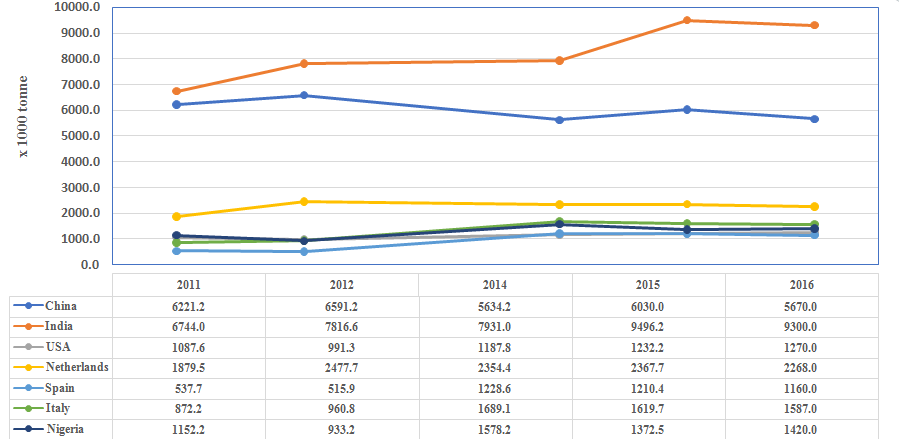
The largest consumers are both developed countries and highly populated countries (or regions) as well. China, Indonesia, India, and the European Union each imports between 10 and 15% of world production. Imports of palm oil have been maintained or have been ascending as illustrated by 2011-2016’s data from countries ranked among the largest importers (Figure 3).
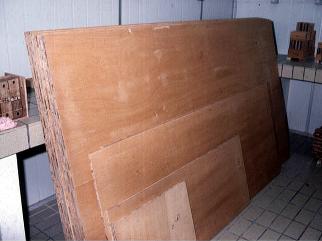
Crude palm oil contains minor natural components used as phytonutrients including tocopherols (vitamin E), tocotrienols, carotenoids, polyphenols, all extracts now well accepted worldwide for their health benefits Carbonneau [1], Monde, et al. [2] including the prevention of breast cancer [10] (Figure 4). Since palm oil is semi- solid at ambient temperature, melting at about 35°C, and needs no dehydrogenation, a more desirable solid fat content can be obtained by blending liquid vegetable oils with palm oil. This property of palm oil has recently increased its consumption in the United States to over one million tonnes [11]. Furthermore, there are technologies in Malaysia to produce oil palm products such as wood for furniture and plywood for block board and roof tiles from biomass that had been left to rot in the past [10] (Figures 5-7).
Source: Wahid [10] Figure 4: Application of tocotrienols for breast cancer control.


Source: Wahid [10]
In Africa, other oil palm products of paramount importance for locals just after palm oil include palm wine (Figure 8). Minor but widespread uses are for leaflet nerve brooms, band brooms, poultry nets, palm cabbage, leaflets for thatching, and the petioles and rachis for making baskets and ropes Bakoumé [12], to name a few.
![Figure 9: World production of 17 oils and fats [4].](/fulltextimages/3010/fig_9.jpeg)
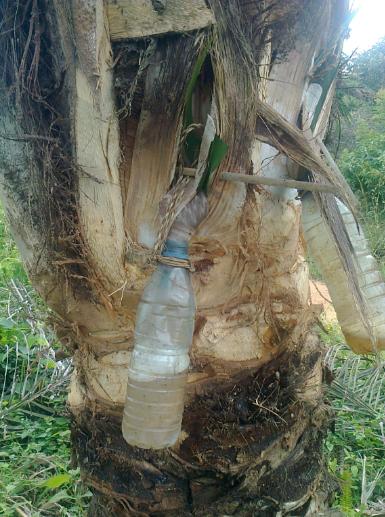
Palm wine from male inflorescence of standing tree Palm oil wine from a felled oil palm tree Figure 8: Palm wine production techniques.
Oil Palm’s Leading Role among Vegetable Oils
improvement is continuing. According to The Planter [5], to produce enough vegetable oils to meet the world demand in 2025 would require either an additional 11 million hectares of oil palm or 85 million hectares of soybean or 50 million hectares of rapeseed or 57 million hectares of sunflower. A study carried out in Germany by WWF (World Wide Fund) showed that replacing all of the palm oil use in that country with a mix of other vegetable oils would require about five times as much land (1.85 million ha compared to 400,000 ha). Palm oil production costs are low due to low input requirements. Moreover, palm oil is the cheapest oil in the world despite the fact that production is relatively less mechanised and therefore labour-intensive.
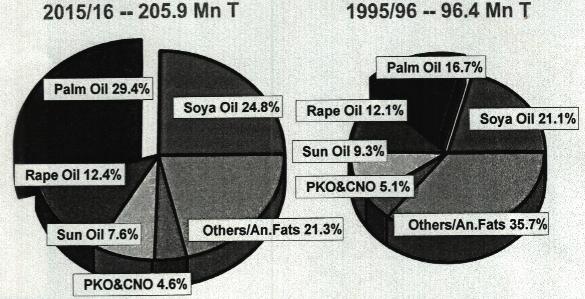
The oil palm remains unchallenged as the world's most efficient oilseed crop, producing more oil but using less land. In 2016, with a yield of 3.37 t/ha and a total production estimated at 60.975 million tons, palm oil ranked first in yield among oilseed crops, including temperate oilseed crops such as rapeseed, sunflower, and soybean [4] (Figure 9). Oils from oil palm represented 34.5% of the 205.9 million tons recorded in 2015/2016 for 17 oils and fats. Research and development on yield of oil palm has resulted in a four-fold increase in yield between 1950 and 1991, and research for yield
The FDA (U.S. Food and Drug Administration) ban on artificial fats has created a gap that is being filled by palm oil. This trend will pave the way for more US palm oil consumption, imports of which climbed by 352% between 2002 and 2012. Palm oil is used by many EU member states as a sustainable, renewable fuel [13]. The greatest non-food use of oil palm is the production of soaps, whose consumption is expected to increase faster than the world population [14].
Sustainability Challenges Facing Palm Oil Production in Africa
Population increase augments the demand for palm oil for food and non-food uses. An expansion of the area planted in oil palm is expected to continue in response to increasing demand to feed the growing African population.
In Africa‚ the oil palm sector comprises industrial plantations as well as numerous smallholders, leading, at certain levels, to two distinct standards in oil palm development.
Although palm oil is the cheapest to produce, NGOs and civil society believe that the true costs of palm oil production are expressed in the devastating impact palm oil has on tropical forests, including those in Central and West Africa [8]. The direct impacts of oil palm include deforestation, land-grabbing and brutal working conditions for local people. In particular, the accusations of land-grabbing and brutal conditions for local people are grievances that have been formulated against industrial plantations like Golden Veroleum, Equatorial Palm Oil, Sime Darby in Liberia, and Herakles Farms in Cameroon, to name a few. Local medium size investors in oil palm are facing similar accusations from NGOs and local communities. Such is the case of Tinah Farms in the Cross River state of Nigeria.
recently in 2017 by another study [16]. A summary is made here according to the origins of the challenges to ease the understanding of oil palm and scientific communities and of country-level decision makers as well. Origins include (i) NGOs and civil society, (ii) government policies, (iii) investors, and (iv) environment (Table 3).
Challenges for oil palm development in Africa have been described by Bakoumé, et al. [15] and updated
| Origin of challenge | Challenges | ||||
|---|---|---|---|---|---|
| NGOs and civil society | 1. Conservation of green rainforest for preservation of biodiversity 2. Climate change 3. Anti-palm oil propaganda | ||||
| Government policy | 1. Lack of political and social stability 2. Land policy is a function of the country 3. Lack of assistance in the development of high yielding planting material 4. Inappropriate measures to support existing national policy towards plantations 5. Poor or no connection between agricultural research and agricultural development | ||||
| Government policy & Investors | 1. Bad state of road networks | ||||
| Investors (Industrials and smallholders) | 1. Unskilled labour 2. Over-aged plantations 3. Old palm oil mills with frequent breakdowns 4. Low FFB and oil yields (≤15 t/ha, ≤2.2 t/ha) 5. Low palm oil extraction rate (≤ 20%) 6. Huge number of artisanal and low-performing palm oil mills 7. High cost of labour 8. Limited technical know-how of best agricultural practices 9. Lack of experienced management with continuity of service | ||||
| Environment | 1. Dry season (2-5 months), insufficient and/or unevenly distributed rainfall 2. Pest threats: Coelaenomenoderaminuta, Rhynchophorus, Recilia mica, Agouti (groundhog) 3. Disease threats: Blast, Fusarium wilt, Ganoderma |
Table 3: Challenges facing industrial and smallholder oil palm plantations in Africa.
Proposed Ways and Means for Developing a Sustainable Oil Palm Sector in Africa
Review of Sound Mitigation Measures
In 2016, total area planted in oil palm was 11.8 million ha in Indonesia Investments [17] and 5.74 million ha in Malaysia MPOB [18], making 16.54 million ha in total for the two world’s largest palm oil producers in East Asia. Planted oil palm area in the 23 African palm oil-producing countries was only 1.764 million ha, showing that African forest areas are only slightly used to plant oil palm. This situation probably explains the fact that all African countries including palm oil-producing countries are net importers of palm oil with the exception of Cote d’Ivoire.
In Africa, NGOs and civil society’s claim that oil palm agriculture leads to deforestation which impacts on biodiversity should be merely considered as an appeal to developers’ consciousness on the future shortcomings of their business. Proforest’s David Hoyle estimates in 2016 that “up to 22 million hectares of land in West and Central Africa could be converted to oil palm plantations over the next five years” were too exaggerated. As of today (September 2018), area in Africa planted in oil palm is still less than 2 million hectares. Africa is currently falling victim to climate change, whose causes are exogenous to the continent. It should be understood by NGOs as African countries’ invited guests that economic and social development plans in Africa must give priority to agriculture. NGOs and civil society should focus on raising rural communities out of poverty and contribute to the socio-economic development of developing countries.
Bakoumé [15] has proposed that environmental and other social challenges would be adequately faced via collaboration between oil palm developers and NGOs, with NGOs helping to identify the high conservation value (HCV) forest areas and high carbon stock forests to preserve. Furthermore, the Malaysian Palm Oil Council [11] has recognised that deforestation is a challenge anywhere in the world when it is unplanned and unmanaged. Most importantly, the African oil palm sector needs to communicate to promote the positive attributes of palm oil, to promote the best agricultural practices, and to defend the sector.
Attempts of NGOs to take advantage of countries’ trust to carry out their anti-oil palm campaign will provoke strong reactions from African governments.
I have provided concise proposals on ways and means for a sustainable development of the African oil palm sector in papers published recently Bakoumé [15]; Bakoumé, et al. [16] as a contribution to the presentation of the oil palm in the Third World coordinated by the Incorporated Society of Planters (ISP). Most of the proposed actions are here tabulated to ease their readability and understanding (Table 4).
| Challenge | Mitigation measures | ||||
|---|---|---|---|---|---|
| Deforestation | 1. Promoting medium-size entrepreneurial plantations (5-100 ha) as an alternative to the big areas of industrial plantations; smallholdings (1-5 ha) are considered less forest-damaging 2. NGO’s should abandon their position as plaintiff and work hand in hand with big investors | ||||
| Lack of political and social stability | Adoption of good governance for the control and prevention of civil unrest | ||||
| Land policy a function of the country | Review of each country’s land policy to ease acquisition of concessions by investors | ||||
| Planting material | Government support for sustainability-driven oil palm research (high yield, drought tolerance, tolerance to Ganoderma) and seed production | ||||
| Dry season (2-5 months), insufficient and/or unevenly distributed rainfall | 1. Acquiring drought-tolerant planting materials 2. Country-level research to develop new high yielding and disease- tolerant (even -resistant) planting materials | ||||
| Poor or no connection between agricultural research and agricultural development | 1. Placing Agricultural Research under the Ministry of Agriculture 2. Creating a separate institute of research on oil palm financed by both public funds and the oil palm sector (then palm oil industry) | ||||
| Limited technical know-how of best agricultural practices | Development of new industrial plantations including smallholders’ programmes that benefit from investors’ technical assistance | ||||
| Inappropriate measures to support existing national policy regarding plantations | Re-stimulation of each country’s oil palm sector for improved productivity and competitiveness | ||||
| Land policy is a function of the country | 1. Maputo 2013, Adoption of a comprehensive African agricultural development programme (CAADP) by the Heads of State and Government, to allocate 10% of their national budgets to agricultural investment 2. In 2013, the Abidjan Declaration (AIPH 2013) reaffirming the commitment of the Ministers of Agriculture of African palm oil- producing countries to involve themselves in a sustainable development process in the production of oil palm in Africa 3. In November 2016 seven West and Central African countries signed the Marrakesh Declaration at COP22, pledging to sustainably develop the oil palm sector in the region; supported by regional and international private sector and civil society organizations |
Table 4: Some main challenges facing oil palm agriculture and proposed mitigation measures.
High-Yield for Oil Palm Business Sustainability, Reduced Deforestation, and Biodiversity Conservation
Very marked increase in demand for palm oil will have profound consequences for the future of global diversity. In terms of supply, rising high yields of plantations will potentially restrict humanity’s impacts on biodiversity since low-yield systems occupy more land for the same level of production. The ultimate approach that will ineluctably and rapidly lead to sustainability of oil palm agriculture is higher yield, i.e. high production per unit area. Using improved high-yielding tenera hybrid palms as planting material along with technical assistance for high productivity and profitability minimises the need to expand planted areas [16]. In 2016, the 9 African palm oil- producing countries recorded 2.434 million tonnes from 1.198 million hectares for an average yield of 2.031 t/ha. Only 609 000 ha were needed for the same palm oil production at 4 t/ha.
In a study of farming systems that could secure sustainable production of palm oil carried out by the University of Cambridge, Blamford, et al. [9] found that agriculture that appears to be more eco-friendly but uses more land may actually have greater environmental costs per unit of food than high-yielding farming that uses less land. Results suggested that high-yield farming could be harnessed to meet the growing demand for food without destroying more of the natural world. For the researchers of the University of Cambridge [19] more intensive agriculture might be the least bad option for feeding world while saving its species, provided the use of such land-efficient systems actually prevents further conversion of wilderness to farmland.
Impacts on the wild oil palm population would be greatly reduced through boosting yields on existing farmlands so as to spare remaining natural habitats. Blamford, et al. [9] added that high-yield farming raises other concerns because expressed per unit area it can generate high levels of externalities such as greenhouse gas emissions, nutrient losses, soil erosion, ammonia emissions, dispersal of harmful pesticides and fresh water depletion. They noted, however, that such metrics underestimate the overall impacts of low-yield systems. Corley & Palat [20, 21, 22] concluded that to ensure economic and environmental sustainability, yield must be maximised over the entire life of an oil palm planting.
There is mounting evidence that the best way to meet rising demand for palm oil while conserving biodiversity is to wring as much palm oil as sustainably possible from the land planted, so that more natural habitats can be “spared the plough”. The theoretical yield of palm oil is 18 t/ha. The current yields vary between 5 and 8.5 t/ha representing 28 to 47% of the crop potential. This information indicates that there are large possibilities for further improvement of palm oil yield.
| Activity | Recommendation | ||||
|---|---|---|---|---|---|
| Site selection | 1. Perform feasibility study 2. Ensure that oil palm fields aged more than 25 years, more than 40 feet tall, and whose yield is<15 t/ha are replanted 3. Viability project based on developing only suitable lands 4. Environmental and social considerations: a) Perform Social and Health Impact Assessment (ESHIA) b) Free prior informed consent (FPIC) c) Monitor high conservation value (HCV) forest areas | ||||
| Planting materials | 1. With high-yield potential from a reliable producer 2. Number of seeds ordered to be 30% in excess, 15% for pre-nursery seedlings and 5% for nursery seedlings 3. Tolerant to drought and biotic constraints |
Table 5: Recommendations for sustainable high-yield oil palm plantation.
4. Main nursery polybag flat dimensions: 40 cm wide, 45 cm deep 5. Use vigorous and healthy seedlings 6. Practice “Zero compromise” or “Zero tolerance” during the culling of abnormal seedlings
1. Provides improved accessibility of plots and of individual oil palm trees 2. Eases supplying of fertilizers to the planted field as well as collection and transportation of FFB from the field Land preparation 1. Zero burning to allow young palms to benefit from the decomposing organic materials Planting
- Planting density must be a function of the terrain
- Adopt optimum planting density according to terrain for high yield
- New planting points should be away from old planting points.
- Application of root-growth promoting fertilizers during planting proper
- Performed regularly to prevent competition of young oil palms with weeds
- Adoption of drought mitigation measures
- Ensuring planting density maintenance with normal palms not later than 3 years after field planting
- Reduce competition of palms with undesired vegetation
- Good canopy management given the positive correlation between canopy and yield
- Field upkeep
- 1. Distinguishing immature palms from mature ones
- 2. Mindful of soil type
- 3. Based on targeted high yield, rainfall pattern, and terrain for mature fields.
- Manuring
- Pests and diseases
- 1. Integrated pest and disease control (difficult to implement in Africa)
- 2. Limited chemical spraying
- 1. Consider ripeness standard
- 2. Zero bunch loss and zero loose fruit left on the ground at harvest
- 3. Delivery to the mill within 24h of harvest
- 4. Frequency to prevent bunch rotting and unripe fresh fruit bunches
- Harvest
Table 6: Recommendations for sustainable high-yield oil palm plantation.
Conclusion
Oils from oil palm are versatile products that are valued worldwide. Adoption of palm oil for its food and non-food uses by a growing world population has boosted the demand for the commodity leading to expansion of oil palm plantation into new areas despite the fact that the species is the least land-demanding among all the oil crops. Unfortunately, oil palm grows and produces better in the humid tropics of the word housing tropical green forests renowned for their regulatory role of the climate in this hot weather-prone region of the earth. Luckily, forests are very heterogeneous ecosystems with uneven distribution of biodiversity. Therefore, NGOs and civil society should assist oil palm growers in selecting areas of low conservation value to allocate to oil palm agriculture. Many other challenges face the harmonious consolidation of the African oil palm sector for its future move to a full industry: the African Palm Oil Industry whose feedstock is palm oil in quantity and quality. The pleiotropic challenge confronting economic sustainability of palm oil production, restricted deforestation and its corollary climate change, and preservation of biodiversity is the high yield of oil palm. Sound technical recommendations are provided for making high-yield oil palm agriculture a reality.
References
-
Carbonneau MA (2013) Les effets sur la santé de l’huile de palme - Role des compose phénoliques [Effects on health of palm oil – Role of phenolic compounds]. Paper presented at the African palm oil congress on Palm Oil - Challenges and Development Perspectives in Africa and in the World, Hotel Sofitel, Abidjan.
-
Monde AA, Carbonneau MA, Michel F, Morena M, Diabaté S, et al. (2013) Teneur en acides gras, en antioxydants et modulation de la NADPH oxydase dans les cultures cellulaires (monocytes THP-1) par les extraits polyphénoliques d'huile de palme rouge brute de Côte d'Ivoire. [Content in fatty acids, antioxydants and modulation of NADPH oxydase in cellular cultures (monocyts TPH-1) by phenolic extracts of red crude palm oil from Côte d'Ivoire]. Paper presented at the African palm oil congress on Palm Oil - Challenges and Development Perspectives in Africa and in the World, Hotel Sofitel, Abidjan.
-
Schneider V (2016) Palm oil profits trump self- sufficiency in Sierra Leone. In: DW made for minds.
-
Oil World (2016) Oil World annual. ISTA Mielke GmbH, Hamburg, Germany.
-
The Planter (2017) Managing sustainability challenges in oil palm production. The Planter 93 (1098): 617-619.
-
UNAIDS (2017) Global HIV and AIDS statistics. Fact sheet.
-
WHO (2017) Global malaria statistics. Fact Sheet.
-
Friends of the Earth (2018) Palm oil in the North American consumer market. Land, forest& finance, Issue brief 2.
-
Balmford A, Amano T, Bartlett H, Chadwick D, Adrian C, et al. (2018) The environmental costs and benefits of high-yield farming. Nature Sustainability 1: 477- 485.
-
Wahid MB (2006) Technological development: future of the oil palm agro-industry. Paper presented at the 15th international oil palm conference Expopalma and business matchmaking forum on new opportunities for strategically positioning palm oil in the world market. Cartagena de Indias Convention Center‚ Cartagena.
-
Malaysian Palm Oil Council (MPOC) (2015) US bans trans fats. Global Oils & Fats Business Magazine 10(3):12-13.
-
Bakoumé C (2006) Oil palm sector in Africa. Paper presented at the 15th Internatinal Oil Palm Conference Expopalma and Business Matchmaking Forum on New Opportunities for Strategically Positioning Palm Oil in the World Market. Cartagena de Indias Conventions Center‚ Cartagena‚ Colombia.
-
Basiron Y (2015) Sustainability through advanced Malaysain palm oil biofuels. Global Oils and Fats 12(1): 6-7.
-
Salmiah A (1995) Non-food uses of palm oil and palm kernel oil. Palm Oil Information Series. Malaysian Palm Oil Promotion Council, (Edn.). 2003: 5-7.
-
Bakoumé C (2013) Current and future development of oil palm in Afria. Paper presented at the ISOPB International seminar on oil palm breeding – Yesterday, Today and Tomorrow, Impiana Hotel, Kuala Lumpur.
-
Bakoumé C, Jannot C, Ndiaye O, Okoye MN, Konan E, et al. (2017) Oil palm development in Africa. The Planter 93(1098): 6323-6641.
-
Indonesia Investments (2018) Oil palm industry in Indonesia.
-
Malaysia Palm oil board (2018) Oil palm planted area 2016.
-
University of Cambridge (2018) High-yield farming costs the environment less than previously thought - and could help spare habitats.
-
Corley RHV, Palat T (2013) Maximising lifetime yield for greater economic sustainability In: Proceedings of the MPOB International Conference on Green Opportunities from the Golden Crop, Kuala Lumpur Convention Centre, Kuala Lumpur.
-
Goodman L (2015) FDA bans trans fat: what does this mean for palm oil consumption in the US? Union of Concerned Scientists-Science for a Healthy Planet and Safe World.
-
Sundran K (2017) The orang utan and palm oil – a deep lesson. Global Oils and Fats 4(4): 6-7.
- The Role of Podocyte Apoptosis and the Involvement of SIRT1 in Diabetic Nephropathy
- Dealcoholization of Beer by Osmotic Distillation for the Beverage Industry
- Biopolymer-Based Edible Packaging- Biomaterials, Methods, and Applications in Food Industry: An Updated Review
- Influence of Bioprocessing Methods on 'China Rice' (Gawal R1), and Soyabean Supplementation on the Quality of Complementary Food
- Cassava (Manihot esculenta) Varietal Growth, Yield and Cyanide Content Performance in Three Sites in the South- Eastern Semi Arid Regions of Kenya
- Food Waste Treatment, Recycling, Management and Production of Value-Products-An Update on Methodologies and Current Trends