
Effect of Sucrose Content (0brix) and Different Flavors on Physical, Mechanical and Sensorial Properties of Ginger Candy
The objectives of this study were to develop value-added low sugar ginger candy based on physical, mechanical and sensorial properties of ginger candy, to improve sensorial properties using different flavors and to investigate the effectiveness of low-density polyethylene (LDPE) and polypropylene (PP) bags to maintain the moisture content of ginger candy during storage. Ginger (Zingiber officinale) is potential against many diseases and infections. Gingers can be converted to ready-to-eat products to increase their utilization and economic value using suitable processing techniques. Due to sharp spicy flavor, pungent aroma and short shelf-life there are few ready-to-eat ginger products available in the market. In this study, ginger candy was developed by dipping ginger slices (cubes) in 65°Brix, 70°Brix and 75°Brix sucrose solutions for osmotic drying followed by hot air drying at 60℃ for 16 hours. The physical properties (moisture content, density and color), mechanical properties (hardness, gumminess, cohesiveness, springiness and chewiness) and sensory properties (appearance, texture. sweetness and overall acceptability) of three different (°Brix) ginger candies were determined to develop the desired ginger candy. The physical, mechanical and sensory properties of 65°Brix, 70°Brix and 75°Brix ginger candy revealed that 70°Brix ginger candy sample was optimum sugar content and was most desired ginger candy. The vanilla and cinnamon flavored candies were developed using the optimum sugar content (70°Brix) and the sensory analysis of the flavored ginger candy was performed to compare the flavor preference. The flavor sensory results indicated that the vanilla flavored ginger candy was more acceptable than the cinnamon flavored ginger candy. All ginger candy samples packed in LDPE and PP achieved equilibrium moisture content at the same time. But the moisture content of ginger candy in LDPE was lower than the moisture content of ginger candy in PP during storage. This result indicated that the shelf-life of ginger candy can be longer in LDPE compared to PP. The findings of this study will be beneficial for the commercial development of low sugar flavored ginger candy.
Introduction
Ginger (Zingiber officinale), belonging to Zingiberaceae family, is a perennial herb available in the form of rhizome and is consumed all over the world. Ginger is a native plant of Asia but cultivated in many tropical countries specifically in West Indies, Africa, India, and Nepal [1]. Because of the presence of polyphenols, terpenoids and isoterpenoids compounds, the ginger has many medicinal properties such as antioxidative, therapeutic and anti- bacterial properties [2]. Ginger contains volatile essential oil and non- volatile oleoresin which are potential to prevent diabetes, common cold, high cholesterol and cardiovascular diseases [3]. Ginger is also potential for the treatment of heart and lungs diseases [1, 2, 3]. Ginger is mainly used as spice/curry powder and flavoring agent in different foods such as bread, tea, cookie and carbonated drinks etc. It is necessary to increase the direct consumption of gingers by developing ginger-based ready-to-eat products such as candy for the long-term health benefit to prevent many diseases and increase the economic value of gingers through proper processing and preservation [4].
Pungent aroma and sharp spicy flavor limit the processing of value added ready-to-eat ginger products [5]. Moreover, the high moisture content (70-75%) of gingers causes the deterioration of the gingers and ginger products due to rapid microbial growth. This causes the short shelf-life of ginger products. The negative effect of shelf-life and pungent taste of gingers lead to the reduction of available ready-to-eat ginger products in the market [6]. This problem can be minimized by using noble processing techniques such as osmotic drying along with different pretreatments and adjusting processing conditions to develop value-added ginger products. Such processing techniques also improve the pungent flavor and sensorial characteristics of ginger products. The partial drying of ginger by dipping in a sugar solution showed potential to extend the shelf life of the ginger products [7]. Ginger candy is attractive and palatable for all aged people. Candying of ginger can be a useful technique to preserve and develop new processed ready- to-eat ginger candy products.
Ginger can be converted to candy by impregnating them in a sugar solution followed by drying. In the impregnating process, partial dehydration occurs due to the partial replacement of moisture content of gingers with the diffused sugar in the ginger and this process is known as the candying process. Generally, candies are a high-calorie food because they contain 75-85% sugar. Nowadays, the consumers want low-calorie products due to increase obesity rates, cardiovascular diseases and other potential health problems. The reduction of sugar content while keeping right textural and sensorial properties of candies is an important issue. It is necessary to optimize the low sugar content based on sensorial and textural properties. Physical properties of candies such as color, density and moisture content influence on the quality of the candies. As consumers are also influenced by the flavor of the candies it is essential to justify different flavors of candies through a sensory panel. Different packaging materials such as polyethylene and polypropylene influence the shelf-life of candies during storage. The objectives of this study were to develop low sugar ginger candy based on sensorial, physical and mechanical properties of developed ginger candy, to compare two different flavors vanilla and cinnamon with control (low calorie optimized ginger candy) and to compare between polyethylene and polypropylene packaging systems for the water uptake during storage.
Materials and Methods
Materials
Fresh ginger (Zingiber officinale) and sugar (sucrose) were purchased from a local Walmart store (Menomonie, WI, USA). Chemicals (citric acids and calcium lactate) and flavors (vanilla and cinnamon) were purchased from Sigma-Aldrich (USA). Sugar was used to make 65°Brix, 70°Brix and 75°Brix sugar syrup. Calcium lactate was used during blanching as a firming agent. Citric acid was added with the sugar syrup as a preservative and to develop acidic taste of the candy. Vanilla and cinnamon flavors were added in the prepared candy to enhance the flavor and to mask the bitterness of ginger.
Ginger Candy Sample Preparation and Blanching
After sorting out of damaged and bruised gingers, the ginger rhizomes were washed thoroughly with cold water to remove soil and foreign materials. After washing, peeling was performed with a hand peeler to remove the skin and the ginger was sliced into cubes of 1.5x1.5x1.5 cm3 using a mechanical slicer. These cubes were submerged in 1% calcium lactate solution and were blanched at 85℃ for 4 minutes.
Processing of Ginger Candy
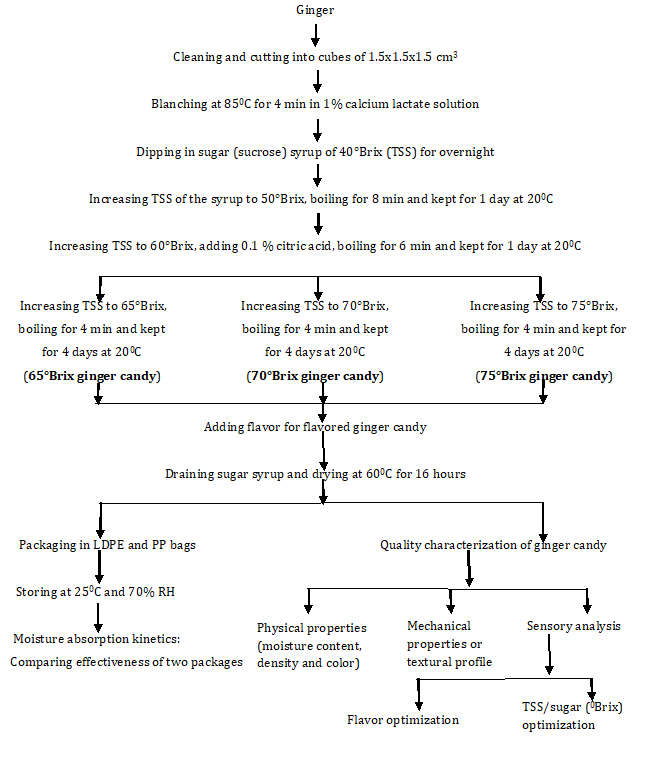
The ginger candy was processed as per the candy processing flow chart (Figure 1). The blanched ginger samples were dipped in a syrup of sucrose with 0.1 % citric acid at the ratio of 1:3 (ginger sample: syrup, w/v).
First, the ginger candy samples were submerged in 400Brix (TSS-total soluble solids) sugar syrup and kept overnight at room temperature (20℃). The total soluble solids (TSS, 0Brix) was measured using a refract meter (Misco Digital Refractometer, Solon, OH, USA). The concentration of syrup was increased to 500Brix adding sucrose. The syrup of 500Brix with ginger samples was boiled for 8 minutes and kept for one day at room temperature. The concentration of syrup was increased from 50 to 600Brix adding more sugar and boiled for 6 minutes and then the 600Brix syrup with ginger candy samples was kept for one day at room temperature. The whole syrup and ginger candy samples were divided into three equal parts and increased TSS to 65°Brix, 70°Brix and 75°Brix for three different sugar content ginger candy samples. Each of the solution (65°Brix, 70°Brix and 75°Brix) was boiled for 4 minutes and kept for 4 days at room temperature. After completing the candying process, the syrup was drained with a screen and the ginger candy samples were dried at 60°C for 16 hours in a convective dryer to develop the final form of 65°Brix, 70°Brix and 75°Brix ginger candies. The developed ginger candies were packed in low density polyethylene (LDPE) and in polypropylene (PP) bags for further analysis.
Determination of Moisture Content of Ginger Candy
The moisture content of ginger candy was determined using a hot air oven drying method Horwitz W, et al. [8] with a little modification of temperature and time. 5g of candy sample was dried at 140°C for 2 hours to a constant weight. Moisture content was calculated from the weight difference between the initial and dried candy samples and was expressed as percentage of the initial weight using the following equation. Analyses were performed in duplicate.
Determination of Piece Density of Ginger Candy
Piece density of ginger candy was measured by using the rapeseed displacement method as defined by AACC [9]. Several pieces of ginger candy with a known weight (g) were placed in a 100 mL graduated cylinder and rapeseeds were added and tapped for complete settlement of the seed to 100 mL of total volume. Then the sample and rapeseeds were removed from the cylinder. Similarly, the used rapeseeds were filled in the cylinder and the volume of rapeseeds was determined. The volume of the candy was calculated by subtracting the volume of rapeseeds from 100 mL. The piece density of the ginger candy was calculated by using the following equation:
$$ P i e c e d e n s i t y (g / m L) = \frac {M a s s o f g i n g e r c a n d y (g)}{V o l u m e o f g i n g e r c a n d y (m L)} $$
Determination of Color of Ginger Candy
The color parameters of ginger candy were measured by using a Hunter Lab Color Flex Colorimeter (Hunter Associates Laboratory Inc., Reston, Virginia, USA). Hunter L value (lightness/darkness), a value (redness/blueness) and b value (yellowness/greenness) were determined. Color measurement of ginger candy was done in six replicates. The total color difference (ΔE) was calculated according to the following formula [10].
Where, Lo, ao and bo are values of the fresh ginger sample while L, a and b are values of ginger candy.
Determination of Mechanical Properties (Textural Profile Analysis) of Ginger Candy
Hardness, gumminess, cohesiveness, springiness and chewiness were determined using a two-cycle compression test Bourne MC [11] with an Instron Machine (Instron Corporation, Norwood, USA). The mean value of textural properties of ginger candy was measured with ten replications. Ginger candy sample was placed on the lower ram and the upper ram with a 35 mm stainless steel probe attached with a 500 N load cell was used to compress the candy sample with a test speed of 1mm/s to break to 80% strain of the samples. Before starting the compression test, the anvil height of the probe was adjusted to 3-5 mm depending on the height of the tested samples. A two-cycle force-deformation curve was generated using the Bluehill 3 software to determine the textural properties of ginger candy. The maximum force required to attain a given deformation was calculated as hardness (N) of the candy. Cohesiveness is defined as the internal integrity of the sample and was calculated as the ratio of the second compression peak force area to the first compression peak force area. Springiness was calculated as the ratio of the second peak compression distance to the first peak compression distance. Gumminess was calculated as the product of hardness and cohesiveness and chewiness was the product of gumminess and springiness [12].
Sensory Evaluation of Ginger Candy
As this research was conducted with the human subjects, we applied for the approval of conducting such research before starting research work. Our all study procedures were approved by the Institutional Review Board (IRB) of the University of Wisconsin-Stout, USA. Sensory evaluation of ginger candy was conducted by a test panel consisting of 16 panelists (students, faculties and staffs of the Department of Food and Nutrition). The intensities of sensory quality attributes were evaluated using a 7-point hedonic scale, where, 1=dislike extremely and 7=like extremely. Sensory evaluation of ginger candy was conducted twice to optimize the sugar content (0Brix) and to optimize the flavor. First, sensory evaluation (appearance, texture, sweetness and overall acceptability) of 65, 70 and 75°Brix ginger candy was conducted to determine the most acceptable total soluble solids (°Brix/TSS) level among three different candy samples. Secondly, the most preferable ginger candy (70°Brix) sample determined by the panelists was considered as a control sample for flavor study. Then the flavored ginger candy was prepared with optimum TSS (70°Brix) adding vanilla and cinnamon flavors, respectively. The sensory (appearance, texture, sweetness, flavor and overall acceptability) of control, vanilla flavored and cinnamon flavored ginger candy was conducted with the same panelists to determine the preferred ginger candy flavor.
Effect of LDPE and PP Packaging of Ginger Candy Maintaining Moisture Content during Storage
Three different ginger candies (65, 70 and 75°Brix) were packed in two different low-density polyethylene (LDPE) bags and polypropylene (PP) bags. The weight of all packed samples was measured, and the measured samples were stored at 25°C and 70% RH in an RCom Digital Pro 90 Incubator (Autoelex Co. Ltd., South Korea). The samples were drawn every 3 days up to 15 days and the weight of the samples was measured to determine the moisture uptake kinetics and the equilibrium moisture content of the ginger candy samples. The data were collected up to 15 days because the equilibrium moisture content was achieved from 9 to 15 days for all samples. Moisture uptake kinetics data were used to determine the effectiveness of LDPE and PP packaging materials in maintaining the moisture content of candy samples. The analyses were done in duplicate.
Statistical Analysis
The data obtained in this experiment were statistically analyzed using IBM SPSS software version 25. The results were reported as mean ± standard deviation. One-way single factor Analysis of Variance (ANOVA) test was used for the analysis of sensory scores, physical and mechanical properties of ginger candy to determine significant difference among the different sugar level (0Brix) ginger candy samples and different flavored ginger candy samples at P ≤ 0.05. In order to determine the differences among the results of the mean of the different ginger candy samples Duncan Multiple Range Test (DMRT) was conducted at P ≤ 0.05.
Results and Discussion
Effect of Sucrose (0Brix) On the Physical Properties of Ginger Candy
The physical properties (moisture content, piece density, L value and total color difference) of 65, 70 and 75°Brix ginger candies are summarized in Table 1 and the Analysis of Variance (ANOVA) of the physical properties of ginger candy is presented in Table 2. The developed ginger candies with different TSS (°Brix) and with vanilla and cinnamon flavors are shown in Figure 2. The one-way single factor ANOVA (Table 2) showed that the F value of moisture content, piece density, L value and total color difference was greater than F value at critical point. The F value>F value at critical point indicated that the null hypothesis was rejected. So, the F value results indicated that the sample means tested were significantly different and the group means were not equal. The P value<0.05 for all physical properties of ginger candies (Table 2) indicated a significant difference between the samples tested [13, 14]. A Duncan’s Multiple Range Test (DMRT) was analyzed to rank the samples among the group because ANOVA cannot determine whether each individual mean is significantly different from all other means of the group [15]. The DMRT results of moisture content, L value and total color difference of ginger candy indicated that the 65oBrix sample was different from the 70oBrix and 75oBrix samples and the piece density of the 65oBrix and 70oBrix samples was different from 75oBrix ginger candy. The overall observations of (Table 1) revealed that the moisture content of ginger candy after osmotic dehydration with sucrose solution followed by 16 hours hot air drying (final moisture content of ginger candy) increased from 7.50 to 12.07% when sugar content increased from 65oBrix to 75oBrix of the ginger candy. The final moisture content of ginger candy was affected by the 16 hours hot air drying and amounts of sugar diffused into ginger during osmotic drying. The hydroxyl (-OH) group of sucrose forms hydrogen bonds with water and the amount of water bound to sugar is proportional to the amount of sugar diffused into the foods [16]. The water boiling point of food products increases due to the binding of water by sugars. The higher energy is needed to break the hydrogen bonds between water molecules as well as between water and sugar to evaporate water of foods. This phenomenon caused the increased amount of sugar in ginger candy decreased the water reduction during hot air drying and increased the final moisture content of ginger candy. The piece density of ginger candy increased with increased 65-75°Brix (Table 1). This might be due to the increase in moisture content with an increase in sugar content of ginger candy. The lightness (L value, 28.42- 31.56) and the total color difference (34.75- 44.23) increased with 65-75°Brix (Table 1 & Figure 2). The lightness of ginger candy increased with sugar content due to leaching of ginger pigments during drying [10, 17]. The higher sugar content gives the higher browning reactions during drying process and this phenomenon might cause increased total color difference with an increased sugar content of ginger candy [16].
![Figure 2: The one-way single factor ANOVA (Table 2) showed that the F value of moisture content, piece density, L value and total color difference was greater than F value at critical point. The F value>F value at critical point indicated that the null hypothesis was rejected. So, the F value results indicated that the sample means tested were significantly different and the group means were not equal. The P value<0.05 for all physical properties of ginger candies (Table 2) indicated a significant difference between the samples tested [13-14]. A Duncan’s Multiple Range Test (DMRT) was analyzed to rank the samples among the group because ANOVA cannot determine whether each individual mean is significantly different from all other means of the group [15]. The DMRT results of moisture content, L value and total color difference of ginger candy indicated that the 65oBrix sample was different from the 70oBrix and 75oBrix samples and the piece density of the 65oBrix and 70oBrix samples was different from 75oBrix ginger candy. The overall observations of (Table 1) revealed that the moisture content of ginger candy after osmotic dehydration with sucrose solution followed by 16 hours hot air drying (final moisture content of ginger candy) increased from 7.50 to 12.07% when sugar content increased from 65oBrix to 75oBrix of the ginger candy. The final moisture content of ginger candy was affected by the 16 hours hot air drying and amounts of sugar diffused into ginger during osmotic drying. The hydroxyl (-OH) group of sucrose forms hydrogen bonds with water and the amount of water bound to sugar is proportional to the amount of sugar diffused into the foods [16]. The water boiling point of food products increases due to the binding of water by sugars. The higher energy is needed to break the hydrogen bonds between water molecules as well as between water and sugar to evaporate water of foods. This phenomenon caused the increased amount of sugar in ginger candy decreased the water reduction during hot air drying and increased the final moisture content of ginger candy. The piece density of ginger candy increased with increased 65-75°Brix (Table 1). This might be due to the increase in moisture content with an increase in sugar content of ginger candy. The lightness (L value, 28.42- 31.56) and the total color difference (34.75- 44.23) increased with 65-75°Brix (Table 1 & Figure 2). The lightness of ginger candy increased with sugar content due to leaching of ginger pigments during drying [10,17]. The higher sugar content gives the higher browning reactions during drying process and this phenomenon might cause increased total color difference with an increased sugar content of ginger candy [16].](/fulltextimages/3608/fig_2.jpeg)
- Means within a column with different letters are significantly different (P < 0.05).
- Physical and mechanical
- Sum of Squares
- Degree of
- Freedom (DF)
- Mean Square properties (SS)
- Moisture content (%)
- 22.35
- 2
- 11.18
- 39.72
- 0.01
- Piece density (g/mL)
- 0.001
- 2
- 0.000
- 11.69
- 0.04
- L value
- 29.90
- 2
- 14.95
- 4.89
- 0.02
- Total color difference
- 307.28
- 2
- 153.64
- 39.90
- 0.00
- Harness (N)
- 10873.65
- 2
- 5436.83
- 13.12
- 0.03
- Gumminess
- 13536.43
- 2
- 6768.22
- 12.08
- 0.00
- Cohesiveness
- 0.005
- 2
- 0.002
- 0.72
- 0.51
- Springiness
- 236
- 2
- 118
- 3.43
- 0.09
- Chewiness
- 196001.16
- 2
- 98000.58
- 10.92
- 0.01
Table 1: ANOVA for physical and mechanical properties of 65, 70 and 75°Brix ginger candy.
| TSS | Final moisture content (%) | Piece density (g/mL) | L* value | Total color difference (ΔE) | ||||||||||
|---|---|---|---|---|---|---|---|---|---|---|---|---|---|---|
| 65°Brix | 7.50a ±0.15 | 0.14a ±0.23 | 28.42a ±1.79 | 34.75a ±1.91 | ||||||||||
| 70°Brix | 8.75a ±0.87 | 0.16b ±0.54 | 29.75ab ±1.68 | 36.42a ±1.87 | ||||||||||
| 75°Brix | 12.07b ±0.22 | 0.17b ±0.32 | 31.56b ±1.77 | 44.23b ±2.09 |
Table 2: ANOVA for physical and mechanical properties of 65, 70 and 75°Brix ginger candy.
Effect of Sucrose (0Brix) on the Mechanical (Textural Profile) Properties of Ginger Candy
The mechanical properties (hardness, gumminess, cohesiveness, springiness and chewiness) of 65, 70 and 75°Brix ginger candy and the DMRT results of the mechanical properties of ginger candy are shown in Table 3. The one-way single factor Analysis of Variance (ANOVA) of the mechanical properties of three different ginger candies is shown in (Table 2). The F value> F value at critical point and P value < 0.05 of hardness, gumminess and chewiness of ginger candy (Table 2) indicated that the different sugar contents (65, 70 and 75°Brix) of ginger candy had very significant effects on those mechanical properties. The DMRT analysis did not find any significant difference between 70 and 75°Brix for hardness, gumminess, and chewiness. But the DMRT found a difference between 65°Brix and, 70 and 75°Brix for the hardness, gumminess and chewiness of ginger candy. The results shown in (Table 3) indicated that the hardness (360-286 N), gumminess (387-302) and chewiness (1120-783) decreased with the increased sugar content (65-75°Brix). Our results (Table 1) showed that increased sugar content in ginger candy increased the final moisture content of ginger candy. The higher moisture content with the higher °Brix (sugar content) of ginger candy reduced the compact force which caused the decreased hardness, gumminess and chewiness with the increased water content of ginger candy [17]. These results are also in the agreement with the results found in the study of effects of moisture contents on textural properties of candy [12]. The DMRT analysis (Table 2) was not able to find any significant difference for cohesiveness of ginger candy. Also, the ANOVA (Table 2) of cohesiveness of ginger candy showed that sugar content did not affect the cohesiveness of ginger candy. The DMRT of springiness of ginger candy (Table 2) ranked the samples as 75°Brix ≤70°Brix ≤65°Brix. The springiness results (Table 2) of different ginger candies showed that the increased sugar content (°Brix) of ginger candy decreased the springiness (elasticity) of ginger candy. The higher sugar content of ginger candy caused higher moisture content (Table 1) of ginger candy. The higher moisture content of ginger candy gave higher plasticity and lower elasticity [12]. This phenomenon caused decreased springiness with increased sugar content (°Brix) of ginger candy.
| Candy | Hardness (N) | Gumminess | Cohesiveness | Springiness | Chewiness | ||||||||||||
|---|---|---|---|---|---|---|---|---|---|---|---|---|---|---|---|---|---|
| 65°Brix | 360.53b±11.07 | 387.01b±18.15 | 1.07a±0.02 | 2.84b±0.22 | 1120.06b±118.23 | ||||||||||||
| 70°Brix | 317.32a±13.91 | 357.40b±24.81 | 1.10a±0.09 | 2.68ab±0.14 | 945.52ab±143.58 | ||||||||||||
| 75°Brix | 286.19a±23.96 | 302.08a±24.39 | 1.06a±0.39 | 2.54a±0.20 | 783.14a ±41.60 |
Table 3: Mechanical properties (texture profile analysis) of different TSS (°Brix) ginger candy.
Means within a column with different letters are significantly different (P < 0.05). Table 3: Mechanical properties (texture profile analysis) of different TSS (°Brix) ginger candy.
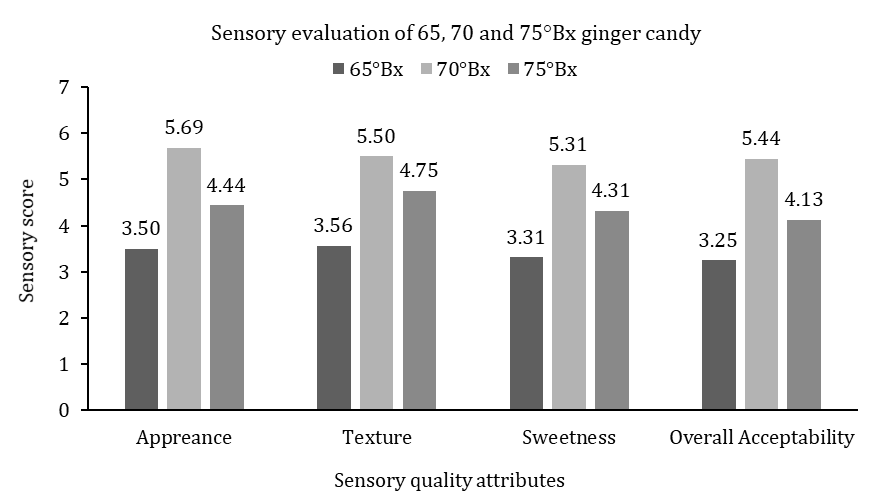
The first sensory test was conducted to determine the preferred 0Brix (sugar content) of ginger candy by the taste panelists. The 65, 70 and 75°Brix ginger candies were tested for their appearance, texture, sweetness and overall acceptability. The sensory results of three different (65, 70 and 75°Brix) ginger candies are shown in Figure 3 and the one-way single factor ANOVA results for appearance, texture, sweetness and overall acceptability of these ginger candies are shown in Table 4. The F value>F value at critical point and P value<0.05 (Table 4) indicated that sugar contents (°Brix) of ginger candy significantly affected the sensory properties (appearance, texture, sweetness and overall acceptability) of 65, 70 and 75°Bx ginger candy [14, 15]. The sensory scores (Figure 3) revealed that the 70°Brix ginger candy was the most acceptable ginger candy achieving the highest sensory score (5.44) among the tested samples. The 75°Brix
| Sensory | Degree of Freedom | |||||||||||||||||||||
|---|---|---|---|---|---|---|---|---|---|---|---|---|---|---|---|---|---|---|---|---|---|---|
| S | um of Squares (SS | ) | Mean Square (MS) | F-Value | Sig. (P value) | |||||||||||||||||
| Attributes | (DF) | |||||||||||||||||||||
| 0Brix | Flavored | 0Brix | Flavored | 0Brix | Flavored | 0Brix | Flavored | 0Brix | Flavored | |||||||||||||
| Appearance | 53.38 | 12.06 | 2 | 2 | 26.69 | 6.03 | 19.41 | 5.03 | 0.00 | 0.01 | ||||||||||||
| Texture | 45.29 | 15.39 | 2 | 2 | 22.65 | 7.69 | 14.28 | 5.98 | 0.00 | 0.01 | ||||||||||||
| Sweetness | 34.13 | 10.50 | 2 | 2 | 17.06 | 5.25 | 8.62 | 3.43 | 0.00 | 0.04 | ||||||||||||
| Flavor | - | 11.17 | - | 2 | - | 5.58 | - | 3.24 | - | 0.05 | ||||||||||||
| Overall acceptability | 39.13 | 27.72 | 2 | 2 | 19.56 | 13.86 | 10.10 | 10.91 | 0.00 | 0.00 |
Table 4: ANOVA for sensory analysis of 65, 70 and 75°Bx (0Brix candy) and 700Brix vanilla and cinnamon flavored ginger candy.
The second sensory test was conducted to compare two different flavors (cinnamon and vanilla) to improve the sensorial properties of 70°Brix (control) ginger candy. The second sensory results (for flavored ginger candy) are shown in Figure 4. The one-way single factor ANOVA for appearance, texture, sweetness, flavor and overall acceptability of flavored candies is shown in Table 4. Since F value was greater than F value at critical point and P value was smaller than or equal to 0.05 for the sensory properties (appearance, texture, sweetness, flavor and overall acceptability) of flavored ginger candy, the different flavors affected significantly on the choice of flavors by the panelists [14, 15]. The taste panelists revealed that cinnamon and vanilla flavors showed potential to improve the sensory properties of ginger candy. But the degree of acceptability for both flavors was not similar. The vanilla flavored ginger candy was more preferred than cinnamon flavored ginger candy. The sensory results of flavors (Figure 4) showed that the mean score of vanilla flavored ginger candy was 5.92 and the mean score of cinnamon flavored ginger candy was. 5.50. The mean scores for overall acceptability of control sample, vanilla flavored ginger candy and cinnamon flavored ginger candy were 4.00, 6.08 and 5.50, respectively. So, the control sample (70°Brix with no flavor) was the least preferable ginger candy to the panelists. The flavors might have masked the sharp pungent flavor of ginger candy causing with gingerol.
panelists preferred vanilla and cinnamon flavored ginger candy compared to the control sample.
![Figure 4: The one-way single factor ANOVA for appearance, texture, sweetness, flavor and overall acceptability of flavored candies is shown in Table 4. Since F value was greater than F value at critical point and P value was smaller than or equal to 0.05 for the sensory properties (appearance, texture, sweetness, flavor and overall acceptability) of flavored ginger candy, the different flavors affected significantly on the choice of flavors by the panelists [14-15]. The taste panelists revealed that cinnamon and vanilla flavors showed potential to improve the sensory properties of ginger candy. But the degree of acceptability for both flavors was not similar. The vanilla flavored ginger candy was more preferred than cinnamon flavored ginger candy. The sensory results of flavors (Figure 4) showed that the mean score of vanilla flavored ginger candy was 5.92 and the mean score of cinnamon flavored ginger candy was. 5.50. The mean scores for overall acceptability of control sample, vanilla flavored ginger candy and cinnamon flavored ginger candy were 4.00, 6.08 and 5.50, respectively. So, the control sample (70°Brix with no flavor) was the least preferable ginger candy to the panelists. The flavors might have masked the sharp pungent flavor of ginger candy causing with gingerol.](/fulltextimages/3608/fig_4.png)
Effect of LDPE and PP Packaging on the Moisture Content of Ginger Candy during Storage
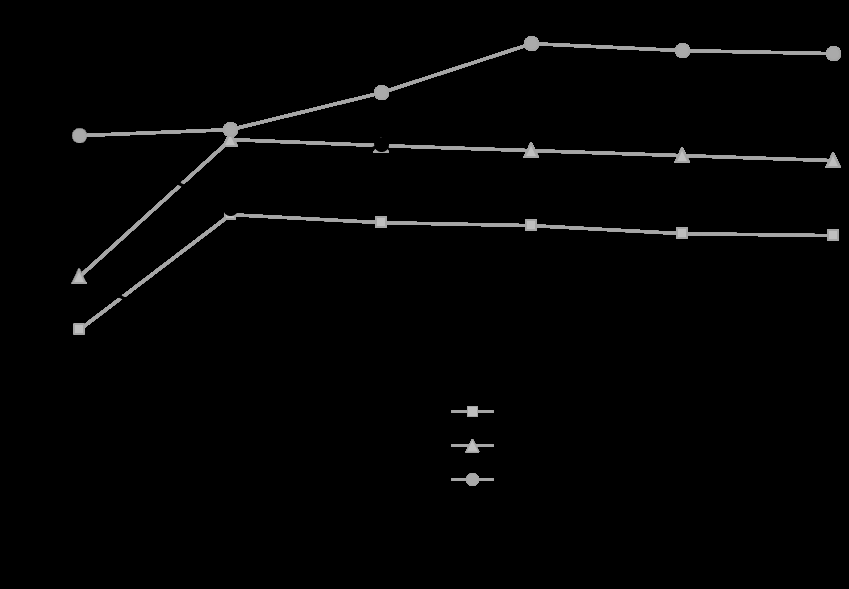
The 65oBrix, 70oBrix and 75oBrix ginger candies with an initial moisture content (wb) of 7.5, 8.75 and 12.07%, respectively, were packed in polypropylene (PP) and low- density polyethylene (LDPE) bags. The moisture content of each sample was determined every 3 days until an equilibrium moisture content of ginger candy was achieved. The effectiveness of PP and LDPE was determined based on equilibrium moisture content and rate of water uptake kinetic by the ginger candy during storage. The moisture uptake kinetics of 65oBrix, 70oBrix and 75oBrix ginger candies in storage are shown in Figure 5. The moisture uptake kinetic results showed that all samples achieved equilibrium moisture content on the 9th day of storage. However, there was variability in the equilibrium moisture content of the samples. The equilibrium moisture contents of 65oBrix, 70oBrix and
75oBrix ginger candy packed in LDPE were 6.72, 7.96 and 13.75 % (wb) and packed in PP were 9.94, 11.71 and 14.23% (wb), respectively. The water uptake kinetic results also indicated that the rate of water uptake and the amount of equilibrium moisture content of different ginger candy was higher when ginger candy was packed in PP compared to LDPE. The equilibrium moisture contents of 65oBrix, 70oBrix and 75oBrix ginger candy packed in PP were 3.22, 3.75 and 0.5% higher than the equilibrium moisture content of 65oBrix, 70oBrix and 75oBrix ginger candy packed in LDPE, respectively. Both LDPE and PP have excellent moisture barrier properties and are potential for maintenance of moisture content of foods in storage. However, the LDPE has a better sealant capacity [18]. LDPE packaging was effective for the moisture barrier in the storage of green banana chips [19]. Our study showed that the LDPE was better than PP for the maintenance of lower moisture content of ginger candy during storage.
Conclusion
The study indicated that the utilization of ginger can be increased by developing value-added ginger candy using a simple candying process (dipping in sugar solution). However, the variability of sugar contents in ginger candy affected the sensory (appearance, texture, sweetness, overall acceptability), mechanical properties (hardness, gumminess, cohesiveness, springiness and chewiness) and physical properties (moisture content, density and color) of ginger candy significantly (P<0.05). Sensory and textural profile (mechanical properties) of 65 0Brix, 70 0Brix and 75 0Brix ginger candy revealed that 70 0Brix ginger candy was the optimum sugar solution to prepare desired ginger candy. Furthermore, vanilla and cinnamon flavors were effective to improve the sensory properties of 70oBrix ginger candy. LDPE and PP packaging systems showed that ginger candy achieved and equilibrium moisture content at the same (9th day of storage) of both packages during storage. But the moisture content of ginger candy packed with PP was higher than the moisture content of ginger candy packed with LDPE. The LDPE was better than PP to maintain the lower moisture content of ginger candy during storage.
Acknowledgement
This research was supported by the Faculty start-up grant of College of Education, Hospitality, Health and Human Sciences (CEHHHS), University of Wisconsin-Stout, USA.
References
-
Singletary K (2010) Ginger: An Overview of Health Benefits. Nutr Today 45(4): 171-183.
-
Famurewa AV, Emuekele PO, Jaiyeoba KF (2011) Effect of drying and size reduction on the chemical and volatile oil contents of ginger (Zingiber officinale). J Med Plants Res 5(14): 2941-2944.
-
Malu S, Obochi G, Tawo E, Nyong B (2009) Antibacterial activity and medicinal properties of ginger (Zingiber officinale). Glob J Pure Appl Sci 15(3- 4): 365-368.
-
Gupta R, Singh B, Shivhare US (2012) Optimization of Osmo-convective Dehydration Process for the Development of Honey-ginger Candy Using Response Surface Methodology. Dry Technol 30(7): 750-759.
-
Kumar V, Kushwaha R, Goyal A, Tanwar B, Kaur J (2018) Process optimization for the preparation of antioxidant rich ginger candy using beetroot pomace extract. Food Chem 245: 168-177.
-
Radhika, Kumar V, Vyas G, Kaur S (2017) Optimization of process for the preparation of antioxidant rich ginger candy by response surface methodology. Int Food Res J 24(2): 483-489.
-
Alam MS, Kamruzzaman M, Khanom SAA, Patowary MRH, Elahi MT, et al. (2018) Quality Evaluation of Ginger Candy Prepared by Osmotic Dehydration Techniques. Food Nutr Sci 9(4): 376-389.
-
Horwitz W, Latimer GW (2005) Official Methods of Analysis of AOAC International, Gaithersburg, Md. 18th (Edn.), Association of Official Analytical Chemistry International, Maryland.
-
AACC (2001) the American Association of Cereal Chemists International, 11th (Edn.). St. Paul, MN.
-
Meda V, Mitra P, Lee JH, Chang KS (2016) Optimization of microwave-vacuum drying processing parameters on the physical properties of dried Saskatoon berries. Open Agric 1(1): 7-17.
-
Bourne MC 2002) Food texture and viscosity : concept and measurement, Academic Press, New York.
-
Figiel A, Tajner-Czopek A (2006) The effect of candy moisture content on texture. J Foodserv 17(4): 189- 195.
-
Mitra P, Chang KS, Yoo DS (2011) Kaempferol Extraction from Cuscuta reflexa using Supercritical Carbon Dioxide and Separation of Kaempferol from the Extracts. Int J Food Eng 7(4): 1-15.
-
Mason RL, Gunst RF, Hess JL (2003) Statistical Design and Analysis of Experiments: With Applications to Engineering and Science 2nd (Edn.). John Wiley & Sons, Hoboken, NJ.
-
Mitra P, Meda V, Green R (2013) Effect of drying techniques on the retention of antioxidant activities of Saskatoon berries. Int J Food Stud 2: 224-237.
-
Clemens RA, Jones JM, Kern M, Lee YS, Mayhew EJ, et al. (2016) Functionality of Sugars in Foods and Health. Compr Rev Food Sci Food Saf 15(3): 433-470.
-
Nagalakshmi SA, Mitra P, Meda V (2014) Color, Mechanical, and Microstructural Properties of Vacuum Assisted Microwave Dried Saskatoon Berries. Int J Food Prop 17(10): 2142-2156.
-
Robertson GL (2012) Food Packaging: Principles and Practice, 3rd (Edn.). CRC Press, Inc, New York.
-
Mitra P, Kim EM, Chang KS (2007) Optimization of the Processing Parameters for Green Banana Chips and Packaging within Polyethylene Bags. Food Sci and Biotechnol 16(6): 889-893.
- The Role of Podocyte Apoptosis and the Involvement of SIRT1 in Diabetic Nephropathy
- Dealcoholization of Beer by Osmotic Distillation for the Beverage Industry
- Biopolymer-Based Edible Packaging- Biomaterials, Methods, and Applications in Food Industry: An Updated Review
- Influence of Bioprocessing Methods on 'China Rice' (Gawal R1), and Soyabean Supplementation on the Quality of Complementary Food
- Cassava (Manihot esculenta) Varietal Growth, Yield and Cyanide Content Performance in Three Sites in the South- Eastern Semi Arid Regions of Kenya
- Food Waste Treatment, Recycling, Management and Production of Value-Products-An Update on Methodologies and Current Trends