
Chitosan Edible Coatings with Geraniol or Vanillin: A Study on Fresh-Cut Strawberries Microbial and Sensory Quality Through Refrigerated Storage
Edible coatings (ECs) are a good strategy to extend shelf-life of fruit products. For this purpose, the use of polysaccharides such as chitosan (CH) are gaining popularity. In this study, chitosan coatings were evaluated in fresh-cut strawberries microbial and sensory quality through refrigerated storage at 5°C for 7 days. Also, two natural antimicrobial agents, i.e. vanillin (V) and geraniol (G), were incorporated in the coatings and evaluated at two different concentrations. In general, chitosan coatings were effective in the initial reduction of fresh-cut strawberries native microflora, even without the incorporated biopreservatives. However, through storage, neither of the coatings tested was able to control the growth of mesophilic bacteria. Among the tested sensory parameters, texture was the most important characteristic, which governed the shelf-life of the product.
Introduction
Strawberry (Fragaria × ananassa) has unique and desirable sensory characteristics which makes it one of the most popular fruits in the world. They are also very nutritious fruits, rich in vitamins and antioxidant compounds (such as, polyphenols and anthocyanins) [1]. However, strawberries are highly perishable, mainly Investigation Paper because of their smooth texture, high softening rate and respiration rate, also susceptible to fungal attack and off- flavor development [2].
One strategy to overcome such issues is the use of edible coatings (ECs), which has rapidly grown in the last years [1, 3, 4]. ECs are environment friendly materials particularly tailored to preserve and maintain (or even enhance) the quality of perishable food products. Their application in food packaging can reduce the environmental issues caused by the accumulation of non- renewable synthetic materials [5]. Edible coatings have been widely applied as an effective tool in fruit science. ECs are made from different natural compounds (biodegradable and edible) in order to respond to consumer demand and at the same time to satisfy environmental concerns [1]. Edible coatings have been demonstrated to extend the shelf-life of food products by reducing weight loss, decreasing respiration and oxidative reaction rates, and reducing or even avoiding physiological disorders of fresh produce [6]. Lots of biological materials including polysaccharides, proteins, lipids and their derivatives have been used to prepare edible coatings [7].
Recently, more and more attention has been focused on edible coatings based on polysaccharide [1]. Among these, chitosan (CH) and its derivatives have shown a wide variety of applications mainly focused on the development of active films and coatings for food products. CH has a vast potential for applications in the food industry due to its physicochemical properties (such as biodegradability and biocompatibility) and specially for its antibacterial and antifungal properties [8]. Commercially, CH is produced by deacetylation of chitin, which is the structural compound present in crustaceous exoskeleton, in insects and in cell walls of fungi. Chitin is a lineal biopolymer, formed by N-acetyl-D-glucosamine chains with β (1-4) links, highly insoluble in water, that can be dissolved in concentrated acid solutions and presents low reactivity [9]. Chitosan is the N-deacetyl form of chitin (Figure 1), and possesses better reactivity and solubility properties compared to chitin. CH has been described as a linear cationic polymer, biodegradable, of high molecular weight, with many and varied applications, and environmentally friendly. CH dissolves easily in diluted solutions of the majority of organic acids (such as, formic, acetic, citric and lactic acids), and also in diluted mineral acids (except sulfuric acid). Its deacetylation degree (DD) varies from 60 to 100%, and its molecular weight (Mw), from 50 to 2000 kDa [9].
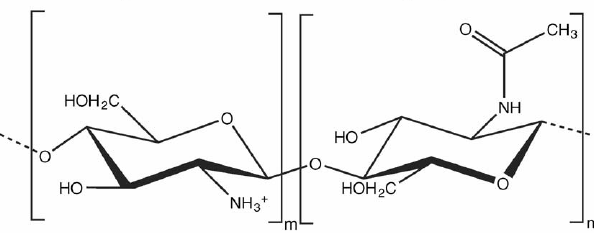
EC can also be used as carriers of many useful ingredients or additives (i.e. antimicrobial compounds, color or aroma additives, antioxidants, or anti-ripening compounds) [3]. Particularly in this study, chitosan coatings will be evaluated in fresh-cut strawberries microbial and sensory quality through refrigerated storage. Furthermore, two antimicrobial compounds of natural origin (vanillin and geraniol) will be incorporated and tested in the chitosan coatings.
Materials and Methods
Materials
Chitosan (CH) (deacetylation degree 90%, Mv = 1.61 × 10⁵ g/mol) was supplied by PARAFARM, Mar del Plata, Argentina. For the films incorporated with antimicrobial agents, geraniol (G) and vanillin (V) were purchased from Sigma Aldrich (St Lois MO, USA) (purity ≥ 97% GC). Glycerol was used as a plasticizer and was purchased from Biopack (Buenos Aires, Argentine).
Preparation of Film Forming Solutions
Chitosan film-forming solutions (2%, w/v) were prepared by dissolving chitosan powder in acetic acid solution (1% v/v) at room temperature (23 ± 2°C), according to Pereda et al. (2012). Glycerol was incorporated as plasticizer at a concentration of 28% (glycerol to chitosan weight). This solution with no biopreservatives was used as a control (CH edible coating). Another sample was used as control with no coating (untreated or control sample).
Film solutions incorporated with natural antimicrobial agents were prepared at different concentrations of geraniol and vanillin according to previous assays, where the solubility and stability of each compound was tested in the chitosan film forming solution at different concentrations using the minimum inhibitory concentration (MIC) of the compounds against relevant foodborne pathogens as previously described by Tomadoni, et al. [10]. Hence, geraniol was incorporated into CH films at two different concentrations: 1.2 and 2.4 μL/mL (CH+G2MIC and CH+G4MIC coatings, respectively). Geraniol was dispersed in the chitosan solution with an Ultra-Turrax (Ika T25, USA) at 14.000 rpm for 15 min. Vanillin was incorporated at 5 and 10 mg/mL (coatings CH+V2MIC and CH+V4MIC, respectively).
Fruit Processing, Treatment Application and Storage Conditions
Strawberries (Fragaria x ananassa) were grown and harvested in Sierra de los Padres, Mar del Plata, Argentina. Fruits with uniform size, and free of physical damage and fungal infection, were selected. Strawberries were washed by immersion in tap water for 2 min, the stems were removed manually, and the fruits were cut in halves. The application of the treatments consisted of immersion of the cut strawberries in the different film forming solutions for 2 min, and the excess of coating solution was allowed to drip off.
Strawberry halves from each treatment (ca. 50 g) were placed into polypropylene sterile trays of dimensions 152.5 mm x 112 mm x 47 mm (Celpack S.A., Argentine). The trays were wrap-sealed in 25.4 μm thick polypropylene film (with permeability to O2, CO2 and water vapor of 3.08x10⁻⁴, 2.05x10⁻³ and 2.05x10⁻⁶ mmol3m-2s-1 respectively, at P = 101325 Pa, T = 25°C) using a manual thermo-sealing machine (HL, FS-300, Argentina). Finally, samples were stored at 5°C in order to assess quality parameters. Two trays of each treatment were analyzed immediately after processing (day 0), and after 2, 5 and 7 days of refrigerated storage to evaluate the impact of chitosan coatings on microbiological and sensory quality of minimally processed strawberries.
Microbiological Analysis
Mesophilic bacteria (MES), yeast and molds (YM) and psychrophilic bacteria (PSY) were assessed to evaluate the impact of the different coatings on native microflora of MP strawberries through refrigerated storage. A portion of 10 g from each treatment, obtained from different strawberry pieces, was aseptically removed from each tray and transferred into sterile plastic bags. Samples were diluted with 90 mL of peptonated water (0.1% w/v) and homogenized for 1 min in a stomacher blender. Serial dilutions (1:10) of each sample were made in sterile peptonated water (0.1% w/v) and surface spread by duplicate.
The enumeration of the microbial populations was performed according to Ponce, et al. [11] by using the following culture media and culture conditions: mesophilic aerobic bacteria on Plate Count Agar (PCA) incubated at 35 °C for 24-48 h; psychrophilic bacteria on PCA incubated at 7°C for 5-7 d; yeast and molds on Yeast- Glucose-Chloramphenicol (YGC) medium incubated at 25°C for 5 d. All culture mediums were purchased from Britania (Buenos Aires, Argentine). Colonies were counted and the results expressed as CFU/g of strawberries. Analyses were carried out periodically during 7 days in randomly sampled pairs of trays. Two replicate counts were performed for each tray.
Sensory Analysis
A quantitative descriptive analysis (QDA) was performed according to Carbonell, et al. [12]. Ten trained panelists evaluated the fresh-cut strawberries prepared on the same day of the test (t = 0 d) and after 7 days of refrigerated storage at 5°C. Samples labeled with 3-digit code numbers were randomly provided to the panelists.
Water was provided to panelists for eliminating the residual taste between samples. The attributes evaluated were: overall visual quality (OVQ), characteristic odor, off- odor, sweetness, acidity and texture. Unstructured line scales (5 cm) anchored at the ends with terms related with minimum and maximum intensities were used to evaluate each attribute. Definitions, anchor terms and reference values (fresh cut strawberry with no treatment) for each attribute are shown on Table 1.
| Attribute | Description | 0 | 5 | Ref. | ||||||||||
|---|---|---|---|---|---|---|---|---|---|---|---|---|---|---|
| Appearance | ||||||||||||||
| OVQ | Overall visual quality | Poor | Excellent | 5 | ||||||||||
| Brightness | Intensity of brightness | Low | High | 5 | ||||||||||
| Odor | ||||||||||||||
| Characteristic odor | Intensity of strawberry odor | Low | High | 5 | ||||||||||
| Off-odor | Intensity of fermentation or other non-characteristic odors | Low | High | 0 | ||||||||||
| Taste | ||||||||||||||
| Sweetness | Intensity of sweet | Low | High | 3 | ||||||||||
| Acidity | Intensity of acid | Low | High | 2 | ||||||||||
| Texture | ||||||||||||||
| Texture | Firmness | Extremely soft | Normal | 5 |
Table 1: Description of the selected sensory attributes, anchor ends and consensus values for the reference sample.
Ref.: Reference: fresh-cut strawberry without coating Table 1: Description of the selected sensory attributes, anchor ends and consensus values for the reference sample.
A completely randomized design was used. Three independent runs were performed. Data obtained was analyzed using R v. 2.12.2. [13]. Results reported in this article are mean values accompanied by their standard errors [14]. Analysis of variance ANOVA was performed and Tukey-Kramer comparison test was used to estimate significant differences between treatments (p < 0.05) and between storage days (p < 0.05).
Effect of Chitosan Coatings on Native Microflora of Fresh-Cut Strawberries
Mesophilic Bacteria: Evolution of mesophilic bacteria in fresh-cut strawberries treated with chitosan edible coatings with biopreservatives is shown on Figure 2.
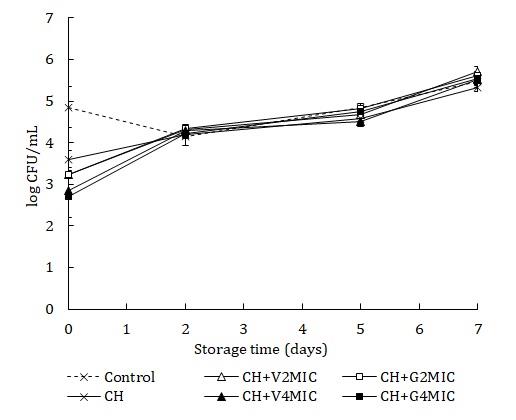
effective those containing the highest dose of V or G (CH+V4MIC or CH+G4MIC, respectively). However, throughout refrigerated storage, MES counts in treated samples also increased concluding that none of the treatments was effective compared to control. Yeasts and Molds: Figure 3 shows the evolution of YM counts in fresh-cut strawberries with chitosan coatings. Like MES, control sample showed an important increment through storage time, starting at 4.28 log CFU/g, and reaching 6.40 log by day 7. At day 0, every chitosan coating tested (including those without biopreservatives) were efficient in reducing YM recounts with respect to control, without significant differences between them, with an average value of 2.22 log. Through refrigerated storage, treated samples also showed a significant growth in YM, reaching values significantly lower than those achieved in untreated strawberries (Figure 3).
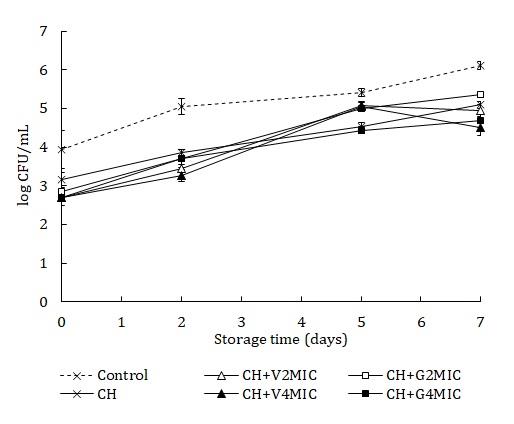
Figure 3: Yeast and molds evolution in fresh-cut strawberries with chitosan coatings through refrigerated storage at 5°C. Bars indicate standard errors. CH: chitosan coatings (2% p/v); V2MIC: 5 mg/mL of vanillin; V4MIC: 10 mg/mL of vanillin; G2MIC: 1.2 µL/mL of geraniol; G4MIC: 2.4 µL/mL of geraniol. With regards to the incorporation of biopreservatives into the chitosan coatings, the lowest concentration of vanillin (CH+V2MIC) showed less effectiveness in the reduction of YM counts, with higher counts than CH sample at days 2 and 5 of storage. By the end of storage period, samples CH+V4MIC and CH+G4MIC were the most effective, with mean values of 4.00 and 3.50 log CFU/g, respectively. Meanwhile, the rest of the coated samples reached similar recounts, between 4.45 and 4.85 log CFU/g, significantly lower than YM counts found in control sample. Psychrophilic Bacteria Regarding psychrophilic bacteria, counts in control sample began at 3.94 log, showing a significant increment through refrigerated storage (as it can be seen in Figure 4). Chitosan coatings with or without biopreservatives, proved to be effective in the inhibition of PSY on day 0, with an initial decrease of approximately 1 log compared to control. However, throughout storage PSY counts in every sample increased with time, reaching values between 4.50 and 5.09 log by the end of storage period.
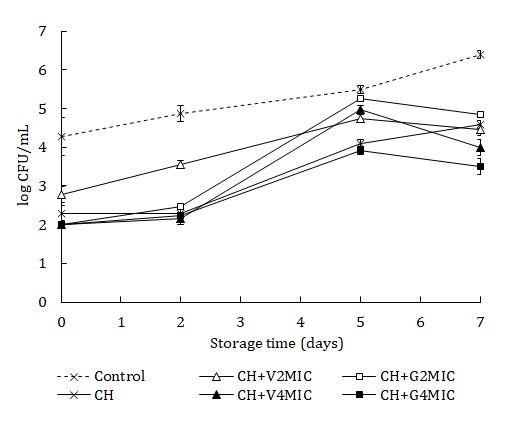
Figure 4: Psychrophilic bacteria evolution in fresh-cut strawberries with chitosan coatings through refrigerated storage at 5°C. Bars indicate standard errors. CH: chitosan coatings (2% p/v); V2MIC: 5 mg/mL of vanillin; V4MIC: 10 mg/mL of vanillin; G2MIC: 1.2 µL/mL of geraniol; G4MIC: 2.4 µL/mL of geraniol. Miocrobiological Shelf-Life Chitosan coatings have shown effectiveness to inhibit initial counts on every microbial population studied, which proves a significant antimicrobial effect of chitosan coatings, with and without the incorporation of biopreservatives. Throughout refrigerated storage, a growth of both YM an PSY populations was observed in every sample, even though treated strawberries showed significantly lower counts compared to control. Even so, none of the treatments here proposed was able to reduce MES counts through storage, and therefore, treatments with chitosan coatings were not capable of extending the product shelf-life from a microbiological point of view with respect to control.
Chitosan antimicrobial activity has been widely studied, and different mechanisms of action have been proposed to justify its effectiveness. Many authors have concluded that antimicrobial activity of chitosan could be related to the electrostatic interactions between its positive charges and the phospholipids negatively charged present in plasmatic membrane of microbial cells. Positive charge in chitosan molecules are a consequence of the deacetylation process of chitin. Therefore, the degree of deacetylation can influence the number of positive charges that are eventually present on the chitosan molecule (i.e. chitosan with higher DD has numerous positive charges) [15].
Antifungic activity of chitosan has been reported against the main pathogens on postharvest fruits, such as B. cinerea [16, 17, 18, 19, 20, 21, 22, 23], and Aspergillus niger [20]. When chitosan is exposed against the fungi cell, it first joins the membrane and covers it; in a second step, after certain concentration threshold is achieved, chitosan causes membrane permeabilization and the liberation of cell content [24]. When chitosan is applied, the homeostatic mechanism of the fungi cells suffer a drastic change, because chitosan forms canals in the membrane, allowing the ion Ca2+ to move freely, which causes instabilities, and may provoke even cell death [24].
With respect to the incorporation of biopreservatives into the coatings, an improved antimicrobial effect of the composite coatings of CH with V or G was expected with respect to plain chitosan coatings. However, the results presented in this study demonstrated that the antimicrobial power of the CH coatings was not significantly increased by the addition of either vanillin or geraniol until day 7 of storage, where a slight improvement was observed in YM and PSY counts in those strawberries treated with the composite coatings. Between days 2 and 5 of storage, even higher YM counts were found in the sample CH+V2MIC compared to CH. The aldehyde group of vanillin could react with the amino groups of chitosan to form Schiff bases (Figure 5) [33, 34, 35, 36].
Beyond its ability to permeabilize the membrane, many studies have demonstrated through visualization with fluorescence that chitosan can penetrate microbial cells. Once inside the cell, positively charged chitosan can join other intracellular targets, such as DNA, RNA, which are negatively charged [20]. Many studies have also described morphological changes in the fungi hyphae and in their reproductive structures caused by chitosan Li, et al. [25], Sánchez-Domínguez, et al. [26].
Another mechanism proposed to explain the antimicrobial power exerted by chitosan has been its effect on the enzyme phenylalanine ammonia lyase (PAL). PAL is a key enzyme in the phenols synthesis mechanism [27] and the accumulation of phenols that act as phytoalexins (antimicrobial compounds that accumulate in some plants in high concentrations, after bacterial or fungal infections) is considered the main inducible response of PAL to biotic and abiotic stresses in plants [28]. It has been shown that the application of chitosan has increased PAL activity in different fruits, such as grapes cherries and strawberries, thus improving the defense mechanism of fruits [23, 29, 30, 31, 32].
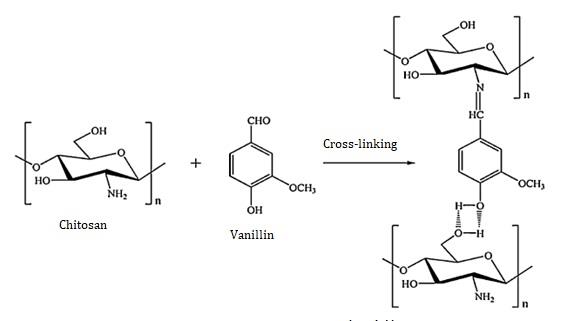
Peng, et al. [35] synthesized chitosan microspheres with vanillin for the controlled release of resveratrol. The authors mentioned that the formation of these microspheres was carried out by chemical cross-linking between chitosan and vanillin. However, as can be seen in Figure 5, the formation of the Schiff base does not count as covalent crosslinking, since the hydroxyl groups of the phenolic compound do not form covalent bonds with the chitosan backbone. Marin, et al. [37] investigated this reaction in more detail. These authors observed the formation of a strong gel by crosslinking chitosan with vanillin and attributed it to the formation of hydrogen bonding instead of covalent crosslinking [34]. Under acid conditions, the aldimine bonds are reversible, being able to recover the original aldehyde [37].
This could explain the decrease in the antimicrobial activity of the chitosan coatings incorporated with V, due to the formation of the aldimine bond and then, the reversibility of this reaction, with the release of the aldehyde could justify the increase in the antimicrobial capacity towards the end of the storage.
Effect of Chitosan Coatings on Sensory Properties of Fresh-Cut Strawberries
The results obtained from the sensory evaluation of fresh-cut strawberries treated with chitosan coatings are shown in Figure 6. As it can be seen, initially the attributes of OVQ, brightness, texture and characteristic odor were not significantly affected by the chitosan coatings or by the chitosan coatings with biopreservatives. With respect to the off-odor, chitosan did not significantly affect this parameter with respect to the control. In contrast, samples coated with chitosan incorporated with biopreservatives, showed a significant increase in off- odor scores in the following order: CH+V2MIC < CH+V4MIC < CH+G2MIC < CH+G4MIC. The increase in the off-odor perceived by the panelists could be due to the characteristic aromas of vanillin and geraniol, samples with the highest score being those treated with the coatings with the highest biocative concentration. The results in this case were in accordance with those observed in strawberry juice in a previous study [38], where vanillin odor was perceived as more compatible with strawberry characteristic odor according to trained panelists.
![Figure 6: As it can be seen, initially the attributes of OVQ, brightness, texture and characteristic odor were not significantly affected by the chitosan coatings or by the chitosan coatings with biopreservatives. With respect to the off-odor, chitosan did not significantly affect this parameter with respect to the control. In contrast, samples coated with chitosan incorporated with biopreservatives, showed a significant increase in off- odor scores in the following order: CH+V2MIC < CH+V4MIC < CH+G2MIC < CH+G4MIC. The increase in the off-odor perceived by the panelists could be due to the characteristic aromas of vanillin and geraniol, samples with the highest score being those treated with the coatings with the highest biocative concentration. The results in this case were in accordance with those observed in strawberry juice in a previous study [38], where vanillin odor was perceived as more compatible with strawberry characteristic odor according to trained panelists.](/fulltextimages/3773/fig_6.jpeg)
Figure 6: Effect of chitosan coatings on sensory characteristics of fresh-cut strawberries under refrigerated storage at 5°C. Sweetness and acidity were not evaluated at 7 days of storage due to the important microbial load of the samples. CH: chitosan coatings (2% p/v); V2MIC: 5 mg/mL of vanillin; V4MIC: 10 mg/mL of vanillin; G2MIC: 1.2 µL/mL of geraniol; G4MIC: 2.4 µL/mL of geraniol.
With respect to flavor attributes, at day 0 samples CH+V2MIC and CH+V4MIC obtained sweetness scores significantly higher than the rest of the samples, and significantly lower acid scores. Chitosan coatings with geraniol at the highest concentration evaluated resulted in a significantly stronger acid taste than the control sample.
Overall visual quality of fresh-cut strawberries and texture were the sensory attributes most affected by storage time. On day 7 of storage, texture scores in all the samples were significantly lower than those observed at day 0, showing a softening of the product with time under refrigeration conditions. Firmness is one of the main attributes that determines the quality of postharvest fruit [39]. Fruit softening is a biochemical process normally attributed to the deterioration in cell wall composition, which involves the hydrolysis of pectin through enzymes such as polygalacturonase (PG) and pectinmethylesterase (PME). Samples treated with CH and CH+V2MIC coatings obtained texture scores at day 7 similar to those found for control; on the other hand, the samples treated with CH+V4MIC, CH+G2MIC and CH+G4MIC showed significantly lower scores, showing a greater softening. In a study on gellan-based coatings, similar results were found [38]. High concentrations of bioactives can affect the texture of the cut fruit, decreasing the firmness through storage as a consequence of the action of the compounds added on the fruit cell tissue [40]. In accordance with our findings, Raybaudi-Massila, et al. [40] also observed that those coatings incorporated with bioactives at high concentrations (among them, alginate- based coatings with 0.5% v/v geraniol), diminished the firmness of fresh-cut melon through storage. This result could be a consequence of the action of geraniol on the cellular tissue of the fruit, that possibly provokes structural changes that directly affects the firmness, or even increases the release of enzymes and substrates that also favor the softening of the fruit [40].
Hernández-Muñoz, et al. [11] studied the effect of chitosan coatings on the firmness of strawberries stored at 10°C for 6 days. These authors reported a significant improvement in the texture of the fruit with respect to the control, although the treated samples also showed a detriment of the firmness throughout the storage time. However, these authors worked on whole strawberry. In this particular study, the work carried out was on fresh- cut strawberries, a minimally processed product that having undergone a cutting operation, suffers a series of biochemical changes, such as release of enzymes and water loss that favor the softening of the tissue. In another study Jongsri, et al. [41, 42, 43, 44, 45, 46, 47, 48, 49] studied the effect of chitosan coatings of different molecular weights on fresh-cut melon and found results in accordance with our findings. These authors found a decrease in the firmness of the fresh-cut melon throughout storage, without significant differences between samples treated with the different coatings and control samples (without coating).
Conclusions
Chitosan coatings were effective in the initial reduction of fresh-cut strawberries native microflora, even without biopreservatives. Throughout the storage, a decrease in the counts of mesophilic bacteria was not achieved, but the psychrophilic and yeast and molds values were reduced with respect to the control. The addition of the biopreservatives, in this case, did not show a significant improvement of the antimicrobial activity of the chitosan coatings per se, as it was expected. Shelf-life of the product was ruled by its sensory characteristics, particularly the texture, showing a strong decrease in firmness with storage time. In this sense, the coatings evaluated could not prolong the shelf-life of the product.
This study shows the need of evaluation through storage, because the effects of the treatments at day 0 (immediately after their application) could lead to erroneous conclusions. Furthermore, sensory assessment is mandatory to adequately arrive to a conclusion regarding the shelf-life of a product. Coatings that were proved to be effective in the whole fruit, failed to enhance the quality of minimally processed cut strawberries. Fresh-cut fruits are a much more complex product, and more studies are needed to find a suitable coating to protect this susceptible food matrix.
Conflicts of Interest
The authors declare no conflict of interest.
Acknowledgments
This work was supported by Consejo Nacional de Investigaciones Científicas y Técnicas (CONICET), Agencia Nacional de Promoción Científica y Tecnológica (ANPCyT) and Universidad Nacional de Mar del Plata (UNMDP).
References
-
Jiawei Y, Luo Z, Ban Z, Hongyan Lu, Dong Li (2019) The Effect of the Layer-by-Layer (LBL) Edible Coating on Strawberry Quality and Metabolites during Storage. Postharvest Biology and Technology 147: 29- 38.
-
Lara I, Garcı́a P, Vendrell M (2004) Modifications in Cell Wall Composition after Cold Storage of Calcium- Treated Strawberry (Fragaria × Ananassa Duch.) Fruit. Postharvest Biology and Technology 34(3): 331-339.
-
Sakineh E, Abdollahi F, Ramezanian A, Dastjerdi AM, Rahimzadeh M (2019) Enhanced Chilling Tolerance of Pomegranate Fruit by Edible Coatings Combined with Malic and Oxalic Acid Treatments. Scientia Horticulturae 250: 388-398.
-
Thakur R, Pristijono P, Golding JB, Stathopoulos CE, Scarlett CJ, et al. (2018) Development and Application of Rice Starch Based Edible Coating to Improve the Postharvest Storage Potential and Quality of Plum Fruit (Prunus Salicina). Scientia Horticulturae 237: 59-66.
-
Reddy MM, Vivekanandhan S, Misra M, Sujata KB, Amar KM (2013) Biobased Plastics and Bionanocomposites: Current Status and Future Opportunities. Progress in Polymer Science 38 (10- 11): 1653-1689.
-
Quirós-Sauceda AE, Ayala-Zavala JF, Olivas GI, González-Aguilar GA (2014) Edible Coatings as Encapsulating Matrices for Bioactive Compounds: A Review. Journal of Food Science and Technology 51(9): 1674-1685.
-
Neeta BG, Patel PR, Ramana Rao TV (2013) Improvement of Quality and Shelf-Life of Strawberries with Edible Coatings Enriched with Chitosan. Postharvest Biology and Technology 85: 185-195.
-
Khokhlova MA, Gallyamov MO, Khokhlov AR (2012) Chitosan Nanostructures Deposited from Solutions in Carbonic Acid on a Model Substrate as Resolved by AFM. Colloid and Polymer Science 290(15): 1471-80.
-
Mármol, Zulay, Páez G, Rinc M, Araujo K, et al. (2011) Quitina y Quitosano Polímeros Amigables. Una Revisión de Sus Aplicaciones. Revista Tecnocientífica URU 1: 53-58.
-
Tomadoni B, Cassani L, Moreira MR, Ponce A (2015) Efficacy of Vanillin and Geraniol in Reducing Escherichia Coli O157:H7 on Strawberry Juice. LWT - Food Science and Technology 64(2): 554-557.
-
Hernández-Muñoz P, Almenar E, Valle VD, Velez D, Gavara R (2008) Effect of Chitosan Coating Combined with Postharvest Calcium Treatment on Strawberry (Fragaria × Ananassa) Quality during Refrigerated Storage. Food Chemistry 110(2): 428-435.
-
Carbonell L, Izquierdo L, Carbonell I (2012) Sensory Analysis of Spanish Mandarin Juices. Selection of Attributes and Panel Performance. Food Quality and Preference 18(2): 329-341.
-
R Development Core Team (2011) The R Project for Statistical Computing. R Project Vienna, Austria.
-
Kuehl R (2001) Diseño de Experimentos. 2nd (Edn.). Thompson Learning Intl.
-
Gianfranco R, Erica Feliziani (2016) Use of Chitosan to Control Postharvest Decay of Temperate Fruit: Effectiveness and Mechanisms of Action. In Chitosan in the Preservation of Agricultural Commodities, edited by S. Bautista-Baños, G. Romanazzi, and A. Jiménes-Aparicio, pp: 155-177.
-
Po-Jung C, Cheng-Chun C (2006) Antifungal Activity of Chitosan and Its Application to Control Post-Harvest Quality and Fungal Rotting of Tankan Citrus Fruit (Citrus Tankan Hayata). Journal of the Science of Food and Agriculture 86(12): 1964-1969.
-
El-Ghaouth A, Smilanick JL, Wilson CL (2000) Enhancement of the Performance of Candida Saitoana by the Addition of Glycolchitosan for the Control of Postharvest Decay of Apple and Citrus Fruit. Postharvest Biology and Technology 19(1): 103-110.
-
Jia L, Shiping T, Meng X, Yong Xu (2007) Effects of Chitosan on Control of Postharvest Diseases and Physiological Responses of Tomato Fruit. Postharvest Biology and Technology 44(3): 300-306.
-
Bautista-Baños S, Bosquez-Molina E, Laura L, Barrera- Necha, Chapter 1 - Rhizopus Stolonifer (Soft Rot). In Postharvest Decay. Control Strategies, edited by S. Bautista-Baños, pp: 1-44.
-
Xiao-Fang Li, Xiao-Qiang F, Sheng Yang, Ting-Pu W, Zhong-Xing S (2008) Effects of MolecularWeight and Concentration of Chitosan on Antifungal Activity Against Aspergillus Niger. Iranian Polymer Journal 17(11): 843-852.
-
Yu T, Li HY, Zheng XD (2007) Synergistic Effect of Chitosan and Cryptococcus Laurentii on Inhibition of Penicillium Expansum Infections. International Journal of Food Microbiology 114(3): 261-266.
-
Ling-Yu Y, Jian-Lei Z, Bassett CL, Xiang-Hong M (2012) Difference between Chitosan and Oligochitosan in Growth of Monilinia Fructicola and Control of Brown Rot in Peach Fruit.” LWT - Food Science and Technology 46(1): 254-259.
-
Meng, Xiang-Hong, Guo-Zheng Q, Shi-Ping T (2010) Influences of Preharvest Spraying Cryptococcus Laurentii Combined with Postharvest Chitosan Coating on Postharvest Diseases and Quality of Table Grapes in Storage. LWT - Food Science and Technology 43(4): 596-601.
-
Palma-Guerrero J, Lopez-Jimenez JA, Pérez-Berná AJ, Huang IC, Jansson HB, et al. (2010) Membrane Fluidity Determines Sensitivity of Filamentous Fungi to Chitosan.” Molecular Microbiology 75 (4): 1021- 1032.
-
Yong-cai LI, Xiao-juan S, Yang Bi, Yong-hong G, Wang Y (2009) Antifungal Activity of Chitosan on Fusarium Sulphureum in Relation to Dry Rot of Potato Tuber. Agricultural Sciences in China 8(5): 597-604.
-
Sánchez-Domínguez D, MY Ríos, Castillo-Ocampo P, Zavala-Padilla G, Ramos-García M, et al. (2011) Cytological and Biochemical Changes Induced by Chitosan in the Pathosystem Alternaria Alternata- tomato Pesticide Biochemistry and Physiology 99(3): 250-255
-
Guiwen WC, Breen PJ (1991) Activity of Phenylalanine Ammonia-Lyase (PAL) and Concentrations of Anthocyanins and Phenolics in Developing Strawberry Fruit. Journal of the American Society for Horticultural Science 116(5): 865-869.
-
Bhattacharya AP, Sood p, Citovsky V (2010) The Roles of Plant Phenolics in Defence and Communication during Agrobacterium and Rhizobium Infection. Molecular Plant Pathology 11(5): 705-719.
-
Xianghong M, Boqiang Li, Jia Liu, Tian S (2008) Physiological Responses and Quality Attributes of Table Grape Fruit to Chitosan Preharvest Spray and Postharvest Coating during Storage. Food Chemistry 106(2): 501-508.
-
Xianghong M, Tian S (2009) Effects of Preharvest Application of Antagonistic Yeast Combined with Chitosan on Decay and Quality of Harvested Table Grape Fruit. Journal of the Science of Food and Agriculture 89(11): 1838-1842.
-
Dang QF, Yan JQ, Yan Li, Cheng XJ, Liu CH, Xi GC (2010) Chitosan Acetate as an Active Coating Material and Its Effects on the Storing of Prunus Avium L. Journal of Food Science 75(2): S125-S131.
-
Romanazzi G, Nigro F, Ippolito A (2000) Effetto Di Trattamenti Pre e Postraccolta Con Chitosano Sui Marciumi Della Fragola in Conservazione.
-
Jagadish RS, KN Divyashree, Viswanath P, Srinivas P, Baldev R (2012) Preparation of N-Vanillyl Chitosan and 4-Hydroxybenzyl Chitosan and Their Physico- Mechanical, Optical, Barrier, and Antimicrobial Properties. Carbohydrate Polymers 87(1): 110-116.
-
Marin L, Stoica I, Mihai MM, Dinu V, Simionescu BC, Mihail Barboiu (2013 Antifungal Vanillin-imino- Chitosan Biodynameric Films. Journal of Materials Chemistry B (27): 3353.
-
Hailong P, Xiong H, Jinhua Li, Xie M, Yuzhen Liu, et al. (2010) Vanillin Cross-Linked Chitosan Microspheres for Controlled Release of Resveratrol. Food Chemistry 121(1): 23-28.
-
Sashikala SS, Shafi S (2014) Synthesis and Characterization of Multifunctional Chiral Schiff Base Derivatives. Der Pharmacia Lettre 6(2): 90-97.
-
Mariana P, Amica G, Marcovich NE (2012) Development and Characterization of Edible Chitosan/Olive Oil Emulsion Films. Carbohydrate Polymers 87(2): 1318-1325.
-
Tomadoni, B, Viacava G, Cassani L, Moreira MR, A Ponce (2016) Novel Biopreservatives to Enhance the Safety and Quality of Strawberry Juice. Journal of Food Science and Technology 53(1): 281-292.
-
Barrett DM, Beaulieu JC, Shewfelt R (2010) Color, Flavor, Texture, and Nutritional Quality of Fresh-Cut Fruits and Vegetables: Desirable Levels, Instrumental and Sensory Measurement, and the Effects of Processing. Critical Reviews in Food Science and Nutrition 50(5): 369-389.
-
Raybaudi-Massilia RM, Mosqueda-Melgar J, Martín- Belloso O (2008) Edible Alginate-Based Coating as Carrier of Antimicrobials to Improve Shelf-Life and Safety of Fresh-Cut Melon. International Journal of Food Microbiology 121(3): 313-327.
-
Jongsri, Pornchan, Wangsomboondee T, Rojsitthisak P (2016) LWT - Food Science and Technology Effect of Molecular Weights of Chitosan Coating on Postharvest Quality and Physicochemical Characteristics of Mango Fruit.” LWT - Food Science and Technology 73: 28-36.
-
Ross GA, Sutherland PW, Johnston SL, Gunaseelan K, Hallett IC, et al. (2012) Down-Regulation of POLYGALACTURONASE1 Alters Firmness, Tensile Strength and Water Loss in Apple (Malus x Domestica) Fruit. BMC Plant Biology 12: 129.
-
Landi L, Feliziani E, Romanazzi G (2014) Expression of Defense Genes in Strawberry Fruits Treated with Different Resistance Inducers. Journal of Agricultural and Food Chemistry 62 (14): 3047-3056.
-
Luminita M, Simionescu B, Barboiu M (2012) Imino- Chitosan Biodynamers. Chemical Communications (Cambridge, England) 48(70): 8778-8780.
-
Xianghong M, Yang L, Kennedy JF, Shiping T (2010) Effects of Chitosan and Oligochitosan on Growth of Two Fungal Pathogens and Physiological Properties in Pear Fruit. Carbohydrate Polymers 81(1): 70-75.
-
Palma-Guerrero J, Huang IC, Jansson HB, Salinas J, Lopez-Llorca LV, et al. (2009) Chitosan Permeabilizes the Plasma Membrane and Kills Cells of Neurospora Crassa in an Energy Dependent Manner. Fungal Genetics and Biology 46(8): 585-594.
-
Yihu S, Zheng Q (2014) Ecomaterials Based on Food Proteins and Polysaccharides. Polymer Reviews 54 (3): 514-571.
-
Tomadoni B, Moreira MR, Pereda M, AG Ponce (2018) Gellan-Based Coatings Incorporated with Natural Antimicrobials in Fresh-Cut Strawberries: Microbiological and Sensory Evaluation through Refrigerated Storage. LWT 97: 384-389.
-
Yage X, Qinglian Xu, Zhenming Che, Xihong Li, Wenting Li (2011) Effects of Chitosan-Oil Coating on Blue Mold Disease and Quality Attributes of Jujube Fruits. Food Funct 2(8): 466-474.
- The Role of Podocyte Apoptosis and the Involvement of SIRT1 in Diabetic Nephropathy
- Dealcoholization of Beer by Osmotic Distillation for the Beverage Industry
- Biopolymer-Based Edible Packaging- Biomaterials, Methods, and Applications in Food Industry: An Updated Review
- Influence of Bioprocessing Methods on 'China Rice' (Gawal R1), and Soyabean Supplementation on the Quality of Complementary Food
- Cassava (Manihot esculenta) Varietal Growth, Yield and Cyanide Content Performance in Three Sites in the South- Eastern Semi Arid Regions of Kenya
- Food Waste Treatment, Recycling, Management and Production of Value-Products-An Update on Methodologies and Current Trends