
In Vitro Assay of Antifungal Activity of Various Elicitors and Binders against Curvularia Lunata
In the present study in vitro antifungal activity of various elicitors and binders were evaluated against Curvularia lunata caused leaf spot disease maize. Antifungal activities were assayed by poison food technique. Among the all Elicitors and all binders best optimum activity was observed for clove bud oil cake and cow dung i.e. 51 % and 33.88 % respectively against Curvularia lunata. On the basis of results obtained, best active elicitor i.e. clove bud oil cake and binder i.e. cow dung can be used to develop the plant extract based bio-formulation for effective control of leaf spot disease of maize in an eco-friendly manner.
Introduction
Plants are exposed to an array of biotic stresses like bacterial, fungal and viral infections. This leads to an enormous loss to plant yield. There are different options available for the farmers to prevent their crop from disease. Some options include development of resistant cultivars, crop rotation, tillage, biological control, and chemical pesticides. Nearly all chemical fungicides or pesticides have a direct antibiotic principle. But their use at commercial level on a large scale is too expensive; application is cumbersome and has been proved to be carcinogenic. Therefore, significant efforts have been made to develop environmental-friendly strategies for management of plant diseases [1, 2].
In order to develop a new active bio-formulation as biological agent for control of plant disease screening is done to find out an active elicitor and binder which enhance the efficacy of plant extract. Initially the term elicitor was used for molecules that are capable of inducing the production of phytoalexins, but it is now normally used for any compounds that stimulate any kind of plant defense [3, 4, 5, 6, 7, 8]. Elicitors include both substances originating from pathogen i.e. exogenous elicitors and compounds generated from plants, i.e. endogenous elicitors [9]. Elicitors are also classified as biotic or abiotic, physical or chemical, and complex or depending on their origin and molecular structure.
Several agro-based ravage and byproducts are known which play an important role in the management of crop plant diseases. They act directly or indirectly on plant pathogens and inhibit the growth and multiplication of the pathogen or induce resistance in crop. Some reports are available on use of agro based ravage and byproduct for control plant diseases like oil cakes [10, 11, 12, 13].
Binder is a material which holds other materials together (elicitors and extracts) to form a cohesive formulation. Several materials such as guar gum, gum acacia etc. are used as binders. Guar gum, also known as guaran, is the ground endosperm of guar beans. In recent year researches have used guar gum as a rate controlling mediator for controlled delivery of bioactive molecules [14, 15, 16, 17]. Gum acacia is used in traditional medicine and pharmaceutical industry but no reports of it are available for controlling plant disease as use as binder [18, 19, 20].
The Hindu Vedas say that the cow is blessed and should be worshiped. In India, cows are very important living thing resources and are highly useful in agricultural and dairy industry [21]. Panchagavya is a term used to illustrate five major substances, obtained from cow, which include cow’s, milk, curd, ghee, urine and dung. All the five products possess medicinal properties against many diseases. This kind of healing is called Panchagavya therapy [22]. Rajeswari, et al. [23] investigated the significant antifungal activity of cow dung extract against Escherichia coli and Klebsiella pneumonia. Krunal, et al. [24] also illustrated the significant activity of cow urine and cow dung against phytopathogenic fungus Colletrotrichum falcatum. In the present study, selection of suitable binder and elicitor to get optimum antimicrobial efficiency from plant extract.
Materials and Methods
In the present study, antifungal activity of various elicitors and binders against Curvularia lunata was studied. For the in vitro antifungal activity there are seven type of elicitors i.e. ground nut oil cake, mustard oil cake, cotton oil cake, sesame oil cake ,clove bud oil cake, coconut oil cake, and neem oil cake and three type of binders i.e. guar gum, gum acacia and cow dung were used.
In Vitro Assay of Antifungal Activity of Various Elicitors and Binders Against Curvularia Lunata There are seven types of elicitors i.e. ground nut oil cake, mustard oil cake, cotton oil cake, sesame oil cake, clove bud oil cake, coconut oil cake, neem oil cake, etc. and three types of binder i.e. guar gum, gum acacia and cow dung have been used to study the antifungal activity against Curvularia lunata. 20 gm of each elicitor was dissolved in 100 ml of autoclaved water for 24 h. The mixture was then filtered and the filtrate was further used for antifungal activity. The antifungal activity of each elicitor was tested using poison food technique. 1 ml of each elicitor with 9 ml molten sterile PDA culture medium was poured into pre-sterilized petri- plates (9 cm diameters) and allowed to solidify at room temperature. Thus prepared petri-plates were inoculated aseptically with 6mm disc of test pathogen’s cultures which was placed at the centre of the plate. The Petri-plates were then incubated at 28 ± 2ºC for seven days, only PDA culture media are used as control series. Antifungal activity of each elicitor was measured as a function of increase in growth diameter of 6 mm disc of inoculums.
Mycelial growth inhibition
$$ n = \frac {\mathrm {g c - g t}}{\mathrm {g c}} \times 1 0 0 $$ gc = growth of fungal colony after 7 days incubation period in control set subtracting the diameter of inoculums disc. gt = growth of fungal colony after 7 days incubation period in treatment set subtracting the diameter of inoculums disc.
Results and Observations
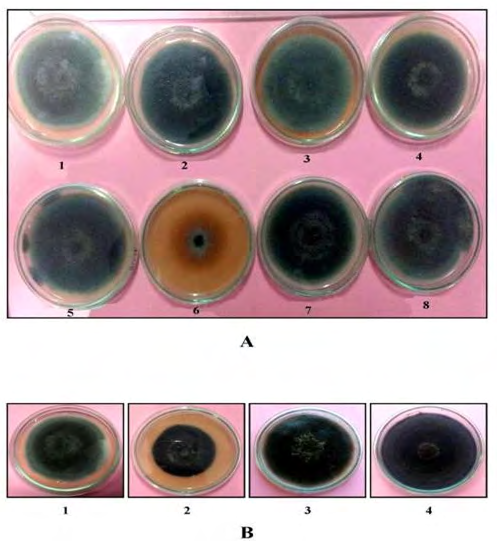
The results of antifungal activity of various elicitors against Curvularia lunata are given in Table 1 and Figure 1A. Among the all elicitors clove bud oil cake showed best activity i.e. 51.00% followed by neem oil cake i.e. 0.11% and the results of antifungal activity of various binders against Curvularia lunata are given in Table 2 and Figure 1B. Among the all binders the best activity was observed with cow dung i.e. 33.88% followed by guar gum and gum acacia i.e. 0.04% and 0.02%, respectively.
| Elicitors | Growth diameter after 7 days (mm) ± SD | Percentage (%) mycelial growth inhibition | |
|---|---|---|---|
| 1. | Neem oil cake | 73.33 ± 0.57 | 0.11 |
| 2. | Mustard oil cake | 81.66 ± 0.57 | 0.012 |
| 3. | Cotton oil cake | 75.66 ± 1.15 | 0.08 |
| 4. | Sesame oil cake | 77.66 ± 0.57 | 0.06 |
| 5. | Clove bud oil cake | 40.33 ± 0.57 | 51.21 |
| 6. | Ground nut oil cake | 80.66 ± 0.57 | 0.02 |
| 7. | Coconut oil cake | 81.33 ± 0.57 | 0.016 |
| 8. | Control | 82.67 ± 0.57 | - |
| S. No. | |||
| 1. | Cow dung | 54.66 ± 0.57 | 33.88 |
| 2. | Guar gum | 79.33 ± 0.57 | 0.04 |
| 3. | Gum acacia | 81.00 ± 1.00 | 0.02 |
| 4. | Control | 82.67 ± 0.57 | - |
Table 1: Antifungal activity of various elicitors against Curvularia lunata.
Discussion
The use of elicitors and binders in crop plant protection and pest management is use as a new control method [25] and thus, the current experiences come from experimental trial, and not yet from large scale agricultural use. Exploiting the used of elicitor and binder to control plant disease is because of the reduced environment hazards and reduced damage from pathogens. Only plant extract used in controlling plant disease is very expensive and a lot of plant parts are required for obtaining it. Use of elicitor and binders in combination with plant extracts is gaining importance because it very cheap and has long term positive effect [26, 27, 28]. In this study, total seven elicitors, i.e. ground nut oil cake, mustard oil cake, cotton oil cake, sesame oil cake, clove bud oil cake, coconut oil cake, neem oil cake, etc. and three binders, i.e. guar gum, gum acacia, and cow dung, were used to evaluate the antifungal activity against test pathogen. Many researchers have evaluated the antimicrobial activity of elicitors and binders against different pathogens and use of elicitor for control of plant diseases is ecofriendly and very effective. Harish, et al. [29] screened four oil cakes i.e. mahua cake extract, neem cake extract, castor and gingelly cake extracts against Bipolaris oryzae, the causal agent of brown spot disease in rice and amongst the all cake extracts neem cake extract showed the maximum inhibition of mycelial growth and spore germination followed by mahua cake extract, castor and gingelly cake extract. Coventry & Allan [30] illustrated the antimicrobial effect of neem seed extract against different plant pathogens. Singh, et al. [31] reported that foliar spray of aqueous extract of neem cake showed significant antifungal potential against powdery mildew of balsam.
The antimicrobial properties of gossypol from cotton plant have been reported by several researchers [32, 33, 34, 35, 36, 37]. Coconut is an important fruit tree in the world the various product of coconut include coconut water, copra, raw kernel, coconut cake, coconut oil, are very useful with many kind of properties such as antibacterial, antifungal, antioxidant, immunostimulant, hepatoprotective and also contain microminerals and nutrients [38] and antimicrobial potential of ground nut oil cake, mustard oil cake, sesame oil cake, clove bud oil cake and oil has been studied [39, 40, 41, 42, 43, 44, 45, 46, 47, 48].
In case of Curvularia lunata significant inhibitory activity was observed with only clove bud oil cake followed by neem oil cake. Other elicitors did not show significant antifungal activity. The reason for this may be presence of specific secondary metabolites in clove which effect the growth and metabolism of the test fungus. Clove bud oil cake contain eugenol, eugenyl acetate and caryophyllene which is known for the antifungal activity [46, 49, 50]. As compare to this other elicitors do not contain these secondary metabolites or the amount of these secondary metabolites is not enough to inhibit the growth of test fungus. This proves that growth inhibitions by secondary metabolites is very specific and probably depend on the ligand binding with surface protein of the test fungus [51, 52, 53].
The next step in the process of exploring a suitable binder for enhancing the antimicrobial activity of plant extract into culture medium the poison food technique was used. Three binders namely guar gum, gum acacia and cow dung, etc.
used to test the antifungal activity against test pathogen. All of these binders have antimicrobial activity against different pathogens. Guar gum (galactomannan polysaccharide) obtains from Guar, Cyamopsis tetragonoloba L. or cluster bean is a drought tolerant annual legume and also contains 13% dry matter crude saponin [54]. Hassan, et al. [55] reported the significant antibacterial activity of saponin rich guar gum against Escherichia coli, Staphylococcus aureus and Salmonella Typhimurium. Hada & Sharma [11] also evaluated the antifungal activity of guar gum, gum acacia and cow dung against Alternaria solani and best antifungal activity was observed with cow dung followed by gum acacia, guar gum. Gum acacia (galactoaraban) is obtained from tree plant Acacia nilotica Linn. All part of the plant i.e. gum, stem bark, leaves and fruits shows medicinal properties [56, 57, 58]. Cow dung posse’s antimicrobial properties against different pathogens [59]. Here, screened out of all the binders, cow dung possesses significant antifungal activity against Curvularia lunata [60, 61, 62, 63, 64, 65, 66, 67].
Conclusion
Results of current study indicated that best active elicitors i.e. clove bud oil cake and binder i.e. cow dung can be used to develop the plant extract based bio-formulation for effective control of leaf spot disease of maize in an eco-friendly manner. These bio-formulations could be considerable in the direction of sustainable agriculture without destroying biological system. The manufactured bio- formulations have vast potential to be economically explored for agriculture use.
Author’s Contributions
TSB: Planned and designed the experimental work, performed the experiments, wrote the manuscript. MM: Analyzed all the data, results assessment and evaluation, implemented all the statistical analysis, prepared and wrote the final version of the manuscript. KS: Supervised the entire work. The final version of the manuscript read and approved by all the authors.
Conflict of Interest
The authors declare that there is no conflict of interest.
Acknowledgments
The authors are thankful to Professor S. S. Sharma, maize pathologist (AICRP-Maize, New Delhi), Department of Plant Pathology, RCA, MPUAT, for helping in the identification of fungus. The author TSB is grateful to University Grants Commission (UGC), New Delhi, Government of India, for the award of UGC-BSR research fellowship. The author MM is thankful to University Grants Commission (UGC), New
Delhi, Government of India, for the award of UGC-Startup Research Grant (UGC Faculty Research Promotion Scheme; FRPS) which is sustained by Mohanlal Sukhadia University, Udaipur, Rajasthan, India.
References
-
El Gamal NG, Abd El Kareem F, Fotouh YO, El Mougy NS (2007) Induction of systemic resistance in potato plants against late and early blight diseases using chemical inducers under greenhouse and field conditions. Research Journal of Agriculture and Biological Science 3(2): 73-81.
-
Barupal T, Meena M, Sharma K (2019) Inhibitory effects of leaf extract of Lawsonia inermis on Curvularia lunata and characterization of novel inhibitory compounds by GC- MS analysis. Biotechnology Reports 23: e00335.
-
Ebel J, Cosio EG (1994) Elicitors of plant defense responses. International Review of Cytology 148: 1-36.
-
Hahn MG (1996) Microbial elicitors and their receptors in plants. Annual Review of Phytopathology 34: 387-412.
-
Nurnberger T (1999) Signal perception in plant pathogen defense. Cellular and Molecular Life Sciences 55: 167-182.
-
Kumari P, Meena M, Upadhyay RS (2018a) Characterization of plant growth promoting rhizobacteria (PGPR) isolated from the rhizosphere of Vigna radiata (mung bean). Biocatalysis and Agricultural Biotechnology 16: 155- 162.
-
Kumari P, Meena M, Gupta P, Dubey MK, Nath G, Upadhyay RS (2018b) Plant growth promoting rhizobacteria and their biopriming for growth promotion in mung bean (Vigna radiata (L.) R. Wilczek). Biocatalysis and Agricultural Biotechnology 16: 163-171.
-
Meena M, Samal S (2019) Alternaria host-specific (HSTs) toxins: An overview of chemical characterization, target sites, regulation and their toxic effects. Toxicology Reports 6: 745- 758.
-
Boller T (1995) Chemoperception of microbial signals in plant cells. Annual Review of Plant Physiology and Plant Molecular Biology 46: 189-214.
-
Kumari A, Kumar R, Maurya S, Choudhary JS, Kumar S (2013) Antifungal efficacy of aqueous extracts of neem cake, karanj cake and vermicompost against some phytopathogenic fungi. The Bioscan 8: 671-674.
-
Hada D, Sharma K (2016) Comparative analysis of different elicitors and binders and development of herbal formulation containing Cassia fistula L. fruit pulp against Alternaria solani. International Journal of Agricultural Science and Research 6(6): 371-380.
-
Meena M, Divyanshu K, Kumar S, Swapnil P, Zehra A, et al. (2019a) Regulation of L- proline biosynthesis, signal transduction, transport, accumulation and its vital role in plants during variable environmental conditions. Heliyon 5(12): e02951.
-
Meena M, Swapnil P, Barupal T, Sharma K (2019b) A review on infectious pathogens and mode of transmission. Journal of Plant Pathology and Microbiology 10: 472.
-
Sen G, Mishra S, Jha U, Pal S (2010) Microwave initiated synthesis of polyacrylamide grafted guar gum (GG-g- PAM): Characterizations and application as matrix for controlled release of 5-amino salicylic acid. International Journal of Biological Macromolecules 47: 164-170.
-
Sarmah JK, Mahanta R, Bhattacharjee SK, Mahanta R, Biswas A (2011) Controlled release of tamoxifen citrate encapsulated in cross-linked guar gum nanoparticles. International Journal of Biological Macromolecules 49: 390-396.
-
Angadi SC, Manjeshwar LS, Aminabhavi TM (2013) Coated interpenetrating blend microparticles of chitosan and guar gum for controlled release of isoniazid. Industrial & Engineering Chemistry Research 52: 6399- 6409.
-
Yang H, Wang W, Zhang J, and Wang A (2013) Preparation, characterization, and drug15 release behaviors of a pH- sensitive composite hydrogel bead based on guar gum, attapulgite, and sodium alginate. International Journal of Polymeric Materials and Polymeric Biomaterials 62: 369-376.
-
Dobelis IN (1986) Magic and medicine of plants. Pleasantville, NY: Reader’s Digest Association.
-
Meena M, Zehra A, Dubey MK, Upadhyay RS (2016b) Mannitol and proline accumulation in Lycopersicum esculentum during infection of Alternaria alternata and its toxins. International Journal of Biomedical Science and Bioinformatics 3: 64-68.
-
Meena M, Prasad V, Upadhyay RS (2016a) Assessment of the bioweedicidal effects of Alternaria alternata metabolites against Parthenium species. Bulletin of Environmental and Scientific Research 5(1): 1-7.
-
Jonker JS, Kohn RA (2001) Using milk urea nitrogen to evaluate diet formulation and environmental impact on dairy farms. Scientific World Journal 1: 852-859.
-
Dhama K, Rathore R, Chauhan RS, Tomar S (2005) Panchgavya (Cowpathy): An overview. International Journal of Cow Science 1: 1-15.
-
Rajeswari S, Poongothai E, Hemalatha N (2016) Antimicrobial activities of cow dung extracts against human pathogens. International Journal of Current Pharmaceutical Research 8(4): 9-12.
-
Krunal GM, Harshad R, Sodhaparmar, Feba J, Prittesh P (2017) Use of urine and dung samples of cow and goat for biological control of phytopathogenic fungus Colletrotrichum falcatum. International Journal of Engineering, Science and Technology (IJEST) 6: 1679- 1684.
-
Thakur M, Sohal BS (2013) Role of elicitors in inducing resistance in plants against pathogen infection: A review. ISRN Biochemistry 2013: 10.
-
Meena M, Prasad V, Zehra A, Gupta VK, Upadhyay RS (2015) Mannitol metabolism during pathogenic fungal- host interactions under stressed conditions. Frontiers in Microbiology 6: 1019-1026.
-
Meena M, Prasad V, Upadhyay RS (2017a) Evaluation of biochemical changes in leaves of tomato infected with Alternaria alternata and its metabolites. Vegetos 30: 2.
-
Meena M, Prasad V, Upadhyay RS (2017b) Evaluation of Alternaria alternata isolates for metabolite production isolated from different sites of Varanasi, India. Journal of Agricultural Research 2: 000124.
-
Harish S, Saravanakumar D, Radjacommare R, Ebenezar EG, Seetharaman K (2007) Use of plant extracts and biocontrol agents for the management of brown spot disease in rice. BioControl 53: 555-567.
-
Coventry E, Allan EJ (2001) Microbiological and chemical analysis of neem (Azadirachta indica) extracts: New data on antimicrobial activity. Phytoparasitica 29: 441-450.
-
Singh UP, Maurya S, Singh A, Gohain L (2010) Foliar spray of aqueous extract of neem cake to control balsam powdery mildew. Archives of Phytopathology and Plant Protection 43: 1056-1063.
-
Bell AA (1967) Formation of gossypol in infected or chemically irritated tissues of gossypium species. Phytopathology 57: 759-764.
-
Margalith P (1967) Inhibitory effect of gossypol on microorganisms. Applied Microbiology 15(4): 952-953.
-
Vadehra DV, Kalla NR, Saxena M, Hashia R, Kaur P, et al. (1985) Antimicrobial activity of gossypol acetic acid. IRCS Journal of Medical Science 13: 10-11.
-
Meena M, Swapnil P, Upadhyay RS (2017c) Isolation, characterization and toxicological potential of tenuazonic acid, alternariol and alternariol monomethyl ether produced by Alternaria species phytopathogenic on plants. Scientific Reports 7: 8777.
-
Meena M, Swapnil P, Zehra A, Dubey MK Upadhyay RS (2017d) Antagonistic assessment of Trichoderma spp. by producing volatile and non-volatile compounds against different fungal pathogens. Archives of Phytopathology and Plant Protection 50: 629-648.
-
Meena M, Zehra A, Swapnil P, Dubey MK, Patel CB, Upadhyay RS (2017e) Effect on lycopene, β-carotene, ascorbic acid and phenolic content in tomato fruits infected by Alternaria alternata and its toxins (TeA, AOH and AME). Archives of Phytopathology and Plant Protection 50: 317-329.
-
DebMandal M, Mandal S (2011) Coconut (Cocos nucifera L.: Arecaceae): In health promotion and disease prevention. Asian Pacific Journal of Tropical Biomedicine 4(3): 241- 247.
-
Abdou YAM (1966) The sources and nature of resistance in Arachis L. species to Mycosphaerella arachidicola Jenk. and Mycosphaerella berkeleyii Jenk., and factors influencing sporulation of these fungi. North Carolina State University, Raleigh, NC.
-
Fukuda N, Nagata M, Osawa T, Namiki M (1986) Chemical aspects of the antioxidative activity of roasted sesame seed oil, and the effect of using the oil for frying. Agricultural and Biological Chemistry 50: 857-862.
-
Zrybko CL, Fukuda EK, and Rosen RT (1997) Determination of glucosinolates in domestic and wild mustard by high-performance liquid chromatography and photodiode-array detection. Journal of Chromatography 767(1-2): 43-52.
-
Mukherjee PS, Nandi B (1998) Preservation of seeds with some antifungal volatile compounds. Journal of Mycopathology Research 36: 25-29.
-
Lewis NG, Davin LB, Sarkanen S (1999) The nature and function of lignins. In: Barton Sir DHR, Nakanishi K. (Eds.), Carbohydrates and their Derivatives Including Tannins, Cellulose and Related Lignins. Comprehensive Natural Products Chemistry 3: 617-745.
-
Ye X, Ng TB (2001) Hypogin, a novel antifungal peptide from peanuts with sequence similarity to peanut allergen. Journal of Peptide Research 57: 330-336.
-
Davin LB, Lewis NG (2003) A historical perspective on lignin biosynthesis: Monolignol, allylphenol and hydroxycinnamic acid coupling and downstream metabolism. Phytochemistry Reviews 2: 257-288.
-
Pandey A, Singh P (2011) Antibacterial activity of Syzygium aromaticum (clove) with metal ion effect against food borne pathogens. Asian Journal of Plant Science and Research 1: 69-80.
-
Swati, Sehwag S, and Das M (2015) A brief overview: Present status on utilization of mustard oil and oil cake. Indian Journal of Traditional Knowledge 14: 244-250.
-
Meena M, Zehra A (2019) Tomato: A model plant to study plant-pathogen interactions. Food Science and Nutrition Technology 4: 000171.
-
Saeed S, Tariq P (2008) In vitro antibacterial activity of clove against gram negative bacteria. Pakistan Journal of Botany 40(5): 2157-2160.
-
Safrudin I, Maimulyanti A, Prihadi AR (2015) Effect of crushing of clove bud (Syzygium aromaticum) and distillation rate on main constituents of the essential oil. American Journal of Essential Oils and Natural Products 2(3): 12-15.
-
Faleiro ML (2011) The mode of antibacterial action of essential oils. In: Méndez Vilas A (Edn.), Science against microbial pathogens: communicating current research and technological advances, pp: 1143-1156.
-
Hamini KN, Hamdane F, Boutoutaou R, Kihal M, Henni JE (2014) Antifungal activity of clove (Syzygium aromaticum L.) essential oil against phytopathogenic fungi of tomato (Solanum lycopersicum L) in Algeria. Journal of Experimental Biology and Agriculture Sciences (JEBAS) 2: 447-454.
-
Darwiche R, Atab OE, Baroni RM, Teixeira PJPL, Mondego JMC, et al. (2017) Plant pathogenesis-related proteins of the cacao fungal pathogen Moniliophthora perniciosa differ in their lipid-binding specificities. Journal of Biological Chemistry 292: 20558-20569.
-
Curl CL, Price RK, Fenwick GR (1986) Isolation and structural elucidation of a triterpenoid saponin from guar, Cyamopsis tetragonoloba. Phytochemistry 25(11): 2675-2676.
-
Hassan SM, Haq AU, Byrd JA, Berhow MA, Cartwright AL, et al. (2010) Haemolytic and antimicrobial activities of saponin-rich extracts from guar meal. Food Chemistry 119(2): 600- 605.
-
Watt JM (1962) Leguminosae In: Watt JM, Breyer- Brandwijk MG (Eds.), The Medicinal and Poisonous Planrs of Southern and Eastern Africa. Livingstone Ltd., Edinburgh, pp: 546.
-
Pousset JL (1989) Plantes médicinales Africaines: Ufilisarion Practique. Agence de Cooperation Culturelle et Technique, Paris, pp: 13-15.
-
Nabi OMAE, Reisinger EC, Reinthaler FF, Still F, Eibel U, et al. (1992) Antimicrobial activity of Acacia nilotica (L.) Willd. ex Del. var. nilotica (Mimosaceae). Journal of Ethnopharmacology 37(1): 77-79.
-
Shrivastava S, Mishra A, Pal A (2014) Cow dung - A boon for antimicrobial activity. Life Sciences Leaflets 55: 60- 63.
-
Adegunloye DV, Adetugi FC, Akinyosoye FA, Doyeni MO (2007) Microbial analysis of compost using cow dung as booster. Pakistan Journal of Nutrition 6: 506-510.
-
Swain MR, Ray RC, Nautiyal CS (2008) Boicontrol efficacy of Baccillus subtilis strains isolated from cow dung against past harvest yam pathogens. Current Microbiology 57(5): 407-411.
-
Joseph B, Sankarganesh P (2011) Antifungal efficacy of panchgavya. International Journal of Pharm tech Research 3(1): 585-588.
-
Teo KC, Teoh SM (2011) Preliminary biological screening of microbes isolated from cow dung in Kampar. African Journal of Biotechnology 10: 1640-1645.
-
Sahoo KC, Tamhankar AJ, Sahoo S, Sahu PS, Klintz, SP, et al. (2012) Geographical variation in antibiotic - resistant Escherichia coli isolates from stool cow dung and drinking water. International Journal of Environmental Research and Public Health 9(3): 746-759.
-
Waziri M, Suleiman JS (2013) Analysis of some element and antimicrobial activity of evaporated extract of cow dung against some pathogens. Journal of Scientific Research 5(1): 135-141.
-
Meena M, Aamir M, Vikas K, Swapnil P, Upadhyay RS (2018) Evaluation of morpho- physiological growth parameters of tomato in response to Cd induced toxicity and characterization of metal sensitive NRAMP3 transporter protein. Environmental and Experimental Botany 148: 144-167.
-
Meena M, Swapnil P (2019) Regulation of WRKY genes in plant defense with beneficial fungus Trichoderma: Current perspectives and future prospects. Archives of Phytopathology and Plant Protection 52(1-2): 1-17.
- The Role of Podocyte Apoptosis and the Involvement of SIRT1 in Diabetic Nephropathy
- Dealcoholization of Beer by Osmotic Distillation for the Beverage Industry
- Biopolymer-Based Edible Packaging- Biomaterials, Methods, and Applications in Food Industry: An Updated Review
- Influence of Bioprocessing Methods on 'China Rice' (Gawal R1), and Soyabean Supplementation on the Quality of Complementary Food
- Cassava (Manihot esculenta) Varietal Growth, Yield and Cyanide Content Performance in Three Sites in the South- Eastern Semi Arid Regions of Kenya
- Food Waste Treatment, Recycling, Management and Production of Value-Products-An Update on Methodologies and Current Trends