
Factors Associated with Self-Care Practice among Adult Diabetes Patients
Background: Diabetes mellitus is a major public health problem worldwide, and the magnitude of its complication is steadily increasing in developing countries. Adherence to diabetes self-care activities is reportedly a vital strategy to halt diabetes related mortalities and morbidities. However, shortage of relevant studies on the area being made things difficult to understand the associated factors, the level of self-care practice and whether it has significantly fired up the prevalence of diabetes complications. Methods: A facility-based cross-sectional study was conducted among 213 diabetes mellitus patients follow-up at Tercha Zonal diabetes center selected by systematic random sampling. Data were entered into Epi-Data version 4.6 and exported to SPSS version 25 for analysis. Both descriptive and inferential statistics were used to describe and test the association between selected variables. Statistical significance was declared at p-value <0.05. Results: Out of the 213 study participants, only 84 (39.4%) had good self-care practices. The multivariate logistic regression analysis revealed that attending secondary education P =0.01, and college and above P <0.001, and having diabetes complications, P=0.013 were significantly associated with self-care practice. Conclusion: The study revealed that a significant number of the study participant has poor self-care practices in control of diabetes mellitus and prevention of complication. Educational level and having diabetes complications were found statistically significantly associated with a good level of self-care practice. Therefore, all frontline healthcare providers should provide basic information and counselling regarding diabetes self-care practice
Background
Diabetes Mellitus (DM) remains a worldwide public health problem and is currently one of the primary causes of morbidity and mortality in both developed and developing countries [1]. According to the International Federation of Diabetes (IDF), approximately half a billion people live with diabetes mellitus, and about 80% of the diabetes burden was estimated from low and middle-income countries including Ethiopia [1, 2]. Currently, the prevalence of diabetes mellitus- related morbidity and mortality is rapidly increasing in Ethiopia, which is the second-largest population in Africa. Evidence reveals that at least 3.9% of the Ethiopian population suffer from diabetes mellites DM [3]. Specifically, the prevalence of diabetic foot ulcers was estimated to be 11.2 % [4]. This can significantly reduce patients ’quality of life and also dramatically increase healthcare costs [5].
However, diabetes mellites is considered a reasonably preventable disease as long as optimal self-care strategies are employed by diabetic patients [6]. A patient’s commitment to both physical and behavioral self-care practices is needed to improve diabetic-related problems [7]. This means regular self-care practice is a backbone to achieving h a healthy productive life, reducing diabetes-related morbidity and mortality, decreasing unnecessary healthcare costs, and improving quality of life [6, 8].
Moreover, self-care practice is the primary objective for preventing and controlling vital organ damage and other complications associated with diabetes [8]. This requires that the patients must implement various self-care activities including adherence to medications [9], dietary intervention [10], continuous monitoring of blood sugar [11], and regular physical exercise [12]. In addition, effective foot self-care interventions have been noted in several studies [4, 13].
Despite, numerous self-care practice and technologies exist to prevent diabetes-related complications, these interventions remain largely inaccessible to patients who live in developing countries including Ethiopia [9, 12, 14]. There are many factors associated with the poor self-care practice. Duration of diabetes treatment and lack of family support, low educational level, lack of adequate knowledge about diabetes self-care practice [15, 16, 17, 18], patients age [9], lack of personal glucometer [19], and lack of nearest diabetic clinic for routine follow up, living in a rural area and having diabetes- related complication [20] and poor medication adherence was among commonly identified factor affecting self-care practice [14]. All of these are considered as contributing factors affecting the quality of life in DM patients. Hence, maintaining optimum self-care practice is very important for the prevention of DM- associated challenges.
Even though self-care practice is a key strategy for the prevention of diabetes-associated morbidity and mortality, the burden of diabetes-related complications is still high in Ethiopia [3, 4]. This indicates that the implementation of diabetes self-management is not well addressed across the region. Moreover, adherence to diabetes self-care activities is reportedly a vital strategy to halt diabetes related mortalities and morbidities. However, shortage of relevant studies on the area being made things difficult to understand the associated factors, the level of self-care practice and whether it has significantly fired up the prevalence of diabetes complications. So, understanding the current level of self- care practice and associated factors among diabetic patients living in a rural environment is vital for developing innovative educational methods that are used for improving patients’ awareness. Therefore, this study aimed to evaluate the level of self-care practice and its associated factors among adults on diabetes mellitus follow-up.
Methods
Study Design, Setting and Populations
The hospital-based cross-sectional study design was conducted among adults with diabetes mellitus visiting Dawro Tercha zonal diabetes care center from June to August 2020. Tercha zonal diabetes care center is the largest zonal referral diabetes care center in Southern Nation, Nationalities, and Peoples of Ethiopia. It was found in Dawro Zone which is located 490 km away from Addis Ababa capital city of Ethiopia. The inclusion criteria of this study were adults with DM (18 years and above) and attending Tercha referral and zonal diabetes-care center for follow-up. All patients who were critically ill and those have mental and visual problems, and gestational diabetes was excluded from the studies.
Variables
The self-care practice among adults diagnosed with Diabetes Mellites (DM) was the dependent variable. But, demographic factors such as age group, sex, level of education, marital status, Occupation, and clinical factors such as the family history of diabetes, duration of diabetes, type of diabetes, patient’s body weight, presence of diabetes complications, and presence of glucometer, history of smoking, social support, and were treated as independent factors.
**Sample Size Determination**
The sample size was calculated by the using single population proportion formula,
$$n = \frac{(Z \alpha / 2)^2 p(1-p)}{d^2}$$
where $n =$ minimum sample size required for the study, $Z =$ standard normal distribution ($Z = 1.96$) with CI of 95% and $d =$ is a tolerable margin of error ($d = 0.05$), $P =$ estimate of our target population having poor diabetes self-care practice of 38.1% which was taken from related studies conducted in Harar and Dire Dawa hospital, eastern Ethiopia [21].
$$n = \frac{(Z \alpha / 2)^2 p(1-p)}{d^2} = 362$$
During the time of data collection, a record from the patient profile indicates that a total of 621 adult patients with diabetes mellites were being followed up at Tercha diabetes care center. Since the total number of the study population is less than ten thousand, we used an adjustment for finite population correction formula ($Nc=n/ (1+n/N)$). Where, $n=$ sample size calculated, $Nc=$ sample size after use of correction formula, and $N=$ number of the source population. ($Nc=362/ (1+362/621) = 229$. Assuming a 5% nonresponse rate: $(0.05) \times (229) = 240$ was calculated for the study. Using systematic random sampling techniques, every third patient who fulfils the inclusion criteria was invited to participate in the study.
**Data Collection Tools, Procedure and Quality Assurance**
The data collection tool was developed based on previous similar literature [16, 18, 21]. Initially, the questionnaire was prepared in English Language and translated into Amharic. A forward-backward translation approach was applied in accordance to the World Health Organization’s procedures [22]. Before initial data collection, we mended the questionnaires based on expert opinion. Then, the content validity index of the study tool was calculated and rated at 0.86. Based on the result of the pre-test, ambiguous questions were modified for clarity and consistency. The Amharic version was pilot tested in a similar hospital but outside of the study area with 25 adults with diabetes. Then, the structured questionnaires had three main categories:
- Socio-demographic questionnaires (age, sex, place of residence, income, occupation, educational status, and marital status) were measured using nine questionnaires.
- Diabetes-related clinical characteristics (presence of diabetic-related complications, body weight, types of DM, Family history of DM, history of smoking, social support, and presence of glucometer,) were measured using ten questionnaires.
- A Self-care activities questionnaire that is concerned with diet, physical activities, SMBG, foot care, and medication adherence were measured by five items, and had Yes and No responses for each item.
Three nurses with BSc degrees and two nurses with MSc were recruited for data collection and supervision respectively. The data collectors were provided with one day of intensive training about the data collection procedure, (how to administer the self-administered questionnaire, informed consent, keep confidentiality, and respect the right of the participants). The completeness and consistency of the collected data were checked daily and closely supervised by the principal investigator. Since data were collected during the COVID-19 pandemic, the World Health Organization (WHO) Safety guidelines and protocols were strictly followed at all times.
**Operational Definitions**
In this study, the proportion of participants with good and poor self-care practice was computed. The sum of the variable between diet, exercise, SMBG, Foot care, and medication adherence was calculated. Then we used the mean to dichotomize the self-care score. Those who scored above the mean in the overall self-care score were categorized as having good self-care practice and those who scored below the mean score were categorized as having poor self-care practice.
**Data Entry, Processing and Analysis**
The data were verified, coded, and entered into Epi data 4.6 software and then exported to Statistical Package for Social Sciences, (SPSS) version 25.0 Software for analysis. Descriptive statistics such as frequency, percentages, mean, standard deviation ($M+SD$), and ranges were used for the interpretation of outcome variables. A cross-tabulation was computed for the cross-comparison of dependent and independent variables needed for graph and logistic regression. A binary logistic regression and multivariate logistic regression analysis were carried out to determine the association between dependent and independent variables. The variable in bivariate analysis with p-value < 0.25 was entered into multivariate logistic regression. A statistically significant association was declared at a P-value less than 0.05 in multivariate logistic regression analysis. The strength of the association of factors with knowledge and practice was demonstrated by computing the odds ratio (OR) and the adjusted odds ratio (AOR) with a 95% confidence interval (CI).
Result
Socio-Demographic Characteristics of Study Participants
In total, 213 diabetic patients participated in this study with a response rate of (89%). Table 1 shows the socio- demographic characteristics of participants. The mean age of participants was 44.4 + 14.2 years. The male population outweighed by 114(53.5%). A significant number of the respondents 169 (79.3%) were married and 112(53.1%) of them were rural residents. The majority 94(44.1%) of the respondents had attended primary education and 88 (57.7%) were civil servants. Nearly two-thirds of 145(68.1%) of the participants had low income.
| Categories | Frequency (N) | Percentage (%) | M+ SD | |
|---|---|---|---|---|
| Gender | Male | 114 | 53.5 | |
| Gender | Female | 99 | 46.5 | |
| Age (in years) | Range= 53(19-72) | M+ SD = 44.4 + 14.2 | ||
| Age (in years) | Range= 53(19-72) | |||
| Marital status | Single | 36 | 16.9 | |
| Marital status | Married | 169 | 79.3 | |
| Marital status | Widowed | 8 | 3.8 | |
| Residence | Rural | 113 | 53.1 | |
| Residence | Urban | 100 | 46.9 | |
| Educational status | Illiterates | 23 | 10.8 | |
| Educational status | Primary education | 94 | 44.1 | |
| Educational status | Secondary education | 57 | 26.8 | |
| Educational status | College and above | 39 | 18.3 | |
| Occupation | Farmer | 35 | 16.4 | |
| Occupation | Civil servant | 88 | 57.7 | |
| Occupation | Merchant | 31 | 14.6 | |
| Occupation | Housewife | 28 | 13.1 | |
| Occupation | Unemployed | 28 | 13.1 | |
| Occupation | Others | 3 | 1.4 | |
| Income (ETB) | <5000 EB | 145 | 68.1 | |
| Income (ETB) | >5000 EB | 68 | 31.9 |
Table 1: Socio-demographic characteristics of study participants. Key: ETB= Ethiopian Birr, SNNPRE= Southern Nation Nationality a
Clinical Characteristics of Study Participants
Table 2, presents the diabetes-related clinical characteristics of the respondents. About 77 (36.2%) of respondents’ duration of diabetes was 10 years and above. More than half 134 (62.9 %) of respondents had no family history of diabetes. The mean of respondents’ body weight was 64.9 + 12.6 Kg. Nearly, three-fifth 126(59.2%) of participants had type-II DM and about 131(61.5%) developed diabetes-related complications. Approximately three-fourths 159(74.6%) of the participants had no glucometer in their home. A vast majority 201(94.4) of the respondents had social support.
| Categories | Frequency (N) | Percentage (%) | M+ SD | |
|---|---|---|---|---|
| Duration of DM | < 5 years | 67 | 31.5 | |
| Duration of DM | 5-9 years | 69 | 32.4 | |
| Duration of DM | 10 years and above | 77 | 36.2 | |
| Family History | Yes | 79 | 37.1 | |
| Family History | No | 134 | 62.9 | |
| Weight (kg.) | 64.9 + 12.6 | |||
| Type of DM | Type I | 87 | 40.8 | |
| Type of DM | Type II | 126 | 59.2 | |
| DM Complication | Yes | 131 | 61.5 | |
| DM Complication | No | 82 | 38.5 | |
| Glucometer Presence | Yes | 47 | 22.1 | |
| Glucometer Presence | No | 166 | 77.9 | |
| History of Smoking | Yes | 12 | 5.6 | |
| History of Smoking | No | 21 | 9.9 | |
| Social Support | Yes | 201 | 94.4 |
Table 2: Diabetes-related clinical characteristics of study participants.
Key: DM= Diabetes mellites, Kg = Kilogram, M+ SD= Mean and standard deviation Table 2: Diabetes-related clinical characteristics of study participants.
The Level of Self-Care Practice among Study Participants
Concerning dietary parameters, the majority of study participants 154(72.3%) have no healthful eating plan every week and a significant number 172(80.8%) of them did not perform a low level of physical exercise. About 164(77.0 %) did not test their blood sugar every week and 155(72.8%) of them did not check their foot on weekly bases and 137(63.3%) of them were not adherent to their antidiabetic medications
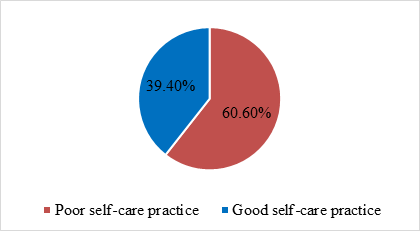
Regarding overall status of self-care practice of the respondents, only 84 (39.4%) diabetic patients had a good level of self-care practices and from the total of respondents,
129 (60.6%) had poor levels of self-care activities (Figure 1).
Factors Associated with Self-Care Practice among Adults with Diabetes Patient
As presented in Table 3, seven variables (age, body weight, educational level, place of residence, having diabetes complications, type of DM, and having private glucometer) were used as candidate variables (at P-value <0.25) and entered together into a multivariate logistic regression. A P-value < 0.05 in multivariate analysis was taken as a cut-point value to be statistically significant. Accordingly, bivariate logistic regression analysis revealed, attending primary education [COR=7.971, (95% CI: 1.020-62.264), P=0.048], Secondary education [COR= 18.452, (95%CI: 2.327-146.326), P= 0.006] and college and above education [COR=100.571, (95% CI: 11.547- 875.969), P <0.001] were found more likely to have good self-care practices compared to those who were illiterates respectively. However, being an urban residence[COR=0.431,(95% CI:0.244-0.760), P=0.004], having DM complication [COR= 0.531, (95 %CI: 0.302 – 0.934), P=0.028], Having Type-II DM [COR=0.536,(95% CI:0.306- 0.938), P= 0.029] and absence of private glucometer [COR=0. 387, (95% CI:0.200– 10.750), P=0.005] were found less likely to have good self-care practice compared to those who were rural residents and did not develop DM related-complication, with type-I DM and had private glucometers respectively.
After controlling some confounders, the multivariate logistic regression analysis revealed that attending secondary education P =0.01 and college and above P <0.001 were found more likely to have good self-care practice compared to those who have no formal education respectively. However, the odds of participants who did not develop DM complications P=0.013 were found 0.412 times less likely to have good self-care practice compared to those who developed DM complications.
| Variables | Categories | Self-Care Practice Status | 95 % of Confidence Intervals | P -Value | ||
|---|---|---|---|---|---|---|
| Poor | Good | COR | AOR | |||
| Age | 0.974(0.952 -0.997)* 1.000(0.966– 1.036) | 0.985(0.966-1.005) | 0.985(0.948-1.025) | 0.464 | ||
| Body weight | 0 .983 | |||||
| Educational | Illiterates | 22(95.7%) | 1(4.3%) | Ref | Ref | Ref |
| level | Primary | 69(73.4%) | 25(26.6%) | 7.971(1.020 – 62.264)* | 6.461(0.803– 51.958) | 0.079 |
| Secondary | 31(54.4%) | 26(45.6%) | 18.452(2.327- 146.326)* | 16.015(1.925- 133.251)* | 0.01 | |
| College& above | 7(17.9%) | 32(82.1%) | 100.571(11.547- 875.969)** | 89.553(9.732 – 824.021)** | <0.001 | |
| Place of residency | Rural | 58(51.3%) | 55(48.7%) | Ref | Ref | Ref |
| Urban | 71(71.0%) | 29(29.0%) | 0.431(0.244-0.760)* | 0.637(0.302– 1.346) | 0.238 | |
| DM complication | Yes | 42(51.2%) | 40(48.8%) | Ref | Ref | Ref |
| No | 87(66.4%) | 44(33.6%) | 0.531(0.302 – 0.934)* | 0.412(0.204 – 0.832)* | 0.013 | |
| Types of DM | Type-I | 45(51.7%) | 42(48.3%) | Ref | Ref | Ref |
| Type-II | 84(66.7%) | 42(33.3%) | 0.536(0.306- 0.938)* | 0.939(0.318– 2.774) | 0.909 | |
| Having private glucometer | Yes | 20(42.5%) | 27(57.4%) | Ref | Ref | Ref |
| No | 109(65.7%) | 57(34.3%) | 0. 387(0.200– 10.750)* | 0.558(0.230 – 1.356) | 0.198 |
Table 3: Bivariate and multivariate analysis to identify factors associated with self-care practice.
Keys: AOR= Adjusted Odd Ratio, COR= Crude Odd Ratio, DM= Diabetes Mellitus, CI= confidence Intervals, Ref = Reference, *Statistically significant at (p<0.05), **Statistically significant at (p<0.01) Table 3: Bivariate and multivariate analysis to identify factors associated with self-care practice.
Discussion
In recent times, the incidence and prevalence of diabetes mellites is rapidly increasing in Ethiopia [3], which is the second largest population in Africa. Therefore, this study aimed to evaluate the level of self-care practice and its associated factors among adult diabetes patients in zonal diabetes care centers of Ethiopia. Based on the results of the current study, mastery of self-care practice among diabetes patients might be determined by educational level and having diabetes complications. Our study participants showed poor results regarding self-care practice in the control and management of diabetes mellites.
Bearing in mind, the higher prevalence of diabetes mellites and its related complications in Ethiopia [3, 4], it is worrisome that this study found only (39.4%) of diabetes patients had good self–care practice. This seems a significant number of study participants were lack good self-care practice for the prevention and management of diabetes- related complications and this can negatively impact the quality of life of DM patients. The poor self-care practice among diabetes patients found by this study is in line with studies conducted in northern Ethiopia (46.7%) [19], in Western Ethiopia (39.8) [18], Eastern Ethiopia (38.1%) [21], in Zambia (38.7%) [23] and India (32.5%) [15]. This might be due to a lack of adequate information and the misconception that diabetes mellitus is only managed at a healthcare institution. However, the finding of our study was significantly lower than studies conducted in Thailand (76.8%) [24] and Vietnam [25]. The discrepancy might be due to differences in cultural and socio-economic aspects. Because low economic status and poor resources could undermine self-care activities among people living in low- income countries [26]. Another discrepancy could be due to a low level of knowledge about health literacy. It is undeniable that the majority of our study participants were rural residents (53.1%) and the majority of them have attended only primary educational level (44.1%). Thus, it is expected that their knowledge level regarding self-care practice in the reduction of diabetes complications was inadequate in all aspects.
Furthermore, the finding of this study indicates that (59.2%) of study participants had Type-II DM. Additionally, our study indicates that only a few respondents (22.1%) had access to a private glucometer that might have low practice of self-monitoring blood glucose levels. The patients’ access to private glucometer does not only promote diabetes self- management but provides them with the knowledge and ability to effectively adhere to treatment [8]. The majority of the uncomplicated management of diabetes mellites is carried out by patients themselves. So, the availability of a private glucometer at home is one of the best strategies for reducing the incidence and progression of DM complications [23].
It has been revealed from this study that participants who didn’t develop a complication were found 0.412 times less likely to have good self-care practice compared to those who developed DM complications. This finding is in agreement with the study conducted in eastern Ethiopia [21]. This signifies that patients who develop diabetes complications probably had a better knowledge of self-care practice in fact, it has been described that most patients come to health institutions after developing complications [5]. However, patients’ awareness of preventive practice is vital to help them cope with the burdens of diabetes-related complications [27].
In line with previous studies [15, 16, 18, 21], this study found a statistically significant association between educational level and self-care practice. It has been revealed from this study that patients with higher levels of education were more likely to perform a self-care practice when compared to those who were illiterate. Having low educational background was frequently reported as one of the basic causes of poor self-care practice among DM patients [9, 15, 21]. In another hand, a high level of health is reported among well-educated and experienced people than among less educated people [16, 21]. Therefore, educated people reflect a low level of disease-related morbidity and mortality. Inversely, low educational attainment is associated with poor health and shorter life expectancy [9]. Since diabetes self-management education is generally considered an integral part of diabetes care [28], providing updated information and awareness for all diabetic patients is vital for the prevention of diabetes-related complications. Unlike the findings of a cross-sectional study conducted in the West Shoa Zone, Oromia region of Ethiopia [18], this study found no statistically significant association between social support and self-care practice. This could be due to variations in the study population, sample size, study area, and measurement tools used in the study. Additionally, this study also found no statistically significant association between age and self-care practice. This is also contrasting with the study finding from Ghana [9], and Cameroon [14], whereby patients’ age has been significantly associated with good self-care practice in diabetes self-management. We, therefore, argue that during the study period, the senior study participants might have had a poor perception regarding diabetes self-care practice for the treatment and prevention of diabetes mellites. But it is undeniable that the prevalence of diabetes mellitus rises with increasing age [8]. Indeed, senior peoples are more expected to have a good experience in the control and management of chronic disease than younger people.
Strengths and Limitations
Despite the strengths of the study such as determining the prevalence and conducting the study in a rural area, our study had also some limitations: First, the use of self-reported methods to evaluate patient’s self-care practice could have resulted in overestimation or underestimation of the level of self-care practice, which is difficult to avoid response biases due to misunderstanding of the questionnaire items, or what they perceived to be socially desirable.
Conclusion and Recommendations
The study concluded that a significant number of the study participants have poor self-care practice in preventing and controlling diabetes mellitus. This finding is bothersome in the increase in prevalence and incidence of DM in the country (Ethiopia). Further educational level and the development of diabetes complications were found statistically significantly associated with good levels of self- care practice implemented by study participants. Therefore, there should be an intervention that mediates the factors affecting participants’ self-care behaviours regarding the prevention and control of diabetes mellites. Moreover, all frontline health care providers (nurses, and diabetes educators) should routinely assess self-care behaviour and provide basic information regarding diabetes self- care activities. Additionally, the researcher should conduct observational and mixed studies, since there is a series shortage of literature on this area in Ethiopia.
Declarations
Ethical Approval and Consent to Participation
Before the start of the study, ethical clearance was obtained from the Institutional Research Ethical Review
Board (IRERB) of the College of health science, Addis Ababa University, (with protocol number: 037/20/SNM, meeting number: 09/2012E.C), in accordance with the declaration of Helsinki. After ethical clearance was obtained, a letter of support was written from Addis Ababa University, School of Nursing and Midwifery to Tercha Referral Hospital. Then, permission was obtained from the diabetic care- center of Tercha Referral Hospital. Study participants were asked for their willingness to participate in the study. All the reasons why the participants were selected and why the research was being conducted were explained verbally to the study participants. The participants were fully explained that they have the right not to participate, to discontinue at any time in between, or have a right not to answer any questions they were not willing to answer. Both verbal and written informed consent was obtained from the study participants. For participants who cannot read and write, verbal consent was obtained from their parents and legal guardians in accordance with the FDRE National Research Ethics Review Guideline. This procedure was discussed with Tercha Hospital administrators and approved by the Institutional Research Board of Addis Ababa University, College of Health Science. Participants were assured of confidentiality and anonymity of their responses. Identification number and codes were used in the survey questionnaires. The collected data were stored and kept on a password-protected computer. Only the principal investigator had access to the computerized data.
Acknowledgments
The authors would like to acknowledge data collectors, supervisors, and the study participants for their valuable contribution to the study. We would also like to extend our gratitude to the medical directors and managers of Tercha Referral Hospital for their unreserved support.
Authors’ Contribution: BAA, ZAM, and BDT: Conceived a data, designed the study, performed analysis, interpreted a data, drafted and finally approved the manuscript for publication. GM, GNB, TG, YLL, AA, MGF, and BB have assisted in designing the study, conceptualization, analysing and interpreting a data, and involved in review process of the finial manuscript.
References
-
(2019) IDF Diabetes Atlas. In: 9th (Edn.), International Diabetes Federation.
-
Aklilu T, Hiko D, Mohammed MA, Dekema NH (2014) Diabetic Patients’ Knowledge of Their Disease, Therapeutic Goals, and Self-management: Association with Goal Attainment at Dessie Referral Hospital, Ethiopia. Ther Innov Regul Sci 48(5): 583-591.
-
Utura T, Fikrie A (2022) Prevalence and associated factors of diabetes mellitus among Governmental Civil Servants at Guji Zone, Oromia Region, Ethiopia, 2021. A community-based cross-sectional study. PLoS One 17(4): e0267231.
-
Negash W, Assefa T, Sahiledengle B, Tahir A, Regassa Z, et al. (2022) Prevalences of diabetic foot ulcer and foot self-care practice, and associated factors in adult patients with diabetes in south-east Ethiopia. J Int Med Res 50(10): 3000605221129028.
-
Stephani V, Opoku D, Beran D (2018) Self-management of diabetes in Sub-Saharan Africa: a systematic review. BMC Public Health 18(1): 1148.
-
Tinoco RS, Xochitiotzi TC, Saldana VT, Garcia EL, Alvarado JS, et al. (2020) Role of social and other determinants of health in the effect of a multicomponent integrated care strategy on type 2 diabetes mellitus. Int J Equity Health 19(1): 75.
-
Souza MS, Karkada SN, Parahoo K, Venkatesaperumal R, Achora S, et al. (2017) Self-efficacy and self-care behaviours among adults with type 2 diabetes. Appl Nurs Res 36: 25-32.
-
LeRoith D, Biessels GJ, Braithwaite SS, Casanueva FF, Draznin B, et al. (2019) Treatment of Diabetes in Older Adults: An Endocrine Society* Clinical Practice Guideline. J Clin Endocrinol Metab 104(5): 1520-1574.
-
Afaya RA, Bam V, Azongo TB, Afaya A, Amponsah A, et al. (2020) Medication adherence and self-care behaviours among patients with type 2 diabetes mellitus in Ghana. PLoS One 15(8): e0237710.
-
Gebeyehu AF, Berhane F, Yimer RM (2022) Dietary knowledge and practice and its associated factors among type 2 diabetes patients on follow-up at public hospitals of Dire Dawa, Eastern Ethiopia. SAGE Open Med 10: 20503121221107478.
-
Osuji NA, Ojo OS, Malomo SO, Ige AM, Egunjobi AO, et al. (2019) Glycaemic Control and Practice of Self-Care Behaviors among People with Type 2 Diabetes in Nigeria. PLAID 5(1).
-
Ketema DB, Leshargie CT, Kibret GD, Assemie MA, Alamneh AA, et al. (2020) Level of self-care practice among diabetic patients in Ethiopia: a systematic review and meta-analysis. BMC Public Health 20(1): 309.
-
Bekele F, Berhanu D, Sefera B, Babu Y (2022) Diabetic foot self-care practices and its predictors among chronic diabetic mellitus patients of southwestern Ethiopia hospitals: A cross sectional study. International Journal of Africa Nursing Sciences 17: 100489.
-
Aminde LN, Tindong M, Ngwasiri CA, Aminde JA, Njim T, et al. (2019) Adherence to antidiabetic medication and factors associated with non-adherence among patients with type-2 diabetes mellitus in two regional hospitals in Cameroon. BMC Endocr Disord 19(1): 35.
-
Burman J, Bhattacharya A, Chattopdhyay A, Dey I, Sembiah S, et al. (2021) Self-care practice and its predictors amongst Type-2 Diabetes Mellitus patients in the outpatient department of a tertiary hospital of Kolkata, Eastern India - A cross-sectional study. J Family Med Prim Care 10(3): 1377-1382.
-
Karthik RC, Radhakrishnan A, Vikram A, Arumugam B, Jagadeesh S (2020) Self-care practices among type II diabetics in rural area of Kancheepuram district, Tamil Nadu. J Family Med Prim Care 9(6): 2912-2918.
-
Emire MS, Zewudie BT, Tarekegn TT, GebreEyesus FA, Amlak BT, et al. (2022) Self-care practice and its associated factors among diabetic patients attending public hospitals in Gurage zone southwest, Ethiopia. PLoS One 17(9): e0271680.
-
Gurmu Y, Gela D, Aga F (2018) Factors associated with self-care practice among adult diabetes patients in West Shoa Zone, Oromia Regional State, Ethiopia. BMC Health Serv Res 18(1): 732.
-
Takele GM, Weharei MA, Kidanu HT, Gebrekidan KG, Gebregiorgis BG (2021) Diabetes self-care practice and associated factors among type 2 diabetic patients in public hospitals of Tigray regional state, Ethiopia: A multicenter study. PLoS One 16(4): e0250462.
-
Mekonen EG, Gebeyehu Demssie T (2022) Preventive foot self-care practice and associated factors among diabetic patients attending the university of Gondar comprehensive specialized referral hospital, Northwest Ethiopia, 2021. BMC Endocr Disord 22(1): 124.
-
Ayele BH, Mengesha MM, Tesfa T (2019) Predictors of self-care activities of outpatient diabetic residents in Harar and Dire Dawa: A hospital-based cross-sectional study. SAGE Open Med 7: 2050312119865646.
-
(2010) WHO. Process of Translation and Adaptation of Instruments, Switzerland.
-
Musenge EM, Michelo C, Mudenda B, Manankov A (2016) Glycaemic Control and Associated Self-Management Behaviours in Diabetic Outpatients: A Hospital Based Observation Study in Lusaka, Zambia. J Diabetes Res 2016: 7934654.
-
Wongrith P, Thirarattanasunthon P, Thirarattanasunthon KS, Kaewsawat S (2021) Glycemic control outcome in patients with type 2 diabetes mellitus: chronic care management support of family care team in Thailand. J Diabetes Metab Disord 20(2): 1269-1279.
-
Nguyen VB, Thi KHP, Nguyen TX, Pham NTL, Nguyen VVH, et al. (2022) Diabetes self-management and its associated factors among patients with diabetes in central Vietnam: A cross-sectional study. PLoS One 17(7): e0270901.
-
Weaver RR, Lemonde M, Payman N, Goodman WM (2014) Health capabilities and diabetes self-management: the impact of economic, social, and cultural resources. Social Science and Medicine 102: 58-68.
-
Ivers NM, Jiang M, Alloo J, Singer A, Ngui D, et al. (2019) Diabetes Canada 2018 clinical practice guidelines: Key messages for family physicians caring for patients living with type 2 diabetes. Can Fam Physician 65(1): 14-24.
-
Saha S, Riemenschneider H, Muller G, Zamir DL, Schwarz PEH, et al. (2017) Comparative analysis of diabetes self- management education programs in the European Union Member States. Prim Care Diabetes 11(6): 529-537.
- Superposition of Cryo-EM and AlphaFold Predictions of Dengue Antigen-Antibody Complexes
- Jugular-Applied Coherent Low-Level Laser Therapy Enhances Systemic Mitochondrial Metabolic Function and Antioxidant Response
- Role of OMC32 Polypeptide in Acrosin-Mediated Exocytosis during the Bovine Sperm Acrosome Reaction
- Association of Galectin-3 but not Laminin in Tamoxifen-Induced Growth Suppression in Breast Cancer MCF-7 Cells
- Effect of Different Wavelengths of Light on the Rate of Photosynthesis
- Nutritional, Therapeutic, and Environmental Effect of Oyster Mushrooms: An Editorial