
Experimental Optimization of Formulation of Non-Dairy Probiotic Drink in Context to Preclusion of Health Impairments
The aim of this study was to experimentally optimize formulation of non-dairy probiotics in context to specific preclusion of health impairments in individuals who cannot consume dairy products because of lactose intolerance or certain other health issues. While looking for alternative carrier for probiotics, the aptness of carrot juice and beetroot juice for the production of probiotic food with L. acidophillus, L. casei and Bifidum longum was explored. Proximate composition of probiotic juice revealed increase in level of protein content and reduction in level of carbohydrates as compared to that in the fresh carrot and beetroot juice. During the study of growth kinetics, gradual change in pH, acidity, vitamin C and sugar concentration was witnessed and represented the significant growth of probiotics and production of lactic acid by them. The data obtained from this investigation provide new insights into projection of fermented carrot- beetroot juice as an appropriate medium for the growth of probiotics.
Introduction
With the demand and requisite of consuming foods to recover health, there is an augmentation in the state of welfare, hence dropping the risk of diseases [1, 2, 3]. This has emerged as the new frontline in the nutrition sciences and its associated arenas; more stress has been given to the preclusion than medication. This is principally because of the rapid proliferation in the cost of health care, the desire of elderly people to live upgraded quality of life and the stable increase in the life prospect. The contribution of functional foods like probiotics, prebiotics and symbiotic has accepted much consideration and hence can be developed as the key pillars of the health care system [4, 5]. These functional foods concomitant with having the customary nutrients have some surplus advantageous effects such as preventing and/or reducing nutrition-related diseases, improving health status and upholding the state of mental and physical well-being. The probiotic products are generally available in the form of fermented milks and yoghurts. But in the developed countries, it has led an increased demand for the vegetarian probiotic products due to an increase in the consumer vegetarianism. Prospective substances like legumes, cereals, fruits, and vegetables can be utilized in the production of a healthy, non- dairy probiotic beverage, offering a valuable alternative for lactose-intolerant consumers. Probiotics signify the group of functional foods, which are demarcated as live microbial feed, likely to provide an intestinal health benefit to the host [6, 7]. Results have been reported to provide the benefits of probiotic foods for humans by sustaining or improving their intestinal microflora. These micro-organisms reveal various healths promoting effects such as improvement of lactose metabolism, prevention of intestinal tract infections and enhancing immunity, reduction of serum cholesterol level, stimulation of calcium absorption, synthesis of vitamins (vitamin B, nicotinic acid, and folic acid), and improvement of protein digestibility and counteracting the effects of food- borne pathogens.
Certain studies have focused on different aspects, including the selection of probiotic strains, the development of appropriate formulations, and the assessment of their efficiency in clinical trials. A study investigated the formulation of a probiotic drink including Lactobacillus acidophilus and Bifidobacterium lactis strains. The formulation has been successfully optimized to ensure the survival and stability of the probiotic strains during storage. The results revealed that the probiotic drink considerably reduced the incidence of diarrhea compared to a placebo [8]. The probiotic drink has been noticed to reduce the incidence of severity of upper respiratory tract infections and thus to improve markers of immune function in the athletes [9]. Also, participants who consumed the probiotic drink were observed to meaningfully reduce the levels of inflammatory markers compared to those in the control group. Moreover, the probiotic drink was found to improve gut microbiota conformation, with an increase in beneficial bacteria [10]. A different study assessed the prospective of a probiotic drink formulation containing Lactobacillus casei and Bifidobacterium animalis to avert respiratory infections in elderly individuals. The trial included 200 participants who used up the probiotic drink or a placebo for 3 months. The outcomes of the study directed the experimental probiotic drink to efficiently reduce the duration and severity of respiratory infections in the elderly participants. Besides, the probiotic drink was noticed to augment immune function and reduce inflammation [11].
Fruits and vegetables have been proposed as suitable media for cultivation of probiotics since they naturally contain crucial nutrients, high amount of vitamins, mineral and polyphenolic compounds, free from allergens and definitely available with attractive appearance and taste [12, 13]. They are a predominantly good source of antioxidants, potassium, vitamin K1, β- carotene, and fiber, and considered as the weight-loss-friendly food lowering cholesterol levels and improving eye health [14]. Carrot (Daucus carota L.), one of the more commonly used vegetables of human nutrition, was chosen as a vehicle for being rich in β-carotene, ascorbic acid, tocopherol and classified as vitaminized food. Carrots are good source of carbohydrate, calcium, phosphorous, iron, potassium, magnesium, copper, manganese and sulphur, but lack in protein and fat [14]. An augmented intake of carrot may favor the enormous synthesis of vitamin A as it has been reported that 100 g of carrot contains carotenoids 6-15 mg, primarily β-carotene (2-10 mg) [15]. The presence of these carotenoids as well as other antioxidants may shield humans against certain types of cancer and cardiovascular diseases probably improving the immune system, and defending against stroke, high blood pressure, Osteoporosis, cataracts, arthritis, heart disease, bronchial asthma and urinary tract infections [15]. Furthermore, the allergenic effect of carrot is very low or lacking and fermentation makes it more appropriate by removal of anti-nutritional factors present if any. Therefore, carrot may be used up by human who cannot take dairy products [13]. Also, Beetroot juice is reflected to contain a huge range of essential vitamins and minerals, antioxidants. Antioxidants reduce oxidative stress, related to the development of cancer, inflammatory conditions, and heart disease [16, 17]. Beetroots are a rich source of crucial vitamins and minerals, including folate that is vital for DNA and cell health [18, 19] vitamin B-6 that supports metabolism and red blood cell production; calcium, an indispensible mineral for bone growth and strength; iron that allows red blood cells to carry oxygen; magnesium, a mineral that supports immune, heart, muscle, and nerve health; manganese, contributing to the regulation of metabolism and blood sugar levels; phosphorous, an essential nutrient for teeth, bones, and cell repair; copper that plays a role in making collagen, maintaining bones and blood vessels, and supporting immune function; zinc, promoting wound healing, supports the immune system, and encourages normal growth. Therefore, the present study was undertaken to determine the suitability of carrot and beetroot juices as raw materials for production of probiotic vegetable juice by probiotic lactic acid bacteria.
Materials and Methods
Raw materials (Carrot, Beetroot, lemon, ginger, black pepper, ajowan caraway and cumin seeds) were procured from Regional Food Research & Analysis Centre (RFRAC), Lucknow, UP, India, for juice extraction by using mixer grinder.
HTST Treatment and Pasteurization
The extracted juice samples were filtered and pasteurized in a laboratory scale HTST pasteurizer at 98 °C for 2 minutes following the modified protocol of Deng H, et al. [20]. The pasteurized juice samples were hot-filled into sterilized glass bottles. The samples were stored at 4 °C for subsequent analyses after being cooled. All treatments were performed in triplicate. The three strains of lactic acid bacteria (Lactobacillus acidophilus, Lactobacillus casei and Bifidium longum) were obtained from Microbiology Lab, RFRAC, Lucknow, UP, India. The pasteurized juice was inoculated at 40°C by these cultures at 1% (v/v). Culture strains were first analysed for bile and acid tolerance according to protocol described by Hassanzadazar et al. [21]. Fresh carrot and juice and probiotic carrot and beetroot juice were analysed for moisture, ash, pH, titrable acidity, carbohydrate, energy value and protein content by AOAC [13].
Preparation of Inoculums
Inoculums were prepared by transferring a glycerol stock culture tube of Lactobacillus acidophilus, Lactobacillus casei and Bifidium longumto a 250 ml flask containing 100 ml MRS broth. The incubator was used for cultivation of cells at 37°C until the cell density corresponding to 9.00 Log CFU/mL with respect to OD 0.600 recorded spectrophotometrically at 590 nm. Using the scale developed by MacFarland according to protocol described by Rafiq S, et al. [13].
Optimization of Probiotic Carrot and Beetroot Juice Production
The optimum fermentation conditions were determined using central composite rotated experimental design (CCRD), where the initial pH and temperature were altered from 4 to 7 and 10-45°C, respectively. The experimental domain was selected since the Lactobacillus can grow in such pH and temperature conditions. HCl (0.1 N) was added to Erlenmeyer’s flasks containing 100 ml of clarified carrot and beetroot juice to attain the initial pH values of experimental design. The HCl treated clarified carrot juice was inoculated with pre- determined concentration suggested for probiotic foods [22]. Fermentations were carried out statically in an incubator set for 72 hrs at diverse temperatures of experimental design. Response surface methodology (RSM) was applied to the response variables (biomass and cell viability) followed by process optimization through an experimental design altering initial pH and fermentation temperature.
Growth and Productivity of Probiotic Strains
Using the optimized factor values (i.e., temp 37°C and initial pH 6.5), culture were grown in pasteurized carrot and beetroot juice (400:300 mL in 1 L Erlenmeyer flasks) by inoculating with the probiotic strains (10%, v/v) at 37°C for 72 hours. Samples for assessing the growth and viable cells count [23] were taken at the interval of every two hours. Growth was estimated by utilization of sugar content, change in pH and titratable acidity. Change in pH was examined every 2 hrs. Titratable acidity was assessed by doing titration against 0.1 N NaOH. Change in sugar content was estimated by DNS (dinitrosalicylic acid) method by reading absorbance at 540 nm [24].
Sensory Quality Evaluation
The different treatments of carrot and beetroot juices were inoculated with Lactobacillus and fermented at 370C for 72 hours in an incubator. The sensory evaluation was steered by the panel of trained judges and the score were given as per the Hedonic Rating Test Scale. Sensory evaluation of the probiotic drink was done by a conducted by a trained group during all the shelf life analysis. The sensory panel consisted of 20 experienced panellists (10 females and 10 males) aged at 24-37 years, and accomplished sensory quality evaluation on the bases of its appearance, aroma, consistency, taste, mouthfeel and overall acceptance.
Statistical Analysis
The result for physico-chemical, microbiological and sensory characteristics of carrot and beetroot probiotic drinks were examined with the aid of Graph Pad Prism (La Jolla, CA, USA) (version 5.01) software. Two-way ANOVA was piloted for statistical significance for mean differences. The significance level was set at 5 % (P<0.05) for all calculations.
Results and Discussion
The three species of lactic acid bacteria (Lactobacillus acidophilus, Lactobacillus casei and Bifidium longum) were found to be capable of growing well on pasteurized carrot and beetroot juice without any specific nutrient requirement.
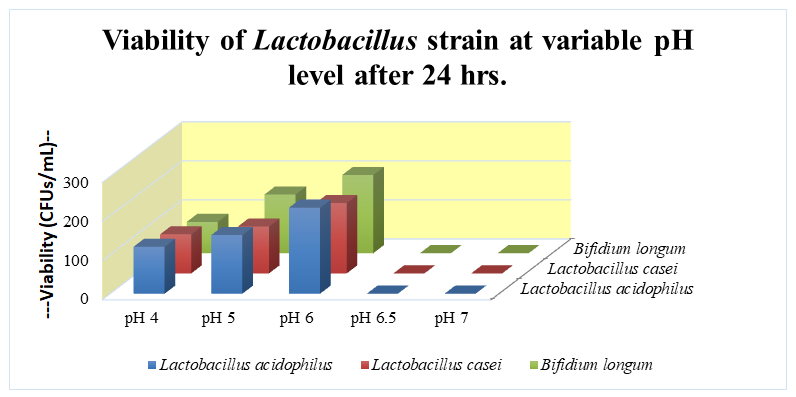
Viability of three strains on different pH level was observed (Figure 1) and it was concluded that at pH 6.5, microbial count was more than 300 CFUs/mL for all three strains. So, pH 6.5 was selected for further product development at 37 0C.
Proximate Analysis of Fresh and Probiotic Juice
As shown in Table 1, additions of probiotic in carrot and beetroot juices result in insignificant reduction in proximate composition of carrot and beetroot juices. Fresh blended carrot and beetroot juice and probiotic drink were evaluated for proximate composition (Table 1) and antioxidant activity. There was significant augmentation in protein % value in probiotic drink of as compared to that in fresh juice, probably might be due to presence of probiotic microorganisms and their metabolites [17, 25, 26]. Acidity of probiotic sample was observed to increase significantly (Table 1).
| pH | Acidity (%) | Sugar (%) | Protein (%) | Antioxidant activity (%) | Flavonoid content (%) | Total Phenol(%) | |
|---|---|---|---|---|---|---|---|
| Fresh | 6.50±0.031 | 0.46±0.021 | 9.95±0.007 | 3.75±0.009 | 78.80±0.051 | 24.12±0.021 | 3.85±0.011 |
| Probiotic | 4.70±0.031 | 0.77±0.011 | 8.25±0.007 | 4.78±0.008 | 82.80±0.051 | 28.30±0.041 | 4.25±0.011 |
Table 1: Nutritional composition of fresh and probiotic drink. All values are Mean ± SD of three sets of experiments with triplic
There was also increase in antioxidant activity, total phenols and flavonoid content. The increase in total antioxidants occurred due to fermentation leading to increase in phenolic and flavonoids compounds due to microbial hydrolysis reaction [27, 28]. Fermentation also results in structural disintegration of cell walls leading to either liberation or synthesis of different antioxidant compounds. As antioxidants possess free radical scavenging capacity and health promoting benefits, so the probiotic drink is highly valuable. Recently, almost similar results have been reported [29] providing authenticity of data obtained from the present study. The ash content in probiotic carrot juice was higher than that in fresh one (Data not shown).The energy content determined was highest in fresh carrot juice than the probiotic juice, probably due to the higher content of fat in fresh carrot and beetroot juice [23].
Further, a study conducted on the evaluation of probiotics in vegetable juices [30]: tomato (Solanum lycopersicum), carrot (Daucus carota sub spp. sativus) and beetroot juice (Beta vulgaris) reveals similarity to the data obtained from the present study. Probiotics are known to human kind since ages as they are important component in fermented milk products; however the use of probiotics in non-dairy product is a novel method for the delivery of probiotics. Delivery of probiotics through non-dairy products will be beneficial for consumers who are lactose intolerant who are deprived of benefits of probiotics by dairy products. This studies aim at developing novel vegetable juices containing probiotic bacteria. Three different strains of bacteria have been used, i.e. Lactobacillus plantarum, Lactobacillus acidophilus, Lactobacillus delbrueckii in carrot, beetroot and tomato juice. The vegetable used for juices (carrot, beetroot, tomato) consist of high amount of antioxidants like carotenoids in carrot, betaxanthins and betacyanins in beetroot, lycopene in tomato. The three bacterial strains Lactobacillus plantarum, Lactobacillus acidophilus and Lactobacillus delbrueckii used in three types of juices including tomato juice, carrot juice and beetroot juice showed good growth except Lactobacillus acidophilus due to reasons like insufficient nutrients. The amount of sugars and acids of the three juices indicated that the fermentation process takes place at a good and satisfying rate. The present study taken together with the data obtained from Goderska, et al. [30] reflects that the resultant probiotic product(s) will be specifically useful for the people who are lactose intolerant and who cannot intake probiotics through milk and milk products. Vegetable juices also have almost zero fat content and high in fiber so the people who are on a fat free diet can consume this product.
Sensory Analysis
The probiotic drink was rather highly accepted as compared to the fresh one, although the benefit of probiotic cultures in beetroot juice has been reported with value addition in terms of health aspects [23]. The highest mean appearance, aroma, consistency, taste, mouth feel was observed in fresh beetroot juice than the probiotic one (Table 2). Taken together previous study Giri SS, et al. [31] and data obtained from the present study it is depicted that microbial fermentation may be used as suitable technology in formulation of health promoting foods.
| Treatments | Appearance | Aroma | Consistency | Taste | Mouth feel | Overall acceptability |
|---|---|---|---|---|---|---|
| Fresh | 7.01±0.341 | 7.50±0.281 | 7.51±0.361 | 7.51±0.421 | 7.01±0.391 | 7.51±0.421 |
| Probiotic | 7.51±0.311 | 8.01±0.341 | 8.01±0.321 | 8.01±0.421 | 7.51±0.321 | 8.01±0.441 |
Table 2: Sensory analysis of fresh and probiotic juice. All values are Mean ± SD of three sets of experiments with triplicates in
Conclusion and Future Perspective
Mixed culture of Lactobacillus acidophilus, Lactobacillus casei and Bifidium longum carried out fermentation and meaningfully survived in carrot-beetroot juice at optimal experimental conditions. Strains were examined to possess good sustainability in beetroot juice without any definite nutrient supplementation. There was non-significant augmentation in proximate composition of fresh carrot- beetroot and carrot-beetroot juice with formulation of probiotic drink. Probiotic drink was noticed to be rich in antioxidants, total phenols as well as flavonoids content. Vegetable juices also have almost zero fat content and high in fiber so the people who are on a fat free diet can consume this product. Also, the study depicted that resultant probiotic product(s) may be specifically useful for the people who is lactose intolerant and who cannot intake probiotics through milk and milk products due to gastro-allergic reactions [23, 31]. Data obtained from present study provide new insights into projection of fermented carrot-beetroot juice as a proper medium for the growth of probiotics. Though lot of further research along these notions and objectives may be conducted regarding sensory improvement, storage stability as well as commercialization of probiotic drinks.
Acknowledgement
This article could be possible as a consequence of inter- institutional collaboration. Authors are grateful to Mr. Pawan Singh Chauhan, Chairman, SR Institute of Management & Technology, Bakshi Ka Talab, Lucknow- 226201, U.P., India for his generous support and throughout inspiration for accomplishment of this study. Besides, authors are thankful to members of Board of Directors, SR Institute of Management & Technology, Bakshi Ka Talab, Lucknow- 226201, U.P., India for providing necessary facilities and time-to-time encouragement for exploring the R&D in the area of Biotechnology.
Competing Interests
Authors have declared that no competing interests exist.
References
-
Nasari H, Baradaran A, Shirzad H, Kopaei MR (2014) New concepts in nutraceuticals as alternative for pharmaceuticals. International Journal of Preventive Medicine 5(12): 1487-1499.
-
Morenga LA, Howatson AJ, Jones RM, Mann J (2014) Dietary sugars and cardiometabolic risk: Systematic review and meta-analyses of randomized controlled trials of the effects on blood pressure and lipids. American Journal of Clinical Nutrition 100(1): 65-79.
-
Hooper L, Abdelhamid A, Bunn D, Brown T, Summerbell CD, et al. (2015) Effects of total fat intake on body weight. Cochrane Database of Systematic Reviews 8: CD011834.
-
Pandey KR, Naik SR, Vakil B (2015) Probiotics, prebiotics and Synbiotics- a review. Journal of Food Science and Technology 52(12): 7577-7587.
-
Federik M (2019) Use of probiotic, prebiotic and symbiotic in infant formulas. Journal of Nutrition & Human Healt 3(1): 12-18.
-
Kechagia M, Basoulis D, Konstantopoulou S, Dimitriadi D, Gyftopoulou K, et al. (2013) Health benefits of probiotics: A review. ISRN Nutrition 481651.
-
Roudsari LP, Pirhadi M, Karami H, Oranj BT, Aghaee EM, et al. (2019) Probiotics and food safety: An evidence- based review. Journal of Food Safety and Hygiene 5(1): 1-9.
-
Santander VEV, Figueroa RHH, Munguia MTJ, Lopez EM, Malo AL (2023) Health benefits of consuming foods with bacterial probiotics, postbiotics and their metabolites: A review. Molecules 28(3): 1230-1257.
-
Araujo MM, Sousa TM, Teixeira PDC, Figueiredo ACMG, Botelho PB (2023) The effect of probiotics on postsurgical complications in patients with colorectal cancer: A systematic review and meta-analysis. Nutrition Reviews 81(5): 493-510.
-
Wang G, Chen Y, Xia Y, Song X, Ai L (2022) Characteristics of probiotic preparations and their applications. Foods 11(16): 2472.
-
Roy S, Dhaneshwar S (2023) Role of prebiotics, probiotics, and Synbiotics in management of inflammatory bowel disease: Current perspectives. World J Gastroenterol 29(14): 2078-2100.
-
Mishra S, Nanda S, Madaan N, Mudgal V (2010) Microbial population succession in alcoholic beverages produced from some tropical fruits. Open Nutraceuticals Journal 3(1): 184-187.
-
Rafiq S, Sharma V, Nazir A, Rashid R, Sofi SA, et al. (2016) Development of probiotic carrot juice. Journal of Nutrition and Food Sciences 6(4): 534-538.
-
Clifford T, Howatson G, West DJ, Stevenson EJ (2015) The potential benefits of red beetroot supplementation in health and disease. Nutrients 7(4): 2801-2822.
-
Singh P, Kulshrestha K, Kumar S (2013) Effect of storage on β-carotene content and microbial quality of dehydrated carrot products. Food Bioscience 2: 39-45.
-
Mishra S, Tiwari AKM, Mahdi AA (2017) Physiological, biochemical and molecular role of oxidative stress in cardiovascular disease: A comprehensive study. Current Research in Cardiovascular Pharmacology 6: 1-16.
-
Mishra S (2018) Nutrient and nutraceuticals versus modulation of genetic expressions in cardiovascular disease: Editorial. Clinical Biotechnology and Microbiology 2(3): 374-376.
-
Mishra S, Singh RB, Dwivedi SP, De Meester F, Rybar R, et al. (2009) Effects of nutraceuticals on genetic expressions. Open Nutraceuticals Journal 2(1): 70-80.
-
Sharma V, Kalim S, Srivastava MK, Nanda S, Mishra S (2009) Oxidative stress and coxsackievirus infections act as mediators of beta cell damage: A review. Scientific Research and Essays 4(2): 42-58.
-
Deng H, Zao PH, Yang TG, Meng YH (2022) A comparative study of the cloudy apple juice sterilized by high- temperature short-time or high hydrostatic pressure processing: shelf-life, phytochemical and microbial view. Food Science and Technology 42: e63620.
-
Hassanzadazar H, Ehsani A, Mardani K, Hesari J (2012) Investigation of antibacterial, acid and bile tolerance properties of lactobacilli isolated from Koozeh cheese. Vet Res Forum 3(3): 181-185.
-
Nguyen DQ, Kun S, Bujna E, Havas P, Hoschke A, et al. (2016) Power of bifidobacteria in food applications for health promotion. In: Gupta VK, (Eds.), the Handbook of Microbial Bioresources. 15th (Chapter), CABI, Hungary, pp: 228-258.
-
Panghal A, Virkar K, Kumar V, Dhull SB, Gat Y, et al. (2017) Development of probiotic beetroot drink. Curr Res Nutr Food Sci 5(3): 257-262.
-
Jain A, Jain R, Jain S (2020) Quantitative analysis of reducing sugars by 3, 5-dinitrosalicylic acid (DNSA method). In Springer Protocols Handbooks. Humana Press, pp: 181-183.
-
Fenster K, Freeburg B, Hollard C, Wong C, Ronhave LRR, et al. (2019) The production and delivery of probiotics: A review of a practical approach. Microorganisms 7(3): 83-99.
-
Ghelardi E, Mazzantini D, Celandroni F, Calvigioni M, Panattoni A, et al. (2023) Analysis of the microbial content of probiotic products commercialized worldwide and survivability in conditions mimicking the human gut environment. Front Microbiol 14:1127321.
-
Verni M, Verardo V, Rizzello CG (2019) How fermentation affects the antioxidant properties of cereals and legumes. Foods 8(9): 362-382.
-
Djaoudene O, Mansinhos I, Goncalves S, Jara PMJ, Mostapha BM, et al. (2021) Phenolic profile, antioxidant activity and enzyme inhibitory capacities of fruit and seed extracts from different Algerian cultivars of date (Phoenix dactylifera L.) were affected by in vitro simulated gastrointestinal digestion. South African Journal of Botany 137: 133-148.
-
Yang SJ, Kim KT, Kim TY, Paik HD (2020) Probiotic properties and antioxidant activities of Pediococcus pentosaceus SC28 and Levilactobacillus brevis KU15151 in fermented black Jamun. Foods 9(9): 1154-1165.
-
Goderska K, Dombhare K, Radziejewska KE (2022) Evaluation of probiotics in vegetable juices: tomato (Solanum lycopersicum), carrot (Daucus carota subsp. sativus) and beetroot juice (Beta vulgaris). Arch Microbiol 204(6): 300-304.
-
Giri SS, Sen SS, Saha S, Sukumaran V, Park SC (2018) Use of potential probiotic Lactobacillus plantarum L7, for the preparation of a rice-based fermented beverage. Front Microbiol 9: 473-476.
- Superposition of Cryo-EM and AlphaFold Predictions of Dengue Antigen-Antibody Complexes
- Jugular-Applied Coherent Low-Level Laser Therapy Enhances Systemic Mitochondrial Metabolic Function and Antioxidant Response
- Role of OMC32 Polypeptide in Acrosin-Mediated Exocytosis during the Bovine Sperm Acrosome Reaction
- Association of Galectin-3 but not Laminin in Tamoxifen-Induced Growth Suppression in Breast Cancer MCF-7 Cells
- Effect of Different Wavelengths of Light on the Rate of Photosynthesis
- Nutritional, Therapeutic, and Environmental Effect of Oyster Mushrooms: An Editorial