
Concept Mapping, Social Value, and Public Administration: Public Administration in the Mind of the Public it Serves
Public Administration has a considerable history creating marked advancements in public policy, education and governance. Yet despite the fact it has such a history, a professional membership organization, bachelor’s and master’s degrees, and a literature to draw on, the field and its discipline are not known as well as all of these important professional and academic elements would suggest nor is the social value they create fully appreciated . Attracting students and practitioners to the field and to its degrees is made more difficult by such a lack of recognition in the public at large. Changing the perceptions of the public about the field and the discipline of Public Administration will remain a challenge until a better understanding of how distant Public Administration and its social value are from public perception individually and collectively. The approach taken here to address the issue is applying communication science and concept mapping with the added feature of distance magnitude estimation (DME). The combination of communication science and DME concept mapping can show the way in creating useful, positive messages with appropriate cognitive load for and about Public Administration. Sample messages and distribution channel suggestions also are provided.
Introduction
The United States is based on and operates societally and governmentally as a social contract. Social philosophers such as John Rawls, Emmanuel Kant, John Locke, and Jean-Jacques Rousseau, thought such a contract would create what they called justice [1]. In the 21st Century, social value remains associated with the social contract and its operation. Governance is the operation of the social contract and Public Administration is the method of operation. Yet, despite these well- established philosophical and governmental foundations, Public Administration has limited resonance with many, if not most citizens. Its social value has not been well communicated despite a worthy history and important contributions to higher education plus public policy. There is a method available to reestablish Public Administration in the minds of citizens. The method is based on communication science. Messages to establish Public Administration’s social value can be crafted and distributed to the public to reawaken what Public Administration contributes to the social contract, its history, and its education contributions.
Public Administration and the Progressive Movement
The Progressive Movement can be considered one of the touchstones of origin for Public Administration. The movement began, in large measure, to overcome corruption which had beset the late 19th century version of the U.S. social contract and to create justice as a major social value for the nation. Durant and Ali write [2], drawing on Adams [3], “the history of public administrative reform movements in America, as well as the public administrative theory associated with them” represent a significant practical and intellectual beginning of Public Administration. Indeed, modernism was the intellectual crucible within which the self-consciousstudy and practice of public administration was inspired and ever since dominated” [2]. Despite some contradictory remarks and some departures from Durant and Ali concerning the importance of the Progressive Era, Luton does admit “that the Progressive Era was part of the period of time that was quite significant in framing a self- conscious, professional public administration in the United States” [4]. Luton even states there are Pre Progressive Movement antecedents to American Public Administration. Whether one uses the Progressive Movement as the starting point or Luton’s Pre Progressive Movement elements in the American Constitutional context, the point is Public Administration has a long history in the United States whose main thrust was to improve the way government works and create mutual advantage for all citizens. However one seeks to mark the beginning of Public Administration, the curriculum created to add to the intellectual foundation of Public Administration has roots in the emerging American University concept of the late 19th century; an additional form of social value. Woodrow Wilson is credited with calling for such a curriculum in his 1887 [5] Political Science Review article “The Study of Administration” [6]. Wilson was joined in this effort by other Progressives including Herbert Baxter Adams, James Bryce, Richard Ely, and Albert Shaw [7]. Hoffman “excavates” the intellectual foundation of Public Administration created by these “founders” of the field. They, along with Wilson wished to create a course of study intended to “inculcate’ their students about the “form and function of public administration” to generate greater social value for government. The years between
1884 and 1896 at Johns Hopkins, Hoffman notes, were particularly germane both to the Progressive Era and the study of what was then the emerging field of Public Administration. The intended result of the study of Public Administration was to create an educational base for the field would inform government and governance to make the social contract of the United States create the “general welfare”; in other words social value. Hashem (2007) [8] further explores the professional development of Public Administration beyond its university base. He indicates Public Administration found its practical “footing” at the “street level”, literally, when the New York Municipal League’s Manhattan Street Survey “stimulated” further educational and professional development. Once begun, these street studies numbered 235 by 1925, forming a “literature” on practical Public Administration. Hashem notes the Maxwell School of Syracuse University was founded in 1924. The first Master’s Degree from Maxwell in Public Administration was conferred in 1926.Since these early efforts, Public Administration has matured and even developed a terminal degree [9]. Importantly, Public Administration advanced itself and added to the Progressive Era’s improvements and greater social value with additional “street level” initiatives. Hazzelbigg characterized the work of the 1313 Group as “marked developments in current history of American government [10], He refers to the effort of public officials as “concerted” to improve the administrative process and develop a professional philosophy. The 1313 Group of Chicago was a “who’s who” of professional public administrative practitioners and academics located at 1313 East 60th Street directly across the street from the University of Chicago. Such professionals as those in public works, city management, city planning, chiefs of police, and even legislators were all part of the 1313 Group. Among the important contributors to the 1313 Group was Louis Brownlow, who was Director of the Public Administration Clearing House. Mr. Brownlow would go on to be a significant influence in the Franklin Roosevelt White House by offering up the framework for the Executive Office of the President and, later, the Reorganization Act of 1939 [11]). Mr. Brownlow was also a founder of the American Society for Public Administration [12]. Brownlow was in large measure responsible for the Federal Housing Act and FHA financed mortgages [12]. Brownlow served as ASPA President from 1941 to 1944 [12]. At this point in its development Public Administration became a profession and, as with all professions, Public Administration had developed degrees and an ethos of service to the community at large and, thus, a new element was added to the field’s approach to social value. The tradition of education for Public Administration and public service continues today with the Network of Schools of Public Affairs/Administration. The member schools carry on the tradition of improving public service through education as the early contributors to the profession and its curriculum did. The curriculum of Public Administration has also been integrated with competency based education in Health Care Administration creating a furthering of the original intent of Public Administration educators plus adding significant social value [13].
Public Perception
Despite the rather long history of Public Administration, its major founding figures, significant work done by some extremely important practitioners, and even cross fertilizing another professional field and its academic preparation, Public Administration remains an enigma to many if not most citizens. Perhaps, a part of the lack of knowledge about Public Administration is associated with antigovernment perceptions among many citizens. Writing in the Public Administration Review in 1990, Cigler described the long decline in public trust in government, concluding, “The problems of today's public service, then, can be understood only within the larger problem of a general decline of trust in government itself” [14]. Joseph Gershtenson and Dennis Plane updated Cigler in the October 2015 issue of Forum reporting that antigovernment sentiment or trust in government has a long history in the United States and continues today [15]. While those feelings are not as bad as many think based on their data analysis, Gershtenson and Plane do point out (1) That such sentiment exists and (2) It is not “boundless”. The second point is significant since it suggests minds can be changed. Whether such sentiment is as bad as some would have it antigovernment sentiment is present in the mind of the public.
Public Administration, Communication Science, and Effective Messages
Relaying messages about important issues and topics related to Public Administration in the face of anti- government sentiment, weak or strong, may be best addressed using communication theory. According to Sanders and Canel, “Politicians and officials seek to position and manage their cities in ways that win legitimacy and trust for themselves and prosperity for their citizens and other stakeholders” [16]. They examined cities in which there is a “gap” between performance of the cities they studied and the communication strategies and policy priorities. The gap includes citizens’ perceptions of the cities’ reputations and those cities actual performance. Their research is an extension of the “street level” Public Administration of an early period. The same “gap” problem would seem to exist for the practice of Public Administration since the cities are a part of it. The Sanders and Canel study ends with recommendations for making information and persuasion about performance and related issues and citizens’ expectations and perceptions [16]. The article title is “Mind Gap: Local Government Communication Strategies and Spanish Citizens Perception of their Cities”. The situation is no different in the United States and circumstances indicate the need for better messages about the value and performance of Public Administration. The mind gap is the central feature of the article and marks a major linkage between the research they did and the research reported below. Both studies are built around communication and the location of the results of communication: the mind of the receiver of the message. While Sanders and Canel were writing for a Public Relations audience, their points are grounded in Communication Theory. Oxley, et al. [17] come at the issue of persuasive messages from a policy perspective and give an account of such messages being first, attitudinal, i.e., in the mind, and second, are based in the perception of the source of the message from an ideological origin, again in the mind. They point out that policy problem recognition is analytic and affective. Thus, any messages intended to inform citizens about the value of government performance, its credibility, and its integrity must consider the facts and perceptions of those who will receive the message. Lee and Lang find that dynamic cognitive load is a key factor in effectiveness of messages [18]. Cognitive load has to do with how much conceptual space is taken up by a message combined with other affective states in the mind of the receiver. Understanding dynamic cognitive load in the message can lead to predictions about message impact. More simply put, cognitive load means how much a person can remember of a message while thinking about other life events and other information about the surrounding environment [18]. The dynamics of a message involve cognitive resources devoted to a message and the complexity of that message. Thus, the cognitive load of a message must have a trajectory to penetrate ideology and perceptions already in place in order for the message to achieve its effect.
Chung and Fink [19] describe their work as researching the “course” of the message trajectory; literally the movement of the message in the mind of the receiver of the message. They report their research points to messages resulting in belief change if they are have appropriate message order properly positioned and have positive content. Such messages, they assert, can change beliefs. Changing beliefs would mean perceptions about such topics as Public Administration, despite anti- government preconceptions, can be navigated in a person’s mind with proper trajectory. Trajectory or movement in conceptual space, i.e., the mind, as communication science would describe it, is addressed below. Borrowing from social marketing and, what Niederdeppe, et al. call “communication science”, there appears to be a way to construct messages for a social value such as Public Administration [20]. They say with a deliberate effort to create effective messages “valuable lessons” from communication science which can “raise awareness” of important social problems such as the disparities in health among the poor across the globe can be crafted. The approach they describe, combined with knowledge cognitive load and message trajectory research, offers an avenue for Public Administration to pursue in raising awareness of its value and its performance since it is a social value of some repute. Among the important lessons running through all of the foregoing communication and messaging research is the importance of the message to an individual or “the self”. Message content must be structured in an order to be on the one hand, positive to the message recipient, and on the other, capable of a trajectory through the cognitive load of the individual while the same message is being sent to many other recipients. The balance among these complex factors is, as might be imagined difficult to achieve. Nonetheless, emerging from communication science is a method which makes a solid start in creating the balance. The approach is concept mapping using distance magnitude estimation.
Concept Mapping
Concept mapping is usually attributed to William Trochim at Cornell University. In his book, Concept Mapping for Planning and Evaluation, along with his co- author, he defines concept mapping as “a generic term that describes any process for representing ideas in pictures or maps” [21]. Trochim list steps for concept mapping which include “brain storming, statement analysis, unstructured statement sorting, multidimensional scaling, and generation of interpretable maps.” Woelfel and Fink, coming at concept mapping from a communication science approach, work along the same lines of research inquiry but add distance magnitude estimation [22]. Hall reports “distance magnitude estimation added to concept mapping” can provide mathematical data on important concepts which Trochim, et al. would call ideas [23]. For Woelfel and Fink, those ideas are represented in distance magnitude estimation (DME) multidimensional map to enhance the understanding of the ideas or concepts in cognitive space. One of those ideas, as the communication science and related literature reviewed above note, is of very primary importance: the message recipient. The depiction of the resulting DME concept map shows the important concepts in relation to the message recipient, known in such a map, as “you” or “self” [24] applied concept mapping to health care marketing directed at the elderly. They call their approach an ‘‘illustrative approach to planning and marketing’’. Their illustrative framework is used to provide suggestions for health care marketing and planning [13]. Trochim, Cabrera, Milstein, Glallagher, and Leischow (2006) [25] use concept mapping to derive eight rules from their concept mapping investigation of 133 respondents as they examine ways to address challenges in and create improvements for public health. In doing so, they are following Freeman and Jessup (2004) [26] whose research indicates the usefulness of concept mapping for ease of use, benefits to the users of the approach and, importantly, for communication [13]. The DME approach seeks to determine the distance (a key notion in any map) between important attributes of the message content’s central ideas. One way Woelfel and Fink applied their communications or messages was to marketing where the ideas become attributes associated with a product, e.g., size, strength, quality, colors. The attributes would emerge in conceptual space once the map is completed. The approach can work with other concepts such as Public Administration. The Trochim braining storming and sorting through unstructured statement data as a step would be what Woelfel and Fink [22] would note as the attribute determining process. Additionally, as Trochim indicated, the DME map is multidimensional. Based on the origins of Public Administration, its practical developments, its education, its policy contributions, and its current work to improve performance, one would judge Public Administration as having a number of important attributes with which to populate a map. Newcombe asserts interacting with the world requires ability to understand magnitude [27]. She provides an illustration of how magnitude is often used to interpret a map. She writes, “perceptual estimation—roughly a quarter away across on a map implies roughly a quarter of the way across on a referent space” [27]. Further, Eadie and Doyle (2002) [28] point out DME provides a measurement advantage since DME measurement avoids the systematic bias attributed to interval scales. The rather ubiquitous interval perceptual scales require units of analysis or respondents attempting to respond to those scales by using a “fixed predefined scale”. The distance perceived between intervals is assumed to be uniform in weight, distance, and magnitude between numerical intervals and, thus, equal [28]. No more information can be generated beyond that provided by the predetermined interval categories. Eadie and Doyle report Stevens (1974) [29] asserts units of analysis do not perceive intervals as equal [28]. As a consequence of needing mathematically sophisticated data to create messages to advance the understanding of Public Administration while balancing all the important messages essentials, the research reported below, used the concept mapping approach combined with DME to create a multidimensional map along with analysis of messages concepts to be applied in the most productive order to create messages which are positive and directed at the mind of the receiver. Cognitive load and message trajectory were also produced. That map is based on the following research methodology.
Research
The concept mapping project began with “brainstorming” for creating open ended questions to inquire among those typical of the population to whom messages about Public Administration were to be directed. The brain storming resulted in 4 questions intended to elicit statements or phrases from those who were questioned. The questions include the following:
- What comes to mind when you hear the term public administration? …Please, tell me more.
- What comes to mind when you hear the term government? …Please, tell me more.
- What do you think about educating people for government work called public administration? …Please, tell me more.
- What do you think people who work for government need to know? …Please, tell me more.
Once these questions were finalized the first phase of the research was underway. One Hundred voting age persons were chosen on a purposive sample basis using a convenience selection procedure. Each interview took approximately 10 minutes and a transcription of answer was created in WORD. The WORD transcription was then submitted to specialized software analysis seeking to find patterns of concepts in all of the answers and across all the answers. The resulting concepts were then placed in a distance magnitude estimation instrument. The concepts which emerged from the analysis of verbal responses were the following: Government, People, Education, Work, State, Officials, Services, and Administration. It is interesting to note at this juncture of the analysis the term Public Administration has been separated and singled out from its two term conceptual base. The most likely explanation for the separation is that in the responses given these two terms were not seen as linked and the software analysis found that pattern. Here, then, were attributes or ideas for DME and a resulting multidimensional map. The concepts or attributes were then placed in a distance magnitude estimation instrument, each term paired with each of the others. Then the terms were placed in comparison to the “yourself” concept. A sample of the paired comparison format is shown in Exhibit 1 below.
Exhibit 1
- Government and Public
- Government and People
- Government and Education
- Government and Work
- Government and State
- Government and Officials
- Government and Services
- Government and Administration
- Government and Yourself The questionnaire with all the pairs was guided by a “base pair” to allow respondents to judge the distances between terms in all the pairs.
The base pair chosen was formed by the concepts of farming and construction. These concepts were chosen since they represented some considerable conceptual difference, thus distance, meaning the terms were dissimilar. Conceptual distance represents similarity or difference in the concepts presented to respondents. Farming and Construction were considered distant enough to warrant the use of the 100 unit difference between them. It is best to approach DME in this way since polar opposites would create the kind of problems encountered using equal appearing intervals and confound the interpretation of the base pair difference and, therefore, differences between the pairs that follow the base pair. The instrument was presented with the following written instructions: Please estimate how different or “far apart” each of the following words or phrases are from each of the others. The more different, or further apart they seem to be, the larger the number you should write. To help you know what size number to write, remember: Farming and Construction are 100 units apart. If two words or phrases are not different at. all, please write zero (0). If you have no idea, just leave the space blank. The reference pair is at the heart of the DME approach. First, the instructions indicate there is a “0” point. Thus establishing a measurement reference point which is critical to any measurement. Second, there is no upper limit. A respondent may use any number between 0 and 100 or beyond once the reference pair is established. Third, a reference point to establish “0” is the beginning step to establishing a ratio scale. In physics, for example, the earth is the reference point to establish the ratio scale of light years. Ratio scales would not encounter the same perceptual difficulty, therefore, as equal appearing interval scales. As had been the case in the open ended portion of the research, before proceeding further with the data gathering, the respondent was informed the Roger Williams University Human Subjects Review Board had approved the project. Respondents were then asked to sign and date an informed consent form. Those who did not wish to sign were thanked for their time and then another respondent was approached. The respondent, in many cases, had not seen such a distance magnitude estimation instrument before. Consequently, some simple additional description of what was being asked for was provided. Once the initial unfamiliarity was overcome, respondents completed the distance estimations for all the pairs. A total of 106 units of analysis or respondents cooperated with the terms of informed consent and completed the DME instrument. Of the 106 respondents were 52% male and 42% were female. The mean age of the sample was 45.01 years. The completed instruments were then coded for analysis to create the concept map and the mathematical analysis which is part of the procedure on DME data. The resulting concept map is appears in Exhibit2below:
Exhibit 2
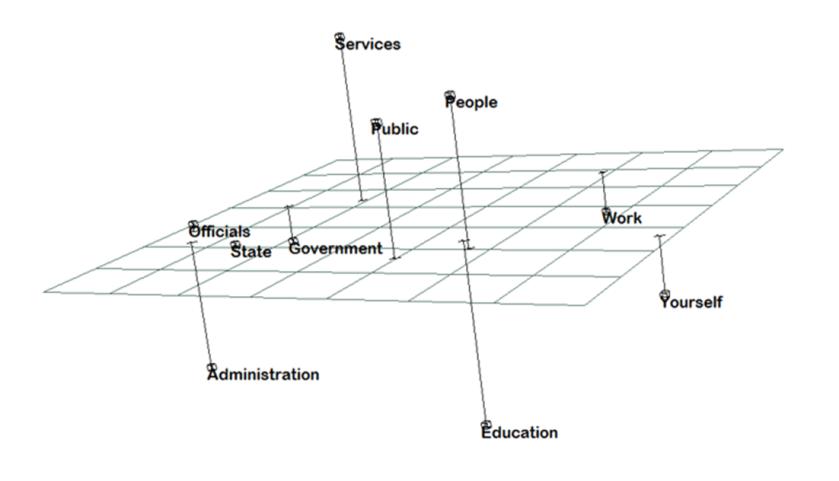
The map is shown in 2 dimensions on the printed page. However, the software analysis allows the map to appear in 3 dimensions and can be rotated for somewhat different perspectives. In mathematical terms, however, the map represents multidimensions, 9 such dimensions to be exact, corresponding the number of concepts in the map. Even if all dimensions were represented, the map would still show the distribution of concepts some considerable distance from “Yourself”. Rotation would not change the distance perspective among and between concepts in the map. The rectangular display of a grid provides the referent space Newcombe discussed. The grid provides a proportional view of how close or distant or different the concepts are. Following Newcombe, viewing map space means appearance of distance translates to perceived distance. Additionally, the spheres representing the location of the concepts are the 95% Confidence Interval meaning the concept shown by the sphere’s location is within that sphere. Thus, the placement of the concepts in the map is based on statistical probability indicating the analysis is trustworthy about the placement on the map of the concept. With concepts this far apart in the collective mind of a community, it will take a major creative and analytic effort to craft positive Public Administration messages demonstrating social value. The concepts forming the best messages are presented in order of valence of message Exhibit 3. As a result of this information, the order needed for appropriate cognitive load and message trajectory are available.
Exhibit 3
- Public, Education, and Work
- People, Education, Work
- Public, People, Education
- Education, Work
- People, Education
- Public, Education, Officials
- Public, Education, Administration
- Public, Education, and State’
- Public, Education, and Services
- Public, People, and Work The map software can also provide numerical data for use in determining how often the concept should appear in the message.
Limited budget did not allow for further analysis on the amount of message content the concepts should comprise. Nonetheless, knowing the most important message concepts and their order provides guidance as to content of messages. The message concept rank order provides the valence of the message or its trajectory value. For example, the three concept list Number 1 moves the concepts to within 26.95 units of the “you” point. List Number 2 moves the concepts within 27.59 units of “you”. Simply, the list of concepts form the message vectors for trajectory across the cognitive space represented by the map. List 1 is the set of concepts for a message with the highest probability of success in getting closer to the “you” location. Moreover, since the DME mathematical analysis for the list does exist in the software, appropriate concept presence in the message or cognitive load can be gauged, thereby strengthening the message’s valence for a stronger trajectory. The dynamic cognitive load is what Lee found to be predictor of the likelihood of success of a message. With appropriate cognitive load, Chung and Fink reported belief change can also occur. Furthermore, communication science points to the need for positive messages in communications which can be aided by the inclusion of “you”. Also of importance, the message trajectory built from the ranked order concept list has a predictable effect on the receiver as shown by the distance predictions in the analysis of movement toward the self. In a DME conceptual space concepts can be moved and the messages formed from the key concepts can be the “vector” which moves the concepts. The vector moving concepts would be equivalent to what Chung and Fink call the trajectory of the message. From the DME perspective the most positive place to be with the greatest message result is near the self-point. Moving Public Administration and government closer to the self would be the vector sought by message creators. It is the appropriate combining of concepts in a message and the “cognitive load” in the message which are the key factors in moving toward the self-point. Thinking of messages as vectors in space or in the case of communication, conceptual space, allows the use of data to add to creativity in message creation and then choose the appropriate communication channel based on the content, cognitive load, and the recipients of the messages. From a communication science perspective assisted by physics, the amount of information about a concept determines it’s mass. The larger the mass the more difficult to move the concept. Consequently, the concept with the greatest mass in the conceptual space is “you”. The other concepts have less mass since less is known about them than anyone’s own person. It is therefore more efficient to form a message vector of the concepts which are not “you” and move them toward the self or “you”.
Sample Messages
For illustration purposes only the messages listed below would be examples of how to use the concept list in Exhibit 3 in preparing Public Administration messages. Public sector workserves the fabric of our communities through education and you. You can help foster well informed people in your community by supporting education about important government services. The message concepts have been underscored to illustrate their appearance in the message. The “you” concept is found in both to illustrate how the self-concept can be used. Brief messages such as these would be best sent in a distribution channel like twitter which many governments and nonprofits use. Another such channel would be the roadside digital displays found on state highways, interstates, and well-traveled thoroughfares. These signs are frequently digital displays reminding drivers of driver licenses renewal, accidents ahead, seat belt reminders, and other messages. A brief message preceding or even following such announcements would be a suitable location for a message such as: 1. Educate yourself and members of the public about safety. Work to Click it or get a Ticket 2. People in your community need to Work for Strong Schools. Travel time to Exit 24 10 Minutes
3. The People form the Public which Government Serves.
Stay in School for a strong community voice 4. Your state values you and the Work you do. Use education. Support your local schools. These message illustrations also demonstrate the idea of limited cognitive load which would be an important factor for messaging to automobile or truck drivers on digital signs along highways. Notable in these 4 examples are the first two which are based on digital signs posted on Interstate 90 East and West and Interstate 87/90 in Massachusetts and New York respectively. Messages need not be this brief to create the appropriate cognitive load, of course. Cognitive load is not dependent exclusively on the length of the message but content. There are long form message channels that can balance dynamic cognitive load with message content. The concepts from DME based concept mapping can be developed into full public relations campaign of positive messages for Public Administration, which Sanders and Canel were interested in. Those messages could be in the form of Facebook postings, emails, opinion/editorials, or press releases. Naturally, knowing the amount of needed concept content would be an enormous aid in crafting all Public Administration messages. Consequently, with a DME based map and concomitant analysis, appropriate cognitive load, positive message can be created without regard to a predetermined length. The concepts can also be used to guide training and degree course content in Public Administration. Presentations in classes, online lessons, and even formal lectures would benefit from the information the DME based concept map provides. Presentations of greater length would allow for use of the entire concept combination list providing reinforcement of the important Public Administration material being presented. Hsu, et al. have found have that concept mapping as an approach to outcome based learning has shown encouraging results that can lead to improved quality among health care professionals they studied [30]. Such results could benefit Public Administration also. Further, education as a concept emerged as part of the analysis of concepts and the map illustrated how distant the education concept was from “self”. Presentations in training and classrooms involving Public Administration practitioners and students would benefit in the way Hsu, et al, have shown managing a larger cognitive load required in Public Administration coursework such as working in the multidisciplinary literature, reading assigned texts, and studying lessons or lecture notes permitted by classroom presentations. Whether the intention is to craft Public Administration messages, public service announcements, or class presentations, the DME concept mapping procedure would also be useful as a “pretest-posttest” approach. A DME questionnaire to begin the approach would be like the one presented above. Delivery of the messages or presentations would follow and at the conclusion of the message delivery period or the course, another map could be generated for comparison to the original map to determine the distance between the important concepts as listed above including the yourself concept on a before and after basis.
Summary and Conclusion
Despite having a significant history and notable accomplishment, the field of Public Administration as an education pursuit or a professional practice application, is not well understood by the general public. The nature of this “perception gap” may be wider than many in education for Public Administration, professional practitioners, or even journalists interested in the work of government have considered. While there has been popular press reportage on the subject or its related application, Public Administration has not been researched fully for the conceptual distance between it and the public mind. While concept mapping is not new or unknown in Public Administration, the amount of movement needed to get Public Administration closer to the people it serves has not been explored. The distance needed to move Public Administration closer to the individual’s or the larger community’s conceptual space is, from a communication theory point of view, an important factor in making positive messages which can enlighten those receiving them. Rather than leave messages about Public Administration to creativity alone. Creativity can be combined with DME concept mapping analysis to create the appropriate cognitive load. There are communication theory components which point the way toward such messages. The literature on messages and Public Administration and related government concepts must be personalized and positive. Rather than leave the message content development to creativity or to those who have created messages through experience, concept mapping augmented by distance magnitude estimation can be added to the tools available to Public Administrators and educators in the field for crafting and sending messages and presentations about Public Administration. Importantly, the value and performance aspects of Public Administration and its full array of work must become more closely associated in the mind of the community/public. A mind gap on the concept clearly exists and DME concept mapping offers vectors to move concepts in the conceptual space of the mind of the receiver of messages. Practitioners and academics can benefit from this kind of effort too. Most importantly, however, is the public can come to know the value it receives from the work of Public Administration. The concept map produced by the present research is an illustration of the method. When combined with mathematical analysis of DME data, not only a map can result but a rank ordering of the important concepts from the map to be used in the messages and/or presentations. The approach used here even lends itself to the test of whether a message produced the positive results it was intended to. Further, the method used here is interdisciplinary and can be applied across not only communication and Public Administration but it can also be added to education and other social sciences to produce messages and course content.
References
-
Matson WI (2000) World Philosophers and their Works. Salem Press 1-4.
-
Durant RF, Susanna BA (2013) Repositioning American Public Administration? Citizen Estrangement, Administrative Reform, and the Disarticulated State. Public Administration Review 73(2): 278-289.
-
Adams GB (1992) Enthralled with Modernity: the Historical Context of Knowledge and Theory Development in Public Administration. Public Administration Review 52(4): 363-373.
-
Larry SL (2002) The Tale that Wagged the Dog: is the Progressive Era the Foundation of American Public Administration? Administrative Theory & Praxis 24(3): 439.
-
Wilson W (1887) The Study of Public Administration. Political Science Quarterly 2(2): 197-222.
-
Stillman RJ II (Ed.) (1992) Public administration: Concepts and cases (5th ed.) pp. 6- 17 Boston: Houghton Mifflin.
-
Hoffman MC (2002) Paradigm Lost: Public Administration at Johns Hopkins University, 1884-96. Public Administration Review 62(1): 12-23.
-
Hashem M (2007) Becoming an independent field: Societal pressures, state, and professions. Higher Education 54(2): 181-205.
-
Boynton RP, Lehnen RG (1978) Graduate Education in Political Science, in Traditional Public Administration and in the Emerging Public Management Approach: A Comparison of the Relevance of Each to Public Service Career Preparation.
-
Hazzelbigg H (1938) The “1313” Group in Chicago. The Annals of the American Academy of Political and Social Science 199(1): 183-189.
-
James WF (1987) The Brownlow Committee Fifty Years Later. Public Administration Review 47(4): 291-296.
-
Ayres DW (2014) A Remembrance of Louis Brownlow. Public Administration Review 74(1): 12- 13.
-
Jill RJ, Sherril BG (2014) Development, Implementation, and Assessment of a Competency Model for a Graduate Public Affairs Program in Health Administration. Journal of Public Affairs Education 20(3): 335-352.
-
Cigler (1990) BA Public Administration and the Paradox of Professionalism. Public Administration Review 50(6): 637-653.
-
Gershtenson J, Plane DL (2015) In Government We Distrust: Citizen Skepticism and Democracy in the United States. Forum (2194-6183) 13(3): 481-505.
-
Karen S, Maria JC (2015) Mind the Gap: Local Government Communication Strategies and Spanish Citizens’ Perceptions of Their Cities. Public Relations Review 41(5): 777-784.
-
Douglas RO, Arnold V, Wood BD (2014) The Effect of Persuasive Messages on Policy Problem Recognition. Policy Studies Journal 42(2): 252-268.
-
Lee S, Annie L (2015) Redefining Media Content and Structure in Terms of Available Resources: Toward a Dynamic Human-Centric Theory of Communication. Communication Research 42(5): 599-625.
-
Chung S, Fink EL (2008) The Cognitive Dynamics of Beliefs: the Effect of Information on Message Processing. Human Communication Research 34 (3): 477-504.
-
Niederdeppe J, Bu QL, Borah P, Kindig DA, Robert SA (2008) Message Design Strategies to Raise Public Awareness of Social Determinants of Health and Population Health Disparities. Milbank Q 86 (3): 481- 513.
-
Mary K, William MK (2007) Concept Mapping for Planning and Evaluation, Sage Publications 50: 216.
-
Woelfel J, Edward F (1980) The Measurement of Communication Processes: Galileo Theory and Method. New York: Academic Press.
-
Hall M (2009) Nonprofit Health Care Services: Persuasive Messages Based on Multidimensional Concept Mapping and Direct Magnitude Estimation. Health Marketing Quarterly 26(3): 165-182.
-
Shewchuk R, O’Connor SJ (2002) Using cognitive concept mapping to understand what health care means to the elderly: An illustrative approach for planning and marketing. Health Marketing Quarterly 20(2): 69–88.
-
Trochim WM, Cabrera DA, Milstein B, Glallagher RS, Leischow SJ (2006) Practical challenges of systems thinking and modeling in public health. American Journal of Public Health 96: 538-547.
-
Freeman LA, Jessup LM (2004) The Power and Benefits of Concept Mapping: Measuring Use, Usefulness, Ease of Use, and Satisfaction. International Journal of Science Education 26: 151- 169.
-
Nora SN (2014) The Origins and Development of Magnitude Estimation. Ecological Psychology 26(1-2): 147-157.
-
Eadie TL, Doyle PC (2002) Direct Magnitude Estimation and Interval Scaling of Naturalness and Severity in Tracheoesophageal (TE) Speakers. Journal of Speech, Language & Hearing Research 45 (6): 1088-1096.
-
Stevens SS (1974) Perceptual magnitude and its measurement. In E. C. Caterette & M. P. Friedman (Eds.) Handbook of Perception 2: 22-40 New York: Academic Press.
-
Hsu LL, Pan HC, Hsieh SI (2016) Randomized Comparison between Objective-Based Lectures and Outcome-Based Concept Mapping for Teaching Neurological Care to Nursing Students. Nurse Education Today 37: 83-90.
- Narcotics and Digital Forensics: Bridging Crimes in the Digital Age
- Ethics in Forensic Psychiatry: Principles, Dilemmas, and Human Rights
- Impact of Acute Stress on Attentional Orienting to Social Cues
- Head Injury and Intracranial Hemorrhage in Western Region of Libya
- A Forensic Study on Handedness: Examination of Handwriting Features in Right and Left Handed Writers
- Techniques for Latent Fingerprint Development Using Natural and Synthetic Powders: A Review