
Determination of Sex of an Individual by Identifying SRY Gene through PCR Analysis of DNA Extracted From Incinerated Teeth-A Single Blind Pilot Study
Introduction: Sex determination using skeletal fragments presents a great difficulty to forensic investigators. The teeth are resistant to all conditions due to relatively high degree of physical and chemical resistance of the dental structure. With the development of Polymerised Chain Reaction (PCR), DNA analysis of teeth for sex determination could be performed in bodies that are severely mutilated. Aim and Objective: To determine the reliability of sex determination from incinerated teeth samples using Polymerised Chain Reaction. Materials and Methods: The study was carried on 10 maxillary and mandibular premolars and permanent molars (5 – male, 5-female). Ten samples were subjected to analysis after the storage period of 6 months. All samples were incinerated at 3000 C for 60 minutes to mimic the forensic scene. DNA extraction was done using Real Genomics YGB 100 DNA extraction kit. DNA quantification was performed using Nano-drop 100 spectrophotometer. SRY gene detection was done by the Real Plex Master Cycler. Results: Gender identification was done by amplification of sex determining region on Y chromosome gene using real time polymerase chain reaction. The prediction rate for males was 100 % and for females was 80% .The difference in the prediction of gender was found to be statistically significant (p value-0.04) . Conclusion: DNA extraction was successful in all the incinerated samples which were incinerated till 3000C . Hence, teeth are reliable source for sex determination with 100 % accuracy using Real time PCR.
Introduction
Sex determination using skeletal remains presents a great difficulty to forensic investigators especially when small fragments of the body are left. The main exogenous factors that may limit the retrieval of person identification and restrict the process of human identification are fire, heat, explosion, decomposing bodies or skeletonized bodies [1]. At this point, the teeth are resistant to all conditions due to relatively high degree of physical and chemical resistance of the dental structure and the durability of the mineralized dental structures and protection afforded by the soft tissue and hard tissue mass of the head and jaw bone tooth complex [2]. Also, the teeth represent an excellent source of DNA. It may provide the necessary relation for gender identification in case of failure of conventional methods [3]. Two types of DNA sources are available. The genomic DNA is found in the nucleus of each cell in the human body and represents a DNA source. The teeth are excellent source of genomic DNA [4]. The other type is mitochondrial DNA. Since the mitochondrial DNA is available as the high number of copies per cell, DNA yield from mitochondrial DNA is higher than that of genomic DNA yield. The teeth, bone and hair are the good sources of mitochondrial DNA [5]. This had led dentists working with forensic investigation to become more familiar with the new molecular biology techniques. With the development of Polymerised Chain Reaction (PCR), DNA analysis of teeth for sex determination could be performed in bodies that are severely mutilated. PCR is a cost effective and attractive procedure in which can be replicated and applied in amplification [6]. Even the minute traces of human DNA are sufficient to amplify a specific gene target using PCR [7, 8]. DNA based gender identification can be performed using various sex markers such as AMEL, DXZ4,SRY, ZFX/ZFY zinc finger genes, SRY gene, DXYS156, and DYZ1 [9, 10]. So far, the most commonly used gene for sex determination is AMEL [11, 12, 13]. It has been found that sometimes AMEL assay may not be indicative for gender identification due to its deletions [14]. In this scenario, STR markers/SRY gene are used for identification of sex of amelogenin deleted males [15]. SRY is a male specific gene in most placental and marsupial mammals located on Y chromosomes [16, 17]. It provides instructions for male transcription factor called the sex determining region Y protein. Therefore, it is considered as a signature gene to differentiate the male from female sex chromosome [18]. Hence, this single blinded pilot study has been undertaken to determine the sex from tooth sample which is subjected to environmental conditions created artificially to mimic a forensic scenario using Real Time PCR method.
Research Methodology
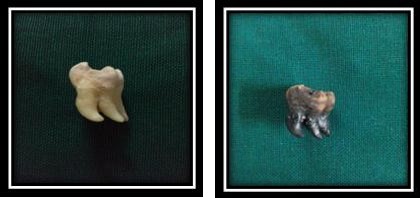
The present study was carried out in the Department of Oral Medicine and Radiology, Ragas Dental College and Hospital, Chennai and in Shrimpex Biotech Lab, Chennai. The study was approved by the Institutional Ethical Committee and informed consent was obtained from all 10 patients (5 –male, 5-female) who came for extraction in the department of Oral and Maxillofacial Surgery. Total 10 teeth sample were collected. The samples were kept at room temperature. Care was taken to avoid any kind of contamination. The clinical detail of the patients was unknown. Ten samples were subjected to analysis after the storage period of 6 months. All samples were incinerated at 3000 C for 60 minutes to mimic the forensic scene. (Fig 1)
Procedure
DNA extraction from each tooth sample was done using Shrimpex Real Genomics YGB 100 DNA extraction kit. DNA quantification was performed using Nanodrop 100 spectrophotometer. SRY gene detection was done by the Real Plex Master Cycler.Primers were designed specific to SRY gene (Sex determining region on Y chromosome). Forward Primer- GCG ACC CAT GAA CGC ATT; Reverse primer-AGT TTC GCA TTC TGG GAT TCT CT; Probe- FAM- TGG TCT CGC GAT CAG AGG CGC –TAMR.
Thermal protocol PCR Guidelines
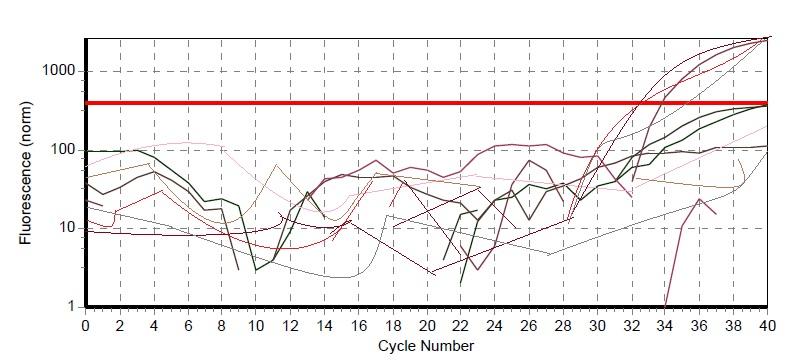
PCR reaction was set up to amplify SRY gene. It performs a two-step PCR cycle consisted of initial denaturation at 95°C for 3 min, followed by 40 cycles of annealing at 95°C for 15 s, and extension at 60°C for 1 min. Real-time PCR acquires data through the 520 nm FAM channel during the 60ºC incubation step. In a probe based real-time PCR assay, a specific fluorescent reporter, such as a Taqman probe is used to monitor the reaction as it occurs. The point at which the fluorescence rises above the background is known as the threshold cycle (Ct value). This Ct value has a linear correlation corresponding to the starting amount of template given (Figure 2).
Statistical Analysis
The data was subjected to statistical analysis using SPSS version 19. The prediction rate for males was 100 % and for females was 80% .The difference in the prediction of gender was found to be statistically significant (p value- 0.04) .The average amount of DNA yield for males was 28.71 and for females was 30.16. The difference in DNA yield was statistically non-significant (p value -0.91). Statistical analysis showed that the type of gender had no correlation on the DNA yield (Table 2).
Results
The actual sex and the sex determined based on the presence or absence of SRY gene is tabulated in Table 3. All male subjects were identified with 100% accuracy. Of the five female subjects, one female was wrongly identified as male by the presence of SRY gene. Hence, the sensitivity and specificity of SRY gene in gender identification was 100% and 80% respectively.
| Predicted gender | |||||||||
|---|---|---|---|---|---|---|---|---|---|
| Actual gender | |||||||||
| FEMALE | Male | ||||||||
| FEMALE | Count | 4 | 1 | ||||||
| % | 80 | 20 | |||||||
| MALE | Count | 0 | 5 | ||||||
| % | 0 | 100 | |||||||
| Chi sq value- 6.67 | |||||||||
| p value 0.04* |
Table 1: Average Yield of DNA.
Gender N Mean Std Deviation Mean rank p value* Male 5 28.712 8.84790 5.4 0.91 (NS) Female 5 30.162 11.81087 5.6 *Mann Whitney test Table 1: Average Yield of DNA.
| Sample | Actual | Gender based | ||||||
|---|---|---|---|---|---|---|---|---|
| Number | Gender | on SRY gene | ||||||
| 1 | Male | Male | ||||||
| 2 | Male | Male | ||||||
| 3 | Male | Male | ||||||
| 4 | Male | Male | ||||||
| 5 | Male | Male | ||||||
| 6 | Female | Female | ||||||
| 7 | Female | Female | ||||||
| 8 | Female | Male* | ||||||
| 9 | Female | Female | ||||||
| 10 | Female | Female |
Table 2: Comparison of actual sex and the Sex determined which based on SRY gene.
Discussion
Oral tissues are relatively resistant to environmental degradation and destruction by thermal, chemical and mechanical insult. Sex determination is the first step in person identification and is usually done by studying the anatomical characteristics. Sex is also determined by observing Barr bodies and F bodies in X and Y chromosomes respectively under microscope .All these methods are having limitations and the percentage of accuracy is not 100%.8 Advanced methods like DNA extraction and Real Time PCR amplification will produce 100% specificity in sex determination. PCR is useful in cases of very minute and degradable samples to increase the quantity of DNA.
Pulp tissue is most commonly used because it is usually abundant and has less chance of contamination. Sampling of the pulp tissue is done in three ways: crushing, vertical or horizontal splitting and by endodontic access. Sweet discovered the use of cryogenic grinding of the teeth. Liquid nitrogen is used to mill the pulverization of teeth. This process reduces the risk of contamination. The powder was solubilized in a proteinase k buffer solution and incubated overnight. DNA yield per gram of tooth powder was 18.4 micrograms. Dentist may be called upon to provide samples and expert analysis in many situations. DNA analysis can provide highly accurate identification if used correctly. The gold standard test for sex identification is Y-STR (Short tandem repeat analysis) or SRY testing. These are newest techniques which simply the work of forensic scientist in DNA amplification. It can be used as definitive took to identify gender identification in mass disaster. Various other different potential sources for DNA extraction are used, such as epithelial cells from tooth brushes, epithelial cells from acrylic partial dentures, etc., however, in markedly decayed and skeletonized bodies, bone and teeth are the only available materials [19]. Teeth are the tissue of choice in the evaluation of DNA sequences when the whole body is destroyed. The amount of DNA yield is affected by various factors. Tanaka et al retrieved 10.430 ug/μl DNA from tooth brushes. Potsch et al retrieved the genomic DNA from a dental sample ranges from 6 μg to 50 μg DNA. Prachi et al retrieved 25 to 27 ng/μl from 20 teeth pulp samples [20]. In our study, DNA isolation from tooth was performed according to the standardized protocol and the average DNA yield was 28 -30 ng/μl irrespective of the storage time and high temperature. In this present study, teeth samples were subjected to high temperature of 300°C for 60 minutes which yielded considerable amount DNA from pulp tissue which is in accordance with Tsuchimochi et al studies where he concluded sex determination could be possible in teeth samples subjected to temperatures 100°C and 200°C, but not possible in those subjected to 300°C and 400°C [22]. Garcia et al obtained DNA from 570 teeth that were subjected to different environmental conditions and found best results [21]. Hanoaka et al. [23] DNA from 50 extracted teeth pulpal and hard tissue had shown a range of 3 to 40 μg. He reported no correlation between storage period and amount of DNA.
Remualdo et al. [24] evaluated DNA retrieval from the teeth subjected to heat (200ºC, 400ºC, 500ºC and 600ºC) during 60 minutes, testing 3 different extraction methods (organic; ammonia acetate/isopropanol and silica) . The organic method for genomic DNA extraction useful for 50% of samples, but only at lower temperatures (200ºC and 400ºC). At higher temperatures (500ºC and 600ºC), the isopropanol/ammonia acetate extraction method yielded better results, mainly for extraction of mitochondrial DNA. Henceforth, Mitochondrial DNA(mtDNA) is a good source of evidence in forensic investigation since it is abundantly present in hair, teeth old bones rather than genomic DNA. This current study is in accordance with the previous study results. Urbani et al. [25] had proven that PCR shown to be 100% reliable when used to assess the gender of teeth, which had been heated at 100°C, but less reliable when the teeth were heated at higher temperatures for longer period of time. Suresh et al. [26] showed sex determination was possible in teeth samples subjected to temperatures 100°C and 200°C, but not possible in those subjected to 300°C and 400°C. In our study, we have proven that gender identification could be possible from tooth sample subjected to temperature of 3000 C with 60 minutes of storage time. Sivagami at al. [27], Hanaoka et al, [23] used tooth sample to retrieve DNA for identification of AMEL gene using PCR based amplification of AMEL gene segment. There are very few studies have been undertaken to determine the usefulness of SRY marker as a sex determining probe under environmental conditions. Kastelic, et al. [15] studied 115 male samples for the validation of SRY marker and found no gender discrepancy .Sri ram et al. [28] shown amplification of SRY gene using real time PCR from epithelial cells from acrylic partial dentures. In the present study, one out of five female subjects showed amplification of the SRY gene. This result might be due to handling contamination and various syndromic conditions such as Turner syndrome (46, X0), Klinefelter syndrome (46,XXY), Androgen Insensitivity Syndrome, chimerism (bone marrow transplants), Microchimerism(occurrence of cell free DNA in the maternal serum). Nicole, et al. [29] reported that sex determination can be erroneous in samples taken from bone-marrow transplanted subjects or from women carrying a male foetus. Hence, it is advised to use a combination of Y markers and X specific genetic marker for gender identification in case of known mutations.
Riley stated that previous contamination of DNA sample may be amplified up to a billion times their original concentrations.
Conclusion
In the present study, we were able to shown successful DNA extraction from tooth sample irrespective of storage time and high temperature using Real time PCR and gender identification through amplification of male specific marker SRY gene with 100 % accuracy. Thus, tooth would be extremely useful for identification of markedly traumatized, decomposed skeletal remains which has been difficult using the conventional morphological methods.
References
-
Oliver WM, Pongruk , Clifford P, Yeddi S, Dana VA, et al. (2006)Mass fatalitymanagement following the south Asian tsunami disaster: Case studies in Thailand, Indonesia, and Sri Lanka. Plos med 3(6): 809-815.
-
Miyajima, Daruge, Daruge (2001) A importância da odontologia Na identificação humana: relato de um caso pericial. Arq odontol 37(2): 133-142.
-
Pretty IA, Sweet D (2001) A look at forensic dentistry – part 1: The role of teeth in the determination of human identity. Br Dent J 190(7): 359-366.
-
SantosCF, SakaiVT, Machado MA, SchippersDN, GreeneAS (2004) Reverse transcription and polymerase chain reaction: Principles and Applications in dentistry. J Appl Oral Sci 12(1): 1-11.
-
Sweet DJ, Sweet CH (1995) DNA analysis of dental pulp to link incinerated remains of homicide victim to crime scene. J Forensic Sci 40(2): 310-314.
-
Syed Vaseemuddin (2010) DNA extraction from pulp tissue for its application in PCR. A study to extract DNA with high purity as quantified by gel electrophoresis; World journal of dentistry 1(2): 85- 8.
-
Naito E, Dewa k, Yamanouchi H, Kominami R (1994) Sex typing of forensic DNA samples using male- and female-specific probes. J Forensic Sci 39(4): 1009- 1017.
-
Vikram simha reddy, G Sriram, Saraswathi TR, Sivapathasundharam B (2011) Isolation of epithelial cells from tooth brush and gender identification by amplification of SRY gene, J Forensic Dent sci 3(1): 27-32.
-
Drobnic k (2006) A new primer set in a SRY gene for sex identification. Int congr ser 1288: 268-70.
-
Bashamboo A, Giran HM, Asim A, Ali S (2003) Genomics of the human Y chromosome and molecular diagnosis proc. Indian natn sci acad 4: 525-538.
-
Ajay, Sivapathasundharam, Sriram, Rao (2008) Sex determination using AMEL gene and personal identification using hla-dqα from DNA isolated from dental pulp. J forensic odontol 1: 26-29.
-
Sivagami AV, Rao AR, Varshney U (2000) Simple and cost-effective method for preparing DNA from the hard tooth tissue, and its use in polymerase chain reaction amplification of amelogenin gene segment for sex determination in an Indian population. Forensic ski Int 110(2): 107-15.
-
Kashyap VK, Sahoo S, Sitalaximi T, Trivedi R (2006) Deletions in the y-derived amelogenin gene fragment in the Indian population. BMC med genet 7: 37.
-
Thangaraj K, Reddy AG, Singh L (2002) Is the amelogenin gene reliable for gender identification in forensic casework and prenatal diagnosis? Int J legal med 116: 121-23.
-
Kastelic V, Budowle B, Drobnic K (2009) Validation of SRY marker for forensic casework analysis. J Forensic sci 54(3): 551-555.
-
Sinclair AH, Berta P, Palmer MS, Hawkins JR, Griffiths BL, et al. (1990) A gene from the human sex Determining region encodes a protein with homology to a conserved DNA-binding motif. Nature 364(6281): 240-244.
-
Foster JW, Brennan FE, Hampikian GK, Goodfellow PN, Sinclair AH, et al. (1992) Evolution of sex Determination and the Y chromosome: SRY-related sequences in marsupials. Nature 359(6395): 531-533.
-
Prachi Ravikant naik, Deepa Das, Gopal H Sharma, Amita Rahul Navalkarv (2012) Viability of human dental pulp in determination of sex of an individual by identifying SRY gene through DNA analysis: a single blind pilot study. 24(2): 133-136.
-
Singh K, Anandani C, Bhullar RK, Agrawal A, Chaudhary H, et al. (2012) Teeth and their Secrets‑Forensic Dentistry. J Forensic Res 3: 141.
-
Tanaka M, Yoshimoto T, Nozawa H, Ohtaki H, Kato Y, et al. (2000) Usefulness of a toothbrush as a source of evidential DNA for typing. J Forensic Sci 45(3): 674- 676.
-
Alvarez García A, Muñoz I, Pestoni C, Lareu MV, Rodríguez-Calvo MS, et al. (1996) Effect of environmental factors on PCR- DNA analysis from dental pulp. Int J Legal Med 109(3): 125-129.
-
Tsuchimochi T, Iwasa M, Maeno Y, Koyama H, Inoue H, et al. (2002) Chelating resin-based extraction of DNA from dental pulp and sex determination from incinerated teeth with y chromosomal alphoid repeat and short tandem repeats. Am J Forensic Med Pathol 23(3): 268-271.
-
Hanaoka Y, Inoue M, Tsai TH, Minaguchi K (1995) Fundamental and practical study for DNA analysis using tooth as a source of DNA. Nihon Hoigaku Zasshi 49(1): 1-10.
-
Remualdo VR (2004) Avaliação de três métodos de extração de DNA de dentes humanos submetidos ao calor [dissertação]. São Paulo (SP): Faculdade de Odontologia, Universidade de São Paulo.
-
Urbani C, Lastrucci RD, Kramer B (1999) The effect of temperature on sex determination using DNA‑PCR analysis of dental pulp. J Forensic Odontostomotol 17(2): 35-39.
-
Suresh Vemuri, Ramya R, Rajkumar K, Rajashree P (2012)Influence of various environmental conditions on DNA isolation from dental pulp for sex determination using Polymerase Chain Reaction. SRM Journal of Research and Dental Sciences 3(4): 231- 235.
-
Renjith George, Sriram G, Saraswathi TR, Sivapathasundharam B (2010) Isolation o epithelial cells from acrylic removable dentures and gender identification by amplification of SRY gene using real time PCR. Journal of forensic dental sciences 2(1): 32- 35.
-
Von Wurmb-Schwark N, Bosinski H, Ritz-Timme S (2007) What do the X and Y chromosomes tell us about sex and gender in forensic case analysis? J Forensic Leg Med 14(1): 27-30.
-
Costa JM, Benachi A, Gautier E, Jouannic JM, Ernault P, et al. (2001) First-trimester fetal sex determination in maternal serum using real-time PCR. Prenat Diagn 21(12): 1070-1074.
- Narcotics and Digital Forensics: Bridging Crimes in the Digital Age
- Ethics in Forensic Psychiatry: Principles, Dilemmas, and Human Rights
- Impact of Acute Stress on Attentional Orienting to Social Cues
- Head Injury and Intracranial Hemorrhage in Western Region of Libya
- A Forensic Study on Handedness: Examination of Handwriting Features in Right and Left Handed Writers
- Techniques for Latent Fingerprint Development Using Natural and Synthetic Powders: A Review