
A Systematic Review on Various Diatoms Species Associated with Drowning
Diatoms are microscopic unicellular photosynthetic organisms with widespread distribution. Diatoms come under a branch of phycology with membrane bound nucleus that separates them from prokaryotes. When the person gets drowned in water containing diatoms then due to force full aspirations they get enter into the lungs and from lungs they get lodged into the distant organs of the body. Various tests have been developed so far for the diagnosis of drowning deaths. Diatoms test have been evolved as one of the most important tests for determination of drowning deaths due to its higher specificity and sensitivity. The extraction methods of diatoms from tissue samples is based on digestive capability, reclaiming ratio of diatoms, destruction of diatoms samples and time consumed for complete diatom digestion. This paper reviewed the recent year’s progress in diatom test, samples used and species of diatoms associated with drowning.
Introduction
Drowning is one of the most serious and neglected health problems. Throughout the world about 42 people died every hour and 3.7 lakh people died from drowning every year. In India out of total cases of un natural deaths 9.4% peoples were died due to drowning, which is second most common cause of death after road accident [1]. Drowning is third leading cause of unintentional death worldwide which accounts for 7% of all injury related deaths. Low- and middle-income countries accounts for about 90% of unintentional drowning deaths. Children, males and individuals with more access to water are most at the risk of drowning. About half of the drowning deaths occur in WHO Western Pacific Region and WHO South East Asia Region. There is uncertainty in the estimation of global drowning deaths. Official data categorization methods for drowning deaths exclude intentional drowning deaths (homicide or suicide) and drowning deaths caused by flood disasters and water transport incidents [2].
Death due to drowning is defined as a death due to submersion in liquid and mechanism of acute drowning is hypoxemia and irreversible cerebral anoxia [3]. Various signs of drowning are hair and clothing wet, washerwomen symptoms on palm and sole, white leathery froth detected in nostril, mouth and trachea. Lungs become voluminous and cover chest wall with impressions of ribs are found. Dissection of lungs shows white froth with blood oozes out with a sound of crackling [4]. When the body is recovered from water there is usually a suspicion that whether the cause of death is a drowning or body has been dumped in water body to simulate it to be a drowning. Diatom test has emerged as one of the most reliable tests to diagnose the cause of death in drowning cases. Diatoms are microscopic unicellular algae which can be used for the diagnosis of drowning deaths. Presence of diatoms in lungs and bone marrow is an indicator of death due to drowning [5]. In forensic science one of the main issues of diagnosis of drowning death in case of submerged corpses occurred when the corpse is heavily putrefied or decomposed. Diatom test is based on the recovery of diatoms from organs of drowned victims. In case of putrefied bodies diagnosis of drowning is one of the difficult tasks and diatom analysis can provide supplementary evidence [6].
Conventional methods used for diatoms test involved extraction of diatoms from tissues and water samples, membrane filtration or centrifugation for the collection of diatoms and identification of diatoms on the basis of morphological features by using light microscopy or Scanning Electron microscope [7]. Diatoms have a siliceous cell wall with distinctive shapes and ornamentations. The ornamentation found on the silica frustules of diatoms is species specific and thus provide important information about their shape and sizes which can be used for their identification and classification. On the basis of shapes diatoms are classified into two specific groups one is centric with radial symmetry and other are pinnate which exhibits bilateral symmetry.
Methods for Literature Search Strategy
Literature search strategy for the papers related to diatoms species associated with drowning deaths was searched on Google research scholar, research gate and Clarivate Analytics Web of Science. From these twenty papers have been identified pertaining to diatoms species associated with drowning deaths. Additional papers were also retrieved from the retrieved list of reference papers. Then the data obtained from the research papers was put Singh AR and Verma P. A Systematic Review on Various Diatoms Species Associated with Drowning. Int J Forens Sci 2019, 4(1): 000160.
on the master charts to get the relevant information and then analyzed after review of literature.
Discussion
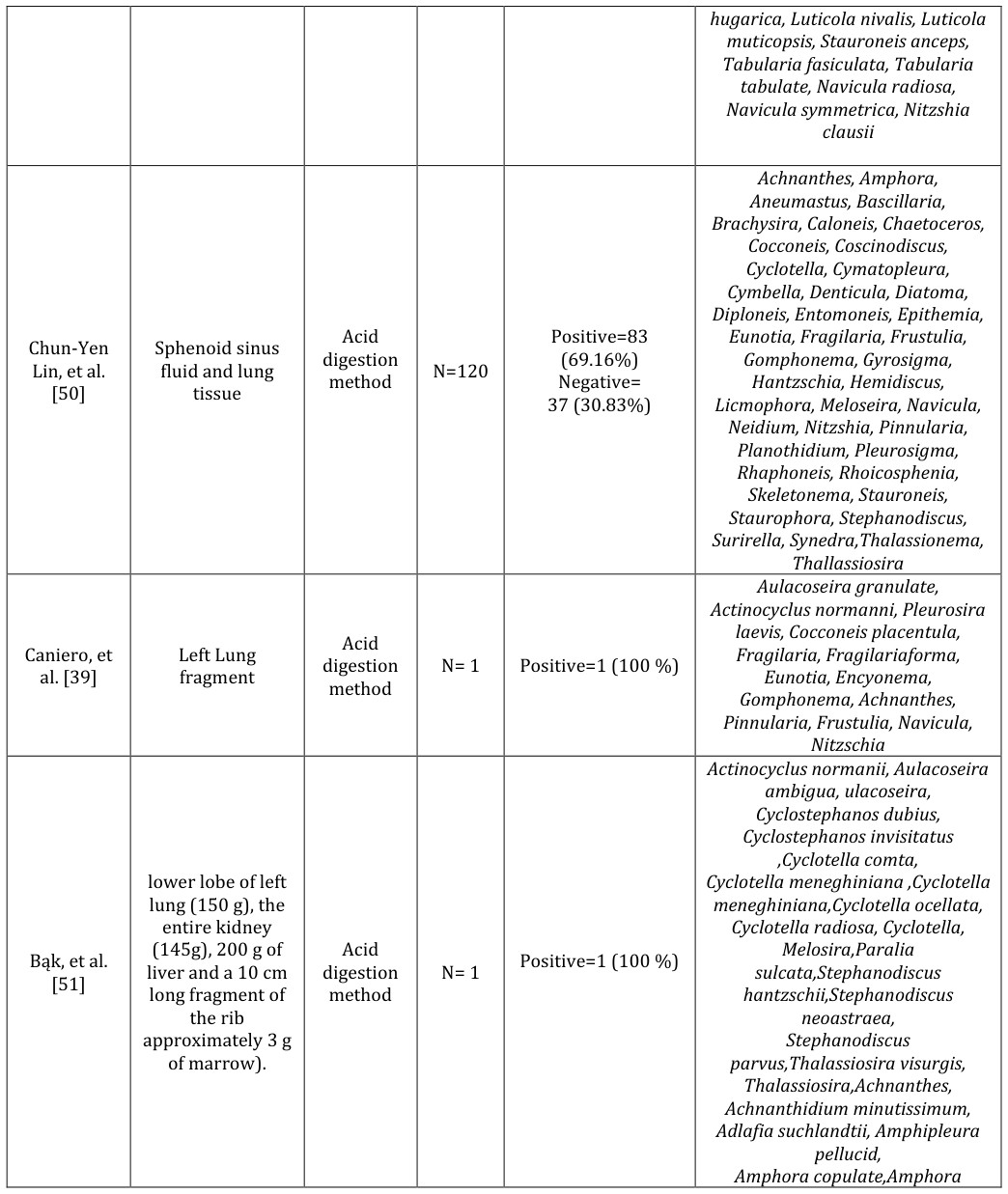
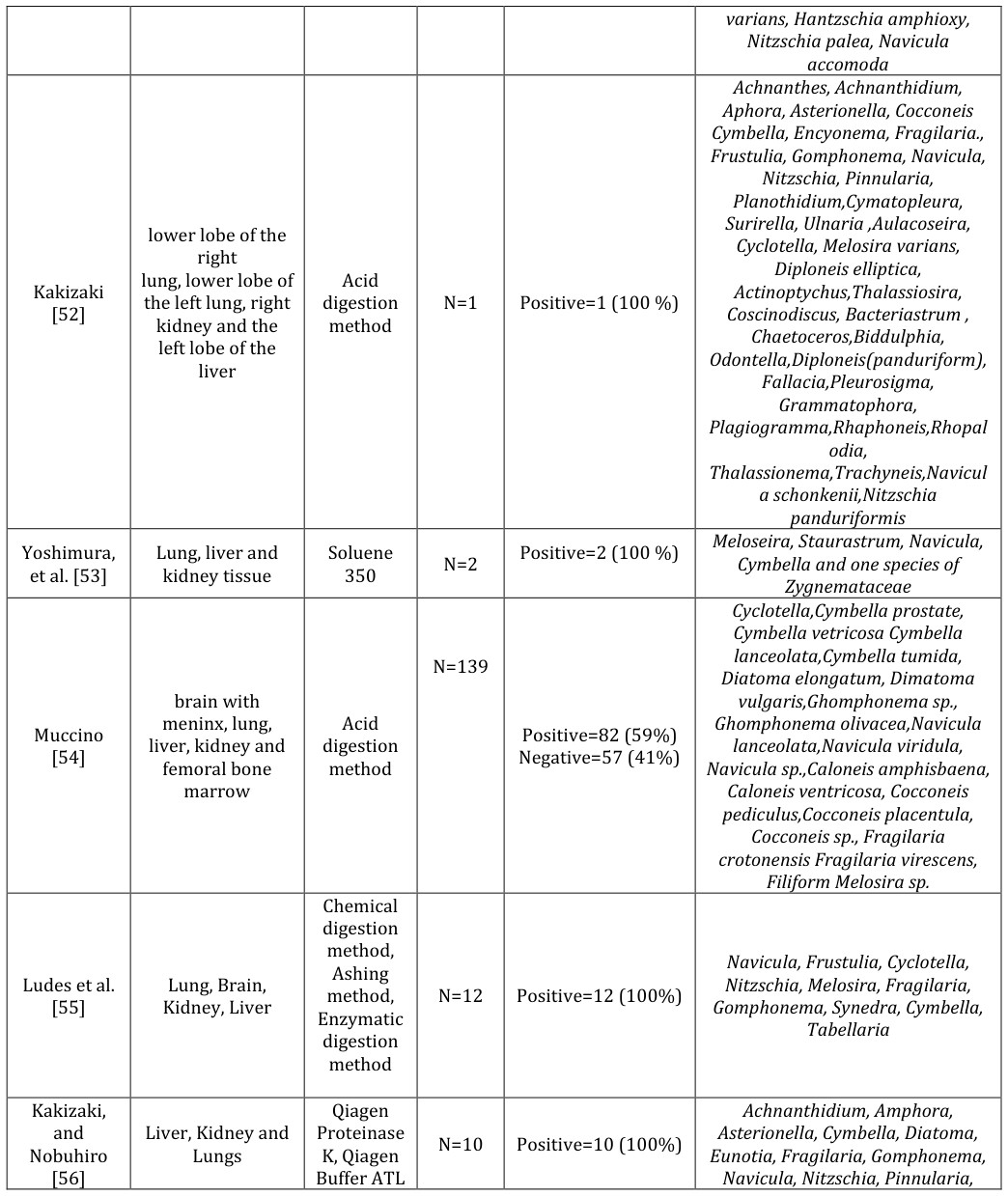
Recent years various methods have been developed for diagnosis of diatoms from tissue samples by enzymatic digestion methods by using proteinase kinase K [8], microwave digestion-vacuum filtration-automated scanning electron microscopy (MD-VF-Auto SEM) [9, 10], Molecular biological techniques [11, 12, 13, 14] and loop mediated isothermal amplification (LAMP) [15] . From all these methods acid digestion method is still widely used for the detection of drowning deaths (Table-1).
Diatom test can not only determine the mode of death as drowning but it can also determine the site where the drowning has taken place. Various researches conducted throughout the world showed that some of the species of diatoms are site specific and thus they can be considered as endemic. Diatoms also show variations with temperature, pH and season. Hence diatomological mapping is of keen interest by the forensic pathologist in the near future [16].
Diatomological mapping helps in generation of baseline data which aids in forensic investigation for diagnosis of drowning deaths, in location of diatoms diversity in particular location and in environmental science and Botany in assessment of water quality in particular region. Cohelo et al in their 37 cases of drowning deaths showed that there is a strong relationship between the diatoms detected in control water sample recovered from the drowning site and tissue samples of drowned victims [17].
Continuous monitoring of water bodies for the presence of diatoms is very essential for the detection of diatoms. Sometimes body of a drowned victim get drifted to other sites due to water currents and thus if diatom database is available then we can locate the exact site where actual drowning has taken place. In recent years some of diatomological mapping by studying distribution and characterizations of diatoms in various water bodies of China was done by Bi et al [18], Ren et al [19], Du et al [20], Bai et al [21] and Tian et al [22]. In India diatomological mapping in some of water bodies were done by Thakar and Singh [23], Vinayak, et al. [24], Saini, et al. [25], Sane, et al. [26], Rana and Bhandari [27] and Mishra and Kumar [28]. Suphan and Peerapornpisal recorded two hundred and fifty three species of benthic diatoms in Meckong river in Thailand [29].
Copyright© Singh AR and Verma P.
Various factors are responsible for the distribution of diatoms in body organs. These factors depend on the density of diatoms in drowning medium, filtration of diatoms into the body when they passed from drowning medium to blood stream and size of diatoms that percolates into the body [30].
Various biological and thanoto-chemical tests like Haemodilution tests [31], sinus fluid [32], microorganisms like algae [33], paranasal sinuses [34], Chemical constituents like strontium [35], diatom test (Table 1) and various markers like magnesium, sodium, chloride, calcium [36] are utilized for the diagnosis of drowning deaths. From all the methods utilized for drowning deaths, diatom test is still considered as “golden standard” [37].
Complete destruction of tissue samples is required for the extraction of diatoms from tissue samples. Various studies conducted throughout the world showed that different internal organs can be used for qualitative and quantitative analysis of diatom test. If the diatoms are detected in the organ samples then cause of death as a drowning can be supported. Various studies conducted on diatom test showed that the lungs sample is commonest organ used for diagnosis of drowning deaths [38, 39]. Besides lungs other tissue samples used for diatom test are Left heart blood [40], Sternum, femur, tibia, lungs, spleen, kidney, heart, clavicle, Peritoneal fluid, Pleural Cavity fluid, Liver, Sphenoid fluid, brain and stomach contents (Table 1). Bone marrow tissue sample is considered as the most appropriate sample for diatom test as it is least effected to contamination and putrefaction.
Various studies conducted on diatom test showed that the pennate diatoms were detected more in number in the tissue samples of drowned victims as compared to the centric diatoms. This might be explained on the basis of the shape as pennate diatoms are most penetrative as compared to centric diatoms. Moreover, the literature cited also showed that the pennate diatoms are more DI1,2 is the similarity between samples 1 & 2 and Ʃqi is the smaller two relative abundances of species i. Both the indices are calculated in terms of percentage and varied from 0% (similarity none) to 100% (similarity matches completely) [30, 42].
No. of sample
Name of
Tissue samples
Methods
Author
used for study used (s) Sternum, femur, Acid Digestion
Pal, et al.
tibia, lungs, spleen, kidney N=66
[43]
Method
and heart Singh AR and Verma P. A Systematic Review on Various Diatoms Species Associated with Drowning. Int J Forens Sci 2019, 4(1): 000160.
abundant in the control water samples as compared to centric diatoms (Table 1).
The diatom test has been extensively used by forensic laboratories for the diagnosis of ante mortem or postmortem drowning in biological samples and their comparison with the putative site of drowning. If the diatoms detected in tissue samples matches with the control water sample then it can act as corroborative evidence that death due to drowning has occurred in same water medium [41].
The identification of the diatom taxa in terms of species and dominant species comparison between the sample tissues and control water samples is required to detect drowning deaths by forensic pathologist. The diatom valves or fragments recovered from the tissue and control water sample must be analyzed at lowest possible level up to species or variety. They must be visually documented in terms of photographs or digital prints. Two similarity indices are used in research process i.e. Species Index (SI) and Dominance Identity (DI). SI is used to compare the number of taxa between two samples and can be calculated as:
SI1,2 =S1∩2/S1+2*100[%] S1∩2 is the number of species of diatoms species common in communities of samples 1 & 2 and S1+2 is the total number of diatoms in two diatoms communities in samples 1 & 2. Dominance identity between two samples can be calculated by DI as DI1,2 = Ʃqi [%]
Percentage of cases positive or
Diatoms species detected
negative Positive=62
Navicula, Nitzschia, Asterionella,
(93.93%) Negative=4
Cymbella, Pinnularia, Coconesis,
Diatoma, Cyclotella, Gyrosigma,
(6.06%) Diplonesis, Aulacoseira, Stauronesis, Coconesis, Tabuleria,
Epithemia, Melosira
Copyright© Singh AR and Verma P.
| Kaushik, et al. [44] | Sternum, Femur, Clavicle, Peritoneal Fluid, Pleural Cavity fluid, Tibia, Humerus, Liver, Spleen, Kidney | Acid Digestion Method | N=17 | Positive=12 (70.58%) Negative=5 (29.41%) | Cymbella, Cyclotella, Diatoma, Epithemia, Aulacoseira, Gyrosigma, Coconesis, Diadesmus, Tabellaria, Amphora, Synedra, Rhoicosphenia |
|---|---|---|---|---|---|
| Gunatilake & Gooneratne [45] | Lungs, Kidney, Bone marrow | Acid Digestion Method | N=35 | -- | Cyclotella, Navicula, Nitzschia, Frustulia, Gomphonema, Pinnularia, Cymbella, Cocconeis |
| Magrey & Raj [46] | Sternum, clavicle, Lungs and Femur | Acid Digestion Method | N=31 | Positive=09 (29.03%) Negative=22(70.96 %) | Navicula lanceolata, Navicula oblonga, Gomphonema gracile, Nitzschia gracilis, Cymbella cymbiformis, Gomphonema spheroporum, Nitzschia frustulum, Cymbella ventricosa, Cocconesis placentula, Amphora, Amphipleura, Aulacoseria, Meloseira, Hantzshia, Eunotia Epithemia |
| Kumar, et al. [47] | Sternum, clavicle and Femur | Acid Digestion Method | N=7 | Positive=04 (57.14%) Negative=3 (42.85%) | Coscinodiscus centrales, Navicula cuspidata, Pinnularia viridis, Cymbella tumida, |
| Malik, et al. [48] | Sternum, clavicle, lungs and Femur | Acid Digestion Method | N=4 | Positive=03 (75%) Negative=1 (25%) | Navicula lanceolata, Navicula oblonga, Gomphonema gracile, Nitzschia gracilis, Cymbella, Navicula radiosa, Cymbella cymbiformis, Gomhonema spheroporum, Nitzschia frustulum, Cymbella ventricosa, Cocconeis placentula |
| Vinayak, et al. [49] | Femur, blood from left side of heart | Acid Digestion Method | N=2 | Positive=1 (50%) Negative=1 (50%) | Navicula, Asterionella, Cocconeis, Caloneis |
| Zhao, et al. [9] | Liver, kidney, bone marrow | Microwave digestion- vacuum filtration- automated scanning electron microscop y method | N=2 | Positive=1 (50%) Negative=1 (50%) | Actinocyclus normanii, Amphora pedicultus, Aulacoseira ambigua, Aulacoseira crassipunctata, Cocconeis placentula var. euglypta, Cyclotella meneghiniana, Cymbella affinis, Cymbella delicatula, Cymbella laptoceros, Cymbella tumida, Fragilaria capucina, Hantzschia amphioxys, Gomphonema clavatum, Gomphonema parvulum,Gomphosphenia lingulatiformis, Lemnicula |
Singh AR and Verma P. A Systematic Review on Various Diatoms Species Associated with Drowning. Int J Forens Sci 2019, 4(1): 000160.
Copyright© Singh AR and Verma P.
Singh AR and Verma P. A Systematic Review on Various Diatoms Species Associated with Drowning. Int J Forens Sci 2019, 4(1): 000160.
Lung fluid and
Acid digestion
Benjamin,
lung tissue et al. [38]
method Singh AR and Verma P. A Systematic Review on Various Diatoms Species Associated with Drowning. Int J Forens Sci 2019, 4(1): 000160.
pediculus, Asterionella Formosa, Bacillaria
paxilifera, Brachysira neoexilis,Cavinula scutelloides,
Cocconeis disculus, Cocconeis
pediculus, Cocconeis placentula, Diatoma tenuis, Diploneis domblittensis, Diploneis fontanella, Diploneis smithii, Encyonema minutum, Encyonema silesiacum, Encyonema vulgare, Encyonopsis subminuta,Eolimna cf. subminuscula, Eolimna minima, Eunotia binularis,Eunotia minor, Eunotia rhomboidea, Eunotia,Fragilaria brevistriata, Fragilaria capucina capucina, Fragilaria leptostauron, Fragilaria pinnata, Fragilaria,Fragilaria subsalina, Fragilaria vaucheriae, Frustulia saxonica, Gomphonema accuminatum,Gomphonema angustatum, Gomphonema auritum, Gomphonema lateripunctatum, Gomphonema minutum, Gomphonema parvulum var. parvulum,Gomphonema,Gomphone ma truncatum , Halamphora Montana, Hantzschia amphioxys, Hippodonta capitata, Hippodonta lueneburgensis,Karayevia kolbei,Karayevia clevei,Karayevia laterostrata, Meridion cirulare, Navicula cryptotenelloides, Navicula cryptocephala , Navicula gregaria , Navicula lanceolata Cocconeis placentula var euglypta, Melosira varians,Navicula radiosa, Cocconeis placentula var euglypta, Melosira varians,, Navicula radiosa N =2 Positive=2 (100 %) Cocconeis placentula var euglypta,Melosira varians, Navicula radiosa,Cocconeis placentula var euglypta, Melosira Copyright© Singh AR and Verma P.
Singh AR and Verma P. A Systematic Review on Various Diatoms Species Associated with Drowning. Int J Forens Sci 2019, 4(1): 000160.
- and 5N hydrochlor ic acid
- Upper and lower lobes of left right lungs, spleen, left and right kidneys,
- Acid digestion
- Ago, et al.
- N=10
- Positive=9 (90%)
- Negative=1 (10%)
- [57] method liver
- Lung, kidney,
- Acid digestion
- Coelho, et liver, bone marrow, stomach
- N=37
- Positive= 63% al. [17] method contents
- Lung tissue,
- Kidney, liver,
- Pachar and
- Acid digestion
- N=40
- Lungs positive =
- Cameron brain, bone
- 93.7%
- [58] method marrow
Table 2: Comparison of results of the studies conducted in different parts of the world.
Positivity and validity of diatom test is based on the number of diatoms valves recovered from the tissue samples and their comparison with the tissue samples. Pal, et al. [43] reported 93.93% positive cases in drowning deaths, Kaushik, et al. [44] in 70.58%, Magrey and Raj [46] in 29.03%, Kumar, et al. [47] in 57.14%, Malik, et al. [48] in 75%, Vinayak, et al. [49] and Zhao, et al. [9] reported in 50% of cases. Caniero, et al [39], Bak, et al [51], Benzamin, et al. [38], Kakizaki [52], Yoshimura, et al. [53], Ludes, et al. [55] and Kakizaki and Yukawa [56] reported positivity of diatoms in 100% of cases. The negativity of diatoms in drowning deaths might be due to low abundance of diatoms in drowning medium, destruction or loss of diatoms during processing or inappropriate organ samples used for the study. Various studies conducted on diatom test showed that number of valves recovered from the tissue samples is based on the type of tissue sample used for the diatom test. Therefore, Singh AR and Verma P. A Systematic Review on Various Diatoms Species Associated with Drowning. Int J Forens Sci 2019, 4(1): 000160.
a standard had to be set up to draw the conclusion regarding positivity or negativity of diatom test.
One of the most criticisms for the validity of diatom test is detection of diatoms in the tissue samples of non- drowned victims. Buri, et al. in their study showed that detection of diatoms in tissue samples of non-drowned bodies might be due to abundance of diatoms frustules in non-vegetarian cooked food stuff, inhalation of air in a atmosphere containing material used for manufacturing the building like paper, cement and paint etc. and long term exposure of body in a water containing diatoms [59]. Disposable equipment’s should be used to avoid the contamination between the samples, appropriate quantity of sample should be taken and quality of sample preparation should be high with minimum residue in the digestive sample [30]. Levkov, et al. in their study showed that rapid death in water medium due to shock or cardiac dysfunction at low temperature, due to diseases and use Copyright© Singh AR and Verma P.
of alcohol or drugs also causes the decrease in time period for the drowning deaths which may cause in negativity of diatom test [60]. Rana and Manhas in their study showed that rapid death due to drowning, less abundance of diatoms in putative site of drowning, inefficient methods of extraction and detection causes negative results in drowning related deaths [61]. Therefore, discrimination between the positive and negative results under such types of circumstances is one of the most challengeable tasks for the forensic experts.
The literature cited on the diatoms study showed that very less data is available regarding the size of the diatoms associated with drowning. The size of diatoms in natural habitat varied from 2µm-200 µm [62]. Hurlimann, et al. in their study showed that maximum length of diatom valve detected in bone marrow should be less than 40 µm. If the length of diatom is more than 40 µm this might be due to post mortem contamination or penetration from gastrointestinal wall [30]. Levkov, et al. in their study showed the minimum to maximum size of diatom valve in ten cases of drowning deaths varied from 9-122 µm in lungs, 7-117 µm in brain, 13-187 µm in liver, 8-85 µm in heart and 11-122 µm in kidney [60]. Similarly, the studies made by Krstic, et al. reported maximum length of diatom is 50 µm in tissue sample [63], Pachar and Cameron reported 30 µm [58] and Lunetta et al reported 110 µm [64] in their respective studies.
Sometimes due to certain environmental conditions diatoms may be scanty or absent in a particular season which causes negative results pertaining to drowning deaths. Therefore, to increase the sensitivity and specificity of the diatom test other phytoplankton besides diatoms can also be used for the diagnosis of drowning deaths [65]. Lunette and Modell in their study showed that presence of phytoplankton other than diatoms can be detected in the drowned bodies and found that aquatic organisms belonging to division chlorophyta, Dinoflagellates, invertebrates, protozoan ciliates in the blood of drowned victims [66]. Díaz-Palma et al standardized the methods for recovery of phytoplanktons from drowned victims and showed that dinoflagellates and some chlorophytes have cell walls and structures which are resistant similar to diatoms [67]. Yoshimura et al in their study showed that phytoplanktons can be extracted from tissue samples by using soluene-350. Diatoms and some species of green algae were detected in the tissue sample and control water sample by using this method [53].
Singh AR and Verma P. A Systematic Review on Various Diatoms Species Associated with Drowning. Int J Forens Sci 2019, 4(1): 000160.
Conclusion
Diatom test has emerged as an important test for forensic laboratories to diagnose the cause of death in drowning cases. Presence of diatoms in the tissue samples can act as supportive evidence that death has occurred due to drowning. If a person is already dead before entering into the water the diatoms could not be detected into the internal organs of the drowned victims. Detection and comparison of diatoms with tissue and control sample is required to rule out the positivity or negativity of diatom test. Validity of the diatom test is also based on the number of diatoms valves recovered from the tissue samples of drowned victims. Various methods have been developed so far for the diagnosis of drowning deaths but still diatom test is considered as a golden standard. Molecular biological techniques, ADIAC and phytoplankton mapping may aid up the diatom test in near future. Ethical approval: Ethical guidelines were respected.
References
-
Phad LG, Dhawane SG (2018) Epidemiological profile of drowning deaths: a cross sectional study. Egyptian Journal of Forensic Science 8(26): 1-6.
-
Global report on drowning Preventing A leading Killer. World Health Organisation, pp: 1-76
-
Farrugia A, Ludes B (2011) Diagnostic of drowning in Forensic Medicine, Forensic Medicine From old problems to new challenges. Prof. Duarte Nuno Veira (Ed.), Intech.
-
Shrivastava N, Satpati DK, Kumar A (2015) Easy confirmation of drowning by detection of diatoms in trachea. J Indian Acad Forensic Med 37(4): 352-354.
-
Zhao J, Liu C, Hu S, He S, Lu S (2013) Microwave digestion-Vacuum filtration-Automated scanning electron microscopy as a sensitive method for forensic diatom test. Int J Legal Medicine 127: 459- 463.
-
Nadia F (2012) A new procedure for diatom extraction in the diagnosis of drowning. Journal of clinical and experimental Pharmacology 2(110): 1-3.
-
Hu S, Liu C, Wen J, Dai W, Wang S, et al. (2013) Detection of diatoms in water and tissues by Copyright© Singh AR and Verma P. combination of microwave digestion, vacuum filtration and scanning electron microscopy. Forensic Science International 226: 48-51.
-
Takeichi T, Kitamura O (2009) Detection of diatom in formalin fixed tissue by proteinase K digestion. Forensic Science International 190 (1-3):19-23.
-
Zhao J, Wang Y, Wang G, Ma Y, Shi H, et al. (2015) Application of the microwave digestion-vacuum filtration-automated scanning electron microscopy method for diatom detection in the diagnosis of drowning. Journal of Forensic and Legal medicine 33 :125-128.
-
Zhao J, Liu C, Bardeesi ASA, Wu Y, Ma Y, et al. (2017) The diagnostic value of quantitative assessment of diatom test for drowning: An analysis of 128 water related death cases using microwave digestion- vaccum filtration-automated scanning electron microscopy. J Forensic Sci 62(6): 1638-1642.
-
N Idota, H Tsuboi, M Takosa, M Tojo, T Kinebuchi, et al. (2017) Comparison between Temperature Gradient Gel Electrophoresis of bacterial 16S rDNA and diatom test for diagnosis of drowning. Journal of Forensic Sciences 63(3): 1-6.
-
He F, Huang D, Liu l, Shu X, Yin H, et al. (2008) A novel PCR-DGGE based method for identifying plankton 16S rDNA for the diagnosis of drowning. Forensic Science international 176: 152-156.
-
Nubel U, Garcia-Pichel F, Muyzer G (1997) PCR primers to amplify 16S rRNA genes from cyanobacteria. Appl Environ. Microbiol 63: 3337-332.
-
Han JG, Wang CB, Li XB, Fan YY, Feng XP (2013), Comparative analysis between diatom nitric acid digestion method and plankton 16S r DNA PCR method. Fa Yi Xue Za Zhi 29(5): 356-359.
-
Kakizaki E, Sonada A, Sakai M, Yukawa N (2018) Simple detection of bacterioplankton using a loop mediated isothermal amplification (LAMP) assay: First practical approach to 72 cases of suspected drowning. Forensic Sci Int. 2018 Aug 289: 289-303.
-
Zhuo L, Lin S, Song P (2016) A future perspective in forensic medicine in China: Diatomological mapping of water bodies. Forensic Science and Medicine 2 (2): 107-110. Singh AR and Verma P. A Systematic Review on Various Diatoms Species Associated with Drowning. Int J Forens Sci 2019, 4(1): 000160.
-
Coelho S, Ramos P, Ribeiro C, Marques J, Santos A (2016) Contribution to the determination of the place of death by drowning – a study of diatoms’ biodiversity in Douro river estuary. Journal of Forensic and Legal Medicine (41): 58-64.
-
Bi Q, Guo X, Guo P, Qu D, Wang D, et al (2011) The morphological and distribution of common diatomsin Guanzhou water areas. J Trop Med 11: 330-333.
-
Ren H, Zhang X, Liu G Xu X, Wu Q (2012) The preliminary survey of diatom in water around Beijing. Forensic Science Tecnol 3: 16-9.
-
Du Y, Zhou Z, Cai HY, Li PF, Xia JL (2013) Change rules of quantity and species of diatoms in Hunhe River in Shenyang 29: 337-343.
-
Bai YJ, DU F, Jin ZX, Gao D, Zhu JL, et al (2013) The application of digital virtual slicing technology in survey of diatoms in waters of central parts of Wuhan in spring. Forensic Sci Tecnol 5:17-21.
-
Tian L, Zang SB, Qiu ZJ (2014) Distribution of diatoms in Chuannyang River of Pudong new area of Shanghai and its forensic application. Fa Yi Xue Za Zhi 30: 114- 116.
-
Thakar MK, Singh R (2010) Diatomological mapping of water bodies for the diagnosis of drowning cases. J Forensic Leg Med 17(1): 18-25.
-
Vinayak V, Mishra V, Goyal MK (2013) Diatom fingerprinting to ascertain death in drowning cases. J Forensic Res 4(207): 1-6.
-
Saini E, Khanagwal VP, Singh R (2017) A Systematic databasing of diatoms from different geographical localities and sites of Haryana for advancing validation of Forensic Diatomology. Data in Brief 10: 63-68.
-
Ramchandra MS, Verma P, Kulkarni R, Mishra PK, Nigam M, et al. (2018) Diatomological mapping of water bodies of Indore (MP) region. Journal of Indian Academy of Forensic Medicine 40(1): 91-95.
-
Rana D, Bhandari D (2016) Isolation and Characterization of diatoms from water bodies of Mumbai. Int J Cur Res Rev 8(17): 13-21.
-
Mishra MK, Kumar S (2017) Study of Diatom flora for site identification of Yamuna river at Delhi. Copyright© Singh AR and Verma P. International Journal of development research 4(3): 1-11.
-
Suphan S, Peerapornpisal Y (2010) Fifty three new record species of benthic diatoms from Meckong river and its tributaries in Thailand. Chiang Mai J Sci 37(2): 326-343.
-
Hurlimann J, Feer P, Elber F, Niederberger K, Dirnhofer R, et al. (2000) Diatom detection in the diagnosis of death by drowning. Int J Legal Med 114(1-2): 6-14.
-
Durigon M, Auger M, Paraire F, Barre’s D (1989), Limites diagnostiques du ionogramme sanguin. Comparatif dans la noyade. Acta Med Leg Soc (Liege) 39: 155-157.
-
Kawasumi Y, Usui A, Sato Y, Sato Y (2016) Distinction between saltwater and freshwater drowning by assessment of sinus fluid on postmortem computed tomography. Eur Radiol 26(4): 1186-1190
-
Abe S, Suto M, Nakamura H, Gunji H, Hiraiwa K, et al. (2003) A novel PCR method for identifying plankton in cases of death by drowning. Med Sci Law 43: 23-30.
-
Lo Re G, Vernuccio F, Galfano MC, Picone D, Milone L, et al. (2015) Role of virtopsy in the postmortem diagnosis of drowning. Radiol Med 120(3): 304-308.
-
Azparren JE , Fernandez-Rodriguez A, Vallejo G (2003) Diagnosing death by drowning in fresh water using blood strontium as an indicator. Forensic Sci Int 137(1): 55-59.
-
BL Zhu, K Ishida, M Taniguchi, L Quan, S Oritani, et al. (2003) Possible postmortem serum markers for differentiation between fresh-, saltwater drowning and acute cardiac death: a preliminary investigation. Legal Med 5(S1): S 298-301.
-
Piette MH, De Letter EA (2006) Drowning: still a difficult autopsy diagnosis. Forensic Science international 163(1-2): 1-9.
-
Benjamin PH, Steve B, Caroline H (2006) The Development and Application of a Diatom- Based Quantitative Reconstruction Technique in Forensic Science. J Forensic Sci 51(3): 643-650.
-
NPM Caniero, LC Torgan, M Vaz, LP Utz (2017) Diatoms in lung tissue: first investigation in Brazil in Singh AR and Verma P. A Systematic Review on Various Diatoms Species Associated with Drowning. Int J Forens Sci 2019, 4(1): 000160. proving death by drowning. Revista Brasileira De Criminalistica 6 (3): 13-16.
-
Funayama M, Aoki Y, Sebetan IM, Sagisaka K (1987) Detection of diatoms in blood by combination of membrane filtering and chemical digestion. Forensic Science International 34(3): 175-182.
-
Mahipal Singh Sankhla, Mayuri Kumari, Manisha Nandan, Rajeev Kumar (2016) Forensic Analysis of drowning death by the use of diatom test. International journal of developmental research 6(9): 9491-9493.
-
Sitthiwang N, Ruangyuttikarn W, Vongvivach S, Peerapornpisal Y (2014) Detection and identification of diatoms in tissue samples of drowning victims. Chiang Mai J Sci 41(5.1): 1020-1031.
-
Pal SK, Sharma A, Sehgal A, Rana A (2017) Diagnosing death with diatoms: A retrospective study of Forensic cases. International Journal of Medical Toxicology and Forensic Medicine 7(2): 124-137.
-
Kaushik N, Kumar Pal S, Thakur G (2017) Role of Diatoms in diagnosis of death due to drowning: Case studies International Journal of Medical Toxicology and Forensic Medicine 7(1): 59-65.
-
PGL Gunatilake, Gooneratne I (2010) Drowning assossiated diatoms in Sri Lanka. Sri Lanka Journal of Forensic Medicine, Science & law 1(20): 23-24.
-
Magrey AH, Raj M (2014) Role of Diatoms in Forensic diagnosis of drowning cases from Jammu Kashmir, India. Biosec Biotech Res Comm 7(1): 72-77.
-
Kumar A, Malik M, Kadian A (2011) Role of Diatoms in Forensic Science for examination of drowning cases. Report and Opinion 3(9): 1-5.
-
Manoj Kumar Malik, Pooja Jakhar, Anita Kadian (2013) Role of Diatoms in Forensic Investigations: Case studies from Haryana. International Journal of Forensic science & Pathology 1(3): 11-12.
-
Vandana Vinayak, MK Goyal, V. Mishra, Anshuman Rai (2010) Diatoms as a great forensic tool in investigation of deaths due to drowning: A case study. Journal of forensic Medicine and Toxicology 27: 51- 54. Copyright© Singh AR and Verma P.
-
Lin CY, Yen WC, Hsieh HM, Tsai LC, Huang TY, et al. (2014) Diatomological investigations in sphenoid fluid and lung tissue from cases of suspected drowning. Forensic Science International 244: 111- 115.
-
Bąk M, Witkowski A, Dobosz S, Kociolek JP, Pietras L (2018) Diatoms and drowning: can diatoms enter the lungs after the initial drowning event?. Romanion Society of Legal medicine 26: 29-36.
-
Kakizaki E, Kozawa S, Matsuda H, Muraoka E, Uchiyama T, et al. (2010) Freshwater bacterioplankton cultured from liver, kidney and lungs of a decomposed cadaver retrieved from a sandy seashore: Possibility of drowning in a river and then floating out to sea. Legal Medicine 12(4): 195- 199.
-
Sumitaka Y, Manabu Y, Yutaka O, Takuma T, Toshimitsu W, et al. (1995) Detection of green algae (Chlorophyceae) for the diagnosis of drowning. Int J Legal Medicine 108(1): 39-42.
-
Enrico M, Graziano DLC, Guendalina G, Matteo M, Alesssandra R, et al. (2014) Suicide drowning in the non coastal territory of Milan. Int. J Legal Med 129(4): 777-784.
-
Ludes B, Quantin S, Coste M, Mangin P (1994) Application of a simple enzymatic digestion method for diatom detection in the diagnosis of drowning in putrified corpses by diatom analysis. Int J Legal Med 107(1): 37-41.
-
Kakizaki E, Yukawa N (2015) Simple protocol for extracting diatoms from lung tissues of suspected drowning cases within 3 h: First practical application. Forensic Science International 251: 179-185.
-
Kazutoshi A, Takahito H, Mihoka A, Mamoru O (2011) The number of diatoms recovered from the lungs and other organs in drowning deaths in bath water. Legal Medicine 13(4): 186-190.
-
Pachar JV, Cameron JM (1993) The diagnosis of drowning by quantitative and qualitative diatom analysis, Med. Sci Law 33(4): 291-299. Singh AR and Verma P. A Systematic Review on Various Diatoms Species Associated with Drowning. Int J Forens Sci 2019, 4(1): 000160.
-
Sanjeev B, OP Saini, Rakesh G, Rajeev NP, Keshav S (2015) Detection of diatoms in autopsy of normal population vis-à-vis drowning. IJSAR 2(6): 22-28.
-
Zlatko L, David MW, Dragica N, Slavica T, Zdravko C (2017) The use of diatoms in forensic science: Advantages and limitations of the diatom test in case of drowning, The archaeological and forensic applications of microfossils: A Deeper understanding of human history 7: 261-277.
-
Ajay R, Sakshi M (2018) Significance of diatoms in diagnosis of drowning deaths: A review. Peer Re J Foren & Gen Sci 1(5): 77-81.
-
Rohn EJ, Frade PD (2006) The role of Diatoms in medico-legal investigations II: a case for the development and testing of new modalities applicable to the diatom test for drowning, Forensic Examiner, The Winter 15(4).
-
Krstic S, Duma A, Janevska B, Levkov Z, Nikolova K, et al. (2002) Diatoms in forensic expertise of drowning- a Macedonian experience, Forensic Science International 127(3): 198-203.
-
Lunetta P, Penttila A, Hallfors G (1998) Scanning and transmission electron microscopical evidence of the capacity of diatoms to penetrate in the alveo-capillary barrier in drowning. International Journal Legal Medicine 111(5): 229-237.
-
Mukesh Kumar T, Deepali L, Jasvirinder SK (2018) Forensic study of phytoplankton ecology of two water bodies of Kurukshetra area of Haryana, state of India. Egyptian Journal of Forensic Science 8(38): 1-15.
-
Lunette P, Modell JH (2005) Macroscopical microscopical and laboratory findings in drowning victims. _In_: Tsokos M (Ed.), Forensic Pathology Reviews, Humana Press, Totowa NJ.
-
Díaz-Palma P, Alucema A, Hayashida G, Maidana N (2009) Development and standardization of a microalgae test for determining deaths by drowning. Forensic Sci Int 184(1-3): 37-41. Copyright© Singh AR and Verma P.
- Narcotics and Digital Forensics: Bridging Crimes in the Digital Age
- Ethics in Forensic Psychiatry: Principles, Dilemmas, and Human Rights
- Impact of Acute Stress on Attentional Orienting to Social Cues
- Head Injury and Intracranial Hemorrhage in Western Region of Libya
- A Forensic Study on Handedness: Examination of Handwriting Features in Right and Left Handed Writers
- Techniques for Latent Fingerprint Development Using Natural and Synthetic Powders: A Review