
The Billey Joe Johnson Homicide
The victim, Billey Joe Johnson Jr., died in 2008 by a near contact, penetrating 12 gauge shotgun discharge to his left head at the ear. The manner of death was “undetermined” by the medical examiner. A county grand jury and two independent pathologists concluded the death was accidental. Another pathologist concluded suicide. Five digital cameras documented the shooting scene over a period of more than 11 h. There was no expert shooting scene reconstruction before this report. We observed 1) the shotgun’s position at discharge was not possible for either suicide or accident scenarios. 2) Stun gun wounds, centered within a halo of hyperemia, were on the victim’s right lateral mid-lumbar skin. 3) The body was moved twice before the scene image documentation and processing by law enforcement. The shooting scene was staged. 4) A love note, which had a blood transfer likely from an assailant, was left in the victim’s vehicle at the scene. 5) The staging of the shooting scene continued into the scene processing, which was documented by the image metadata time stamps. 6) Multiple persons were involved in the homicide.
Bryan R Burnett1*, Cataldo Raffino2 and John D Sabow3
Introduction
In the early morning of December 8, 2008 the victim, Billey Joe Johnson Jr., died from the alleged discharge of his 12 gauge shotgun (Sears Model 200) to his head. The death occurred in George County, a rural county in southern Mississippi, USA. Johnson was beside his truck on the driveway of a small business park at the time of death. According to the alleged only witness to the shooting, a police officer, “I walked back to my vehicle got down my glasses to read the driver’s license [of the victim] and I heard a gunshot and glass break. I looked up, the black male fell on the ground and the gun he had in his hand fell on top of him.” The time was 0530 (5:30 AM) [1].
Mississippi State Medical Examiner (ME) performed the autopsy. She noted, “… it is not possible to determine whether the decedent discharged the weapon accidentally or intentionally. Therefore, the manner of death is best left undetermined at this time.” The 12 gauge shotgun discharge was external, not intraoral [2].
The victim’s manner of death was determined accidental by the George County Grand Jury in a decision published February 12, 2009, “The Grand Jury finds that Billey Joe Johnson, Jr. died from a single shotgun blast to the left side of his head entering at the approximate location of his left ear.” The Grand Jury determined that Johnson died from the accidental discharge of the shotgun [3].
In a letter to the parents of Billey Joe Johnson Jr. from the United States Department of Justice, Civil Rights Division (DoJ), dated April 15, 2011 declared the death as suicide [4].
A formal, redacted report was released about the same time by the DoJ, which claimed the victim died by suicide from an intraoral shotgun discharge [5]. The report from the Armed Forces Institute of Pathology (AFIP) was not available.
In 2018 J. Jones and A. Letson of Reveal–The Center for Investigative Reporting [6] became aware of the controversy surrounding the death of the victim and retained author, BRB.
Jones interviewed the ME. Prior to the interview, she had changed her opinion on the manner of death from “undetermined” to “accidental” [7].
Two additional forensic pathologists were asked by Jones and Letson to comment on the manner of death. The amount of discovery they reviewed is unknown. Forensic pathologist 1 determined that the shotgun discharge was external to the victim’s head and was a self-inflicted [8]. Forensic pathologist 2 also determined the shogun was discharged to the victim’s head externally and was “likely self-inflicted” [9].
Jones requested author BRB for a shooting scene reconstruction (J. Jones, personal communication, May 6, 2019).
Reveal-Center for Investigative Reporting profiled this case in a series of podcasts from mid to late 2021 [10]. They noted in the final podcast that there was insufficient evidence to show that Billey Joe Johnson died by homicide contrary to the evidence of homicide we presented to Jones and Letson by a report and recorded interview of author BRB.
Materials and Methods
This shooting scene analysis described in this report used the discovery provided by Jones and Letson, which consisted of witness and police reports, an autopsy report, approximately 300 death scene and 60 autopsy images.
Photoshop (version CS5) provides numerous image processing/modification tools, some of which assisted in the analysis of images from this shooting. A tool used with most images in this report is Levels (Image/Adjustments/ Levels) by which minor gamma adjustments were usually made to the figures. The Levels tool can also expand an image’s pixel RGB range if less than 256 channels, which allows visualizing detail within underexposed images or reveal objects within shadows [11]. Other Photoshop tools used to enhance some of the figure images are identified in their captions.
The unmodified camera-generate formatted images of the scene [12] and autopsy [13] can be downloaded. The image file names/numbers are displayed on each used in the figures.
Evidence Analysis and Discussion
Shooting Scene and Autopsy Image Documentation
The death scene was processed as a homicide or suspicious death. A probable suicide or accident scene would have limited documentation, usually a short report with few scene images and an autopsy report if performed with perhaps a few additional images [14].
| Camera | File Name Image Number Range | Resolution MP | Time Span | Comments |
|---|---|---|---|---|
| Shooting scene 12/08/2008 | ||||
| NIKON D300 | Picture 003 to Picture 042 | 12 | 0708 to 0719* | missing 016-018, 026 |
| Fine Pix 3800 | Photo_s063 to Photo_s071 | 1.2 | 0923 to 0933 | Fujifilm camera |
| NIKON D380 | DSC_0001 to DSC_0216 | 0.7 | 1011 to 1558 | |
| CANON EOS 30D | IMG_1244 to IMG_1269 | 8.2 | 1044 to 1147 | |
| NIKON D80 | DSC_00010217 to DSC_00290245 | 0.7 | 1600 to 1804 | |
| Autopsy 12/09/2008 | ||||
| KODAK Z812 | Picture 037 to Picture 070 | 8 | 1124 to 1459? | Wrong date, missing 055-064 |
| Fine Pix 3800 | Photo_s077 to Photo_s106 | 1.2 | 0953 to 1101 | Fujifilm camera |
| * Sunrise in Misssissippi was 0650. It was still dark when these images were taken |
Table 1: Listing of the six digital cameras used to document the scene and autopsy; the five digital cameras at the death scene a
Table 1. Listing of the six digital cameras used to document the scene and autopsy; the five digital cameras at the death scene all showed by their image metadata files the correct date (12/8/2008). Four of the cameras had time stamps consistent with the scene lighting and changes in the bloodstains. However, the Nikon D300 appeared to have been off by an hour. MP: megapixel size of images for that camera. TIME SPAN: from the 24-hour time stamps found in the metadata associated with each image. A camera at the autopsy (Kodak Z812) had an incorrect date and likely time stamps for its images.
The shooting scene was documented by five digital cameras at different time spans over a period of approximately eleven hours (Table 1). The resolution, date and time were documented by the associated image metadata. The image time stamps appear accurate where the image contents (lighting and blood drying etc.) reflect the time taken, although the Nikon D300 camera appeared to be off by an hour (it should have been light when these images were taken).
![Figure 1: A. Image of the left side of the victim’s head showing the massive defect caused by the 12 gauge shotgun’s discharge; the autopsy report determined this is the entrance wound [2]. B. LL projection X-ray of the victim’s head shows lead projectiles; one of the shotgun pellets is at the victim’s upper jaw, overlapping his teeth. C. Enlargement of the area within the rectangle in B show numerous fine particles from lead shot fragmentation.](/fulltextimages/12150/fig_1.png)
Figure 1. A. Image of the left side of the victim’s head showing the massive defect caused by the 12 gauge shotgun’s discharge; the autopsy report determined this is the entrance wound [2]. B. LL projection X-ray of the victim’s head shows lead projectiles; one of the shotgun pellets is at the victim’s upper jaw, overlapping his teeth. C. Enlargement of the area within the rectangle in B show numerous fine particles from lead shot fragmentation.
Autopsy
The autopsy was conducted on the day after the shooting by the ME of the Mississippi State Medical Examiner Office. She reported that Billey Johnson died from a single, external shotgun discharge to the left side of his head at the location of his left ear (Figure 1A). The shotgun muzzle at discharge was near contact and the shot penetrating. The wound track was “left to right, front to back and upward.” The victim’s left pinna was destroyed. According to the autopsy report, there were no signs of a struggle or physical altercation on the victim’s body and the only injury was the shotgun wound [2]. However, additional injuries to the victim were found in the scene and autopsy images (see below). The manner of death on the death certificate was “undetermined.” Multiple lead pellets and fragments within the victim’s head (Figures 1B and 1C) were shown in a LL projection X-ray image. The shotgun discharge was not intraoral, although the entrance/exit wound Figure 1A appears similar to an exit wound for an intraoral shotgun discharge [15].
The Death Scene
The shooting scene diagram is to scale (Figure 2), which was revised from the poor photocopy of the graphic of the scene provided in the discovery. Evidence items 1 through 5 and 13 are identified.
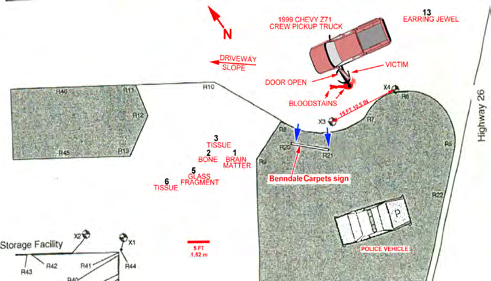
Figure 2. The shooting scene drawing provided in the discovery; the victim, truck and bloodstains graphics were redone due to poor copy quality. The truck’s driver side door was open and the victim was lying under it. The red graphics/lettering by the author, and the scale of the scene drawing was verified. The driveway slope is slightly downward in the direction of the arrow. Blue arrows indicate the locations on the Benndale Carpets sign that was hit with blood/tissue spatter.
Blowback
Backspatter is “blood drops which can be produced when a projectile creates an entrance wound” [16], when the firearm muzzle is contact, near contact, or close intermediate range to the head, the discharge injects propellant gas into the entrance wound along with the projectile. The propellant gas that exits through the entrance wound not only can carry blood, but other tissues (skin, bone, brain matter etc.).
This phenomenon has been described as “blowback” by some authors (e.g., Shields LB, et al. [17]). In Johnson, the entrance was also the exit wound where the blowback from the shotgun discharge included shot and shot fragments along with blood and other tissue.
The interior driver side door of Johnson’s truck Figure3A shows that blowback occurred where blood and tissue coated part of the window’s remaining tempered glass fracture mosaic (Figure 3B circled area).
Tissue debris also coated the door mirror (Figure 3C) which is evidence that the victim’s head was close to the window at blowback. A close-up image of the remaining window shows the extent of the blood and tissue covering it (Figure 3D, from lower left circled area of Figure 3B).
The victim’s earring post was attached to the lower windowsill (Figure 3E, arrow) and its jewel separated and deflected off the sill to the location indicated in Figure 2 (evidence item 13) due to the shotgun blast. There were only a few small blood spatters associated with the surface of the door sill surrounding the earring post, which indicates that the earring was blown from the victim’s pinna by the shotgun blast, not by blowback. The distance from the truck’s driver side door to the earring jewel was approximately 6.7 m (22 feet). The earring jewel separated from its post in the shotgun blast, bounced off the door windowsill to the pavement at the rear of the victim’s truck.
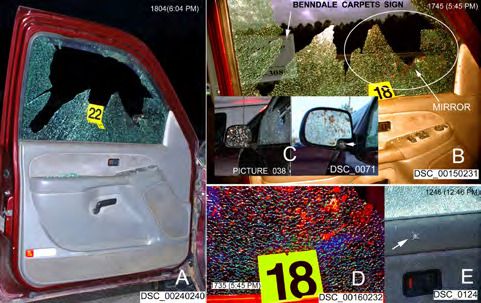
Figure 3. A. The driver side interior door of the victim’s truck showing the windows tempered glass fracture mosaic. B. The image of the interior door window had been red enhanced using Photoshop/Image/Adjustments/ Color Balance to show extensive blood/tissue spattering on the window. C. Two images of the driver side door mirror, which show extensive tissue spattering. D. Close- up of the window where red was enhanced in Photoshop/ Image/Adjustments/Color Balance to show detail of the coating of blood and tissue at the lower left part of the window circled in B. E. The victim’s earring base attached to the windowsill at the arrow; only small blood spatters are nearby.
Glass Shards on the Pavement
Tempered glass, when subject to a force that fractures it, has two features: 1) the initial shock creates a fracture mosaic, which can include partial (e.g., Figure 3A) to full break-out of the glass. 2) Any remaining fracture mosaic glass of the window is fragile and subject to collapse by vibration or touch [18].
Glass shards were deposited onto the pavement from the driver side window at three different times.
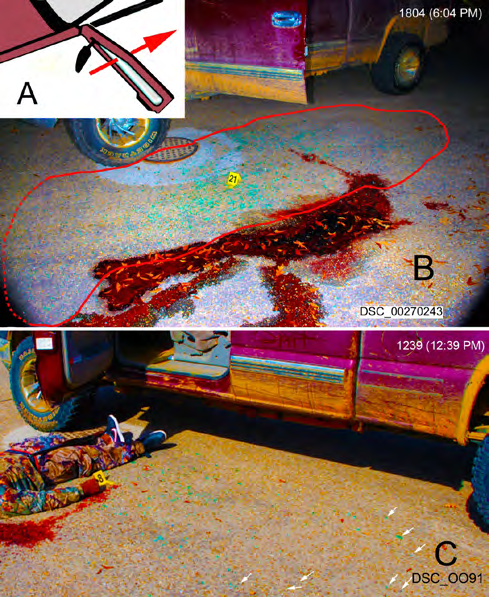
Figure 4. A. Graphic showing the direction of the initial breakage from the driver side door window that projected glass shards toward the rear of the truck. B. Distribution of glass shards on the pavement with the body removed (time stamp 1804 (6:04 PM)); the glass shards on the pavement were from the initial breakage with shard projection to the rear tire. The red outlined area is the approximate demarcation of the glass shards on the pavement. The red line is dotted on the left due to the glass shards extended beyond those shown in the image. Adjustment by Photoshop/Image/Adjustments/Vibrance tool accentuates the glass shards (blue) on the pavement. Adjustment by Photoshop/Image/Adjustments/Vibrance tool accentuated the glass shards (blue) on the pavement. C. Distribution of glass shards on the pavement (time stamp 1239 (12:39 PM)); the glass shards on the pavement extend to the rear tire. Some of the glass shards are indicated by the arrows.
The first occurred from the initial breakage/fracturing where the breaking force was to the outside of the open door (Figure 4A) and had sufficient force to project glass shards as far as the rear tire of the truck (Figure 4B and 4C). Only one glass shard was found on the victim’s clothing (Figure 6A), at arrow and none on his left shoe (Figure 6A, insert). If the victim was standing within the area of the glass projection at breakage, the area of glass shards on the pavement, without a void, and the lack of numerous glass shards on his clothing indicate the victim was not within the glass fragment projection when it occurred.
The second glass shard project from the truck door window mosaic was by blowback, which propelled one glass fragment as far as evidence marker 5 (Figure 2).
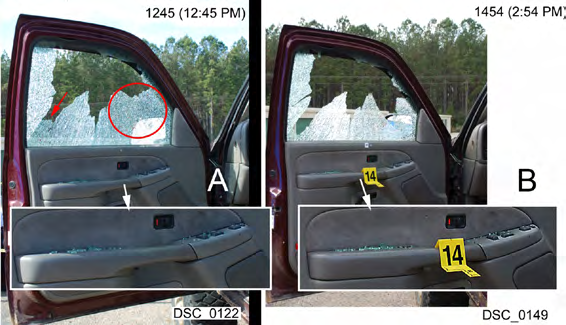
Figure 5. A. The appearance of the truck window at early afternoon (1245 (12:45 PM)); the circled area has the spattered blood and tissue from blowback as well as the subsequent loss of glass (see B). Red arrow points to the other area of the window where glass loss occurred. Backlighting prevents seeing blood and tissue coating on the window in this image (see Figure 3C). Inset: enlargement of armrest showing accumulation of glass shards from the initial window break. B. Image shows the collapse of some of the glass from the window, which occurred between 1245 (12:45 PM) and 1454 (2:54 PM); the inset of the armrest glass shards showed few shards were added, which means the additional collapse of the tempered fracture glass mosaic was mainly towards the exterior side of the open door.
Between 1245 (12:45 PM) and 1454 (2:54 PM) a portion of the fractured tempered glass still in place (Figure 5A) collapsed (Figure 5B) onto the pavement (third deposition). This deposition was mostly exterior to the open truck door and away from the body. Some of the glass fell on the armrest on the interior side of the door (compare the armrest images (insets) Figures 5A&5B).
The force that caused this later collapse was to the interior window of the open door or the door was swung hard open.
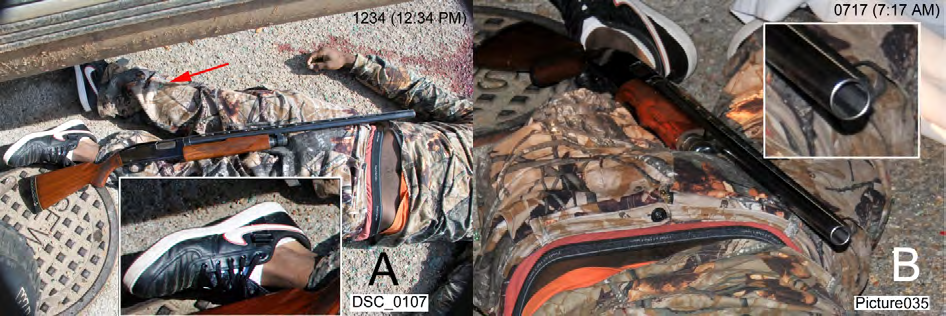
Figure 6. The Sears M200 12 gauge shotgun. A. Despite being identified as the source of the fatal wound to the victim, the shotgun had no associated blood or tissue; inset: enlargement of the victim’s left shoe showed no associated glass shards. Arrow points to the single glass shard on victim’s pant leg. B. Another view of the shotgun; tissue and blood would be expected to cover the victim’s shotgun if this was the shotgun used in his death. Inset: no blood of tissue was evident in the bore of the shotgun.
The Shotgun
The shotgun barrel should have been hit with blood due to the massive blowback, brain tissue, etc., which usually occurs in either suicide or homicide scenarios by a near contact shotgun discharge to the head [15]. The exterior of the shotgun had no tissue contamination (Figures 6A&6B). No tissue was within the bore of the shotgun (Figure 6B, inset). Another shotgun discharged into the victim’s head.
The 12 gauge shotgun has the strongest recoil of most firearms [19]. The trajectory of the pellets in the head [2] and the blowback, which occurred near the truck door window (Figure 3), would have the shotgun elevated off the ground and unsupported in the suicide scenario. The close proximity of the victim’s head to the door window and the angle at the shotgun’s discharge would mean more than half the shotgun would be on the exterior side of the door window. In the suicide scenario, the victim somehow managed to reach the trigger on the exterior side of the window after breaking it with the shotgun stock. Upon the discharge in this scenario, the unsupported shotgun recoil would propel it through the widow, away from the victim. The victim’s shotgun was on top of his body (Figure 6).
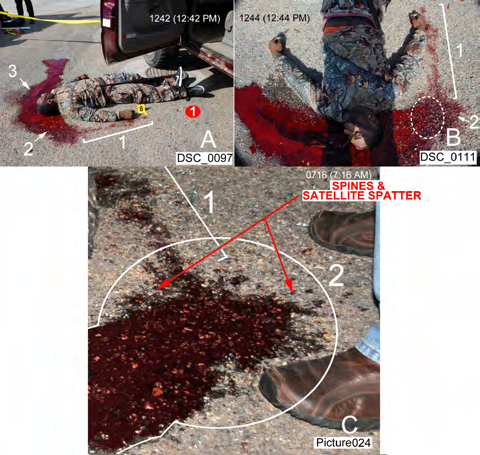
Figure 7. Pavement bloodstains; stain numbers 2 and 3 correspond to the numbered body positions (see text). The body was moved twice before its final found position. A. Image of the body and associated stains; blood trail 1 documents that the body was moved from the position where he collapsed (at the red dot) following the shotgun discharge. Blood trail 1 goes from the stain just in front of the right hand to the larger stain 2. Bloodstain 3 originated from the body at position 3 as shown. B. As in A, but image was taken with the photographer standing near the victim’s head with his shadow over the body; the dashed line oval is the probable location of the victim’s head in body position 2. C. Image of stains 1 and 2; a spattering event (splash pattern) occurred in circled area of stain 2 when the head was elevated above the pavement prior to setting the body down in position 2. The blood came from the massive, vessel-like head wound (Figure 1A) when the head was turned to the left while elevated above the pavement, poring blood onto the pavement which created a pool with the spines and satellite spatter due to splashing. Image was probably taken at 0616. The driveway pavement was sloped down to the west as evidenced by the blood flow (e.g. Figure 7A).
Bloodstains on the Pavement
The victim vertically collapsed after the shotgun discharge. The bloodstains labeled 1 in Figure 7 was a trail, which originated from the initial victim collapse location (at the red dot in Figure 7A). The trail led to a pool. Blood had quickly filled the massive vessel-like head wound (Figure 1A) and created a splash pattern on the pavement (Figures 7B&7C) when the victim’s head turned left while he was elevated above the pavement. Blood spilled from the vessel-like wound and into the developing pool, the blood-onto-blood splashing created spines and satellite spatter (Figure 7C).
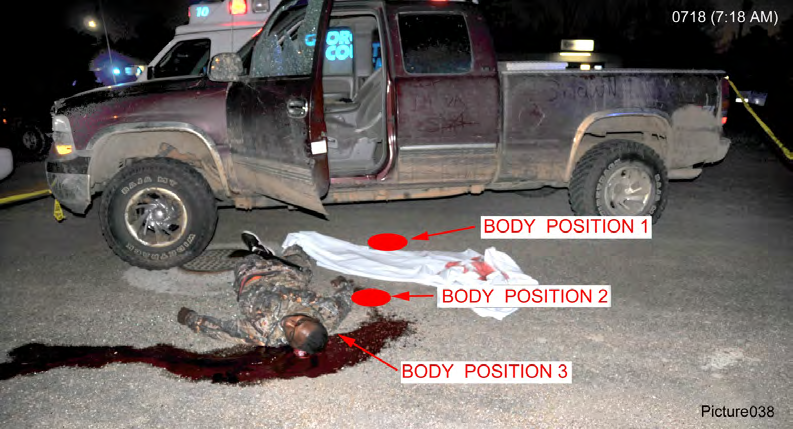
The bloodstains on the pavement document Johnson’s body was moved two times.
A demarcation between the bloodstain pool deposited when the body was on the pavement at position 2 and the final position can be seen in Figure 8A at white arrow. The blue arrow in Figure 8A points to blood flow from the mouth when the head was face up or turned to the right. The extent of stain 2 is outlined in Figure 8B. The dashed line approximates where stain 2 merged with stain 3.
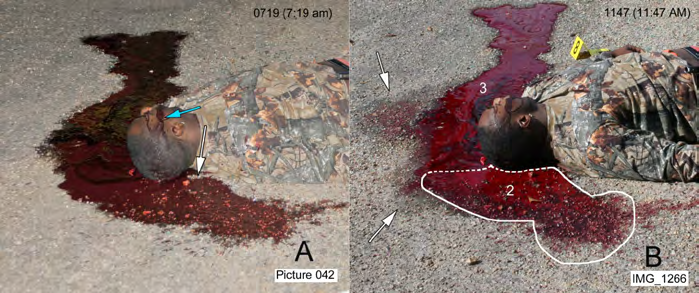
Figure 8. Bloodstains 2 and 3 and the result of covering the body with a sheet. A. Image taken at 0719 (likely ~ 0619 (6:19 AM)) showing a gap in the stain near the victim’s neck (at white arrow) which was not present in the images taken later. Blood flow from the victim’s mouth occurred when his head was facing up or to the right (at blue arrow). B. The stain gap at the arrow in A provides demarcation estimation between the blood deposited when the body was at position 2 (Figure 7) and the final position 3 of the body. Bloodstain 3 originated from the final position of the body. The white outline is the estimated extent of the stain when the body was at position 2 to where the blood flow from body position 3 added to the stain from the victim at position 2 (estimated at dashed line). Arrows point to the stains caused by blood and serum wicking by the cloth sheet placed over the body.
Bloodstain Modification by Body Covering Sheet
The consequence of the sheet covering the body is a modification of the bloodstain. Figure 8A is an image of the unmodified stain. Figure 8B, taken more than four hours later, shows the result of the placing a sheet over the body. Blood and serum wicked by the body-covering sheet created blood/serum stains (Figure 8B at arrows) from the large blood pool.
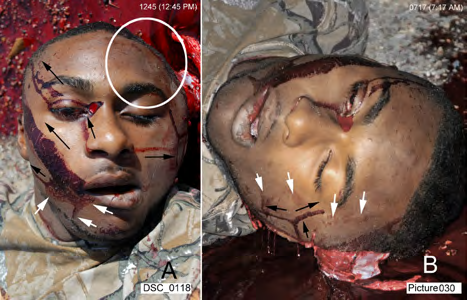
Figure 9. A. Bloodstains on the victim’s face; black arrows indicate the direction of blood flow when each stain was created. The head had changed positions from the time of the shotgun discharge to the position shown in the scene images. The victim’s forehead came in contact with dirt (circled). The white arrows point to a blood wipe that occurred immediately after the shotgun discharge by an assailant’s hand when the body was being moved. B. Transfer stains (white arrows): the time stamp on this image was likely 0617 (6:17 AM) or within one hour of the shooting; the bloodstream from the victim’s left nostril shown in A had not yet occurred. Three changes in the body position occurred, which are reflected by the Y-shaped stain. These bloodstreams could not have occurred in the found body position if the victim fell to that position immediately after the shotgun discharge. Black arrows show the direction of the blood flow. Transfer stains (at white arrows) occurred before the “Y” arms of the bloodstream. This image was color adjusted by Photoshop/Image/Adjustments/Hue-Saturation.
Bloodstains On The Victim’s Face
The bloodstains on the face of the victim (Figure 9) provide additional evidence of the movement of the body immediately after the fatal shot. Dirt on the victim’s forehead (Figure 9A, circled area) indicates that his left forehead came into contact with the pavement. The black arrows in Figure 9A indicate blood flow directions. The stains on the victim’s right face (Figure 9B) show his head was face down on pavement for a short time. This blood, which originated from his mouth, flowed along his cheek and then to the ground and may have contributed to the stain trail 1(Figure 7). Another source for stain trail 1 was from the massive shotgun wound on the left side of the victim’s head (Figure 1A).
A blood wipe was on the victim’s face (Figure 9A, white arrows). Its dried appearance, like the large blood flow from the victim’s mouth to his right pinna, indicates that these two stains occurred within a short time, likely seconds, of each other. The victim’s head was initially near the evidence marker 8 in Figure 7A, following the shotgun discharge.
The Y-shaped rivulet on the victim’s left face (Figure 9B), which originated from the shotgun wound, indicated changes in the head positions occurred within seconds of the wounding. The base of the Y stain showed that the victim’s head was face down immediately after wounding when his forehead contacted the pavement. The head position then momentarily became vertical (the left arm of the Y-shape stain), which was followed by the head angle changing to a third position (the right arm of the Y-shaped stain).
The latter blood flow was approximately at the same angle as the blood flow from the victim’s mouth on his right face (Figure 9A).
Before the creation of the two arms of the Y-shaped bloodstain, multiple transfer stains (Figure 9B, white arrows) were on the victim’s left face, under the two arms of the Y-shaped stain. The victim’s head/body was manipulated immediately after the shotgun discharge by blood-contaminated hands.
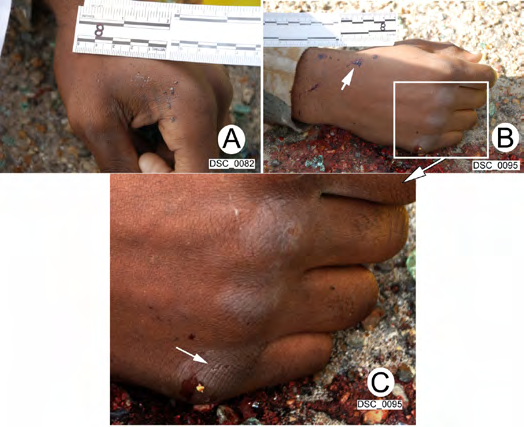
Figure 10. A. Left hand of the victim; the hand was in contact with the road pavement where it picked up dirt. B. Right hand of the victim; the bloodstain at arrow has dirt associated. Arrow points to dirt associated with bloodspatter. C. An enlargement of the outlined area in B, which shows the victim’s knuckles were abraded; a small amount of skin was more deeply abraded at the arrow.
The Victim’s Hands
The victim’s hands had dirt on them Figures 10A&10B indicating that these surfaces had been in contact with the pavement before the body attained position 3. The right hand knuckles (Figure 10C) also had abrasions, which were not reported in the autopsy report [2]. The victim appeared to have been punching at his assailants before his death although he could have obtained these abrasions in a high school football game two days earlier.
Stun Gun Discharge Wounds
Two small wounds were on the victim’s right lateral mid- lumbar region (Figure 11A and Figure 11B at red arrows). Notable is a halo of hyperemia approximately 10 cm from the wounds (Figure 11B). The inferior wound (Figure 11C, left) appears superficial, dispersed and roughly square. The superior wound (Figure 11C, right) appears to have had skin penetration. An oval brown discoloration was within the hyperemic region of this wound, suggesting penetration and perhaps singeing. However, some wounds keep margins somewhat reddened (hyperemic) as the refrigeration in the morgue reoxygenates the areas that subject to a small loss of the superficial layer of the epidermis. The distance between the wounds was approximately 3.7 cm using the scale shown in Figure11A.
![Figure 11: Wound evidence of the stun gun used in the victim’s attack. A. Two small wounds were on the victim’s right lateral mid-lumbar posterior torso skin. B. Enlargement of the area in the square in A; image was color adjusted by Photoshop/Image/ Adjustments/Hue/Saturation to accentuate the halo of hyperemia about 10 cm from the wounds. C. Additional enlargement of this wound area reveals the two wounds have different shapes. D. Similar wounds were attributed to a stun gun in the1996 JonBenet Ramsey homicide case; images downloaded from the Internet via Google. E. The Air Taser 34000 without its taser dart projection module; this Taser model ceased production in 1998 [20]. F. The Air Taser 34000 face without its taser module showing its electrodes; the two electrodes are flat, copper or copper plated tabs (image from [21]). The right electrode (inset) was forcibly lifted, breaking away part of the electrode housing (note scratch marks), likely to achieve better skin contact, thus converting the taser into a stun gun. The two electrode central distance between the two was approximately 3.7 cm.](/fulltextimages/12150/fig_11.png)
Figure 11. Wound evidence of the stun gun used in the victim’s attack. A. Two small wounds were on the victim’s right lateral mid-lumbar posterior torso skin. B. Enlargement of the area in the square in A; image was color adjusted by Photoshop/Image/ Adjustments/Hue/Saturation to accentuate the halo of hyperemia about 10 cm from the wounds. C. Additional enlargement of this wound area reveals the two wounds have different shapes. D. Similar wounds were attributed to a stun gun in the1996 JonBenet Ramsey homicide case; images downloaded from the Internet via Google. E. The Air Taser 34000 without its taser dart projection module; this Taser model ceased production in 1998 [20]. F. The Air Taser 34000 face without its taser module showing its electrodes; the two electrodes are flat, copper or copper plated tabs (image from [21]). The right electrode (inset) was forcibly lifted, breaking away part of the electrode housing (note scratch marks), likely to achieve better skin contact, thus converting the taser into a stun gun. The two electrode central distance between the two was approximately 3.7 cm.
In the JonBenet Ramsey homicide (Dec 25, 1996), two small wounds were found on her body and another two on her face were attributed to a stun gun by some investigators. However, a stun gun involvement in her death was disputed [22, 23]. These wounds are distinctive in that they appear to be burns (Figure 11D, top). On her abdomen one was square (Figure 11D, left) and the other was smaller and elongated (Figure 11D, right).
The Air Taser 34000 was manufactured from 1994 to 1998, and came in two parts: the handle power source and the dart/electrode projection module or taser [24]. When the dart projection module is removed (Figure 11E) two flat copper-colored electrodes are revealed. It appears that a requirement to convert the base taser to a stun gun necessitates forcibly lifting one of the electrode tabs (Figure 11F, right inset). The Air Taser 34000 base unit shown with this modification Figure 11F is consistent with the wounds with the JonBenet Ramsey (Figure 11D). The distance between the wounds was 3.5 cm when measured from the center of each [23].
The difference between these wounds in Johnson (3.7 cm) and those of Ramsey (3.5 cm) appears due to the one electrode (the right one in Figure11F) had been bent to 90 degrees in Johnson, increasing this distance by 2 mm. Evidence that an electrical current was applied via a stun gun to Johnson was the victim’s clothing (3 shirts, Picture 005 [12]) and skin impedance reduced the electrical current to cause vasodilatation [25], which generated a halo of hyperemia approximately 10 cm from the wounds (Figure 11B). This halo remained at Johnson’s death and although distinctive, was not noted in the autopsy report [2].
Love Card on the Truck’s Instrument Panel
Figure 12 shows a 7.6 x 20.3 cm (3 X 5 inch) card on the instrument panel area of the victim’s truck at three different times during the shooting scene processing. This is a hand- written love note (Figure 13). Figure 12A, an image likely taken at 0609 (6:09 AM), shows the original position of the card on the instrument panel of the victim’s truck. The victim did not place the card there simply because it was not in a stable position and there is a transfer stain on the card’s top left corner (Figure 13B). The card was also slightly bent (Figure 12A, arrow).
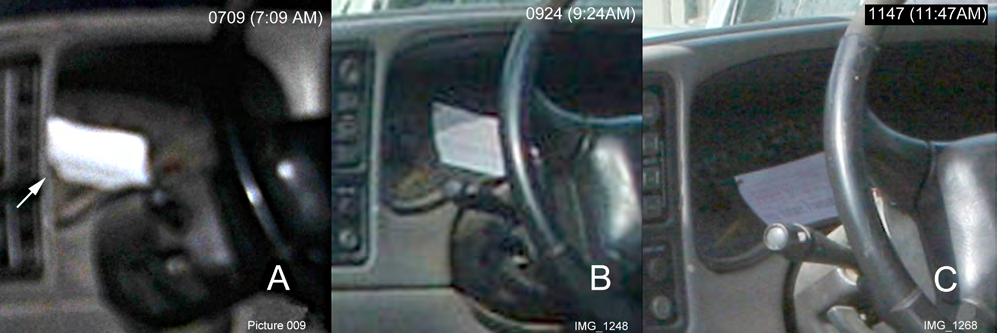
Figure 12. Images taken at different times of the victim’s truck instrument panel with the love card (see Figure 13). A. Image taken at 0709 (7:09 AM); the time stamp is likely off by an hour would mean this image was taken at 0607 or within an hour of the victim’s death. This image is out of focus. However, there is enough focus and resolution to show that the card is slightly bent at the arrow and positioned with its left side propped on the side of the instrument panel and its right lower corner on the steering column base bracket. Image sharpened by Photoshop/Filter/Sharpen/Unsharp Mask. B. Image taken at 0924 (9:24 AM) and is enlarged by pixel addition (Photoshop/Image//Image Size/Pixel Dimensions – pixels added), but due to low resolution of the original image, is pixilated. The card is now fully on the instrument panel. It is in this card position that a secondary transfer bloodstain occurred (Figure 12B). C. By 1147 (11:47 AM), the card had shifted from the position shown in B.
Before 0924 (9:24 AM) the card had been flattened and moved more onto the instrument panel (Figure 12B). The position of the card at 1147 (11:47 AM) shows that it had moved again (Figure 12C) although this time it likely shifted without human assistance.
As of this writing, the origin of the card is unknown and who “Shelley” is Figure 13A. The bloodstain on the card (Figure 13B) is a transfer, which likely occurred immediately after the shooting. The person who placed the card was contaminated with the victim’s blood. Enough blood was associated with the transfer and was wet for there to be secondary transfer (Figure 13B, at upper pair of white arrows). The poor focus of image (Figure 12A) and the card’s relative brightness makes the stain, likely present at this time, undetectable. The secondary bloodstain transfer to the instrument panel surface occurred when the card was in its second position (Figure 12B).
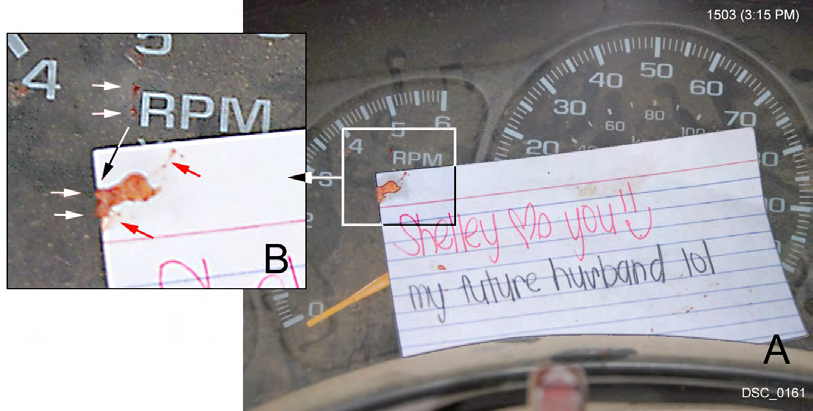
Figure 13. A. The instrument panel love card; the upper corner (in square) is a transfer bloodstain. B. The enlargement of the edge of the card shows the transfer bloodstain, which had an edge accumulation of blood that secondarily transferred to the instrument panel surface (upper pair of white arrows); this occurred at the time the card attained the position shown in Figure 12B. The pattern of the transfer corresponds to under-card edge blood accumulation on the card (at lower pair of white arrows). The bloodstains at the red arrows are associated with the main transfer but had just a small amount of blood transfer.
Despite the card offering critical information that likely would lead to those responsible for this homicide, it was not collected as evidence and could have remained with the truck when it was returned to the victim’s family.
Reconstruction
The victim drove into the driveway of a small business park, followed by the police officer. Upon stopping, the victim got out of his truck, leaving his vehicle’s door open. Two or more assailants attacked him. The struggle with his attackers either started away from the truck or he could have been pulled from his truck. There appeared to have been no physical contact with the dirty truck (Figure 14) during the attack. At this point, another assailant proceeded to the front left of the truck so that the truck’s door was between him and the victim struggling with his assailants. He thrust the muzzle of a 12 gauge shotgun through the window projecting tempered glass shards to the rear of the truck (Figure 4). An assailant discharged a stun gun to the victim’s right lateral lumbar region of his abdomen (Figure 11) while he was apparently punching at his assailants, abrading his right- hand knuckle (Figure 10C) although he could have received the abraded knuckles during a football game two days before. It appears that the physically associated victim/assailants were not within the projection area of the glass when the breakage occurred because only one glass shard was detected on the victim’s clothing (Figure 6A, arrow). No void in the pattern of the shards on the pavement was detected.
The assailants maneuvered the victim so that his head was within inches of the open interior truck door with the shotgun muzzle projecting from the broken window. The assailant’s 12 gauge shotgun was discharged with the muzzle at near contact to the left side of the victim’s head. The discharge of the shotgun dislodged the victim’s earring from his pinna with sufficient force to not only separate the earring’s jewel from its base but embed the earring base in the vinyl of the truck door’s windowsill (Figure 3E). The earring jewel bounced off the door windowsill to the location at the rear of the truck (Figure 15, item 13).
Moreover, if the victim had broken the truck window during his alleged suicide, most of the glass shards would have been on the exterior side of the open truck door, which is not the case (Figure 4).
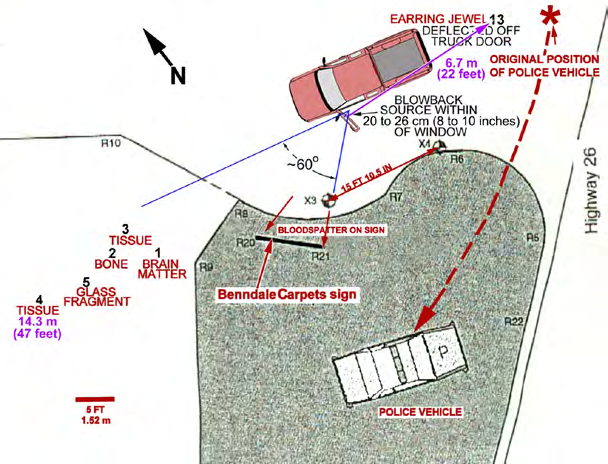
Figure 15. Estimation of the distance of the victim’s head from the interior window; the tissue spatter on the door’s mirror, tissue (item 3), and the east spatter on the Benndale Carpets sign (R21) mark the sides of a spatter triangle, which places its vertex (the victim’s head) roughly 20 to 26 cm (8 to 10 inches) from the interior surface of the door window when blowback occurred.
The blowback sent tissue as much as 14.3 m (47 feet) from the victim (Figure 15, item 4). The west border of the triangular area of tissue blowback was marked by evidence item 3 and the east border was marked by the Benndale Carpets sign (R21) (Figure 15). The diameter of the window spatter is about half the width of the window (Figure 5). Spatter covered the door rearview mirror. Using these scene features, we estimate an angle of about 60 degrees (Figure 15). When projecting back on the triangular area to the truck interior window, the blowback was 20 to 26 cm (8 to 10 inches) source point from the interior side of the truck door window. Tissues were projected through the iris-like window remnant and onto the remaining tempered glass fracture mosaic window (Figures 3B&3C). The shooter and his shotgun would also have been hit by tissue blowback.
Following the discharge of the shotgun into the victim’s head, he vertically collapsed into position 1 (Figure 14) with his head down, bloodstreams flowed onto his face (Figures 9A&9B) and his forehead was momentarily on the pavement where it picked up dirt on his forehead (Figure 9A, within circle). Transfer/wiped bloodstains were associated and under these bloodstreams (Figures 9A&9B), which indicates that the body was handled by at least one blood-contaminated assailant immediately after the shotgun discharge.
The Y-shaped stain (Figure 9B) reflects the blood flow that resulted in at least three positions of the head. The blood transfer from assailant to victim (Figure 9B at white arrows) occurred during the early staging of the victim’s body before the creation of the Y-shaped blood flow.
The moving of the body from position 1 to position 2 (Figure 14) left a trail of blood (Figure 7, at 1), which came from both the entrance wound and blood flow from the victim’s mouth (Figure 9A). At bloodstain 2 (Figure 7) is a large stain that has spines and satellite spatter. This was created when the victim’s head was elevated above the pavement and his head turned left spilling blood from the vessel-like wound (Figure 1A) before placing the body down where additional bleeding from the wound added to the blood pool, which flowed west (Figure 8). The body was moved again to its final position (Figure 14, BODY POSITION 3) where the blood pool 2 was joined by the blood pool 3 (Figure 8). The demarcation of the two blood pools is estimated in Figure 8B. The victim’s heart was beating for some time after he was shot.
Officer Kevin McDonald (Mississippi Department Wildlife & Fisheries) was at the shooting scene within minutes of the radio call by Officer Sullivan at 0530. Officer MacDonald noted, “There was also a shotgun on the scene laying [sic] not approximately two to three feet from the subject on the ground” [26].
The staging was completed by placing the victim’s shotgun on the body (Figures 6 and 7A), which occurred after game warden McDonald left the scene.
The victim’s shotgun was not used in this homicide because no spattered blood/tissue was detected on the shotgun or within its bore at the muzzle.
The victim’s head position was within 20 to 26 cm (8 to 10 inches) of the truck door window when shot. Even if this distance was as much as 30 cm (12 inches), it would still not allow for the positioning of the shotgun in the suicidal or accidental (e.g., Figure 16A) discharge of the shotgun. Given the shot trajectory in the victim’s head, the shotgun’s recoil at discharge would have projected it away from the body.
The 12 gauge casing shell could have been transferred from assailant’s shotgun to the victim’s shotgun. This homicide reconstruction predicts that the casing in the victim’s shotgun was fired by another shotgun (unless a casing was left in the shotgun from a previous discharge by the victim). Examination of the firing pin and breach- face marks on the 12 gauge shotgun casing recovered from the victim’s shotgun and comparison to test-fired casings from that shotgun might show that the casing remaining in the shotgun was not fired by that shotgun. The firearm examiner’s report did not have a toolmark examination of the 12 gauge shotgun casing found in the victim’s shotgun.
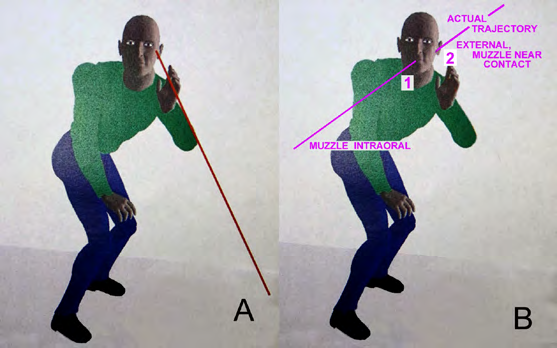
Figure 16. A. Graphic of the Billey Joe Johnson “accidental” death scenario presented to the George County Grand Jury, which showed an incorrect shot trajectory (simulated by the red line). B. Trajectory at 1: The suicide scenario where the shotgun muzzle was inserted into the victim’s mouth and discharged. The exit wound is at the left side of the victim’s head in this scenario. Trajectory at 2: The corrected graphic of the trajectory of the shot from the shogun discharge; the shot was from left to right and upward from the mouth or in terms of shotgun discharge origin, the trajectory of the near contact discharge was downward from the left ear to the mouth.
The act of an assailant at the scene was the placing of a 7.6 x 20.3 cm (3 x 5 inch) card to the left of the truck’s steering wheel column (Figure 12A). The card was initially partially folded when placed on the truck’s dash (Figure 12A, arrow). During the processing of the scene by the police and criminalists, by 0924 (9:24 AM), the card had been flattened and moved from its unstable position (Figure 12A) to be directly on the instrument panel (Figure 12B). Before 1147 (11:47 AM), the card had shifted counter clockwise (Figure 12C).
The transfer bloodstain on the card was from a blood- contaminated assailant. The flattening of the card and repositioning it one, perhaps two, times during the processing of the scene indicates a processor or official who had access to the scene was modifying it.
Conclusion
The Victim Died by Accidental Discharge of Dropped Shotgun (Figure 16A)
The Mississippi Medical Examiner, settled on accident as the manner of death. “I think most convincing evidence of that the gun fired when it was dropped” [7]. This determination was based on a Mississippi crime lab’s firearm expert who dropped the victim’s 12 gauge shotgun on its muzzle, which caused it to discharge [27] but contradicts trajectory.
The George County Grand Jury allegedly interviewed 30 witnesses and reviewed 65 exhibits [3]. Only one of these exhibits was available for this study, which was a summary graphic presented to the jury showing the trajectory of the alleged accidental discharge of the shotgun (Figure 16A). This bizarre scenario, which is illustrated by this graphic (Figure 16A), the entrance wound is at an incorrect trajectory angle. A dropped shotgun’s muzzle would not be in the victim’s mouth, the blast of which would be directed towards his face.
The Victim Died by Suicide (Figure. 16B 1)
Soot was found in the mouth of the victim [2], in which other forensic pathologists [5, 8, 9] concluded was due to an intraoral discharge of the shotgun, despite the ME’s observation, that the “left lateral surface of the tongue has a large ragged ballistic defect” [2] which would be below the shotgun muzzle discharge in this scenario. If the shotgun was discharged intraorally, with the exit through the left side of his head, the glass fragments from the consequential breakage of truck door window would be projected to the front of the truck, not towards the rear. The lack of lacerations at the corners of the victim’s mouth for an intraoral firearm discharge [15, 28] supports the ME’s conclusion the entrance also was the exit wound [2]. Ten autopsy images are missing (Table 1) and if these had been included in the discovery and if reviewed by these pathologists, could have resulted in a manner of death conclusion other than suicide. It appears that none of the forensic pathologists, even the ME, reviewed the shooting scene images.
Even in the suicide scenario (i.e., inserting the shotgun muzzle into his mouth and discharging) was the manner of the victim’s death, it does not refute the evidence of close association of individuals at the scene who manipulated the body quickly after the shotgun discharge.
The Victim Died by Homicide (Figure 16B 2)
The massive head wound (Figure 1A) was both the entrance and exit wounds [2].
The truck’s driver side window was broken prior to the shotgun discharge which projected glass shards to the rear tire of the victim’s truck. The exterior near contact shotgun discharge not only projected the victim’s earring base into the windowsill without accompanying blood and its jewel bounced off the sill to behind his truck (Figure 13).
The body was moved twice after the shotgun discharge to stage the body showing that persons were in close proximity to the victim when the shotgun discharged. A person who handled the victim or was the shooter placed the love note on the truck dash transferring blood to the card. Multiple assailants were involved: one person firing the shotgun (not the victim’s shotgun), two or more holding the victim, applying the stun gun to the victim’s lower right lateral abdomen, and positioning him to be shot near the interior part of the open truck door with the shotgun barrel sticking through its broken window. The lack of spatter on the victim’s shotgun indicates it was not the shotgun which discharged.
The victim was not the shooter by a shotgun that was not his.
Mistaken Expert Opinion
The ME’s report [2] apparently missed both the victim’s abraded right knuckle and stun gun wounds on his right lateral lumbar abdomen.
Forensic pathologist 1 noted that it was “highly probable that this self-inflicted wound given the scene and circumstances of the case” [8]. Even if she did examine the scene images she was not familiar with bloodstain pattern analysis. When forensic pathologist 2 was asked if Billey Joe Johnson killed himself, he replied, that it was “highly probable-whether intentionally or accidentally.” But when asked if “someone else may have shot him,” he noted, “this really requires looking at all the case information, which I do not have the time to do” [9].
References
-
Sullivan J (2008) BJJ witness review and log: interview transcript police officer witness – 14/08/2008 trt:11:09. George Country Sheriff’ S Department pp: 1-2. www. meixatech.com/johnson-officer.pdf
-
Lewis A (2008) Autopsy Report: Johnson, Billey Joe, Jr. mississippi state examiner medical office pp: 1-4. www. meixatech.com/LEWIS-AUTOPSY1.pdf
-
(2009) George County Grand Jury. Death investigation of Billey Joe Johnson, Jr., accidental death by shotgun. www. meixatech.com/johnson-gjreport.pdf
-
Moossy RJ (2011) Letter to Billey Joe Johnson Sr. Civil Rights Division, United States Department of Justice Mississippi. www.meixatech.com/johnson-doj.pdf
-
(2009) US Department of Justice, Civil Rights Division 2011. Notice to Close File, Investigation of the death of Billey Joe Johnson. www.meixatech.com/johnson-doj. pdf
-
Reveal: The Center for Investigative Reporting. PO Box 8307, Emeryville, CA 94662. https://revealnews.org
-
Lewis A (2018) Interview Transcript- The autopsy of Billey Joe Johnson Jr. www.meixatech.com/LEWIS- AUTOPSY2.pdf
-
Melineck J (2018) Autopsy Review. pp: 1-2. www. meixatech.com/johnson-melinek.pdf
-
Weedn V (2018) Review of Autopsy on Background. pp: 1-2. www.meixatech.com/johnson-weedn.pdf
-
Mississippi-Goddam the Ballad of Billey Joe. https:// revealnews.org/mississippi-goddam/
-
Burnett BR (2016) Analysis of Fraudulent photographs submitted to Federal Court and the United States Congress. J Forensic Res 7(5): 1-8.
-
(2008) Billey Johnson - Shooting scene images. Mississippi Department of Justice Crime Lab pp: 1-314. www.meixatech.com/johnson-sceneimages.pdf
-
(2008) Billey Johnson- Autopsy images . Mississippi Department of Justice Crime Lab pp: 1-71. www. meixatech.com/johnson-autopsyimages.pdf
-
Geberth VJ (2013) The seven major mistakes in suicide investigation. Law & Order Magazine 61(1): 54-567. www.practicalhomicide.com/Research/7mistakes.htm
-
DiMaio VJM (2021) Gunshot wounds: practical aspects of firearms, ballistics, and forensic techniques, In: 3rd (Edn.), CRC Press, USA, pp: 1-378.
-
Rotter G, Agostini V, Borrini M, Camana F, Capatti D, et al. (2020) Terms and definitions in bloodstain pattern analysis (OSAC/ASB). Forensic Science Communications 11(2): 1-8.
-
Shields LB, Hunsaker DM, Hunsaker III JC (2004) Trends of suicide in the United States during the 20th century. In: Tsoko M (Ed.), Forensic Pathology Review 3: 305-335.
-
Haag MG, Haag LC (2011) Shooting incident reconstruction, In: 2nd (Edn.), Elsevier, San Diego CA, USA, pp: 1-18.
-
Hawks C (2020) Shotgun recoil tables. www.chuckhawks. com/shotgun_recoil_table.htm
-
Randall (2022) Evolution of the police TASER. ThinBlueFlorida. thinblueflorida.com/?p=2703
-
Anon (2022) The original Air Taser. https:// lessleathalarms.worldpress.com/2013/01/19/th- original-air-taser/
-
Carra M (2016) The JonBenét Stun Gun Theory Is Disputed. Bustle. https:// www.bustle.com/ articles/179198-things-about-the-jonbenet-ramsey- mystery-you-need-to-know
-
Kohn D (2022) Searching: The stun gun theory. CBS News. https://www.cbsnews.com/news/searching-the- stun-gun-theory/
-
Anon (2022) Taser. Wikipedia. httpe:/e.wikipedia.org/ wiki/Taser
-
Walker J, Salo RW, Pastore JM, Mokelke E (2008) Systems and methods for electrical stimulation of blood vessels. Google Patents.
-
(2021) Mississippi Goddam Chapter 6: Mississippi Justice. Reveal. https://revealnews.org/podcast/ mississippi-goddam-chapter-6-mississippi-justice/
-
Fullilove C (2009) Dropped shotgun experiment. www. meixatech.com/johnson-shotgun.pdf
-
DiMaio VJM (1999). Gunshot wounds: practical aspects of firearms, ballistics, and forensic techniques. 2nd ed. Boca Raton: CRC Press.
-
GUWS (2024). Shotgun Wounds. https://www. hermantheshocker.com/the-dynamics-of-a-firearm- discharge-into-the-mouth/
- Narcotics and Digital Forensics: Bridging Crimes in the Digital Age
- Ethics in Forensic Psychiatry: Principles, Dilemmas, and Human Rights
- Impact of Acute Stress on Attentional Orienting to Social Cues
- Head Injury and Intracranial Hemorrhage in Western Region of Libya
- A Forensic Study on Handedness: Examination of Handwriting Features in Right and Left Handed Writers
- Techniques for Latent Fingerprint Development Using Natural and Synthetic Powders: A Review