
“Meth-Skin” in the Differential Diagnosis of Trauma in Forensic Medicine Practices: Two Cases
Introduction: Regardless of their origin, all injury cases are forensic cases. In forensic medicine practices, the factors that cause traumatic changes in the body, the localization of traumatic changes, their qualities, degrees of severity, origin and age of the wound are evaluated. One of the conditions with dermatological findings that can be confused with lesions such as blunt traumatic and cigarette burns in forensic medicine practices is prurigo, also called " meth -skin", which occurs with repeated manipulations in chronic methamphetamine users nodularis and excoriations. Cases: They are two men, aged 21 and 25, who were brought to the forensic medicine clinic at different times for a medical examination before detention. Multiple lesions were observed on the hands and both knees of one patient, and on the forehead and all extremities of the other patient. A differential diagnosis of trauma was made by evaluating the history and examination findings together. Conclusion: In order to treat the medical problems of the applicants in a timely manner and to prevent errors in the judicial process, lesions due to drug use should be kept in mind in the differential diagnosis during the examination of forensic cases. In the forensic report, these lesions should be described in detail and possible causes should be mentioned.
Introduction and Purpose
Forensic traumatology is the branch of science that examines the factors that cause traumatic changes in the body, the localization of these changes, their qualities, degrees of severity, origins, time of occurrence and other elements related to them [1]. Trauma patients should be evaluated as forensic cases and hospital records should be created accordingly. Records in patient files must be kept complete and complete [2]. Some medical symptoms and findings that can be confused with traumatic lesions may be encountered both in the forensic examination of living cases and in the forensic examination and autopsy of the dead . In addition to various social consequences of drug use, it can also cause various skin changes. Understanding the skin symptoms associated with substance addiction will enable early medical intervention and treatment [3] and will prevent misinterpretations and legal consequences during forensic examination.
Here, prurigo, a soft tissue disorder associated with methamphetamine use that is not frequently encountered in the literature, is discussed. Two different cases with developed nodularis and excoriations will be mentioned.
Cases
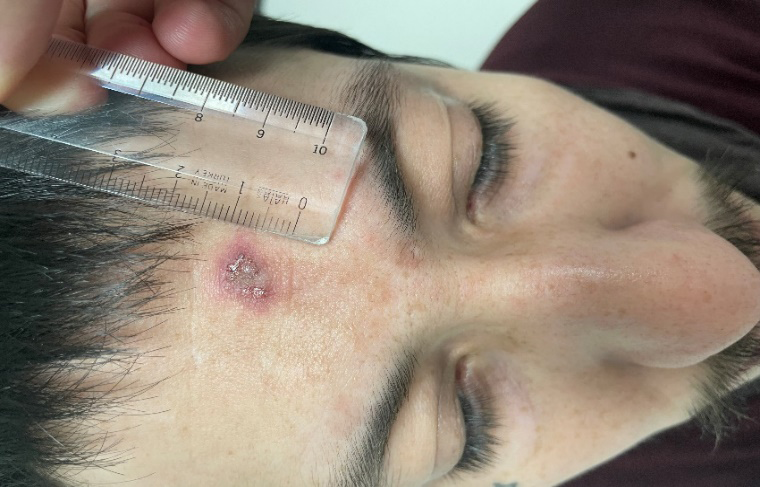
The first case, a 21-year-old male, was brought to the Forensic Medicine Unit of the University of Health Sciences Ümraniye Training and Research Hospital by police officers for a health examination before the detention process. During the examination carried out by me accompanied by a forensic medicine technician, he was found to be in the midline of the forehead, irregularly shaped with a diameter of 1 cm, with edges raised from the skin in places, and the middle. It was observed that there was a darker red lesion with hyperemia around it (Figure 1). When the history of the current wound was taken from the person, he stated that he was addicted to methamphetamine, that such wounds developed in different parts of his body from time to time, that he had a scratching sensation, that he was bleeding due to scratching, that the healing process was late, that he had previously received treatment for drug addiction and that he wanted to take it again. This situation was described in detail in the forensic report of the patient, who had no external acute or chronic traumatic lesions.
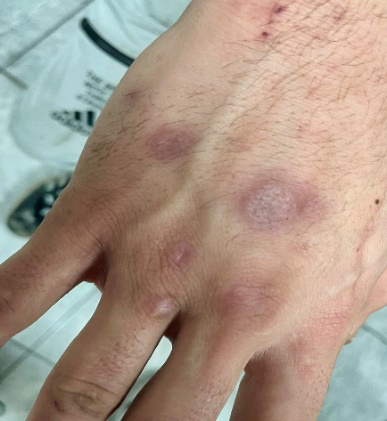
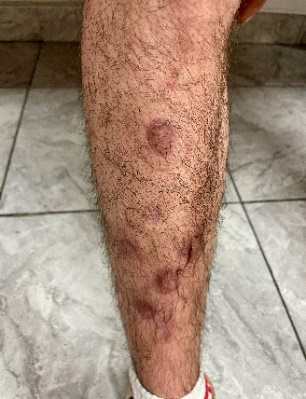
The second case, a 25-year-old male, was brought to the forensic medicine unit by police officers for the purpose of a medical examination before detention. On examination, there were a few healed lesions on the dorsal surface of the right hand , 1-1.5 cm in diameter, circular in shape, darker in color than the surrounding area, with a lighter color in the middle, and many smooth lesions, 1-2 cm in diameter, darker than the skin, on the front, inner and outer surfaces of both knees. A limited and circular shaped lesion was observed (Figures 2&3). When asked how these developed, the case stated that he was a drug addict, used methamphetamine , that he had these lesions for a long time and they did not heal, that they disturbed him, and that he wanted to be treated. This finding and situation was described in detail in the forensic report.
Discussion
Wound; It is defined as the damage caused to the body by forces of different characteristics and degrees, and is basically affected by the energy applied and transferred to the tissue. Since wounds change from the moment they first develop, their appearance also changes over time, so examining them at the earliest stage - especially in forensic cases - will prevent wounds from healing and losing their defining characteristics by treating them before they are identified [4].
Within the scope of forensic case evaluation, the wounds that physicians may encounter during all kinds of living and dead examination and autopsy must go through appropriate and competent definition, interpretation and reporting stages. In this way, the understandability and reliability of the forensic report written about the case will be ensured at all medical and legal stages [5].
Delusional parasitosis develops in long-term users of substances such as cocaine and methamphetamine, resulting in prurigo nodularis and excoriations with repeated manipulations of the skin. This condition is called "meth-skin", "meth mites" or "cocaine bugs" [6, 7, 8]. In both of our cases, delusional It has been determined that the existing lesions occur as a result of chronic scratching and delayed healing of wounds as a result of parasitosis. Additionally, in chronic substance use, pseudoacanthosis may occur , especially in the folds of the skin. Gray color and darkening, defined as nigricans, as well as the development of hyperhidrosis and bad odor, are also typical [6].
Various levels of oral symptoms may also be observed in substance abusers. One of the well-known oral side effects of methamphetamine addiction is excessive tooth decay. Tooth decay is common in chronic methamphetamine users; It is seen on flat buccal surfaces and interproximal surfaces of anterior teeth . It has been reported that cavities may also occur in cocaine and narcotic addicts [7]. It is known that a condition called "meth mouth" develops after amphetamine use and can continue for 15 years after use. In addition, xerostomia, jaw locking and teeth grinding are also present [6, 8, 9].
In the mechanism of delusional parasitosis; dopaminergic agonists increase skin picking symptoms, cocaine and methamphetamine ventral in the striatum It is reported that by increasing dopamine, it causes picking behavior in people who do not have skin picking disorder; hence opioid of antagonists ventral in the striatum It has been reported that it will be beneficial in the treatment of skin picking disorder as a result of modulating dopamine [10].
Crime scene investigation, forensic examination and autopsy are practices that require experience. Interpretation of macroscopic findings with microscopic examination, if necessary, is a part of forensic medicine processes, especially forensic autopsies. For correct diagnosis, non-traumatic wounds in the antemortem period and findings that can be called artifacts in the postmortem period must be interpreted correctly [11].
The dictionary meaning of artifact is “anything artificially produced or altered by human art” [12].
Forensic medical artifacts are considered to be any findings or changes that are seen on the body after death and that may lead to misinterpretations as an important antemortem finding and are not related to the natural condition of the tissues or the person’s illness before death. Correct identification of artifacts is important in preventing loss of time during autopsy and in correctly determining the cause and origin of death. Therefore, in forensic autopsies, it is of great importance to distinguish lesions that occur perimortem from lesions that occur as artifacts, especially during medical interventions in the last period of life [13].
In cases where there is a gap in examination in the antemortem period, dermatology consultation may also be requested. In a study, some of the cases examined after laser epilation burns were consulted to the dermatology clinic for detailed wound examination; in the vast majority of cases, the answer was given that “the detected lesions were complications due to laser application” [14]. Indeed, in the dermatology literature, “hyperpigmentation, hypopigmentation and scarring” are stated as complications that may occur at certain rates of laser epilation application [15, 16, 17, 18, 19, 20].
Wounds encountered during the examination of forensic cases do not always have to occur as a part of the forensic event. The most important way to understand this is; It is a detailed forensic medical examination and anamnesis . In both of our cases, the wounds, which were initially thought to be of traumatic origin, were examined in detail and evaluated together with other changes in the body (injection marks, oral mucosa and tooth-gum disorders), and as a result of the anamnesis taken from the cases supporting this situation, it was understood that the wounds were not of a nature to be evaluated within the scope of wounding crimes. Especially in cases where it is difficult to decide, making a multidisciplinary decision together with the dermatology team will ensure a more accurate decision in most cases.
References
-
Aşırdizer M, Yavuz MS, Zeyfeoğlu Y (2005) Adli Tıp Stajı Ders Notları. Celal Bayar Üniversitesi Adli Tıp Stajı Ders Notları, Manisa.
-
Gök E (2023) Adli Travmatoloji. Adli Bilimler ve Kriminalistik Ansiklopedisi Cilt 7.
-
Liu SW, Lien MH, Fenske NA (2010) The effects of alcohol and drug abuse on the skin. Clinics in dermatology 28(4): 391-399.
-
Mant AK (1993) Injuries and death in road traffic accidents. The pathology of trauma.
-
Ekizoglu O, Arican N (2010) Yaralar. İçinde: Birinci Basamakta Adli Tıp 2: 57-73.
-
Fink B, Landthaler M, Hafner C (2011) Skin alterations due to illegal drug abuse. JDDG: Journal der Deutschen Dermatologischen Gesellschaft 9(8): 633-639.
-
Mutlu ÖÖ, Aslan ÖÇ, Bingöl D, Kayadibi T (2014) Madde bağımlılığı ile ilişkili yumuşak doku hastalıkları. Okmeydanı Tıp Dergisi 30: 129-133.
-
Saini GK, Gupta ND, Prabhat KC (2013) Drug addiction and periodontal diseases. Journal of Indian Society of Periodontology 17(5): 587-591.
-
Trimarchi M, Bertazzoni G, Bussi M (2014) Cocaine induced midline destructive lesions. Rhinology 52(2): 104-111.
-
Odlaug BL, Grant JE (2010) Pathologic skin picking. The American journal of drug and alcohol abuse 36(5): 296- 303.
-
Özer E, Şam B, Tokdemir MB, Yıldırım A, Çetin G (2010) Medikolegal otopsi artefaktları. Adli Tıp Bülteni 15(2): 68-74.
-
Soysal Z, Eke SM, Çağdır AS (1999) Adli Otopsi Olgularında Görülen Artefaktlar. Adli Otopsi Cilt 2. İstanbul, Turkey, pp: 673-707.
-
Kar H, Dokgöz H, Bilgin NG, Albayrak B, Kaya TI (2016) Lazer Epilasyona Bağlı Cilt Lezyonlarının Malpraktis Açısından Değerlendirilmesi. The Bulletin of Legal Medicine 21(3): 153-158.
-
Sean Lanigan W (2003) Incidence of side effects after laser hair removal. J Am Acad Dermatol 49(5): 882-886.
-
Stephanıe D, Emmy GM (2013) Laser Hair Removal: A Review. Dermatol Surg 39: 823-838.
-
Bjerring P, Zachariae H, Lybecker H, Clement M (1998) Evaluation of the free-running ruby laser for hair removal: a retrospective study. Acta Derm Venereol (Stockh) 78: 48-51.
-
Wimmershoff MB, Scherer K, Lorenz S, Landthaler M, Hohenleutner U (2000) Hair removal using a 5-msec long pulsed ruby laser. Dermatol Surg 26: 205-209.
-
Eremia S, Li CY, Umar SH, Newman N (2001) Laser hair removal: long term results with a 755nm alexandrite laser. Dermatol Surg 27: 920-924.
-
Mahrukh Nisar S, Jenifer Lloyd R, Khan T (2013) Laser Hair Removal Put in the Wrong Hands. Dermatol Surg 39: 480-482.
-
Nanni CA, Alster TS (1998) A practical review of laser- assisted hair removal using the Q-switched Nd: YAG, long-pulsed ruby, and long-pulsed alexandrite lasers. Dermatol Surg 24: 1399-405.
- Narcotics and Digital Forensics: Bridging Crimes in the Digital Age
- Ethics in Forensic Psychiatry: Principles, Dilemmas, and Human Rights
- Impact of Acute Stress on Attentional Orienting to Social Cues
- Head Injury and Intracranial Hemorrhage in Western Region of Libya
- A Forensic Study on Handedness: Examination of Handwriting Features in Right and Left Handed Writers
- Techniques for Latent Fingerprint Development Using Natural and Synthetic Powders: A Review