
A Different Type of Physical Violence; Ear Amputation via Human Bite
General Information: A bite is a type of injury caused by animal or human teeth that can leave tooth marks at the wound site. Human bites may occur in cases of physical and sexual violence and sexual abuse. It is often seen on easily accessible arms, neck, trunk, cheeks, breasts and legs. One of the areas where tissue loss occurs frequently due to bites is the auricle. Case: The case presented in this article is a 21-year-old male. He has a history of being bitten on his left ear by the same person, following the two victims whose ear was bitten before him on the day of the incident. While there was no amputation in the ears of the other two people, in this case the left ear lobule was damaged. He was amputated . Although the lobule piece was stitched into place by the ear, nose and throat physician at the hospital admission on the same day, it could not provide nutrition. Conclusion: Infections that develop directly or after a human bite Since it may cause amputation, these cases should be evaluated from a forensic medical perspective. Depending on the area of amputation , evaluation of the permanent scar on the face and the permanent change of the face, the possibility of injury, if any, causing bone fractures and loss of earning capacity in the profession will be important in eliminating the person's grievance.
Introduction and Purpose
Human bite injuries are frequently seen in situations such as physical and sexual violence and sexual abuse of children [1]. Despite the great forces that can occur during biting, penetration of the teeth deep into the skin and amputation of the organ is a rare occurrence. This is because most bites occur on soft tissue that is not supported by bone . Common areas where bite marks may be found include the arms, neck, breasts, torso, cheeks, and legs. Tooth penetration may be noticed when bone or cartilage is close to the skin surface . Ears and the tip of the nose are some areas where tissue loss may occur due to bite [2].
It is aimed to discuss a case in which there were multiple victims in the same incident, in which ear lobule amputation occurred as a result of a human bite, in which blood supply was not achieved despite rapid and effective intervention, and the stump was closed, together with similar cases reported in the literature.
Case
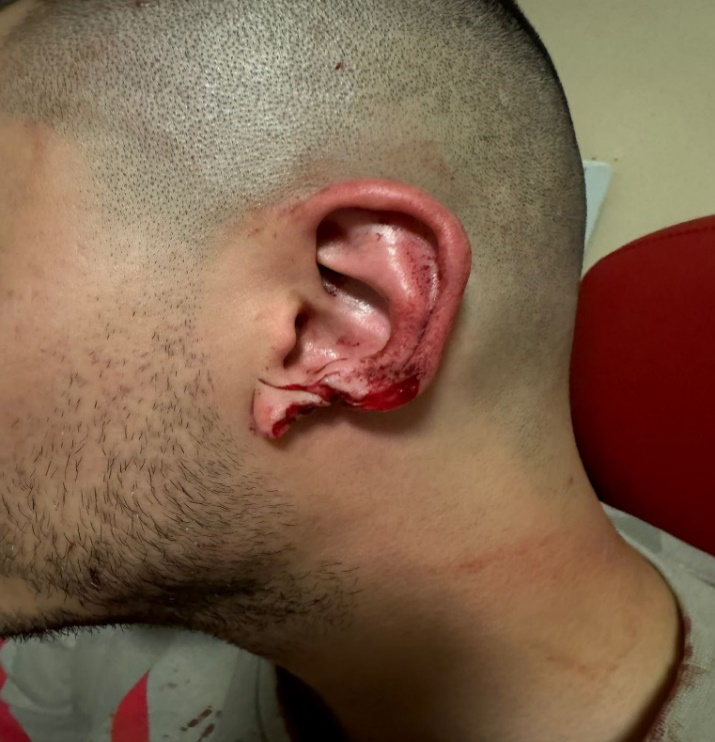
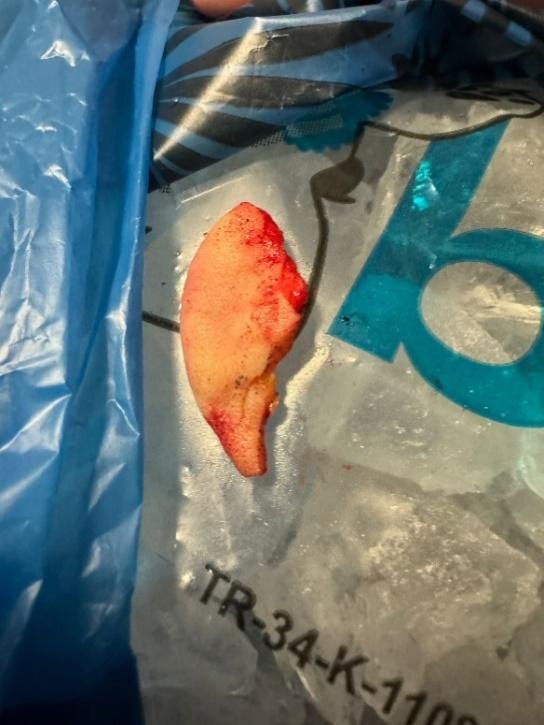
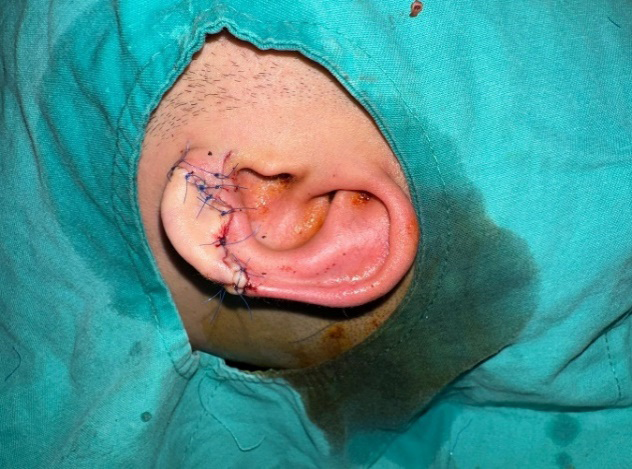
The 21-year-old male patient applied to the Emergency Medicine Clinic of the University of Health Sciences Ümraniye Training and Research Hospital and received medical records. in anamnesis; Distal left ear as a result of human bite It was stated that he was an amputate (Figure 1), the otorhinolaryngology clinic was consulted, and the amputate the patient brought in ice was sutured with 4/0 prolene by the specialist (Figures 2&3).
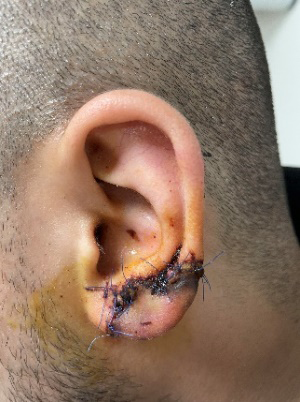
The infectious diseases clinic was consulted for antibiotic prophylaxis. In the follow-up examination 2 days later, it was observed that he did not use the recommended antibiotics, there was an infective discharge at the wound site, and the flap was not bleed, and Forensic Medicine consultation was requested for wound evaluation of the case, which was a forensic case. On examination, left auricle It was observed that the lobule was stitched and the wound area was black, necrotic, and had discharge (Figure 4). Although he was invited, he did not come to the control examinations.
Discussion
Although a large amount of force can be applied by biting, deep penetration of the teeth into the skin is not always possible. This is because most bites occur in soft tissues that have no underlying support [3].
Boxer Mike Tyson’s opponent Evander in 1997 Holyfield biting off his ear is an important example showing that ears are a sensitive area in this respect [4].
The fact that the person who bit off our patient’s ear also bit the ears of two other people in the context of the same incident suggests that he had an active psychopathology, but is a separate evaluation subject.
Complications such as infection and tendon rupture may also occur as a result of human bites [5].In our case, as a result of not using the prescribed prophylactic antibiotic, discharge and infection developed at the wound site, the ear rejected the amputation and no blood flow occurred. Prognostic factors for the development of infection in these injuries are the level of tissue injury, the depth of the wound, which compartment is affected and the pathogenicity of the inoculated oral flora bacteria [6, 7].
In bite injuries; Penetrating and crushing injuries, injuries penetrating tendons, joints, bones and vascular tissue, injuries to the hand, face, foot and genital area, injuries seen in patients under 2 years of age and over 50 years of age, presence of prosthetic joints and heart valves, delay in medical intervention (> 12 hours), inappropriate wound cleaning, presence of additional diseases (DM, asplenia, systemic lupus erythematosus, renal failure and immune system disorder), pre-existing edema at the bite site, chronic alcoholism, human and cat bites, contaminated wounds are determined risk factors for the development of infection after injury [8].
Physical violence ranges from traumas that do not cause any lesions to amputations that cause anatomical loss, and even death, as seen in our case [9]. It is known that human bites can be used as a weapon in both general physical violence cases and partner violence cases. In a study conducted by Ugwu in 2016, it was revealed that, unlike the situation in our case, violence caused by human bites is most frequently committed by women against male partners [10].
Conclusion
As a result, since human bites, which can be considered as a method of physical violence, can cause amputation due to infections that develop directly or subsequently, it is extremely important to evaluate such cases from a forensic medical perspective. According to the amputation area, for example, if there is an ear, nose and lip amputation, it should be evaluated in terms of permanent scars on the face and permanent changes in the face. If it has occurred, the injury should cause bone fractures and organ and limb loss should be evaluated and sequelae that can be subject to compensation should be determined. This issue should be stated in the forensic report prepared by calculating the severity of the injury. A comprehensive and multidisciplinary evaluation to be made in these respects; can eliminate the injustice suffered by the victim of the crime of injury, even if to some extent, and provide a more effective administration of justice.
References
-
Rothwell BR (1995) Bite marks in forensic dentistry: a review of legal, scientific issues. The Journal of the American Dental Association 126(2): 223-232.
-
Drummond JR, McKay GS (1999) Biting off more than you can chew: a forensic case report. British dental journal 187(9): 466-466.
-
Doğan KH, Artuç S, Doğan NÜ, Demirci Ş (2013) İnsan Isırığı Sonucu Gelişen Parmak Amputasyonu. The Bulletin of Legal Medicine 18(3): 107-109.
-
Mike Tyson spoke out about the ear-chopping incident.
-
Tan W, Wazir NN, Chiu CK, Ko M (2012) Chronic osteomyelitis secondary to human bite: a case report. Malaysian orthopaedic journal 6(3): 40.
-
Aziz H, Rhee P, Pandit V, Tang A, Gries L, et al. (2015) The current concepts in management of animal (dog, cat, snake, scorpion) and human bite wounds. J Trauma Acute Care Surg 78(3): 641-648.
-
Goldstein EJC (2010) Bites. Principles and practice of Infectious Diseases. In: 7th (Edn.), Philadelphia: Churchill Livingstone, pp: 3911-3915.
-
Patil PD, Panchabhai TS, Galwankar SC (2009) Managing human bites. J Emerg Trauma Shock 2(3): 186-190.
-
Güngördü E, Yılmaz (2023) Kadına Yönelik Fiziksel Şiddetin Farklı Bir Türü: İnsan Isırığı Yoluyla Parmak Ampütasyonu. Turkiye Klinikleri Journal of Forensic Medicine & Forensic Sciences/Türkiye Klinikleri Adli Tıp ve Adli Bilimler Dergisi 20(3).
-
Ugwu BT (2016) Human bite injuries on the jos plateau. J West Afr Coll Surg 6(2): 1-19.
- Narcotics and Digital Forensics: Bridging Crimes in the Digital Age
- Ethics in Forensic Psychiatry: Principles, Dilemmas, and Human Rights
- Impact of Acute Stress on Attentional Orienting to Social Cues
- Head Injury and Intracranial Hemorrhage in Western Region of Libya
- A Forensic Study on Handedness: Examination of Handwriting Features in Right and Left Handed Writers
- Techniques for Latent Fingerprint Development Using Natural and Synthetic Powders: A Review