
Assessment of Some Selected Heavy Metals Concentration in the Organs of Two Different Fish Species (Clarias gariepinus and Mormyrus rume) of River Gidin Dorowa
This study was aimed to assess selected heavy metals concentration in the organs of Clarias gariepinus and Mormyrus rume from River Gidin Dorowa, Wukari, Taraba State, Nigeria. The liver, muscles and Gills of the fish species and water were collected. During dry (September, October and November,) and wet (December, January and February) seasons. Cadmium, Lead, Zinc and Copper were analyzed using Atomic Absorption Spectrometer. Sampling of fish was carried out monthly for six (6) months. The results showed that heavy metals mean were high in the muscles followed by the liver and low in the gills of Clarias gariepinus, while heavy metals were highest in the gills followed by the liver and lowest in the muscles of Mormyrus rume. High heavy metals concentration (1.900mg/kg) was recorded for Zinc (Zn) in the gills follow by copper (Cu) with a mean of (0.00917mg/kg) recorded in the liver of Mormyrus rume, Pb recorded the high mean of (0.2932mg/kg) in the liver while low lead (Pb) mean (0.1855mg/kg) was recorded in the muscle. However, Zn (1.6250mg.kg) and Pb (0.2882mg/kg) was high in the muscle than in other tissues of C. gariepinus. In other to avoid serious health hazards, there is need to institute effective fisheries pollution control measures and management of River Gidin Dorowa fisheries resources. Continuous monitoring of the pollution levels of the River Gidin Dorowa using fish species as bioindicators can provide adequate information necessary for its effective management.
Introduction
Fish has been recognised as an important food source for the human body. Fish provides essential fatty acids like Omega 3, proteins, vitamins, and minerals [1]. The African Catfish (Clarias gariepinus) is one of the most widely consumed freshwater fish in Nigeria due to its large acceptability. C. gariepinus is a native species of Africa and has drawn attention of aquaculturists because of its biological attributes that include faster growth rate, resistance to diseases and possibility of high stocking density [2].
Mormyrus rume is an endemic fish species of sub-Saharan Africa. It is one of the species of Mormyridae’s family which shows good growth in the natural environment and therefore has a good potential for aquaculture. Mormyrus rume has a high vulnerability around 63%. Hence it’s necessary to point to studies for a sustainable management of this ichthyological resource in order to preserve the ecological balance of hydrosystems [3]. Contamination of natural waters by heavy metals negatively affects aquatic biota and poses considerable environmental risks and concerns [4, 5].
Estuaries and inland water bodies which are major source of drinking water in Nigeria are often contaminated by urban populations and industrial establishment [6]. Among environmental pollutants, trace metals are of particular concern due to their potentially toxic nature and ability to bio-accumulate in fish and aquatic ecosystem [7, 8]. The ingestion of heavy metals by fish via food and water might affects not only the productivity capabilities of such fish, but ultimately the health of man that depends in this organism as a major source of protein [9, 10]. All metals are potentially harmful to fish and most organisms at some level of exposure and absorption. Therefore, knowledge of the changing concentration and distribution of heavy metals in various components of the environment is a priority for good environmental management programmes all over the world [11].
The use of fish as a bio-indicator metal pollution in aquatic environments and its suitability for human use from toxicological view point has been documented [12, 13, 14, 15, 16]. The occurrence of higher levels of heavy metals in sediments found at the bottom of the water column can be a good indicator of man-induced pollution rather than natural enrichment of the sediment by geological weathering [16, 17]. A lot of industrial effluents are emptied into the aquatic environment untreated, the products of treatment plants are still potentially harmful to aquatic organism and human, a common component of these influence is heavy metal [18].
Materials and Methods
Study Area
The study carried out at River Gidin dorowa, Wukari L.G.A., Taraba State, Nigeria. Wukari L.G.A., comprises various towns include Bantaji, Gidin dorowa, kumutu and others with a population of 241,546, scattered over many small to large villages throughout the area as at 2006 census and a total land area of 4,308km2 (1,663m2). It is multi-ethic, include Tiv, Hausa-Fulani people as well as the original Jukun race. Wukari is located between Latitude 7o 52” and 38o
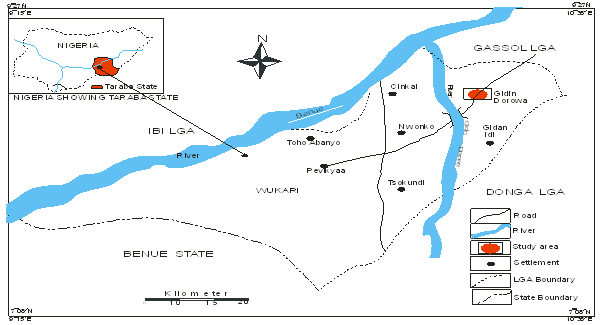
4”N and a longitude of 9o46 and 44o 48”E. The vegetation in Gidin dorowa is mainly secondary forest, shrubs, re-growth and swamp. There are two seasons: April to October raining season while the month of November to March are generally much drier than the remaining months. Its annual rainfall ranges from 130 cm to 266.30 cm/yr with temperature between 32°C and 36°C. The majority of the people are farmers and fishermen. See diagram of study area (Figure 1).
Experimental Design
The study was conducted as a factorial experiment in Completely Randomized Design (CRD) with 2(Species) × 4(Metals) × 6(Months) × 3(Sources) replicated thrice.
Collection of Fish Samples
A total of thirty six fish were used for the study. Three fish sample each was collected monthly for the experiment.
Sampling of fish was carried out monthly for six (6) months. The Fish samples were purchased at the landing site of River Gidin Dorowa immediate after caught by the fisher folk and transported to the Department of Biology Science Laboratory on sampling days from the sampling location. Fish samples obtained were identified using key and monograph in the laboratory. The fish samples were placed in labeled clean polyethylene bags and stored in a deep freezer. The Fish was then allowed to thaw at room temperature prior to the dissection and their parts (gills, liver and muscles) were procured by dissection using a stainless steel dissection kit.
Heavy Metal Determination
The fish organs were oven dried at 80°C for 48hours. Milled separately using porcelain mortar and pestle, placed in labeled polyethylene packs and stored at -10°C prior to digestion and analysis. Each organ was digested using the Organic Extraction method described by Sreedevi PA, et al. [19]. 1g of each milled sample was placed in 50ml Kjeldhal flask. 10ml of nitric acid, 2ml per chloric acid and 2mlsulpuric acid (5:1:1) ratio was added to the sample in the flask. Contents of the flask were treated with moderate heat under a hood. Digestion was terminated at the appearance of white fumes. An aliquot of the digest were diluted with 10ml distilled water and further boiled for a few minutes and allowed to cool. This was subsequently filtered into 50ml volumetric flask and made up to mark. Blank samples were prepared using the same quantity of mixed acids.
Data Analysis
Generated data were subjected to one way analysis of variance (ANOVA) using statistical package for social sciences (SPSS) 9.0 Version 2012 was used to determine the significance difference at 5% level of probability. Significant means were separated using New Duncan Multiple Range Test [20].
Results
The results of heavy metal levels in fish organs of two commercially important fish species Mormyrus rume and Clarias gariepinus from River Gidin Dorowa are presented below in Tables 1 and 2. The results of Mean Monthly Concentrations of Selected Heavy Metals in liver, muscle and gills of Clarias gariepinus during the study period are presented in Table 1 below. The results showed that Zn (1.6250mg.kg) and Pb (0.2882mg/kg) were the high in the muscle than other tissues. The mean value high concentration (1.6250mg/kg) was recorded for Zinc (Zn) in the muscles and liver with a mean value (1.5917mg/kg). The high (Cu) mean (0.1084mg/kg) was recorded in the liver of C. gariepinus. While the low lead (Pb) mean (0.2060mg/kg) was recorded in the gills of same fish. There was no significant different for cadmium mean values recorded among the fish tissues studied. The low mean (0.0072mg/kg) recorded for cadmium (Cd) was in the gills while the high mean (0.0093mg/kg) was recorded in the liver during the study period.
| Fish Organs | Cd | Pb | Zn | Cu |
|---|---|---|---|---|
| Liver | 0.0093±0.0015a | 0.2574±0.0363a | 1.5917±0.1312a | 0.1084±0.0288a |
| Muscle | 0.0077±0.0012a | 0.2882±0.0757a | 1.6250 ± 0.1558a | 0.0750±0.0180a |
| Gills | 0.0072±0.0011a | 0.2060±0.0375a | 1.4750±0.1997a | 0.0750±0.0180a |
Table 1: Mean (±SEM) Monthly Concentrations of Selected Heavy Metals in Liver, Muscle and Gills of Clarias gariepinus (n=6)
Means with the same superscript across the column are not significancly different (P>0.05). Table 1: Mean (±SEM) Monthly Concentrations of Selected Heavy Metals in Liver, Muscle and Gills of Clarias gariepinus (n=6)
| Fish Organs | Cd | Pb | Zn | Cu |
|---|---|---|---|---|
| Liver | 0.0065±0.0017a | 0.2214±0.0433a | 1.6750±0.1986ab | 0.0917±0.0193a |
| Muscle | 0.0061±0.0008a | 0.1855±0.0387a | 1.3334±0.0980a | 0.0417±0.0149b |
| Gills | 0.0068±0.0011a | 0.2932±0.0275a | 1.900±0.1355 b | 0.0750±0.0131c |
Table 2: ** Mean Monthly Concentrations of Selected Heavy Metals (mg/kg) in Liver, Muscle and Gills of Mormyrus rume During the S
*Values are presented as mean ± S.E.M. Values with different superscript across the column indicate a level of significance (P<0.05). Table 2: Mean Monthly Concentrations of Selected Heavy Metals (mg/kg) in Liver, Muscle and Gills of Mormyrus rume During the Study Period (n=6) The concentration pattern of heavy metals in all the organs of C. gariepinus was in the order of Zn>Pb>Cu>Cd. The results of mean Monthly Concentrations of Selected Heavy Metals in liver, muscle and gills of Mormyrus rume during the study period are presented in table 2. The result showed that between the organs heavy metals was highest in the gills followed by the liver and lowest in the muscles. The mean heavy metals value higher concentration (1.900mg/ kg) was recorded for Zinc (Zn) in the gills follow by copper (Cu) with a mean (0.00917mg/kg) recorded in the liver of M. rume, Pb recorded the highest mean value (0.2932mg/kg) in the gills while the lowest lead (Pb) mean (0.1855mg/kg) was recorded in the muscle. The lowest mean was recorded for cadmium (Cd) in the muscle (0.0061mg/kg) in M. rume during the study period. The concentration pattern of heavy metals in all the organs of M. rume was in the order of Zn>Pb>Cu>Cd.
Discussion
The study revealed highest concentrations of Zn found in the muscles of Clarias gariepinus (Table 1) which is a bottom feeders. This could be as a result of high exposure of bottom feeding fish to the sediment which contained high concentrations of the metal. The high concentration of Zn (1.6250mg/kg) agreed with similar study of Kelle HI, et al. [21] who reported (1.669mg/kg) in the muscle of fish samples from Abraka market also Eneji IS, et al. [22] reported high mean concentration of (3.85 mg/kg) in muscle tissue of Clarias gariepinus obtained from River Benue, and (1.5917mg/kg) measured in the liver could also be as a result of the important roles performed by the liver. The high concentration of Zinc in this study could also be associated with human activities and vehicle movement that occur in the environment. Human activities such as the use of chemicals and Zinc-based fertilizers by farmers and spent engine oil waste from rice milling machines and other petrochemical sources around the area [23].
This is similar to Annune PA [24], Demirak A, et al. [25] and Yang R, et al. [26] who reported that metals accumulate in high concentrations in the liver, because the organ has relatively high potential for metal accumulation than the muscle. The liver is the metabolizer and major detoxifier of the body. The Cd, Pb and Cu concentrations reported in this study were similar to studies of Kelle HI, et al. [21], in the gill of C. gariepinus from the Ogbeogonogo market from Asaba, Delta State, Ezekiel B, et al. [27] from Dadin Kowa Dam in Clarias gariepinus, Oreochromis niloticus, Alestes nurse, Bagrus bayad and Synodontis schall water from Difa, Dadin kowa and Gwani sampling stations of the Dam but low than the study of Abdulali T, et al. [28] in Oreochromis niloticus from five locations around Bangi area, Selangor, Malaysia. However the values recorded for this study were within the Federal ministry of Environment [29] safe limit for food and fish products.
Copper is considered to be an important part of many enzymes but occur in very low levels in food. From this study, the highest concentration of Cu was found in the liver of C. gariepinus. This value was below the 1.0-3.0 and 3.0 mg/kg recommended limits for food fish by FEPA [30] and WHO [31] respectively; thus indicating that the fish species examined could not pose copper related hazards to consumers. The high level of Copper in the liver is due to the fact that Copper toxicity in fish is taken up directly from the water via gills and stored in the liver [31].
The concentration of Cu in this study was below the concentrations in the liver, gills and muscles of C. gariepinus from Kubanni River Uzairu A, et al. [32], T. zilli and C. gariepinus from River Benue Eneji IS, et al. [22] and the concentration in T. guineensis from Nworie River Allinor IJ, et al. [33] and from Dadin Kowa Dam [27]. However values reported in this study were low compare to values report by Wangboje OM, et al. [34] in the Myonematic tissues of selected finfish species from a freshwater ecosystem in south western Nigeria and within range World Health Organization [35] safe limit. The low value report in this study for Cd, Cu, Pb, could be due to differences in the species, sizes, ages, and sampling periods [36]. The increase in concentrations of these metals could be attributed to indiscriminate disposal of industrial, domestic and municipal wastes and runoffs of agricultural chemicals.
Conclusion
The outcome of his study confirmed the occurrence and levels of Zn, Cd, Pb, and Cu in muscles of the two commercially important species Mormyrus rume and Clarias gariepinus of River Gidin Dorowa. The levels of Pb, Cd, Cu and Zn in the two fish species were below the WHO and FAO recommended limits in fish and fisheries products. Lead (Pb) values were generally Low in both species.
References
-
Enkeleda SD, Luljeta A, Jetmira Z, Muhamet H, Imer B, et al. (2013) Heavy metals in fish for public consumption and consumer protection. Natura Montenegrina Podgorica 9(3): 843-851.
-
Lal KK, Singh RK, Mohindra V, Singh B, Ponniah AG (2003) Genetic makeup of exotic Catfish, Clarias gariepinus in India. Asian Fisheries Science 16: 229-234.
-
IUCN (2019) Red list of threatened species. International Union for the Conservation of Nature (IUCN). Version 2014. 3.
-
Cajaraville MP, Bebianno MJ, Blasco J, Porte C, Saarasquete C, et al. (2011) The use of biomarkers to assess the impact of pollution in coastal environments of the Iberian Peninsula: a practical approach. Science of the Total Environment 247(2-3): 295-311.
-
Ravera O (2011) Monitoring of the aquatic environment by species accumulator of pollutant: A Review. Journal of Limmology 60(1): 63-78.
-
Ikponmwen EG, Orowe AU, Oguzie FA (2020) Heavy Metal concentration in Water and Sediment of Ovia River, Edo State, Nigeria. Nigerian Journal of Applied Sciences 38: 49-56.
-
Censi P, Spoto SE, Saiano F, Sprovieri M, Mazzola S (2006) Heavy metals in coastal water system. A case study from the North Western Gulf of Thailand. Chemosphere 64(7): 1167-1176.
-
Edward JB, Idowu EO, Oso JA, Ibidapo OR (2013) Determination of Heavy Metal Concentration in Fish Samples, Sediment and Water from Odo-Ayo River in Ado-Ekiti, Ekiti-State, Nigeria. International Journal of Environmental Monitoring and Analysis 1(1): 27-33.
-
Fonger BA, Tening AS, Egbe AE, Awo EM, Focho DA, et al. (2011) Fish (Arius heudelotivelen ciennes, 1840) as bio- indicator of Heavy Metals in Doula Estuary of Cameroon. African Journal of Biotechnology 10(73): 16581-16588.
-
Wangboje OM, Ikhuabe AJ (2015) Heavy metals contenting fish and water from River Niger at Agenebode, Edo stat, Nigeria. African Journal of Environmental Science and Technology 9(3): 210-217.
-
Don-Pedro KN, Oyewo OE, Otitooju AA (2004) Trend measurement of heavy metals in Lagos lagoon ecosystems, Nigeria. West African Journal of Applied Ecology 5(1): 103-114.
-
Sangodoyin AY (1995) Characteristics of Control of Industrial Effluents-Generated Pollution. Environmental Management and Health.
-
Oguzie AF, Okhagbuzo GA (2010) Concentrations of Heavy Metals in effluent discharges downstream of Ikpoba River in Benin City, Nigeria. African Journal of Biotechnology 9(3): 319-325.
-
Butu AW, Iguisi EO (2013) Concentration of Heavy Metals in Sediments of river Kubanni, Zaria, Nigeria. Journal of Environment Earth Science 2(1): 10-17.
-
Orowe AU, Ikponmwen GE (2020) White Blood Cell (WBC) and their differential count of Clarias gariepinus as influenced by Crude oil and Moringa Treatment. Chemical Transactions of Material Science and Technology Society of Nigeria 3: 20-26.
-
Davies CA, Tomlinson K, Stephenson T (2011) Heavy Metals in River Tees Estuary Sediments. Environ Technology 12(11): 961-972.
-
Chang JS, Yu KC, Tsai LJ, Ho ST (2018) Spatial distribution of heavy metals in bottom sediment of Yenshui River, Taiwan. Water Science and Technology 38(11): 159-167.
-
Kumolu-Johnson CA, Hammed AM, Amos UAO, Jimoh AA (2005) Some physico-chemical parameters and heavy metal analysis of Ologe Lagoon, Lagos, Nigeria. Journal of Agriculture and Environmental Research 1: 110-118.
-
Sreedevi PA, Suresh A, Siraramakrishna B, Prebhavathi B, Radhadrshnaah K (1992) Bioaccumulation of Nickel in the organs of the freshwater musse, Lamelhadens maginalis under letha and subethal nickel stress. Chemosphere 24(1): 2936.
-
Duncan DB (1955) Multiple Range and Multiple F-test. Biometrics 11: 1-41.
-
Kelle HI, Ngbede EO, Oguezi VU, Ibekwe FC (2018) Determination of Heavy Metals in Fish ( Clarias gariepinus) Organs from Asaba Major Markets, Delta State, Nigeria. Journal of Chemical Sociology Nigeria 43(1): 60 -73.
-
Eneji IS, Rufus S, Annune PA (2011) Bioaccumulation of Heavy Metals in Fish (Tilapia zilli and Clarias gariepinus) organs from River Benue, North Central Nigeria. Pakistan Journal of Analytical and Environmental Chemistry 12(1): 25-31.
-
Adekola F, Eletta O, Abass SA (2002) Determination of the levels of some heavy meals in urban run-off sediments in Ilorin and Lagos, Nigeria. Journal of Applied Sciences and Environmental Management 6(2): 23-26.
-
Annune PA (2017) Aquatic Pollution, a Thorn in the Flesh”, University of Agriculture, Makurdi, Nigeria Inaugural Lecture Series, pp: 19.
-
Demirak A, Yilmaz F, Tuna AL, Ozdemir N (2006) Heavy metals in water, sediment and tissues of Leuciscus cephalus from a stream in Southwestern Turkey. Chemos 63(9): 1451-1458.
-
Yang R, Yao T, Xu B, Jiang G, Xin X (2007) Accumulation features of organo-chlorine pesticides and heavy metals in fish from high mountain lakes and Lhasa River in the Tibetan Plateau. Environment International 33(2): 151- 156.
-
Ezekiel B, Annune PA, Solomon SG (2019) Concentrations of heavy metals in selected fish species from Dadin Kowa Dam, Gombe state, Nigeria. International journal of fisheries and Aquatic Studies 7(3): 279-284.
-
Abdulali T, Shuhaimi-Othman M, Ahmad AK (2011) Heavy metals concentration in different organs of tilapia fish (Oreochromis niloticus) from selected areas of Bangi, Selangor, Malaysia.
-
Federal ministry of Enivronment (FMENV) (2001) Federal ministry of Environment guideline and standards for water quality in Nigeria, pp: 114.
-
FEPA (2003) Guide Line and Standards for environmental pollution and Control in Nigeria”. Federal Environmental Protection Agency Nigeria, pp: 288.
-
World Health Organisation (WHO) (2003) Atrazine in Drinking-water: Background document for development of WHO Guidelines for Drinking-water Quality, pp: 10.
-
Uzairu A, Harrison GFS, Balarabe ML, Nnaji JC (2009) Concentration Levels of Trace Metals in Fish and Sediment from Kubanni River, Northern Nigeria. Bulletin of the Chemical Society of Ethiopia 23(1): 9-17.
-
Allinor IJ, Obiji IA (2010) Assessment of trace metals concentration in fish samples from Nworie River. Pakistan Journal of Nutrition 9(1): 81-85.
-
Wangboje OM, Umufo JR, Efenudu UI (2018) Heavy metal concentration profile in the Myonematic tissues of selected finfish species and water from a freshwater ecosystem in south western Nigeria. Nigerian journal of scientific research 17(1): 79-90.
-
World Health Organization (WHO)/Food Agricultural Organization FAO (2011) A Safety evaluation of certain food additives and contaminants. WHO food additives series, Cambridge University Press, Cambridge 44: 49.
-
Idodo-Umeh G (2002) Pollution Assessment of Olomoro water Bodies Using Physical, Chemical and Biological Indices. Ph.D. Thesis, University of Benin, Benin City, Nigeria, pp: 485.
- Genetic Improvement of Nile Tilapia (Oreochromis niloticus): Advances in Selective Breeding and Genomic Approaches for Sustainable Aquaculture
- Microplastics, Contaminants, and Waste Hotspots: Divergences and Faults in Prioritizing Control Efforts
- Creating a Healthier, More Vibrant Open and Closed Aquatic Environment. A Submersible, Centrifugal Magnetically Affixed Current Changing Aquarium Pump
- An Attempt to Assess Alpha Diversity and Sample Size: Using the Ostracod Assemblages off Kumamoto Port, Japan
- Assessment of the Efficiency of Common Fishing Gears and Crafts Used at Mohananda River of Chapai Nawabganj, Bangladesh
- Fish Productivity and Biodiversity Status of Sundarban Mangrove in Bangladesh