
Application Study of Integrated Treatment Device for Treating Aquaculture Tail Water
To reduce the pollution load of aquaculture tail water and improve the quality of the aquaculture water environment, this study constructed an integrated treatment device. This device utilizes the complementary and synergistic effects of inclined plate sedimentation, biochemical reaction, and activated carbon filtration processes. The effectiveness of the device in purifying aquaculture tail water and its adaptability to changes in water quality were evaluated and analyzed. The results showed that, under continuous operation for processing low concentration tailwater (24 hours), the removal rates of suspended solids and permanganate index could not be calculated due to low content in the tailwater. The total phosphorus removal rate ranged between 9% and 22%, and the total nitrogen removal rate was around 25%. For high concentration tailwater (48 hours), the removal rate of suspended solids ranged from 18% to 40%, the total phosphorus removal rate was between 12% and 32%, the total nitrogen removal rate was maintained between 5% and 18%, and the removal rate of permanganate index ranged from 4% to 16%.
Introduction
Intensive aquaculture has brought about increasingly prominent farming problems. The traditional aquaculture practices are often inefficient, resulting in the generation of significant amounts of tail water. The direct discharge of untreated tail water will bring significant environmental pressure [1, 2]. Residual bait, feces and other culture wastes from tail water continuously enter the natural environment [3, 4], resulting in the accumulation of nitrogen and phosphorus in the water. The rapid deterioration of aquaculture water quality leads to a series of aquaculture diseases and reduced farm efficiency [5, 6, 7, 8]. Jiangsu Province has issued the “Discharge standard of water from aquaculture ponds” (DB32/4043-2021) to enhance the ecological and healthy aquaculture methods, strengthen ecological environment protection in fishery waters, and promote standardized practices for the discharge or recycling of pond aquaculture effluent. The first-level emission standard stipulates that the concentration of suspended solids must not exceed 40 mg/L, the pH range should be between 6 and 9, the total nitrogen concentration must not exceed 3.0 mg/L, the total phosphorus concentration should not exceed 0.4 mg/L, and the permanganate index must not exceed 15 mg/L. Currently, aquaculture tailwater is primarily treated using multi-stage combination processes such as the ‘three pools and two dams’ method [9], artificial wetlands [10], and other treatment facilities. However, these methods have significant drawbacks, including a large footprint, limited effectiveness in winter, and the need for professional operation and maintenance, which requires highly skilled farmers [11]. To address the aforementioned issues and the specific characteristics of aquaculture tailwater quality, this study independently developed an integrated tailwater purification device. This device utilizes the complementary and synergistic effects of slant plate sedimentation, biochemical reaction, activated carbon filtration and other processes, including on-site evaluation of its purification capacity, in order to achieve the high efficiency of the removal of pollutants in the aquaculture tailwater. This research aims to provide a technological reference for the new green aquaculture mode of tailwater treatment unit, contributing both theoretical insights and technical support for optimizing and applying integrated tailwater purification devices.
Material and Method
Equipment Structure
The process flow of the integrated treatment device (hereinafter referred to as “device”) designed in this study is shown in Figure 1. The device includes an outer box and an internal treatment box, with a water inlet and outlet at the left and right ends, respectively. The internal treatment box is located inside the outer box and consists of a water distribution area, a primary sedimentation area, a biochemical reaction area, and a secondary sedimentation area, arranged in that order from left to right. The main body of the equipment is made of steel, with overall dimensions of 213 cm × 115 cm × 165 cm and an effective operating volume of 2000 liters.
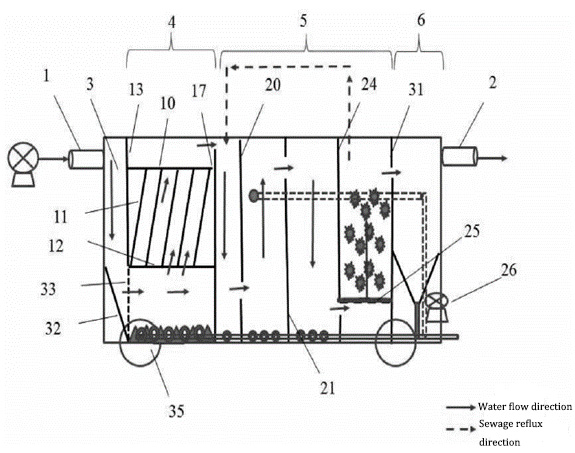
Note: 1- water inlet, 2- water outlet, 3- water distribution area, 4- initial sedimentation area, 5- biochemical reaction area, 6- secondary sedimentation area, 7- pre reaction area, 8- anaerobic area, 9- hypoxia area, 10- upper baffle, 11- diagonal flow plate, 12- lower baffle, 13- first vertical plate, 14- first sludge pipe, 15- sludge hopper, 16- aerobic area, 17- second vertical plate, 18- second sludge pipe, 19- third sludge pipe, 20- third vertical plate, 21- fourth sludge pipe, 22- fourth vertical plate, 23- packing box, 24- fifth vertical plate 25- exhaust duct, 26- blower, 27- funnel shaped sludge hopper, 28- sludge reflux port, 29- sludge discharge port, 30- flocculant feeding port, 31- sixth vertical plate, 32- baffle plate, 33- slot plate, 34- water pump, 35- movable wheel. Figure 1: Schematic diagram of device structure.
Experimental Site
The test site is located at Jiangsu Kuntai Agricultural Development Co., Ltd. The tail water used for the experiment comes from two sources: outdoor pond No. 2, which has been used for aquaculture activities since this year and is dominated by Mylopharyngodon piceus (a low-concentration pollutant), and indoor pond No. 1, also under aquaculture activities since this year and dominated by Myxocyprinus asiaticus (a high-concentration pollutant).
Running Time
The first phase of this test began on August 22, 2023 and ended on August 26, 2023 and lasted five days; the second phase began on November 2, 2023 and ended on November 4, 2023 and lasted three days.
Operational steps
Filler Pre-Treatment
The selected filler is repeatedly rinsed with tap water to remove impurities, then soaked in water overnight. The soaked filler is then packed in nylon mesh bags, ensuring each bag contains an equal volume of filler.
Filling The aquaculture tail water integration device mainly includes a water inlet, sedimentation tank, biological purification tank, packing filter tank, and water outlet. According to the test arrangement, activated carbon and stone were selected as the filler. The filler was placed in the packing filter tank using the regular loading method. Commissioning of water intake.
Use the pump to transfer the breeding tail water into the packing filter pool. After 2 hours of continuous operation, turn off the inlet and outlet water valves.
Water Sampling and Testing The first and second tests were conducted at t=0h, 6h, 12h, and 24h. Water samples were collected from both the inlet and outlet of the aquaculture tail water integration device to measure five indicators: pH, permanganate index, suspended solids, total nitrogen, and total phosphorus.
Sample Testing and Evaluation The indicators in this study were determined according to the Methods of Analysis for Water and Wastewater Monitoring (Fourth Edition) [12]. COD, TN, TP, and suspended solids were measured within 24 hours after acidification of the collected samples (pH was detected in the field). COD was determined by the dichromate method, TN by UV spectrophotometry with alkaline potassium persulfate digestion, and TP by ammonium molybdate spectrophotometry. The water quality was analyzed and evaluated according to the Discharge Standard of Water from Aquaculture Ponds (hereinafter referred to as the “discharge standard”).
Statistical Analysis All statistical analyses were carried out with SPSS 20.0 (SPSS Inc., Chicago, IL, USA).
Results and Discussion
pH
Stabilizing pH within a certain range is beneficial for the growth of aquatic organisms [13]. When the pH of the water body is lower than 5, the resulting acidic environment can cause acidosis in fish, leading to protein denaturation, organ failure, and ultimately, death [14]. For instance, the U.S. Environmental Protection Agency stipulates that the pH discharge standard for aquaculture wastewater is 6 to 9, while Australia specifies a pH discharge standard of 5 to 9. Analysis of Fig. 2 reveals that the device shows good adaptability to pH values when treating tail water with low pollution concentration. Under continuous operation (24 hours), the pH value at the outlet remains stable below 7.6, meeting the first-class emission standard (6-9). Additionally, the device demonstrates good stability in response to fluctuations in the pH value of tail water with different pollution concentrations. After 48 hours of continuous operation, the pH value at the outlet remains stable below 7.7, still meeting the first-class emission standard. This stability is achieved by cultivating microbial communities through bio-rope and bio-balloon, which utilize microorganisms to produce organic acids during the degradation of organic matter, thereby reducing the pH value of the water [15].
Activated carbon is primarily used for the adsorption of organic matter and gases, and not directly for pH regulation. However, during water treatment, activated carbon may indirectly affect the pH of water bodies. In the process of adsorbing organic matter, some acids may be released, thus influencing the pH of the water bodies [16, 17] (Figure 2).
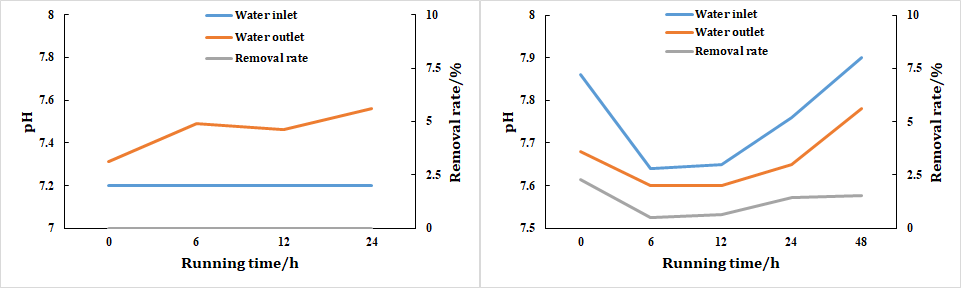
(Left: Low concentration, Right: High concentration) Figure 2: Changes in pH.
Suspended Solids
The effects of suspended solids on aquatic animals are multifaceted. They can reduce water clarity and affect photosynthesis, thereby impacting the growth and primary productivity of aquatic plants [18]. Suspended solids can also clog the gills of fish, affecting their respiratory function and leading to hypoxia and physiological stress [19]. Furthermore, they significantly reduce the survival and growth rates of juvenile fish [20].
The device uses gravity to precipitate the suspended matter to the bottom of the water by setting up a sedimentation zone and a secondary sedimentation zone [21]. Additionally, the porous structure and high specific surface area of activated carbon can effectively adsorb and remove dissolved organic matter, and physically intercept some smaller suspended particles [22], thus greatly reducing the concentration of suspended matter (Figure 3).
From the analysis of Figure 3, it can be seen that when treating low-pollution tail water, the device’s suspended solids concentration at the outlet first rises and then falls. This is because the suspended solids in the tail water are too low and do not reach the pollution standard, while the filter packing is not cleaned. In the treatment of highly polluted tail water, the removal rate of suspended solids shows a steady increase (from 18% to 40%), and the concentration of suspended solids at the effluent outlet is below 13 mg/L, which meets the first-class discharge standard.
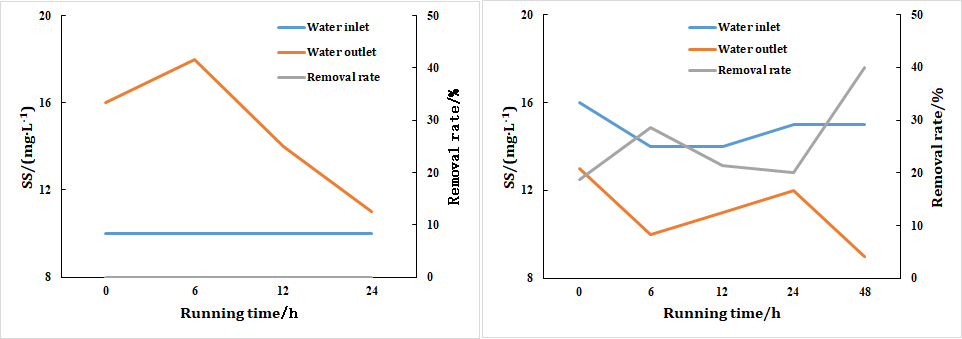
(Left: Low concentration, Right: High concentration). Figure 3: Changes in suspended matter.
Total Phosphorus
Total phosphorus is one of the major factors of eutrophication in water bodies [23]. High concentrations of phosphorus can lead to eutrophication, triggering algal blooms that greatly affect the living environment of aquatic organisms (fish, invertebrates, etc.). The device has high purification efficiency for total phosphorus in tail water of different concentrations, maintaining removal rates between 10% and 30% (Figure 4). With increased operating time (up to 48 hours), the removal rate remains stable, with only brief decreases possibly due to the microbial community’s adaptation process to high phosphorus concentrations [24].
The microbial treatment of total phosphorus is an effective method to remove phosphorus by incorporating it into microbial cells through anaerobic/aerobic processes [25]. The device is equipped with anaerobic and aerobic zones to better cultivate the microbial community (Figure 4).
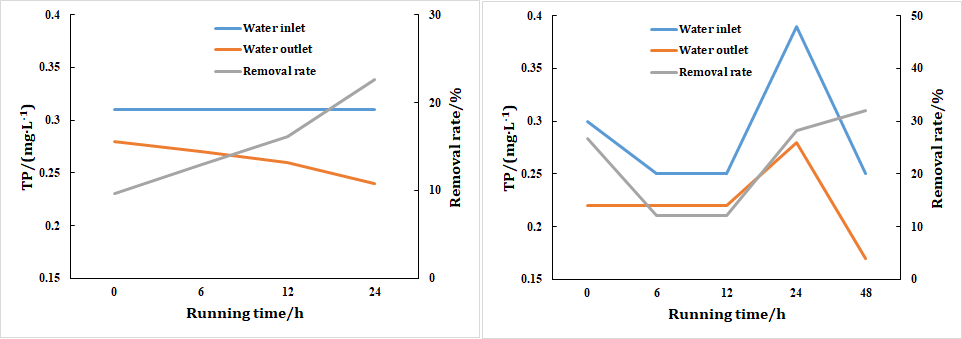
(Left: Low concentration, Right: High concentration). Figure 4: Changes in total phosphorus.
Total Nitrogen
Total nitrogen has an important impact on aquatic animals and ecosystems. High concentrations of total nitrogen can lead to eutrophication, triggering algal blooms, which consume oxygen in the water and cause hypoxia. The decomposition of these blooms further consumes oxygen, affecting the survival of aquatic animals by impacting their respiratory and immune systems [26]. High total nitrogen levels can also affect the population structure and number of zooplankton, disrupting the entire food chain and altering fish population structures [27].
Analysis of Figure 5 shows that the removal rate of total nitrogen by this device is stable at about 25% for low concentrations (1.6 mg/L). For high concentrations (6.21- 6.5 mg/L), the removal rate is slightly lower, at less than 20%. This difference is likely due to the limited effectiveness of activated carbon in removing total nitrogen, as nitrogen typically exists in forms such as ammonia, nitrates, and nitrites, which are not easily adsorbed by activated carbon [28].
Enhancing the device by adding fillers like zeolite, which can adsorb and ion-exchange, may effectively remove ammonia nitrogen and nitrates, thereby reducing the total nitrogen concentration [29] (Figure 5).
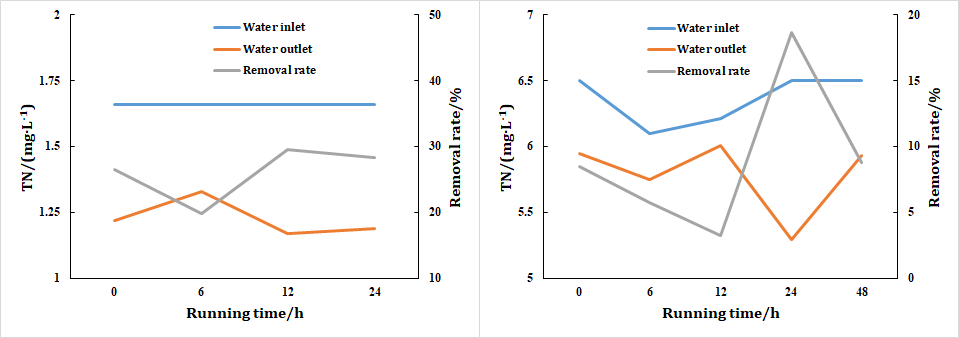
(Left: Low concentration, Right: High concentration). Figure 5: Changes in total nitrogen.
Permanganate Index
The permanganate index is an important indicator of the amount of organic and reducing substances in water [30]. Excessive levels of the permanganate index can have acute toxic effects on aquatic animals, leading to death or physiological stress; long-term exposure to high permanganate index levels can have chronic toxic effects on the physiological functions and immune systems of aquatic animals. As seen in Figure 6, under continuous operation of the device (24h), the removal rate of the permanganate index cannot be calculated due to its low content in the tail water, and the permanganate index at the outlet remains stable at 7.2 mg/L or less, meeting the first-class discharge standard.
In Figure 8, under continuous operation of the device (48h), the removal rate of the permanganate index ranges from 4% to 16%, with the permanganate index at the outlet also stable at 7.2 mg/L or less, all meeting the primary discharge standard.
This efficiency is due to the cultured microbial community removing the permanganate index through multiple mechanisms, including biodegradation (where organic and reducing substances are metabolized into harmless substances), biosorption (where these substances are adsorbed onto the cell surface), and biotransformation (where enzymes convert these substances into other forms) [31, 32, 33, 34] (Figure 6, Table 1).
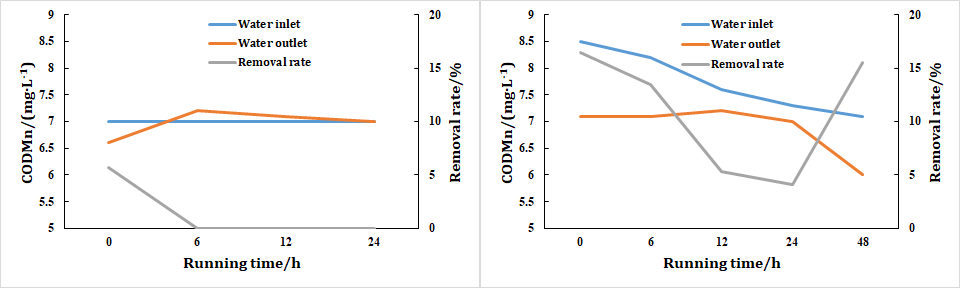
(Left: Low concentration, Right: High concentration). Figure 6: Changes in permanganate index.
| Data number | Ph | Suspended solids | Total phosphorus | Total nitrogen | Permanganate index |
|---|---|---|---|---|---|
| mg/L | mg/L | mg/L | mg/L | ||
| l-ct | 7.2 | 10 | 0.31 | 1.66 | 7 |
| l-t0-1 | 7.3 | 16 | 0.28 | 1.22 | 6.6 |
| Removal rate/% | 0 | 0 | 9.68 | 26.51 | 5.71 |
| l-t6-1 | 7.5 | 18 | 0.27 | 1.33 | 7.2 |
| Removal rate/% | 0 | 0 | 12.9 | 19.88 | 0 |
| l-t12-1 | 7.5 | 14 | 0.26 | 1.17 | 7.1 |
| Removal rate/% | 0 | 0 | 16.13 | 29.52 | 0 |
| l-t24-1 | 7.6 | 11 | 0.24 | 1.19 | 7 |
| Removal rate/% | 0 | 0 | 22.58 | 28.31 | 0 |
| h-t0-0 | 7.9 | 16 | 0.3 | 6.5 | 8.5 |
| h-t0-1 | 7.7 | 13 | 0.22 | 5.95 | 7.1 |
| Removal rate/% | 2.3 | 18.75 | 26.67 | 8.16 | 16.48 |
| h-t6-0 | 7.6 | 14 | 0.25 | 6.1 | 8.2 |
| h-t6-1 | 7.6 | 10 | 0.22 | 5.75 | 7.1 |
| Removal rate/% | 0.5 | 28.57 | 12 | 5.74 | 13.41 |
| h-t12-0 | 7.7 | 14 | 0.25 | 6.21 | 7.6 |
| h-t12-1 | 7.6 | 11 | 0.22 | 6.01 | 7.2 |
| Removal rate/% | 0.7 | 21.43 | 12 | 3.22 | 5.26 |
| h-t24-0 | 7.8 | 15 | 0.39 | 6.5 | 7.3 |
| h-t24-1 | 7.7 | 12 | 0.28 | 5.29 | 7 |
| Removal rate/% | 1.4 | 20 | 28.24 | 18.62 | 4.11 |
| h-t48-0 | 7.9 | 15 | 0.25 | 6.5 | 7.1 |
| h-t48-1 | 7.8 | 9 | 0.17 | 5.93 | 6 |
| Removal rate/% | 1.5 | 40 | 32 | 8.77 | 15.49 |
Table 1: Water quality test results.
Note: l-indicates low-pollution aquaculture tail water, h-indicates high-pollution aquaculture tail water; t0-sampling time is 0h, 0-water samples taken at the inlet of aquaculture tail water integration device, i.e., raw water; 1-water samples taken at the outlet of aquaculture tail water integration device.
Conclusion
The integrated treatment device for aquaculture tail water shows impressive adaptability in handling various pollutants. The data showed that in low concentration polluted water, under continuous operation for 24 hours, the outlet suspended solids stabilized below 18 mg/L, total phosphorus below 0.28 mg/L, total nitrogen below 1.33 mg/L, and the permanganate index below 7.2 mg/L. In high concentration polluted water, under continuous operation for 48 hours, the outlet pH stabilized below 7.7, suspended solids below 13 mg/L, total phosphorus below 0.28 mg/L, total nitrogen below 6.0 mg/L, and the permanganate index below 7.2 mg/L. All these values comply with the first-class discharge standard.
Under continuous operation for 24 hours with low concentration tail water, the removal rates of suspended solids and permanganate index could not be calculated due to their low content in the tail water. The total phosphorus removal rate was between 9% and 22%, and the total nitrogen removal rate was around 25%. For high concentration tail water, under continuous operation for 48 hours, the removal rate of suspended solids ranged from 18% to 40%, total phosphorus removal rate ranged from 12% to 32%, total nitrogen removal rate ranged from 5% to 18%, and the permanganate index removal rate ranged from 4% to 16%.
The aquaculture tailwater integrated treatment device efficiently and rapidly degrades aquaculture pollution while being a low-cost solution. The device supports long-term continuous operation and offers high operability, shock load resistance, mobility, and treatment efficiency. This device effectively addresses issues in industrialized recycling aquaculture systems. However, its effect on total nitrogen removal is not significant, indicating a need for more in- depth research.
Acknowledgements
Thank Zizhou Wang for polishing the language. This work was supported by Jiangsu Province Agricultural Science and Technology Independent Innovation Project [CX(23)3070].
References
-
Zhang Q, Achal V, Xu Y, Xiang W (2014) Aquaculture wastewater quality improvement by water spinach (Ipomoea aquatica Forsskal) floating bed and ecological benefit assessment in ecological agriculture district. Aquacultural Engineering 60: 48-55.
-
Mook WT, Chakrabarti MH, Aroua MK (2012) Removal of total ammonia nitrogen (TAN), nitrate and total organic carbon (TOC) from aquaculture wastewater using electrochemical technology: a review. Desalination 285: 1-13.
-
Yang G, Wang W, Zhou W (2021) Water quality problems and countermeasures faced by pond aquaculture in China. Journal of Aquaculture (CHN) 42(08): 64-66.
-
Yao F, Zhen S, Yang Y, Peng K (2009) Effects of stocking density on nitrogen and energy budget of gibel carp. Journal of Anhui Agricultural University (CHN)36(03): 451-455.
-
Cheng L, Xu H, Chen M, Liu Z, Chen W, et al. (2007) Review on causes of eutrophication of water body and its control measure. Environmental Protection Science (CHN) 01: 18-21+38.
-
Huang T, Bai J, Li S, Jiang L (2017) Exploration into the Current Status and Green Development Issues of Micropterus salmoides Farming in China. China Fisheries (CHN) 12: 44-47.
-
Zhang A, Jin B, Fu Y, Zhang G (2016) Analysis of the problems faced by freshwater aquaculture and strategies for its healthy development. Jiangxi Fishery Science and Technology (CHN)04: 46-48.
-
Zhang H (2001) Problems and Countermeasures of Marine Aquaculture in Dongying. China Fisheries (CHN)07: 28.
-
Liu M, Yuan J, Ni M, Lian Q, Guo A (2021) Treatment of inland pond aquaculture tail water by multi-stage combined process of three ponds and two dams. Journal of Environmental Engineering (CHN) 11(01): 97-106.
-
Breen PF (1990) A mass balance method for assessing the potential of artificial wetlands for wastewater treatment. Water Research 24(6): 689-697.
-
Shutes RBE (2001) Artificial wetlands and water quality improvement. Environment international 26(5-6): 441- 447.
-
Environmental Protection Administration (2002) Water and waste water monitoring and analysis method. Beijing: China Environmental Press 2002.
-
Serpone N (1996) Aquatic chemistry: Chemical equilibria and rates in natural waters. Journal of Chemical Education 73(11): A277.
-
Galloway J N, Cowling E B (2002) Reactive nitrogen and the world: 200 years of change. AMBIO: A Journal of the Human Environment 31(2): 64-71.
-
Bitton G (2011) Wastewater microbiology. Hoboken NJ: John Wiley & Sons.
-
Salam KA (2019) Assessment of surfactant modified activated carbon for improving water quality. Journal of Encapsulation and Adsorption Sciences 9(1): 13-34.
-
Hayati B, Mahmoodi N M (2012) Modification of activated carbon by the alkaline treatment to remove the dyes from wastewater: mechanism, isotherm and kinetic. Desalination and water treatment 47(1-3): 322-333.
-
Bilotta GS, Brazier RE (2008) Understanding the influence of suspended solids on water quality and aquatic biota. Water research 42(12): 2849-2861.
-
Au DWT, Pollino CA, Wu RSS, Shin PKS, Lau STF, et al. (2004) Chronic effects of suspended solids on gill structure, osmoregulation, growth, and triiodothyronine in juvenile green grouper Epinephelus coioides. Marine ecology progress series 266: 255-264.
-
Nyanti L, Soo CL, Danial-Nakhaie MS, Ling TY, Sim SF, et al. (2018) Effects of water temperature and pH on total suspended solids tolerance of Malaysian native and exotic fish species. Aquaculture, Aquarium, Conservation & Legislation 11(3): 565-575.
-
Ivanova LA, Prosekov AY, Ivanov PP, Mikhaylova ES, Timoshchuk IV, et al. (2024) Assessment of the efficiency of wastewater treatment from coal enterprises for suspended solids using various filtering materials. Gornye nauki i tekhnologii= Mining Science and Technology (Russia).
-
Enoch GD, Van Den Broeke WF, Spiering W (1994) Removal of heavy metals and suspended solids from wastewater from wet lime (stone)—gypson flue gas desulphurization plants by means of hydrophobic and hydrophilic crossflow microfiltration membranes. Journal of membrane science 87(1-2): 191-198.
-
Feng W, Wang T, Zhu Y, Giesy JP, Wu F (2023) Chemical composition, sources, and ecological effect of organic phosphorus in water ecosystems: a review. Carbon Research 2(1): 12.
-
Gu AZ, Saunders A, Neethling JB, Stensel HD, Blackall LL (2008) Functionally relevant microorganisms to enhanced biological phosphorus removal performance at full‐scale wastewater treatment plants in the United States. Water Environment Research 80(8): 688-698.
-
Gu AZ, Saunders A, Neethling JB (2008) Functionally relevant microorganisms to enhanced biological phosphorus removal performance at full‐scale wastewater treatment plants in the United States. Water Environment Research 80(8): 688-698.
-
Rabalais NN (2002) Nitrogen in aquatic ecosystems. AMBIO: a Journal of the Human Environment 31(2): 102-112.
-
Camargo JA, Alonso Á (2006) Ecological and toxicological effects of inorganic nitrogen pollution in aquatic ecosystems: a global assessment. Environment international 32(6): 831-849.
-
Erabee IK, Ethaib S (2018) Performane of activated carbon adsorption in removing of organic pollutants from river water. International Journal of Engineering & Technology 7(4.20): 356-358.
-
de Magalhães LF, da Silva GR, Peres AEC (2022) Zeolite application in wastewater treatment. Adsorption Science & Technology 2022: 4544104.
-
Koelmans AA, Van der Heijde A, Knijff LM (2001) Integrated modelling of eutrophication and organic contaminant fate & effects in aquatic ecosystems. A review. Water Research 35(15): 3517-3536.
-
Manem JA, Rittmann BE (1992) Removing trace‐level organic pollutants in a biological filter. Journal‐American Water Works Association 84(4): 152-157.
-
Kanaujiya DK, Paul T, Sinharoy A (2019) Biological treatment processes for the removal of organic micropollutants from wastewater: a review. Current pollution reports 5: 112-128.
-
Qing W, Guo LY, Zhou GQ (2021) Effects of chicory polysaccharides on the growth, antioxidant activity, and disease resistance in the Chinese mitten crab Eriocheir sinensis H. Milne Edwards, 1853 (Decapoda: Brachyura: Varunidae). The Journal of Crustacean Biology 2: 1-3.
-
Zheng H, Shan H, Wang Q (2024) Application of Astaxanthin-Added Feed in Macrobrachiumnipponense Culture. International Journal of Oceanography & Aquaculture 8(3): 000332.
- Genetic Improvement of Nile Tilapia (Oreochromis niloticus): Advances in Selective Breeding and Genomic Approaches for Sustainable Aquaculture
- Microplastics, Contaminants, and Waste Hotspots: Divergences and Faults in Prioritizing Control Efforts
- Creating a Healthier, More Vibrant Open and Closed Aquatic Environment. A Submersible, Centrifugal Magnetically Affixed Current Changing Aquarium Pump
- An Attempt to Assess Alpha Diversity and Sample Size: Using the Ostracod Assemblages off Kumamoto Port, Japan
- Assessment of the Efficiency of Common Fishing Gears and Crafts Used at Mohananda River of Chapai Nawabganj, Bangladesh
- Fish Productivity and Biodiversity Status of Sundarban Mangrove in Bangladesh