
Overview of the Complexities in Diagnosing Treating and Preventing Tuberculosis along with the Most Effective Dosage Plans
Mycobacterium tuberculosis is the name of the bacterium that causes tuberculosis (TB), which typically affects the lungs. Lifetime exposure to TB bacteria increases the risk of developing TB by 5–10%. A person’s likelihood of getting sick rises if they lead an unhealthy lifestyle or have a compromised immune system. A person may take several months before showing symptoms of active TB disease. As a result, getting medical help may take longer, and the virus may spread to more people. Rifampicin, isoniazid, pyrazinamide, and ethambutol are given as part of the traditional treatment for pulmonary TB during the first two months, and then rifampicin and isoniazid are given for the following four months. For the treatment of multidrugresistant TB, levofloxacin, moxifloxacin, and bedaquiline are suggested.
Introduction
One of the oldest diseases known to man, tuberculosis (TB) co-evolved with humans for at least several million years before. The oldest known DNA evidence of tuberculosis was found in a 9000-year-old human bone [1]. The pulmonary form of TB was linked to “tubercles” by Dr. Richard Morton as early as 1689 and it was given the name “tuberculosis” by Martini, et al. [2]. A group of bacterial species that cause tuberculosis is known as the Mycobacterium tuberculosis complex. Currently, Mycobacterium tuberculosis is the principal culprit behind TB in humans. While M. bovis is the primary agent of TB in other animal species and has a greater host range. Meat from infected animals, milk, and milk derivatives can all spread M. bovis to humans [3].
Since the TB bacteria typically affect the lungs, airborne transmission of TB between individuals is widespread. When TB patients cough, sneeze, or spit, the TB germs are released into the air, and only a few number of these microorganisms need to enter a person’s lungs for them to become unwell. A quarter of the world’s population has TB infection, meaning they have the germs in their bodies but are not ill and are unable to spread the disease. A lifetime exposure to the TB bacteria increases the risk of developing TB by 5–10%. A person may take several months before showing symptoms of active TB disease. As a result, getting medical help may take longer, and the virus may spread to more people. Through
intimate contact, people with active TB can infect 5–15 more people over the course of a year [4].
Risk Factors for TB
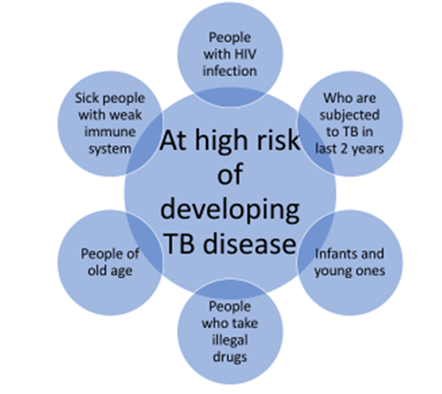
The majority of TB patients are in the prime of their careers. But there is risk for people of all ages. More than 80% of illnesses and fatalities occur in low and middle-income countries. HIV-positive individuals have an 18 times higher risk of developing active TB. In addition, those who suffer from other immune-system-damaging conditions are more likely to have active TB. People who are undernourished are three times more vulnerable [5]. Smoking, excessive alcohol consumption and malnutrition all increase the risk of TB [6] (Figure 1).
Signs and Symptoms of TB
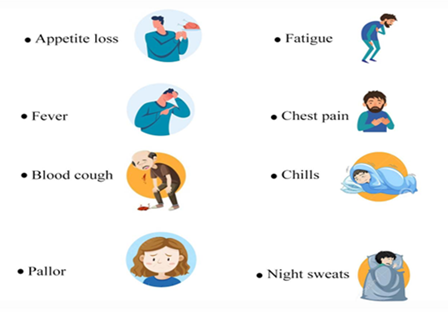
Chest pains, fatigue, weight loss, fever, night sweats, and coughs that occasionally produce sputum and blood are all common symptoms of active lung TB [7] (Figure 2).
Diagnosis
In order to detect the TB bacteria in the body, two types of tests are used.
TB Skin Test
The Mantoux tuberculin skin test (TST), sometimes referred to as the TB skin test, is performed by injecting a tiny amount of tuberculin fluid into the patient’s skin. Based on the hard or swollen part of the arm, the outcome will be determined. If the skin test is successful, it indicates that the individual has TB germs in their body. For children under the age of five, TB skin tests are preferred [8].
TB Blood Test
In blood tests for TB, also called interferon-gamma release assays or IGRAs, patient’s blood is taken and sent to the laboratory for inspection. A positive result means the person has been diagnosed with TB bacteria. Individuals who have already been injected with the TB vaccine Bacille Calmette-Guérin (BCG) are preferred to get blood tests [9]. Diagnosis of active TB is done with the help of the patient’s medical history, physical examination, chest x-ray, and other tests.
Treatment of TB
Vaccination
BCG vaccine has 50% efficiency against TB [10]. One dose is recommended in healthy babies after birth. Dose includes infants less than one year of 0.05ml intradermal and children over one year with 0.1ml intradermal.
Latent Tuberculosis Treatment
In this type, a person is infected with TB but does not have any symptoms yet. Its treatment includes the course of ATT, Rifampicin, and isoniazid (3 months course) OR Rifinah (Rifampicin and isoniazid together in tablet) or Isoniazid only (6 months course) [11]. Latent TB should be cured properly because one in ten people with latent TB develops active TB later on, removing the bacteria from your body is the only treatment.
Active Tuberculosis Treatment
In this type, the bacterium is in the body and multiplies. It is of two types i) Pulmonary TB (damaging lungs) ii) Extra Pulmonary TB (affects organs or bones outside lungs). Treatment for pulmonary TB involves a 6-month course of rifinah and an initial 2-month treatment of ATTs (ethambutol and pyrazinamide).The same ATT combination that is used to treat pulmonary TB can also be utilised to treat extra pulmonary TB [12]. For a few weeks, corticosteroids may be recommended together with your ATTs if you have TB in the surrounding sacs of your heart or brain. Multidrug-Resistant Tuberculosis (MDR-TB) Treatment. The TB germs in MDR-TB are resistant to the drugs isoniazid and rifampin (the drug most potent for TB). Levofloxacin and moxifloxacin have been approved by the WHO for the treatment of MDR-TB. Bedaquiline was given FDA approval as a medication to treat MDR-TB [13] (Table 1).
| Dose | Preparation | ||
|---|---|---|---|
| 1. Isoniazid | Children: | • Tablets (50mg, 100mg, 300mg) .• Syrup (50mg/5ml) • Aqueous solution (100mg/ml) for IM or IV injections | |
| 1. Isoniazid | • 10-15 mg/kg (300mg) daily | • Tablets (50mg, 100mg, 300mg) .• Syrup (50mg/5ml) • Aqueous solution (100mg/ml) for IM or IV injections | |
| 1. Isoniazid | • 20-30mg/kg (900mg) twice weekly | • Tablets (50mg, 100mg, 300mg) .• Syrup (50mg/5ml) • Aqueous solution (100mg/ml) for IM or IV injections | |
| 1. Isoniazid | Adult: | • Tablets (50mg, 100mg, 300mg) .• Syrup (50mg/5ml) • Aqueous solution (100mg/ml) for IM or IV injections | |
| 1. Isoniazid | • 5mg/kg (300mg) daily | • Tablets (50mg, 100mg, 300mg) .• Syrup (50mg/5ml) • Aqueous solution (100mg/ml) for IM or IV injections | |
| 1. Isoniazid | • 15mg/kg (900mg) once, twice, or thrice a week | • Tablets (50mg, 100mg, 300mg) .• Syrup (50mg/5ml) • Aqueous solution (100mg/ml) for IM or IV injections | • Capsules (150mg,300mg) |
| 2. Rifampicin | Children: | ||
| 2. Rifampicin | • 10-20mg/kg (600mg) once daily or twice weekly | ||
| 2. Rifampicin | Adult: | ||
| 2. Rifampicin | • 10mg/kg (600mg) once daily twice weekly or three times weekly | ||
| 3. Rifabutin | Children: | • Capsule (150 mg) | • Capsules (150mg,300mg) |
| 3. Rifabutin | • Unknown appropriate dosing | • Capsule (150 mg) | • Capsules (150mg,300mg) |
| 3. Rifabutin | Adult: | • Capsule (150 mg) | • Capsules (150mg,300mg) |
| 3. Rifabutin | • 5mg/kg (300mg) daily twice or thrice time weekly | • Capsule (150 mg) | |
| 3. Rifabutin | (if used with efavirenz dose of rifabutin increased to 450-600mg) | • Capsule (150 mg) | |
| 4. Rifapentine | Children: | • Tablet (150mg,film-coated) | |
| 4. Rifapentine | • Not approved for children’s use | • Tablet (150mg,film-coated) | |
| 4. Rifapentine | Adult: | • Tablet (150mg,film-coated) | |
| 4. Rifapentine | • 10mg/kg(600mg) once weekly | • Tablet (150mg,film-coated) | |
| 5. Pyrazinamide | Children: | • Tablet (500mg) | |
| 5. Pyrazinamide | • 15-30mg/kg(2.0g) daily | • Tablet (500mg) | |
| 5. Pyrazinamide | • 50mg/kg (2.0g) twice weekly | • Tablet (500mg) | |
| 5. Pyrazinamide | Adult: | • Tablet (500mg) | |
| 5. Pyrazinamide | • 20-25mg/kg per day | • Tablet (500mg) | |
| 6. Ethambutol | Children: | • Tablets (100mg,400mg) | |
| 6. Ethambutol | • 15-20mg/kg (2.5g) per day | • Tablets (100mg,400mg) | |
| 6. Ethambutol | • 50mg/kg (2.5g) twice weekly | • Tablets (100mg,400mg) | |
| 6. Ethambutol | Adult: | • Tablets (100mg,400mg) | |
| 6. Ethambutol | • 15-20mg/kg per day | • Tablets (100mg,400mg) |
Table 1: First-Line Treatment for TB [14].
To prevent neuropathies Vitamin B6 is given with Isoniazid (Table 2).
| Second-line ATTs: | I. Injectable aminoglycosides: | |
|---|---|---|
| • Amikacin | ||
| • Kanamycin | ||
| • Streptomycin | ||
| II. Injectable Fluoroquinolones: | ||
| • Levofloxacin | ||
| • Moxifloxacin | ||
| • Ofloxacin | ||
| • Gatifloxacin | ||
| III. Injectable polypeptides: | ||
| • Capreomycin | ||
| • Viomycin | ||
| Pretomanid is a new 2nd line drug. | ||
| Antibiotic | Dose | Preparation |
| 1. Clarithromycin | 500mg orally every 12 hours | · 500 mg tablets |
| · 125mg/5ml suspension | ||
| 2. Linezolid | Adult: | · Tablets 600mg |
| · 600mg daily or twice a day | · Syrup 100mg/5mL | |
| Children: | ||
| · 15mg/kg once daily | ||
| 3. Clofazimine | Adults: | · 100 mg capsules (unlicensed medicine) |
| · 100 mg to 200mg once daily | ||
| Children: | ||
| · 2-5mg/kg once daily | ||
| 4. Amoxicilli/clavulanate | 500mg/125mg three times daily | |
| 5. Imipenem/ cilastatin | Adult >50kg: | · 500/500mg 250mg powder for solution for infusion |
| · 1g twice a day (intravenous) | ||
| Adult <50kg: | ||
| · 15mg twice a day (intravenous) | ||
| Children: | ||
| · Not used in patients less than 15 years | ||
Table 2: Second-Line Treatment for TB [15]. They do not have any proven efficiency right now, used as a last resort for TB drugs
Adverse Effects of TB Medicines
Rifinah may disturb the menstrual cycle, sickness, flu- type symptoms, hormonal changes, redness, itching, rashes, hypersensitivity, and red-orange urine color. The use of isoniazid could cause sickness, diarrhea, numbness, and rashes, while retrobulbar neuritis could be triggered by ethambutol. Pyrazinamide usage may result in acute gouty arthritis, rash, nausea, and hepatotoxicity. Optic neuropathy, lactic acidosis, nausea, and diarrhea may be brought on by taking Linezolid.
Preventions of TB
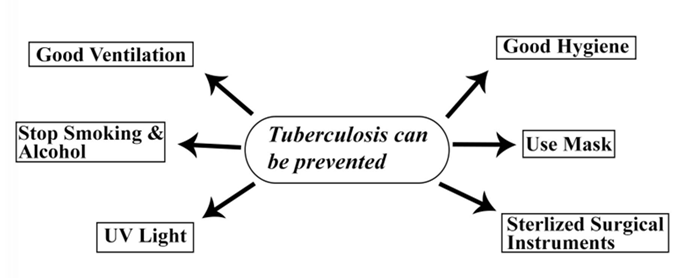
M. Tuberculosis is present in airborne particles called the droplet nuclei and spreads when patients with TB cough, speak and sneeze. They are very small, and they remain suspended in the air. In order to prevent the formation of droplet nuclei and reduce the likelihood of bacterium transfer, patients with active TB should receive the appropriate care and testing at healthcare facilities. Additionally, local exhaust ventilation should be offered because the bacterium persists in the air without ventilation for a long period of time. The patients must be kept in healthcare facilities with enough sunshine to kill the microorganisms that are killed by germicidal UV lights. Needles, catheters, and surgical tools used in patient care that come into touch with blood directly must be cleansed and sterilized [17]. Give respiratory programme training in educational institutions so that students learn how to protect themselves from the sickness (Figure 3).
Future Strategies and Recommendations
Considering the size of Pakistan, we need proper implementation of a TB program. The current National Tuberculosis Program has suffered a lot because of the negligence of the government. The actions listed below must be followed to lower TB. • All public or private hospitals should be properly equipped to carry out the tests and proper guidelines should be given to the workers.
- The message regarding the severity of the disease must be passed to the public so that they must protect themselves.
- Proper attention must be given to laboratories and the government should be informed about any of the needed drugs.
- The personnel in charge of tehsils and districts must keep a record of the total number of patients suffering from the disease.
Statements and Declarations: The authors declared that this work has not been published elsewhere.
Ethical Approval: Not required
Consent to Participate: None
Competing Interests: The authors declare no competing interests.
References
-
Sabin S, Herbig A, Vagene AJ, Ahlstrom T, Bozovic G, et al. (2020) A seventeenth century Mycobacterium tuberculosis genome supports a Neolithic emergence of the Mycobacterium tuberculosis complex. Genome biology 21.
-
Martini M, Riccardi N, Giacomelli A, Gazzaniga V, Besozzi G (2020) Tuberculosis: an ancient disease that remains a medical social economical and ethical issue. Journal of Preventive Medicine and Hygiene 61(Suppl 1): 16-18.
-
Thakur A, Sharma M, C Katoch V, Dhar P, Katoch RC (2012) Detection of Mycobacterium bovis and Mycobacterium tuberculosis from cattle possible public health relevance. Indian journal of microbiology 52(2): 289-291.
-
Shakoor S, Mir F (2022) Updates in pediatric tuberculosis in international settings. Pediatric Clinics 2022 69(1): 19-45.
-
Sulistyawati S, Ramadhan AW (2021) Risk Factors for Tuberculosis in an Urban Setting in Indonesia A Case- control Study in Umbulharjo I Yogyakarta. Journal of UOEH 43(2): 165-171.
-
Balinda IG, Sugrue DD, Ivers LL (2019) More than malnutrition: a review of the relationship between food insecurity and tuberculosis. Open forum infectious diseases 6(4).
-
Feldman MD, Pratt RH, Price SF, Tsang CA, Self JL (2021) Tuberculosis United States. Morbidity and Mortality Weekly Report 70(12): 409-414.
-
Zhou G, Luo Q, Luo S, Teng Z, Ji Z, et al. (2020) Interferon γ release assays or tuberculin skin test for detection and management of latent tuberculosis infection a systematic review and meta analysis. The Lancet Infectious Diseases 20(12): 1457-1469.
-
Petrone L, Petruccioli E, Vanini V, Cuzzi G, Fard SN, et al. (2021) A whole blood test to measure SARS CoV 2 specific response in COVID 19 patients. Clinical microbiology and infection 27(2): 286.
-
Hatherill M, White RG, Hawn TR (2020) Clinical development of new TB vaccines recent advances and next steps. Frontiers in microbiology 10: 3154.
-
Rustage, K, Lobe J, Hayward SE, Kristensen KL, Margineanu A, et al. (2021) Initiation and completion of treatment for latent tuberculosis infection in migrants globally a systematic review and meta analysis. The Lancet Infectious Diseases 21(12): 1701-1712.
-
Subbaraman R, Nathavitharana RR, Mayer KH, Satyanarayana S, Chadha VK, et al. (2019) Constructing care cascades for active tuberculosis a strategy for program monitoring and identifying gaps in quality of care. PLoS medicine 16(2): 1002754.
-
Zheng H, He W, Jiao W, Xia H, Sun L, et al. (2021) Molecular characterization of multidrug resistant tuberculosis against levofloxacin moxifloxacin bedaquiline linezolid clofazimine and delamanid in southwest of China. BMC infectious diseases 21: 330.
-
Peloquin CA, Davis GR (2021) The treatment of tuberculosis. Clinical Pharmacology Therapeutics 110(6): 1455-1466.
-
Prasad R, Singh A, Gupta N (2021) Adverse drug reactions with first-line and second line drugs in treatment of tuberculosis. Annals of the National Academy of Medical Sciences India 57(01): 16-35.
-
Novikov VE, Usacheva NE, Myakisheva TV (2021) Modern approaches to pharmacotherapy of tuberculosis infection in children. Research Results in Pharmacology 4.
-
Escombe AR, Ticona E, Perez VC, Espinoza M, Moore AJD (2019) Improving natural ventilation in hospital waiting and consulting rooms to reduce nosocomial tuberculosis transmission risk in a low resource setting. BMC infectious diseases 19: 88.
- Potential Medicinal Herbs and Secondary Metabolites in Combating Corona Virus
- Monkeypox and its Clinical Implications in Pregnancy
- Pharmacognostical Analysis of the Leaves of Important Nervine Medicinal Plant: Strychnos Nux-Vomica L
- Assessment of Antibacterial Activity of Various Solvent Extracts of Dictyota Dichotoma Against Multidrug Resistant Bacterial Strain
- An Insights of Bioactive Elements on Malignancy: Mechanistic Avenues
- Advances and Future Directions in Pharmacognosy and Chinese Medicine