
Stability of Citrullus lanatus Thunb Extract as Colourant in Paracetamol Syrup Formulation
Synthetic colourants used in pharmaceutical formulations have been associated with cancer aetiology and toxicity to some vital human organs. Therefore, this study was designed to determine the stability of natural colourant from Citrullus Lanatus in paracetamol syrup. The fleshy fruit was sliced into smaller pieces, dried, powdered and the physicochemical properties were determined using standard protocols. The powdered sample was extracted successively by maceration using ethyl acetate and ethanol, and then dried in an oven at 80oC. The solubility of the extract was tested in ethanol and water, pH and insoluble matter determinations. Paracetamol syrup was formulated and then coloured with the C. lanatus extract in comparison to amaranth (reference). The effect of light and temperature at 37oC and 52 oC on the colourants were determined over a period of 14 days. The effect of the colourants on the drug was determined by placing the syrup in desiccator at 75 % RH and 40oC. The absorbance of the samples was measured using the UV-VIS spectrophotometer. The result of the light stability study showed that C. lanatus colourant was more stable when stored in amber bottles than in plain bottles. The temperature stability studies demonstrated a gradual increase in concentration at 37oC which decreases when the temperature was raised to 52oC. The formulations used for drug stability studies showed a decrease in concentration over the study period. The study indicated that Citrullus lanatus colourant is suitable for paracetamol syrup when protected from light and high temperature.
Introduction
A colour additive is any dye, pigment, or other substance that has the ability to give colour to a food, drug, and cosmetic or to the human body. Colour additives are important components of many products, making them attractive, appealing, appetizing, and informative (The United States Food and Drug Administration, USFDA).
Colouring agents are employed in almost all kinds of pharmaceutical dosage forms in small concentrations and their safety is not discussed extensively Khale, et al. [1]. Today, a growing number of natural dyes are produced on an industrial scale, partly due to health concerns of consumer surrounding synthetic dyes Khale, et al. [1]. Some examples of natural colourants are caramel, amaranth, annatto, cochineal, betanin, turmeric (curcuminoids), saffron (carotenoids) and paprika. Natural colourants are less toxic when its effects on health and good performance to the human body is measured in comparison with synthetic colourants [2, 3]. Several synthetic colourants have been banned because they are capable of causing allergic reaction or are carcinogenic [4]. Synthetic colouring agents like tartrazine which causes hives and erythrosine is linked to thyroid tumours in rats have also been banned [5]. Japan and some European countries have the banned the trading of synthetic colouring products [2].
Citrullus lanatus Thunb. (Watermelon) belongs to the family Cucurbitaceae and it has been reported to be useful in the treatment of obesity, diabetes, heart diseases, asthma, hypertention, cancer, and inflammation Mortensen [6] and Ware [7].
The red fleshed watermelons are a rich source of lycopene which is the red-coloured carotenoid with potent antioxidant activity [8]. Reports have shown that lycopene- rich diets prevent cell damage, premature skin aging and skin cancer by free radical scavenging. Lycopene is currently among the list of colourants permitted to be used as food colourant in Europe and the USA Mortensen [6]. Lycopene generally remains stable during processing as long as it is within the plant tissues.
Nutritionally, C. lanatus has been reported to contain 92% water, 7.55% carbohydrates and 0.4% dietary fibre. C. lanatus is a good source of vitamin C, citrulline, flavonoids, β-carotene which is an antioxidant and a precursor of vitamin A. C. lanatus is also a source of vitamin B1 and B6, as well as minerals such as potassium and magnesium.
The awareness of the harmful effects of the usage of synthetic colourants and chemicals has now become a serious public health safety concern for the society and therefore demands for the search for natural colourants. Hence, the aim of this study was to determine the stability of Citrullus lanatus pigment as a colourant in paracetamol syrup (Figure 1).
![Figure 1: _Citrullus lanatus_ fruit (Watermelon): Source: Ambreen, et al. [13].](/fulltextimages/10635/fig_1.png)
Materials and Methods
Collection and Identification of the Plant
A fresh sample of Citrullus lanatus fruit was obtained from Gawon nama market Sokoto metropolis, Nigeria. The sample was authenticated by Dr. H.E. Mshelia (Pharmacognosist) at the Department of Pharmacognosy and Ethnomedicine, Faculty of Pharmaceutical Sciences, Usmanu Danfodiyo University, Sokoto Nigeria. A voucher specimen was deposited for future reference.
Drying and Size Reduction
The watermelon fruit was sliced into smaller pieces and spread under the sun for three (3) days to initially remove the excess water. Thereafter it was transferred to a hot air oven for further drying at 80oC for five (5) days. The dried sample was size reduced with the aid of porcelain mortar and pestle and then weighed.
Determination of Percentage Foreign Matter
The dried watermelon (2 Kg) was weighed and spread out in a thin layer. The materials were inspected visually to detect any foreign matter such as mould, insects, any undesirable substances and other plant parts. All the foreign matter were removed, weighed and the percentage was calculated.
Determination of Percentage Moisture
The powder Citrullus lanatus (2 g) was weighed and dried to constant weight in an oven at 105oC. The percent loss in weight was calculated.
Determination of Total Ash
The C. lanatus powder sample (2 g) was incinerated in a tarred silica dish in a furnace at 550oC. It was cooled in a desiccator and then weighed. The percentage of the total ash was calculated.
Determination of Acid Insoluble Ash
The total ash obtained above was boiled for 5 min with 10 mL of 2 N dilute hydrochloric acid. The liquid was filtered through an ashless filter paper and washed thoroughly with hot distilled water. The insoluble matter was collected on the filter paper, dried and then ignited to a dull redness and weighed. The percentage of acid insoluble ash was calculated with reference to the weight of the initial sample.
Extraction of Colourant by Cold Maceration
The C. lanatus powder (1500 g) was extracted by cold maceration with 450 mL of ethanol in 1000 mL conical flask. The sample was covered with an aluminium foil and then placed on a mechanical shaker for 12 h at 72 rpm. The liquid extract was filtered and the marc was rinsed with 50 mL of ethanol. The extract was transferred into an evaporating dish and was dried at 80oC in a hot air oven to a syrupy residue. The percentage yield of the extract was determined.
Physicochemical Properties of the Extract of Citrullus Lanatus
Test for Solubility
The dried extract (0.2 g) was transferred into a test- tube and then 10 mL of cold distilled water was added. The mixture was stirred and allowed to stand for 20 min. The procedure was repeated using 97% ethanol. The solubilities in the two solvents were observed and recorded.
Test for Acidity and Alkalinity
The extract (0.1 g) was added to 20 mL of cold distilled water in a test-tube and then stirred. The mixture was tested for acidity and alkalinity using the pH meter.
Determination of Water Insoluble Matter
The extract (0.5 g) was dissolved in 50 mL of boiling water and then allowed to cool. The solutions were filtered and the residue washed with cold water until it was practically colourless. The residues were dried at 105oC for 2 h. The weight of each residue was determined. Formulation of Paracetamol (Acetaminophen) Syrup BP Sucrose (1000.5 g) was weighed in order to prepare 1500 mL of syrup BP. A freshly boiled and cooled distilled water was added to make a volume of 1500 mL. The mixture was boiled and then cooled. Paracetamol powder BP (9.12 g) was dissolved in 40.5 ml of 97% ethanol, then followed by addition of 40.5 mL of propylene glycol. The prepared 111.4 g syrup was added and then stirred. Sodium benzoate (0.405 g) was added as preservative. The volume was adjusted to 405 mL, then filled into a bottle and then labelled appropriately. The prepared C. lanatus courant (40 % and 20 %) from which 0.3 mL each were added to 15 mL of paracetamol syrup. The formulation parameters for paracetamol syrup are presented in Table 1.
| Excipient | Standard (%) | F1 | F2 | F 3 | F 4 |
|---|---|---|---|---|---|
| Paracetamol | 2.4 | + | + | + | + |
| Ethanol | 10.0 | + | + | + | + |
| Propylene glycol | 10.0 | + | + | + | + |
| Syrup B.P | 27.5 | + | + | + | + |
| Sodium benzoate | 0.1 | + | + | + | + |
| Amaranth (Reference) | 0.2 | - | + | + | - |
| C. lanatus 40% | 2.0 | - | + | + | - |
| C. lanatus 20% | 2.0 | + | - | - | - |
| Water to | 100 | + | + | + | + |
Table 1: Formulation parameters for paracetamol syrup using _C. lanatus_ colourant and Amaranth. Key: (+) indicates the presence
Table 1: Formulation parameters for paracetamol syrup using C. lanatus colourant and Amaranth. Key: (+) indicates the presence of colourant, (-) indicates absence of colourant, F1= formulation coloured with 20% C. lanatus, F2= formulation coloured with 40% C. lanatus and F3= formulation coloured with amaranth, F4= plain formulation i.e., without colorant,
Temperature Stability Test
Three plain bottles were filled with 15 mL of paracetamol syrup. Two were coloured with 0.3 mL of C. lanatus colourant and one was coloured with 0.03 mL amaranth.
The bottles were appropriately labelled and then exposed to various temperature change at 37oC (body temperature) and 52oC. The samples coloured with 0.3 mL C. lanatus and 0.03 mL amaranth were exposed to same temperature. Each sample was analysed at two days intervals for 14 days by taking 1 mL each of paracetamol syrup in the bottle and made up to 100 mL with distilled water. The absorbance was taken, recorded and tabulated.
Light Stability Test
The effect of light was tested by placing 15 mL of paracetamol syrup formulation in 3 plain bottles, as described above and two were coloured with 0.3 mL Citrullus lanatus colourant and one was coloured with 0.03 mL amaranth. They were observed at room temperature (25℃) weekly for 2 weeks. The control was prepared by colouring 15 mL of paracetamol syrup each with 0.3 mL of C. lanatus colourant and 0.03 mL of amaranth in a separate amber bottle. They were kept at room temperature and analysed using a colorimeter at 2 days intervals for a period of two weeks. The results were measured and then tabulated.
Drug Stability Test
The paracetamol syrup (2 mL) equivalent to 48 mg of paracetamol was accurately transferred into a 100 mL volumetric flask. 70 mL of 0.01 M sodium hydroxide was added and shaken for 15 min and then the volume made up to 100 mL with 0.01 M sodium hydroxide. 1 mL of the solution was again taken and transferred into another 100 mL volumetric flask. The volume was made up to 100 mL with 0.01M sodium hydroxide (NaOH) and mixed well. The absorbance was measured at 257 nm weekly for 4 weeks taking 0.01M sodium hydroxide as blank.
The content of the paracetamol syrup was calculated by taking 715 as the value of A (1 %,1 cm) and the maximum at 257 nm concentration of sample=0.00048 %. The following formula was used:
100 0.00048 715 absorbance of sample Percentage of paracetamol = × ×
Statistical Analysis
The data obtained from the study were analysed using Student t- test statistical analysis to test for significance of difference.
Results
Physicochemical Studies
The physicochemical properties Table 2 revealed moisture content of 11%, total ash of 10.7% and pH of 3.42.
| Parameter | Result |
|---|---|
| Powder | |
| Foreign matter (%) | 7.25 |
| Moisture content (%w/w) | 11 |
| Total ash (%w/w) | 10.70 |
| Acid insoluble ash (%w/w) | 2.00 |
| Extract | |
| Yield of colourant (extract) in ethanol (%) | 5.50 |
| Water insoluble matter (%w/w) | 8.00 |
| Colour | Red |
| pH | 3.42 |
| Solubility in cold distilled water & ethanol | Soluble |
Table 2: Physicochemical parameters of _Citrullus lanatus_ powder and extract.
Stability of Citrullus Lanatus Colourant to Light
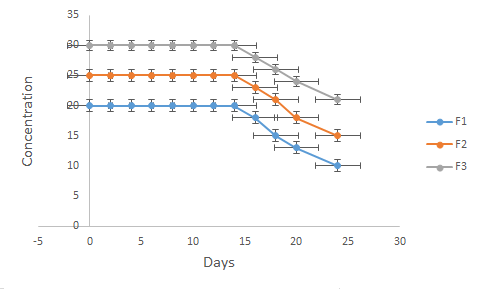
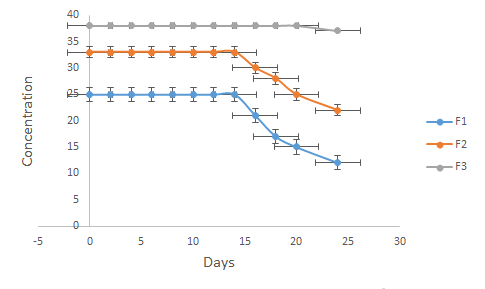
The formulated paracetamol syrup coloured with Citrullus lanatus extract showed better stability when stored in amber coloured bottles than in plain bottles. The concentration of the colourants was stable over a period of time, and it began to decrease after 14 days. However, the concentration of the synthetic colourant (amaranth) in the amber coloured bottle remained stable even after 14 days Figures 2 & Figure 3. Amber coloured bottles have been reported to protect drugs from the effects of photolytic and thermal degradation hence the formulations stored in amber coloured bottles showed better stability than those stored in plain bottles.
Results of Temperature Stability Test
The formulated paracetamol syrups coloured with Citrullus lanatus extract were stable at 37°C and when the temperature was increased to 52°C the concentration decreased. However, the formulations coloured with amaranth was stable to heat at 52°C as the concentration remained constant over a period of 14 days Figure 4. This is due to the presence of lycopene which imparts colour to amaranth and has been shown to stable at a temperature as high as 70°C and only degrades at temperatures above 100°C [9].
![Figure 4: This is due to the presence of lycopene which imparts colour to amaranth and has been shown to stable at a temperature as high as 70°C and only degrades at temperatures above 100°C [9].](/fulltextimages/10635/fig_4.png)
Discussion
The physicochemical evaluation of vegetable crude drugs is a preliminary requirement for establishment of quality and purity. The physicochemical properties of Citrullus lanatus Table 2 revealed 7.25% of foreign matter. The percentage moisture content of C. lanatus was 11 %. This high moisture content of C. lanatus was due to its high-water content thereby making it a suitable habitat for microbial growth or highly susceptible to microbial contamination. The ethanol extract was readily soluble in water and therefore making it a suitable colourant for water soluble drugs.
The C. lanatus extract had a pH of 3.42 which is within the physiological pH and hence less likely to cause any problem in the GIT. However, the acidic pH of the extract may create problems for formulation with basic drugs. The percentage of insoluble matter present in C. lanatus ethanol extract was 8%, this could be attributed to the presence of particles during the filtration process.
Paracetamol syrup coloured with C. lanatus ethanol extract and amaranth which showed a better stability when stored in amber bottles than in plain bottles. The concentration over time for C. lanatus extract showed a continuous increase over a period of 14 days whereas fluctuation in concentration was observe when plain bottles were used. The formulations stored in plain bottles showed colour deterioration with time. This study shows that paracetamol syrup coloured with C. lanatus ethanol extract is best stored in amber coloured bottles since they will protect the drug from photolytic and thermolytic degradation. Formulation coloured with amaranth on the other hand, were stable to light whether placed in amber or plain bottles over a period of time. The findings are in agreement with [22] which observed that the stability of colourants are guaranteed when exposed to light and are stored in amber bottles because the amber colour protects the content of the bottle from photolysis.
Paracetamol syrup formulation coloured with C. lanatus showed stability to heat at 37℃ and when the temperature was increased to 52℃ with slight increase in concentration over a period of two weeks this is due to the fact that lycopene responsible for the colour of C. lanatus is stable at a temperature as high as 70℃ and only degrades at temperatures above 100℃ [10]. At 37℃ all formulation initially showed a significant increase in concentration with a peak reached at 52℃ (day 9) after which the values gradually reduced with no much significant difference. Amaranth on the other hand, being synthetic colourant, is relatively more stable than natural colorants hence showed a better stability to heat over a period of 14 days (Figure 5).
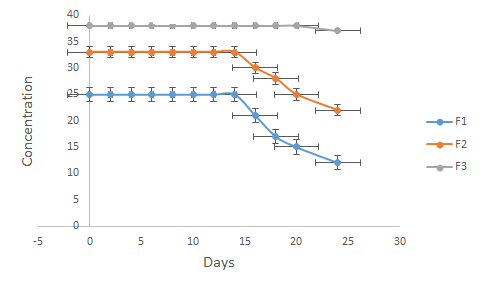
However, the colour intensity of all the colorants in paracetamol syrup deteriorated over time. The temperature stability of C. lanatus colourant was comparable with that of amaranth at 37℃ proving that storage of paracetamol syrup formulation at low temperature was preferable. This observation is in agreement with all formulations showed a significant decrease in concentration over a period of 28 days. Furthermore, little fluctuations in concentration were observed probably due to concentration of the colouring agents, or variations resulting from variety of UV-VIS spectrophotometers used. Ethyl acetate extracts of C. lanatus showed a less intense colour which was lost completely over a period of 3 weeks thereby requiring a higher concentration to maintain its colour intensity hence making them unsuitable colouring agent since an ideal colouring agent should be effective at low concentration [11]. Ethanol extract of the samples at same concentration, maintained similar colour intensity with amaranth which decreased slightly over a period of 28 days.
Conclusion
Ethanol extract of Citrullus lanatus at concentration of 40% and 20% solutions were successfully used as a natural colourant in paracetamol syrup formulation. The study revealed that the syrup coloured with these extracts were susceptible to deterioration on exposure to light and high temperature over time. It can be concluded that the ethanol extracts of Citrullus lanatus (watermelon) can be a good colouring agent for paracetamol syrup and a good substitute for amaranth when protected from high temperature and light [12, 13, 14, 15, 16, 17, 18, 19, 20, 21, 22].
References
-
Khale A, Kenekar H (2014) Coloring Agents Current Regulatory Perspective for Coloring Agents Intended for Pharmaceutical and Cosmetic Use. International Journal of Pharmaceutical and Phytopharmacological Research 3(5): 365-373.
-
Lakshmi C (2014) Food Coloring the Natural Way. Research Journal of Chemical Science 4(2): 87-96.
-
Sen D, Basu D, Pha F (2015) Organoleptic agents Adaptability Acceptability and Palatability in Formulations to make it lucrative. World Journal Pharmacy and Pharmaceutical Sciences 4(10): 1573- 1586.
-
Chengaiah K, Rao M, Kumar M, Alagusundaram M, Chetty CM (2010) Medicinal Importance of Natural dyes a Review. International Journal of PharmTech Research 2(1): 144-154.
-
Khanal D (2013) Helping Ingredients excipient in Pharmaceutical formulation: Coloring Agents use and health concern. Journal of Manmohan Memorial Institute of Health Sciences, pp: 40-48.
-
Mortensen A (2006) Carotenoids and other pigments as natural colourants. Pure and Applied Chemistry 78(8): 1477-1491.
-
Ware MBN (2017) watermelon health benefits risk and nutritional facts. Possible benefits of watermelon 20: 1-5.
-
Tehniat S, Ahmad I, Choudhry S, Saeed MK, Khan MN (2014) DPPH Free Radical scavenging activity of tomato cherry tomato and watermelon Lycopene extraction purification and quantification. International Journal of Pharmacy and Pharmaceutical Sciences 6(2): 223-228.
-
Tola BY, Ramaswamy HS (2015) Temperature and high pressure stability of lycopene and vitamin C of watermelon juice. African Journal of Food Science 9(5): 351-358.
-
Hosahalli Y (2015) Temperature and high pressure stability of lycopene and Vit C of watermelon juice. African Journal of food science 9(5): 351-358.
-
Allam KV, Kumar GP (2011) Colorants the Cosmetics for the Pharmaceutical Dosage Forms. International Journal of Pharmacy and Pharmaceutical Sciences 3(3): 13-21.
-
Agronews (2017) Sokoto carrot farmer push for seeds processing plant.
-
Ambreen N, Butt MS, Sultan MT, Nasir Qayyum MM, Niaz RS (2014) Watermelon Lycopene and Allied Health Claims. Experimental and Clinical Sciences Journal 13: 650-666.
-
Dias JS (2014) Nutritional and Health Benefits of Carrots and Their Seed Extracts. Food and Nutrition Sciences 5(22): 2147-2156.
-
Ekene N, Erhirhie EO (2013) Medicinal Values on Citrullus lanatus Watermelon Pharmacological Review. International Journal of Research in Pharmaceutical and Biomedical Sciences 4(4): 1305-1312.
-
Enujeke EC (2013) An assesment of some growth and yield indices of six varieties of watermelon citrullus lanatus thumb in Asaba area of Delta state Nigeria. International Research Journal of Agricultural Sciences and Soil Science 3(11): 376-380.
-
Frimpong G, Adotey J, Kwakye KO, Kipo SL, Fokuo YD (2014) Potential of aqueous extract of Hibiscus sabdariffa calyces as coloring agent in three pediatric oral pharmaceutical formulations. Journal of Applied Pharmaceutical Sciences 4(12): 1-7.
-
Obasanho (2017) Watermelon farming in Nigeria.
-
Ware M (2016) Carrot health benefit and nutritional information.
-
Mshelia EH, Mathias SN, Umaru ML, Adam AB (2020) Phytochemical and antioxidant evaluation of Cassia sieberiana DC stem bark extracts. The Proceedings of the Nigerian Academy of Science 13(2): 97-110.
-
Mohammed A, Ovenseri AC, Emmanuel HM (2022) Stability Studies of Daucus carota Apiaceae Extracts as Colourant in Paracetamol Syrup Formulation. The Nigerian Journal of Pharmacy 56(1): 49-55.
-
Mohammed A, Mshelia HE, Abdulrazaq F, Shedrach MJ (2020) Stability of Hibiscus sabdariffa Colourant in Paracetamol Syrup Formulation. African Journal of Pharmaceutical Research Development 12(2): 157-163.
- Potential Medicinal Herbs and Secondary Metabolites in Combating Corona Virus
- Monkeypox and its Clinical Implications in Pregnancy
- Pharmacognostical Analysis of the Leaves of Important Nervine Medicinal Plant: Strychnos Nux-Vomica L
- Assessment of Antibacterial Activity of Various Solvent Extracts of Dictyota Dichotoma Against Multidrug Resistant Bacterial Strain
- An Insights of Bioactive Elements on Malignancy: Mechanistic Avenues
- Advances and Future Directions in Pharmacognosy and Chinese Medicine