
Analyzing Conclusions on Classical Terminology by the Study of Symptoms Associated with Agni for its Clinical Relevance
The digestive, metabolic factor has been a vital criterion through various aspects of health and healing in any medicinal system. Ayurveda termed this factor as ‘Agni.’ Ayurveda is one of the oldest Systems of Medicine (TSMs) originating from India. All the eight branches of Ayurveda incorporate a fundamental line of treatment known as ‘Kayachikitsa’ (Internal Medicine), which literally means “treatment of Agni” (Kaya means Agni, ‘Chikitsa’ translated as ‘treatment’). Each Classical text from Ayurvedic Greater Trilogy specified symptoms associated with Agni by precise terminology, and with its reference, described its ‘state’, role in primordial stage, accompanying symptoms, disease prognosis, manifestation, differentiation, disease-stage-wise Agni’s treatment, measures, e.g., nutrition, lifestyle, etc., markers for agni’s recovery and Agni related disease recovery, etc. Evidence of similarities and variances in classical terminology pertaining to relevant outcome criteria bring in the need to refer to all classics since they did not use one and the same term in the same context of some symptoms associated with Agni as a standard protocol. This topic is meticulously researched and published by ‘The Study of Symptoms Associated with ‘Agni.’ with Special Emphasis on Durbalatwa, Sada, Nasha on the Basis of Brihattrayee in Context of Lakshankaosha’. Therefore, it is essential to analyze conclusions drawn on Classical Terminology by this work for Clinical relevance of each classic’s terminology. Which may reveal sequence or correlation of one terminology used by the one, two or each classic for similar or variable symptoms associated with Agni, strategic plan for Agni’s diagnosis within various diseases, its causes, its role as a causative factor, acute-short term effects, recovery markers, early signals of potential underlying long-term sequelae leading to lifelong traces and treatment.
Aim and Objective
This article aims to make authentic classical Ayurvedic information, and core concept of digestive metabolic factor ‘Agni’ accessible, approachable, and applicable globally, for Ayurvedic and non-Ayurvedic scholars. Use of one and the same terminology for describing symptoms associated with Agni is not observed within Greater Trilogy Ayurvedic classics. These classics were composed in different time frames and authors have expertise in variable branches of Ayurvedic medicine. It is observed that each Ayurvedic Classic from Greater Trilogy [1, 2, 3] designated different and precise terminology to explicitly express own interpretation for clinical presentation of many different symptoms associated with Agni indicating health or disease wise different states of Agni, pertaining to relevant outcome criteria. Causes for Agni’s ‘specific state’, its nutrition, lifestyle, and treatment in various stages of disease; starting from primordial stage, its role in disease prognosis, manifestation, differentiation, etc. are indicated. Similarities and differences are observed in these classics regarding this data. Therefore, it is essential to analyze classical terminology for symptoms associated with Agni to standardize clinical significance of each classic’s terminology, highlight its connection with other term by the same or different classic for similar or different symptoms associated with Agni.
Which may provide threads to throw light on its causes, its role, presentation within various diseases, intensity, acute-short term effects, treatment, and signals of potential underlying long-term sequelae leading to lifelong traces. As compared to the ‘immunosuppressant treatment approach’ incurring drug induced adverse side effects, the ‘Ayurvedic immunity-strengthening, detoxifying, rejuvenating, wide range of modalities with conservative approach’ may offer effective pharmaceuticals, care, and cure. Understanding and clinical significance of the foundational functional principles like, digestive factor, the ‘Agni’ is needed for the efficacy and success of Ayurvedic intervention. It is aimed to encourage conscious integration of ‘Agni’ to investigate its significant diagnostic and therapeutic aspects within medicines outside of Ayurveda by non-Ayurveda doctors as well as Ayurvedic doctors.
Methodology
The authentic basis of this manuscript is ‘The Study of Symptoms Associated with Agni with Special Emphasis on Durbalatwa, Sada, Nasha on the Basis of Brihattrayee in Context of Lakshankaosha’, i.e., a scholarly work by researcher Dr. Savita Rajurkar [3]. This scholarly literature research brings in the comparative authentic data from the classical texts in the context of symptoms associated with Agni the original greater trilogy classical texts Brihattrayee, (brihat=greater called as the Greater Trilogy [2] Charak, Sushrut, Ashtang Hridaya and Ashtang Sangraha. The most ancient classical texts, the Greater Trilogy that are authorized main source of knowledge in Ayurveda, are selected within this literature research.
The Greater Trilogy includes Charak Samhita (Charak is name of the author, samhita means book), Sushrut Samhita (Sushrut is name of the author), Ashtanga Hridaya Samhita (Ashta means eight, anga-parts or branches, Ashtanga means eight parts or eight branches; Sanskrit word Hridaya literally means ‘heart’ and can be explained as a core), or Vagbhata Samhita (Vagbhata is name of the author), and Ashtanga Sangraha Samhita (Ashtanga means eight parts or eight branches, Sangraha means collection) They are rigorously studied from the Sanskrit version of the Classics as well as their most authentic Sanskrit commentaries and Lakshanakosha [4] within this research. Details of the Classics used for reference are presented in Table 1.
| Name of Classic Text From Greater Trilogy Bruhattrayee Bruhatgreater, Trayee Three | Name of the Honorable Scholar Author Aacharya Honorable Scholar Aacharya | Name of the Commentary Teeka Teeka commentary | Name of the Commentator Teekakaar |
|---|---|---|---|
| Charak Samhita | Written by Agnivesha, revised by Charak and Drudhabala | Ayurveda Deepika | Chakrapani |
| Charak Samhita | As mentioned above | Jalpa-kalpa-taru | Gangadhar |
| Sushrut Samhita | Acharya Sushrut | Nibandha Sangraha | Dahlan |
| Ashtanga Hrudaya | Acharya Vagbhat | Shashilekha | Indu |
| Ashtanga Hrudaya | Acharya Vagbhat | Sarvanga-Sundara | Arundatta |
| Ashtanga Sangraha | Acharya Vagbhat | Ayurveda Rasayana | Hemadri |
Table 1: Details of Ayurvedic Classics - Greater Trilogy, Authors, Commentaries, Commentators.
Lakshana Kosha [4] is not a Lexicon, but it is a compilation providing classified original information on symptoms with certain aim or specific purpose. Lakshana=symptom, Kosha=normally word Kosha points towards dictionary. Meaning of word Triskandhakosha [5] Tri=three, skandha=parts/sections, kosha=normally word Kosha points towards dictionary. ‘Triskandha kosha’ has systematically segregated and compiled the various references from Brihattrayee into three different parts, viz. Lakshanakosha [4] which elaborates symptom-disease health relationships. Hetukosha, [6] (hetu=cause/causative factor) which elaborates on the spectrum of causative relationships between diet, behavior etc. and health and disease. Aushadhakosha, [7] (Aushadha=medicine/ treatment protocol) which elaborates all such relationships from the perspective of treatment.
Triskandhakosha [5] thus involves a blend of Ayurveda, Sanskrit, and information technology. It comprises a complete listing of textual information classified according to Triskandha approach causes (Hetu), symptoms (Lakshana) and treatments (Aushadha) of health and disease [8]. The entire thesis work, observations, and conclusions are keenly assessed from the lens of analyzing their conclusions explore interconnections, sequences, and views of authors for their clinical relevance and present consolidated.
Observations
It is observed that the Agni, its exact meaning, interpretation, and clarification for each classical terminology expressing symptoms associated with Agni are rigorously studied, evaluated, compared, and concisely presented with the help of authentic classical references in the referred thesis [3] with the objective to facilitate process of perfect clinical diagnosis and treatment of the Agni [1]. This multifaceted study is in two steps [3]. The foundational step clarifies Ayurvedic concept of Agni, comprises its etymological meaning, synonyms in general, their variable meanings, synonyms of Agni as a digestive factor, meanings, and functional resemblance with Pachaka agni [9]. For the analysis on conclusions, we have focused on the second step from this thesis which is the study of symptoms associated with Agni [10]. It is evident that despite being quite critical topic, this study is quite methodically conducted with the four logical aspects, viz. 1.Triskandha approach, 2.Author- wise segregation, 3.Status of symptom, and 4. Consideration of meaning of terminology [11]. Triskandha Approach (Triskandha=three parts, Tri=three, skandha=parts/
aspects), Charaka has described the information regarding
health and disease in a Ayurvedic Triskandha manner
$$ i. e., \quad H e t u = c a u s a t i v e \quad f a c t o r s, \quad L i n g a = s y m p t o m s \quad a n d $$
Aushadha=medicine [8] Lakshana-symptom being part of
Triskandha, the same approach is taken up for this study of
symptoms associated with Agni.
Author Wise Segregation of Symptoms
A symptom is caused due to a causative factor; a symptom can be a cause for another symptom. Cause wise treatment is applicable accordingly. Various authors have own views regarding that particular symptom itself, either a hetu- causative factor of a symptom, or treatment or assessment whether it is causing any progressive scenario. Hence it is appropriate to study the symptom by the way of author wise segregation of each and every symptom and its concerned information.
Status of the Symptom
Nidana Panchaka is Ayurveda’s one of the several diagnostic procedures for determining the source of an illness, as well as predicting its prognosis. Nidana=diagnosis, Panchaka=five, translated as five items to consider during diagnosis, viz. Nidana (etiological factors), Purvaaroopa (primordial symptoms before actual presentation of disease), Roopa (signs and symptoms as a disease presentation), Upashaya (like and dislike with respect to symptoms and disease/recovery or progression) and Samprapti (prognosis/ etiopathogenesis).
It is necessary to understand whether the symptom is expressed as a lakshana-symptom, as a primordial symptom prior to manifestation of a pathology as a disease or roopa-signs and symptoms of a manifested disease, or Upadrava-secondary pathology arising from the primary disease having origin in the primary disease or as a part of samprapti-prognosis/ etiopathogenesis, Rishta or arishta lakshana-symptom indicative of a critical state that may be fatal. It is considered as a status of that symptom. This has helped in expressing the sequence of the symptoms in particular disease.
Consideration of the Meaning
The literary meaning of the term changes with respect to the associated reference or word. Agni is a functioning entity. Anatomical existence of Agni can’t be put forth as a solid substance or a mass as such. Certain terms like ‘Nasha’ express anatomical anomaly of any organ or its functionality but with respect to Agni, it indicates functional impairment. The information concerned with health and/or disease, related to Agni as a causative factor, and Agni as a Lakshana symptom are collected from Lakshanakosha [4] and Agni as a cause and cause of Agni from Hetukosha [6].
Discussion
Research work ‘The study of symptoms associated with Agni [3] has offered twenty-three relevant terminologies mentioned within different contexts for symptoms of Agni by the greater trilogy. For the purpose of symptoms-specific- study, those twenty symptoms are systematically grouped and collectively and independently explained, viz. chapter 3 includes ‘Sama, Vishama, Sandhukshana, Udeerana- Deernatwa, Utklesha, Vriddhi, Deepana, Teekshna, Atyagni, Dushti, Badhana, Kshaya, Kshamatwa, Alpatwa, Mrudutwa, Mandatwa, Hatatwa, Haani, Bhramsha and Nirasana’, followed by the focused study of symptoms, viz. ‘Durbalatwa’, ‘Sada’, ‘Nasha’ in chapters 4,5,6 respectively [12]. Each symptom is analyzed on the basis of its below aspects.
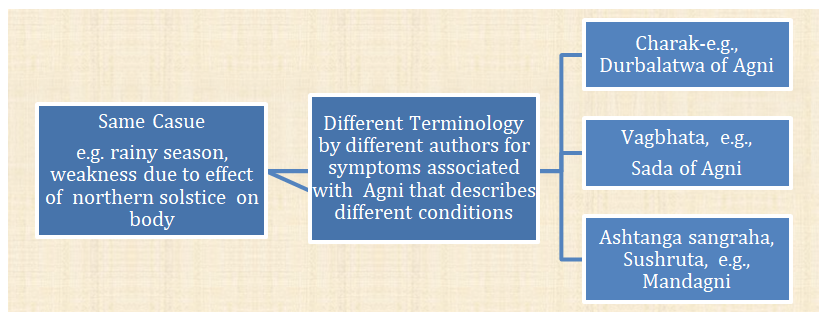
Etymology Meaning a dictionary meaning and meaning with respect to Agni. Introduction - quoting the key information about symptom. Research and assesses of Lakshanakosha references followed by Hetukosha which describe the symptom as a hetu-cause and from Karyahetukosha clarifying the causative factors for that symptom. The references acknowledged from Aushadha Kosha are mentioned wherever applicable. Otherwise, the treatment related references concerned with that symptom of Agni are assessed and selected from original texts. The original references are researched, studied, evaluated, and presented author wise. Comparison regarding various issues, and mainly based on 3 below aspects is conducted accordingly by the researcher. One cause and different terminologies used by different authors, e.g., refer picture 2. Some terms like Bhramsha, Kshamatwa are used only in specific context by certain authors, (Table 2). This type of author wise comparative study of various symptoms associated with Agni with Triskandha perspective is done for the first time; it is a pioneer study [3]. Clinical relevance is observed that specific classical terminology for Agni associated symptoms incur their relevant information on author’s views, treatment, etc. Analyzing conclusions on meanings of classical terminology used for symptoms associated with Agni for its clinical relevance as below.
| Name of the classic | Terminologies not used for Symptom associated with Agni |
|---|---|
| Charaka | Kshamatwa, Bhramsha |
| Sushruta | Sandhukshana, Bhramsha, Khamatwa, Kshaya, Utklesha, Haani, Udeerana, |
| Ashtangahridaya | Badhana, Durbalatwa, Utklesha |
| Ashtangasangraha | Utklesha |
Table 2: Bhramsha, Kshamatwa.
The Study of Symptoms Associated with Agni with Special Emphasis on Durbalatwa, Sada, Nasha on the Basis of Brihattrayee in Context of Lakshankosha
- Sama Agni= balanced, expresses normality, a balanced condition of agni is a symptom of a healthy person ( prashasta = healthy, purusha=person) [13].
- Vishama Agni = irregular, inconsistent, imbalanced agni [14].
- Agni Sandhukshana = kindling, enhancing [15].
- Udeerana-deernatwa=grow, rise, increase, normal when previous food is digested, new input is awaited [16].
- Utklesha=excitement, natural upsurge-as a marker of proper panchakarma-detoxification. Charak’s special terminology for condition of Agni as marker of positive effect of proper samshodhana-panchakarma [17].
- Vruddhi/ Vriddhi=increase-natural or unnatural, grown, enlightening with respect to agni [18].
- Deepana=kindling, condition of Agni as marker of positive effect of proper samshodhana-panchakarma [19].
- Teekshnagni=severe, sharp, harsh-hyperfunctioning [20].
- Atyagni=hyperactive, considered as highest level of hyperfunctioning [21].
- Dushti=corruption, depravity [22].
- Badhana=harassing, opposing [23].
- Ksheenatwa=loss, decline, removal [24].
- Kshamatwa=diminished, little, thin, destruction- Kshamatwa is a stage which is found as a lakshana- symptom of vishuddha sharir (properly detoxified body of a person who underwent detoxification- panchakarma) in samyak yoga (samyak=the way it has to be/ ideal/ optimum, yoga=outcome) of Samshodhana Karma=detoxification method/ panchakarma. It is not mentioned irrespective of panchakarma. It’s a terminology specific to expressing the status or condition of Agni only after panchakarma by Ashtangahridaya and Ashtangasangraha [25].
- Alpatwa=little bit existence, tiny [26].
- Mrudutwa=softening, weakening [27].
- Mandatwa= slow, tardy, lazy, inactive, dull, feeble, weak [28].
- Hatava=to kill, finish [29].
- Haani=loss, failure, damaged, omission [30].
- Bhransha/Bhraumsha dropping down due to lack of own strength leading to displacement from its original place [31].
- Nirasana=to get thrown, get kicked out of own seat/ location forcibly and drawn away by imbalanced dosha (from tridosha Vata, Pitta, Kapha) [32].
- Durabala=durbalatwa=spiritless, enfeebled, difficult to do certain function. In context of Agni, durbalatwa of agni indicated malfunctioning due to preexisting condition of toxic substance ama created by Mandagni and therefore, it is somehow functioning but leading to more ama [33].
- Sada=sinking, decay, settling down, to be helpless [34].
- Nasha=misfortune, calamity, ruin, loss, disappearance, death, elimination [35].
A normal or balanced Agni, sama agni, is a benchmark finding; complementary ‘increase’ is an aspect for symptoms stating functioning normal or close to normal activity of sama agni [13]. Abnormal increase leading to hyperfunctioning is termed as Teekshnagni [20], and a highest grade of hyperfunctioning is termed as Atyagni [21]. ‘Contamination’ of agni occuring due to influence of one dosha, combined two dosha or combined three dosha (Dosha - Ayurvedic functional anatomical considerations; they can contaminate in imbalanced state. Vata, Pitta and Kapha are the three dosha; collectively called Tridosha, independently called as a dosha), or due to agni’s displacement from own seat are more aspects leading to Agni’s irregular functioning, or malfunctioning, indicated by specific terminology. Clinical relevance of comparative study of Vriddhi, Sandhukshana, Udeernatwa, and Deepana: Sandhukshana, Udeernatwa, Vriddhi and Deepana symptoms indicative of Agni’s inherent tendency or behavior or a naturally due hyperactivity to support and manage its normal state. The terms Vriddhi, Sandhukshana, Udeerana, Deepana are purposely used by the authors. All the terms mainly suggest the situation of normal functioning except for Agni in Sthaulya-obesity and in Pittaja Grahani-colitis caused by pitta imbalance. Charaka used the terminology Udeerana as agni associated symptom in Pittaja Grahani-colitis disease, and Vriddhi to express the kindling of Agni.
Sushruta did not use Udeernatwa term for symptoms associated with Agni. Among above four terminologies, only the Karyahetukosha references of Udeernatwa include the list of the properties of the food and water responsible for Udeernatwa of Agni. It can be considered as a stage where Agni just needs a little bit of push and Udeernatwa occurs that increases the flame. A symptom indicative of health. It is moreover expressing the normal situation of rise in Agni, when previous food is digested, and the new input is awaited [16]. The terminology Sandhukshana of Agni is used with respect to the association of Saman vayu by Charaka, Ashtangasangraha and Ashtangahridaya. In Sushruta Samhita term Sandhukshana is not used with respect to the symptom associated with Agni, but it is used with respect to the treatment of Mandatwa of Agni in Arsha- piles/hemorrhoids. Long list of medicines, herbs and food preparations is given to bring about Sandhukshana or Vriddhi or Deepana of Agni as well. Deepana and Sandhukshana moreover reflect the similar meaning. Deepana term is more oftenly used with respect to certain conditions like Samshodhana=detoxification, Karma actions/modalities, samshodhana karma panchakarma, and certain diseases like Arsha piles/hemorrhoids.
Deepana, Deeptatwa of Agni, an enhancement or kindling of Agni up to the mark, normal level, occurring naturally due to pitta’s prominence in middle age and regular due consumption of healthy internal oleation by fatty substances is termed as Deepana. Deepana is listed as an outcome or part of treatment of diseases, symptom indicating sadhyatwa- healing, and a marker leading to recovery in diseases. All the four authors have used the term Vriddhi of Agni with the same sense of kindling. Vriddhi of Agni directs towards the increase of Agni, but it expresses non-recovery marker also. The term Sandhukshana is used by Charaka in Sthaulya Obesity, while the term ‘Vriddhi’ is used by Ashtangasangraha in Sthaulya-obesity. So, it can be said that Vriddhi and Sandhukshana can be considered synonyms of each other in the case of Sthaulya-obesity. The terminology Vriddhi is used while explaining the dependance of other twelve Agni over the Jatharagni. Vriddhi of Jatharagni, which is the main digestive factor, causes Vriddhi of dhatwagnis and bhutagnis.
The other twelve agni, viz. seven dhatwagnis-agni of each of the seven dhatu and five bhutagnis-agni of each of the elements. Dhatwagni or Dhatu agni- dhatu agni, which means the Agni responsible for the digestion related to each dhatu, body constituent. Each body constituent has its own digestive factor called as dhatu agni and named after that dhatu~body constituent-tissue, viz. rasa~cytoplasm, rakta~blood, mamsa~muscles, meda~adipose tissue, fat, asthi~bones, majja~bone marrow, shukra~reproductive tissue (sperm/ovum). Agni of elements is called as bhutagnis- space, air, water, fire, and earth are the five elements. Each element’s agni takes care of digestion related to that element. Natural Vriddhi of Agni means bringing upgradation of Agni to making it up to the mark is one aspect. The other aspect is the unnatural growth or abnormal increase in Agni, and pachaka pitta that leads to Teekshnagni, aggravation of Teekshnagi causes Atyagni.
Teekshnagni and Atyagni indicate hyper functioning of Agni. Teekshna Agni means unduly agitated, sharp, harsh, hyperfunctioning Agni due to influence of aggravated pitta dosha, pachaka agni digesting improper food even if consumed in improper quantity, content, method, and time easily within a short period. If insufficient fuel i.e., food supply is provided, then Teekshnagni [20] starts absorbing the essential body constituents, i.e., dhatus of the body. Atyagni [21] reflects sequentially next grade and a highest grade of hyperfunctioning state of Teekshna Agni that can quickly digest improperly consumed, improper food in improper quantity and time. If there is insufficient food supply, it digests dhatus of the body. A classic different treatment plans are designated for different terminologies.
Vishama is a Vikruti=imbalanced state due to Vimargagamana-disposition or displacement or improper movements of vata dosha [14]. Due to improper and irregular state of vata dosha, the tendency of digestive capacity of Pachaka agni becomes irregular. It causes many symptoms at the time of digestion. Whenever this movement is due to increased vata, it abnormally increases agni, agitates it and then sometimes even improperly consumed improper food gets digested; but if this movement leads to decreased vata and increased kapha situation, it slows down agni and leads to indigestion. Then properly consumed food in proper quantity, quality and time is not digested. Vishama reflects like a combination of Teekshna/tikshna and Manda agni. Mandagni, a weak fire that fails to digest a food even consumed in proper quantity, proper contents, method, and time. Mandatwa of Agni is caused due to Kaphadosha contamination, kapha dosha increase. Improper and slow digestion is the characteristic feature. Manda Agni gives rise to Aama dosha [16]. Hatatwa, Kshaya, Ksheenatwa, Haani indicate hypofunctioning of Agni due to damage caused by certain causative factors. Kshamatwa and Utklesha are terms used only with respect to certain specific conditions like Samshodhana Karma-Panchakarma detoxification methods [36]. Dushti, Badhana indicate the disturbed Agni. The terms Dushti and Badhana may sound the same meaning, but their references reveal a difference. Badhana of agni terminology is used to indicate disturbance in Agni due to increased and liquified Kapha in Spring and due to Vata dosha contamination because of rain, increased humidity, etc. in rainy season Ashtangasangraha and Ashtanga Hridaya [37]. Ashtangasangraha mentioned, Badhan of Agni, which is already Manda, takes place in rainy season due to climate conditions. Sushruta used Badhana terminology to express condition of Agni in a vyapad-undue effect of Niruha Basti- therapeutic decoction enema when Anuvasanbasti-oil enema is given in a decreased vata condition for consecutive 3 days.
Dushti of Agni deals with improperly consumed improper food, any other disease or due to corruption of any other organ like Grahani-colon or pitta dosha imbalance caused due to natural causes of imbalance like improper/ untimely presentation of seasons. Dushti expresses the low functioning level of Agni caused by pitta’s abnormal increase due to contamination. Dushta Agni fails to digest even a qualitatively/ quantitatively light food. To analyze, Udar Roga-ascites etiopathogenesis described Dushti means contaminated Agni accompanied by contamination of prana vayu, (Ayurvedic meaning of prana vayu one of the five types of vata, prana vayu controls inward movements, e.g., inhalation, ingestion) and apan vayu (Ayurvedic meaning of prana vayu one of the five types of vata controls downward and outward movements, e.g., excretion of urine, feces) Dusti is the term used mainly in Udara Roga-ascites and Grahani- colitis.
The analysis reveals clinical relevance that understand Agni Dushti as the one that can be occuring before the situation Mandatwa of Agni. Durbalatwa occurs after Mandagni has started generating ama due to slow digestion. Alpatwa, Mrudutwa, Mandatwa of Agni: these terms indicate malfunctioning of Agni. The references are variable for each term. Alpatwa is caused by food poisoning, undue side effect of panchakarma like therapeutic emesis, improperly managed kapha dosha. Mrudutwa is caused by excess of oiling/ oleation of body, a condition caused by undue effect of in Niruha basti-therapeutic decoction enema, one of the panchakarma, due to consumption of food in greater quantity. Alpatwa, Mrudutwa can be the stages of Agni prior to Mandatwa of Agni. e.g., in Udara Roga - ascites, the symptoms Manda, Durbalatwa and Nasha associated with Agni express a specific sequence which points out a further deterioration of Agni, and disease condition thereby.
Bhramsha: Bhramsha of Agni indicate Haani of Agni also. Ashtangasangraha, Ashtangahridaya used term Bhramsha; Charaka and Sushruta have not used it. Bhramsha may indicate Kshaya as said by Charaka in another type of herpes zoster-Antarashtriya Visarpa which may indicate dropping down of bala-strength of Agni. Nirasana: of Agni indicates forcibly moved from its own seat by vitiated or contaminated doshas whereas Bhramsha reflects Agni is not displaced or dispersed but Agni’s own ability to stay at its own place is affected. The references for Bhramsha and Nirasana vary. The Nirasana term is used to mention Agni’s state only in etiopathology of Jwara-fever by all the four authors unanimously [38].
Ashtangasangraha and Ashtangahridaya used Haani separately in one type of Herpes. Sushruta didn’t use term Haani of Agni. Haani of Agni can be stated as Nasha, Bhramsha, Hatatwa, but the difference in references of concerned terms clarify the views of authors for using the specific term in specific condition. The term Nasha is used by Charaka as a primordial symptom of Kardamaka Visarpa-a type of herpes, the term Haani is used by Ashtangasangraha and Vagbhata as a part of etiopathogenesis of Kardamaka Visarpa-the same type of herpes. Kshaya is a reduced state of Agni caused by external reasons and mentioned as one of the symptoms indicating rishtalakshana-markers of non- recovery leading to loss of lifespan in some diseases. Hatatwa means hampered killed destroyed Agni is moreover because of the dosha is a condition in which Agni is attacked by increased liquid/watery quality of pitta or by undue low dose application of Niruha basti- therapeutic decoction enema or by forcible excretion of watery substance from body by Vata. Due to the effect of the climate conditions, the heat of sun in Spring season, Kapha starts liquifying and thereby increase of kapha takes place causing Hatatwa of Agni. The treatment is different than Durbalatwa of Agni, since the causes are different. Although the causes are different, the outcome effect ‘Aamadosha’ is a common factor in Durbalatwa &
Hatatwa. Agni is said to be Durbala in rainy season, by Charaka.
It causes annavidaha, that may be understood as hyperacidity, acid reflux. Sada of Agni is Hypofunctioning of Agni mainly due to decreased vata dosha, non-cooperation of saman vayu and increased kapha. The sinking condition of Agni indicates that if the proper treatment is not given timely, Agni may go off. Vagbhata has said Agni Sada in rainy season, Ashtangasangraha has described Agni Sada in winter season due to insufficient food supply. Nasha of Agni described as a total breakdown of Agni. Nasha of Agni’s strength to perform is specifically mentioned by Charaka that it is caused by excessive application of vata aggravating modalities like fasting (Langhana), and by Ashtangasangraha that it is caused when Aamadosha becomes strong. Comparative Study of Mandatwa, Durbalatwa, Sada & Nasha reveals that Durbalatwa as a cause of various diseases and conditions. Durbalatwa of the Agni (caused by non-conducive diet and lifestyle) is a causative factor of angry dosha in Sannipatic Udar Roga-ascites caused due to combined effect of imbalance of all the three dosha, is one reference in Charaka Chikitsa sthana. In other place in Sushruta nidana sthana causes of Udararoga – ascites, Nasha of Agni is found as a roopa-symptom in Pleehodara- involves spleen enlargement, and as a part of Samprapti in Udakodara - a type of ascites and Baddha Gudodara – intestinal obstruction, according to Charaka.
The treatment of Sannipatic Udararoga is different from other types of Udararoga. Mandatwa of Agni cause Samprapti-etiopathology of Udararoga according to Charaka. It is necessary to understand whether Durbalatwa and Mandatwa are synonyms in this or different stages or shades of the Agni, causing different types of Uderroga. In causative factors of Uderroga, etiopathology and general explanation of Uderroga, classics instructed to examine the Agni’s different states separately because each state leads to different etiopathology. Further in the explanation of etiopathology of Udararoga-ascites, Charaka uses the specific terminology, and the list of causative factors indicates specific cause for that state of Agni. Mandatwa as a cause, and that the Mandatwa is caused by dosha prakopa- aggravation of vitiated doshas in their own seats has taken place. It specifically causes symptoms concerned with mala, purisha or excretory organ (guda -Anus). It can be considered that when other than the required strength of medicine in samshodhana karma panchakarma is consumed by a person, he may get Mandagni causing such symptoms [39]. Mandatwa, Hatatwa, Saada, Nasha, are the symptoms indicating malfunctioning of Agni progressively.
Conclusion
This literature research brings in below conclusions [40]. A word may have many meanings, their clinical relevance lead to different clinical outcomes. It is essential to take- up this kind of study for the clinical relevance of different classical terminologies deliberately used by different authors of classics for various Ayurvedic foundational principles, e.g., ‘Agni.’ This manuscript presents literature research, which is facilitating to thoroughly understand, scrutinize, compare the similar and dissimilar terminologies used to describe symptoms associated with Agni by Ayurveda’s most authentic greater trilogy. Which throws light on their clinical relevance for diagnosing Agni’s strength at various stages of health and disease, disease diagnosis, etc., that may bring in optimum outcome from authentic, scientific ayurvedic practice.
Classical Triskandha i.e.,(hetu)-cause-(linga/lakshana)- symptoms-(aushadha)-medicine-based approach, and Triskandha Kosha’s use for this study are appropriate strategies for methodology for this type of study [18]. All
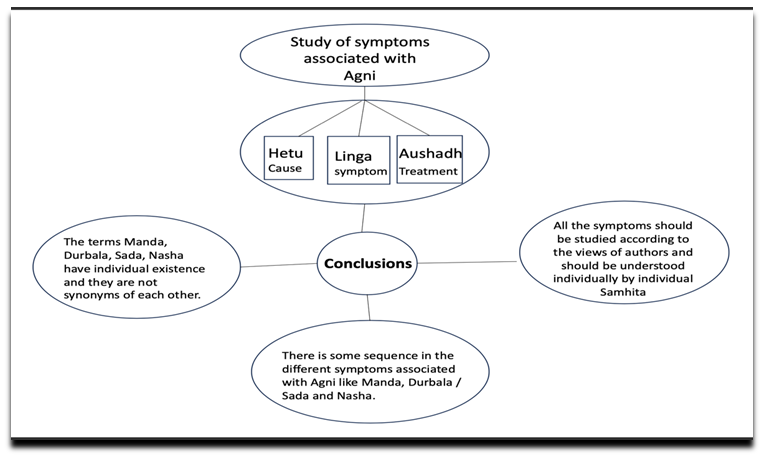
symptoms should be studied according to views of authors and should be understood individualy by individual samhita. Classics include time tested data applied for substantial number of patients successfully. It is analyzed that when one author designated specific terminology for a symptom associated with Agni then he continued use of that same terminology to explain its causes, diagnosis, primordial symptom, relevant underlying symptoms, Agni’s that stage based medicines, modalities, treatment plan, management of treatment protocols, Agni recovery markers, overall disease recovery markers based on Agni’s recovery, regression or progression of disease, its relationship with any other disease, etc. Which may include any or many connecting aspects (Figure 1).
Therefore, it is clinically relevant to check, validate causes to diagnose Agni’s state, align with relevant classical terminology so that relevant references for its classical clinical management are readily available in greater trilogy. It may be an evidence-based approach to follow authentic guidelines by classics [19].
One terminology by one author in one context may be used in a different context by another author. This reflected a different meaning, causes and outcomes. Therefore, it may be reasonable to study causes for Agni’s symptoms and diagnose the symptoms by referring to specific terminology used by the specific author. Sometimes one and the same word is not used by another author in one and the same situation or cause, but some different word is used. In that case the situation/cause should be given priority, and the sequence for Agni’s state should be understood. Note the terminologies not used by certain authors for symptom associated with Agni (Table 2).
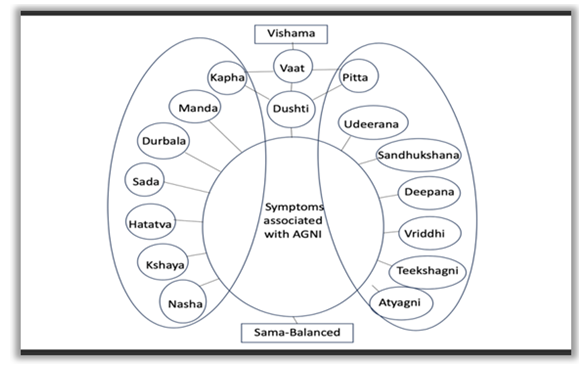
Once it is clinically observed that a particular condition matches perfectly with references, views of one author, then it may be logical to adhere to that author’s that text at a time, consider exploring his views on specific terminology to describe condition for relevant treatment protocols, etc. in the interest of optimum outcomes. Analysis on Classical Terminologies for Symptoms associated with Agni: Sama Agni is prakruti- normality. Udeerana, Sandhukshana, Deepana, Vriddhi are indicative of increase of Agni closer to normal functioning of Agni. All the four authors have used the term Vriddhi of Agni with the same sense. Teekshna, Vishama, Manda are fundamentally different states of agni vikruti, abnormalities of Agni. Teekshnagi and finally Atyagni are extreme levels of abnormal hyper functioning of Agni. Vishamagni can be unpredictably variable. It can be hypo sometimes or hyper sometimes. Manda is an initial level of hypofunctioning. It further progressively declines to the state Durbalatwa, Sada, Kshaya, Hatatwa, Nasha according to concerned hetus-causative factors. Refer picture 1. it can be the conclusion that Agni in the rainy season is Manda initialy, and then Sada or Durbalatwa can be furthur hypofunctioning of Agni according to concerned causes.
This may be indicative of a kind of sequence for the symptoms associated with Agni, i.e., Mandatwa (slowness/ inactivity)-Durbalatwa-Nasha in the progress of a disease. starting from slowness and inactivity leading to ama- a toxin created in the body due to indigestion of food from the undigested food. weakening, Especially, in diseases like Arsha-piles/ hemorrhoids and Udara Roga-Ascites symptom Mandatwa is said to be the primary stage followed by Durbalatwa followed by Nasha. So Mandatwa, Durbalatwa and Nasha respectively can be considered as a progressive stage of Agni vikruti/vikriti=imbalance. This may be indicative of a kind of sequence for the symptoms associated with Agni, i.e., Mandatwa(slowness/inactivity)- Durbalatwa-Nasha in the progress of a disease. starting from slowness and inactivity leading to ama- a toxin created in the body due to indigestion of food from the undigested food. undigestion weakening, finding such a sequence is itself a great achievement. Efforts have been taken to illustrate each symptom with the Triskandha approach. Please refer to the conclusion part of those chapters for a better understanding of that symptom. In nutshell, to give an overall grasp of the study, the following conclusions are important [41]. Mandatwa / Mandatva, slowness, directs towards the stage where Agni is slowed down but functioning. It may lead to poor appetite. Mandatwa/Mandatva leads to Aamadosha. Durbalatwa, usually found in association with preexisting Aamadosha. Durbalatwa is observed directing towards the stage where Agni is weakened due to ama, but somehow working generating more Aama. The most interesting and noteworthy conclusion this research is bringing forth is that Vagbhata in his text Ashtanga Hridaya has not used the terminology ‘durbalatwa/durbala’ for symptoms associated with Agni. Sada, specifically used to indicate Agni’s stage when increasingly weakening of agni who is already manda happens. Sada agni who is weaker than ‘manda staged agni,’ needs to be pulled up and stimulated to work. Charaka has used term Sada rarely. Quite oftenly other authors have used the term Sada in the conditions where Charaka has used term Durbalatwa. Sada term is used by Vagbhata for the condition when previously Manda Agni is getting affected due to Adanakala-northern solstice in rainy season. Ashtangasangraha has used the term Sada to indicate hypofunctioning of that Agni who is already manda due to seasonal effect of rainy season (Figure 2).
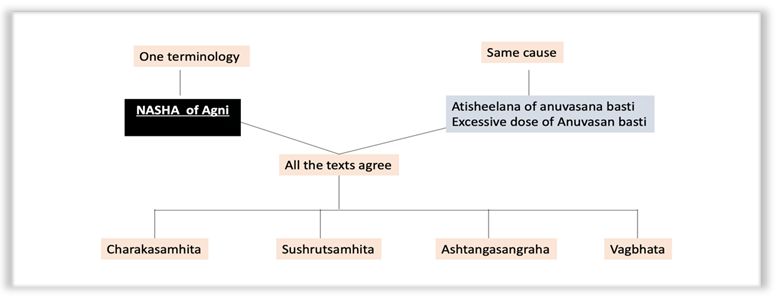
Nasha is a stage moreover concerned with total breakdown of Agni. It is separately mentioned by Charaka and Ashtangasangraha. With one cause, all the authors used Nasha of Agni terminology (Figure 3).
Kshamatwa indicate condition of Agni in Vishudha sharir-detoxified body after proper panchakarma. It is considered as a cause of Mandatwa of Agni in Grahaniroga- colitis according to Ashtangasangraha & Ashtangahridaya. F) Utklesha term is used only by Charaka to express the Agni in undue side effect called ‘Parisrava’, from improper panchakarma. G) This study enables us to understand the significance of the specific term used by the author in specific place in his Samhita. H) It enables us to know, how many times this reference has occured and in which place and in which respect it is used every time I) This study explains different terms used by different authors in one and the same context, it can be concluded that they are used as synonyms of each other, in some of the conditions e.g., Haani and Bhramsha. J) All the four authors emphasized that Agni reflects the Avastha=stage of disease and the sadhyatwa- curability, asadhyatwa-non curability of disease. K)Agni’s state is significant criteria within the set of Arishta Lakshana of certain diseases, i.e., set of symptoms indicative of nonrecovery, deterioration of disease affecting that patient’s lifespan [42, 43, 44].
To summarize, clinical relevance of analyzing conclusions on classical terminology for each symptom associated with Agni is evident in clinical practice. A clinician is encouraged to align clinical diagnosis and treatment by following the terminology used by classics in context of relevant disease/ conditions that they are addressing. E.g., Deepan and Sandhukshana sound quite similar, leading to the outcome of kindling of agni. However, we need to clinically check agni’s symptoms by different dosha. ‘Sandhukshana’ terminology indicate that saman vayu, vata dosha is responsible for Sandhukshana. Sandhukshana can be natural symptom of health, or it is expected to achieve. Therefore, classics listed specific medications, treatment protocols working on Saman Vayu’s function to light up the Agni’s flame to achieve Sandhukshana. Whereas pitta’s predominance, young age, panchakarma refer to deepan, treatment is listed accordingly (Figure 4).
Contribution of This Work to The Science: Due to analysis a confirmation and proper use of terminology according to Ayurvedic classics is clearer. Classic Ayurvedic treatment can be successfully administered by means of such Ayurvedic mode of diagnosis through its critical review and study. This study throws light on causative aspects of Agni and Agni as a cause. The purpose of conducting integrative medical research is to incorporate complementary and natural medicine into medical practice. Some Ayurvedic perspectives have been written off prior to investigation from the research community. Challenging the status quo and investigating novel approaches are at the forefront of cutting-edge research.
One example where Ayurved can be utilized in a randomized controlled trial (RCT) pertaining to a particular disease and treatment is by adding Agni as a variable inclusive of subjective as well as objective parameters. It may allow research to assess the validity of Ayurvedic practices, and in turn draw from the depth of resources available through treatment practices. Students of medical research that desire to be a part of a scientific community open and willing to test new ideas, also seek to incorporate these practices into studies. These conclusions can be valuable while addressing Agni’s state, based on authentic classical diagnostic and therapeutic aspects by referring to relevant classical treatment protocols.
References
-
WHO, Ayurvedic Clinical Terminologies, pp: 61.
-
(1992) Brihattrayee Charaka Samhita with commentary by Chakrapanidatta. In: Acharya YT (Ed.), Chaukhamba Surbharati.
-
(1997) Sushruta Samhita with commentary by Dalhana. In: Acharya YT (Ed.), 6th (Edn.), Chaukhamba Orientalia.
-
(1995) Vagbhata Ashtangahridaya. In: Kunte HN (Eds.), Commentary by Arundatta Krishanadas Academy, Varanasi and Hemadri.
-
Ashtangasangraha. In: Vaidya AD (Ed.), Athawale with Indu commentary.
-
Shrimad Atreya Prakashan (1980).
-
Rajurkar S (2021) Study of symptoms associated with Agni with special emphasis on Durbalatwa, Sada, Naasha, on the basis of Brihattrayee in context of Lakshanakosha. Shodhganga, pp: 153.
-
Gadgil DP (2004) Lakshanakosha. Tilak Maharashtra Vidyapeeth.
-
Gadgil DP (2010) Understanding Ayurveda. Journal of Ayurveda and Integrative Medicine 1(1): 77-80.
-
Gadgil DP (2004) Hetukosha. Tilak Maharashtra Vidyapeeth.
-
(2009) Charak Samhita Sutrasthana, pp: 1-42.
-
Rajurkar S (2021) Study of symptoms associated with Agni with special emphasis on Durbalatwa Sada Naasha on the basis of Brihattrayee in context of Lakshanakosha. Shodhganga, pp: 10.
-
Rajurkar S (2021) Study of symptoms associated with Agni with special emphasis on Durbalatwa, Sada, Naasha, on the basis of Brihattrayee in context of Lakshanakosha. Chapter 3, pp: 21, Chapter 4, pp: 100, Chapter 5, pp: 104, Chapter 6, pp: 112, Chapter 7, Precis, pp: 119, Chapter 8, pp: 136.
-
Rajurkar S (2021) Study of symptoms associated with Agni with special emphasis on Durbalatwa, Sada, Naasha, on the basis of Brihattrayee in context of Lakshanakosha. Chapter 1, pp: 7
-
Rajurkar S (2021) Study of symptoms associated with Agni with special emphasis on Durbalatwa, Sada, Naasha, on the basis of Brihattrayee in context of Lakshanakosha. Chapter 3, pp: 21, Chapter 4, pp: 100, Chapter 5, pp: 104, Chapter 6, pp: 112.
-
Rajurkar S (2021) Study of symptoms associated with Agni with special emphasis on Durbalatwa, Sada, Naasha, on the basis of Brihattrayee in context of Lakshanakosha. Chapter 3, pp: 21, Lakshanakosha, pp: 852-999, Hetukaryakosha, pp: 5-1183, Karyahetukosha, pp: 1289-2464, Aushadha.
-
Rajurkar S (2021) Study of symptoms associated with Agni with special emphasis on Durbalatwa, Sada Naasha on the basis of Brihattrayee in context of Lakshanakosha. Chapter 3, pp: 22-28, Lakshanakosha, pp: 999-1001, Hetukaryakosha, pp: 10704, Karyahetukosha, pp: 1289- 2257.
-
Rajurkar S (2021) Study of symptoms associated with Agni with special emphasis on Durbalatwa, Sada Naasha on the basis of Brihattrayee in context of Lakshanakosha. Chapter 3, pp: 26-29, Lakshanakosha, pp: 852, Hetukaryakosha, pp: 1182, Karyahetukosha, pp: 2464.
-
Rajurkar S (2021) Study of symptoms associated with Agni with special emphasis on Durbalatwa, Sada, Naasha, on the basis of Brihattrayee in context of Lakshanakosha. Chapter 3, pp: 29, Lakshanakosha, pp: 201, Karyahetukosha, pp: 1426.
-
Rajurkar S (2021) Study of symptoms associated with Agni with special emphasis on Durbalatwa, Sada, Naasha, on the basis of Brihattrayee in context of Lakshanakosha. Chapter 3, pp: 30, Lakshankosha, Hetukaryakosha, pp: 122, Karyahetukosha, pp: 1404.
-
Rajurkar S (2021) Study of symptoms associated with Agni with special emphasis on Durbalatwa, Sada, Naasha, on the basis of Brihattrayee in context of Lakshanakosha. Chapter 3, pp: 31-32, Lakshanakosha, pp: 4, Karyahetukosha, pp: 2276.
-
Rajurkar S (2021) Study of symptoms associated with Agni with special emphasis on Durbalatwa, Sada, Naasha, on the basis of Brihattrayee in context of Lakshanakosha. Chapter 3, pp: 37, Lakshanakosha, pp: 366, Hetukaryakosha, pp: 513-514.
-
Rajurkar S (2021) Study of symptoms associated with Agni with special emphasis on Durbalatwa, Sada, Naasha, on the basis of Brihattrayee in context of Lakshanakosha. Chapter 3, pp: 57-58, Lakshanakosha, pp: 999-1001, Hetukaryakosha, pp: 3-482, Karyahetukosha, pp: 1697.
-
Rajurkar S (2021) Study of symptoms associated with Agni with special emphasis on Durbalatwa, Sada, Naasha, on the basis of Brihattrayee in context of Lakshanakosha. Chapter 3, pp: 60-63 , From Lakshankosha, pp: 1015, Hetukaryakosha, pp: 16-1035 , Karyahetukosha, pp: 1301.
-
Rajurkar S (2021) Study of symptoms associated with Agni with special emphasis on Durbalatwa, Sada, Naasha, on the basis of Brihattrayee in context of Lakshanakosha. Dushti corruption depravity Thesis Chapter 3, pp: 65, Lakshanakosha pp: 373-999, Hetukaryakosha pp: 4-520, Karyahetukosha pp: 1740.
-
Rajurkar S (2021) Study of symptoms associated with Agni with special emphasis on Durbalatwa, Sada, Naasha, on the basis of Brihattrayee in context of Lakshanakosha. Chapter 3, pp: 70, Lakshankosha, pp: 513, Hetukaryakosha, pp: 743 , Karyahetukosha, pp: 1978.
-
Rajurkar S (2021) Study of symptoms associated with Agni with special emphasis on Durbalatwa, Sada, Naasha, on the basis of Brihattrayee in context of Lakshanakosha. Chapter 3, pp: 70, Lakshankosha, pp: 210, Hetukaryakosha, pp: 354, Karyahetukosha, pp: 1544.
-
Rajurkar S (2021) Study of symptoms associated with Agni with special emphasis on Durbalatwa, Sada, Naasha, on the basis of Brihattrayee in context of Lakshanakosha. Chapter 3, pp: 71, Lakshanakosha, pp: 217 , Hetukaryakosha, pp: 359 , Karyahetukosha, pp: 1552.
-
Rajurkar S (2021) Study of symptoms associated with Agni with special emphasis on Durbalatwa, Sada, Naasha, on the basis of Brihattrayee in context of Lakshanakosha. Thesis Chapter 3, pp: 72-73, Lakshanakosha, pp: 53, Hetukaryakosha, pp: 3-92, Karyahetukosha, pp: 1289- 1355.
-
Rajurkar S (2021) Study of symptoms associated with Agni with special emphasis on Durbalatwa, Sada, Naasha, on the basis of Brihattrayee in context of Lakshanakosha. Chapter 3, pp: 75-76, Lakshanakosha, pp: 579, Hetukaryakosha, pp: 852 , Karyahetukosha, pp: 2071-2072.
-
Rajurkar S (2021) Study of symptoms associated with Agni with special emphasis on Durbalatwa, Sada, Naasha, on the basis of Brihattrayee in context of Lakshanakosha. Chapter 3, pp: 79-84, Lakshanakosha, pp: 540-1000, Hetukaryakosha, pp: 802-804, Karyahetukosha, pp: 2018.
-
Rajurkar S (2021) Study of symptoms associated with Agni with special emphasis on Durbalatwa, Sada, Naasha, on the basis of Brihattrayee in context of Lakshanakosha. Chapter 3, pp: 90-92, Lakshankosha, pp: 978, Karyahetukosha, pp: 2575.
-
Rajurkar S (2021) Study of symptoms associated with Agni with special emphasis on Durbalatwa, Sada, Naasha, on the basis of Brihattrayee in context of Lakshanakosha. Thesis Chapter 3, page pp: 95-96, Lakshankosha, pp: 987, Hetukaryakosha, pp: 1273, Karyahetukosha, pp: 2584.
-
Rajurkar S (2021) Study of symptoms associated with Agni with special emphasis on Durbalatwa, Sada, Naasha, on the basis of Brihattrayee in context of Lakshanakosha. Thesis Chapter 3, page pp: 97, 98, Lakshankosha, pp: 529.
-
Rajurkar S (2021) Study of symptoms associated with Agni with special emphasis on Durbalatwa, Sada, Naasha, on the basis of Brihattrayee in context of Lakshanakosha. Chapter 3, pp: 98, Lakshankosha, pp: 405, Hetukaryakosha, pp: 594 , Karyahetukosha, pp: 1797.
-
Rajurkar S (2021) Study of symptoms associated with Agni with special emphasis on Durbalatwa, Sada, Naasha, on the basis of Brihattrayee in context of Lakshanakosha. Chapter 4, pp: 100, Lakshanakosha, pp: 370, Hetukaryakosha, pp: 517-518, Karyahetukosha, pp: 1737.
-
Rajurkar S (2021) Study of symptoms associated with Agni with special emphasis on Durbalatwa, Sada, Naasha, on the basis of Brihattrayee in context of Lakshanakosha. Chapter 5, pp: 104-106, Lakshankosha, pp: 862-865, Hetukaryakosha, pp: 1193, Karyahetukosha, pp: 2470.
-
Rajurkar S (2021) Study of symptoms associated with Agni with special emphasis on Durbalatwa, Sada, Naasha, on the basis of Brihattrayee in context of Lakshanakosha. Chapter 6, pp: 112-113, Lakshankosha, pp: 396, Hetukaryakosha, pp: 584 , Karyahetukosha, pp: 1779.
-
Rajurkar S (2021) Study of symptoms associated with Agni with special emphasis on Durbalatwa, Sada, Naasha, on the basis of Brihattrayee in context of Lakshanakosha. Chapter 7 pp: 119-120.
-
Rajurkar S (2021) Study of symptoms associated with Agni with special emphasis on Durbalatwa Sada, Naasha, on the basis of Brihattrayee in context of Lakshanakosha. Chapter 7, pp: 123.
-
Rajurkar S (2021) Study of symptoms associated with Agni with special emphasis on Durbalatwa, Sada, Naasha, on the basis of Brihattrayee in context of Lakshanakosha. Chapter 7, pp: 124.
-
Rajurkar S (2021) Study of symptoms associated with Agni with special emphasis on Durbalatwa, Sada, Naasha, on the basis of Brihattrayee in context of Lakshanakosha. Chapter 7, pp:131
-
Rajurkar S (2021) Study of symptoms associated with Agni with special emphasis on Durbalatwa, Sada, Naasha, on the basis of Brihattrayee in context of Lakshanakosha. Chapter 8.
-
Rajurkar S (2021) Study of symptoms associated with Agni with special emphasis on Durbalatwa, Sada, Naasha, on the basis of Brihattrayee in context of Lakshanakosha. Chapter 8, pp: 136-139.
- Potential Medicinal Herbs and Secondary Metabolites in Combating Corona Virus
- Monkeypox and its Clinical Implications in Pregnancy
- Pharmacognostical Analysis of the Leaves of Important Nervine Medicinal Plant: Strychnos Nux-Vomica L
- Assessment of Antibacterial Activity of Various Solvent Extracts of Dictyota Dichotoma Against Multidrug Resistant Bacterial Strain
- An Insights of Bioactive Elements on Malignancy: Mechanistic Avenues
- Advances and Future Directions in Pharmacognosy and Chinese Medicine