
Pharmacognostical Analysis of the Leaves of Important Nervine Medicinal Plant: Strychnos Nux-Vomica L
Medicinal plants play a vital role for the development of new drugs as they are not only used as traditional medicine but also as trade commodities, meeting the demand of distant markets. Almost 70% modern medicine in India is derived from natural products. The bioactive extract should be standardized on the basis of active compound which than undergo safety studies. Medicinal plant Strychnos Nux-Vomica L. belongs to the genus Strychnos of the family Loganiaceae and have been coveted since ancient times. It has a rich history of traditional use for centuries and throughout the world as a remedy for treating various ailments such as paralysis, muscle weakness, itching, skin diseases epilepsy, rheumatism, insomnia, diabetes and many more due to the presence of various phytochemicals mainly strychnine and brucine. Stem, bark and dried ripe seeds of Strychnos Nux-Vomica L. have been used extensively for the above purposes. In present study, a comprehensive and meticulous analysis is done to identify and ensure precise characterization and identification of the pharmacognostical constants of leaves of Strychnos nux vomica L. which are employed in the treatment of numerous ailments to facilitate a deeper understanding and accurate validation of its therapeutic properties. Macroscopic and microscopic indices were used as per the pharmacopoeial guidelines to standardize the identification characters of selected medicinal plant, which can be used for future references. The results showed that anomocytic, kidney shaped stomata between polygonal to irregular shaped epidermal cells are found in Strychnos Nux-Vomica L. leaves, beneath which lies numerous parallel palisade mesophylls filled with chloroplast pigments. Hence, the observations of the current study can be useful for identification, standardization and authentication of the plant.
Introduction
The nature has provided us thousands of medicinal plants to cure the ailments of humans as traditional herbal medicines. Traditional herbal medicines are still widely used in our country as it is utilized by a large part of community who depends on natural medication for their healthcare system. Strychnos Nux-Vomica L. has been used for various purposes throughout history as it serve different functions and has distinct effects on body. It has been used in the past for its stimulant effect and for the treatment of certain medical conditions particularly related to the nervous system.
Over 84 compounds, including alkaloids, iridoid glycosides, flavonoid glycosides, triterpenoids, steroids and organic acids, among others, have been isolated and identified from it. These compounds possess an array of biological activities, including effects on the nervous system, analgesic and anti- inflammatory actions, antitumor effects, inhibition of the growth of pathogenic microorganisms and regulation of immune function [1, 2]. However, Strychnos Nux-Vomica L. is highly toxic due to its potential for severe and unpredictable adverse effects [3]. Therefore, it should be used with extreme caution. According to WHO, the macroscopical and microscopical description of the medicinal plants is the first step towards establishing the identity and degree of purity. The present study is carried out to determine the macro and micro morphological characters and quantitative parameters to evaluate pharmacognostic properties of the leaves of Strychnos Nux-Vomica Linn.
Plant Description
Strychnos Nux-Vomica L. is a plant of Loganiaceae family. It is an evergreen or deciduous tree usually 10 to 20 m high and 0.9 to 1.8 m in girth with 3.6 to 6 m long fairly straight and cylindrical bole. Tree is found growing in regions where the absolute maximum shade temperature varies from 35 to 450C while minimum from 4 to 180C and where rainfall ranges from 75 to 375 cm [4].
Geographical Distribution
Strychnos Nux-Vomica L. tree distribution includes Ceylon, India, East Bengal, Burma, Thailand, Laos, Cambodia and S.Vietnam [5]. The wild tree is plentiful throughout tropical India [6, 7] upto an altitude of 360 m commonly in the jungles about Manbhoom, in the Madras presidency, Malabar and Coromandal Coasts, Coachin, Travancore, Southern India, Orissa, Uttar Pradesh, Bihar, Andhra Pradesh and Mysore [8] . It is exported from Mumbai, Madras, Cochin, Cocanada and Calcutta [5].
Scientific Classification
- Kingdom- Plantae
- Division-Magnoliophyta
- Class- Magnoliopsida
- Order- Gentianales
- Family- Logianiaceae
- Genus- Strychnos
- Species- nux-vomica
Vernacular Names
Strychnos nux-vomica L. is known by different names in different areas of the world, as follows [4, 6, 7, 8, 9, 10]:
- English- Nux vomica, Strychnine tree, Poison nut, Quaker button, Snakewood
- French- Noix vomiqu
- German- Gemeiner Brechnussbaum
- Arabic- Hub uljarab
- Sanskrit- Kupilu, Kulaka, Vishamushti, Vishtindu
- Hindi- Jahar, Kuchla, Kajra, Bishtendu
- Punjabi- Kagphala
- Bengali- Kuchila
- Telugu- Mushtivittulu, Muchidi
- Assammese- Ajraki, Habbulgurab, Kuchila
- Marathi- Kajra, Kuchala
- Tamil- Yetti, Yetti-kottai, Kakotee, Yettimaram
- Malayalam- Kanjiram, Kannirakkuru
- Burma- Khaboung
- Gujarat- Kuchla, Kochala, Jherkochla
- Orissa- Kachila
Phytochemical Constituents
Strychnos Nux-Vomica L. usually contains about 1.8 to 5.3% of the indole alkaloids strychnine and brucine (Figure 1) as main constituents out of which Srtychnine is physiologically much more active [5]. These alkaloids occur not only in seeds but also in the roots, wood, bark, leaves, fruit pulp and the hard fruit shells [4]. They usually contain 1.23% of strychnine [C21H22O2N2; mp: 286-288] and about 1.55% of Brucine [C23H26O4N2; mp: 178 degree] beside other minor alkaloidal constituents [4, 5, 6] like vomicine, α-columbrine, β-columbrine, 3-methoxyicajine, prostostrychnine, novacine, n-oxystrychnine, pseudostrychnine, isostrychnine, chlorogenic acid and glycoside, loganin [11, 5]. The bitter taste and highly poisonous action of Strychnos Nux-Vomica L. are chiefly due to the presence of these alkaloids [8, 12].
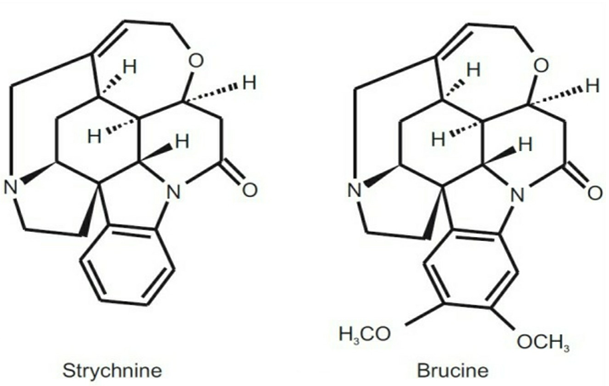
Figure1: Active phytochemical Strychnine and Brucine present in S.nux-vomica L.
Pharmacological Actions
The physiological actions of the drug are due to the presence of these phytochemicals. These are nervine, stomachic, tonic, aphrodisiac, spinal, respiratory and cardiac stimulant. Strychnos Nux-Vomica L. is used in the treatment of anemia, lumbago, asthma, bronchitis, constipation, diabetes, malarial fever, skin disease, paralysis, muscle weakness and appetite loss [9, 19]. In excessive doses it is a virulent poison producing stiffness to muscles and tetanic convulsions ultimately leading to death [4, 5, 7, 8, 12, 13, 14].
Material and Methods
Collection and Authentication of Selected Medicinal Plant
Fresh leaves of Strychnos Nux-Vomica Linn. was collected from the herbal garden, department of Ilmul Advia, Faculty of Unani Medicine, Aligarh Muslim University, Aligarh. The description found in Unani literature was used to validate the identity of medicinal plant. Additionally, the sample was verified for authencity by the pharmacognosist of the same department.
Preparation for Test Samples of Leaf of Selected Test Drug
Samples of fresh leaves was washed with water and foreign material and other contaminants was removed from it. Microscopic examination was done using standard method as per the guidelines.
Chemicals
The chemicals like Safranin stain, 50% Ethanol, Glycerin, were used. Entire chemicals used in experiments were of analytical grade.
Macroscopic Analysis
Fresh leaves of the plant was evaluated for various thorough morphological and organoleptic parameters such as shape, size, color, odor, taste, leaf margin, apex, texture, presence or absence of petiole, phyllotaxy etc. which were recorded in accordance of standard textbooks [15, 5, 16].
Microscopic Examination
Microscopy was done to analyze structure of epidermal cells, structure, distribution and type of stomata, structure and distribution of trichome on the fresh leaves.
Quantitative Microscopy
Quantitative microscopy was done to determine the number of epidermal cells, number of stomata and stomatal index, no of trichomes, palisade ratio of leaves. For this, fresh leaf was washed thoroughly with tap water followed by double distilled water, after which it was dried and thin transverse section of leaf was made with the help of fine blade. The fine transverse section of leaf was than shifted to petridish containing water and then shifted to watch glass holding 2-3 drops of safranin. After sometime, section was taken and rinsed with water. Excess stain was removed by ethanol. Section of leaf were transferred to slide, covered with cover slip and observed under microscope.
Leaf Surface Study
Stomatal number: Stomatal number (SN) or stomatal density is defined as the average number of stomata count in 1 mm square of the leaf within both upper and lower epidermises. Stomatal length and Osteolar length: It were measured with the help of software available OPTIKA B-290 microscope software. Total stomatal and total osteolar length was measured accordingly. Stomatal index: Percentage of number of stomata to the total number of epidermal cell (where each stomata is also considered to be a single epidermal cell [5, 17]. Procedure: For determination of stomatal number and stomatal index within both upper and lower epidermises were peeled off from fresh young leaves using a pair of forceps, razor and by sticking transparent cotton tape. The peeled section was fixed on slide by glycerin and examined under OPTIKA binocular digital microscope B-290 using 40X magnification. Numbers of stomata per mm square were recorded for stomatal number. To calculate exact, accurate and standard values five readings were taken for each, and the slides were photographed.
Stomatal Index was calculated as per following formulae:
S = Number of Stomata per Unit Area
( ) ( ) S×100 Stomatal Index= S+E
E= Number of ordinary epidermal cells in the same Unit Area
Vein islet number: It is the average number of vein islet enclosing small green area in 1 sq. mm leaf surface [5, 17]. Veinlet termination number: It is the determination of average number of terminated veinlet in 1 mm square of leaf surface area taken from region of midrib to margin of the leaf veinlet termination, the ultimate free end of veinlet [5, 17]. Procedure: To determine vein islet and vein termination number, lamina of leaf between midrib and margin was cut into small pieces about 1-3 mm square and boiled in a concentrated solution of chloral hydrate for 15 minutes till the discoloration of pieces. The transparent fragments were transferred into glass slide and observed under microscope at magnification of 10X. Vein-islets were counted in 1mm2 area. Along with veins-islets, the veinlet terminations were also, counted which were inside the square only. To calculate exact, accurate and standard values five readings were taken for each vein-islet and vein termination number, and the slides were photographed. Palisade ratio: Palisade ratio is defined as the average number of Palisade cells below single upper epidermal cell [5]. It is an important parameter for determination and characterization of leafy drugs [18]. Procedure: Small pieces (1-2mm) of leaf grown in full sun light were taken and cleared by boiling in 200% chloral hydrate solution. The cleared pieces were mounted and examined under microscope. A number of groups of each of four upper epidermal cells were first focused. Then by minor rotation of the fine adjustment, the under lying palisade cells were focused within the area of four epidermal cells. Palisade ratio was then obtained by dividing the number of palisade cells by 4. Five readings were taken from different pieces in order to obtain accurate average [19, 5].
Result and Discussion
Macroscopic Examination
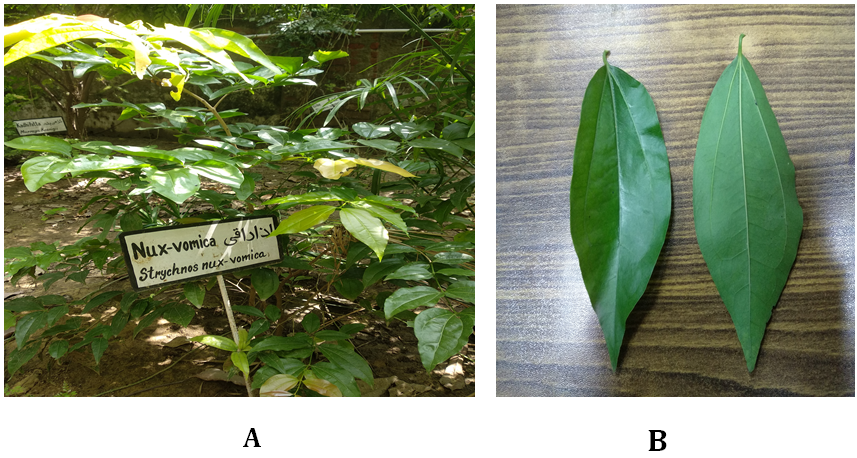
The results of the macroscopic and organoleptic examination established that Strychnos Nux-Vomica L. is a medium sized deciduous tree with simple, broad, orbicular to broadly elliptic to ovate leaves which are glabrous, bright green, shiny and smooth. Leaves are opposite, petiolate with entire margin having 3 veins running along from base parallely (Figure 2; Table 1). The findings are than co-related with other research papers also.
| Parameters | Strychnos Nux-Vomica L. |
|---|---|
| Bearing of leaf | Cauline and Ramal |
| Odour | Specific |
| Taste | Bitter |
| Leaf type | Simple |
| Phyllotaxy | Opposite |
| Petiole | Present(5-13mm) |
| Stipule | Absent |
| Color of leaf (adaxial surface) | Bright, shiny green |
| Color of leaf (abaxial surface) | Dull green |
| Shape | Orbicular to broadly elliptic or ovate |
| Length | 6-12cm |
| Breadth | 6-10cm |
| Margin | Entire |
| Apex | Broadly acuminate |
| Base | Cuneate or attenuate |
| Surface appearance | Broad, glabrous, shiny, smooth, 3 nerved |
| Venation | Parallel |
Table 1: Organoleptic Characters of the leaves of Strychnos Nux-Vomica L.
Microscopic Examination
The results of micromorphology reveal that the leaves of Strychnos Nux-Vomica L. Consists of anomocytic stomata which are kidney shaped. The epidermal cells are polygonal to irregular in shape. Beneath the epidermal cells numerous parallel palisade cells were found which are filled with chloroplast (Table 2).
| Parameters | Strychnos nux-vomica L. |
|---|---|
| Type of stomata | Anomocytic |
| Shape of stomata | Kidney |
| Open/Close | Open |
| Trichomes | Absent |
Table 2: Microscopic Parameters of the leaves of Strychnos Nux-Vomica L.
Quantitative Microscopic Examination
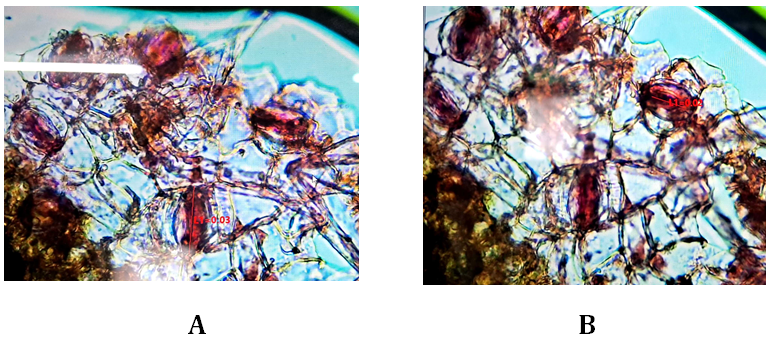
The quantitative analysis of leaves of Strychnos Nux- Vomica L. reveals that the number of stomata vary from 14 to 22/mm2 and the epidermal cells varies from 186 to 250/ mm2. The stomatal indexes were calculated from the mean values of epidermal cells and stomatal number. Therefore stomatal index is 7.62 (Figure 3; Table 3).
| Parameters | Strychnos Nux-Vomica L. |
|---|---|
| Mean Stomatal number | 18/mm2 |
| Mean epidermal cell number | 218 |
| Stomatal Index | 7.62 |
| Stomatal length at 40x | 0.03mm |
| Ostiolar length at 40x | 0.02mm |
| Palisade ratio | 5.5 to 10 |
| Vein islet number | 19-24/mm2 |
| Vein termination number | 22-27/mm2 |
Table 3: Quantitative microscopic parameters of the leaves of Strychnos Nux-Vomica L.
Discussion
The growing demand of herbal medicines around the world reflects a broader shift towards natural, holistic, and personalized approaches to health and wellness. As scientific research continues to validate their efficacy and safety, and as regulatory frameworks evolve to ensure quality and standards, herbal medicines are increasingly becoming integral to modern healthcare systems worldwide. In present study, various pharmacognostical characters of leaves of Strychnos Nux-Vomica L. have been studied through macroscopic and microscopic examination. The leaves of Strychnos Nux-Vomica L. consists of anomocytic stomata which are kidney shaped. The epidermal cells are polygonal to irregular in shape. Beneath the epidermal cells numerous parallel palisade cells were found which are filled with chloroplast. Furthermore, the quantitative analysis of leaves of Strychnos Nux-Vomica L. reveals that the number of stomata vary from 14 to 22/mm2 and the epidermal cells varies from 186 to 250/mm2. The stomatal index is found to be 7.62 [20, 21].
Hence, pharmacognostical research helps in the accurate identification and authentication of medicinal plants. Detailed morphological, anatomical, macroscopic and microscopic studies ensure the correct plant species is used, which is crucial for the efficacy and safety of herbal medicines. It also helps to detect adulteration and contamination in herbal products. This is essential for protecting consumers from harmful substances and ensuring the therapeutic value of the products.
Conclusion
The pharmacognostic profile in terms of macro and micro morphological characters of the leaves of Strychnos Nux-Vomica L. can be useful in identification, standardization and authentication of raw materials. The various parameters studied during the present analysis will also be helpful in the quality assessment and detection of adulterants in the herbal material used by various pharmaceutical companies.
Conflict of Interest
There is no conflict of interest.
References
-
Guo R, Wang T, Zhou G, Xu M, Yu X, et al. (2018) Botany, Phytochemistry, Pharmacology and Toxicity of Strychnos Nux-Vomica L.: A Review. The American journal of Chinese medicine 46(1): 1-23.
-
Razzaq A, Hussain G, Rasul A, Xu J, Zhang Q, et al. (2020) Strychnos Nux-Vomica L. seed preparation promotes functional recovery and attenuates oxidative stress in a mouse model of sciatic nerve crush injury. BMC complementary medicine and therapies 20(1): 181.
-
Ma L, Gu R, Tang L, Chen ZE, Di R, et al. (2015) Important poisonous plants in tibetan ethnomedicine. Toxins 7(1): 138-155.
-
Anonymous (1976) The wealth of India (A Dictionary of Raw material and Industrial products). CSIR, New Delhi, India, 10: 62-67.
-
Evans WC (2009) Trease and Evans pharmacognosy 16th(Edn.), Elsevier Ltd, Edinburgh, Scotland, pp: 399- 401.
-
Dymock W, Warden CJH, Hooper D (1890) Pharmacographica Indica: A history of the principal drugs of vegetable origin. The institute of health and tibbi research, London, United Kingdom, 99: 458-500.
-
Warier PK (1996) Indian Medicinal Plants: A compendium of 500 species. Orient Longman private limited, india, pp: 202.
-
Nadkarni KM (1904) Indian Materia Medica (with Ayurveda, Unani-tibbi, Siddha, Allopathic, Homeopathic, Naturopathic and home remedies, appendices and indexes). Popular Prakashan private limited, India, pp: 1175.
-
Kirtikar KR, Basu BD (2012) Indian Medicinal plants 2nd(Edn.), Periodical expert book agency, Delhi, India, pp: 1645-1647.
-
Chandra M, Madhab B (2019) Strychnos Nux-Vomica Linn -Strychnine Tree.
-
Bhati R, Singh A, Saharan VA, Ram V, Bhandari A, et al. (2012) Strychnos Nux-Vomica seeds: Pharmacognostical standardization, extraction, and antidiabetic activity. Journal of Ayurveda and integrative medicine 3(2): 80- 84.
-
Maji AK, Banerji P (2017) Strychnos Nux-Vomica: A Poisonous Plant with Various Aspects of Therapeutic Significance. J Basic Clin Pharma 8: S087-S103.
-
Chan TY (2002) Herbal medicine causing likely strychnine poisoning. Human & experimental toxicology 21(8): 467-468.
-
Eldahshan OA, Abdel-Daim MM (2015) Phytochemical study, cytotoxic, analgesic, antipyretic and anti- inflammatory activities of Strychnos Nux-Vomica. Cytotechnology 67(5): 831-844.
-
Anonymous (2006) Standardization of Single drugs of unani medicine, CCRUM. Ministry of health and family welfare, Govt of India, New Delhi, India, pp: 7-11.
-
Mohammed A (2000) Textbook of Pharmacognosy 2nd (Edn.), CBS Publishers and Distributors, India, pp: 332-
-
Khandelwal KR, Sethi V (2021) Practical Pharmacognosy. Nirali Prakashan, India, pp: 33-35.
-
Khan SA, Ibrar M, Barkatullah (2016) Pharmacognostic evaluation of the leaf of Rhus succedanea var. himalaica. J. D HOOKER. African journal of traditional complementary and alternative medicines 13(6): 107-120.
-
Kokate CK, Gokhale SB, Surana SJ, Kalaskar MG (2020) Pharmacognosy 3rd (Edn.), Nirali Prakashan, India, pp: 311.
-
Gruenwald J (2000) PDR for herbal medicines 2nd (Edn.), Thomson Healthcare, Montvale, New Jersey, USA, pp: 548.
-
Vermillion K, Holguin FO, Berhow MA, Richins RD, Redhouse T, et al. (2011) Dinoxin B, a withanolide from Datura inoxia leaves with specific cytotoxic activities. Journal of natural products 74(2): 267-271.
- Potential Medicinal Herbs and Secondary Metabolites in Combating Corona Virus
- Monkeypox and its Clinical Implications in Pregnancy
- Assessment of Antibacterial Activity of Various Solvent Extracts of Dictyota Dichotoma Against Multidrug Resistant Bacterial Strain
- An Insights of Bioactive Elements on Malignancy: Mechanistic Avenues
- Advances and Future Directions in Pharmacognosy and Chinese Medicine
- Pharmacognostical and Phytochemical Study of Hibiscus rosasinensis Linn.