
Medicinal Plants in the Diet of Golden Langur Trachypithecus geei in Kakoijana Reserve Forest, Western Assam, India. A Bio-Rational for the Search of New Medicines for Human Use?
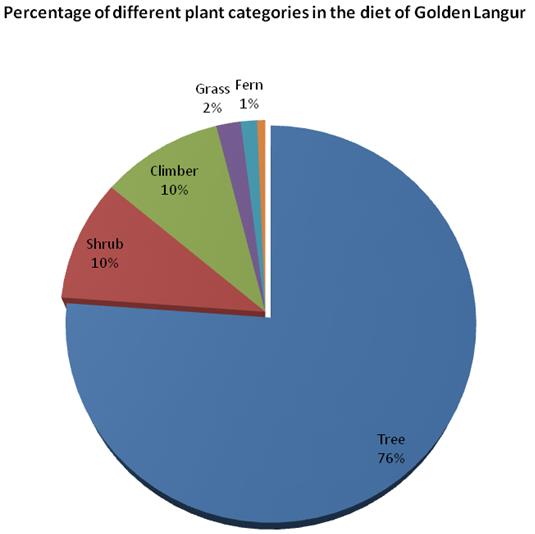
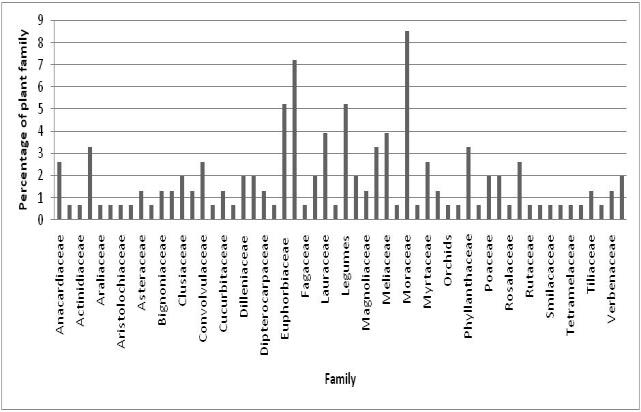
The present study expected to compare the plant food diet of Golden Langur (Trachypithecus geei) inhabiting in Kakoijana Reserve Forest of Western Assam with medicinal plant species used by humans in the surrounding areas of the park as vegetables with medicinal properties. The diet of Golden Langur was studied by direct observation and Scan sampling method along with the plants used as medicine and food by the local tribes, India from March 2013 to April 2015. A group of 9 Golden Langurs of different age and sex classes was observed to feed on 152 different plant species belonging to 55 families. Among the different plant categories, trees accounts for 76%, followed by climber and shrub each 10%, grass 2%, fern and orchid each being 1% and liana 0.7% .The highest percent of food tree species belonged to the family Moraceae (9%) followed by Fabaceae (7%) and Euphorbiaceae (5%). The Langurs primarily fed on young leaves, mature leaves, fruits, seeds, figs, tubers and flowers during the study period. Semi structured interviews showed that 45 plant species used by locals as medicines, 17 species used as vegetables and two are rare medicinal plants of Assam. The diet species of Golden Langur was compared with other areas and discussed. The similarities between the ingestion of plants by primates and their medicinal use by humans provide a bio-rational for the search of bioactive plants in primate diet.
Introduction
Food and shelter are the vital needs of all living organisms. The appraisal of feeding habits of an animal is of the outmost significance for the correct determination of the carrying capacity of their habitat and for the study Medicinal Plants in the Diet of Golden Langur Trachypithecus geei in Kakoijana Reserve Forest, Western Assam, India. A Bio-Rational for the Search of New Medicines for Human Use?
of their population dynamics [1, 2]. To endure and reproduce successfully every animal needs food. The food habit of a species is one of the most basic aspects of its ecology and needs to be understood not only to determine the species’ nutritional requirements, but also to understand how distribution of food resources could Int J Zoo Animal Biol
determine the density, local distribution and social interactions [3]. It has been shown that many different primates species ingest plants containing both nutritional and medicinal value, suggesting that these secondary metabolites could actually be beneficial to the health of the user [4, 5, 6] Food habit studies helps to assess the dietary overlap with other sympatric species. Most primates have a diverse plant based diet, from which they obtain the needed calories and nutrients necessary for survival and reproduction [7, 8] Plants provide more then just nutrients. The major plant dietary strategies are frugivory and folivory, supplementing this with seeds, sap, bark and flowers [8]. Plants also contain a variety of secondary metabolites that have largely been viewed as deterring primates from eat them [9]. It allows us to assess the impacts of anthropogenic pressures like fire and cattle grazing, also natural and manmade changes in the structure and composition of vegetation [2].
Golden Langur Khajuria, 1956 is one of the least studied primate species of North- east India. The Golden Langur Trachypithecus geei is a rare colobine monkey with a very restricted range being confined to western Assam in India, and Bhutan only. Within India, its entire population is restricted to parts of western Assam where it is bounded by the rivers, Brahmaputra in the south and its tributaries, the Manas and the Sankosh towards east and west respectively [10]. The golden Langur is classified as Endangered (EN) [A2c; C2a (i)] on the IUCN Red List 2008 and is listed on Appendix I of CITES. Listed as Endangered because of a serious population decline, estimated to be more than 50% over the last three generations (thirty years), inferred from observed reduction in the extent of its habitat; and because its population size is estimated to number fewer than 2,500 mature individuals, there is an observed continuing decline in the number of mature individuals, and no subpopulation contains more than 250 mature individuals. The Golden Langur population has recovered significantly at Kakoijana Reserve forest recently, after the Golden Langur Conservation Project (GLCP) begun by Community Conservation, Nature’s Foster and Green Forest Conservation in 1998 continues to bring locals into the conservation fold.
The study of diet can help to understand the role of a species in the energy flow and nutrient cycle of an ecosystem. It also sets a foundation for understanding of foraging behaviour, population dynamics, habitat use and social organization of a species [11]. Knowledge on feeding preferences and nutritive requirements is essential in planning habitat management. Overlap in the plant food/medicinal use with the plant food of Golden Langur can suggest a new side for the search of bioactive plants in the diet of primates. Further detailed investigation of their pharmacological value is considered necessary. It would be advantageous to have information on the habitat requirements of a species in order to protect and improve these attributes. The present study aims to provide such information for Golden Langur and also aims at increasing our knowledge of the species.
Study Area
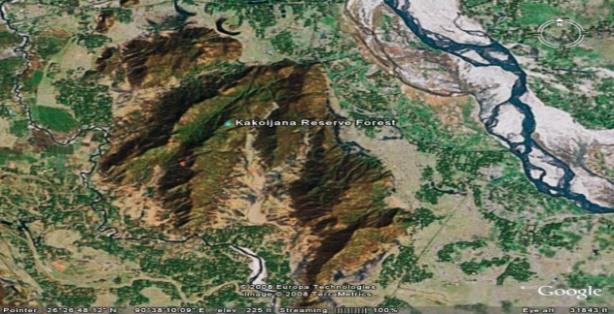
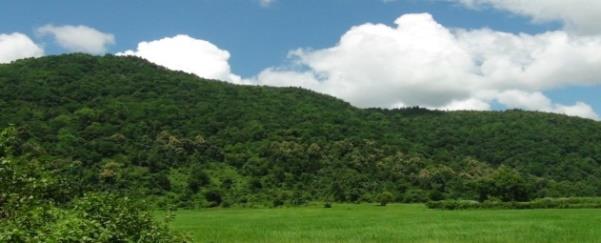
Kakoijana Reserve Forest (KRF) is located in Bongaigaon district of western Assam between 26° 24' N- latitude and 90° 36.5' E longitude with a total area of 17.201 square kms. The region has a tropical monsoon climate receiving an annual average rainfall of about 100 cm with max and min temperature of 36 c and 10 c respectively. Altitudinal variation of KRF ranges between 35 meter and 60 meter above sea level. KRF is bounded on East by the river Aie and on west by river Kujia with its tributaries. Remaining sides of KRF possess paddy fields.
- Flora : Shorea robusta, Dillenia sp., Ficus sp.,Albezia sp.,Terminalia sp., etc
- Fauna: Binturong, Jungle Fowl, Porcupine, Python, Civets, Barking Deer, Monitor Lizard, Jungle Cat etc.
- Primate community: Golden Langur (Trachypithecus geei) and Rhesus Macaque (Macaca radiata)
Roy D and Nagarajan R. Medicinal Plants in the Diet of Golden Langur Trachypithecus geei in Kakoijana Reserve Forest, Western Assam, India. A Bio-Rational for the Search of New Medicines for Human Use?. Int J Zoo Animal Biol 2019, 2(2): 000137.
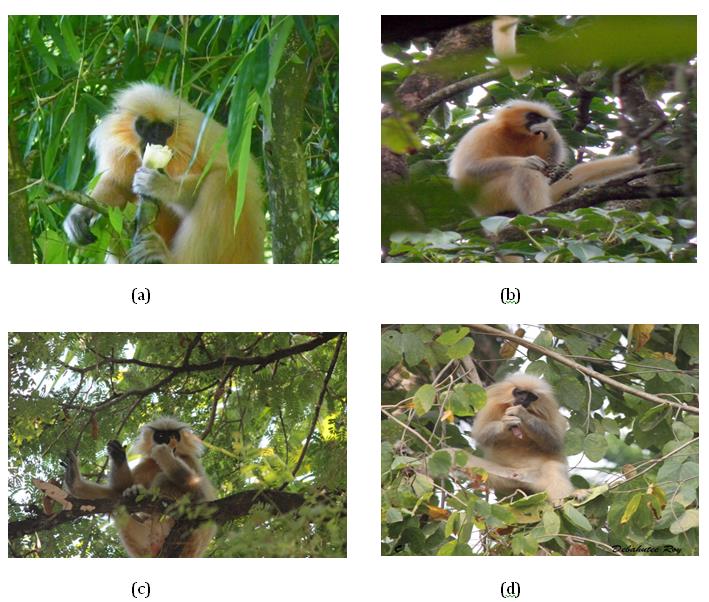
(a): 9Golden Langur feeding on bamboo shoot (b): Golden Langur feeding on fruits of Bischoffia javanica (c): Golden Langur feeding on fruits of Tamrindus indica (d): Golden Langur feeding on seeds of Bauhinia purpurea Figure 4: Golden Langur feeding on plant parts that are also used by humans in the study area.
Materials and Methods
Information on the food plants was collected through direct observation and indirectly by recording plants fed on by Langur by following their feeding trail. The study was conducted in Kakoijana Reserve Forest from March 2013 to April 2015. Feeding by individuals was observed using scan animal sampling [1] during different time blocks throughout the day (Figure 5). Binoculars were used to make all direct observations. The feeding trails were examined for fresh feeding signs after Langur left the location as Langurs have the habit of discarding half of leaf or fruit they consume. Fresh feeding signs could be easily distinguished from old signs by examining the tip of the branches/twigs and fruits with bite signs. A herbarium of the food plants was made for confirmation of the species identity. Semi structured interviews, field diary and participant observation were used during fieldwork Bernard, et al. were conducted among the different tribes around the forest areas to know the usage of plant species regarding the medicinal use of the plants included in the diet of Golden Langur.
Results
Golden Langurs are diurnal, mostly arboreal and partly terrestrial. Golden Langurs are generally Roy D and Nagarajan R. Medicinal Plants in the Diet of Golden Langur Trachypithecus geei in Kakoijana Reserve Forest, Western Assam, India. A Bio-Rational for the Search of New Medicines for Human Use?. Int J Zoo Animal Biol 2019, 2(2): 000137.
foliovorous and young leaves are major component in its diet followed by mature leaves, fruits, shoot, seeds, figs and flowers. Golden Langurs are selective feeders and feed on variety of food plants throughout its life time. During the study period, it was observed that Golden Langur consumed different plant species from various physiognomic categories. The list of food plants, parts eaten (based on scan sampling) are given in the (Table 1). During the study period it was observed that Golden Langur consumed different plant species belongs to 55 families and 152 species. Terminalia belerica, Lagerstroemia parviflora, fruits of Syzygium cumni,young leaves of Cassia fistula, leaf petiole of Shorea robusta, Tectona grandis, Delonix regia, ,Hevea brasilliensis, Moringa oleifera, Gmelina arborea, Syzygium sp, Dillenia indica, Mallotus philippinensis, Biscofia javanica, and Bauhinia varieagata were mainly eaten.
| S | l.no | . | Plant Species | Category | Order | Family | Parts Eaten | ||||||||||
|---|---|---|---|---|---|---|---|---|---|---|---|---|---|---|---|---|---|
| 1 | Acacia auriculiformis | Tree | Fabales | Fabaceae | YL,ML,FL | ||||||||||||
| 2 | Acacia pinnata | Tree | Fabales | Fabaceae | YL,ML,FL | ||||||||||||
| 3 | Adina cordiflora | Tree | Gentianales | Rubiaceae | YL,ML | ||||||||||||
| 4 | Aegle marmelos | Tree | Sapindales | Rutaceae | YL,ML | ||||||||||||
| 5 | Aglaia elaeagnoidea | Tree | Sapindales | Meliaceae | YL,ML | ||||||||||||
| 6 | Alangium chinensis | Tree | Cornales | Cornaceae | YL,ML,RFR | ||||||||||||
| 7 | Albizia lebbeck | Tree | Fabales | Fabaceae | YL,ML | ||||||||||||
| 8 | Alstonia scholaris | Tree | Gentianales | Apocynaceae | YL,ML | ||||||||||||
| 9 | Amoora Cucullata | Tree | Sapindales | Meliaceae | YL | ||||||||||||
| 10 | Anthocephalus cadamba | Tree | Gentianales | Rubiaceae | YL | ||||||||||||
| 11 | Anthocephalus chinensis | Tree | Gentianales | Rubiaceae | YL,ML | ||||||||||||
| 12 | Antidesm acidum | Shrub | Malpighiales | Phyllanthaceae | RFR | ||||||||||||
| 13 | Argyreia nervosa | Tree | Solanales | Convolvulaceae | YL,ML | ||||||||||||
| 14 | Aristolochia sp. | Liana | Magnolids | Aristolochiaceae | YL | ||||||||||||
| 15 | Artocarpus chaplasha | Tree | Rosales | Moraceae | YL,ML | ||||||||||||
| 16 | Artocarpus heterophyllus | Tree | Rosales | Moraceae | YL,ML | ||||||||||||
| 17 | Asplenium nidus | Fern | Polypodiales | Aspleniaceae | YL | ||||||||||||
| 18 | Averrhoa carambola | Tree | Geraniales | Oxalidaceae | YL,ML | ||||||||||||
| 19 | Azadiracta indica | Tree | Sapindales | Meliaceae | YL,ML | ||||||||||||
| 20 | Bambusa sp | Grass | Poales | Poaceae | YL,ML | ||||||||||||
| 21 | Bambusa tulda | Grass | Poales | Poaceae | YL,ML | ||||||||||||
| 22 | Bauhinia bhelli | Tree | Fabales | Fabaceae | YL,ML | ||||||||||||
| 23 | Bauhinia purpurea | Tree | Fabales | Fabaceae | YL,ML | ||||||||||||
| 24 | Bischoffia javanica | Tree | Malpighiales | Phyllanthaceae | YL | ||||||||||||
| 25 | Bridelia Montana | Tree | Malpighiales | Phyllanthaceae | YL | ||||||||||||
| 26 | Bursera serrata | Tree | Sapindales | Burseraceae | YL,ML | ||||||||||||
| 27 | Butea monosperma | Tree | Fabales | Legumes | YL,ML | ||||||||||||
| 28 | Callicarpa macrophylla | Tree | Lamiales | Lamiaceae | YL,ML | ||||||||||||
| 29 | Careya arborea | Tree | Ericales | Lecythidaceae | YL,ML | ||||||||||||
| 30 | Cassia fistula | Tree | Fabales | Fabaceae | YL,ML,FL | ||||||||||||
| 31 | Castanopsis purpurella | Tree | Fagales | Fagaceae | YL,ML | ||||||||||||
| 32 | Cedrela toona | Tree | Sapindales | Meliaceae | YL,ML | ||||||||||||
| 33 | Cinnamomum sp. | Tree | Laurales | Lauraceae | YL | ||||||||||||
| 34 | Cinnamomum tamala | Tree | Laurales | Lauraceae | YL | ||||||||||||
| 35 | Cissampelos pareira | Climber | Ranunculales | Menispermaceae | YL,ML | ||||||||||||
| 36 | Cissus quadrangularis | Shrub | Vitales | Vitaceae | YL,ML | ||||||||||||
| 37 | Cissus rependus | Shrub | Vitales | Vitaceae | YL,ML | ||||||||||||
| 38 | Dalbergia latifolia | Tree | Fabales | Legumes | YL,ML | ||||||||||||
| 39 | Dalbergia paniculata | Tree | Fabales | Legumes | YL,ML |
Table 1: List of food plants of Golden Langurs identified in Kakoijana Reserve Forest of Assam, India. The list is prepared based
Roy D and Nagarajan R. Medicinal Plants in the Diet of Golden Langur Trachypithecus geei in Kakoijana Reserve Forest, Western Assam, India. A Bio-Rational for the Search of New Medicines for Human Use?. Int J Zoo Animal Biol 2019, 2(2): 000137.
| 40 | Dalbergia sissoo | Tree | Fabales | Legumes | YL,ML |
|---|---|---|---|---|---|
| 41 | Delonix regia | Tree | fabales | Fabaceae | YL,ML,FL |
| 42 | Dendrobium sp. | Orchid | Asparagales | Orchids | YL |
| 43 | Deris indica | Tree | Fabales | Fabaceae | YL,ML |
| 44 | Dillenia indica L | Tree | Dilleniales | Dilleniaceae | YL,ML |
| 45 | Dillenia pentagyna | Tree | Dilleniales | Dilleniaceae | YL,ML |
| 46 | Dillenia sp | Tree | Dilleniales | Dilleniaceae | YL,ML,FL |
| 47 | Dioschorea bulbifera | Climber | Dioscoreales | Dioscoreaceae | TUBER |
| 48 | Dioscorea alata | Climber | Dioscoreales | Dioscoreaceae | TUBER |
| 49 | Dioscorea floribunda | Climber | Dioscoreales | Dioscoreaceae | TUBER |
| 50 | Diplazium esculentum | Fern | Polypodiales | Athyriaceae | YL,ML |
| 51 | Dolichos lablab | Climber | Fabales | Legumes | YL,RFR |
| 52 | Duabanga grandiflora | Tree | Myrtales | Lythraceae | YL,ML |
| 53 | Dysoxylum bincetariferum | Climber | Sapindales | Meliaceae | YL,RFR |
| 54 | Dysoxylum gobara | Climber | Sapindales | Meliaceae | YL,RFR |
| 55 | Elaeocarpus serratus L. | Tree | Oxalidales | Elaeocarpaceae | YL,ML,RFR |
| 56 | Emblica officinalis | Tree | Malpighiales | Phyllanthaceae | YL,RFR |
| 57 | Endospermum chinense | Tree | Malpighiales | Euphorbiaceae | YL,ML |
| 58 | Erythrina sp | Tree | Fabales | Legumes | YL,ML |
| 59 | Erythrina variegata L | Shrub | Fabales | Legumes | YL,ML |
| 60 | Eupatorium odoratum | Shrub | Asterales | Daisy | YL,ML |
| 61 | Evolvus alsinoides | Shrub | Solanales | Convolvulaceae | YL,ML |
| 62 | Ficus auriculata | Tree | Rosales | Moraceae | YL,FIG |
| 63 | Ficus bengalensis | Tree | Rosales | Moraceae | YL,FIG |
| 64 | Ficus drupacea | Tree | Rosales | Moraceae | YL,FIG |
| 65 | Ficus glomerata | Tree | Rosales | Moraceae | YL,FIG |
| 66 | Ficus heterophylla | Tree | Rosales | Moraceae | YL,FIG |
| 67 | Ficus hirta | Tree | Rosales | Moraceae | YL,FIG |
| 68 | Ficus hispida | Tree | Rosales | Moraceae | YL,FIG |
| 69 | Ficus lepidosa | Tree | Rosales | Moraceae | FIG |
| 70 | Ficus racemosa | Tree | Rosales | Moraceae | YL,ML,FIG |
| 71 | Ficus sp | Tree | Rosales | Moraceae | YL,FIG |
| 72 | Flacourtia jangomas | Tree | Malpighiales | Salicaceae | YL,ML |
| 73 | Flueggea leucopyrus | Shrub | Malpighiales | Phyllanthaceae | YL,ML |
| 74 | Garcinia cowa | Tree | Malpighiales | Clusiaceae | YL,ML |
| 75 | Garcinia xanthochymus | Tree | Malpighiales | Clusiaceae | YL,ML |
| 76 | Garuga pinnata | Tree | Sapindales | Burseraceae | YL,ML |
| 77 | Gmelina arborea | Tree | Lamiales | Verbenaceae | YL,ML,FL |
| 78 | Grewia multiflora | Tree | Malvales | Tiliaceae | YL,ML |
| 79 | Grewia sp | Tree | Malvales | Tiliaceae | YL,ML |
| 80 | Hemidesmus indicus | Shrub | Gentianales | Apocynaceae | YL,ML |
| 81 | Hevea brasilliensis | Tree | Malpighiales | Euphorbiaceae | YL,LP,RFR,SEED |
| 82 | Hibiscus macrophyllus | Tree | Malvales | Malvaceae | YL,ML |
| 83 | Holmskiodia sp | Tree | Lamiales | Lamiaceae | YL |
| 84 | Homonoia riparia | Tree | Malpighiales | Euphorbiaceae | YL,ML |
| 85 | Hoya sp. | Tree | Gentianales | Apocynaceae | YL |
| 86 | Ipomea sp | Shrub | Solanales | Convolvulaceae | YL |
| 87 | Jasminum officinale | Tree | Lamiales | Oleaceae | YL,ML,FL |
| 88 | Kydia calicina | Tree | Malvales | Malvaceae | YL,ML |
| 89 | Lagerstroemia parviflora | Tree | Myrtales | Lythraceae | YL,ML |
| 90 | Lagerstroemia speciosa | Tree | Myrtales | Lythraceae | YL,ML |
| 91 | Lannea coromandelica | Tree | Sapindales | Anacardiaceae | YL,ML |
| 92 | Lantana camara | Shrub | Lamiales | Verbenaceae | YL,FL |
| 93 | Litsaea sebifera | Tree | Laurales | Lauraceae | YL,ML,RFR |
| 94 | Litsea laeta | Tree | Laurales | Lauraceae | YL,ML |
| 95 | Litsea monopetala | Tree | Laurales | Lauraceae | YL,ML,RFR |
| 96 | Litsea salicifolia | Tree | Laurales | Lauraceae | YL,ML |
| 97 | Macaranga denticulata | Tree | Malpighiales | Euphorbiaceae | YL,ML |
| 98 | Mallotus philippinensis | Tree | Euphorbiales | Euphorbiaceae | YL,ML |
| 99 | Mangifera indica | Tree | Sapindales | Anacardiaceae | YL,RFR |
| 100 | Mangifera sylvatica | Tree | Sapindales | Anacardiaceae | YL,RFR |
| 101 | Merremia sp | Tree | Solanales | Convolvulaceae | YL,ML |
| 102 | Mesua ferrea | Tree | Malpighiales | Clusiaceae | YL,ML |
| 103 | Michelia champaca | Tree | Magnoliales | Magnoliaceae | YL,ML,FL |
| 104 | Michelia oblonga | Tree | Magnoliales | Magnoliaceae | YL,ML |
| 105 | Microcos paniculata | Tree | Malvales | Malvaceae | YL,ML |
| 106 | Mikania micrantha | Shrub | Asterales | Asteraceae | YL,ML |
| 107 | Mikenia sp | Shrub | Asterales | Asteraceae | YL,ML |
| 108 | Mimosa pudica | Shrub | Fabales | Fabaceae | YL,ML |
| 109 | Moringa oleifera | Tree | Brassicales | Moringaceae | YL,FL,UNRF,RFR |
| 110 | Nyctanthes arbor-tristis | Tree | Lamiales | Oleaceae | YL,ML |
| 111 | Oroxylum indicum | Tree | Lamiales | Bignoniaceae | YL,FL |
| 112 | Paederia foetida | Climber | Gentianales | Rubiaceae | YL,ML |
| 113 | Piper sp | Climber | Piperales | Piperaceae | YL |
| 114 | Psidium guavaja | Tree | Myrtales | Myrtaceae | YL,ML,RFR |
| 115 | Pterospermum acerifolium | Tree | Malvales | Sterculiaceae | YL,ML |
| 116 | Rauvolfia serpentina | Tree | Gentianales | Apocynaceae | YL,ML |
| 117 | Rubus sp | Tree | Rosales | Rosalaceae | YL,ML |
| 118 | Salmalia sp | Tree | Malvales | Malvaceae | YL,ML |
| 119 | Sapium baccatum | Tree | Malpighiales | Euphorbiaceae | YL,ML |
| 120 | Sapium sp | Tree | Malpighiales | Euphorbiaceae | YL,ML |
| 121 | saurauia roxburghii | Tree | Actinidiales | Actinidiaceae | YL,ML |
| 122 | Schefflera arboricola | Tree | Apiales | Araliaceae | YL,ML |
| 123 | Schima wallichii | Tree | Ericales | Theaceae | YL,ML |
| 124 | Shorea robusta | Tree | Malvales | Dipterocarpaceae | YL,ML |
| 125 | Smilax sp. | Shrub | Liliales | Smilacaceae | YL,ML |
| 126 | Spondias pinnata | Tree | Sapindales | Anacardiaceae | YL,ML |
| 127 | Stercula villosa | Tree | Malvales | Malvaceae | YL,ML |
| 128 | Sterospermum chelonoides | Tree | Lamiales | Bignoniaceae | YL,ML |
| 129 | Streblus asper | Tree | Rosales | Moraceae | YL,ML |
| 130 | Syzygium cumni | Tree | Myrtales | Myrtaceae | YL,ML,RFR,FL |
| 131 | Syzygium jambos | Tree | Myrtales | Myrtaceae | YL,ML,RFR |
| 132 | Syzygium kurjii | Tree | Myrtales | Myrtaceae | YL,ML,RFR |
| 133 | Tamarindus indica | Tree | Fabales | Legumes | YL,RFR |
| 134 | Tectona grandis | Tree | Lamiales | Lamiaceae | YL,LP |
| 135 | Terminalia bellerica | Tree | Myrtales | Combretaceae | YL,RFR |
| 136 | Terminalia chebula | Tree | Myrtales | Combretaceae | YL,RFR |
| 137 | Tetrameles nudiflora R | Tree | Cucurbitales | Tetramelaceae | YL,ML |
| 138 | Thunbergia alata | Tree | Lamiales | Acanthaceae | YL,ML |
| 139 | Trema orientalis | Tree | Rosales | Ulmaceae | YL,ML |
| 140 | Trichosanthes tricuspidata | Climber | Cucurbitales | Cucurbitaceae | YL,ML |
| 141 | Tricosanthes anguina | Climber | Cucurbitales | Cucurbitaceae | YL,ML |
| 142 | Triwia nudiflora | Tree | Malpighiales | Euphorbiaceae | YL,ML |
| 143 | Vatica lanceifolia (critically en sp.) | Climber | Malvales | Dipterocarpaceae | YL,ML,RFR |
| 144 | Vigna catjang | Climber | Fabales | Fabaceae | YL,RFR |
| 145 | Vigna Sp | Climber | Fabales | Fabaceae | YL |
| 146 | Vitis latifolia | Climber | Vitales | Vitaceae | YL,ML |
| 147 | Wrightia tomentosa | Tree | Gentianales | Apocynaceae | YL |
| 148 | Zanthoxylum rhetsa | Tree | Sapindales | Rutaceae | YL |
| 149 | Zea mays | Grass | Poales | Poaceae | YL,RFR |
| 150 | Zizyphus jujuba | Tree | Rosales | Rhamnaceae | YL, RFR,UNRF |
| 151 | Zizyphus mauritiana | Tree | Rosales | Rhamnaceae | YL, RFR,UNRF |
| 152 | Zizyphus oenoplia | Shrub | Rosales | Rhamnaceae | YL, RFR,UNRF |
Table 2: List of food plants of Golden Langurs identified in Kakoijana Reserve Forest of Assam, India. The list is prepared based
Roy D and Nagarajan R. Medicinal Plants in the Diet of Golden Langur Trachypithecus geei in Kakoijana Reserve Forest, Western Assam, India. A Bio-Rational for the Search of New Medicines for Human Use?. Int J Zoo Animal Biol 2019, 2(2): 000137.
Roy D and Nagarajan R. Medicinal Plants in the Diet of Golden Langur Trachypithecus geei in Kakoijana Reserve Forest, Western Assam, India. A Bio-Rational for the Search of New Medicines for Human Use?. Int J Zoo Animal Biol 2019, 2(2): 000137.
(YL-young leaf; ML-mature leaf; RFR- ripened fruit; UNFR; unripened fruit; FL-flower) Table 1: List of food plants of Golden Langurs identified in Kakoijana Reserve Forest of Assam, India. The list is prepared based on alphabetical order of plant species. (a-Classification is based on Bentham and Hooker (1962-63), Sasidharan (2004).
Among the different plant categories, trees accounts for 76%, followed by climber and shrub 10% each, grass 2%, fern and orchid 1% each and liana 0.7% (Figures 1 & 2). Thus trees, climber and shrub were constituted 96% of overall composition of food plant species. The highest percent of food tree species belonged to the family Plant Species Category Family Local Medicinal use Recorded in this Study Leaf is used against headache, bark is used to treat stomach trouble Alstonia scholaris Tree Apocynaceae Antidesm acidum Shrub Phyllanthaceae Leaves are used against headache, and appetizer Argyria nervosa Tree Convolvulaceae Anemia, cold and cough Leaves are used Averrhoa carambola Tree Oxalidaceae Fuit used in jaundice Leaf extract is uded to Azadiracta indica Tree Meliaceae cure skin and tooth diseases Infusion of the leaves are used to treat labour Asplenium nidus Fern Aspleniaceae pain Bambusa tulda Climber Poaceae Not known Shoots are used Bark juice is used against menstruation Bauhinia purpurea Tree Fabaceae trouble Bischoffia javanica Tree Phyllanthaceae Bark is used to treat tuberculosis, mouth - - Moraceae followed by Fabaceae and Euphorbiaceae (Figures 3 & 4). Of these 152 plant species, 45 plant species were used by the local tribes as medicines, 17 were used as vegetables and two species were listed as rare medicinal plants of Assam (Table 2).
Use as Vegetables by
Remarks
the Locals
- - Leaves are used
as food - as food -
and kidney diseases - - - -
Leaves are used
as food - as food -
- - Roy D and Nagarajan R. Medicinal Plants in the Diet of Golden Langur Trachypithecus geei in Kakoijana Reserve Forest, Western Assam, India. A Bio-Rational for the Search of New Medicines for Human Use?. Int J Zoo Animal Biol 2019, 2(2): 000137.
ulcers and inflamations Butea monosperma Tree Legumes seed, bark and fruit -
Cassia fistula Tree Fabaceae leaf pase is used against Rare medicinal plant of Assam (Bhattacharya et al., 1991) allergy - Cinnamomum againt diarrhoea Cissampelos pareir Climber Menispermaceae Cures ulcer and sinus Stem paste is applied in Cissus quadriangularis Climber Vitaceae bone fracture and wound Hair washed with Dillenia indica Tree Dilleniaceae mucilage for hair growth Dioscorea alata Climber Dioscoreaceae Tubers are used in piles Fruit juice used for indigestion and hair Emblica officinalis Tree Euphoriaceae growth Erythrina variegata Shrub Legumes Roots helps in Ficus bengalensis Tree Moraceae Bud is used to tread Roots and bark are used to cure piles and urinary Gmelina arborea Tree Lamiaceae discharge Plant species Category Family Local medicinal use recorded in this study Grewia multiflora Tree Tiliaceae Bark is used to treat Helps to treat low haemoglobin content in Ipomoea Tree Convolvulaceae blood Lantana camara Shrub Verbanaceae Young leaf extract are used to treat indigestion - - Stem juice is useful in skin disease, cuts and Macaranga denticulata Tree Euphoriaceae wounds Stem juice is useful against gastric problems Mangifera sylvativca Tree Anacardiaceae and ucers Leaf is used against colic, Seed is used as Michelia champaca Tree Magnoliaceae appetizer.
Mikenia Shrub Asteraceae leaves and stem are - -
as spice Rare medicinal
plant of Assam (Bhattacharya et
problems - al., 1991) - -
- - Tubers are consumed as -
vegetables - - comceiving - -
scabies and boils - - Flowers are used as vegetable -
Use as vegetables
by the locals Remarks
bone fracture - - Young leaves and shoots are used as -
vegetable - - - - - -
Roy D and Nagarajan R. Medicinal Plants in the Diet of Golden Langur Trachypithecus geei in Kakoijana Reserve Forest, Western Assam, India. A Bio-Rational for the Search of New Medicines for Human Use?. Int J Zoo Animal Biol 2019, 2(2): 000137.
macarantha used to cure diarrhoe
- Mimosa pudica
- Shrub
- Mimosaceae
- Root is use fot treating snake bite
- -
- -
- Leaf extraxt is used to treat blood pressure and
- Moringa
- Fruit is used as oleifera
- Tree
- Moringaceae diabetes
- Leaf and flower juice
- Nyctanthes arbortristis
- Tree
- Oleaceae used for cough and stomach worm cure
- -
- Oroxylum indicum
- Tree
- Bignoniaceae
- Seeds are used as
- Flowers are used digestive
- Paderia foetida
- Climber
- Rubiaceae
- Leaf juice used to cure constipation used as vegetable
- -
- Piper longum
- Climber
- Piperaceae leaf extract is used as
- Fruits are used as fever
- Psidum guajava
- Tree
- Myrtaceae
- Root and bark used for treating diarrhoea
- Fruits are edible
- -
- Used to treat high blood
- Rauvolvia serpentina
- Shrub
- Apocynaceae pressure and mental illness
- Unripe fruit along with leaf used to cure gastric
- Spondias pinnata
- Tree
- Anacardiaceae ulcer
- Sterculia villosa
- Tree
- Sterculiaceae
- Root extract are used to treat blood dycentry
- -
- -
- Syzygium cumni
- Tree
- Myrtaceae
- Young leaf extract are used to treat diabetes
- -
- -
- Tamarindus indica
- Tree
- Caesalpiniaceae
- Fruit extract is used to
- Fruits are used to treat cough and cold
- Terminalia bllerica
- Tree
- Combretaceae
- Fruit used to cure gastric ulcer
- -
- -
- Fruit mixed with turmeric used to cure
- Terminalia chebula
- Tree
- Combretaceae loss of appetite
- It is a good source of iron and boosts immene
- Leaves are used
- Vigna catiang
- Climber
- Fabaceae system
- Vitis latifolia
- Climber
- Vitaceae
- Not available
- Leaves are used
- Wrightia tomentosa
- Tree
- Apocynaceae
- Bark is used to treat kidney stone
- -
- Ziziphus jujuba
- Tree
- Rhamnaceae
- Bark juice is useful in
- Fruits are used to stomach trouble
Table 3: List of food/medicinal plants identified in Kakoijana Reserve Forest of Assam, India.
Discussion
Golden Langur consumed different plant species throughout the study period identified from May 2013 to April 2015. It was observed that during flowering and fruiting season, flowers and fruits of certain plants are also consumed along with its young leaf. Flowers and fruits of Syzygium sp., Moringa oleifera, Gmelina arborea, Roy D and Nagarajan R. Medicinal Plants in the Diet of Golden Langur Trachypithecus geei in Kakoijana Reserve Forest, Western Assam, India. A Bio-Rational for the Search of New Medicines for Human Use?. Int J Zoo Animal Biol 2019, 2(2): 000137.
Ficus glomerata, Tamarindus indica, Phylanthus emblica and Spondias pinnata were mostly preferred.
Das, et al. reported 91 plant species as food species for Golden Langur comprising both trees and climbers in Chirang RF [12]. Mukherjee, et al. reported the names of plants utilized by the Golden Langur for feeding and those data were relevant for summer months [13]. In winter months the most preferred plant items were Terminalia belerica, Lagerstroemia parviflora, fruits of Bridelia retusa in Manas sanctuary. Terminalia belerica at Jamduar and Flowers of Salmalia malabarica at Manas [13]. The above results indicate that Golden Langur consumed variety of plants. The number of food species listed varied greatly with forest type, duration of study period and method of foraging data collection. Some of the plants which have medicinal property are used as food as well as ethno medicine by the local community. The present study reveals that the rural tribal people are well versed with the nature and natural resources around them. These people in order to get rid of various problems like abortion, conception, menstrual problems etc., depend on plant products. Such types of plant extracts have also been reported to be used for abortification and reproductive related diseases from other part of the state also. The efficacy of the traditional medicine cannot be judged properly, although the ethnic tribal people use these plants for curing different type of reproductive and in general physical ailments [14, 15, 16]. Due importance should be provided for further research on these medicinal plants for their effectiveness, side effects and mode of action. Overlapping with the usage of these plants as food by Golden Langur with the practice of local tribes as medicines and food gives a general idea of bioactive properties of plants which can be further use to investigate the pharmacological properties of the plant species. A thorough and complete survey is to made for the availability of these plants. The common people must be made conscious about the usage of the plants by Golden Langur in their respective localities. The social forestry may bear an important share for plantation of different medicinal and fruit bearing plants like Amlaki, (Emblica officinalis ), Jamu (Syzygium cumini ) etc. which are the sources of different natural vitamins and minerals and are food sources of Golden Langur too. Moreover, the wise use of the food plant species of Golden Langur by the locals as medicines and vegetables can help to sustain the lives of Primates in the fragmented habitats. The relationships between plants, primates and humans observed in the present study indicate potential bioactive compounds to be examined in future pharmacological and phyto-chemical studies, especially those plants with antiparasitic activity [17, 18]. Both aspects could significantly contribute to improving the quality of life of local communities and to the sustainability of the fragmented forests, especially at the study site. The study gives a real time situation on field information that can be utilized for habitat assessment and management too.
Acknowledgement
The authors are thankful to Assam Forest Department for permission to conduct research in Kakoijana Reserve forests of Assam, India. We are highly grateful to Bombay Natural History Society (BNHS), India for their help in identifying Plant species and A.V.C. College (Autonomous), Department of Zoology and Wildlife Biology, Tamil Nadu, India for their support. We thank Nature’s Foster (NGO, based at Bongaigaon, Assam, India) for their moral support. We thank our field assistants for their help in the field.
References
-
Altmann J (1974) Observational study of behavior: sampling method. Behaviour 49 (3/4): 227-267.
-
Ashokkumar M (2011) Population, Foraging, And Activity Pattern of Gaur. In: Bos gaurus H, et al. (Eds.), Mudumalai Tiger Reserve, Ph.D. Dissertation, Bharathidasan University. Tiruchirappalli, Tamilnadu, India.
-
Swapna N (2008) Assessing the feeding ecology of the Bengal Slow Loris (Nycticebus bengalensis) in Trishna wildlife sanctuary. Tripura. M.sc., thesis submitted to Manipal University.
-
Carrai V, Borgognini Tarli SM, Huffman MA, Bardi M (2002) Increase in tannin consumption by sifaka (Propithecus verreauxi verreauxi) females during the birth season: a case for self-medication in prosimians? Primates 44: 61-66.
-
Cousins D, Huffman MA (2002) Medicinal properties in the diet of gorillas: an ethno-pharmacological evaluation. Af rStudy Monogr 23(2): 65-89.
-
MacIntosh AJJ, Huffman MA (2010) Towards understanding the role of diet inhost-parasite interactions in the case of Japanese macaques. In: Nakagawa F, et al. (Eds.), The Japanese Macaques. Springer, Tokyo, pp: 323-344. Roy D and Nagarajan R. Medicinal Plants in the Diet of Golden Langur Trachypithecus geei in Kakoijana Reserve Forest, Western Assam, India. A Bio-Rational for the Search of New Medicines for Human Use?. Int J Zoo Animal Biol 2019, 2(2): 000137.
-
Oats JF (1987) Food distribution and foraging behavior. In: Smuts BB, et al. (Eds.), Primate Societies. University of Chicago Press, Chicago.
-
Lambert JE (2011) Primate nutritional ecology. Feeding biology and diet at ecological and evolutionary scales. In: Campbell, (Ed.), Primates in Perspective. University of Oxford Press, Oxford, pp: 512-522.
-
Glander KE (1982) The impact of plant secondary compounds on primate feeding behavior. Am J Phys Anthropol 25(S3): 1-18.
-
Khajuria H (1956) A new Langur (Primates: Colobidae) from Goalpara District, Assam. Annual Magazine Natural History 9(98): 86-88.
-
Mills MGL (1992) A comparison of methods used to study food habits of large African Carnivores. In Wildlife 2001: Population, pp: 1112-1124.
-
Das R, Sinha H, Sahu HK, Choudhury K (2013) Golden Langur Trachypithecus geei (Khajuria, 1956) feeding on Cryptocoryne retrospiralis (Roxb.) Kunth (Family: Araceae): a rare feeding observation in Chirang Reserve Forest, Assam, India Journal of Threatened Taxa 5(15): 5013-5015.
-
Mukherjee RP, Saha SS (1974) The Golden Langurs (Presbytis geei Khajuria, 1956) of Assam. Primates 15(4): 327-340.
-
Boissya CL, Mazumdar R, Mazumdar AK (1981) Some medicinal plants from Darrang District of Assam (India). J Anthropos (West Germany) 76: 220-222.
-
Bentham G, Hooker JD (1983) Genera Plantarum, pp:
-
Bhattacharya PC, Muzumder R, Sarmah GCD (1991) Rare medicinal plants of Assam. Ancient Science of life 10(4): 234-238.
-
Kumar A, Solanki GS (2004) A rare feeding observation on water lilies (Nymphaeaalba) by the Capped Langur (Trachypithecus pileatus). Folia Primatologica 75(3): 157-159.
-
Sasidharan N (2004) Forest Trees of Kerala. Kerala Forest Research Institute, Peechi, Thrissur. Roy D and Nagarajan R. Medicinal Plants in the Diet of Golden Langur Trachypithecus geei in Kakoijana Reserve Forest, Western Assam, India. A Bio-Rational for the Search of New Medicines for Human Use?. Int J Zoo Animal Biol 2019, 2(2): 000137.
- Mitochondrial Bio-Logistics: Steering Co-Enzyme Q10 and Lycopene Synergies within the Science 4.0 Bio-OS Framework
- Hymenoptera Specimens from the Caño Negro Wetland, of the National Museum Collection, Costa Rica
- Science 4.0: Comprehensive Architecture of the Biological Operating System (Bio-OS) A Framework for Systemic Resilience and Industrialized Bio-Governance
- Rabbit on, or Hare Back? Understanding Climate Change
- Clinical Validation of Science 4.0: Flow Steering and Epigenetic Drift Inversion on a 76-Year-Old Hybrid System
- Seeds Planted by another Mind