
Distribution of Stripe-Necked Mongoose Herpestes Vitticollis by Camera Trapping in Similipal Tiger Reserve, Odisha
The Presence of Stripe-necked mongoose Herpestes vitticollis in the Similipal Hills, Odisha, India has been confirmed by Camera-Trapping .This record extends the earlier known distribution range of this species, from southern and central Western Ghats in southwest India far to the north of the Eastern Ghats and hence constitutes a biogeographically significant record. Total fourty numbers of Photo captured during the exercise covering the three ranges in Similipal Tiger reserve. Highest (27) numbers of photo captured in Upper barakamuda range followed by (09) numbers in Jenabil Range and (04) numbers in National park range of similipal.
Introduction
Stripe-necked Mongoose Herpestes vitticollis, the largest mongoose in Asia, is found in southwest India and Sri Lanka [1]. In India; its stronghold is believed to be the forested Western Ghat [2, 3, 4, 5, 6]. However, there is a report well outside the range of other records, from Horsley Konda (tentative location 13 39N, 78 25 E: perhaps about 750 m asl) in the Eastern ghat [7]. As a sight-record without specimen Allen himself expected, in keeping with the norms of the time, that his observation would be taken as unconfirmed. Thus, it was not mentioned even in Pocock’s [2] comprehensive review. Van Rompaey, Jayakumar, et al. [5] considered Allen’s record doubtful on grounds of habitat. Much further northeast, the species was reported by Mishra, et al. [8] from the state of Orissa. They considered it restricted in the state to similipal Distribution of Stripe-Necked Mongoose Herpestes Vitticollis by Camera Trapping in Similipal Tiger Reserve, Odisha forest of Mayurbhanj district and Bhitarkanika Mangroves of kendrapara districts. A later review of Orissa’s small Carnivores Acharjyo [9] doubted these reports given that specimen were not obtained. Nor has the species found a place in the check-list of similipal Tiger Reserve [10]. Hence as of now, it is thought to be confined in India to the Western Ghats [1, 6].
Study Area
Similipal Tiger Reserve located in the Mayurbhanj District of Odisha and spreads over 2750km2 of the Chotanagpur plateau. The park is surrounded by high plateaus and hills, the highest peak being the twin peaks of Khairiburu and Meghashani (1515m above mean sea level). At least twelve rivers cut across the plain area, all of which drain into the Bay of Bengal. The prominent among them are Budhabalanga, Palpala, Bandan, Salandi, Int J Zoo Animal Biol
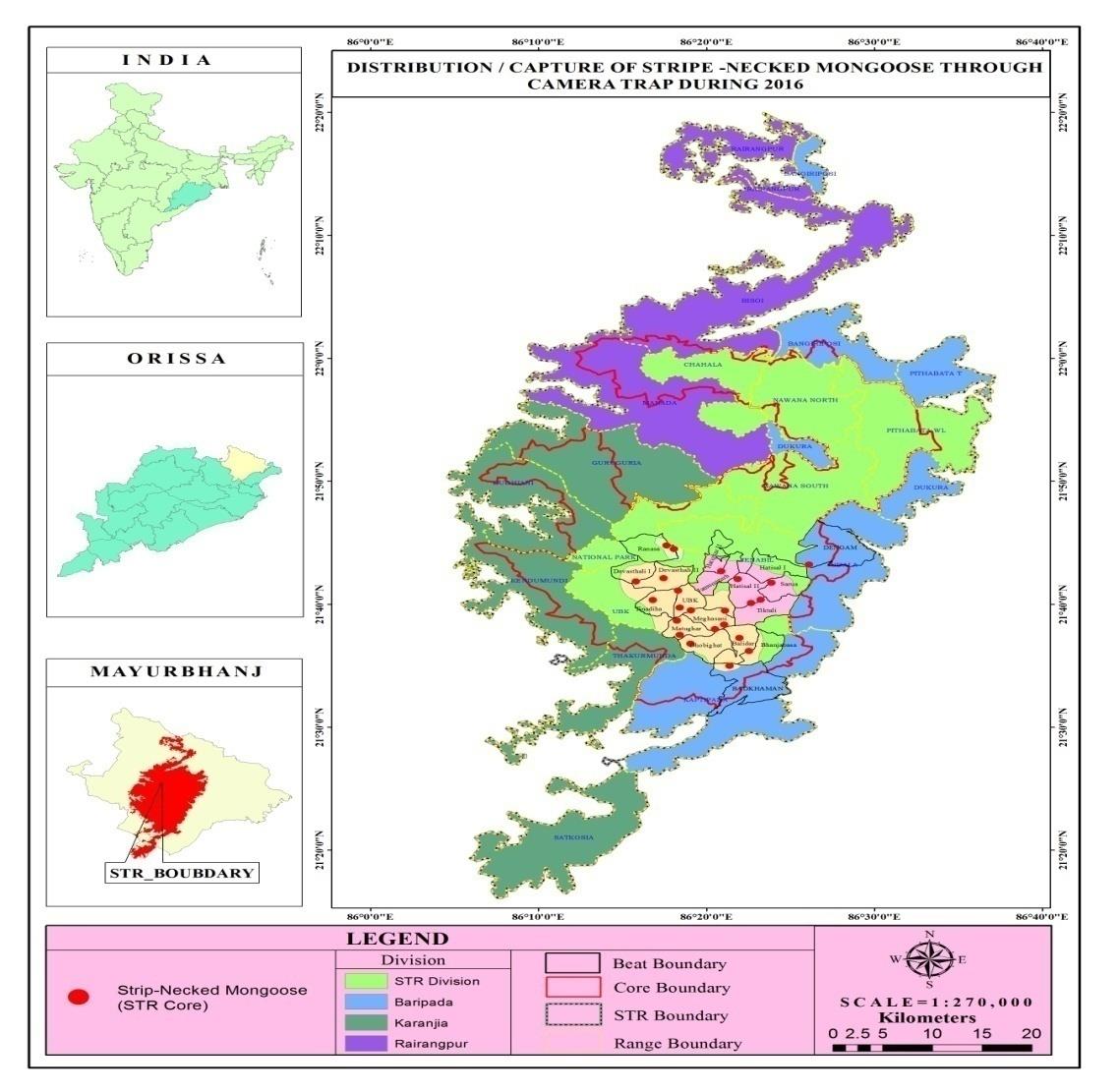
Khairi, Khadkei, Budhabalanga, West Deo, and East Deo. An astounding 1078 species of plants including 94 species of orchids find their home in the tiger reserve [11]. It host 55 species of mammals, 304 species of birds, 60 species of reptiles, 21 species of frogs, 60 species of fishes and 164 species of butterflies that have been recorded from the park (Figure 1). The core area comprises of ranges with an area of 1194.75km2.
Methodology
The Success of camera-trapping depends on the selection of ideal locations to deploy the camera traps so as to maximize the number of captures. Prior to camera placement, survey is done along the forest paths, animal trails, dirt-trackers, dried stream bed to record carnivore presence through indirect signs (pug marks, tracks, scat, scraps, rake marks, scent deposits and kills). Potential location of camera trap stations were then mapped using ArcGIS 9.3. Camera trapping exercise lasted from February2016 to May 2016 for 119 days. The cameras were active 24h period that accounted for one sampling occasion. Each camera was assigned a unique identification number, Date, time and camera ID was Mishra SR, et al. Distribution of Stripe-Necked Mongoose Herpestes Vitticollis by Camera Trapping in Similipal Tiger Reserve, Odisha. Int J Zoo Animal Biol 2019, 2(1): 000136.
recorded for every capture. The locations of each capture of stripe necked mongoose was recorded and mapped over similipal Tiger reserve to understand their geographic distribution in the study area..
Result & Discussion
During All Odisha Tiger Estimation in Similipal TR between February 2016 to May 2016 Stipe-necked Mongoose was captured in different places in Similipal Tiger Reserve. Total fourty numbers of Photo captured during the exercise covering the three ranges in Similipal Tiger reserve. Highest (27) numbers of photo captured in Upper barakamuda range followed by (09) numbers in Jenabil Range and (04) numbers in National park range of Copyright© Mishra SR, et al.
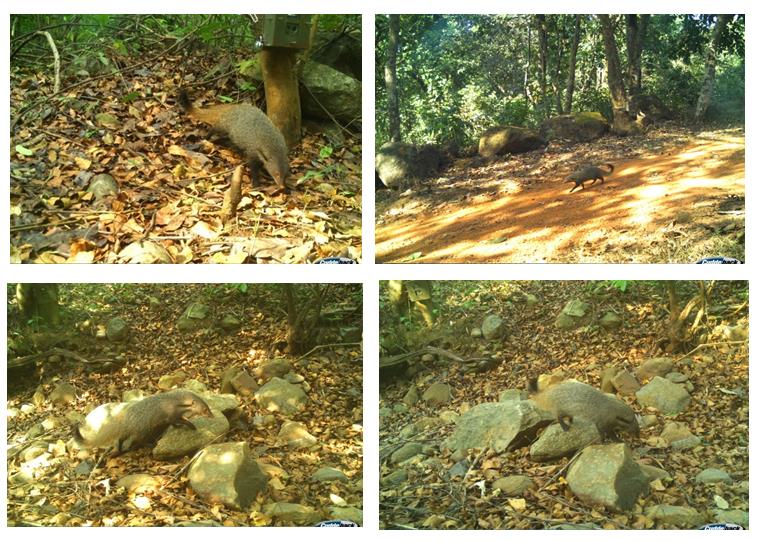
similipal. The primary habitat of the Stripe-necked Mongoose is deciduous forest (both dry and moist) and ever green forest, plantations and scrub, favoring swampy areas or those close to water courses. It prefers hilly country and has been recorded up to 2,200m.The study area varied from dry deciduous and moist deciduous to semi-ever green. The present records of Stripe-necked Mongoose were in moist deciduous forest and semi-ever green forest patches where human disturbance is minimal. Apart from Camera trap photographs most of the direct sightings were during day light near hill streams and the animals crossed forest roads (Table 1 & Figure 2).
| SL No | Division | Range | Camera ID | Longitude | Latitude | No of Photo captures | ||||||||||||||
| 1 | STR | UBK | 102 | 86°18'19.1" | 21°41'06.2" | 1 | ||||||||||||||
| 2 | STR | UBK | 113 | 86°17'26.9" | 21°42'07.4" | 3 | ||||||||||||||
| 3 | STR | UBK | 111 | 86°15'47.1" | 21°41'51.0" | 1 | ||||||||||||||
| 4 | STR | UBK | 115 | 86°21'58.2" | 21°37'15.8" | 1 | ||||||||||||||
| 5 | STR | UBK | 121 | 86°18'24.3" | 21°39'43.1" | 1 | ||||||||||||||
| 6 | STR | UBK | 122 | 86°21'06.6" | 21°39'28.2" | 3 | ||||||||||||||
| 7 | STR | UBK | 124 | 86°21'03.5" | 21°38'20.4" | 2 | ||||||||||||||
| 8 | STR | UBK | 125 | 86°20'29.8" | 21°37'58.7" | 1 | ||||||||||||||
| 9 | STR | UBK | 127 | 86°19'03.3" | 21°36'47.6" | 2 | ||||||||||||||
| 10 | STR | UBK | 130 | 86°21'22.3" | 21°34'58.7" | 1 | ||||||||||||||
| 11 | STR | UBK | 132 | 86°22'32.4" | 21°36'12.6" | 1 | ||||||||||||||
| 12 | STR | UBK | 138 | 86°18'24.5" | 21°37'30.3" | 3 | ||||||||||||||
| 13 | STR | UBK | 140 | 86°18'14.5" | 21°38'40.0" | 2 | ||||||||||||||
| 14 | STR | UBK | 141 | 86°16'49.0" | 21°40'20.7" | 1 | ||||||||||||||
| 15 | STR | UBK | 126 | 86°19'04.3" | 21°39'30.7" | 4 | ||||||||||||||
| 16 | STR | JENABIL | 206 | 86°21'51.2" | 21°42'02.6" | 4 | ||||||||||||||
| 17 | STR | JENABIL | 209 | 86°23'13.5" | 21°40'22.4" | 1 | ||||||||||||||
| 18 | STR | JENABIL | 216 | 86°23'51.9" | 21°41'45.4" | 1 | ||||||||||||||
| 19 | STR | JENABIL | 219 | 86°26'05.9" | 21°43'13.6" | 1 | ||||||||||||||
| 20 | STR | JENABIL | 231 | 86°20'52.4" | 21°42'41.4" | 1 | ||||||||||||||
| 21 | STR | JENABIL | 234 | 86°22'39.4" | 21°40'05.0" | 1 | ||||||||||||||
| 22 | STR | NATIONAL | 303 | 86°17'37.3" | 21°44'47.5" | 1 | ||||||||||||||
| PARK | ||||||||||||||||||||
| 23 | STR | NATIONAL | 305 | 86°18'03.6" | 21°44'28.8" | 3 | ||||||||||||||
| PARK |
Table 1: Capture of Stripe-Necked Mongoose at different place by Camera Trap.
Mishra SR, et al. Distribution of Stripe-Necked Mongoose Herpestes Vitticollis by Camera Trapping in Similipal Tiger Reserve, Odisha. Int J Zoo Animal Biol 2019, 2(1): 000136.
Copyright© Mishra SR, et al.
Conclusion
Small Carnivore species cannot be Surveyed using direct sighting since they are usually elusive , rare and often nocturnal or sign such as tracks and scat since sign of several sized species cannot be unambiguously identified to species. From different survey it was observed that mongooses are hunted for food and medicines.
References
-
Mudappa D (2013) Herpestids, Viverrids and mustelids. In: Johnsingh AJT, (Ed.), Mammals of South Asia-1, Universities Press, India, pp: 471-498.
-
Pocock RL (1941) The fauna of British India, including Ceylon and Burma, mammalian, 2nd (Edn), 2 Taylor & Francis, UK.
-
Prater SH (1971) The book of Indian animals. 3rd (Edn.), Bombay natural History Society and Oxford University Press, India, pp: 348. Mishra SR, et al. Distribution of Stripe-Necked Mongoose Herpestes Vitticollis by Camera Trapping in Similipal Tiger Reserve, Odisha. Int J Zoo Animal Biol 2019, 2(1): 000136.
-
Corbet GB, Hill JE (1992) Mammals of the indo- Malayan Region: A Systematic Review. Oxford University Press, UK, pp: 488.
-
Van Rompaey H, Jaykumar MN (2003) The Stripe- necked Mongoose, Herpestes vitticollis. Small Carnivore Conservation 28: 14-17.
-
Menon V (2014) Indian mammals-a field guide. Hachette India, India, pp: 200.
-
Allen PR (1911) Mongooses in the Eastern Ghats. Journal of the Bombay Natural History Society 21: 237-238.
-
Mishra CG, Patnaik SK, Sinha SK, Kar CSK, Singh LAK (1996) Wildlife wealth of Orissa. Wildlife Wing, Forest Department, Government of Orissa, India.
-
Acharjyo LN (1999) Status of mustelids, Viverrids and herpestids of Orissa, ENVIS Bulletin: Wildlife and protected Areas 2(2): 62-64. Copyright© Mishra SR, et al.
-
Anon (1999) Checklist of animals: Similipal Tiger Reserve and Similipal Biosphere Reserve (based on compilation by S.S Srivastava and L.A.K Singh) Similipal Tiger Reserve, Baripada, India. Mishra SR, et al. Distribution of Stripe-Necked Mongoose Herpestes Vitticollis by Camera Trapping in Similipal Tiger Reserve, Odisha. Int J Zoo Animal Biol 2019, 2(1): 000136.
-
Nayak AK, Yadav SP, Behera S (2014) Seasonal Occurrence of available prey densities in Similipal Tiger Reserve, Mayurbhanj, Odisha, India. Int J Conserv Sci 5(3): 379-386. Copyright© Mishra SR, et al.
- Mitochondrial Bio-Logistics: Steering Co-Enzyme Q10 and Lycopene Synergies within the Science 4.0 Bio-OS Framework
- Hymenoptera Specimens from the Caño Negro Wetland, of the National Museum Collection, Costa Rica
- Science 4.0: Comprehensive Architecture of the Biological Operating System (Bio-OS) A Framework for Systemic Resilience and Industrialized Bio-Governance
- Rabbit on, or Hare Back? Understanding Climate Change
- Clinical Validation of Science 4.0: Flow Steering and Epigenetic Drift Inversion on a 76-Year-Old Hybrid System
- Seeds Planted by another Mind