
Trichonephila sexpunctata (Araneae: Nephilidae): New Record from Rio Grande do Sul State, Southern Brazil
Araneae order has almost 51,500 described species in the world, distributed in 135 families. Nephilidae is one of those families and presents 58 species, but only three in South America. Specifically southern Brazil there are two representants of thus family: Nephilingis cruentata, Trichonephila clavipes. In this way, we aim to record the Trichonephila sexpunctata (Giebel, 1687) species from Rio Grande do Sul state, southern Brazil. For this, we observed, collected, fixed, preserved, analyzed, and deposited in the institutional zoological collection six specimens between 2017 and 2018. They were also seen in later years in the region. Our survey indicates that this species, commonly called golden orbweaving spiders, appears to have a limited distribution. In fact, there are few records of T. sexpunctata, totalizing 15 records. Therefore, the ecology of T. sexpunctata is not fully determined. Thus, we record T. sexpunctata from southwest of Rio Grande do Sul, region characterized by Brazilian Pampa biome presence. Moreover, our observations suggest that these spiders can be well adapted in anthropic environmental.
Introduction
Arachnida group include the Araneae order, which today has almost 51,500 described species in the world, distributed in 135 families. In this context, Brazil presents 3,210 records of species observed, about 6% of international spider diversity. Nevertheless, it is estimated that only 27% of the Brazilian area was covered by studies focused on spider. And we know that the spider species richness is strongly influenced by the sampling effort [1, 2].
Here, we will talk about a species from the Nephilidae
group, which is a small family in the order mentioned above with 58 species distributed by seven genera such as Clitaetra (5), Herennia (11), Indoetra (1), Nephila (9), Nephilengys (2), Nephilingis (4), and Trichonephila (26) [2]. Their origins are Gondwan, approximately 130 Ma ago, in ancestral range as Indomalaya and Australasia [3]. Now, nephilids are renowned for their female-biased sexual size dimorphism, which represent the most extreme case of sexual size dimorphism among all terrestrial animals because with females up to 500 times heavier than males (Figure 1) [4, 5].
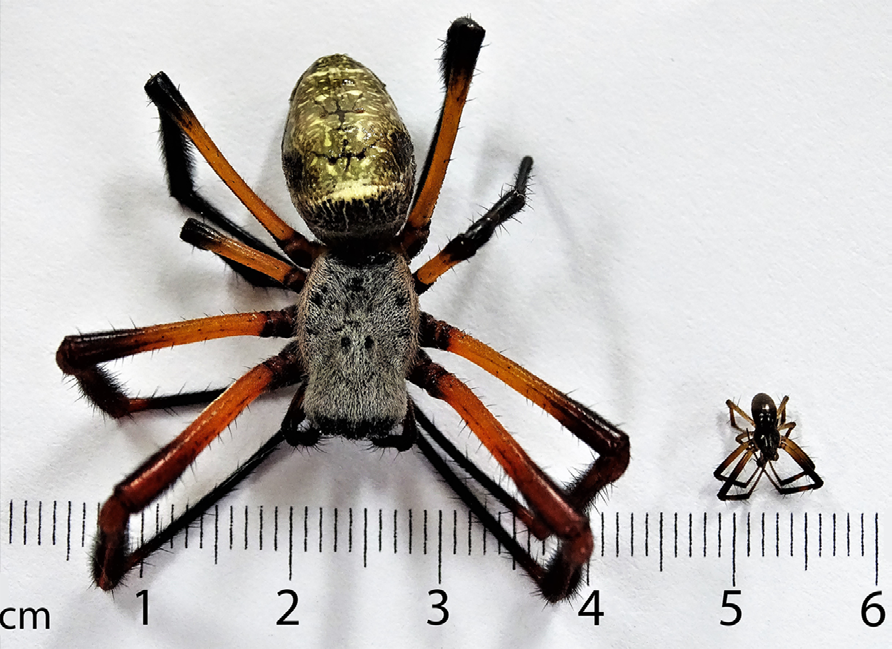
Among species of Trichonephila genus there is T. sexpunctata [16], previously belonged to the Nephila genus. Species of these genera are commonly called golden orbweaver spiders and are also characterized by its beautiful cobwebs [7]. Moreover, T. sexpunctata occurs in Brazil, Paraguay and Argentina [2]. But Nephilidae group presents others two species in South America: T. clavipes and Nephilingis cruentata. We highlight that N. cruentata is African spider introduced in Colombia, Paraguay, and Brazil [2, 8]. On the other hand, literature reports T. clavipes as a common species from Brazil to United States, including in anthropic environments. This spider was also introduced in São Tomé e Príncipe [2, 9, 10].
These two golden orbweaving spiders - T. clavipes and N. cruentata - also have been recorded in Rio Grande do Sul (RS) state, situated in southern Brazil, in which presents its territory divided into two biomes. In northern half there is the Atlantic Forest biome, while Pampa biome is present in the southern half. We see that T. clavipes is widely distributed throughout the state, whereas N. cruentata was recorded only in Rio Grande city. Meanwhile T. sexpunctata had been reported in the states belonging to the southeast and central-west regions of Brazil, such as São Paulo, Goiás, Mato Grosso and Mato Grosso do Sul. In this way, they appear are associated with Cerrado biome and adjacent dry forests until now [9, 10, 11, 12, 13, 14, 15, 16]. Therefore, to contribute with knowledge of T. sexpunctata species, we record this spider for the first time in the literature for southern Brazil, especially for south half of RS. Thus, we also indicate that T. sexpunctata can be related to Brazilian Pampa biome and anthropic environment.
Material and Methods
Study Area
The study was conducted in a Pampa biome area in the Federal University of Pampa - UNIPAMPA (29°49’49.2’’S and
57°06’07.1’’W) located in the municipality of Uruguaiana, state of RS, Brazil. The university has approximately 247 hectares and its vegetation is marked by areas of pastures with a steep slope, streams and woods. It contains a dam and livestock farming predominates in its surroundings [11, 12, 13, 14, 15, 16, 17]. The climate in the region is subtropical, classified as Cfa according to Köppen [18]. The average temperature is 18.6°C and the annual average rainfall is 1567.8 mm.
Sampling
Collections were carried out between December and March of 2017 and 2018. These collections always took place in the summer through random walks in UNIPAMPA, in which two collectors participated. Then, when the spider of interest was seen, it was captured with the aid of a small sweeping net and stored in pots with date and localization identification. Thus, collected specimens T. sexpunctata were taken to the Biology and Animal Diversity Laboratory of the UNIPAMPA, where they were fixed (2% formaldehyde) and preserved (70% alcohol) for analysis [19, 20, 21, 22]. Morphological identification was performed through comparison with specialized literature. The images and measurements were made under a stereoscopic microscope with a digital camera attached to it. The live animals were photographed with a Sony HX400V camera. Afterwards, the specimens were deposited in the zoological collection of the laboratory.
Results
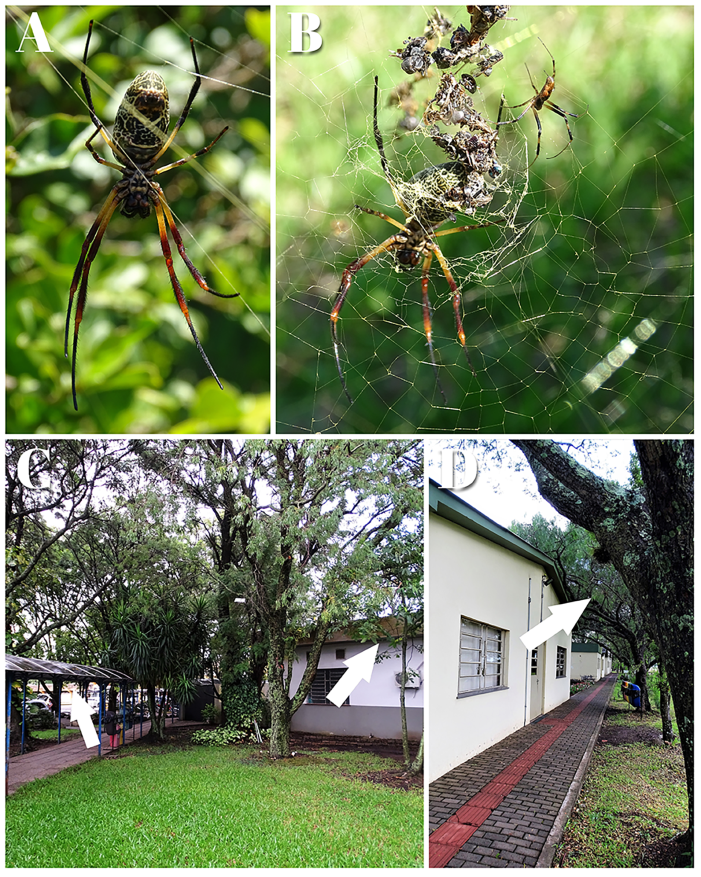
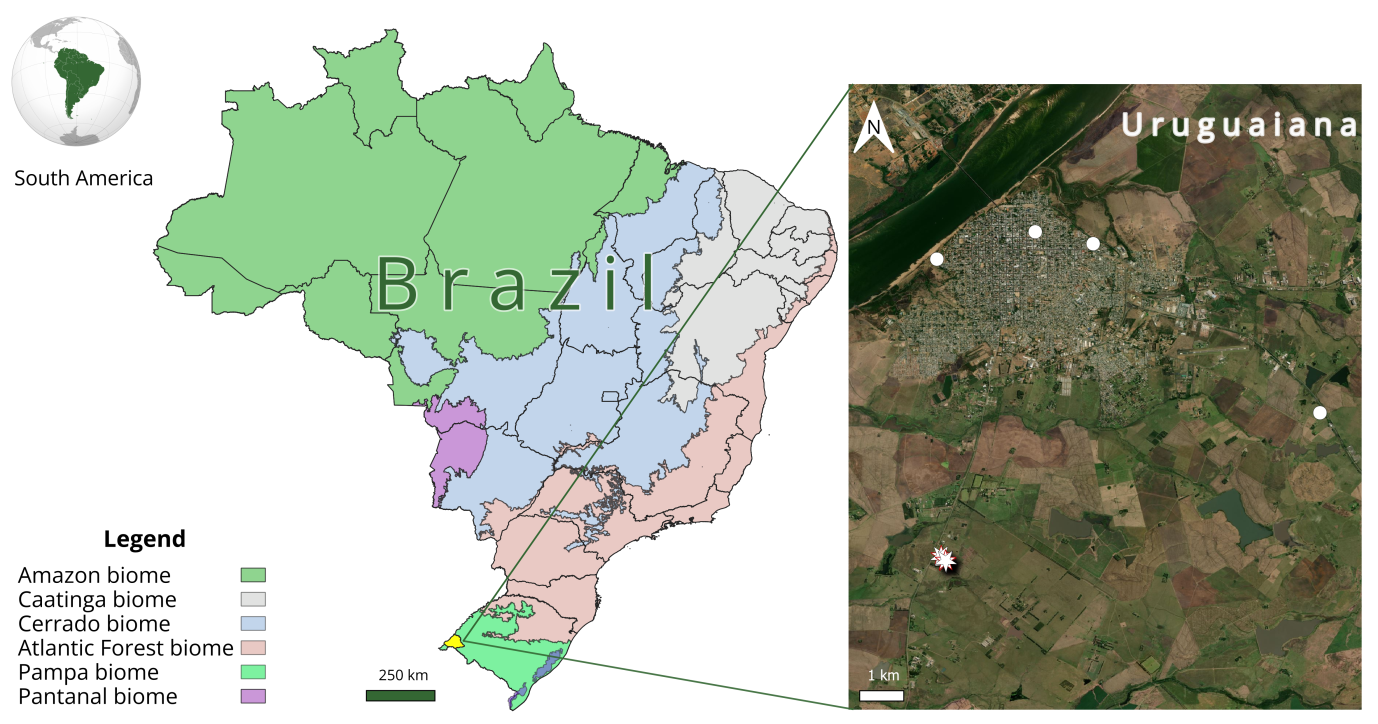
Between 2017 and 2018, six specimens of Trichonephila sexpunctata (Giebel, 1867) were collected and identified by authors in the UNIPAMPA – Campus Uruguaiana: four females and two males. Then they were deposited at institutional zoological collection (Table 1). It was highlighted these specimens were observed in trees, shrubs of pasture areas (Figures 2A, 2B), as well anthropic environments at UNIPAMPA (Figures 2C, 2D). In 2019 and 2020, there were other visual records of the species in the region, including on the banks of the Uruguay River and downtown (Figure 3). These encounters with golden orbweaving spiders always occurred in the summer.
| Country/Region | GPS Coordinates | Sex/Voucher | Collection date | |
|---|---|---|---|---|
| Trichonephila sexpunctata | UNIPAMPA, Uruguaiana, Brazil | 29°49'53.32"S, 57°06'01.48"W | 1♀, LBDA Arac_159 | March 13, 2017 |
| Trichonephila sexpunctata | UNIPAMPA, Uruguaiana, Brazil | 29°49'53.32"S, 57°06'01.53"W | 1♂, LBDA Arac_160 | March 13, 2017 |
| Trichonephila sexpunctata | UNIPAMPA, Uruguaiana, Brazil | 29°49'48.57"S, 57°06'05.58"W | 2♀, LBDA Arac_167/168 | Dec 21, 2017 |
| Trichonephila sexpunctata | UNIPAMPA, Uruguaiana, Brazil | 29°49'52.40"S, 57°06'01.85"W | 1♀, LBDA Arac_170 | Jan 30, 2018 |
| Trichonephila sexpunctata | UNIPAMPA, Uruguaiana, Brazil | 29°49'52.40"S, 57°06'01.85"W | 1♂, LBDA Arac_171 | Jan 30, 2018 |
Table 1: Information about specimens collected, identified, and deposited in zoological collection of Biology and Animal Diversit
Morphological Identification
Analysis of these found specimens were performed shortly after the capture once the color patterns may disappear over time. In this sense, their identification was based on the characteristics according to Giebel [6], Levi and Eickstedt [9], and Kuntner et al. [19].
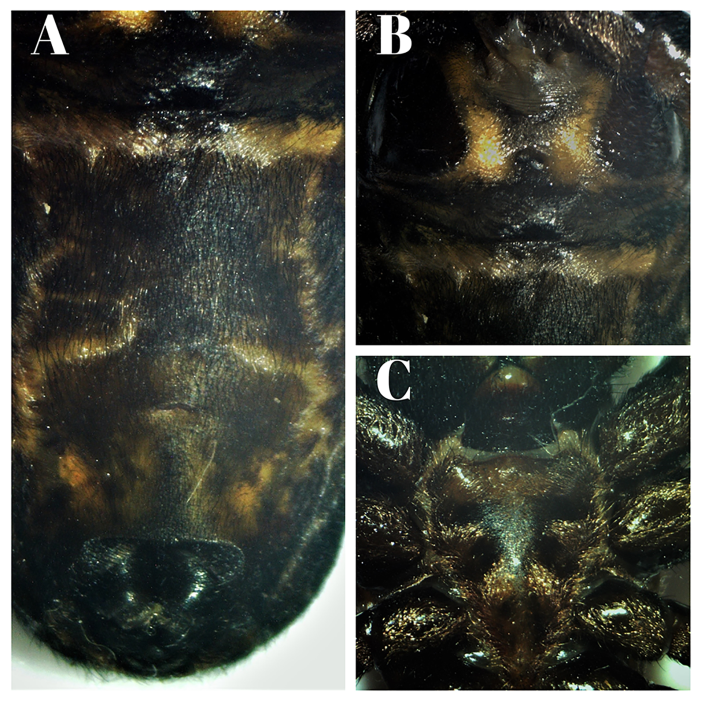
Basically, the specific taxonomic level of T. sexpunctata was identified mainly by presence of female oval abdomen, marbled and not overhanging spinnerets (Figure 4A). Moreover, the epigynum is an oval depressed plate with a groove on each side into anterior (Figure 4B). The entire upper part of their cephalothorax is densely covered with small white hairs, which leaves only two bare black spots in the middle and two round black spots on each side near the edge, which gave the species of sexpunctata its name. Their eyes are spherical and positioned on the rounded edge of the cephalothorax. Forehead eyes are the slightly larger and stay on the sides of a bulge. The other eyes closer together and are below those mentioned above, on the sides of a small central protuberance on the cephalothorax. Carapace without horns (Figure 1). T. sexpunctata does not present a frontal unpaired elevation of the female sternum, which is elongated and heart-shaped, yellow anteriorly, black- brown, and densely covered throughout with old-yellow hair (Figure 4C). These spiders also do not have a pair of tubercles on mid carapace.
Discussion
Brazil is a country rich in biodiversity, so new species from different groups are recorded every year [20, 21]. When
talking about spiders, the country has more than 3,210 species [1]. RS has a list of 808 species of spiders, included in 51 families. Among these families Nephilidae is represented to date by two species: T. clavipes and N. cruentata [13]. Now, with this record, the family has three representative species in southern Brazil. We highlight that this species is only found as an adult between late spring, summer and early autumn. Making your study difficult.
But the diagnosis of the females of T. sexpunctata are easily detected, because they are larger than the T. clavipes and N. cruentata. Another characteristic is that its abdomen is more oval and less cylindrical. In addition, the males present dark carapaces (see Figure 1) while T. clavipes males are bright yellow [9].
On the other hand, individuals of T. sexpunctata were observed in trees, shrubs of pasture areas (Figure 2A, B) and anthropic environments (Figure 2C, D), showing similar habits with T. clavipes [9, 10]. This fact may have aided in success of this species in the Brazilian Pampa biome, besides justify the observation of T. sexpunctata on the banks of the Uruguay River and downtown.
Until now, 15 locations are cited in South America for the presence of T. sexpunctata (Appendices, Table 1), 04 of them are in Brazil, 09 in Argentina and 02 in Paraguay [9, 22, 23, 24, 25, 26]. Thus, we emphasize that there are few records of this arachnid. Some studies date from the 1920s, as in Paraguay. Therefore, the ecology of T. sexpunctata is not fully determined. Lastly, this species is classified as Least Concern [9, 22, 23, 24, 25, 26, 27].
Hence present paper also demonstrates the potential aerial dispersion in nature of T. sexpunctata and its expansion capacity, since this ability allows overcome physical barriers such as rivers and transition zones [28]. This significant dispersal capacity of T. sexpunctata is compatible with the new niche occupied by their, because until now all the points where the golden orbweaving T. sexpunctata occurs are distributed in the central part of South America.
Conclusion
This study reported for the first time in literature the record of T. sexpunctata in Brazilian Pampa biome, southern Brazil. The species appears well adapted in anthropic environmental, which may partially explain its expansion. However, more studies are necessary to elucidate its ecology and possible risks in this habitat.
Conflicts of Interest
The authors declare that they have no known competing financial interests or personal relationships that could have appeared to influence the work reported in this paper.
Acknowledgements
The authors are grateful to the Biologist Thiago Gralha for support in the photographs in Research Center on Ichthyology, Limnology and Aquaculture of the Uruguay River Basin from the Federal University of Pampa. As well as Professor Ph.D. Vanderlei Folmer and Professor Ph.D. Edward Pessano from the same university for the guidance provided.
References
-
Oliveira U, Brescovit AD, Santos AJ (2017) Sampling effort and species richness assessment: a case study on Brazilian spiders. Biodivers Conserv 26: 1481-1493.
-
World Spider Catalog (2023) Version 24.5 Natural History Museum Bern.
-
Turk E, Čandek K, Kralj Fišer S, Kuntner M (2020) Biogeographical history of golden orbweavers: Chronology of a global conquest. J Biogeogr 47(6): 1333- 1344.
-
Kuntner M, Zhang S, Gregorič M, Li D (2012) Nephila female gigantism attained through post-maturity molting. Journal of Arachnology 40(3): 345-347.
-
Coddington JA, Hormiga G, Scharff N (1997) Giant female or dwarf male spiders. Nature 385: 687-688.
-
Giebel CG (1867) New spider, Nephila sexpunctata, from Mendoza. Journal for the entire natural sciences 30: 325- 326.
-
Hormiga G, Scharff N, Coddington JA (2000) The Phylogenetic Basis of Sexual Size Dimorphism in Orb- Weaving Spiders (Araneae, Orbiculariae). Syst Biol 49(3): 435-462.
-
Kuntner M (2006) Phylogenetic systematics of the Gondwanan nephilid spider lineage Clitaetrinae (Araneae, Nephilidae). Zool Scr 35: 19-62.
-
Levi HW, Eickstedt VRD Von (1989) The Nephilinae spiders of the neotropics (Araneae: Tetragnathidae). Mem Inst Butantan 51: 43-56.
-
Bonaldo AB, Carvalho LS, Pinto-da-Rocha R, Tourinho AL, Miglio LT, et al. (2009) Inventário e história natural dos aracnídeos da Floresta Nacional de Caxiuanã In: Lisboa PLB (Ed.), Caxiuanã: desafios para a conservação de uma Floresta Nacional na Amazônia Belém, LISBOA, PLB, pp: 577-621.
-
Rodrigues ENL (2005) Litter fauna from two areas of a restinga forest in the municipality of Capão do Leão, Rio Grande do Sul, Brazil. Biotemas 18(1): 73-92.
-
Podgaiski LR, Ott R, Rodrigues ENL, Buckup EH, Marques MA de L (2007) Araneofauna (Arachnida; Araneae) from Turvo State Park, Rio Grande do Sul, Brazil. Biota Neotrop 7(2): 197-212.
-
Buckup EH, Marques MAL, Rodrigues ENL, Ott R (2010) List of spider species (Arachnida, Araneae) from the state of Rio Grande do Sul, Brazil. Iheringia Ser Zool 100(4): 483-518.
-
Brescovit AD, Oliveira U de, Santos AJ dos (2011) Spiders (Araneae, Arachnida) from the State of São Paulo, Brazil: diversity, sampling effort and state of knowledge. Biota Neotrop 11(S1): 717-747.
-
Kuntner M, Arnedo MA, Trontelj P, Lokovsek T, Agnarsson I (2013) A molecular phylogeny of nephilid spiders: Evolutionary history of a model lineage. Mol Phylogenet Evol 69(3): 961-979.
-
Ricalde MP, Brescovit AD, Nava DE, Loeck AE, Bisognin A, et al. (2016) Spider assemblage in olive groves in southern of Brazil. Bioagro 28(2): 125-130.
-
Pessano EFC, Costa MT, Pessano CLA, Carvalho AV de, Castro LRB (2020) Campus Fauna: catálogo dos principais grupos animais registrados na Universidade Federal do Pampa-Campus Uruguaiana, Maringá, Uniedusul.
-
Köppen (2020) Climate classification for Brazilian municipalities
-
Kuntner M, Coddington JA, Hormiga G (2008) Phylogeny of extant nephilid orb-weaving spiders (Araneae, Nephilidae): testing morphological and ethological homologies. Cladistics 24(2): 147-217.
-
Flk S, Luiz F, Salgado K (2021) _Astyanax pardensis_ (Ostariophysi: Characiformes: Characidae), New Species from Das Contas and Pardo Rivers Basins, Bahia, Brazil. Int J Zoo Animal Biol 4(5): 000330.
-
Rocha CFD, Barros-Filho JD, Sluys MV (2023) A New Amphisbaena species from a Restinga Habitat of Southeastern Brazil (Reptilia, Squamata, Amphisbaenidae). Int J Zoo Animal Biol 2023 6(4): 000501.
-
Araujo D, Paula-Neto E, Brescovit AD, Cella DM, Schneider MC (2015) Chromosomal similarities between Nephilidae and Tetragnathidae indicate unique evolutionary traits among Araneoidea. Italian Journal of Zoology 82(4): 513-520.
-
Bartoleti LF de M, Peres EA, Sobral Souza T, Fontes F von HM, Silva MJ da, et al. (2017) Phylogeography of the dry vegetation endemic species Nephila sexpunctata (Araneae: Araneidae) suggests recent expansion of the Neotropical Dry Diagonal. J Biogeogr 44(9): 2007-2020.
-
Mello-Leitão C de (1944) Arañas de la provincia de Buenos Aires. Revista del Museo de La Plata 3(24): 311- 394.
-
Mello-Leitão C de (1940) Las arañas de Córdoba, La Rioja, Catamarca, Tucumán, Salta y Jujuy. Colectadas por los profesores Birabén. Revista del Museo de La Plata 2(12): 99-198.
-
Badcock HD (1932) Reports of an Expedition to Paraguay and Brazil in 1926-7, supported by the Trustees of the Percy Sladen Memorial Fund and the Executive Committee of the Carnegie Trust for the Universities of Scotland. Arachnida from the Paraguayan Chaco. Journal of the Linnean Society of London, Zoology 38(257): 1-48.
-
IUCN Red List of Threatened Species.
-
Lee VMJ, Kuntner M, Li D (2015) Ballooning behavior in the golden orbweb spider Nephila pilipes (Araneae: Nephilidae). Front Ecol Evol 3: 121744. Appendix 1 [INLINE_TABLE:6:0] Table 2: Information about specimens collected, identified, and deposited in zoological collection of Biology and Animal Diversity Laboratory by authors.
- Mitochondrial Bio-Logistics: Steering Co-Enzyme Q10 and Lycopene Synergies within the Science 4.0 Bio-OS Framework
- Hymenoptera Specimens from the Caño Negro Wetland, of the National Museum Collection, Costa Rica
- Science 4.0: Comprehensive Architecture of the Biological Operating System (Bio-OS) A Framework for Systemic Resilience and Industrialized Bio-Governance
- Rabbit on, or Hare Back? Understanding Climate Change
- Clinical Validation of Science 4.0: Flow Steering and Epigenetic Drift Inversion on a 76-Year-Old Hybrid System
- Seeds Planted by another Mind