
Morphometric and Internal Measurement of African Mourning Doves at Elssuki Area, Sinnar State Sudan
The African Mourning Dove (Streptopelia decipiens decipiens) is the most widespread species of Columbidae in Africa. There is little research done on this species in Sudan. This study was conducted in 15/12/2016 to 29/3/2017, at Elssuki area, N 13 19 0 E 33 52 60, Sinnar state, Sudan. The aims of this study are to assess the morphometric (body weight, bill, tarsus, tail, wing, head and culmen length) and physiological variation of African mourning dove (Streptopelia decipiens decipiens). Twenty birds were captured by traditional traps from Alssuki city and around Hamadna allah village 11 km from Elssuki. Morphological measurement like body weight, the tall of the tail, bill, bill with ahead, wings and tarsus were measured using ruler and registered in a sheet. Internal parts were also measures, the tall of intestine and kidneys, the heart, liver and gizzard were weighed using sensitive balance. There is significant variation between the bird in body weight, the tall of morphological feature and external one. The sample from Hamadna allah reflect higher weigh and of tall of both internal or external parts. It was agreed with some studies in other parts of the world of morphometric variation but on other hands showed that there is a relationship between body weight and some internal parts like gizzard weight. The difference may be attributed to genetic characters, or type, or availability of food or food quality, and habitat differentiation.
Introduction
African mourning dove Streptopelia decipiens decipiens is belong to order Columbiformes which includes two families: Raphidae and columbidae, while family consists of approximately 300 species of doves and pigeon, the most important species in this family are Pigeons and Doves. Species of this family characterized by producing milk in the crop which secreted by sloughing of fluid – filled from the lining of the crop and feeding chicks directly on their mouth.
This family distributed worldwide with greatest occurrence of variety in the indomalay and Australia Eco zones. The family divided into five sub families one of them is columbinae which includes 29 genera eg: Streptopelea.
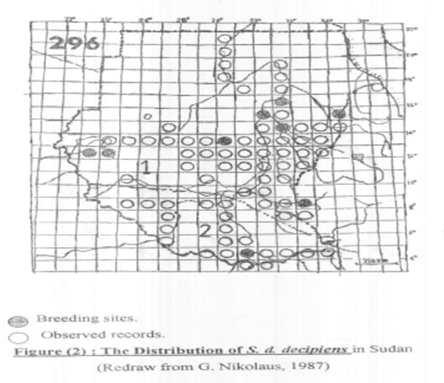
African mourning dove is common resident in Sudan where distributed widely from Dongola to Sudan boarders up to South Sudan and neighbouring countries, preferring a tall tree, open dry woodland and land near water [1].
Species of the family Columbidae recorded in Sudan comprise 23 species [2] (doves and pigeons), although some of these were rare records. The more common dove spieces are laughing Dove (Streptopelia Senegalensis), Namaqua Dove,(Oena capensis), Ring- necked Dove, (Streptopelia capicola), Mourning Dove, (Streptopelia decipiens decipien) s, Turtle Dove, (Streptopelia turtur), Lemon Dove, (Aplopelia larvata), Pink-breasted Dove, (Streptopelia lugens), Red eyed Dove, (Streptopelia semitorquata), Black billed Wood Dove (Turtur abyssinicus), Speckled Pigeon, (Columba guinea guinea), Rock Pigeon, (Columba livia), Green Pigeon, (Teron australis uellensi)s, Tambourine Dove, (Turtur tympanistria).
There is a need for field data and detailed information about the family Columbidae in Sudan. No study was made on this species except one in Khartoum [3].
The result of that study revealed that the length of the body is about 30.0 cm, the wings are 15.8 to 18.4 cm. In Sudan breeding activity is from February to April and from June to October [4, 5].
The sub species of African Mourning doves characterized by sleek, streamlined, medium sized migratory birds, ranging in length from 27.94 to 33.02 cm. They have a wingspan of 43.18 to 48.26 cm and weigh just over 113 gm [6].
Mourning doves are adapted to a wide variety of habitat conditions, but depend particularly on edge cover and mixed successional stages throughout their range. They primarily inhabit woodland/grassland edges. They prefer open or semi-open lands and are primarily farm game birds that thrive where grain crops are grown. Mourning doves generally do not feed in areas containing heavy, densely- matted vegetation; bare ground on which seeds are available and visible is preferred [7].
Many studies in North America stated that there are seasonal and of body mass differences sex (male and female), highest and lowest between adult, changing due to breeding and nesting activities and to some extent to primary feather replacement [7].
The relationship between declines in body mass and progress of primary moult in adults is believed to be due primarily to energetic demands of breeding activities, although primary moult may also have a role. Previous data reveal that body mass of males in southern Arizona ranged from 86 to 153 g with a mean of 116.3 g and for females ranged from 80 to 139 g with a mean of 109.0 g [8].
In Sudan most studies about birds focusing on diversity of birds as priority to fulfil the gab but little studies of morphometry. It is very necessary to conduct such studies to provide information about the effect of habitat, feeding and other factors on birds for better conservation measurement.
Objectives
- To determine the body weight.
- To determine the outer parts, tall of the head, bill, wings, tarsus and tail.
- To determine the internal parts, tall of kidney, intestine, weight of heart and gizzard (empty and full).
Materials and Methods
Study are
Elssuki area is located at eastern bank of the Blue Nile at the south east of Sinnar state, N 13 31 67 E 33 8833, its elevation is 399 meters above sea level and it population amounts to 33,524. It Is located in poor Savanah zone. It dominated by tropical climate, the mean of annual rainfall is 400 – 500 mm, the temperature 370 – 40°C.
| No | Species |
| 1 | Balanites aegyptiaca |
| 2 | Acacia nilotica |
| 3 | Acacia orefota |
| 4 | Prosopis juliflora |
| 5 | Capparis decidua |
Table 1: Tree species at study area.
| No | Species |
| 1 | Cyndon dactylon |
| 2 | Chloris prieeurii |
| 3 | Setartaria ballide |
| 4 | Corchours fasscularis |
| 5 | Xanthium brasillicum |
| 6 | Cyperus rotundus |
| 7 | Salvia officalis |
| 8 | Arabidopsis thaliana |
Table 2: Weeds at the study area.
Material
• Ruler
Results and Discussion
- Electronic balance
- Bags
- Vernier Caliber
- Traditional traps
- Dissection set
Method
Birds were captured by traditional traps and the subjected to the following.
External parts:
- Wing length was measured folded from the bend of the wing to the largest primary feather.
- Measured the distance from distal end of parietal to the tip of the bill (bill and head length) using callipers Tail length was measured from the base to the tip of the largest rectrix using ruler.
- Tarsus length was measured from the joint of the femur to the joint of the feet with calliper [9].
- The body weight was measured by sacs where the bird was put inside and tided then hanged to the balance. (The birds weight alive and after dead). Internal parts: The birds were dissected and the following measurement had been made.
- The tall of intestine by putting it along flat table parallel to the ruler.
- Heart weight using sensitive and electronic balance.
- Liver weight using sensitive and electronic balance.
- Gizzard weight (full and empty).
- The tall of the kidneys.
| No | Wing/Cm | Head With Bill | Tail/Cm | Tarsus/Cm | Weight Before Death | Weight After Death |
|---|---|---|---|---|---|---|
| 1 | 18 | 3.6 | 10.2 | 2.5 | 69 | 50 |
| 2 | 16.8 | 4 | 9.6 | 2 | 65 | 50 |
| 3 | 16.2 | 3.8 | 9 | 1.9 | 60 | 48 |
| 4 | 18.3 | 4.1 | 10.6 | 2.6 | 75 | 62 |
| 5 | 20 | 4.5 | 11,2 | 3 | 88 | 67 |
| 6 | 21 | 4 | 11 | 2.9 | 89 | 72 |
| 7 | 19.7 | 4.3 | 10.1 | 3 | 83 | 76 |
| 8 | 19 | 4 | 12 | 2.5 | 74 | 60 |
| 9 | 20.2 | 4 | 10 | 3.1 | 80 | 74 |
| 10 | 20,0 | 4.8 | 11.7 | 2.5 | 80 | 75 |
| 11 | 18.2 | 3.3 | 10.8 | 2.5 | 60 | 51 |
| 12 | 17.7 | 4 | 10.8 | 2.4 | 58 | 53 |
| 13 | 22 | 4.1 | 13 | 2.8 | 120 | 100 |
| 14 | 20 | 3.7 | 10 | 3.5 | 95 | 82 |
| 15 | 19.8 | 3 | 10 | 2.5 | 71 | 63 |
| 16 | 20.1 | 4.6 | 11 | 3 | 81 | 78 |
| 17 | 20.6 | 4 | 11,2 | 2.7 | 70 | 65 |
| 18 | 20 | 4.1 | 11 | 2.5 | 66 | 64 |
| 19 | 18.5 | 4.5 | 10.1 | 2.5 | 58 | 53 |
| 20 | 20.9 | 4.3 | 11 | 2.5 | 90 | 79 |
Table 3: The length of outer parts and weight of the body.
| Wing | Head With Peak | Tarsus | Tail | Weight After Death | Weight Before Death | |
|---|---|---|---|---|---|---|
| Mean | 18.4 | 1.9 | 4 | 2.6 | 76.6 | 66.1 |
Table 4: Mean of weight and tall of outer parts.
| Liver/G Weight/ Cm | Heart/G Weight | Gizzard/G (Empty) | Gizzard/G (Full) | Kidney/Cm (Tall) | Intestine/Cm (Tall) | |
|---|---|---|---|---|---|---|
| 1 | 2 | 1 | 1 | 2 | 2 | 31 |
| 2 | 1 | 1 | 1 | 1 | 1.3 | 25.1 |
| 3 | 1 | 0 | 1 | 1 | 1.5 | 27 |
| 4 | 2 | 1 | 1 | 2 | 1.7 | 35 |
| 5 | 2 | 1 | 3 | 5 | 2.5 | 48 |
| 6 | 2 | 1 | 3 | 4 | 2 | 42 |
| 7 | 2 | 1 | 2 | 4 | 3 | 46 |
| 8 | 2 | 0 | 1 | 2 | 2.5 | 39 |
| 9 | 2 | 1 | 3 | 4 | 2.3 | 45 |
| 10 | 1 | 1 | 2 | 3 | 2.5 | 39.4 |
| 11 | 1 | 1 | 1 | 2 | 3 | 30 |
| 12 | 1 | 0 | 1 | 1 | 2.5 | 23.7 |
| 13 | 4 | 1 | 3 | 5 | 2.5 | 51 |
| 14 | 3 | 1 | 3 | 4 | 2.5 | 35 |
| 15 | 1 | 0 | 1 | 2 | 2.5 | 41 |
| 16 | 2 | 1 | 3 | 4 | 2.5 | 43 |
| 17 | 1 | 1 | 2 | 4 | 2.5 | 39 |
| 18 | 1 | 1 | 2 | 3 | 2.5 | 42 |
| 19 | 1 | 1 | 2 | 2 | 2 | 28 |
| 20 | 2 | 1 | 3 | 4 | 2.5 | 40 |
Table 5: Weight and length of internal parts.
| Parts | Gizzard/G (Full) | Gizzard/G (Empty) | Heart/G Weight | Intestine/Cm (Tall) | Kidney/Cm (Tall) | Liver/G Weight/ Cm |
|---|---|---|---|---|---|---|
| Mean | 3 | 2 | 0.8 | 38 | 2.5 | 1,7 |
Table 6: Mean of weight and tall of outer parts.
Discussion
The results showed that Tables 3 & 4 highest weight for birds is 120 g and 100 before death and after death respectively and mean is 77, 66.1g respectively. Wings length was between 16.2 – 22 cm with a mean of 18.4 cm. The mean length of head 4 cm with a peak of 4.6 – 4.8 cm, head length is 2.3 – 2.9 cm, tarsus is 3.1 – 3.5 cm, with the mean of 2.6 cm and the tail is 12- 13 cm with mean of 9.6 cm.
For the length and weight of internal parts Tables 5 & 6, higher figures recorded are given below.
Full Gizzard weight is 5 g, mean is 3 g, an empty gizzard weight is 3 g with mean 2g. Heart weigh is 1g, the mean is 0.8 g. Liver weight is 4 g and its mean is 1.7 g. The length of kidney is 3 cm, calculated mean is 2.3 and the length of intestine is 51 cm, mean is 38 cm.
It can be obtained from the result that there is no significant variation in wing tail length which agreed with previous studies in other parts of the world.
The higher weight was recorded for birds collected from Hamadna allah 120 g while the lower one for the Elssuki 58 g Salazar Borund, et al. [10] stated that: No significant differences noted in tail length and wings length at Alabama and New York. But there is great variation between body weight which is proved by Salazar Borunda, et al. [10], they showed in their studies that Southern New York doves, were larger than specimens from Alabama, North Carolina, Virginia and Illinois. No variation registered for head and bill length which similar to other studies.
Salazar Borunda, et al. [10], found that body measurements varied between both dove species (Streptopelia decaocto) and (Zenaida macroura) also some size dimorphism of some but not all of these measurements such as head and bill length and body condition index. Indeed, (Streptopelia decaocto) is larger than (Zenaida macroura) and they have found that season has some influence on body condition index for both species.
The similarity of morphometric measurements variation reported in this species with some other parts of the world found that it is there is slight variation in body weight suggest that morphology might be influenced by historical or geographical factors, such that environment is shaping morphology through adaptation, probably linked to habitat selection or feeding and its modifications caused by human activities [10].
The higher figures of dove measurements in this study is contrast to Bergmann’s Rule which states that races of larger body size are found in the cooler climate [11].
It was no variation between the internal parts but it seems that there is relationship between the length of intestine and the gizzard weight. Also one important finding of this study is the relationship between body weight and gizzard weight which needed more studies to confirm these relationships between outer parts and external ones, and between some internal parts themselves.
Conclusion and Recommendations
- The study findings are the following recommendations.
- The needed of more studies about Morphometry studies and Mourning dove in different part of Sudan based on sex differentiation, habitat variation, seasonal changes and prior moult of feather.
- Encourage physiological research and studies about birds in Sudan.
- Awareness should be raised among the community.
- Conservation measures should be taken and with protection for compacting illegal hunting for dove species.
References
-
Elrahman Mohmmed DA (2012) The advantages of folocking behaviour of African Mourning Dove Streptopelia decipiens. Faculty of science, university of Khartoum.
-
Nikolaus G, (1987) Distribution atlas of Sudan’s birds with notes on habitat and status. Bonn Zool Monogr 25: 1-322.
-
Margani NN, (2018) The Status, diversity and some aspects of breeding behaviour of avian species in Khartoum State with emphasis on the Laughing Dove _Streptopelia senegalensis_, In Wildlife science, Sudan University of Science and Technology.
-
Erickson CJ (1973) Mate familiarity and reproductive behavior of Ring turtle dove. The Ank 90: 780- 795.
-
Westmorelrand D, Bet LB (1985) The effect on disturbance Mourning Dove resting success. The Auk 102(4): 774-780.
-
Indiana Department of Natural Resources (2006) Division of Fish and Wildlife.
-
Marks R, Pauline R, Rewa C, Mirarchi RE, Dolton DD, et al. (2005) Mourning Dove (Zenaida macroura). Wildlife Habitat Council, Wildlife Habitat Management Institute, US> Fish and Wildlife services, USA.
-
Braun CE, Tomilinson RE, Wann GT (2015) Seasonal Dynamics of Mourning Dove _Zenaida macroura_ Body Mass and Primary Moult. The Wilson journal of ornithology 127(4): 638.
-
Pyle P (1997) Identification Guide to North America Birds. Part I: Columbidae to Ploceidae. Slate Creek Press, Point Reyes Station.
-
Salazar Borunda MA, Martínez Guerrero JH, Pereda Solís ME (2015) Morphometrics and Body Condition Index of Eurasian Collared-Dove and Mourning Dove in Durango, Mexico. Open Journal of Ecology 5(2): 33-38.
-
Schemnitz SD (1975) Food habitat and body measurements of mourning dove in southern Maine. School of Forest Resources, University of Maine at Orono Technical Bulletin 78.
- Mitochondrial Bio-Logistics: Steering Co-Enzyme Q10 and Lycopene Synergies within the Science 4.0 Bio-OS Framework
- Hymenoptera Specimens from the Caño Negro Wetland, of the National Museum Collection, Costa Rica
- Science 4.0: Comprehensive Architecture of the Biological Operating System (Bio-OS) A Framework for Systemic Resilience and Industrialized Bio-Governance
- Rabbit on, or Hare Back? Understanding Climate Change
- Clinical Validation of Science 4.0: Flow Steering and Epigenetic Drift Inversion on a 76-Year-Old Hybrid System
- Seeds Planted by another Mind