
Remarks on the Misunderstood Use of the Term Biodiversity
The term diversity is intended to denote species richness understood as the number of species and individuals; it was explicitly discussed at length by Hutchinson in 1959 and by many other scientists in the following decades. The term biodiversity, certainly derived from diversity, was born in the 1980s. The difference between the two terms is substantial, diversity is a part of the whole, as biodiversity is understood as diversity of organisms at the level of species, individuals, genes, interactions and ecological processes among them and at the level of ecosystems. Thus, it is correct to write ‘plant diversity’ or ‘animal diversity’, but not ‘plant biodiversity’ or ‘animal biodiversity’. Biodiversity is unique, it includes all living things, it is equal to a fundamental law of life, the maintenance of adequate levels of biodiversity is a necessity for the very life of our Planet. An illustration of biodiversity seen in the form of mosaic tesserae is tentatively presented.
Introduction
On the 100th anniversary of the presentation of the theory of Charles Darwin and Alfred Russel Wallace, on December 30, 1958, the Anglo-American Hutchinson, president of the American Society of Naturalists, read a paper with the decidedly original title ‘Homage to Santa Rosalia, or why there are so many kinds of animals?’ [1]. The title summarized two substantial facts, namely, the circumstances under which the author had come to ask the question why there is so much diversity on our Planet and the possible answers to that question. Hutchinson had been to Palermo (Sicily, Italy) to look for some aquatic hemipterans of genus Corixa Geoffroy, 1762, but finding no trace of them, he went to Mount Pellegrino to admire the view from above. Hutchinson wrote «An early interest in zoogeography and in aquatic insects led me to attempt to collect near Palermo, certain species of Commentary water-bugs, of the genus Corixa, described a century ago by Fieber and supposed to occur in the region, but never fully reinvestigated. It is hard to find suitable localities in so highly cultivated a landscape as the Concha d’Oro».
The reason for the title of the article (Homage to Santa Rosalia) was derived from the fact that Mount Pellegrino is home to the ‘grotto’, believed to be the hermitage that had housed, until 1166, a woman named Rosalia, whose bones carried in procession during the plague of 1624 - it is said - eradicated the disease. Rosalia was beatified and the Palermitans since that time considered her their patron saint. «A little below the summit, a church with a simple baroque facade stands in front of a cave in the limestone of the hill. Here in the 16th century a stalactite encrusted skeleton associated with a cross and twelve beads was discovered. Of this skeleton nothing is certainly known save that it is that of Santa Rosalia, a saint of whom little is reliably reported save that she seems to have lived in the 12th century, that her skeleton was found in this cave, and that she has been the chief patroness of Palermo ever since». Just below the shrine of Santa Rosalia, Hutchinson found a small pond, still existing, in which he discovered a large number of Corixa, belonging to two species, C. punctata, larger in size, and C. affinis, smaller in size. Of the former species only females were present at the end of their biological cycle, while of the latter both sexes could be observed, probably at the beginning of their reproductive cycle.
Convinced that he had found good scientific inspiration at Mount Pellegrino, Hutchinson proposed on that occasion that St. Rosalia should also be considered patroness of evolutionary biology studies, and laid the theoretical foundation on the topic of the ecological niche and the concept of diversity [1]: «Nothing in her history being known to the contrary, perhaps for the moment we may take Santa Rosalia as the patroness of evolutionary studies, for just below the sanctuary, fed no doubt by the water that percolates through the limestone cracks of the mountain, and which formed the sacred cave, lies a small artificial pond, and when could get to the pond a few weeks later, I got it a hint of what I was looking for». However, in 1825 the English geologist William Buckland could establish that the bones preserved in the cave of Mt. Pellegrino were those of a goat [3, 4].
The Concept of Diversity
Mount Pellegrino is considered by many ecologists and biologists studying evolution to be a kind of sacred mountain where Hutchinson found inspiration. And it can be argued that the concept of diversity has its origins in Palermo, where Hutchinson was a guest of the University for his limnological studies. Today we know that there are millions of living species and that we know only a modest percentage of them.
‘An inordinate penchant for beetles’: Hutchinson [2] reported this sentence, probably apocryphal, that the biologist Englishman John Burdon Sanderson Haldane is said to have uttered in response to a group of theologians who asked him what one might conclude about the nature of the Creator based on the biological studies he had been conducting for so many years. Later however, Hugh Scott suggested that the Diptera might be rivals of the Coleoptera in terms of species abundance [2]. The question about the number of species, that is specific diversity, that Hutchinson was asking himself as he went around Mount Pellegrino in search of species of the genus Corixa, was repeated monotonously by many other researchers over the next 60 years and is the basis for understanding a vast biological concept that is on everyone’s lips today: biodiversity.
Just to give an idea of how successful Hutchinson’s article was, some subsequent monographs on the inspiring Hutchinsonian theme are below given. Two articles were published in 1981, both bearing the name ‘Santa Rosalia’ in the title. Brown [5] wrote his ‘Two decades of Homage to Santa Rosalia: toward a general theory of diversity’, in which he gave a concise overview of ecological issues related to the concept of diversity, while Simberloff and Boecklen [6] published ‘Santa Rosalia reconsidered: size ratios and competition’. Massa [7] dedicated an article to Hutchinson thirty years after his Homage, in a 138-page volume of Il Naturalista Siciliano devoted entirely to the Anglo-American ecologist one year before his death. A few years later, de Meeûs, et al. [8] published the paper ‘Santa Rosalia revisited: or why are there so many kinds of parasites in the ‘Garden of Earthly Delights’?’. In the title they refer to the magnificent triptych painted by Hieronymus Bosch, dated ca. 1500 and housed in the Prado Museum in Madrid, because in the left panel the trained eye of the biologist could detect in the fantastic characters, usually produced by Bosch’s brush, the result of possible recombinations, mutations and hybridizations, assorted with considerable diversification, in short an artistic sign of the diversity of the living. Getting to the heart of the specific topic, the three authors emphasized how parasites must continually adapt to their hosts, to which they are closely related, and the host allows ample opportunities for niche diversification among parasite populations, a necessary condition for sympatric speciation.
A small volume edited by Sommer and Worm, ‘Competition and coexistence’ [9], was published in 2002, the last chapter of which is titled ‘Synthesis. Back to Santa Rosalia, or no wonder there are so many species’. Again in 2006 Wright, et al. [10] published ‘The road from Santa Rosalia: a faster tempo of evolution in tropical climates’. They premised that already von Humboldt [11] had interpreted the decrease of species from tropical areas toward the poles as an energetic effect, dependent on the fact that in warmer and more productive environments the metabolic rate of species is higher; then they showed that since the mutation rate is positively correlated with the metabolic rate, in the tropics the time for evolution and speciation is faster. Additionally, in 2008 Carson, et al. [12] fine volume devoted a chapter to endophytic fungi, edited by Arnold, who closed her paper with a paragraph entitled ‘Santa Rosalia’s fungal blessings’ in which it was pointed out that endophytic fungi, symbionts of many plant species, in tropical areas are probably more than a million species, of which only five percent are known. At the end the author asks the question ‘Why are there so many species of tropical endophytes?’. Further, the question ‘How many species are there on Earth?’ is also the title of two interesting papers published in 1988 by May [13] and 2023 by Wiens [14], respectively.
Numerous articles since Hutchinson’s have attempted to place a value on diversity understood as specific richness, making use of affordable algorithms, many of them have been summarized in Pielou’s fine book [15]. The best known are certainly Shannon-Wiener’s and Simpson’s diversity indexes; from them was derived the ‘equitability’ index, which corresponds to the maximum possible value of diversity. All these indices are based on: a) number of species belonging to a given taxonomic group; b) number of individuals of each taxon. In nature, species can be divided into very common, common, infrequent, rare, and very rare; using this division yields mathematical values of diversity that are on average lower than what would be obtained with an equi-replicate species frequency (= all species with the same number of individuals), a fact that is ecologically impossible. The concept of diversity therefore relies on only two parameters, the specific richness of a limited taxonomic group and the relative frequency of the species considered.
The Concept of Biodiversity
The above text serves to better understand what is meant by diversity; however, people often misunderstand the meaning of diversity (part of the whole), confusing it with that of biodiversity (which as we shall see represents a broader concept). The concept of biodiversity originated some years after Hutchinson’s seminal paper, but in a sense he was its inspiration. Biodiversity is a ‘feminine singular noun’ synonymous with ‘biological diversity’, meaning the ‘diversity of organisms at the level of species, individuals, genes, interactions and ecological processes among them and at the level of ecosystems’ [16]. Biological diversity, noun and adjective, can merge into a single term, in which the adjective becomes a suffix of the noun. Bio-diversity consequently is already a term of complete meaning, there is no point in adding an additional adjective, as we sometimes read; therefore, it is correct to write ‘plant diversity’ or ‘animal diversity’, but not ‘plant biodiversity’ or ‘animal biodiversity’; biodiversity is unique, it includes all living things [17, 18]. ‘Biological Diversity’ was used in the United States in 1984 by Bruce A. Wilcox to describe ‘the variety of living forms, the ecological role they play and the genetic diversity they contain’, but its contracted form Biodiversity seems to have been first used fluently by Walter G. Rosen, specifically at the Forum organized September 21-24, 1986, by the National Academy of Sciences and the Smithsonian Institution in Washington. As early as 1986 this term is found in a document intended for the American Congress. A senator, with a formal question, requested its precise meaning, and as a result the Office of Technological Assessment in 1987 not only explained its meaning, but produced a booklet on the subject, in which it defined biodiversity as ‘the variety of living organisms, their genetic variability, and the ecological complexes of which they are a part’. Simply put, the term biodiversity includes taxa, their abundance, their morphological and genetic variability, the relationships among them, and the ecological processes involving them within ecosystems.
Biodiversity, therefore, more than a term must be conceived as a concept, it is the product of evolution but at the same time its driving force; biodiversity is equal to a fundamental law of life [19], the maintenance of adequate levels of biodiversity is a necessity for the very life of our Planet. According to Fontana [19] ‘la naturaleza no es una fotografía, es una película’ (Nature is not a picture, it’s a movie) and ‘Biodiversity is thus both the motor and the product of evolution; the motor, because life is in constant motion’.
Investigating the complex interactions among all living organisms and their reflection on ecosystems is the basis for understanding the concept of biodiversity. The true meaning unfortunately remains somewhat blurry to most scholars. It is essential to be clear about the concept, otherwise it is not possible to argue the importance of its conservation; one cannot talk about something whose meaning is not understood. Scientific journals should be prudent when accepting articles that speak improperly about biodiversity.
Difference between Diversity and Biodiversity
Unlike diversity, there is no algorithm that can measure biodiversity; it would be impossible to possess numerical values relating to all living taxonomic groups, the genetic variability of organisms, and the interactions between organisms both ecologically and evolutionarily. We can only appreciate an area with high biodiversity, a biodiversity hotspot, but we cannot give a numerical value as we do with measures of specific richness. It seems quite obvious that a tropical African forest is an expression of greater biodiversity than a temperate forest; we can appreciate the difference but we cannot measure it. The biodiversity that we can see in a tropical forest degraded by human interventions and that of a desolate Antarctic land where only little more than a few lichens could attest to the presence of life are obviously totally different and a numerical comparison between them is rationally of little significance.
Specific richness (= diversity) is one of the main elements that allow the manifestation of high biodiversity, but as mentioned above, it is not the only component. In many cases, diversity (specific richness and number of endemics) has been used as evidence of high biodiversity; the Mediterranean is considered a biodiversity hotspot because it is home to so many animal and plant species, many of which are endemic. This is a simplifying way to appreciate biodiversity, but it only takes one parameter into account; biodiversity is much more than just diversity, that prefix (bio-) has a really great value, unfortunately still little understood.
Conservation of Biodiversity
Biodiversity conservation also comes through global changes in policy: contemporary economic thinking does not recognize that the human economy can be part of nature but treats humanity as a customer who draws on nature; if we are to ensure the maintenance of biodiversity, we must also set limits on its exploitation. In a very recent paper Dasgupta and Lewin [20] presented a grammar for economic reasoning that is not based on this fallacy, but on a comparison between our demand for nature’s services (= ecosystem services) and its ability to provide them sustainably (= without compromising the ability of future generations to obtain their needs). The authors suggest that to measure economic well- being, national statistical offices should estimate an inclusive measure of the wealth of their natural economies, not of Gross Domestic Product and its distribution. They use the concept of ‘inclusive wealth’ to identify policy instruments that should be used to manage global public goods such as the open sea or tropical rainforests. Trade liberalization does not take into account the fate of local ecosystems from which primary products are drawn and exported. Trade leads to a transfer of inclusive wealth from some countries to rich importing countries, that is, a transfer of resources from inclusive wealth of some countries to the sole benefit of importing countries.
The concept and the word Biodiversity itself were inserted into the Constitution of the Italian Republic (in force since 1st January 1948) with the modification of two articles (9 and 41) approved on 8 February 2022. Article 9 was modified in this way: ‘The Republic promotes the development of culture and scientific and technical research. It protects the landscape and the historical and artistic heritage of the nation. It protects the environment, biodiversity and ecosystems, also in the interests of future generations. State law regulates the ways and forms of animal protection’. An important statement, strengthened by the integration of article 41, which unequivocally clarifies how ‘Private economic initiative is free. It cannot take place in conflict with social utility or in such a way as to cause damage to safety, freedom, human dignity, health or the environment. The law determines the appropriate programs and controls so that public and private economic activity can be directed and coordinated for social and environmental purposes’ (translated from Italian).
Hutchinson [1] spoke only of diversity, but the set of concepts expressed by the Anglo-American ecologist shows that a more complex concept was blossoming in his mind.
If we reflect on what Hutchinson wrote, he demonstrated that was also attentive to the problems of biodiversity conservation, as some sentences show as early as the mid-twentieth century: «man has been reducing diversity by a rapidly increasing tendency to cause extinction of supposedly unwanted species, often in an indiscriminate manner. Finally we may hope for a limited reversal of this process when man becomes aware of the value of diversity no less in an economic than in an esthetic and scientific sense» [1]; «It is often forgotten that the universe and its inhabitants can be extremely decorative», «Maintain an adequate diversity of living organisms on our planet, for without this diversity it will be considerably more difficult to understand ourselves», «A world containing none of these animals would be intellectually impoverished to a degree that we are only now beginning to understand» [2]. Six years later of the Hutchinson’s book ‘The enchanted voyage and other studies’, on March 18, 1968 at the University of Kansas Robert Kennedy made a reflection that has remained in history: «If we measure our progress only by economic well- being, it means that we are ignoring much of what it means to be an inhabitant of this planet». It seem like words written by Hutchinson.
In the early 1980s Thomas Lovejoy (1941-2021), in his position as vice president for science at WWF in the United States, conceived and launched the ‘Minimal Critical Size Project’ for the Amazon rainforest, later termed the ‘Biological Dynamics of Forest Fragments Project’, a project on the results of which numerous scientific papers have been published, most notably the nearly 500-page volume by Bierregaard, et al. [21] for Yale University Press entitled ‘Lessons from Amazonia: The Ecology and Conservation of a Fragmented Forest’. Lovejoy played a really important role in conservation biology back in 1978 when he participated to the First International Conference on Research in Conservation Biology, organized by Michael Soulé and Bruce A. Wilcox [22] (the same who first used the term ‘biological diversity’ in 1984), whose 1980 Proceedings (Conservation Biology: An Evolutionary-Ecological Approach) introduced conservation biology within the international scientific community, including the roles of genetics and population ecology. Lovejoy coined the fundamental concept of the ‘debt- for-nature swap’, a mechanism whereby part of a country’s foreign debt would be forgiven in exchange for investments in nature conservation. In practice, rich countries would have to pay poor ones to ensure the conservation of oceans and tropical forests. Wilson [23], one of the fathers of the biodiversity concept, provocatively proposed in his latest book, ‘Half-Earth’, that half of the Earth’s surface be set aside as nature reserves to preserve biodiversity. Do you think anyone on this Planet will listen to the words of the two great biologists, Lovejoy and Wilson, who recently passed away?.
The need to Preserve Individual Populations
Biodiversity must be considered as a complex mosaic; if we talk about biodiversity conservation, we must also refer to the protection of individual mosaic tesserae (Figure 1). We would like to conclude with a remark that can give further practical value to the concept of biodiversity.
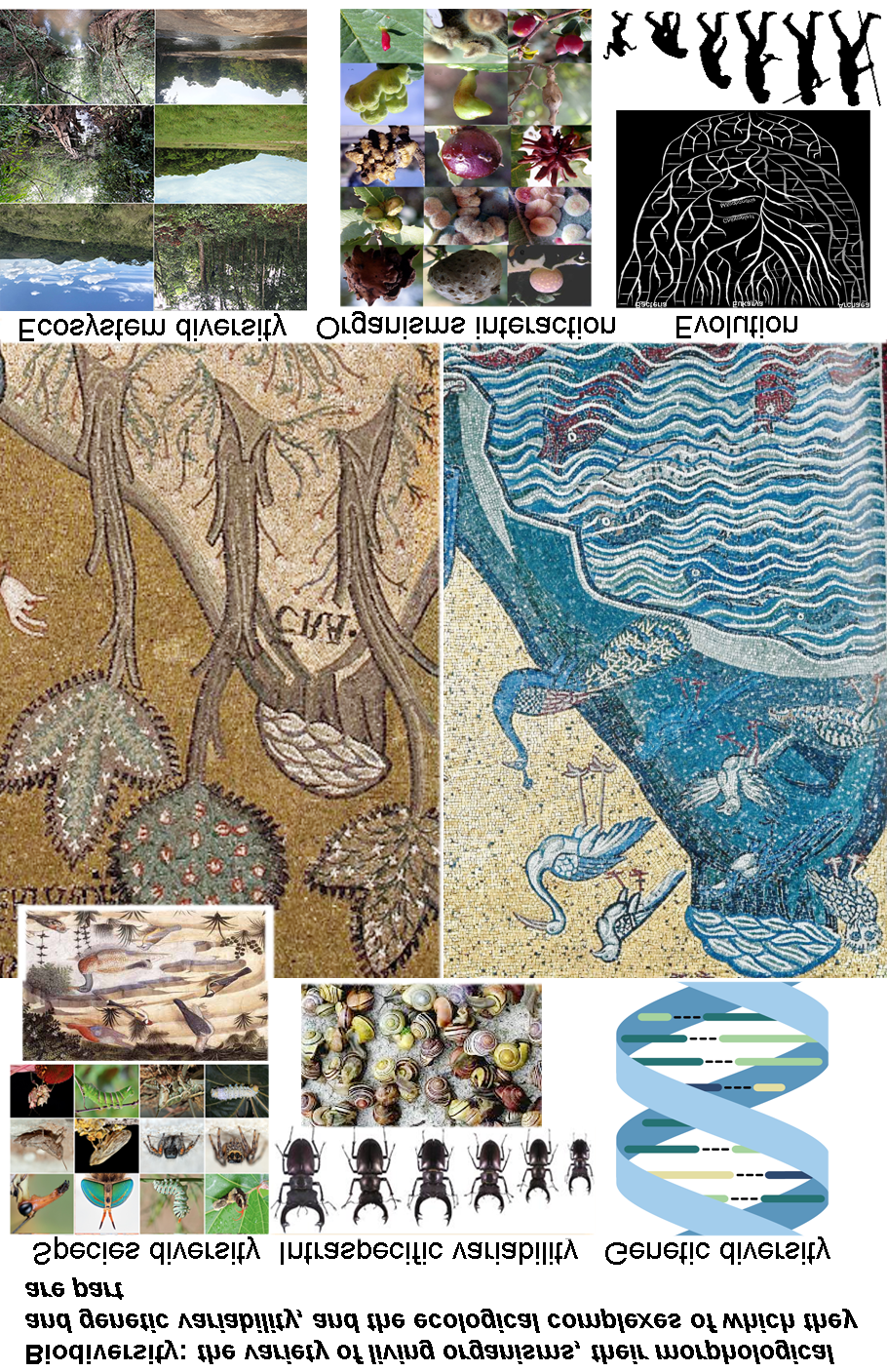
Figure 1: Graphic attempt to illustrate biodiversity as tesserae in a mosaic. In the center are two particulars of the Creation of plants (left) and animals (birds and fish, right) from the Byzantine mosaics of Monreale Cathedral (1172-1267); above and below are metaphorical tesserae that make up biodiversity. Species diversity or richness (top left) with images of arthropods and a detail from Benozzo Gozzoli’s painting (Adoration of Angels, 1459-1460, Medici Palace, Florence) depicting different species of birds and plants. Intraspecific variability (top center), understood as diversity within species, with the example of the size variability of the beetle Lucanus cervus and the chromatic variability of a snail of the genus Helix. Genetic diversity (top right), often but not always correlated with phenotypic diversity, enshrined in the genes of different populations of individual species. Ecosystem-level diversity (below left), often brought up as an example of biodiversity hotpsots; it is correctly held that in preserved ecosystems there is a greater richness of species and thus of ecological interactions among them. Regarding the latter, the interesting example of the coevolutionary plant-gall inducing insect relationship is given (below centre), on which there is a very large bibliography; gall inducing insect species have a close relationship with individual plant species on which upon hatching of larvae from eggs they induce galls, produced by the plant, of a specific shape and size, within which the insect develops. Finally, the driving force behind biodiversity is evolution (below right), which uninterruptedly, thanks precisely to species-environment interactions, has produced a very large number of species, of which only a tiny representation is present today. These include bacteria, archaebacteria, eukaryotes and among the most evolved mammals, the Primates, which include anthropomorphic apes and humans (Photos by P. Fontana, B. Massa, W. Miles, T. Puma, drawings by V. Massa).
Most researchers agree that the main goal of conservation is to preserve both evolutionary processes and the ecological viability of populations by maintaining all the genetic variability of different species and their evolutionary processes; conservation is only possible with a comprehensive, biodiversity-level approach. There is a continuity of the evolutionary process in space and time; the degree of phenotypic divergence and reproductive isolation can vary quantitatively and often increases when evolutionary divergence proceeds in stages, from polymorphism to differentiation into populations, the formation of ecotypes, speciation and subsequent divergence. If we transfer these concepts to the field of biodiversity conservation, the importance of the different populations that make up a species, as important components of biodiversity (genotypically or phenotypically), as pieces of a mosaic that deserve appropriate conservation because of their intrinsic evolutionary potential and unique characteristics, becomes apparent [24]. This approach was, for example, adopted and developed in a document drawn up in Italy in 2018, namely the San Michele all’Adige Declaration [25] for the protection of native honey bee subspecies of Apis mellifera in Italy. This document sets forth the scientific arguments in support of the conservation of native subspecies, and lists the existing Italian legislation in terms of subspecies protection initiatives. It also lists the main factors that are contributing to loss of genetic diversity and of local adaptations.
Acknowledgments
We would like to thank several colleagues and friends with whom we have discussed at length the concepts of diversity and biodiversity, namely Ferdinando Boero, Gianfranco Bologna, Marco Bologna, Gianfranco Caoduro, Attilio Carapezza, Giuliano Cerasa, Renato Chemello, Vicio Cigna, Camillo Cusimano, Rocco Lo Duca, Gabriella Lo Verde, Tommaso La Mantia, Federico Marrone, Giulia Massa, Ezio Peri, Toni Puma, Silvano Riggio, Marcello Romano. Further we are indebted with William Miles, and Toni Puma, who provided some nice photos, and with Violetta Massa who carried out some drawings.
References
-
Hutchinson GE (1959) Homage to Santa Rosalia or why are there so many kinds of animals?. American Naturalist 93: 145-159.
-
Hutchinson GE (1962) The enchanted voyage and other studies. Yale University Press, New Haven and New York, USA.
-
Lewin R (1983) Santa Rosalia was a goat. Science 221: 636-639.
-
Massa B (2010) 1959: l’omaggio a Santa Rosalia di George Evelyn Hutchinson nel primo centenario dell’Origine delle specie. In: Massa B (Ed.), Omaggio a Charles Darwin. 1809-2009: duecento anni di evoluzionismo, Kalòs ed., Palermo, pp: 105-122.
-
Brown JH (1981) Two decades of Homage to Santa Rosalia: toward a general theory of diversity. American Zoology 21: 877-888.
-
Simberloff D, Boecklen W (1981) Santa Rosalia reconsidered: size ratios and competition. Evolution 35: 1206-1228.
-
Massa B (1990) Omaggio a G.E. Hutchinson, ovvero trentanni di omaggio a Santa Rosalia. In: Massa B (Ed.), Omaggio a G. E. Hutchinson, Il Naturalista siciliano 14: 11-32.
-
de Meeûs T, Michalakis Y, Renaud F (1998) Santa Rosalia revisited: or why are there so many kinds of parasites in the ‘Garden of Earthly Delights’?. Parasitology today 14(1): 10-13.
-
Sommer U, Worm B (2002) Competition and coexistence. Springer-Verlag, Berlin, Heidelberg.
-
Wright S, Keeling J, Gillman L (2006) The road from Santa Rosalia: a faster tempo of evolution in tropical climates. PNAS 103: 7718-7722.
-
Von Humboldt A (1808) Ansichten der Natur mit Wissenschaftlichen Erlauterungen. Tubingen, Germany.
-
Carson WP, Schnitzer SA (2008) Tropical forest community ecology. Wiley-Blackwell, Oxford.
-
May RM (1988) How many species are there on Earth?. Science 241: 1441-1449.
-
Wiens JJ (2023) How many species are there on Earth? Progress and Problems. PLoS Biol 21(11): e3002388.
-
Pielou EC (1977) Mathematical Ecology. John Wiley & Sons, New York, USA.
-
Wilson EO (1988) Biodiversity. National Academy Press, Washington, USA.
-
Massa B (2021) Biodiversità, sostantivo singolare femminile. Il Naturalista siciliano 45: 275-278.
-
Massa B (2023) Commenti sui concetti di diversità e biodiversità. Entomata 21: 21-28.
-
Fontana P (2019) The Joy of Bees. Bees as a model of sustainability and beekeeping as an experience of Nature and human history. WBA Project pp: 748.
-
Dasgupta P, Lewin S (2023) Economic factors underlying biodiversity loss. Philosophical Transactions Royal Society B 378: 20220197.
-
Bierregaard RO, Gascon C, Lovejoy TE, Mesquita R (2001) Lessons from Amazonia: The Ecology and Conservation of a Fragmented Forest. Yale University Press, New Haven and London, UK.
-
Soulé ME, Wilcox BA (1980) Conservation biology: an evolutionary-ecological perspective. Sinauer Associates, Sunderland, Massachusetts.
-
Wilson EO (2016) Half-Earth: Our Planet’s Fight for Life. Liveright Publ. Corp, WW Norton & Co, New York, USA.
-
Massa B, Borg JJ (2018) European Birds of Conservation Concern: some constructive comments. Avocetta 42: 75- 84.
-
Fontana P, Costa C, Di Prisco G, Ruzzier E, Annoscia D, et al. (2018) Appeal for biodiversity protection of native honey bee subspecies of Apis mellifera in Italy (San Michele all’Adige declaration). Bulletin of Insectology 71 (2): 257-271.
- Mitochondrial Bio-Logistics: Steering Co-Enzyme Q10 and Lycopene Synergies within the Science 4.0 Bio-OS Framework
- Hymenoptera Specimens from the Caño Negro Wetland, of the National Museum Collection, Costa Rica
- Science 4.0: Comprehensive Architecture of the Biological Operating System (Bio-OS) A Framework for Systemic Resilience and Industrialized Bio-Governance
- Rabbit on, or Hare Back? Understanding Climate Change
- Clinical Validation of Science 4.0: Flow Steering and Epigenetic Drift Inversion on a 76-Year-Old Hybrid System
- Seeds Planted by another Mind