
Food and Feeding Habits of Cattle Egret (Bubulcus ibis) in Thanjavur District, Tamil Nadu
The cattle egret (Bubulcus ibis) is a cosmopolitan species of heron (family Ardeidae) and they are found in the tropics, subtropics and warm temperate zones. The cattle egret and grazing cattle in close association is a classic example of commensalism. Their feeding habitats include seasonally flooded grasslands, pastures, farmlands, wetlands and rice. They often accompany cattle or other large mammals, catching insect and small vertebrate prey disturbed by these animals. This study is a first attempt in the Cauvery delta region where the abundance and distribution of cattle egrets which are common. The study was conducted in the villages such as Thugili and Kanjanur which are situated in Thiruvidaimaruthur Taluk of Thanjavur District of Tamil Nadu. The methods used for this study was direct observation involves following the birds early in the morning between 7. 00 am and 10.00 am and 4.00 pm - 6.00 pm in the evening. The observation was made on birds for feeding directly on the field. Samples of the food material eaten by the birds were collected for further observation. It fed mainly on arthropods species such as grasshoppers, cricket, catterpillers, flies, termites, ants, rarely on ticks and spiders and very rarely on plants which makes the bird to be an omnivorous. The diet of cattle egret reveals that order Orthopteran insects were the highest percentage (33.33%). This study recommends that all efforts should be taken to reduce further decline in the population of this birds so as to improve its conservation status in the environment.
Introduction
The cattle egret (Bubulcus ibis) is a cosmopolitan species of heron (family Ardeidae) and they are found in the tropics, subtropics and warm temperate zones. It is the only member of the monotypic genus Bubulcus, although some authorities regard two of its subspecies as full species, the western cattle egret and the eastern cattle egret. Despite the similarities in plumage to the egrets of the genus Egretta, it is more closely related to the herons of Ardea [1]. Originally native to parts of Asia, Africa and Europe, it has undergone a rapid expansion in its distribution and successfully colonized much of the rest of the world in the last century. It is a white bird adorned with buff plumes in the breeding season. It nests in colonies, usually near water bodies and often with other wading birds. The nest is a platform of sticks in trees or shrubs. Cattle egrets exploit drier and open habitats more than other heron species. Cattle Egrets are often found associated with cattle and occasionally with pigs, goats, and horses, and also with moving vehicles such as tractors [2, 3, 4, 5, 6, 7]. They were also reported to be associated with other moving vehicles and their association with grazing cattle helps increase their prey captures and utilizes less energy than those of solitary feeders [8].
The cattle egret and grazing cattle in close association is a classic example of commensalism. The egrets always forage close to where the cattle are grazing because the cattle, as they move, stir up and flush out insects from the vegetation that otherwise might be difficult for the egrets to find and catch. The cattle egret is commensal in this interaction as it is getting benefited and the grazing cattle is neither benefited nor harmed. The demographic explosion and wide distribution of this species may be related to the increase of cattle-raising activities, in addition to the lack of competition with other species and their biotic potential [9]. Their feeding habitats include seasonally flooded grasslands, pastures, farmlands, wetlands and rice paddies paddies [10, 11, 12]. They often accompany cattle or other large mammals, catching insect and small vertebrate prey disturbed by these animals. Some populations of the cattle egret are migratory and others show post-breeding dispersal. They can obtain their food from different environmental units of the aquatic system by means of the spatial differential use of the environment [13].
Egrets are able to exploit resources throughout the year and at different hours of the day. Many studies on the trophic ecology of Egrets, their association with habitats, food resources and feeding spectrum have been reported. Although Cattle Egret is very common and occupies a large geographic area, little is known about its feeding activity, with the only available contributions being those of Jobling in northern Argentina. The feeding can take place at any time of the day and depends on habit and foraging abilities of species and individual. The feeding method includes from a simple picking up a food item to more complex and energetic feeding like levering over object, digging into the ground, snatching, swooping, plucking and hawking. Food items are manipulated in different ways. They are simply swallowed whole by tossing a food item back from the bill tip into the throat. Some items are stripped of extraneous parts before being swallowed, such as fruits of their skins or insects of their wings and legs; some are softened before swallowing by passing them through and crushing them in the bill or cleaned of unwanted covering by being wiped back and forth over a perch or along the ground. Sometimes instead of swallowing, the food is for courtship feeding [14]. There are few studies on the ecology of cattle egret especially in many areas in the globe, therefore a knowledge of the food and feeding habit will provides a very important information on the ecology of this species. This study is a first attempt in the Cauvery delta region where the abundance and distribution of cattle egrets which are common. Hence the study was conducted to identify the food of cattle egret and feeding habits cattle egrets and also to assess the interaction with cattles.
Material and Methods
The study was conducted in the villages such as Thugili 11o044’ N and 79o50’ E and Kanjanur 11o06’ N and 79o49’ E which are situated in Thiruvidaimaruthur Taluk of Thanjavur District of Tamil Nadu. The methods used for this study was direct observation, the direct observation was involves following the birds early in the morning between 7. 00 am and 10.00 am and 4.00 pm - 6.00 pm in the evening, the birds was watched for feeding directly on the field. Focal observations were carried on randomly selected foraging cattle egrets, during which number of strikes, successful captures (identified by the characteristic head-jerk swallowing behaviour [2, 15, 16, 17]. The food materials which the birds consumed were noted and identified and recorded in the data sheets. Samples of the food material eating were collected for further observation. The studies covered a period of three months (January - March, 2023). Data generated were analyzed using descriptive statistics which comprises simple tables, percentages and frequency distribution.
Results
Table 1 shows the checklist of food items consumed by cattle egret in the study area, it shows that the birds fed on wide variety of foods i.e. it fed mainly on animal species such as grasshoppers, cricket, catterpillers, flies, termites, ants, rarely on ticks and spiders and very rarely on plants which makes the bird to be omnivorous.
| Food Item | Order/Family | Name of Species | |
|---|---|---|---|
| ANIMAL MATTER | INSECTS | Orthoptera | Grasshoppers and Cricket |
| Coleoptera | Beetles | ||
| Lepidoptera | Butterflies Caterpillars | ||
| Diptera | Flies | ||
| Isoptera | Termites | ||
| Formicidae | Ants | ||
| Alphididae | Aphids | ||
| Annelida | Oligocheata | Earthworm | |
| Arachinids | Arachinidae | Tick and Spider |
Table 1: Different Food items consumed by Cattle Egret in the study area.
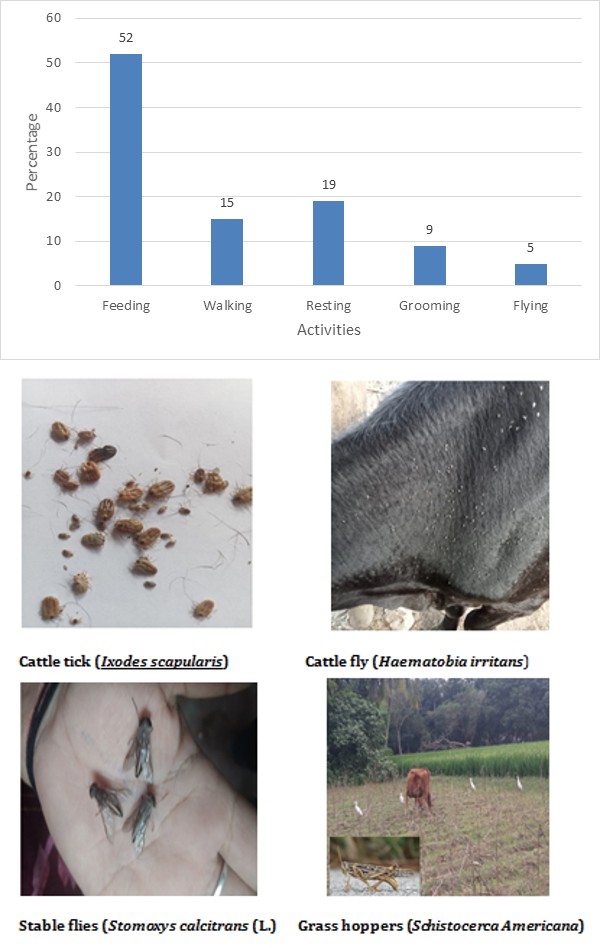
The activity pattern of the birds was revealed in Fig.1, the results shows that feeding (52%) was the highest activities followed by that they spend most of their time on and follow by resting (19%) while flying (5%) was the least activity.
Table 2 showed the percentage of arthropods species found in the diet of cattle egret, it reveals that Orthoptera recorded the highest percentage (33.33%) follows by Formicidae (26%), Isoptera recorded 16%, Coleoptera recorded 10.33% while the least is recorded amongst Arachinidae.
| Arthropod Species | Percentage (%) |
|---|---|
| Orthoptera | 33.33 |
| Coleoptera | 10.33 |
| Lepidoptera | 5.3 |
| Diptera | 6.8 |
| Isoptera | 9.2 |
| Formicidae | 26 |
| Aphididae | 8.7 |
| Arachinidae | 2.1 |
Table 2: Composition of Arthropod in the diet of Cattle Egret.
Plates: Food species of Cattle egret.
Discussion
Insects represent the main food of Cattle egret while plants were secondary categories. The results obtained basically agree with the works of Bo, et al. [18] which reported that the diet of this heron is distinctly carnivorous, being 80% represented by invertebrates, mostly insects (orthopterous, coleopterous, dipterous and lepidopterous in decreasing abundance). There is also agreement on the fact that arachnids and plants represent a minor percentage of the food [19]. These authors report reptiles (Anguidae) as constituents of the egret’s diet but these were not observed in the present study. Zaccagnini, et al. [20] found a total of 25 taxonomic entities being insects the largest category, followed by amphibians, fish and arachnids. In the area of the Parana´ River, Beltzer, et al. [19] found 11 taxonomic items highlighting the orthopterous as the largest followed by arachnids, amphibians and other insects. Others studies elsewhere in its area of distribution agreed that the diet of the species is basically composed by insects of the order Orthoptera [21, 22]. Siegfried [23] observed in South Africa a similar importance of Lepidoptera and Orthoptera. Siegfried [23] reported that the Cattle Egret’s diet varied temporarily depending on the abundance of prey and indirectly depending on rainfall at some times of the year. Dietary selectivity was not significant, thus showing that the Cattle Egret has a high degree of plasticity in its diet. In these studies, cattle egret were seen to prey upon cattle ectoparasites which was in line with the result of Kaufman [24] and Seedikkoya, et al. [6]. This is probably why they were always following the animal because they were sure getting their highly delicious food. According to Szijj, usage of a particular habitat will be a function of, amongst other factors, food availability and accessibility [27, 28, 29, 30]. In agreement with this concept, the Cattle Egret demonstrated a differential use of pastures where food is obtained more easily. The preference for this type of environment is a characteristic feature of the basically insectivorous species.
Conclusion
The feeding and breeding requirements are driving forces that determine how egret species locate and consume preferred food, and where to place their nests. The dynamic nature of resources such as availability of cattle and nest tree availability for a variety of cattle egret species determine the movements, social structure, breeding season, productivity, and moult. The results show that cattle egret is found in large numbers mostly with cattle and they are diurnal animals. They are omnivorous animals but they fed mostly on insects of the order Orthoptera but they also fed on plants such as cotton and neem plants. They spend most of the time feeding and the least of their time flying. Their food source are available throughout the year. Therefore, availability of food resources cannot be a factor contributing to a reduction in population of this bird in the study area. This study recommends that all efforts should therefore be taken to halt further decline in the population of this birds so as to improve its conservation status in the environment.
References
-
Rasmussen PC, Anderton JC (2005) Birds of South Asia. The Ripley Guide. Smithsonian Institution and Lynx Edicions pp: 58.
-
Dinsmore JJ (1973) Foraging success of Cattle Egrets, Bubulcus ibis. The American Midland Naturalist 89(1): 242-246.
-
Thompson CF, Lanyon SM, Thompson KM (1982) The influence of foraging benefits on association of cattle egrets (_Bubulcus ibis_) with cattle. Oecologia 52: 167-70.
-
Wahungu GM, EN Mumia, Manoa D (2003) The effects of flock size, habitat type and cattle herd sizes on feeding and vigilance in cattle Egrets (_Ardeola ibis_). African Journal of Ecology 41: 287-288.
-
Kamler JF, TN Suinyuy, W Goulding (2008) Cattle Egret and Common Ostrich associations in South Africa. Ostrich 79: 105-106.
-
Seedikkoya K, Azeez, PA, Shukkur EAA (2005) Cattle egret Bubulcus ibis habitat use and association with cattle. Short Notes Forktail 21: 174-176.
-
Verma M, Elangovan V, Dwivedi A, Kumar M (2021) Foraging Behaviour and Host Selection of Cattle Egret (_Bubulcus ibis)_ Among Different Host Species in Lucknow (Uttar Pradesh). Bulletin of Pure and Applied Sciences- Zoology 40A(1): 6-14.
-
Svensson L (2001) Birds of Europe. In: 3rd (Edn.), Princeton University Press, pp: 480.
-
Silva MP, Coria NE, Favero M, Casaux RJ (1995) New Records of Cattle Egret _Bubulcus ibis_, Blacknecked Swan _Cygnus melancoryhyphus_ and White-rumped Sandpiper _Calidris fuscicollis_ from the South Shetland Islands, Antarctica. Marine Ornithology 23: 65-66.
-
Abulude O, Ogunkoya M, Osadare B (2005) Nutrient status of meat content of cattle egret (Bubulcus ibis) in Nigeria. J Food Technol 3: 498-501.
-
Sharah HA, Ali EA, Mohammed ID (2008) The feeding behavior of the cattle egrets, (_Bubulcus ibis_ L.) in North Eastern arid zone of Nigeria. J Agric Soc Sci 4: 6-12.
-
Mohammedi A, Kerrouzi M (2017) The share of crop pests in the food of cattle egret (_Bubulcus_ _ibis_ L. 1758) in Chlef Region (Algeria). Biopertic Int 13(2): 154-161.
-
Dutson G, Watling D (2007) Cattle egrets (Bubulcus ibis) and other vagrant birds in Fiji. _Notornis_ 54 (4): 54-55.
-
Kemp A (1995) The Hornbills:Bucerotiformes. Oxford: Oxford University Press Inc.
-
Heatwole H (1965) Some aspects of the association of Cattle Egrets with cattle. Anim Behav 13: 79-83.
-
Grubb TC (1976) Adaptiveness of foraging in the Cattle Egret. Wilson Bull 88: 145-148.
-
Scott D (1984) The feeding success of cattle egrets in flocks. Anim Behav 32: 1089-1100.
-
Bo S, Darrieu PK (1993) Utilization of Birds. Vet Scan 4(1): 31.
-
Beltzer E, Dei P, Deacon JW (1987) Introduction to modern Avian. In: 2nd (Edn.), Cambridge, MA: Blackwell Scientific.
-
Zaccagnini J, Beltzer PJ (1982) Seasonal translation of Egret in Sahara Desert. Aves Parasitology pp: 99-116.
-
Amat U, Soriguer VO (1981) Interactions among host diet, nutritional status and gastrointestinal parasite infection in wild birds. International Journal for Parasitology 34(4): 535-542.
-
Mckilligan I (1984) Aves Adaptation and Evolution. In: 2nd (Edn.), San Diego: Academic Press. pp: 195-197.
-
Siegfried R (1971) Parasites of Laboratory Birds. The lowa State University Press, Ames, Lowa, USA, pp: 203- 301.
-
Kaufman K (1996) Avian extinction and mammalians on oceanic island. Science: 305.
-
Ash S (1992) Food and feeding of Egreta. Journal of Zoo and Wildlife 1(1): 662-670.
-
Abu O (2003) Plants Abundance and Distribution in Sahel Savanah of Nigeria. J Forestry pp: 23-43.
-
Jobling JA (2010) The Helm Dictionary of Scientific Bird Names. London: Christopher Helm. pp: 201.
-
Kinnaird MF, Brien TG (2007) The ecology and conservation of Asian hornbills: farmers of the forest. Chicago: University of Chicago Press.
-
Kour DN, Sahi DN (2012) Studies on the community ecology of cattle egrets _Bubulcus ibis coromandus_ (Boddaert) in Jammu (Jammu and Kashmir), India. International Journal of Biodiversity and Conservation 4(13): 439-445.
-
Robbins OD (1993) Management Birds. Journal of Science 3(1): 345-352.
- Mitochondrial Bio-Logistics: Steering Co-Enzyme Q10 and Lycopene Synergies within the Science 4.0 Bio-OS Framework
- Hymenoptera Specimens from the Caño Negro Wetland, of the National Museum Collection, Costa Rica
- Science 4.0: Comprehensive Architecture of the Biological Operating System (Bio-OS) A Framework for Systemic Resilience and Industrialized Bio-Governance
- Rabbit on, or Hare Back? Understanding Climate Change
- Clinical Validation of Science 4.0: Flow Steering and Epigenetic Drift Inversion on a 76-Year-Old Hybrid System
- Seeds Planted by another Mind