
Sustainable Solutions for Wheat Grain Protection: Evaluation of Inert Materials against Rice Weevil (Sitophilus oryzae L.)
This study investigated the potential of three readily available inert materials – apple wood ash, kaolin, and silica – for controlling the rice weevil (Sitophilus oryzae L.), a pest of stored grains. We evaluated their efficacy at three concentrations (2%, 4%, and 8%) against adult weevils over an 8-day treatment period. Apple wood ash emerged as the most potent material, achieving a remarkable 100% cumulative mortality rate on the eighth day at the highest concentration, statistically exceeding the performance of kaolin (90%) and silica (40%). The untreated control group exhibited a significantly lower mortality rate of 6.66%. Beyond immediate mortality, both apple wood ash and kaolin demonstrated outstanding ability to protect wheat grains from infestation damage. Treatment at 8% significantly reduced the emergence of new adult weevils, minimized grain damage percentage, and mitigated of weight loss. Apple wood ash displayed remarkable effectiveness, with protection values exceeding 95% for all three parameters (emergence: 96.02%, damage: 89.09%, weight loss: 91.68%). Kaolin also performed well, achieving close to 90% protection in all categories (emergence: 89.55%, damage: 84.13%, weight loss: 88.24%). Conversely, silica displayed a significantly lower efficacy, with protection values hovering around 55% for all parameters (emergence: 56.40%, damage: 51.48%, weight loss: 56.64%). These findings highlight the promising potential of readily available inert materials, particularly apple wood ash and kaolin, as eco-friendly alternatives to synthetic insecticides for managing rice weevil populations in stored wheat. Their integration into pest management programs offers a sustainable and effective approach to minimizing grain losses and preserving food security.
Introduction
Grains, a staple food worldwide, are packed with essential nutrients that nourish the body. Beyond their dietary value, whole grains offer a range of health benefits, including improved cholesterol management, weight control, and blood pressure regulation. Studies have shown that consuming whole grains significantly reduces the risk of developing chronic conditions such as diabetes and heart disease [1].
Despite their nutritional value and health benefits, grains suffer from significant post-harvest losses, particularly during storage. Minimizing these losses is crucial for ensuring global food security and maintaining access to this essential source of nutrients for future generations [2, 3].
Post-harvest grain losses, primarily caused by insect pests like the rice weevil, jeopardize global food security. Conventional pest management strategies often rely on chemical insecticides and fumigants, which pose environmental, health, and resistance concerns, motivating the quest for sustainable alternatives.
Despite the effectiveness of chemical pesticides in controlling insect pests, their widespread reliance poses several critical challenges, including the emergence of resistant insect pests [4, 5] environmental contamination [6], and potential human health risks [7].
Inert dusts and ash effectively control stored grain pests through physical disruption, influenced by material type, species susceptibility, concentration, exposure time, and dust adherence [8, 9, 10, 11, 12].
Strong empirical evidence supports the effectiveness of this approach. Applying ash to stored seeds has demonstrably reduced pest damage by up to 80% and inhibited offspring production in pulse beetles (9, 10).
The toxicity of wood ash from Acacia polyacatha willd and Hymenocardia acida Tul against adult maize weevils Sitophilus zeamais Mostch increased with higher concentration and treatment time on stored maize grains [13].
The mortality rates of adult Cowpea seed beetle Callosobruchus maculatus L and the pulse beetle Callosobruchus chinensis L reached 100% at high concentrations of kaolin dusts, ranging from 0.2-1% [14].
A study by Aldryhim [15] demonstrated that silica dusts effectively control wheat weevils Sitophilus granarius L. and Confused floor beetles Tribolium confusum Duv, with higher concentrations and longer exposure times leading to increased mortality and reduced offspring production. Notably, wheat weevils were more susceptible to silica than confused floor beetles.
Shams, et al. [12] further investigated the insecticidal efficacy of diatomaceous earth (DE) against wheat weevils S. granarius and cowpea seed beetles Callosobruchus maculatus. They found that DE, primarily composed of silica, exhibited concentration-dependent mortality rates, with higher concentrations and longer exposure times leading to more effective control. Interestingly, cowpea seed beetles showed greater sensitivity to DE compared to wheat weevils.
Abdelgaleil, et al. [16] evaluated the effectiveness of zeolite inert dusts against S. granarius and S. oryzae. Zeolite treatment at 500 mg/kg resulted in mortality rates of 43.5% and 50.3%, respectively. Synergistic effects were observed when zeolite was combined with insecticides, leading to higher mortality rates. All treatments provided effective protection against insect damage and weight loss for 90 days.
Astuti, et al. [17] investigated the insecticidal activity of five types of ash against R. dominica. Giant bamboo leaves ash and rice husks ash demonstrated superior efficacy, significantly reducing mortality, hindering reproduction, and delaying population growth. Their effects extended to subsequent generations, impairing growth and reducing adult weight. Additionally, treated rice grains showed significantly lower damage compared to untreated controls, therefore giant bamboo leaves ash and rice husks ash hold promise as environmentally friendly alternatives to chemical insecticides for stored product pest control. Gvozdenac, et al. [18] further supported this notion by demonstrating the feasibility and effectiveness of inert dusts for small- scale farmers in protecting their stored crops from insect infestations.
This experiment investigates the efficacy of kaolin dust, silica dust, and apple ash against the rice weevil (Sitophilus oryzae) by assessing their impact on cumulative mortality rates, grain weight loss, damage percentage, and adult emergence under controlled laboratory conditions (26±1°C temperature and 60±5% relative humidity).
Materials and Methods
The Preparation of the Insect Colon and Wheat Grains
Wheat samples infected with the rice weevil, S. oryzae, were collected from commercial markets and the type of insect was determined based on its external appearance, according to CABI and Hong [19, 20]. They were raised in the laboratory in order to obtain a permanent colony of this insect.
The wheat grains intended for use in the experiment were prepared by removing impurities and foreign materials. They were then placed in the refrigerator for three days to eliminate any potential pests. After that, they were exposed to a fan air to remove excess moisture and prevent fungal growth, and finally stored in the refrigerator for later use in the required experiments
Inert Dusts, Ash Preparation
Branches resulting from pruning Golden Delicious variety Malus domestica B. apple trees were burned, and the resulting ash granules were sieved through a 100-micron sieve to obtain homogeneous granules. Kaolin (Al4(Si4O10)
(OH)8) and silica (Si2O) were obtained from the General Authority for Geology, with the silica sourced locally. Both kaolin and silica were ground and sieved through a 100-micron sieve to achieve homogenous dust particles for subsequent experiments.
The effect of kaolin, silica dusts, and apple ash on the adults of rice weevil was studied using three concentrations: 2, 4, and 8 g/100g of wheat grains for each of the three mentioned inert materials. 10g of healthy wheat grains were added to each 250ml plastic cup (repeated), and each 3 replicates were treated with a specific concentration of the previous concentrations for each treatment, while untreated healthy wheat grains were used as a control. Then, 10 newly emerged adults of the rice weevil were added to each replicate of the above-mentioned treatments. The cups were covered with muslin and incubated at the specified temperature and relative humidity.
The number of dead adults was recorded on days 1, 2, 4, and 8 after treatment. The treatments were monitored for up to 50 days, and the following readings were taken:
- The cumulative percentage of mortality of rice weevil adults after 1, 2, 3, 4, 6, 8, and 10 days of treatment. Then, the effectiveness in increasing the mortality rate was calculated using the equation: Effectiveness = [(Treatment Mortality Ratio - Control Mortality Ratio) / Treatment Mortality Ratio] × 100
- The efficacy of the inert materials in in reducing adult emergence The number of adults emerging in the control and different treatments was counted, and then the effectiveness of the inert materials in reducing adult emergence was calculated using the following equation: Effectiveness = [(Number of Adults Emergence in the Control - Number of Adults Emergence in the Treatment) / (Number of Adults Emergence in the Control)] × 100 [21]
- Percentage weight loss of grains: This reading was taken after 50 days of treatment for the different treatments and the control. using the following equation: Loss of Grain Weight Ratio = [(Initial Weight - Final Weight) / (Initial Weight)] × 100 [22]
- Then the effectiveness of the inert materials in reducing grain weight loss was calculated using the following equation: Effectiveness = [(Weight Loss Ratio by Control - Weight Loss Ratio by Treatment) / (Weight Loss Ratio by Control)] × 100
- Percentage damage in grains: The grain damage ratio was determined 50 days after treatment using the following equation Damage Ratio = (Number of Punctured Grains / Total Grain Number) × 100
- The effectiveness of the inert materials in reducing the grain damage ratio was calculated using the following equation: Effectiveness = [(Damage Ratio by Control - Damage Ratio by Treatment) / (Damage Ratio by Control)] × 100
Statistical Analysis
The experiment was designed according to a Completely Randomized Design (CRD), and the results were analyzed using an F-test. Mean comparisons were conducted using the Least Significant Difference (LSD) test at a significance level of 0.01. This was done for three factors (type of inert material, concentration, treatment time) for cumulative mortality rates. Additionally, a comparison of the two factors (type of inert material and concentration) was conducted for their effectiveness in reducing the adult emergence, grain weight loss, and the grain damage ratio using the GenStat ver.7.4 program [23].
Results
Cumulative Mortality Rates of Rice Weevil Adults and Efficacy in Increasing Mortality Ratio by Kaolin, Silica, and Apple Ash on the Eighth Day of Treatment
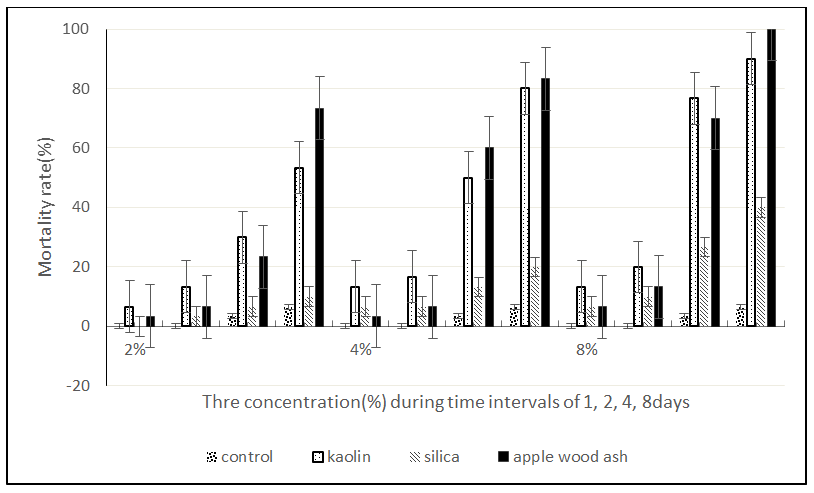
Figure 1 shows the average cumulative mortality rates of rice weevil adults treated with kaolin, silica, and apple ash at three concentrations (2%, 4%, and 8%) after treatment durations of 1, 2, 4, and 8 days.
Kaolin outperformed both apple ash and silica in causing adult mortality. After one day, only kaolin at 8% concentration showed significant or apparent mortality (13.33%), while apple ash and silica exhibited none. Similar results were observed on the second day. Mortality rate increased with concentration for all treatments. This trend held true throughout the experiment, with higher concentrations leading to greater mortality. Kaolin significantly outperformed silica at all tested concentrations. At day 8, kaolin achieved 13.33%, 16.67%, and 20% mortality at 2%, 4%, and 8% concentrations, respectively, compared to silica’s 3.33%, 6.67%, and 10%.
No significant differences were observed between kaolin and apple ash at 2% and 8% concentrations. Both treatments reached comparable mortalities of 6.67% and 13.33% at these concentrations, respectively.
The tested dusts and ash showed a clear time-dependent and concentration-dependent effect on rice weevil adult mortality. Mortality rates steadily increased with longer treatment durations compared to the untreated control, which reached just 3.33% after four days. Similarly, higher concentrations within each treatment led to greater mortality.
At the highest tested concentration (8%), kaolin and apple ash achieved comparable high mortality rates, with 76.67% for kaolin and 70% for apple ash. These values exhibited no statistically significant difference. However, both significantly outperformed silica dust, which only achieved 26.70% mortality at the same concentration after four days.
Table 1 results reveal a clear positive correlation between increasing adult mortality rate and longer treatment durations. This trend is evident on the eighth day, where all treatments except silica at 2% showed significantly higher mortality compared to the untreated control (6.66%).
Apple ash emerged as the most effective treatment, achieving significantly higher mortality than both kaolin and silica at 2% and 8% concentrations. With an impressive 73.33% mortality at 2% concentration, apple ash significantly outperformed kaolin (53.33%) and silica (10%). Interestingly, no significant difference was observed between apple ash and kaolin at 4% concentration.
The highest overall mortality was achieved with apple ash at 8% concentration, reaching a remarkable 100%. Kaolin and silica followed at 90% and 40%, respectively, demonstrating the potency of apple ash in this experiment.
Mean %
70.49 90.66Aa 33.4Bc 87.42Aa 2
80.96 91.98Aa 59.30Bb 91.59Aa 4
89.5 93.34Aa 82.61Ba 92.54Aba 8 91.99 58.44 90.52 Mean%
Powder × concentration =18.56 concentration =10.72 Powder =10.72 LSD0.01 Means followed by the same small letters in the same column are not significantly different at P=0.01. Means followed by the same big letters in the same row are not significantly different at P=0.01. Table 1: Effectiveness of kaolin, silica and apple ash in increasing of adult’s cumulative mortality ratio of the rice weevil S. oryzae on the eighth day after treatment.
The results of Table 1 illustrate the effectiveness of treatment with kaolin, silica, and apple ash in increasing the average cumulative mortality ratio in rice weevil adults after eight days of treatment, using concentrations of 2, 4, and 8%.
Effectiveness in increasing cumulative mortality ratio on the eighth day of treatment% concentration% Apple ash Silica Kaolin Apple ash achieved the highest reduction values at all tested concentrations, with values of 90.66, 91.98, and 93.34% respectively. The values were not significantly different from those of kaolin, which achieved values of 87.42, 91.59, and 92.54% respectively. On the other hand, the lowest effectiveness values were recorded for silica, with reduction values of 33.40, 59.30, and 82.61% for cumulative mortality ratio respectively. There were no significant differences between silica and kaolin when treated with a concentration of 8%. The order of effectiveness, from highest, was as follows: apple ash > kaolin > silica.
The Effect of Inert Dusts and Ash on Adult Emergence and Effectiveness in Reducing the Average Percentage of the Adult Emergence Laboratory
From the results in Table 2, it is evident that the most effective tested material in reducing the number of adult emergence resulting from rice weevil infestation was apple ash, which gave the best values compared to both kaolin and silica, with significant or apparent differences and an average of 91.43%. The reduction values for ash ranged between 85.16% to 96.02%, depending on the concentration used 2- 8%. Following in importance was treatment with kaolin, with reduction percentages ranging from 65.93% to 89.55%. On the other hand, treatment with silica gave the lowest average reduction percentage for the adult emergence of rice weevil, ranging from -14.01% to 56.40%. The effectiveness in reducing increased with higher concentrations, with average reduction percentages ranging from 55.03% to 80.66%. The ranking of effectiveness starting from the best was: apple ash > kaolin > silica
| Concentration % | Average effectiveness in reducing the percentage of the adult emergence % | Mean % | Average number of the adult emergence | Mean % | ||||
|---|---|---|---|---|---|---|---|---|
| Kaolin | Silica | Apple ash | Kaolin | Silica | Apple ash | |||
| 2 | 65.93Bb | 14.01Cb | 85.16Aa | 55.03a | 23.00Ba | 58.00Aa | 10.00Ca | 30.33a |
| 4 | 77.33Aab | 53.76Ba | 93.12Aa | 74.74b | 15.33Bab | 30.67Ab | 4.67Ca | 16.89b |
| 8 | 89.55Aa | 56.40Ba | 96.022Aa | 80.66c | 7.33Bb | 29.33Ab | 2.67Ba | 13.11b |
| Untreated control | 67.33 | |||||||
| Mean % | 77.60a | 41.39b | 91.43b | 15.22 | 39.33 | 5.78 | ||
| LSD 0.01 | concentration =16.18 | Powder=16.18 | Powder= × concentration =28.02 | concentration =10.02 | Powder= =8.68 | Powder× concentration =17.35 |
Table 1: Effects of Kaolin, Silica, and Apple Ash on Rice Weevil Adult Emergence Rate after Laboratory Treatment.
Means followed by the same small letters in the same column are not significantly different at P=0.01. Means followed by the same big letters in the same row are not significantly different at P=0.01. Table 2: Effects of Kaolin, Silica, and Apple Ash on Rice Weevil Adult Emergence Rate after Laboratory Treatment.
Effect of Inert Dusts and Ash on Grain Damage by Rice Weevil
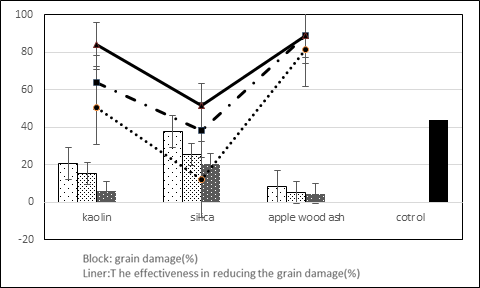
This section examines the effectiveness of various inert dusts and ash in reducing grain damage caused by rice weevil infestation. Figure 2 shows that applications of apple ash, kaolin, and silica dust significantly reduced grain damage compared to the untreated control, which experienced a 44% damage rate. Among these treatments, apple ash at 8% concentration achieved the lowest damage rate of 4.67%, exhibiting a significant difference from kaolin and silica. Conversely, silica at 2% concentration resulted in the highest damage rate of 38%.
Furthermore, the analysis of effectiveness values revealed that apple ash offered the most significant protection against grain damage. The effectiveness of apple ash compared to silica was significantly higher at all tested concentrations, ranging from 81.68% at 2% concentration to 12.26% at higher concentrations.
The effectiveness values increased when using an 8% concentration, and the reduction values for grain damage were similar for both apple ash and kaolin, with no significant difference between them, but both were significantly superior to silica, reaching values of 89.09%, 84.13%, and 51.48%, respectively. The ranking of effectiveness starting from the best was: apple ash > kaolin > silica.
The Effect of Inert Dusts and Ash on Grain Weight Loss and their Effectiveness in Reducing Grain Weight Loss after 50 days of Treatment
It was noted from Table 3 the effect of the tested concentrations of apple ash, kaolin, and silica dusts on the average percentage loss in grain weight, as the lowest percentage of loss was 2.33%when treated with apple ash at an 8% concentration, with a non-significant difference compared to kaolin at the same concentration, which recorded 3.30%. while the differences It had a significant effect with silica dust, which gave the highest weight loss value at a concentration of 2%, which was 22.80%. All tested dusts and ash resulted in lower weight loss percentages compared to the untreated control, which was 27.27% Apple ash achieved Concentration% The effectiveness in reducing the percentage of grain weight loss% Mean % the percentage of grain weight loss% Mean %
2 63.35Bb 16.31Cb 78.98Ab 52.88 10.03Ba 22.80Aa 5.73Ca 12.85
4 70.35Bb 52.24Ca 90.18Aab 70.92 8.13Ba 12.97Ab 2.63Cb 7.91
8 88.24Aa 56.64Ba A91.68 78.85 3.30Bb 11.80Ab 2.33Bb 5.81
the best effectiveness values in reducing the average percentage of grain weight loss. Significant differences were observed between apple ash and both kaolin and silica at concentrations of 2 and 4%, with values reaching 90.18%, 70.35%, and 52.24% respectively at a concentration of 4%. No significant differences were observed between apple ash and kaolin at an 8% concentration, with values of 91.68% and 88.24% respectively, both superior to silica which had an effectiveness of 56.64%.
It was noted that the effectiveness values using an 8% concentration were higher than those using concentrations of 2 and 4% for all tested materials. The ranking of effectiveness from best to least effective was: apple ash > kaolin > silica.
Kaolin Silica Apple Ash Kaolin Silica Apple ash Untreated control 27.27
Mean % 73.98 41.73 86.95 7.15 15.86 3.56
Powder × concentration =21.54
LSD 0.01 concentration = 12.44 Powder =12.44
Powder × concentration =5.28
concentration =3.05 Powder =2.64
- Means followed by the same small letters in the same column are not significantly different at P=0.01.
- Means followed by the same big letters in the same row are not significantly different at P=0.01.
Table 2: The effect of inert dusts and ash on grain weight loss and the effectiveness in reducing grain weight loss laboratory.
Discussion
The study found that inert dusts, including kaolin, silica dust, and apple ash, significantly increased rice weevil mortality compared to untreated controls. This effect was consistent with the findings of previous research [16, 24, 25]. The mechanism of action involves physical damage to the insect cuticle, disrupting water balance, and potentially obstructing respiratory pores, leading to death.
Our study revealed varying efficacy of inert dusts against rice weevil mortality. Silica dust exhibited the lowest effectiveness, with maximum mortality not exceeding 40%. Conversely, kaolin and apple ash demonstrated superior efficacy, achieving mortality rates of 90% and 100%, respectively. This trend aligns with previous research [26, 27].
In a recent study, researchers evaluated the efficacy of inert dusts, including kaolin, diatomaceous earth, and vermiculite, in controlling adult rice weevils (S. oryzae) and Indian meal moth larvae (P. interpunctella Hubner), the results indicated that kaolin and diatomaceous earth exhibited superior efficacy, achieving mortality rates of 86.7-98% and 86.7-98%, respectively, after two days of treatment at the highest concentrations. Prolonged exposure further enhanced mortality, reaching 100% for both inert dusts after seven days of treatment at lower concentrations. Vermiculite, on the other hand, demonstrated limited effectiveness, with mortality rates ranging from 7-11% at all tested concentrations [18].
A study by Amin, et al. [28] revealed that the mortality rate of adult rice weevils (S. oryzae) increased with higher concentrations and exposure periods. Sulfur powder emerged as the most effective substance, followed by diatomaceous earth, white cement, phosphate rock, zinc powder, animal dung ash, pyrethrum, calcium carbonate, talcum powder, and silica gel. Hiruy [26] demonstrated that inert dusts at rates of 5 to 10% significantly reduced maize weevil infestation (Sitophilus zeamais) compared to untreated controls [26].
Apple ash and kaolin effectively protected wheat grains from rice weevil damage by reducing new adult emergence, weight loss, and damage ratio. These materials killed insects quickly, hindered movement, reduced egg laying sites, and prevented egg adhesion, all contributing to their effectiveness. Higher concentrations further enhanced their impact, aligning with previous research [13, 14, 29].
Studies have shown that ash from various plant species effectively reduced the number of eggs laid by cowpea seed beetle (C. maculatus) and pulse beetle (Callosobruchus chinensis), leading to decreased grain weight loss and offspring production [29, 30]. Additionally, the use of corn cob ash and mustard seed powder significantly increased mortality rates of S. oryzae, Rhyzopertha dominica, Tribolium castaneum, and C. maculatus [31].
Adopting physical control methods like ash and inert dusts, particularly kaolin, is a sustainable and effective approach to safeguard stored grains and seeds from insect damage. Their integration into integrated pest management (IPM) strategies promotes reduced reliance on chemical pesticides, contributing to a more environmentally friendly approach to pest control.
Conclusion
The findings of this study provide compelling evidence that apple ash and kaolin dust exhibit remarkable potential as eco-friendly alternatives to conventional chemical pesticides for managing rice weevil infestations and mitigating their detrimental impact on stored grains. This efficacy stems from their ability to suppress adult emergence, reduce grain weight loss, and minimize damage percentages. Consequently, these inert materials offer promising strategies for integration into integrated pest management (IPM) programs, effectively addressing rice weevil populations while adhering to stringent environmental and human health considerations.
References
-
Mattia GM, Nevola G, Mazzeo R, Cucciniello L, Totaro F, et al. (2022) The Impact of Cereal Grain Composition on the Health and Disease Outcomes. National Library of Medicine 9: 888974.
-
Hodges R, Buzby JC, Bennett B (2011) Postharvest losses and waste in developed and less developed countries: Opportunities to improve resource use. The Journal of Agricultural Science 149(S1): 37-45.
-
Stathers T, Lamboll R, Mvumi BM (2013) Postharvest agriculture in changing climates Its importance to African smallholder farmers. Food Security 5: 361-392.
-
Benhalima H, Chaudhry MQ, Mills KA, Price NR (2004) Phosphine resistance in stored-product insects collected from various grain storage facilities in Morocco Journal of Stored Products Research 40(3): 241-249.
-
Collins PJ, Daglish GJ, Pavic H, Kopittke RA (2005) Response of mixed-age cultures of phosphine-resistant and susceptible strains of lesser grain borer, Rhyzopertha dominica, to phosphine at a range of concentrations and exposure periods. Journal of Stored Products Research 41(4): 373-385.
-
Rajashekar Y, Bakthavatsalam N, Shivanandappa T (2012) Botanicals as grain protectants. hindawi publishing corporation. Psyche pp: 13.
-
Aulicky R, Stejskal V, Frydova B (2019) Field validation of phosphine efficacy on the first recorded resistant strains of Sitophilus granarius and Tribolium castaneum from the Czech Republic. Journal of Stored Products Research 81: 107-113.
-
Christos A, Nickolas K, Andrei C, Thomas V, Viorel F, et al. (2016) Insecticidal efficacy of natural diatomaceous earth deposits from Greece and Romania against four stored grain beetles: the effect of temperature and relative humidity. Bulletin of Insectology 69(1): 25-34.
-
Kanteh SH, Norman J, Kamara J (2016) Bio-efficacy of ashes from four plant materials and pepper fruit powder against population of Callosobruchus. pp: 14.
-
Ofuya Z, Akhidue V (2005) The role of pulses in human nutrition: A review. Journal of Applied Sciences and Environmental Management 9(3): 99-104.
-
Shah H, Ahmed M, Khalequzzaman M (2006) Toxicity studies of some inert dusts with the cowpea beetle, Callosobruchus maculatus (Fabricius) (Coleoptera: Bruchidae). Journal of Biological Sciences 6: 402-407.
-
Shams G, Hassan M, Imani S (2011) Insecticidal effect of diatomaceous earth against Callosobruchus maculatus (F.) (Coleoptera: Bruchidae) and Sitophilus granaries (L.) (Coleoptera: Curculionidae) under laboratory conditions. African Journal of Agricultural Research 6(24): 5464-5468.
-
Jean WG, Nchiwan NE, Dieudonne N, Christopher S, Adler C (2015) Efficacy of diatomaceous earth and wood ash for the control of Sitophilus zeamais in stored maize. Journal of Entomology and Zoology Studies 3(5): 390- 397.
-
Mahmoud A, El-Sebai O, Shahen A, Marzouk A (2010) Impact of kaolin-based particle film dusts on Callosobruchus maculatus (F.) and C. chinenesis (L.) after different storage periods of treated broad bean seeds. 10th International Working Conference on Stored Product Protection pp: 638-646.
-
Aldryhim Y (1990) Efficacy of the amorphous silica dust, dryacide, against Tribolium confusum Duv. and Sitophilus granarius (L.) (Coleoptera: Tenebrionidae and Curculionidae). Journal of Stored Products Research 26(4): 207-210.
-
Abdelgaleil SAM, Gad HA, Atta AM, Al-Anany MS (2022) Control of Sitophilus granarius and Sitophilus oryzae on stored wheat using low-rate combinations of natural zeolite with three insecticides. Journal of Stored Products Research pp: 97.
-
Astuti LP, Maula R, Rizali A, Mario MB (2019) Effect of Five Types Inert Dust to Rhyzopertha dominica (Fabricius) (Coleoptera: Bostrichidae) in Stored Rice Seed. Journal of Experimental Life Science 9(3): 164-169.
-
Gvozdenac S, Tanaskovic ST, Prvulovic D, Krnjajic SB (2018) Effects of different inert dusts on Sitophilus oryzae and Plodia interpunctella during contact exposure. In: Conference: 12th International Working Conference on Stored Product Protection (IWCSPP)At: Berlin, Germany, pp: 829-834.
-
CABI (2021) Sitophilus oryzae (Linnaeus, 1758) Rice weevil. Datasheet. Invasive Species Compendium.
-
Hong KJ, Lee W, Park YJ, Yang JO (2018) First confirmation of the distribution of rice weevil, Sitophilus oryzae, in South Korea. Journal of Asia-Pacific Biodiversity 11(1): 69-75.
-
Tapondju L, Alder A, Bonda H, Fontem D (2002) Efficacy of powder and oil from Chenpodium ambrosioides leaves as post-harvest grain protectants against six stored products beetles. Journal Stored Prod Res 38(4): 395-402.
-
Odeyemi O, Daramola A (2000) Storage Practices in The Tropics. Dave Collins Publication 2: 235.
-
Genstat (2004) GenStat for windows. Release 7.2. In: 7th (Edition) VSN International Ltd, Oxford.
-
Fields P, Korunic Z (2002) Postharvest insect control with inert dusts. In: Encyclopedia of pest management. Marcel Dekker Inc., New York, USA, pp: 650-653.
-
Upadhyay K, Ahmad S (2011) Management strategies for control of stored grain Insect pests in farmer stores and public warehouses. World Journal of Agricultural Sciences 7(5): 527-549.
-
Hiruy B, Getu E (2018) Efficacy of two locally available inert dusts against Sitophilus zeamais (Motschulsky) (Coleoptera: Curculionidae) of Stored Maize in Ethiopia. Proceedings of the 12th International Working Conference on Stored Product Protection (IWCSPP) in Berlin, Germany 2018: 829-834.
-
Subramanyam BH, Sehgal B (2014) Laboratory evaluation of a synthetic zeolite against seven stored grain insect species. In: Proceedings of the International Working Group Conference on Stored Product Protection, pp: 894-902.
-
Amin Y, Aamir MMI, Mohamed RA, Abd-Alla SM (2017) Efficacy of some inert dusts against the rice weevil Sitophilus oryzae (L.) on wheat and rice grains. Plant Protection Research. Zagazig Journal Agricultural Research 44(1): 247-259.
-
Chandrakala A, Reni Prabha A, Chitra A, Muralidharan Sand S (2013) Toxic potential of Neem stem Ash powder (Azadirachta indica, A. juss) against Callosobruchus chinensis infestation (Bruchidae; Coleoptera) on the Cowpea (vigna unguiculata) seeds. International Journal of Pure and Applied Zoology 1(1): 52-60.
-
Rahman A, Talukder FA (2006) Bioefficacy of some plant derivatives that protect grain against the pulse beetle, Callosobruchus maculatus. Journal of Insect Scince 6: 1-10.
-
El-Lakwah A, Mahgoub M, Ahmed S (2000) Effect of maize husk ash and mustard seeds powder (Brassica arvensis) as grain protectants on some stored product insects. Annals Agricultural Sciences Moshtohor 38: 565-571.
- Mitochondrial Bio-Logistics: Steering Co-Enzyme Q10 and Lycopene Synergies within the Science 4.0 Bio-OS Framework
- Hymenoptera Specimens from the Caño Negro Wetland, of the National Museum Collection, Costa Rica
- Science 4.0: Comprehensive Architecture of the Biological Operating System (Bio-OS) A Framework for Systemic Resilience and Industrialized Bio-Governance
- Rabbit on, or Hare Back? Understanding Climate Change
- Clinical Validation of Science 4.0: Flow Steering and Epigenetic Drift Inversion on a 76-Year-Old Hybrid System
- Seeds Planted by another Mind