
Barbastella barbastellus (Chiroptera: Vespertillionidae) a New Bat Record in Algeria by the Echolocation Method
In this present work the presence of six bat species were recorded in the large forest of Akfadou .This included the Western Barbastelle, Barbastella barbastellus, which is recorded here for the first time in Algeria on the basis of several sound sequences. With this we confirm the presence of the twenty-seventh species of bat for the country, a species which is classified as Near Threatened by the IUCN. Our finding highlights the need for further works to understand the status of this species in Algeria, along with the identification of any potential threats to its populatio.
Introduction
The identification of bats has largely been carried out by direct observation of individuals in their roosts, or through capture in their feeding areas. However, work of the sound identification of bats is also offering opportunities for providing large-scale data on the distribution and status of bats. Since 1939, scientists have known that bats navigate using ultrasound [1]. In the early years of bat acoustics research, ultrasonic emissions were captured and made audible using one of three techniques -heterodyning, frequency division and recording in full spectrum (time expansion or real-time recording). Each of these methods provides information on echolocation (or sonar) calls and social calls, where the former are used to help provide the bats with spatial information that it can use to navigate through its environment, whilst social calls have a huge range of functions including mother and offspring interactions, coordination of social behavior and group cohesion, food patch defense, and activities relating to mating. This technique of acoustic observation proves to be an effective tool for identifying European bats (on average more than
90% of contacts lead to specific identification). Compared with other survey approaches, this approach allows data to collect over a large area, without the need for disturbance of capture of individuals. In addition to species identification, acoustics also makes it possible to assess the behavior of the individual contacted, including feeding behaviour, transit, distance from obstacles, degree of curiosity about its flight environment. This information can be provided to us, through the combined analysis of the structure of the signals, the repetition rate and rhythm within a sequence [1]. In 2018, Stathopoulos V, et al. [2] citing [3], stated that bats can be monitored non-invasively by acoustic sensors, as many species actively use their calls and interpretation of their echoes to detect, locate and classify objects (echolocation). Hughes working in Thailand mentioned that variation in the acoustic structure of bat echolocation calls can often provide sufficient information for reliable and efficient species identification [4]. She noted that acoustic identification of bats emitting FM calls should be approached with caution in species-rich communities, unlike the identification of rhinolophoid bats, where many species use distinctive constant frequencies that can facilitate identification.
Recordings of bat sounds have been used to describe 23 species in Dadia-Lefkimi-Soufli National Park, Greece [5]. And according to Fenton MB, et al. [6] the identification of echolocating bats by their calls depends on the size of the bat fauna, bat activity levels, and the inherent characteristics of the calls.
In Algeria, the largest country in Africa (2,381,741km²), with 85% of the area consisting of the Sahara opening onto the Mediterranean (2,148 km of coastline), 26 species of microbats were initially reported [7], however no comprehensive study has been undertaken since 1991. The advent of genetic molecular studies has revealed some species to be the same (Pipistrellus deserti and P. kuhlii), while others have had their nomenclature changed Eptesicus isabellinus instead of E. serotinus, Plecotus gaisleri instead of P.austriacus, Rhinopoma cystops instead of R. hardwickei). These changes corrected the number of Algerian bat species to 25, belonging to seven different families [8]; Meanwhile Loumassine HE, et al. [9] reported for the first time in Algeria from two caves of the Boukaïs region (Bechar) the presence of the greater mouse-tailed bat Rhinopoma microphyllum as the twenty-sixth species of Algerian Chiropterological heritage. All bat species are threatened globally and are protected at the national level by Decree 12-135 [10]. To better understand the status and distribution of bat species in Algeria, research campaigns to visit roosts [8, 11] and to use acoustics have been carried out [12].
The Western Barbastelle Barbastella barbastellus here after Barbastelle, is a species of bat in the family Vespertilionidae. Medium in size, it has a long, dark coat. Its ears are large, with internal edges fused at their base. Its two-beam echolocation system, one up and the other down, is quite unique among vespertilionids. It is distributed throughout almost all of Europe and a little further east, but its populations are believed to have suffered a significant decline since the mid-20th century [13].
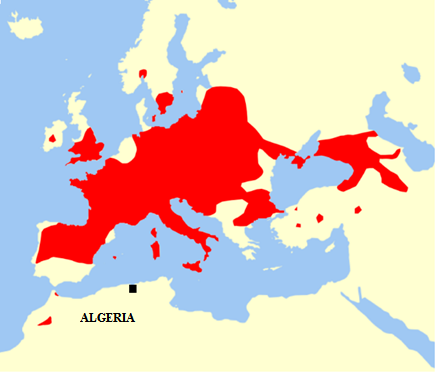
The IUCN classifies the Barbastelle as “near threatened” [13], where it is considered to occur over a wide area, but where it occurs it is generally rare, and present at low density. The population is fragmented and linked to particular types of old-growth forest habitats, which are in decline. The species does not easily colonize new areas, and declines have been widely reported across most of its range. The status of this species is linked to forestry practices and the decline in the number of old trees (a colony may use up to 30 old, holed trees each summer season). Barbastelle is found up to 1,800 m above sea level in the Alps [14], 1,900 m above sea level in the Caucasus and 2,260 m above sea level in the Pyrenees [15]. The number of summer colonies is usually approx. 30 individuals. Winter groups are generally small (individuals tend to be solitary).In Africa, the population size and trends are unknown. It has only been reported in Morocco (North Africa) in subalpine and montane forests up to more than 2,000 meters above sea level [16]. It forages in mature forests and forest edges, feeding mainly on large moths [17]. In summer, roosting sites are found in mature forests and sometimes in older buildings. This bat shows great fidelity to roosting and feeding areas. In winter, hibernation may begin in trees, but later underground sites are preferred. Underground habitats can be of any type, but they generally consist of very cold sites (Figure 1).
The Barbastelle produces distinctive echolocation calls, often with an “alternation” in the frequency of calls in a sequence. Most commonly this species produces calls with a regular alternation of two types of short signals (3 to 5 ms at low LB (10 – 11 kHz), Type A: FME = 34.5 kHz and Type B = 43 kHz [17, 18]. Other bat species with a similar diet have developed acoustic adaptations against their prey escape strategies, such as allotonic frequencies and whispering emissions [18]. There is provide support for the hypothesis that the species sonar, with frequency and intensity alternation, is adapted to counteract the escape reaction of a tympanate prey. Basic principle would be acoustic mimicry, with its hunting calls resembling the inoffensive acoustic environment of their preys. This adaptation appears successful because its diet is the most specialized amongst European bats; A question has always been asked by chiropterologists: Can the acoustics she used be related to the behavior of the species or an individual; with the type of habitat used; with the type of prey captured [19]. The species emits two types of cries alternating. Type A starts at
33.4 – 49 kHz with a maximum duration of 5 milliseconds, goes down to 24 – 37 kHz. Type B starts at 37 – 47 kHz, lasts up to 10 milliseconds and on the spectrogram the signal is often a flat convex arc. Type A is much more intense than Type B but 1 to 100 times weaker than the calls of Nyctalus leisleri. The two types of cries are undoubtedly emitted by the movement of the larynx and the soft palate alternating with the mouth downwards and forwards (type A through the mouth) and the nose forwards and straightened (type 2 through the nose). When taking off, it is exclusively type B which is emitted, generally with the mouth closed (Table 1) [16].
| Type of Signal | Number of signals | Interval duration (ms) | Duration Signals (ms) | Initial frequency (kHz) | Frequency Terminal (kHz) | Bandwidth | FME | ||||||
|---|---|---|---|---|---|---|---|---|---|---|---|---|---|
| Mean | SD | Mean | SD | Mean | SD | Mean | SD | Mean | SD | Mean | SD | ||
| Type A alternation | 18 (7) | 82,6 | 40,2 | 3,2 | 0,9 | 37,5 | 1,8 | 27,6 | 1,1 | 9,8 | 2 | 34,5 | 1,5 |
| Type B alternation | 17(7) | 58,5 | 8,4 | 5,9 | 2,5 | 45,5 | 2,1 | 34,2 | 4 | 11,3 | 3,8 | 43,1 | 2,3 |
Table 1: Average values of measured alternating signals of B. barbastellus in Europe [19].
Materials and Methods
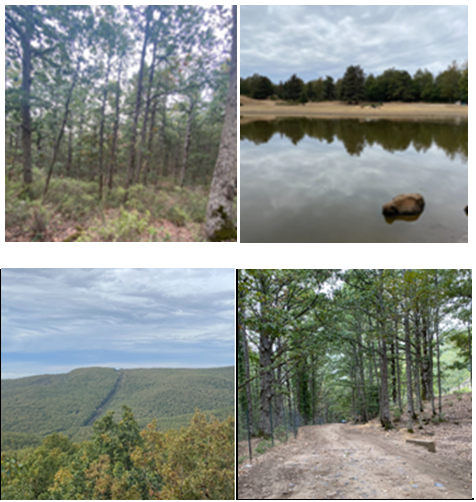
The recordings of bat echolocation in the Akfadou forest were made on December 30 and 31, 2023 in favorable weather conditions given that there had been drought in that year, despite the fact that we were almost in winter. This important forest, located approximately 160 km east of Algiers and 20 km from the sea, administratively depends on the departments of Béjaia and Tizi-Ouzou and extends over an area of approximately 11,000 ha, or 18% of Algeria’s deciduous oak forest. Its orography is quite complicated: it is structured around a succession of ridge lines generally oriented northeast and southwest with an altitude varying from 800 m to 1,646 m. The climate is humid with a temperate variant [20]. There are 484 plant species and subspecies, representing 16.50% of the flora of northern Algeria, 171 species of medicinal plants and 59 species of moss, 16 species of mammals, of which 10 are protected, and 81 species of birds representing 27 families. The largest population of barbary macaque Macaca sylvanus lives in this forest and it is estimated at 2000 individuals, as for bats no major work has been done.
The forest is essentially made up of stands of Zean oak (Quercus canariensis Willd.), Afares oak (Q. afares Pomel) and cork oak (Quercus suber L.). Zeen oak is the dominant species up to 1,646 m altitude, where it occupies approximately 45% of the wooded area. The afares oak abounds on some ridge lines, the south and southwest slopes and areas characterized by more or less clayey soils. Most often, it is located below 1,250 m altitude. Pure stands occupy approximately 15% of the forested area. Mixed stands of Zeen oak and Afares oak are found throughout the transition zones. The same applies to mixed stands of Zeen oak and cork oak, limited to an altitude of 1,100 m. These mixed stands cover approximately 25% of the forested area. As for cork oak in its pure state, it occupies
15% of the peripheral area of Akfadou. Black alder (Alnus glutinosa (L.) Gaertn.), yew and holly colonize everywhere the wettest, swampy areas of Akfadou, as well as springs and watercourses. Among the deciduous species also include the maple (Acer obtusatum W. et al.), the mountain ash (Sorbus torminalis (L.) Crantz and the cherry (Cerasus avium L.). The maple can sometimes codominate with the zean oak, even dominate it to constitute real maple groves occupying fairly small areas. The phytogeographic spectrum shows that this is made up of 41% by Mediterranean species, while, totaling nearly 36%, the Eurasian and Euro-Mediterranean elements are far from “be negligible. Around thirty species (9%) are endemic to North Africa and only 3% are endemic to Algeria. The latter include the following species: Carum montanum Coss. et Dur., Genista numidica Spach., Genista vepres Pomel, Nepeta algeriensis De Noé, Phlomis bovei De Noé and Scrophularia tenuipes (Coss.) (Figure 2).
For the first time a chiropterological investigation was carried out using acoustics to provide a preliminary assessment of the chiropterological heritage of this forest. We used a Pettersson ultrasound microphone M500-384 coupled to a smartphone with capture on its Oppo A32 brand OTG. We started detecting bat sounds 10 minutes before sunset and for 60 minutes afterwards on a 10 kilometer transect on which we recorded for 20 seconds every 300 meters. The recordings were made in sequences of 30 seconds each, and during each sequence there can be several sounds from multiple species, and / or individuals .Bat calls were analyzed using the real-time analysis software Bat Sound, v.3.10 (Petterson Elektronik AB), for spectrogram analyses. Stuart Newson, bat acoustics specialist at the British Trust for Ornithology (United Kingdom) independently analysed and listen to our recordings.
Results
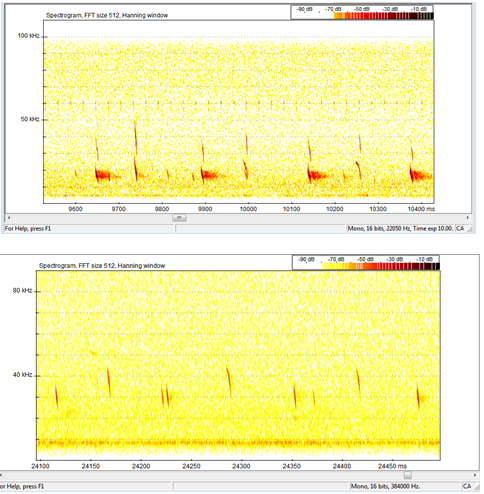
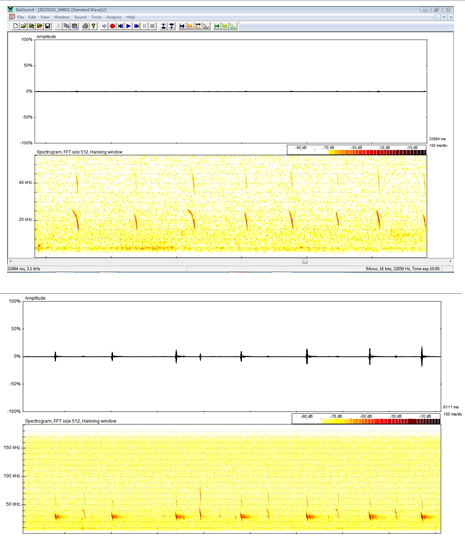
A total of 821 bat echolocation sequences were recorded. From these we chose the most representative and clearest sequences to assign these species. The results of our recordings show that during our field work we were able to record the presence of six species of bats including a probable recording of Pipistrellus nathusii and a new species for Algeria, Barbastella barbastellus.
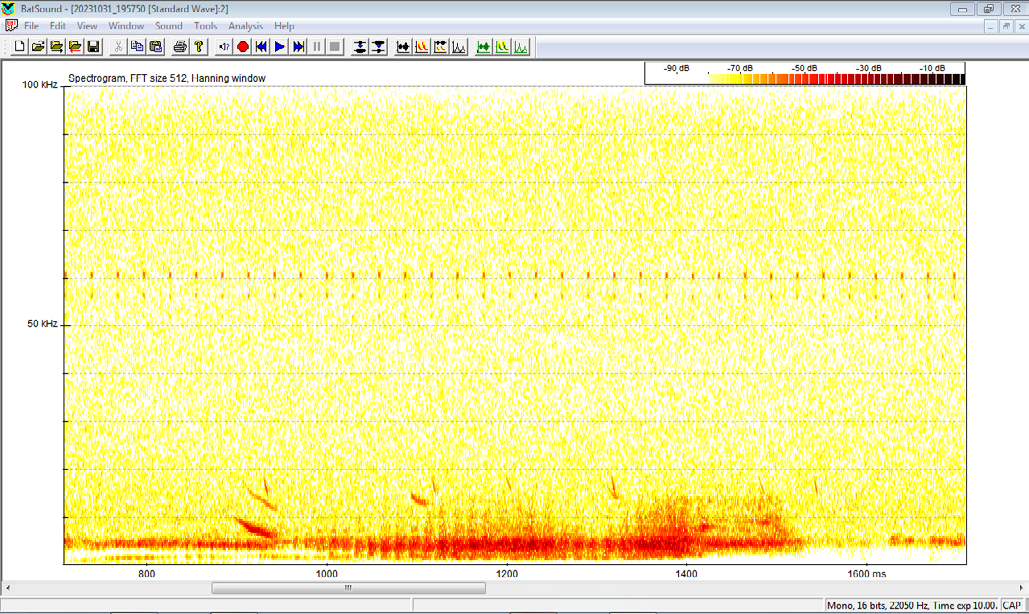
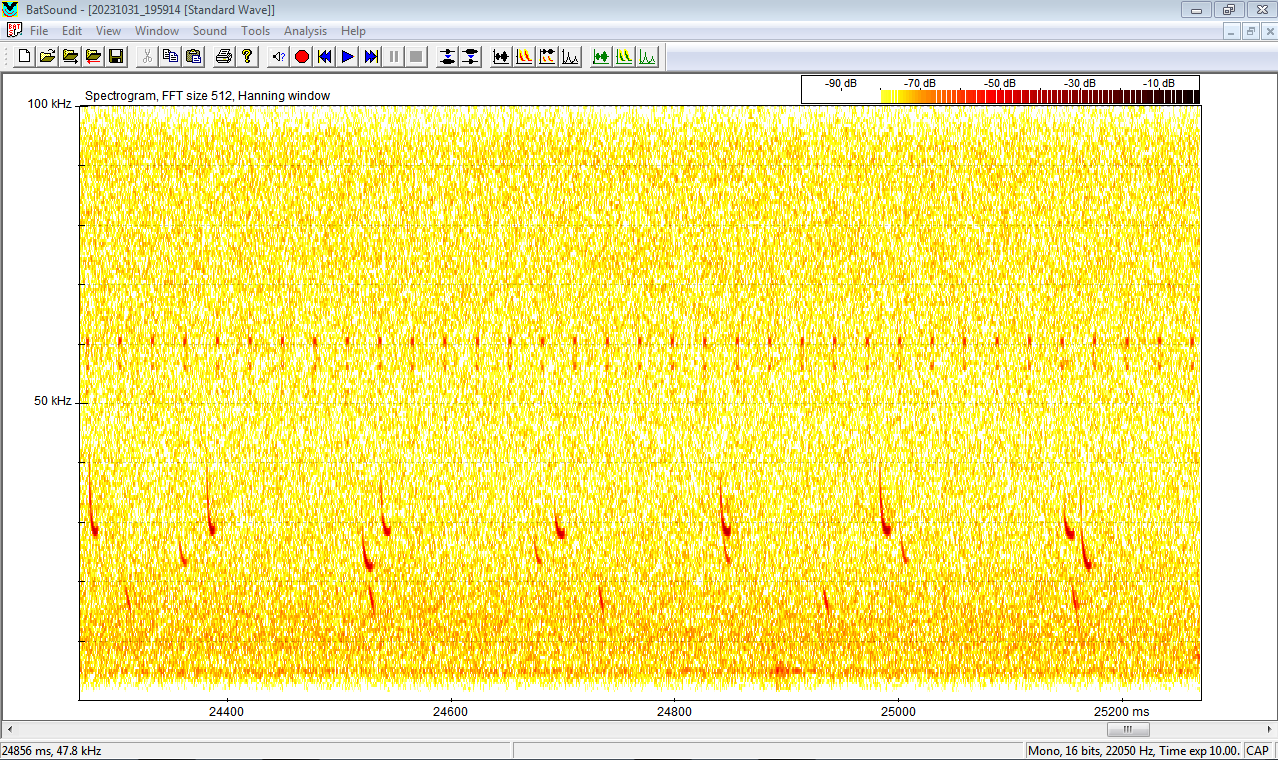
In addition to these, Nyctalus leisleri, Pipistrellus kuhlii, P. pipistrellus and Miniopterus schreibersii were also recorded. For Barbastelle, there were seven very clear sequences, three sequences containing social calls with Nyctalus leisleri, and a sequence with Nyctalus leisleri, P. kuhlii and P. pipistrellus. Stuart Newson, bat acoustics specialist at the British Trust for Ornithology (United Kingdom) independently analysed and listen to our recordings. He concluded his analysis by saying that he did not think there is evidence to support the presence of P. nathusii (with some doubt), in addition, he thought that there was strong evidence for the presence of several sequences of Barbastellus barbastella calls (Table 2 & Figures 3-6).
| Date | Time | Species | Type of sounds |
|---|---|---|---|
| 31/12/2023 | 19:45:36 | Barbastella barbastellus | Normal call |
| 31/12/2023 | 19:48:21 | Barbastella barbastellus | Normal call |
| 31/12/2023 | 19:48:54 | Barbastella barbastellus | Normal call |
| 31/12/2023 | 19:51:41 | Barbastella barbastellus | Normal call |
| 31/12/2023 | 19:52:43 | Barbastella barbastellus | Normal call |
| 31/12/2023 | 19:57:34 | Barbastella barbastellus – Nyctalus leisleri | Normal call |
| 31/12/2023 | 19:57:50 | Barbastella barbastellus – Nyctalus leisleri | Social call |
| 31/12/2023 | 19:57:53 | Barbastella barbastellus – Nyctalus leisleri | Social call |
| 31/12/2023 | 19:59:14 | Barbastella barbastellus – Nyctalus leisleri – Pipistrellus kuhlii – Pipistrellus pipistrellus | |
| 31/12/2023 | 20:05:08 | Barbastella barbastellus | Normal call |
| 31/12/2023 | 20:05:40 | Barbastella barbastellus | Normal call |
| 31/12/2023 | 20:24:41 | Nyctalus leisleri | Social call |
| 31/12/2023 | 20:24:57 | Nyctalus leisleri | Social call |
Table 2: Table of recorded species and their type of call.
Discussion
The recorded sequences of Barbastelle are typical for this species, except that the frequency of the calls is shifted a bit lower than is typical for continental Europe [1]. Other species present in these recordings include P.kuhlii which is very common, and includes some examples of social calls. We suspect that P. nathusii (which could also be a new species for Algeria), but it is difficult to confirm this. Miniopterus schreibersii was also quite widely recorded, and with several recordings of Nyctalus leisleri including some with social calls. Stuart Newson, bat acoustics specialist at the British Trust for Ornithology (United Kingdom) independently analysed and listen to our recordings. He concluded his analysis by saying that he did not think there is evidence to support the presence of P. nathusii (with some doubt). He was not able to comment on the identification of the higher frequency Pipistrelle species, because he has not worked on V. rueppelli and has little experience with the North African subspecies of P. pipistrellus. The recordings included high frequency pipistrelle calls that he would attribute to P. pygmaeus in Europe, but with the uncertainty regarding the identification of P. pipistrellus and V. rueppellii in Algeria. In addition, he thought that there was strong evidence for the presence of several sequences of Barbastellus barbastella calls.
Conclusion
The present work confirms that Barbastella barbastellus is present in Algeria, as the 27th species of bat reported for the country. Knowing that this species is threatened and classified Near Threatened by the IUCN, more in-depth work is necessary to establish its distribution in Algeria.
Acknowledgements
We would like to thank Stuart Newson, bat acoustics specialist at the British Trust for Ornithology (United Kingdom) who kindly commented on our recordings, and for correcting our manuscript. We also thank Konrad Sachanowicz for providing us free of charge with a photo of Barbastelle barbastellus. We also thank the reviewers who corrected and commented on our present work.
References
-
Tupinier Y, Barataud M (2004) Acoustic observation of bats. Natural Spaces 5.
-
Stathopoulos V, Zamora-Gutierrez V, Jones KE, Girolami M (2018) Bat echolocation call identification for biodiversity monitoring: a probabilistic approach. Journal of the Royal Statistical Society Series C: Applied Statistics 67(1): 165-183.
-
Griffin DR (1944) Echolocation by blind men, bats and radar. Science 100(2609): 589-590.
-
Hughes AC, Satasook C, Bates PJ, Soisook P, Sritongchuay T, et al. (2011) Using echolocation calls to identify Thai bat species: Vespertilionidae, Emballonuridae, Nycteridae and Megadermatidae. Acta Chiropterologica 13(2): 447-455.
-
Papadatou E, Butlin RK, Altringham JD (2008) Identification of bat species in Greece from their echolocation calls. Acta Chiropterologica 10(1): 127- 143.
-
Fenton MB, Bell GP (1981) Recognition of species of insectivorous bats by their echolocation calls. Journal of Mammalogy 62(2): 233-243.
-
Kowalski K, Rzebik-Kowalska B (1991) Mammals of Algeria. The Ossolinski National Institute, Publishing House of the Polish Academy of Sciences pp: 370.
-
Ahmim M, Moali A (2013) The diet of four species of horseshoe bat (Chiroptera: Rhinolophidae) in a mountainous region of Algeria: evidence for gleaning. Hystrix 24(2): 174-176.
-
Loumassine HE, Allegrini B, Bounaceur F, Peyre O, Aulagnier S (2017) A new mammal species for Algeria, Rhinopoma microphyllum (Chiroptera: Rhinopomatidae): morphological and acoustic identification. Mammalia 82(1): 85-88.
-
JORADP (2012) Official Journal of the Democratic and People’s Republic of Algeria. 18.
-
Ahmim M (2017) Current status, distribution and conservation status of Algerian bats (Mammalia: Chiroptera). Journal of Threatened Taxa 9(1): 9723- 9733.
-
Ahmim M, Dalhoumi R, Măntoiu DS (2020) First data on the acoustic characteristics of some Chiropteran species from northern Algeria. Bioacoustics 29(5): 499-517.
-
Piraccini R (2016) Barbastella barbastellus. The IUCN Red List of Threatened Species.
-
Spitzenberger F (2001) Die Säugetierfauna Österreichs. Bundesministerium für Land- und Forstwirtschaft, Umwelt und Wasserwirtschaft.
-
Mitchell-Jones AJ, Amori G, Bogdanowicz W, Kryštufek B, Reijnders PJH, et al. (1999) The Atlas of European Mammals. Academic Press, London, UK.
-
Dietz C, Kiefer A (2014) European bats, Know, Identify and protect. Ed Delachaux et Niestlé Paris, pp: 396.
-
Barataud M (1999) Habitat structures used by the barbastelle in hunting activity. In: Roué SY, Barataud M (Eds.), Hunting activities of threatened bats in Europe, Synthesis of current knowledge for conservative management. 137: 111-116.
-
Barataud J, Barataud M, Giosa S, Vitter J (2014) Acoustic temporal monitoring of forest bats in Limousin. Application of year 1 GMHL protocol, Limoges, France, pp: 20.
-
Barataud M (2011) Adaptation of B. barbastellus sonar to capture tympanic butterflies: a case of deceptive acoustic mimicry. 2: 95-105.
-
Messaoudene M (1989) Dendroecological study and productivity of Q. canariensis Willd. and Q. afares Pomel in the Akfadou and Beni-Ghobri massifs in Algeria. Doctoral thesis in science, Aix-Marseille III University, France, pp: 124.
- Mitochondrial Bio-Logistics: Steering Co-Enzyme Q10 and Lycopene Synergies within the Science 4.0 Bio-OS Framework
- Hymenoptera Specimens from the Caño Negro Wetland, of the National Museum Collection, Costa Rica
- Science 4.0: Comprehensive Architecture of the Biological Operating System (Bio-OS) A Framework for Systemic Resilience and Industrialized Bio-Governance
- Rabbit on, or Hare Back? Understanding Climate Change
- Clinical Validation of Science 4.0: Flow Steering and Epigenetic Drift Inversion on a 76-Year-Old Hybrid System
- Seeds Planted by another Mind