
Use of Copernicia vespertilionum as Habitat for Mormopterus minutus (Chiroptera: Molossidae) in Ciego De Avila, Cuba
5Mormopterus minutus is a bat endemic to Cuba and its preferred habitat is the palm Copernicia vespertiliorum. Due to its specialization and the loss of its habitats due to anthropogenic action, the species is classified as Vulnerable. The aim of this work is to characterize the population of C. vespertilionum as possible refuges of M. minutus in the Loma de Santa Maria Wildlife Refuge protected area. Between March and August 2019, 4 random grids were marked in the Coastal Savannah for sampling the palm population. Night time counts of the bats were carried out using camera traps and basic morphometry was performed on individuals captured with mist nets. There were 27 specimens of C. vespertilionum with five active colonies that had an average height of 9.81m, while the refuge areas showed an average height of 2.75m. Colonies can present between 2000 and 5500 individuals per refuge. The alar expansion showed an average of 21.8cm, the length of the forearm an average of 9.65cm and the weight of the species averaged 6.5 g. It was determined that forest fires, as a result of anthropogenic actions, were the main cause of the decrease in the population of M. minutus in the protected area. Finally, measures and actions were established for the conservation and protection of the palm trees and with it, of the bat.
Introduction
Mormopterus minutus or little jata bat, belongs to the Molossidae Family, and is endemic to Cuba. It is one of the smallest bat species in the archipelago, with an average body length of 5 to 6 centimeters and an approximate weight of 5 to 8 grams. Its coat is dense and short, with a dark brown or grayish color and a small white spot on its throat. Its snout is elongated and thin, the upper lip protrudes considerably from the lower lip [1]. It presents a very long tail that protrudes from the free edge of the moderately wide uropatagium.
The same author suggests that it is distributed in several provinces in the center and east of the country, and its type locality is Trinidad. This species feeds mainly on insects, such as mosquitoes, moths and beetles. It is a nocturnal bat that is usually active during the early hours of the night. The reproductive period of Mormopterus minutus runs from June to October, with a short lactation time between June and July [2]. The species is of vital importance in the ecosystems were habits, due to its role in controlling insect populations.
The habitat of these bats is associated with the distribution of the jata palm (Copernicia gigas), although they rarely live in urban and rural areas, where they seek refuge in abandoned buildings, caves and hollow trees [2]. It should be noted that these palms constitute their preferred daytime refuge, so due to this specialization and the loss of its habitat due to anthropic action, the species is classified as Vulnerable to extinction.
The species Copernicia gigas and Copernicia rigida constitute palms that inhabit the Cuban savannahs and have the ability to reproduce among themselves [3]. The resulting hybrid between these is called Copernicia vespertiliorum [4] and is a species of palm tree endemic to Cuba. Its populations are restricted to the central and eastern regions of the island. This species prefers to grow in calcareous soils and in areas with a high level of humidity, such as coastal areas and river valleys. It is medium in size and can reach a height of up to 12 meters. Its flowering period occurs between the months of April and May, while its fruiting stage extends from August to September [4]. This species is important for the ecology of the regions where is found, as it provides food and shelter for various species of animals, including birds and some bats (e.g. M. minutus). In addition, its wood and leaves are used in the construction of homes and in the manufacture of furniture and crafts by the communities near its populations.
Due to the specialization of this bat and the scarce presence of C. vespertilionum palms in the province of Ciego de Ávila, the present work has the following objective: characterize the population of C_. vespertilionum_ as possible refuges of M. minutus in the area. In addition, measures are proposed for its conservation and protection.
Materials and Methods
Area
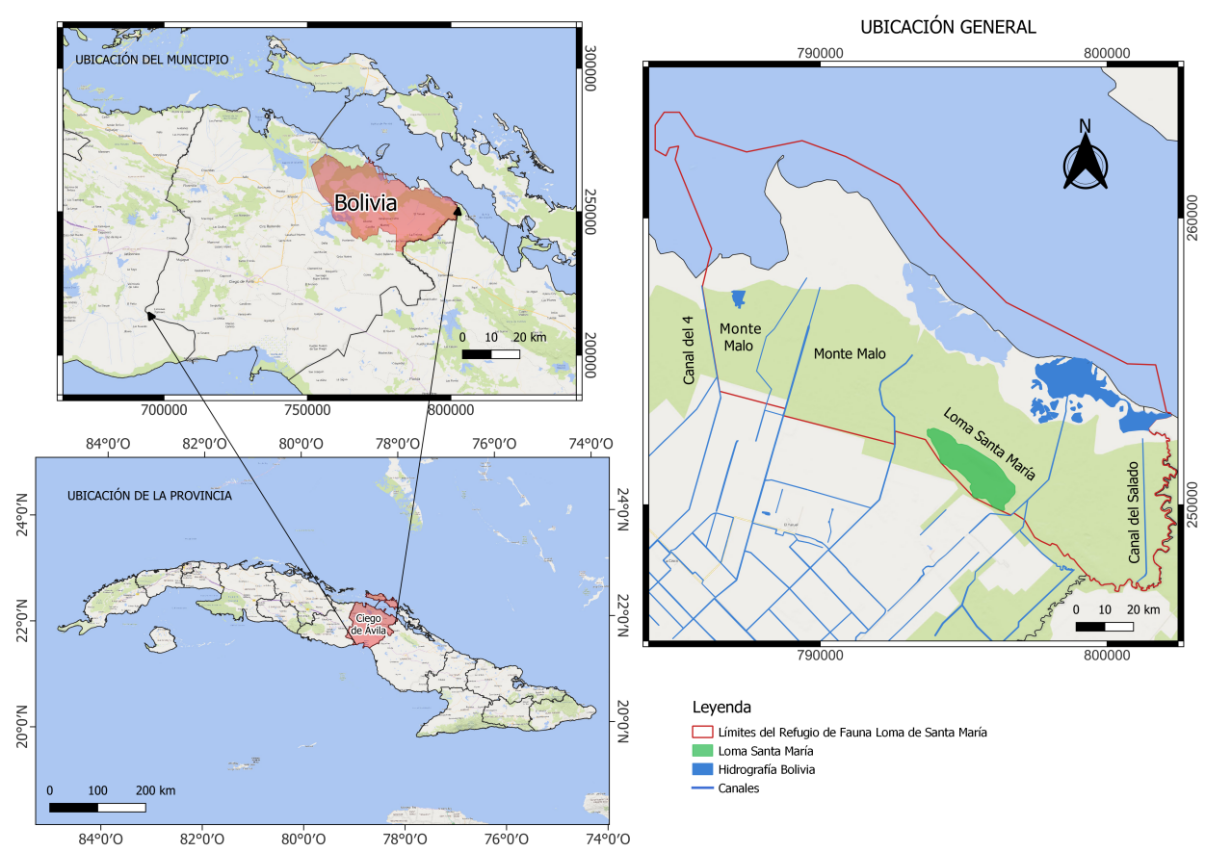
Ciego de Ávila is a predominantly flat province, located in the central region of the Cuban archipelago. Specifically, the area known as “Monte Malo” constitutes an area of 8 ha with mostly forestal use. It is located 6 km east of the Municipality of Bolivia, in the border area with the province of Camagüey. It is located at -78.27, 22.09, included in the western limit of the Loma de Santa María Wildlife Refuge Protected Area, which currently has no administration (Figure 1). The predominant plant formation consists of a Coastal Savannah with a predominance of Palmaceae (Sabal domingensis, Copernicia hospita, Copernicia baileyana and Copernicia gigas).
Methods
The sampling was carried out between March and August 2019. To sample the C. vespertilionum population, 4 grids of 500 m on each side were randomly marked in the Coastal Savannah area, which included the entire population. The routes were carried out on an 8 m grid between people. Plant counts were carried out directly. The identification of the species was carried out following León’s criteria in 1931. The population was classified into abandoned plants, with colonies and young plants. Those that did not show the typical accumulation of bat feces underneath were taken as abandoned plants. In the case of plants with a colony, those that did show evidence of feces accumulation under the foliage were taken, and those that had not yet flowered were taken as young plants. The height and size of the shelter of each palm specimen found were measured with a measuring tape. The size of the shelter was taken as the area of overlapping dry leaves that the palm creates as a “mattress” just below its green leaves, but without separating from the trunk.
Each palm specimen with the presence of M. minutus was taken as an independent colony. Five Spartan GoCam No Glow camera traps were placed in positions covering each palm specimen with established colonies. Using photographs at regular intervals during the period between 6:00 p.m. and 8:00 p.m., the average number of bat specimens per colony was inferred. This duration was due to the fact that M. minutus constitutes a crepuscular species and according to Mancina, et al. [5] sampling should extend during the activity period of each species. In addition, mist nets were established at the same time and in areas surrounding the palms, to cover the exit of the bats from each colony and capture them. The nets were checked every 15 minutes to prevent the bats from escaping, becoming too entangled and damaging the nets or being attacked by predators [6]. It should be noted that these nets were not located in the vicinity of the colonies, because in these situations it is very likely that a large number of individuals will be captured, making it very difficult to untangle them quickly without mistreating them or without damaging the net itself [6].
During the captures of M. minutus individuals, basic morphometry was performed before releasing them again. Data on alar expansion, forearm length and weight were taken. Wing expansion was measured with a caliper from one end of the patagio to the other (span). Similarly, a caliper was used to measure the length of the forearm, which consists of the minimum distance between the elbow and the wrist of the forelimbs [6]. In the case of the weight of the individuals, a 50Kg Weiheng manual scale regulated in grams was used. A Chi square test (X2) was used to check the existence of significant differences between the individuals of each colony and between the colonies found. The significance level used was 0.5%.
Finally, we determined what could be the possible causes of the gradual decline in the population of M. minutus and C. vespertilionum as their preferred habitat in this protected area. In addition, a strategy was developed to increase the presence of the palm tree and thus create possible new bat colonies in the future.
Results and Discussion
In the sampled area, 27 specimens of C. vespertilionum were found. It should be noted that the 4 sampled grids included all the individuals of this palm species that exist within the Coastal Savannah as a plant formation of the Loma de Santa Maria Wildlife Refuge. The classification of the palm specimens included five with established bat colonies and three with the possibility of being new colonies. In addition, seven specimens with abandoned M. minutus colonies and 12 young palm trees were found.
The five palm trees with colonies showed abundant bat feces forming a thick mound that surrounded the base of the trunk of each specimen. This coincides with what was found by Silva G [1]. Likewise, the three that could contain new colonies showed a thin layer of feces that also surrounded the trunks of the palm trees, although not continuously. In the five previous cases, numerous individuals of M. minutus were sighted around the established colonies; while in the three palms with possible new colonies, bat individuals were observed sporadically. The latter, probably due to a low number of the species in its first stages of forming a new colony. It should be added that bats were not sampled in these three plants to avoid unnecessary disturbances in the colonies that were forming.
In the case of the seven palm trees that were classified as abandoned colonies, they showed the characteristic mounds of bat feces surrounding the bases of the trunks. However, it was found that these mounds were already old and no new feces were evident in any of them. Furthermore, palms were recorded and no individuals of M. minutus or other bat species were found. This abandonment of the colonies may be due to the passage of Hurricane Irma through the territory in 2017. This meteorological event felled and defoliated a large part of the tree and shrub layer of the Savannah in the area. This could have caused the migration of some established colonies to other habitats or the consequent fusion of some of these colonies with others settled in more robust specimens of C. vespertilionum (Espinosa Romo, pers. comm.). On the other hand, the fact that there are 12 young palms shows that the small population of C. vespertilionum is recovering. This may contribute to the increase in the M. minutus population with the formation and establishment of new colonies.
The five plants with established colonies had an average height of 9.81m. Likewise, the refuge areas presented an average of 2.75m. The specific data for each specimen of C. vespertilionum are shown in Table 1. It was observed that colony number 2 was almost abandoned. This could be confirmed by the lower density of feces at the base of the palm tree trunk, as well as the lower number of bats that surrounded the shelter at night. The smaller size of the refuge area with respect to the height of the tree (Tvable 1 may have influenced the M. minutus colony to be in the process of migrating towards a refuge with a higher density of habitable area.
| Colony | Height of the tree (m) | Size of the refuge (m) |
|---|---|---|
| 1 | 13.5 | 4.4 |
| 2 | 9.12 | 1.88 |
| 3 | 8.73 | 2.44 |
| 4 | 9.3 | 2.73 |
| 5 | 8.4 | 3.7 |
Table 1: Height of each Specimen of _C. vespertilionum_ and Size of the Refuge, Measured as Height of the Area used as Habitat by
After observing all photographs, the average number of M. minutus individuals per colony was established by grid counting. They showed that the five colonies can present between 2000 and 5500 individuals per refuge. It was verified that in the case of the colony marked on palm specimen 2, it did not exceed 800 individuals of M. minutus, which could be due to the smaller refuge area discussed above. Furthermore, it is the only one that yields significant values when performing the statistical test and comparing it with the rest of the colonies (X2= 17.63, p = 0.0013).
The morphometric results of the M. minutus individuals captured by each colony showed that wing expansion varies between 20.4 cm and 23.3 cm, with an average of 21.8 cm for this variable. There were no significant statistical differences for this variable (X2= 4.27, p = 0.2329) between all the individuals sampled from the five colonies. In the case of the length of the forearm in the colonies, the average was 9.65cm, and only significant differences were evident (X2= 23.53, p = 0.0001) from a statistical point of view between the individuals sampled from colony 2 with respect to the remaining shelters. Regarding the weight of the sampled animals, no significant differences were evident between the five colonies (X2= 22.33, p = 0.1139). The average weight among all sampled individuals of the species was 6.5 g.
Finally, it was determined that forest fires, as a result of anthropogenic action, were the main cause of the decrease in the population of M. minutus in the protected area. These fires are increased due to the typical characteristics of the swamp grassland as a vegetal formation where the palm is found, which constitutes its preferred habitat. It should be noted that predation by the Cuban boa (Chilabothrus angulifer) was also identified as a cause of the bat’s population decline; as well as the decrease in the size of palm leaves. Both, from natural causes, or in the case of the second, possibly also with an anthropic explanation, because the same human actions collecting palm leaves would decrease the bat population.
In addition, a strategy was developed to increase the extent of palm tree presence and thus create possible new colonies of M. minutus in the future. The growing demand from the local population for the construction and rehabilitation of homes in Playa Brisas in Bolivia, and the construction of rural works by the UEB Forestal of that territory, have also increased the loss of C. vespertilionum (Espinosa Romo, pers. comm.). This is due to the use of wood and guano from both the species and its parents (Copernicias gigas and C. rigida). For this reason, regulations and control by the corresponding entities must be increased and thus avoid greater losses of the palm population and, consequently, of M. minutus. Several of the most endangered bat species in Cuba (e.g. M. minutus) show arboreal shelter habits [7], so the preservation of their shelters is a key element for the conservation of these species.
Fruits of C. vespertilionum were collected in different areas of the Great Northern Wetland of the province. These collections were made only in the upper part of the palms, because it has been proven that they are the most viable when it comes to germination (Espinosa Romo pers. comm.). Subsequently, these fruits were subjected to a boiling process to soften the bark, because the seeds are very sensitive, but, like almost all Cuban palms, they have a latency period when germinating, called dormancy [8]. In the week after the boiling process, 30 fruits were planted in marked plots distributed throughout the areas most impacted by anthropization in Monte Malo. The protected area surveillance group carried out weekly monitoring in these plots to take into account the effectiveness of seedling germination. This process lasted three months, the approximate time it takes for the seed of the species to germinate. The 27 seedlings that germinated will continue to be monitored weekly, as part of the area’s conservation projects. It is known that C. vespertilionum needs decades to complete its growth and development process. With the future recovery of the population of this palm, not only the population of M. minutus will benefit, but also various species of frogs, pigeons, benzenes and other small birds that use it as refuge and breeding sites.
The results of the inventories, as well as the abundance and distribution studies, allow us to determine the presence of threatened species and important daytime refuges, which constitutes key information for management and conservation in protected areas [6]. Furthermore, there is evidence that the management plans of the National System of Protected Areas (SNAP) show little representation of bats as a group considered within conservation objects [9].
Acknowledgement
We thank all the Protected Area surveillance personnel for allowing us access to the area. Furthermore, we thank Joel Monzon Gonzaez (Antonio Nunez Jimenez Foundation of Nature and Man), for his clarifications for the final confirmation of this document. Finally, we thank to Llilian Martinez Perez for their valuable revisions and writing recommendations.
References
-
Silva G (1979) The bats of Cuba. Academia Publishing, Cuba, pp: 423.
-
Mancina CA (2011) Introduction to bats. In: Borroto- Paez R, Mancina CA (Eds.), Mammals in Cuba (Edn.). UPC Print, Finland, pp: 123-133.
-
Lopez MCE (2024) Inventory of native palms of Cuba. Geoscience pp: 1-37.
-
Hermano L (1931) Contribution to the study of the palms of Cuba. I. Magazine of the Geographic Society of Cuba 4(2): 33-59.
-
Mancina CA, Castro-Arellano I (2013) Unusual temporal niche overlap in a phytophagous bat ensemble of western Cuba. Journal of Tropical Ecology 29(6): 511-521.
-
Mancina CA, Alvares VB, Perdomo HMD, Sanchez LS, Garcia TH, et al. (2017) Land mammals. In: Biological diversity of Cuba: Inventory, monitoring and biological collections methods (Edn.), Mancina CA, Cruz DD (Eds.). Editorial AMA, Cuba, pp: 448-479.
-
Mancina CA (2012) Mammals. In: Red Book of Vertebrates of Cuba (Edn.), Gonzalez H, Rodriguez L, Rodriguez A, Mancina CA, Ramos I (Eds.). Editorial Academia, Cuba, pp: 268-274.
-
Moya CA, Leiva SAT (2000). Checklist of the Palm of Cuba. With notes on their Ecology, Distribution and Conservation. Palms 44(2): 69-84.
-
Mancina CA, de Arcila RF (2013) Preliminary study of the potential distribution of bats in Cuba as a tool for conservation. In: Plan of the National System of Protected Areas 2014-2020 (Edn.). CNAP pp: 165-174.
- Mitochondrial Bio-Logistics: Steering Co-Enzyme Q10 and Lycopene Synergies within the Science 4.0 Bio-OS Framework
- Hymenoptera Specimens from the Caño Negro Wetland, of the National Museum Collection, Costa Rica
- Science 4.0: Comprehensive Architecture of the Biological Operating System (Bio-OS) A Framework for Systemic Resilience and Industrialized Bio-Governance
- Rabbit on, or Hare Back? Understanding Climate Change
- Clinical Validation of Science 4.0: Flow Steering and Epigenetic Drift Inversion on a 76-Year-Old Hybrid System
- Seeds Planted by another Mind