
Digital Techniques for Monitoring Cerambyx cerdo in SAC “Gravine di Matera”: Population Size Insights
Monitoring species of Community interest included in Annexes II, IV, and V of the Habitats Directive is mandatory for EU member states under Art. 11 of Directive 92/43 “Habitats”. This study presents a population estimate of Cerambyx cerdo L. (Coleoptera, Cerambycidae), a species listed in the Directive, to define its conservation status in the SAC “Gravine di Matera”. Using the Android app “Great cAPPricorn” for field data collection and processing, we obtained population estimates for 2019 and 2021, revealing variations in population size and sex ratio. Comparative analysis highlights dynamic trends, variable sex ratios, and differential trap performance across years and sites. These findings advance monitoring practices and underscore the need for ongoing innovation in ecological conservation. The study offers valuable insights into the conservation status of C. cerdo in the Gravine di Matera SAC, emphasizing habitat features and technological tools in species monitoring. Results enabled updating the Standard Data Form for the Natura 2000 site IT9220135 “Gravine di Matera”. Authorizations for capturing and handling individuals were obtained from the Basilicata Region and the Environment Ministry, with the authors identified asresponsible for the activities.
Introduction
In recent years, there has been an increasing effort to connect traditional monitoring methods for species of community interest with advanced digital techniques. This Investigation Paper integration aims to create more efficient and accurate ways to evaluate, distribute, and safeguard natural habitats and their associated species. The EU Habitat Directive (COUNCIL DIRECTIVE 92/43/EEC) is the key document for biodiversity conservation in the European Union, ensuring the protection of natural habitats and wild fauna and flora [1]. Member states of the European Union are obligated to maintain the favourable conservation status of protected habitats within the Natura 2000 network. The Natura 2000 Standard Data Form provides information on the conservation status of the habitats in the spaces included in the Natura 2000 network [2]. The primary goal of the Directive is to implement conservation measures focused on qualifying habitats and species listed in Annexes I and II, supporting long-term and large-scale biodiversity conservation across the European Union [1]. This study aims to assess the population size of Cerambyx cerdo (Coleoptera, Cerambycidae), a species included in the Directive’s annexes, thereby promoting the research and scientific activities necessary to meet the obligations outlined in Articles 11 and 17 of the Habitat Directive. The data for this study were collected from projects conducted by the authors on behalf of the Murgia Materana Regional Park in Matera, Basilicata. The study focuses on the Natura 2000 site “Gravine di Matera”. IT9220135, a 7000-hectare protected area in southern Italy. The Natura 2000 site “Gravine di Matera” IT9220135, a 7000-hectare protected area in southern Italy [3], with 8 different habitat types and 61 species, is located southeast of the City of Matera in the portion of the Murgia called Matera-Laternza (Murgia Materana) and is configured as a plateau interposed between the territories of Apulia and Basilicata regions. The Great Capricorn beetle, Cerambyx cerdo, plays a crucial role in the decomposition of wood and ecosystem functioning of natural and semi-natural oak forests [4]. Saproxylic beetles, like C. cerdo, which depend on old trees and dead wood, are a diverse and functionally important group, though they are decreasing globally [5, 6, 7, 8, 9]. The presence of C. cerdo in the area has been confirmed by the Standard Data Form of IT9220135 “Gravine di Matera.” Trees hosting C. cerdo provide habitats for other species, making this beetle an important ecosystem engineer and an umbrella species [10]. It is globally threatened and internationally protected [11]. The in-situ conservation of viable populations is a fundamental requirement for the maintenance of biodiversity. Monitoring Cerambyx cerdo is fundamental for understanding the distribution, abundance, and conservation status of this species. It is crucial for assessing the population and implementing conservation measures, which can be achieved through a combination of field techniques, scientific approaches, and modern technologies. Digitization significantly impacts monitoring and conservation activities, including those for Cerambyx cerdo. Therefore, an Android App named “Great cAPPricorn” was developed to facilitate surveying, data storage, and processing activities. The main objective of this study is to acquire detailed data on the temporal and spatial distribution of C. cerdo, enhancing the understanding and conservation efforts of this important species.
Materials and Methods
Study Areas
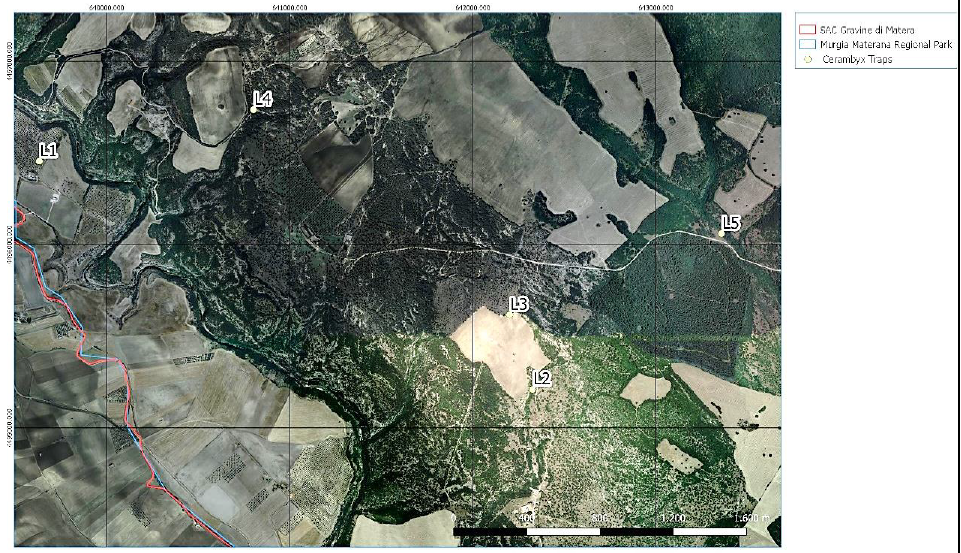
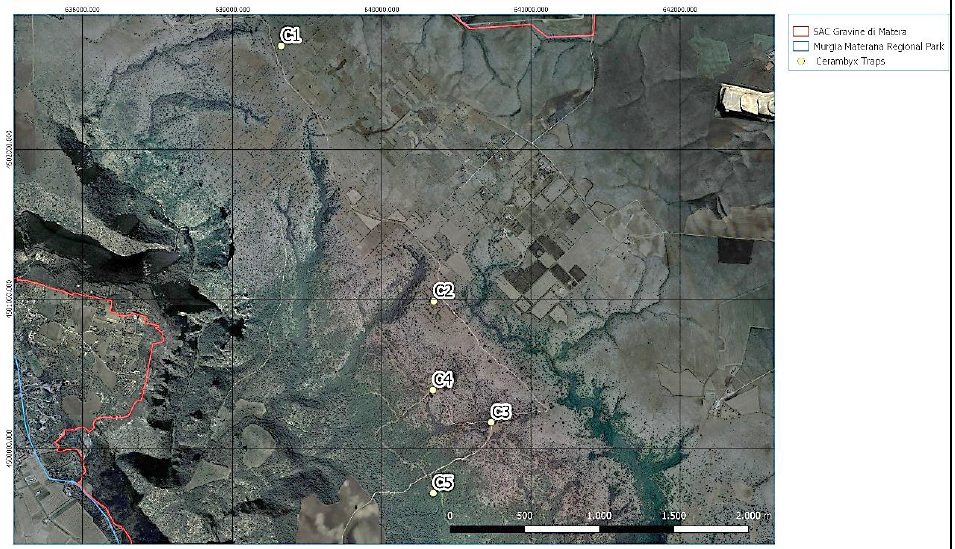
The study areas were selected based on the distribution of habitats suitable for Cerambyx cerdo and by identifying old oak specimens with signs of the species’ presence. The woodland formations within the “Gravine di Matera” SAC (Special Area of Conservation) are residual compared to those present until the last century, as fires and deforestation for cereal cultivation over the years have degraded them. Due to the extensive territory suitable for the species (over 1000 ha), two sampling areas were chosen, corresponding to the main woodland formations within the ZSC “Gravine di Matera”, named “Bosco di Lucignano” and “Bosco del Comune”. The decision to divide the sampling area into two sub-areas was driven by logistical challenges associated with sampling activities across the park area. Two monitoring sessions were conducted, one in 2019 and the other in 2021. The methods employed in this study focused on sampling adults, which are highly active seasonally. Therefore, sampling was conducted within a specific season period, estimated based on literature data. The first monitoring activity (2019) of Cerambyx cerdo took place from June 10, 2019, to July 7, 2019. The best time of year for monitoring C. cerdo adults is from late May to early August [12]. The survey initially targeted “Bosco di Lucignano”, followed by “Bosco del Comune”. Each survey lasted a total of 14 days per study area. To ensure representative data collection, five traps were positioned within both “Bosco di Lucignano” and “Bosco del Comune” were positioned at five different locations. The traps deployed in the “Bosco di Lucignano” area (Table 1) were activated on Quercus pubescens in the “Parco dei Monaci” locality, two on Quercus ilex in the “Murgia Sant’ Andrea” and “Vallone del Prete” localities, and two on Quercus trojana in the “Murgia Sant’ Andrea” and “Madonna del Giglio” localities (Table 1, Figure 1). Subsequently, the traps were also installed at the “Bosco del Comune” site. They were placed on Quercus pubescens at “Jazzo di Temparossa”, on Quercus ilex at “Vallone Conca d’Aglio”, on Quercus pubescens at “Volta Cornale”, on Quercus pubescens at “Jazzo del Comune” and “Bosco del Comune” (Table 1, Figure 1).
| ID Point | Oak Species | GPS coordinates (EPSG:32633 - WGS 84 / UTM zone 33N) | Location | Year | Site | |
|---|---|---|---|---|---|---|
| Longitude | Latitude | |||||
| L 1 | Quercus pubescens | 639631.39 | 4496455.21 | Parco dei Monaci | 2019 / 2021 | Bosco di Lucignano |
| L 2 | Quercus ilex | 642326.78 | 4495209.96 | Murgia Sant’Andrea | 2019 / 2021 | Bosco di Lucignano |
| L 3 | Quercus ilex | 642201.77 | 4495616.79 | Vallone del Prete | 2019 / 2021 | Bosco di Lucignano |
| L 4 | Quercus trojana | 640801.75 | 4496735.66 | Murgia Sant’Andrea | 2019 / 2021 | Bosco di Lucignano |
| L 5 | Quercus trojana | 643358.83 | 4496059.19 | Madonna del Giglio | 2019 / 2021 | Bosco di Lucignano |
| C 1 | Quercus pubescens | 639631.39 | 4496455.21 | Jazzo di Temparossa | 2019 / 2021 | Bosco del Comune |
| C 2 | Quercus ilex | 642326.78 | 4495209.96 | Vallone Conca d’aglio | 2019 / 2021 | Bosco del Comune |
| C 3 | Quercus pubescens | 642201.77 | 4495616.79 | Volta Cornale | 2019 / 2021 | Bosco del Comune |
| C 4 | Quercus pubescens | 643957.0267 | 4494922.233 | Jazzo di Temparossa | 2019 / 2021 | Bosco del Comune |
| C 5 | Quercus ilex | 645242.2167 | 4494503.023 | Vallone Conca d’aglio | 2019 / 2021 | Bosco del Comune |
Table 1: List of locations with location information and year of sampling (Bosco di Lucignano and Bosco del Comune).
Trap Design and Capture-Mark-Recapture Protocol
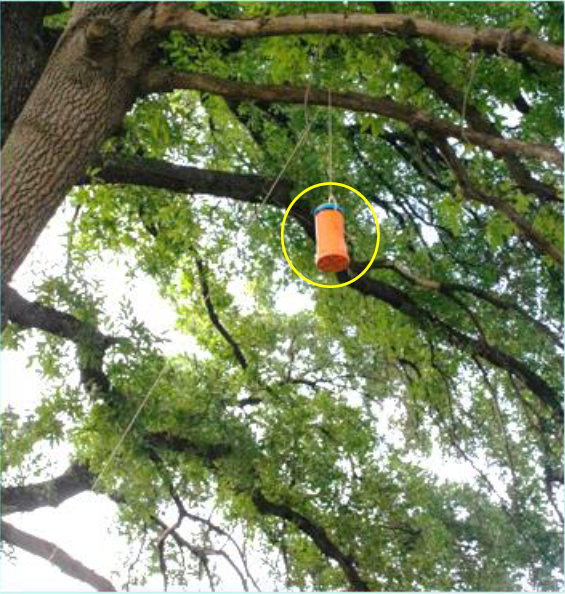
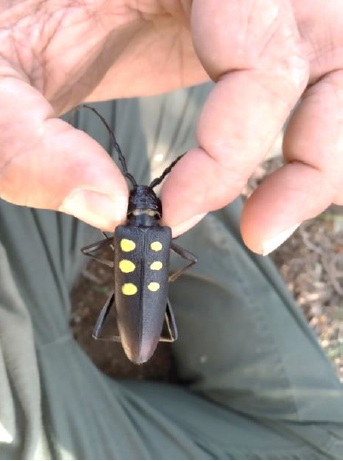
To assess the abundance of Cerambyx cerdo, a Capture- Mark-Recapture (CMR) approach was employed targeting emerging adults. Adults of this species are easily sampled by the utilisation of aerial traps, baited with a mixture of wine and sugar which have been proven to be the most effective survey technique [13]. We developed a novel trap design based on the model described by De Zan LR, et al. [12] with the intent of simplifying the construction procedure (Figure 3). The traps were constructed using 25 cm high and 20 cm in diameter polyvinyl-chloride (PVC) tubes, with a total volume of 7853.9 cubic centimeters, commonly used in the construction industry. A metal mesh was affixed inside the tube to prevent captured insects from escaping into the attractant. At the upper part of the trap, a funnel with a 4 cm entrance hole was installed to allow beetles to enter while preventing their escape. Traps were active from dusk until the following afternoon, as C. cerdo is predominantly nocturnal. They were checked daily from Monday to Friday (Figure 3). Captured individuals were marked on the elytra with common nail polish (Figure 4), which has proven to be an effective way to mark coleopters [13]. Everyone was marked with colored nail polish, with one or more dots, unique to each trap, to facilitate the identification of recaptures. Captured C. cerdo individuals were released onto the trunk of the tree where they were trapped following marking. Traps proved highly efficient in keeping captured individuals alive, with no recorded deaths inside the traps, and all released individuals were in excellent condition. The bait consisted of a fermenting liquid attractant.
Literature suggests that trap effectiveness increases with the fermentation level of the liquid; therefore, preparation of the mixture was necessary several days before its use. Following the formula proposed by De Zan LR, et al. [12], each litre of liquid comprised two equal parts of red and white wine and 200 grams of white sugar. Preparation of this mixture was recommended to occur seven days before use. Each trap contained approximately 15 cl of liquid attractant, which was not replaced throughout the session. In cases of evaporation, the container was refilled with the same bait.
Innovation in Monitoring Activities
Innovative instruments were employed to facilitate the management of collected data during monitoring activities.
In the first year of monitoring (2019), innovation was implemented in the data storage and processing phases through the utilization of a shape file capable of calculating the parameters of the Schnabel function. In the second year of monitoring (2021), innovation extended to both survey and data management phases with the adoption of a dedicated software system called “Great cAPPricorn” (Figure 5). This software, developed by the Murgia Materana Regional Park specifically for monitoring Cerambyx cerdo, was utilized for the first time in the present study. All field data necessary for population estimation and documentation of survey activities related to Cerambyx cerdo were collected using the “Great cAPPricorn” Android application. This app allows for georeferencing of trap installation points along with textual and multimedia information, such as survey data, photos, or bait used. Furthermore, the software is capable of processing population estimates using the Schnabel method. The Android application guides users in applying the methodology outlined in the “Manual for monitoring species and habitats of Community interest (Directive 92/43/EEC) in Italy: animal species,” published by ISPRA, Manuals and Guidelines Series 141/2016 [14]. The use of the app in the field streamlines post-survey activities such as data archiving and processing. The monitoring system archives all entered data in dedicated databases and processes survey data to calculate population estimates of the species.
Additionally, the software generates detailed reports summarizing survey activities and data processing performed.
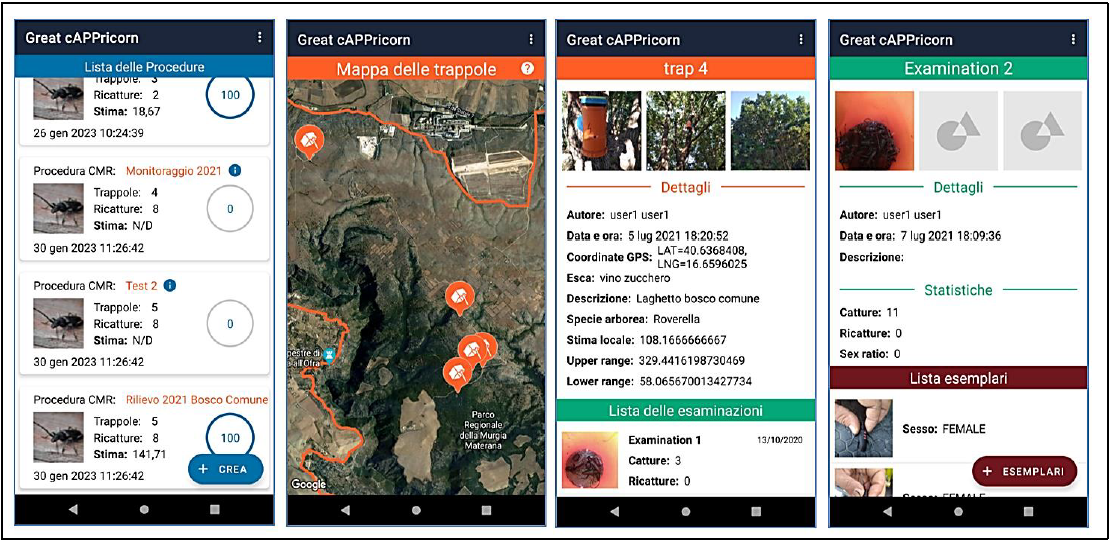
App Functionality for Data Processing
The incorporation of advanced data processing functionalities within our application (Great cAPPricorn) plays a pivotal role in enhancing the precision and efficiency of ecological studies, as demonstrated through our investigation into the population dynamics of C. cerdo in a specified study area. One of the main features of the application is the estimation of population size. To estimate the size of the C. cerdo population in the study area, we utilized the Schnabel Estimator function (Equation 1) widely employed in Capture-Mark-Recapture studies where more than two capturing events are carried out [14].
$$N = \frac{\sum (M_{t-1} \times C_t)}{\sum R_t + 1}$$
Equation 1: The population size $N$ is estimated using the Schnabel function where $C_t$ stands for the individuals captured at the sampling event $t$, $R_t$ indicates the individuals recaptured at sampling event $t$ and $M_t$ (t-1) are the individuals that were captured and marked at the previous sampling event $t-1$. We estimated population sizes for every single trap, assuming they were independent populations, and we then extended the population size to each one of the two major sampling areas, the "Bosco del Comune" and "Bosco di Lucignano" sites. Moreover, the App’s functionality extends to the calculation of confidence intervals for the mean population size indicator. The variance can be calculated as:
$$V \arctan \left( \frac{1}{N} \right) = \frac{\sum R_t}{\left( \sum (C_t M_t) \right)^2}$$
This formula gives the sampling uncertainty (variance) for the inverse of $N$ (1/N). To calculate the confidence interval around $N$, one way is to first calculate a confidence interval on the inverse of $N$ using the above formula, and apply the following formula:
$$\frac{1}{N} \pm 1,965 \times \sqrt{V \arctan \left( \frac{1}{N} \right)}$$
To calculate the confidence interval for $N$, take the inverse of the lower and upper bounds (limits) of the confidence interval calculated above. In addition to population size estimation, the App empowers researchers to perform sex ratio estimations—a crucial aspect in ecological studies. The sex ratio was calculated as recommended by Wilson K, et al. [15], as the proportion of adult males over the whole adult population. A strong sexual dimorphism is present in this species and is possible to easily recognize males as they have antennae that protrude when fully extended, beyond the tip of the abdomen. In the present study, the sex ratio, following Wilson K, et al. [15], was expressed as:
$$Sex \text{ ratio} = \frac{Males}{Males + Female}$$
Results
Estimating Population Size (2019)
During the monitoring conducted at two sampling sites in 2019, a total of 78 specimens of Cerambyx cerdo were captured over 14 sampling days, exhibiting a balanced sex distribution with 37 females and 41 males, yielding a sex ratio of 0.5. All C. cerdo individuals were promptly marked and released back into their natural habitat. The population estimate (Table 3) at the "Bosco del Comune" site stood at 116.30, with a lower confidence interval of 69.3 and an upper confidence interval of 260.7. Meanwhile, at the "Bosco di Lucignano" site, the population estimate was 23.8, with a lower confidence interval of 12.3 and an upper confidence interval of 87.1. It is noteworthy that the confidence intervals are substantial relative to the calculated estimate, likely due to the limited number of recaptures recorded during monitoring.
Traps placed in various locations gave different catch results. Specifically, traps L1 and L5, sited on Quercus trojana, captured 3 and 2 males and 1 female of C. cerdo, respectively. In the "Bosco del Comune" locale, trap C3 reported 11 captures, including 3 males and 8 females of C. cerdo, alongside various specimens of Stictoleptura cordigera. Conversely, in the "Murgia Sant’Andrea" vicinity, traps L2 and L4 documented a significant presence of Vespa crabro, Cetonia aurata, and Proatetia morio, but no C. cerdo captures were recorded.
Estimating Population Size (2021)
During the study period, we observed significant variations in the population of Cerambyx cerdo in the two sampling sites, "Bosco di Lucignano" and "Bosco del Comune". In the "Bosco di Lucignano", we noted a substantial increase in the population of C. cerdo, with a total of 59 individuals captured. On the other hand, in the "Bosco del Comune", we did not observe significant changes in the population of C. cerdo during the study period, with a total of 53 individuals captured. It is also interesting to note the differences in sex composition between the two sampling sites. In "Bosco di Lucignano", we observed a higher number of individuals captured compared to "Bosco del Comune", with a relatively equal distribution between males and females. In contrast, in "Bosco del Comune", the proportion of males captured was lower compared to females. Overall, our results suggest that there are significant variations in the population of C. cerdo between the two sampling sites. The increase observed in “Bosco di Lucignano” may indicate the presence of more favourable environmental conditions or recovery of populations after any disturbances, while the stability in “Bosco del Comune” may require further investigation to fully understand the factors influencing the population of C. cerdo in that area. The population estimate (Table 3) in the “Bosco di Lucignano” is 216.8, with a lower confidence interval of 116.39 and an upper confidence interval of 660.4. Meanwhile, the population estimate (Table 3) in the “Bosco del Comune” is 141.7, with a lower confidence interval of
77.3 and an upper confidence interval of 379.6. Across both sampling sites, a total of 112 beetles (34 females and 78 males) were captured during the 14-day sampling period, resulting in a sex ratio of 0.6. All individuals of C. cerdo were promptly marked and released back into their natural habitat. These findings indicate fluctuations in population size between 2019 and 2021, with notable differences observed between the two sampling sites. The increase in population size in the “Bosco di Lucignano” area suggests potentially favourable conditions for C. cerdo in that habitat. However, further monitoring is necessary to assess the long- term trends and factors influencing population dynamics.
| ID Point | Oak Species | Location | Site | Captured 2019 | Recaptured 2019 | Captured 2021 | Recaptured 2021 | ||
|---|---|---|---|---|---|---|---|---|---|
| Male | Female | Male | Female | ||||||
| C 1 | Quercus pubescens | Jazzo di Temparossa | Bosco del Comune | 0 | 0 | 0 | 0 | 0 | 0 |
| C 2 | Quercus ilex | Vallone Conca d’aglio | Bosco del Comune | 5 | 1 | 1 | 1 | 6 | 0 |
| C 3 | Quercus pubescens | Volta Cornale | Bosco del Comune | 3 | 8 | 0 | 1 | 2 | 0 |
| C 4 | Quercus pubescens | Jazzo del Comune | Bosco del Comune | 1 | 1 | 0 | 8 | 35 | 6 |
| C 5 | Quercus pubescens | Bosco del Comune | Bosco del Comune | 5 | 19 | 5 | 0 | 0 | 0 |
| L 1 | Quercus pubescens | Parco dei Monaci | Bosco di Lucignano | 2 | 1 | 0 | 4 | 7 | 0 |
| L 2 | Quercus ilex | Murgia Sant’Andrea | Bosco di Lucignano | 0 | 0 | 0 | 10 | 12 | 3 |
| L 3 | Quercus ilex | Vallone del Prete | Bosco di Lucignano | 7 | 4 | 4 | 4 | 10 | 1 |
| L 4 | Quercus trojana | Murgia Sant’Andrea | Bosco di Lucignano | 0 | 0 | 0 | 2 | 2 | 0 |
| L 5 | Quercus trojana | Madonna del Giglio | Bosco di Lucignano | 2 | 1 | 0 | 4 | 4 | 1 |
Table 2: Summary of survey results in the years 2019 and 2021 in “Bosco di Lucignano” and “Bosco del Comune”.
Comparative Analysis of Monitoring 2019 and 2021
In the “Bosco di Lucignano” area, our study used strategically positioned traps to measure the population changes of Cerambyx cerdo. The results from the two monitoring years, 2019 and 2021, showed different capture patterns across various locations. Notably, trap L2 in the “Murgia Sant’Andrea” site which had no captures of the target species in 2019, had the highest capture rate in 2021 (Table 2). This suggests a significant change in the distribution or abundance of C. cerdo within this specific area over the two years.
In contrast, the “Vallone del Prete” area consistently showed a notable capture rate in both monitoring years. However, the recapture rate during the 2021 monitoring period was lower compared to 2019, indicating potential fluctuations in the movement or behaviour of the population within this area. The population estimates for the two sites were 141.71 in “Bosco del Comune” and 216.83 in “Bosco di Lucignano” (Table 3). These estimates underline substantial variations in the population size of C. cerdo between the two years of monitoring, particularly evident in the “Bosco
di Lucignano” area. These findings highlight the dynamic nature of insect populations and emphasize the importance of continuous monitoring to understand and potentially mitigate fluctuations in population size and distribution.
Further investigation into the factors driving these changes is needed to inform effective conservation strategies for C. cerdo in the studied regions.
| Survey 1 | Survey 2 | Survey 3 | Survey 4 | Survey 5 | Survey 6 | Survey 7 | Survey 8 | Population estimates | Lower confidence interval | Upper confidence interval | ||
|---|---|---|---|---|---|---|---|---|---|---|---|---|
| Bosco Lucignano | Total Capture 2019 | 0 | 0 | 0 | 0 | 5 | 3 | 8 | 4 | 23.8 | 12.3 | 87.1 |
| Bosco Lucignano | Recaptures 2019 | 0 | 0 | 0 | 0 | 0 | 2 | 0 | 2 | 23.8 | 12.3 | 87.1 |
| Bosco Lucignano | Total Capture 2021 | 9 | 12 | 20 | 4 | 2 | 3 | 4 | 5 | 216.8 | 116.3 | 660.4 |
| Bosco Lucignano | Recaptures 2021 | 0 | 1 | 3 | 0 | 0 | 0 | 0 | 1 | 216.8 | 116.3 | 660.4 |
| Bosco Comune | Total Capture 2019 | 0 | 2 | 0 | 5 | 13 | 15 | 19 | 3 | 116.3 | 69.3 | 260.7 |
| Bosco Comune | Recaptures 2019 | 0 | 0 | 0 | 0 | 0 | 2 | 7 | 0 | 116.3 | 69.3 | 260.7 |
| Bosco Comune | Total Capture 2021 | 4 | 15 | 15 | 16 | 1 | 1 | 1 | 0 | 141.7 | 77.3 | 379.6 |
| Bosco Comune | Recaptures 2021 | 0 | 0 | 2 | 4 | 0 | 0 | 0 | 0 | 141.7 | 77.3 | 379.6 |
Table 3: Summary of results in the years 2019 and 2021 in “Bosco di Lucignano” and “Bosco Comune” sites.
Discussion
The introduction of the Android app “Great cAPPricorn” has significantly improved the efficiency of data collection, storage, and processing in our study. This innovative tool streamlines field surveys and automates population estimates, marking a significant advancement in monitoring techniques. By adopting the Capture-Mark-Recapture Method, we could accurately estimate population sizes for Cerambyx cerdo while ensuring the specimens’ welfare through marking and release protocols. Based on previous models, our trap design proved effective in capturing and recapturing individuals without causing harm. The increase in population estimates for C. cerdo from 2019 to 2021, particularly in the “Bosco del Comune” site, suggests a potential population expansion or improved detection efficiency. The fluctuation in the sex ratio between the two years, with 2021 showing a lower male representation, warrants further investigation into underlying ecological and behavioural factors. Notably, specific traps, such as Trap No. 4 in “Bosco di Lucignano” and Trap No. 2 in “Bosco del Comune,” consistently captured higher numbers, indicating localized population dynamics. The higher recapture rates for females suggest potential movement within the monitored areas, highlighting the species’ spatial behaviour. Our findings contribute valuable insights into C. cerdo dynamics within the study area, emphasizing the importance of continued monitoring efforts. The variations observed may be influenced by ecological factors, habitat conditions, or external pressures, underscoring the need for adaptive conservation strategies. The successful utilization of “Great cAPPricorn” underscores the efficacy of modern monitoring techniques in biodiversity conservation.
Conclusion
In conclusion, our study confirms the presence of C. cerdo in the Gravine di Matera SAC, with significant populations found in the most suitable areas. The updated data and population parameters identified provide a basis for ongoing monitoring and conservation efforts within the ZSC “Gravine di Matera” site.
The results of the monitoring activities have allowed us to identify a population parameter closely linked to the population of C. cerdo present in the ZSC “Gravine di Matera” site. This population parameter represents the initial numerical value for monitoring the species, estimating the population present in the site, and assessing the degree of conservation of habitat features important for the species and the possibilities for restoration. Updating the data on the studied species requires modification of the Standard Data Form (SDF) of the SAC “Gravine di Matera” site (Table 4). Our findings provide valuable insights for biodiversity conservation within the Gravine di Matera SAC, informing future research directions and conservation strategies aimed at preserving the habitat features essential for C. cerdo. Species Population in the site Site assessment
| Species | Population in the site | Site assessment | ||||||||||||
|---|---|---|---|---|---|---|---|---|---|---|---|---|---|---|
| G | Code | Scientific name | S | NP | T | Size | Unit | Cat. | D. quality | A|B|C|D | A|B|C | |||
| Min | Max | Pop. | Con. | Iso. | Glo. | |||||||||
| I | 1088 | Cerambyx cerdo | _ | _ | p | 96 | 519 | i | _ | G | C | B | B | C |
Table 4: SDF of the ZSC “Gravine di Matera” site updated.
- Group: A = Amphibians, B = Birds, F = Fish, I = Invertebrates, M = Mammals, P = Plants, R = Reptiles
- S: in case that the data on species are sensitive and therefore have to be blocked for any public access enter: yes
- NP: in case that a species is no longer present in the site enter: x (optional)
- Type: p = permanent, r = reproducing, c = concentration, w = wintering (for plant and non-migratory species use permanent)
- Unit: i = individuals, p = pairs or other units according to the Standard list of population units and codes in accordance with Article 12 and 17 reporting (see reference portal)
- Abundance categories (Cat.): C = common, R = rare, V = very rare, P = present - to fill if data are deficient (DD) or in addition to population size information
- Data quality: G = ‘Good’ (e.g. based on surveys); M = ‘Moderate’ (e.g. based on partial data with some extrapolation); P = ‘Poor’ (e.g. rough estimation); VP = ‘Very poor’ (use this category only, if not even a rough estimation of the population size can be made, in this case the fields for population size can remain empty, but the field “Abundance categories” has to be filled in)
Acknowledgements
Funded by Regione Basilicata - PO-FESR Basilicata 2014-2020 - Project “Centre for Studies and Conservation of Biodiversity” of the Murgia Materana Regional Park Murgia Materana Regional Park (Body Responsible for the site ZSC “Gravine di Matera” management).
Competing Interests
The authors declared that they have no competing interests.
References
-
Vrezec A, Ambrozic S, Kapla A (2012) An overview of sampling methods tests for monitoring schemes of saproxylic beetles in the scope of Natura 2000 in Slovenia. Studia Forestalia Slovenica 137: 73-90.
-
Velázquez J, Tejera R, Hernando A, Nunez MV (2010) Environmental diagnosis: Integrating biodiversity conservation in management of Natura 2000 forest spaces. Journal for Nature Conservation 18(4): 309-317.
-
Bianco G, Santarcangelo V, De Capua E, Giuseppe G, Tarasco R (2020) Monitoring Great Capricorn Beetle (Cerambyx cerdo) populations in the Natura 2000 network. IOBC/WPRS Bulletin 152: 183-187.
-
Buse J, Ranius T, Assmann T (2008) An endangered longhorn beetle associated with old oaks and its possible role as an ecosystem engineer. Conservation Biology 22(2): 329-337.
-
Berg A, Ehnstrom B, Gustavsson L, Hallingback T, Jonsell M, et al. (1994) Threatened plant, animal, and fungus species in Swedish forests: distribution and habitat association. Conservation Biology 8(3): 718-731.
-
Jonsson BG, Kruys N, Ranius T (2005) Ecology of species living on dead wood-Lessons for dead wood management. Silva Fennica 39(2): 289-309.
-
Müller J, Bussler H, Kneib T (2008) Saproxylic beetle assemblages related to silvicultural management intensity and stand structures in a beech forest in Southern Germany. Journal of Insect Conservation 12: 107-124.
-
Nieto A, Alexander KNA (2010) European red list of saproxylic beetles. Publications Office of the European Union, Luxembourg, pp: 1-24.
-
Lindenmayer DB, Laurance WF, Franklin JF (2012) Global decline in large old trees. Science 338: 1305.
-
Buse J, Schröder B, Assmann T (2007) Modelling habitat and spatial distribution of an endangered longhorn beetle - A case study for saproxylic insect conservation. Biological Conservation 137(3): 372-381.
-
Stoch F, Genovesi P (Eds.), (2016) Manuals for the monitoring of species and habitats of community interest (Directive 92/43/EEC) in Italy: Animal species, ISPRA Manuals and guidelines series 141.
-
De Zan LR, Bardiani M, Antonini G, Campanaro A, Chiari S, et al. (2017) Guidelines for the monitoring of Cerambyx cerdo. Nature Conservation 20: 129-164.
-
Hagler JR, Jackson CG (2001) Methods for Marking Insects: Current Techniques and Future Prospects,” Annual Review of Entomology 46(1): 511-543.
-
Krebs CJ (1999) Ecological Methodology, 2nd (Edn.), Menlo Park, California. Benjamin Cummings pp: 620.
-
Wilson K, Hardy ICW (2002) Statistical analysis of sex ratios: an introduction. Sex ratios concepts and research methods 1: 48-92.
- Mitochondrial Bio-Logistics: Steering Co-Enzyme Q10 and Lycopene Synergies within the Science 4.0 Bio-OS Framework
- Hymenoptera Specimens from the Caño Negro Wetland, of the National Museum Collection, Costa Rica
- Science 4.0: Comprehensive Architecture of the Biological Operating System (Bio-OS) A Framework for Systemic Resilience and Industrialized Bio-Governance
- Rabbit on, or Hare Back? Understanding Climate Change
- Clinical Validation of Science 4.0: Flow Steering and Epigenetic Drift Inversion on a 76-Year-Old Hybrid System
- Seeds Planted by another Mind