
Avifauna of the Upper Guaporé River Valley in Mato Grosso state, Southern Brazilian Amazon Forest
The Guaporé Valley is located in an important transition area between the Cerrado and the Amazon biomes and has a large area of its extent legally protected by Conservation Units or Indigenous Territories. However, the region, inserted in the "deforestation arc", territorial area known for high rates of forest loss, has been changed over the years by the replacement of natural forests by pastures for cattle production. This work aimed to survey the bird population with the current land use in different areas. The research on bird species was performed from March 2012 to January 2013 in eight points along 25 km of the Guaporé River. It was recorded 11,192 birds belonging to 173 species from which 5 was seasonal visitors. Our study was also compared with other studies carried out in the area, and so we added 30 species not yet recorded by previous studies.
Ribeiro da Silva Nunes J*, Wagner Zago B, Joana da Silva C, Aparecida Lima da Cruz E and Aparecida dos Santos Galvanin E
Keywords: Birds and Environment; Conservation; Endangered Species
Introduction
The Upper Guaporé Valley, located in the southwest of the state of Mato Grosso-Brazil, is formed by a complex ecotone, made up of the confluence of three important Brazilian biomes, the Amazon Rainforest and the Cerrado [1]. Drained by the Guaporé River, the valley is made up of a mosaic of unique ecosystems, reflecting its rich biodiversity. This makes the region of fundamental importance for studies aimed at understanding the composition of the fauna and flora of these unique environments.
The Ornithological Records Committee has registered 1,832 species of birds in Brazil. Of these, 1,300 species are registered in the Amazon rainforest, with 20% endemic species. The Cerrado has recorded 837 species, of which 4.3% are endemic.
Although it has enormous potential for bird species richness, the Upper Guaporé Valley region has few studies Natterers-Pelzeln, et al. [2, 3, 4] which aim to carry out systematized surveys in order to gain knowledge of all its rich avifauna. In this way, we present the first systematized survey of avifauna carried out in the Alto Guaporé Valley region, in the municipality of Vila Bela da Santíssima Trindade - MT.
Material and Methods
Study Area
The Alto Guaporé Valley is made up of six municipalities, all located in the southwestern region of the state of Mato Grosso. The valley is drained by the Guaporé River, one of the main tributaries of the Mamoré River, which after its confluence forms the Madeira River, one of the most important tributaries of the Amazon River [5, 6].
Inserted in the transition region between the Amazon and Cerrado morphoclimatic domains [1]. The Upper Guaporé Valley is characterized by three to four dry months (from June to September) with summer rains, an average temperature of the coldest month of approximately 23ºC and an average annual rainfall of 2150 mm [7].
In general, the environmental impacts frequently observed in the valley are represented by the advance of deforestation to make way for pastures and agriculture, as well as the burning and elimination of riparian forests, causing soil erosion and the carrying of sediment into the riverbed [8].
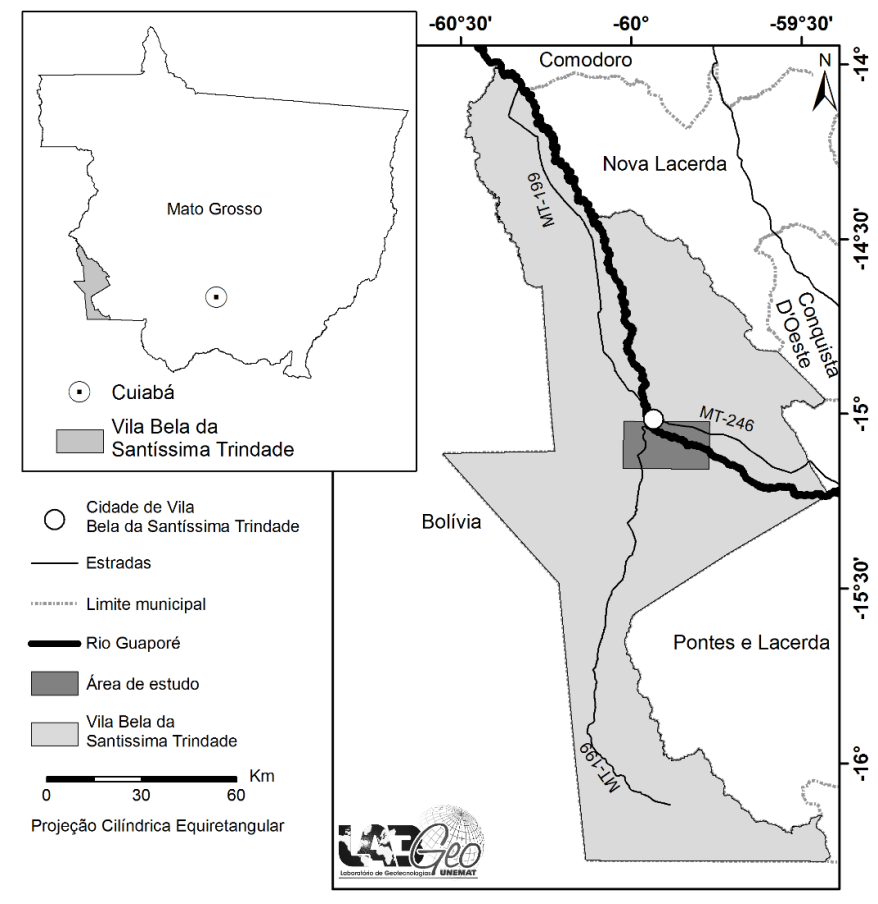
The municipality of Vila Bela da Santíssima Trindade/ MT (Figure 1) was chosen for the study, as it is the first municipality in which the Guaporé River is entirely navigable [8], as well as being the area that best represents the ecological tension between the two biomes in the region.
Data Collection
The bird census was carried out monthly between March 2012 and January 2013, sampling every hydrological period. Birdlife was sampled using the modified point sampling method at eight points along approximately 25 km of the Guaporé River, in the municipality of Vila Bela da Santíssima Trindade, considering the diversity of environments and forms of use found [9, 10].
At each point, 20-minute stops were made to establish visual and auditory contact with the bird species. Binoculars (7x50mm) were used to observe and record the bird species, and photographs were taken with a Canon Rebel XTI digital camera, with 12 mega pixel resolution, and vocalization records were made when possible. The species were systematically sorted using basic references on the birds found on Sick, et al. [11, 12, 13, 14, 15]. The nomenclature used was in accordance with the Brazilian Committee of Ornithological Records [16].
Using the qualitative data, it was possible to estimate the richness of the region’s birds and the most representative families and orders. As well as allowing us to verify the occurrence of species that are endemic to Brazil, seasonal visitors or threatened with extinction.
Using the qualitative data, we calculated the frequency of occurrence in order to establish their abundance indices. The calculation of frequency of occurrence was determined using the Lindsdale Index [17]. This is the ratio between the number of times the species was recorded and the total number of visits expressed as a percentage. Abundance
indices were defined as: very abundant, species recorded between 81-100%; abundant, 61-80%; frequent, 41-60%; occasional, 21-40% and rare, 1-20%. Species described as seasonal visitors were not taken into account, nor were species with nocturnal habits, since no censuses were carried out that included the time when individuals were most active.
Results and Discussion
In this study we recorded 173 species of birds belonging to 48 families and 23 orders in the Upper Guaporé Valley, southwestern Mato Grosso State, Brazil (Table 1). The families with the highest number of species were Tyrannidae with 19 species, followed by the Accipitridae, Ardeidae and Icteridae families, all with 10 species, and the Psittacidae family with 9 species recorded. All the species recorded in this study are considered to be of low concern in terms of threat of extinction on a global scale [18] and are not on the Ministry of the Environment’s list of endangered species at a national or local level [19].
The frequency of occurrences showed that more than half (55%) of the species recorded in this study for the region were considered rare, 16% were very abundant, 13% were occasional, 8% were abundant and 7% were frequent species (Table 1).
In previous bird surveys carried out in the Upper Guaporé Valley by Natterers-Pelzeln [2]; Willis, et al. [3], Silveira, et al. [4], a total of 472 species were recorded for the region. In our surveys, we recorded 30 species that were not recorded in the aforementioned surveys: Dendrocygna autumnalis (Linnaeus 1758), Circus buffoni (Gmelin 1788), Porphyrio flavirostris (Gmelin 1789), Phaetusa simplex (Gmelin 1789), Brotogeris chiriri (Vieillot 1818), Pionus maximiliani (Kuhl1820), Phaethorni spretrei (Lessone Delattre 1839), Chloroceryle inda (Linnaeus 1766), Campylorhamphus trochilirostris (Lichtenstein 1820), Certhiaxis cinnamomeus (Gmelin 1788), Schiffornis virescens (Lafresnaye 1838), Elaenia flavogaster (Thunberg 1822), Elaenia chiriquensis (Lawrence 1865), Myiarchus swainsoni (Cabanise Heine 1859), Tyrannopsis sulphurea (Spix 1825), Griseotyrannus aurantioatrocristatus (d’Orbigny eLafresnaye 1837), Arundinicola leucocephala (Linnaeus 1764), Lathrotriccus euleri (Cabanis 1868), Riparia riparia (Linnaeus 1758), Troglodytes musculus (Naumann 1823), Cantorchilus guarayanus (d’Orbignye Lafresnaye 1837), Paroaria capitata (d’Orbignye Lafresnaye 1837), Sicalis flaveola (Linnaeus 1766), Sporophila nigricollis (Vieillot 1823), Sporophila bouvreuil (Statius Muller 1776), Piranga flava (Vieillot 1822), Icterus pyrrhopterus (Vieillot 1819), Icterus croconotus (Wagler1829), Amblyramphus holosericeus (Scopoli 1786), Molothrus oryzivorus (Gmelin 1788).
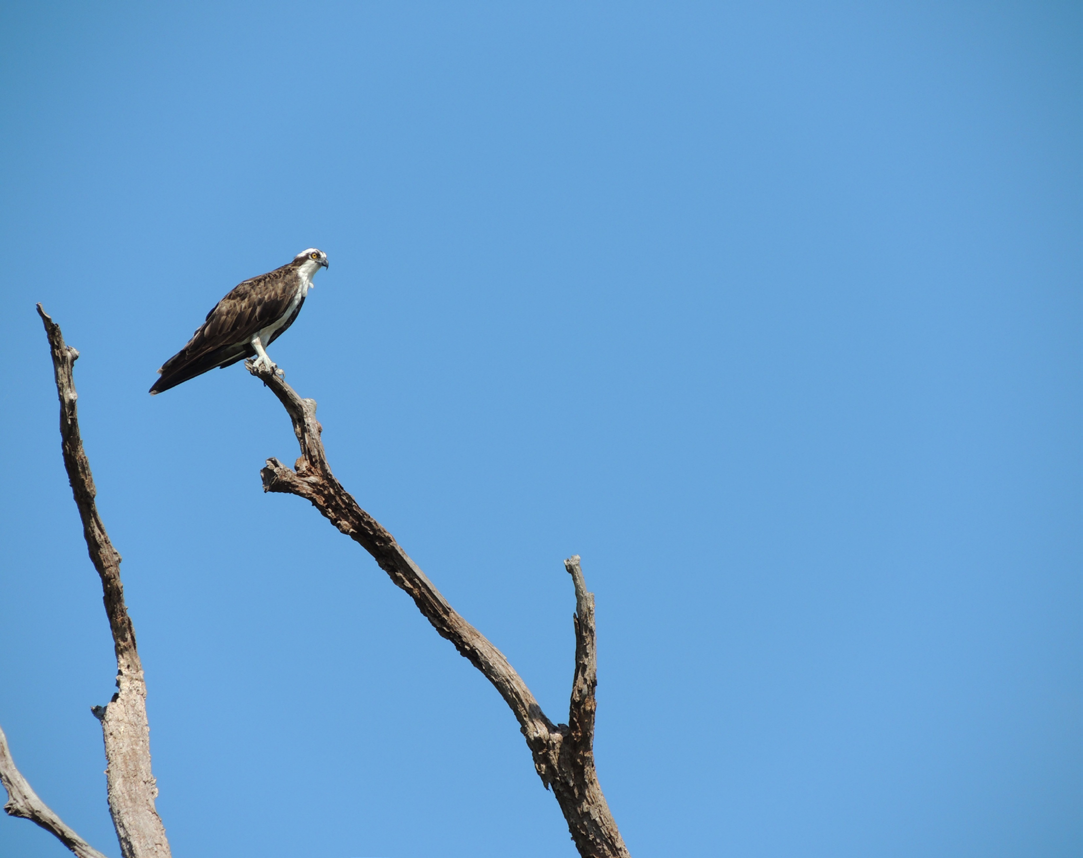
We recorded 5 known migratory species in this study [20]. The Osprey (Pandion haliaetus, Linnaeus 1758) (Figure 2), the only member of the Pandionidae family, was recorded from September onwards. P. haliaetus is native to North America, where it breeds, migrating to South America during the winter. This species can be seen in almost all Brazilian states. Its migration route usually follows bodies of water, due to its preference for feeding on fish.
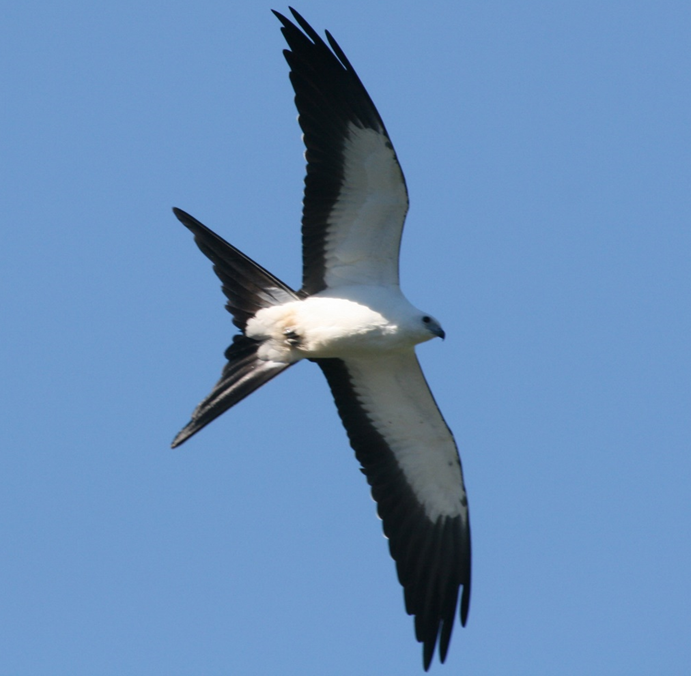
Swallow-tailed Kite (Elanoides forficatus, Linnaeus 1758) (Figure 3), recorded in March and then only from September onwards, with the number of individuals gradually increasing over the months, reaching 317 individuals in December flying over the study area in search of food, clearly demonstrating a migratory movement. E. forficatus has a subspecies resident in Brazil and a subspecies from North America, migrating to the south and southeast of Brazil from August/September and remaining until February/March, corroborating what was recorded in this study Nunes, et al. [21]. This pattern of occurrence was also recorded by Vitorino, et al. [22]; Nunes, et al. [23] Nunes, et al. [24] in different regions of the Pantanal in Mato Grosso.
Vermilion flycatcher (Pyrocephalus rubinus, Boddaert 1783), a bird from the Tirannydae family, notable for the strong red coloration of the male during the breeding season. It was sighted from July to August, with the males wearing breeding plumage. P. rubinus are southern migrants, coming from southern Brazil and Argentina to the Amazon in winter. They return to the south in spring-summer to begin breeding.
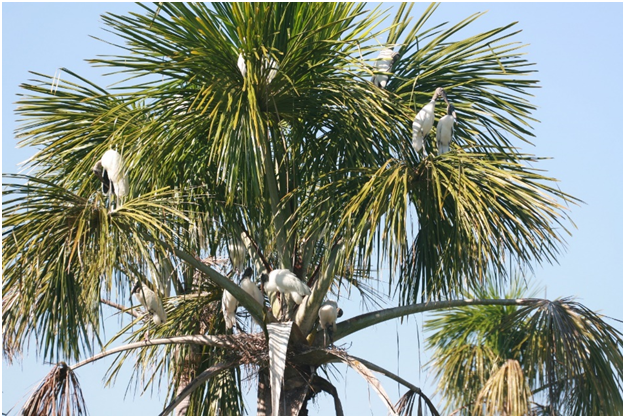
Another noteworthy fact is the formation of a nesting area for wood stork (Mycteria americana, Linnaeus 1758) (Figura 4) at one of the sampling points. The area has dominant Buriti vegetation (Mauritia flexuosa, Linnaeus1782). The individuals of M. americana were seen sporadically from April onwards. Later, in July, around 120 individuals of M.americana (in a mixed flock with Platalea ajaja, Linnaeus 1758) established themselves in the area, building nests and starting to reproduce. Young individuals of M. americana began to appear in September and remained in the area until October. This makes the area extremely important for maintaining the species in the state’s Pantanal plains.
It is important to note that the Upper Guaporé Valley is located in a region that is extremely rich in biodiversity and is still little known. It also has a unique composition of species as it is a transition area between two important Brazilian biomes (the Amazon and the Cerrado). This raises the need for the creation of Conservation Unit areas, in view of the advance of agricultural and pastoral activities in the region.
| TAXON NAME | PORTUGUESE NAME | FO | STATUS |
|---|---|---|---|
| TINAMIDAE | |||
| Crypturellus undulatus (Temminck, 1815) | Jaó | O | R |
| ANHIMIDAE | |||
| Chauna torquata (Oken, 1816) | Tachã | Ma | R |
| ANATIDAE | |||
| Dendrocygna viduata (Linnaeus, 1766) | Irerê | O | R |
| Dendrocygna autumnalis (Linnaeus, 1758) | Asa-branca | A | R |
| Cairina moschata (Linnaeus, 1758) | Pato-do-mato | Ma | R |
| Amazonetta brasiliensis (Gmelin, 1789) | Pé-vermelho | Ra | R |
| CRACIDAE | |||
| Ortalis guttata (Spix, 1825) | Aracuã | Ra | R |
| Penelope superciliaris (Temminck, 1815) | Jacupemba | Ra | R |
| Aburria cujubi (Pelzeln, 1858) | Cujubi | Ra | R |
| Pauxi tuberosa (Spix, 1825) | Mutum-cavalo | Ra | R |
| Crax fasciolata(Spix, 1825) | Mutum-de-penacho | Ra | R |
| CICONIIDAE | |||
| Ciconia maguari (Gmelin, 1789) | Maguari | Ra | R |
| Jabiru mycteria (Lichtenstein, 1819) | Tuiuiú | Ra | R |
| Mycteria americana (Linnaeus, 1758) | Cabeça-seca | A | R |
| PHALACROCORACIDAE | |||
| Phalacrocorax brasilianus (Gmelin, 1789) | Biguá | Ma | R |
| ANHINGIDAE | |||
| Anhinga anhinga (Linnaeus, 1766) | Biguatinga | Ma | R |
| ARDEIDAE | |||
| Tigrisoma lineatum (Boddaert, 1783) | Socó-boi | Ma | R |
| Agamia agami (Gmelin, 1789) | Garça-da-mata | Ra | R |
| Cochlearius cochlearius (Linnaeus, 1766) | Arapapá | - | R |
| Nycticorax nycticorax (Linnaeus, 1758) | Savacu | - | R |
| Butorides striata (Linnaeus, 1758) | Socozinho | Ma | R |
| Bubulcus ibis (Linnaeus, 1758) | Garça-vaqueira | Fr | R |
| Ardea cocoi (Linnaeus, 1766) | Garça-moura | Ma | R |
| Ardea alba (Linnaeus, 1758) | Garça-branca-grande | Ma | R |
| Pilherodius pileatus (Boddaert, 1783) | Garça-real | Ra | R |
| Egretta thula (Molina, 1782) | Garça-branca-pequena | Fr | R |
| THRESKIORNITHIDAE | |||
| Mesembrinibis cayennensis (Gmelin, 1789) | Coró-coró | A | R |
| Phimosus infuscatus (Lichtenstein, 1823) | Tapicuru-de-cara-pelada | A | R |
| Theristicus caudatus(Boddaert, 1783) | Curicaca | Ra | R |
| Platalea ajaja (Linnaeus, 1758) | Colhereiro | Ra | R |
| CATHARTIDAE | |||
| Cathartes aura (Linnaeus, 1758) | Urubu-de-cabeça-vermelha | A | R |
| Cathartes burrovianus (Cassin, 1845) | Urubu-de-cabeça-amarela | O | R |
| Coragyps atratus (Bechstein, 1793) | Urubu-de-cabeça-preta | Ma | R |
| PANDIONIDAE | |||
| Pandion haliaetus (Linnaeus, 1758) | Águia-pescadora | - | VN |
| ACCIPITRIDAE | |||
| Elanoides forficatus (Linnaeus, 1758) | Gavião-tesoura | - | VN |
| Circus buffoni (Gmelin, 1788) | Gavião-do-banhado | Ra | R |
| Busarellus nigricollis (Latham, 1790) | Gavião-belo | Ma | R |
| Rostrhamus sociabilis (Vieillot, 1817) | Gavião-caramujeiro | A | R |
| Geranospiza caerulescens (Vieillot, 1817) | Gavião-pernilongo | Ra | R |
| Heterospizias meridionalis (Latham, 1790) | Gavião-caboclo | Ra | R |
| Urubitinga urubitinga (Gmelin, 1788) | Gavião-preto | Ra | R |
| Rupornis magnirostris (Gmelin, 1788) | Gavião-carijó | A | R |
| Pseudastur albicollis (Latham, 1790) | Gavião-branco | O | R |
| Buteo nitidus (Latham, 1790) | Gavião-pedrês | Ra | R |
| FALCONIDAE | |||
| Daptrius ater (Vieillot, 1816) | Gavião-de-anta | Ra | R |
| Caracara plancus (Miller, 1777) | Caracará | Ra | R |
| Milvago chimachima (Vieillot, 1816) | Carrapateiro | Ra | R |
| Herpetotheres cachinnans (Linnaeus, 1758) | Acauã | O | R |
| Falco sparverius (Linnaeus, 1758) | Quiriquiri | Ra | R |
| Falco rufigularis (Daudin, 1800) | Cauré | Ra | R |
| EURYPYGIDAE | |||
| Eurypyga helias (Pallas, 1781) | Pavãozinho-do-pará | Ra | R |
| ARAMIDAE | |||
| Aramus guarauna (Linnaeus, 1766) | Carão | Ma | R |
| RALLIDAE | |||
| Aramides cajanea (Statius Muller, 1776) | Saracura-três-potes | Ra | R |
| Laterallus viridis (Statius Muller, 1776) | Sanã-castanha | Ra | R |
| Porzana albicollis (Vieillot, 1819) | Sanã-carijó | Ra | R |
| Porphyrio martinica (Linnaeus, 1766) | Frango-d’água-azul | O | R |
| Porphyrio flavirostris (Gmelin, 1789) | Frango-d’água-pequeno | Fr | R |
| HELIORNITHIDAE | |||
| Heliornis fulica (Boddaert, 1783) | Picaparra | Fr | R |
| CHARADRIIDAE | |||
| Vanellus chilensis (Molina, 1782) | Quero-quero | A | R |
| JACANIDAE | |||
| Jacana jacana (Linnaeus, 1766) | Jaçanã | Ma | R |
| STERNIDAE | |||
| Phaetusa simplex (Gmelin, 1789) | Trinta-réis-grande | Ra | R |
| COLUMBIDAE | |||
| Columbina talpacoti (Temminck, 1811) | Rolinha-roxa | O | R |
| Claravis pretiosa (Ferrari-Perez, 1886) | Pararu-azul | O | R |
| Columba livia (Gmelin, 1789) | Pombo-doméstico | Ma | R |
| Patagioenas cayennensis (Bonnaterre, 1792) | Pomba-galega | A | R |
| Patagioenas plumbea (Vieillot, 1818) | Pomba-amargosa | O | R |
| Zenaida auriculata (Des Murs, 1847) | Pomba-de-bando | Ra | R |
| Leptotila verreauxi (Bonaparte, 1855) | Juriti-pupu | Ra | R |
| PSITTACIDAE | |||
| Ara ararauna (Linnaeus, 1758) | Arara-canindé | Ma | R |
| Ara chloropterus (Gray, 1859) | Arara-vermelha-grande | Fr | R |
| Orthopsittaca manilata (Boddaert, 1783) | Maracanã-do-buriti | Ma | R |
| Aratinga leucophthalma (Statius Muller, 1776) | Periquitão-maracanã | Ra | R |
| Brotogeris chiriri (Vieillot, 1818) | Periquito-de-encontro-amarelo | A | R |
| Pionus menstruus (Linnaeus, 1766) | Maitaca-de-cabeça-azul | O | R |
| Pionus maximiliani (Kuhl, 1820) | Maitaca-verde | Ra | R |
| Amazona amazonica (Linnaeus, 1766) | Curica | Ra | R |
| Amazona aestiva (Linnaeus, 1758) | Papagaio-verdadeiro | O | R |
| OPISTHOCOMIDAE | |||
| Opisthocomus hoatzin (Statius Muller, 1776) | Cigana | Ma | R |
| CUCULIDAE | |||
| Coccycua minuta (Vieillot, 1817) | Chincoã-pequeno | Ra | R |
| Piaya cayana (Linnaeus, 1766) | Alma-de-gato | O | R |
| Crotophaga major (Gmelin, 1788) | Anu-coroca | A | R |
| Crotophaga ani (Linnaeus, 1758) | Anu-preto | Ma | R |
| Guira guira (Gmelin, 1788) | Anu-branco | O | R |
| STRIGIDAE | |||
| Pulsatrix perspicillata (Latham, 1790) | Murucututu | - | R |
| Bubo virginianus (Gmelin, 1788) | Jacurutu | - | R |
| APODIDAE | |||
| Streptoprocne zonaris (Shaw, 1796) | Taperuçu-de-coleira-branca | Ra | R |
| TROCHILIDAE | |||
| Phaethornis nattereri (Berlepsch, 1887) | Besourão-de-sobre-amarelo | Ra | R |
| Phaethornis pretrei (Lesson&Delattre, 1839) | Rabo-branco-acanelado | Ra | R |
| Anthracothorax nigricollis (Vieillot, 1817) | Beija-flor-de-veste-preta | Ra | R |
| Hylocharis cyanus (Vieillot, 1818) | Beija-flor-roxo | Ra | R |
| TROGONIDAE | |||
| Trogon melanurus (Swainson, 1838) | Surucuá-de-cauda-preta | Ra | R |
| Trogon curucui (Linnaeus, 1766) | Surucuá-de-barriga-vermelha | Ra | R |
| ALCEDINIDAE | |||
| Megaceryle torquata (Linnaeus, 1766) | Martim-pescador-grande | Ma | R |
| Chloroceryle amazona (Latham, 1790) | Martim-pescador-verde | Ma | R |
| Chloroceryle aenea (Pallas, 1764) | Martinho | Ra | R |
| Chloroceryle americana (Gmelin, 1788) | Martim-pescador-pequeno | Ma | R |
| Chloroceryle inda (Linnaeus, 1766) | Martim-pescador-da-mata | Fr | R |
| BUCCONIDAE | |||
| Monasa nigrifrons (Spix, 1824) | Chora-chuva-preto | Fr | R |
| RAMPHASTIDAE | |||
| Ramphastos toco (Statius Muller, 1776) | Tucanuçu | A | R |
| Pteroglossus castanotis (Gould, 1834) | Araçari-castanho | Fr | R |
| PICIDAE | |||
| Melanerpes cruentatus (Boddaert, 1783) | Benedito-de-testa-vermelha | Ra | R |
| Veniliornis passerinus (Linnaeus, 1766) | Picapauzinho-anão | Ra | R |
| Colaptes melanochloros (Gmelin, 1788) | Pica-pau-verde-barrado | Ra | R |
| Dryocopus lineatus (Linnaeus, 1766) | Pica-pau-de-banda-branca | O | R |
| Campephilus rubricollis (Boddaert, 1783) | Pica-pau-de-barriga-vermelha | Ra | R |
| Campephilus melanoleucos (Gmelin, 1788) | Pica-pau-de-topete-vermelho | Ra | R |
| THAMNOPHILIDAE | |||
| Taraba major (Vieillot, 1816) | Choró-boi | Ra | R |
| DENDROCOLAPTIDAE | |||
| Dendrocincla fuliginosa (Vieillot, 1818) | Arapaçu-pardo | Ra | R |
| Campylorhamphus trochilirostris (Lichtenstein, 1820) | Arapaçu-beija-flor | Ra | R |
| Dendroplex picus (Gmelin, 1788) | Arapaçu-de-bico-branco | Ra | R |
| FURNARIIDAE | |||
| Furnarius rufus (Gmelin, 1788) | João-de-barro | Ra | R |
| Certhiaxis cinnamomeus (Gmelin, 1788) | Curutié | O | R |
| TITYRIDAE | |||
| Schiffornis virescens (Lafresnaye, 1838) | Flautim | Ra | R |
| Tityra cayana (Linnaeus, 1766) | Anambé-branco-de-rabo-preto | Fr | R |
| TYRANNIDAE | |||
| Camptostoma obsoletum (Temminck, 1824) | Risadinha | Ra | R |
| Elaenia flavogaster (Thunberg, 1822) | Guaracava-de-barriga-amarela | Ra | R |
| Elaenia chiriquensis Lawrence, 1865 | Chibum | Ra | R |
| Elaenia parvirostris (Pelzeln, 1868) | Guaracava-de-bico-curto | Ra | R |
| Myiopagis caniceps (Swainson, 1835) | Guaracava-cinzenta | Ra | R |
| Myiarchus swainsoni (Cabanis & Heine, 1859) | Irré | Ra | R |
| Casiornis rufus (Vieillot, 1816) | Maria-ferrugem | Ra | R |
| Pitangus sulphuratus (Linnaeus, 1766) | Bem-te-vi | Ma | R |
| Philohydor lictor (Lichtenstein, 1823) | Bentevizinho-do-brejo | A | R |
| Machetornis rixosa (Vieillot, 1819) | Suiriri-cavaleiro | O | R |
| Tyrannopsis sulphurea (Spix, 1825) | Suiriri-de-garganta-rajada | Ra | R |
| Myiozetetes cayanensis (Linnaeus, 1766) | Bentevizinho-de-asa-ferrugínea | O | R |
| Tyrannus albogularis (Burmeister, 1856) | Suiriri-de-garganta-branca | Ra | R |
| Tyrannus savana (Vieillot, 1808) | Tesourinha | R | |
| Griseotyrannus aurantioatrocristatus (d’Orbigny&Lafresnaye, 1837) | Peitica-de-chapéu-preto | Ra | R |
| Empidonomus varius (Vieillot, 1818) | Peitica | Ra | R |
| Pyrocephalus rubinus (Boddaert, 1783) | Príncipe | - | VS |
| Arundinicola leucocephala (Linnaeus, 1764) | Freirinha | O | R |
| Lathrotriccus euleri (Cabanis, 1868) | Enferrujado | Ra | R |
| CORVIDAE | |||
| Cyanocorax cyanomelas (Vieillot, 1818) | Gralha-do-pantanal | Ra | R |
| HIRUNDINIDAE | |||
| Stelgidopteryx ruficollis (Vieillot, 1817) | Andorinha-serradora | A | R |
| Progne tapera (Vieillot, 1817) | Andorinha-do-campo | O | R |
| Progne chalybea (Gmelin, 1789) | Andorinha-doméstica-grande | O | R |
| Tachycineta albiventer (Boddaert, 1783) | Andorinha-do-rio | Ma | R |
| Riparia riparia (Linnaeus, 1758) | Andorinha-do-barranco | Ra | VN |
| TROGLODYTIDAE | |||
| Troglodytes musculus (Naumann, 1823) | Corruíra | Ra | R |
| Campylorhynchus turdinus (Wied, 1831) | Catatau | Ma | R |
| Pheugopedius genibarbis (Swainson, 1838) | Garrinchão-pai-avô | Ra | R |
| Cantorchilus guarayanus (d’Orbigny&Lafresnaye, 1837) | Garrincha-do-oeste | Ra | R |
| DONACOBIIDAE | |||
| Donacobius atricapilla (Linnaeus, 1766) | Japacanim | Ma | R |
| POLIOPTILIDAE | |||
| Polioptila dumicola (Vieillot, 1817) | Balança-rabo-de-máscara | Ra | R |
| TURDIDAE | |||
| Turdus rufiventris (Vieillot, 1818) | Sabiá-laranjeira | Ra | R |
| MIMIDAE | |||
| Mimus saturninus (Lichtenstein, 1823) | Sabiá-do-campo | Ra | R |
| THRAUPIDAE | |||
| Saltator maximus (Statius Muller, 1776) | Tempera-viola | Ra | R |
| Saltator coerulescens (Vieillot, 1817) | Sabiá-gongá | Ra | R |
| Ramphocelus carbo (Pallas, 1764) | Pipira-vermelha | Ma | R |
| Tangara sayaca (Linnaeus, 1766) | Sanhaçu-cinzento | Ra | R |
| Tangara palmarum (Wied, 1823) | Sanhaçu-do-coqueiro | Fr | R |
| Schistochlamys melanopis (Latham, 1790) | Sanhaçu-de-coleira | Ra | R |
| Paroaria capitata (d’Orbigny&Lafresnaye, 1837) | Cavalaria | Ma | R |
| EMBERIZIDAE | |||
| Sicalis flaveola (Linnaeus, 1766) | Canário-da-terra-verdadeiro | Ra | R |
| Volatinia jacarina (Linnaeus, 1766) | Tiziu | O | R |
| Sporophila collaris (Boddaert, 1783) | Coleiro-do-brejo | Ra | R |
| Sporophila lineola (Linnaeus, 1758) | Bigodinho | Ra | R |
| Sporophila nigricollis (Vieillot, 1823) | Baiano | Ra | R |
| Sporophila bouvreuil (Statius Muller, 1776) | Caboclinho | Ra | R |
| Sporophila angolensis (Linnaeus, 1766) | Curió | Ra | R |
| CARDINALIDAE | |||
| Piranga flava (Vieillot, 1822) | Sanhaçu-de-fogo | Ra | R |
| Pheucticus aureoventris (d’Orbigny & Lafresnaye, 1837) | Rei-do-bosque | - | VA (O) |
| ICTERIDAE | |||
| Psarocolius decumanus (Pallas, 1769) | Japu | Ra | R |
| Procacicus solitarius (Vieillot, 1816) | Iraúna-de-bico-branco | Ra | R |
| Cacicus cela (Linnaeus, 1758) | Xexéu | O | R |
| Icterus pyrrhopterus (Vieillot, 1819) | Encontro | Ra | R |
| Icterus croconotus (Wagler, 1829) | João-pinto | Fr | R |
| Gnorimopsar chopi (Vieillot, 1819) | Graúna | Ra | R |
| Amblyramphus holosericeus (Scopoli, 1786) | Cardeal-do-banhado | Ra | R |
| Agelasticus cyanopus (Vieillot, 1819) | Carretão | Ra | R |
| Molothrus oryzivorus (Gmelin, 1788) | Iraúna-grande | Ra | R |
| Molothrus bonariensis (Gmelin, 1789) | Vira-bosta | Ra | R |
Table 1: Systematic list of birds recorded in the Upper Guaporé Valley - Mato Grosso, Brazil. (FO) Frequency of Occurrence: (Ma)
Table 1: Systematic list of birds recorded in the Upper Guaporé Valley - Mato Grosso, Brazil. (FO) Frequency of Occurrence: (Ma) very abundant, species recorded between 81-100%; (A) abundant, between 61-80%; (Fr) frequent, 41-60%; (O) occasional, 21-40%; (Ra) rare, 1-20%; (-) birds not considered for classification. The categories and abundance classes were based on Bugalho (1974). Status: (R) resident, (VS) seasonal visitor from the south of the continent, (VN) seasonal visitor from the north of the continent (VA (O)) vagrant, species of apparently irregular occurrence in Brazil; may be a regular migrant in neighboring countries to the west. Status classes were based on CBRO.
Bank Swallow (Riparia riparia) belonging to the Hirundinidae family, was only seen in December. R. riparia appears as a northern visitor in Brazil from September to April. Commonly found in mixed flocks with Barn Swallow (Hirundo rustica).
Black-backed Grosbeak (Pheucticus aureoventris, d’Orbigny eLafresnaye 1837), belonging to the Cardinalidae family, only one individual was seen in November. P. aureoventris has a scarce and irregular occurrence in Brazil, having so far only been recorded in the far west of the state of Mato Grosso. It can be considered a southern migrant, as it has a wide distribution in the Andes.
Conclusions
The Upper Guaporé Valley has great potential for richness of fauna and flora, its location in a transition area between the Amazon and the Cerrado, and with the Pantanal as a neighboring biome, the species composition in this environment becomes unique as species from all three biomes can be found in the area.
The species richness recorded in this study is considered to be high when compared to other environments in Brazil and even abroad, even more so when taking into account that we are only dealing with species that can be found along the river.
Conflicts of Interest
The authors declare that there are no conflicts of interest involving this publication.
Acknowledgements
We would like to thank the Research Support Foundation of the State of Mato Grosso (FAPEMAT), the National Council for Scientific and Technological Development (CNPQ), the Ministry of Science and Technology and the Bionorte Network for funding and maintaining the project, and the Coordination for the Improvement of Higher Education Personnel (CAPES) for granting the scholarship. We would also like to thank the State University of Mato Grosso (UNEMAT) and the Graduate Program in Environment and Agricultural Production Systems (PPGASP) for their support.
References
-
Ab’Saber AN (1967) Domínios morfoclimáticos e províncias fitogeográficas do Brasil. Orientação 3: 45-48.
-
Natterer J, Pelzeln AV (1871) Zur Ornithologie Brasiliens Resultate von Johann Natterers Reisen in der Jahren 1817 Ibis 1835. Vienna: Oxford University pp: 479.
-
Willis EO, Oniki Y (1990) Levantamento preliminar das aves de inverno em dez áreas do sudoeste de Mato Grosso Brasil. Ararajuba 1: 19-38.
-
Silveira LF, D’Horta F (2002) Avifauna da região de Vila Bela da Santíssima Trindade, Mato Grosso. Papeis Avulsos de Zoologia 42: 265-287.
-
Foschiera AA, Miorin VMF (2006) Globalização e movimentos sociais no campo: o movimento união dos lavradores do Vale do Guaporé (MT). Fragmentos deCultuta 16: 885-906.
-
Pierangeli MAP, Eguchi ES, Ruppin RF, Costa RBF, Vieira DF (2009) Teores de As, Pb, Cd e Hg e fertilidade de solos da região do Vale do Alto Guaporé, sudoeste do estado de Mato Grosso. Acta Amazônica 39(1): 61-70.
-
Projeto Radambrasil (1979) Levantamento de Recursos Naturais, Folha Guaporé (SD-20). BRASIL - Departamento Nacional de Produção Mineral, Rio de Janeiro, Brasil pp: 364.
-
Moss G, Moss M (2007) Projeto Brasil das águas, 7 rios: Guaporé.
-
Blondel J, Ferry C, Frochot B (1970) La méthode des indicesponctuels d’abundance (IPA) ou desrelevés d’avifaune par “stations d’écoute”. Alauda 38: 55-71.
-
Vielliard JM, Silva WR (1990) Nova metodologia de levantamento quantitativo e primeiros resultados no interior do Estado de São Paulo In: Encontro nacional de anilhadores de aves. Anais UFRPe 4: 117-151.
-
Sick H (1997) Ornitologia brasileira. Rio de Janeiro. Nova Fronteira pp: 912.
-
Sigrist T (2008) Aves da Amazônia Brasileira. São Paulo: Avis Brasilis pp: 472.
-
Sigrist T (2009) Avifauna Brasileira. São Paulo: Avis Brasilis pp: 480.
-
Sigrist T (2009) Avifauna Brasileira: Descrição das Espécies. São Paulo: Avis Brasilis pp: 600.
-
Gwynne JA, Ridgely RS, Tudor G, Argel M (2010) Aves do Brasil: Pantanal & Cerrado. São Paulo: Editora Horizonte pp: 322.
-
CBRO (2011) Listas das aves do Brasil versão.
-
Bugalho JF (1974) Métodos de recenseamento de aves. Gráfica Monumental, pp: 106.
-
IUCN (2011) Red List of Threatened Species. Version 9.0.
-
Ibama (2003) Instrução Normativa nº 3 de 27de maio de 2003. Lista das Espécies da Fauna Brasileira Ameaçada de Extinção.
-
CEMAVE Centro Nacional de Pesquisa para Conservação das Aves Silvestres (2005) Lista das espécies de aves migratórias ocorrentes no Brasil.
-
Nunes AP, Tomas WM (2008) Aves migratórias e nômades ocorrentes no Pantanal. Corumbá: Embrapa Pantanal, pp: 124.
-
Vitorino BD, Frota AVB, Castrillon SKI, Nunes JRS (2018) Birds of Estação Ecológica da Serra das Araras, state of Mato Grosso, Brazil: additions and review. Check List 14 (5): 893-922.
-
Nunes JRS, Da Silva CJ, Ikeda-Castrillon SK, Sander NL (2020) Changes in composition of aquatic bird assemblages associated with changing in water levels in the Aquatic Terrestrial Transitional Zone of the Pantanal wetland Brazil, RSD 9(10): e4479108555.
-
Nunes JRS, Albernaz-Silveira R, Da Silva CJ (2012) Avifauna do Rio Cuiabá e do Sistema de Baías Chacororé – Sinhá Mariana, In: Água, Biodiversidade e Cultura do Pantanal, Org. Carolina Joana da Silva e Jane Simoni, pp: 256.
- Mitochondrial Bio-Logistics: Steering Co-Enzyme Q10 and Lycopene Synergies within the Science 4.0 Bio-OS Framework
- Hymenoptera Specimens from the Caño Negro Wetland, of the National Museum Collection, Costa Rica
- Science 4.0: Comprehensive Architecture of the Biological Operating System (Bio-OS) A Framework for Systemic Resilience and Industrialized Bio-Governance
- Rabbit on, or Hare Back? Understanding Climate Change
- Clinical Validation of Science 4.0: Flow Steering and Epigenetic Drift Inversion on a 76-Year-Old Hybrid System
- Seeds Planted by another Mind