
New Locality Record of Cuban Kite-Swallowtail, Neographium celadon (Lepidoptera: Papilionidae) en Ciego de Avila, Cuba
In Cuba occurs some 200 species of butterflies, of which 42 are endemic [1]. Cuban Kite-Swallowtail (Neographium celadon Lucas 1852) it is a day butterfly, endemic of Cuba and belonging to the Papilionidae family that presents a span between 60 and 90 mm
Opinion
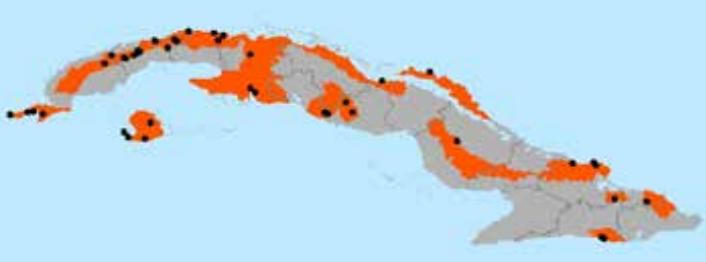
In Cuba occurs some 200 species of butterflies, of which 42 are endemic [1]. Cuban Kite-Swallowtail (Neographium celadon Lucas 1852) it is a day butterfly, endemic of Cuba and belonging to the Papilionidae family that presents a span between 60 and 90 mm. It possesses a black coloration, in Opinion the first wings, with the presence of bands of blue cobalt and stains of the same color [2]. The later wings have three blue bands and in their anal angle exists a stain of intense red color. The same authors point out that the border of both wings is dark and blue stains are observed in submarginal position. It presents a wide distribution, although it is more frequent in the western region of the island (Figure 1). It has been observed in differents plants formations as a coastal shrublands, uverales, evergreen forests, pine forests and gallery forests; where it prefers areas of open vegetation [3].
At 0909 h on 12 May 2024, we documented an adult male of Cuban Kite-Swallowtail, (Neographium celadon) flying over a Romerillo´s plant (Videns alba) in the garden of a domestic house (Figure 2). The place in question is in (22.117 N, -78.611 W), in the Moron municipality belonging to the Ciego de Avila province. The butterfly stayed feeding in the romerillo flowers during six minutes, after that which abandoned the garden and it was out of sight.
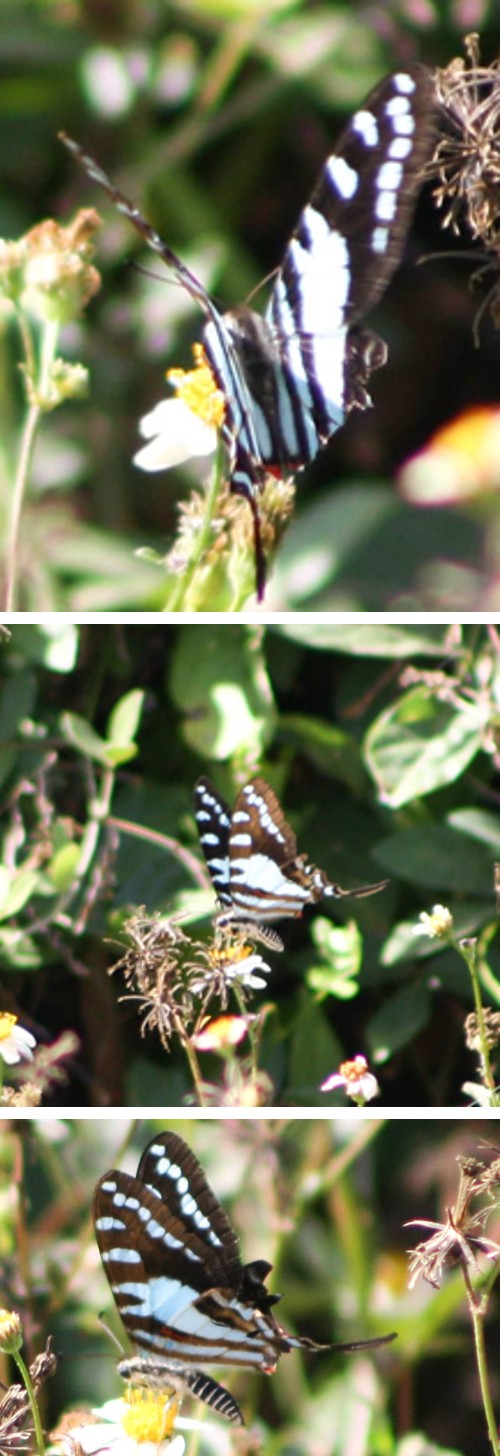
With it, is shown here the first report of distribution of the species for the municipality and the second for the whole mainland province region. Neographium celadon was only reported for the north keys of Ciego de Ávila and the west limit of the Chambas municipality, belonging to the denominated “Moron´s Plain”, such as establish it by Mancina, et al. [2] in their geographical zonifications of Cuba. It is necessary to stand out that this sight was fortuitous, so with a sampling effort based on the search of this and other butterflies species, could be increase the number for the different geographical areas of the province.
References
-
Barro A, Mancina CA, Neyra B, Fontenla JL (2019) Mariposas diurnas endémicas. En: Atlas Nacional de Cuba: LX Aniversario. Instituto de Geografía Tropical, La Habana.
-
Mancina CA, Neyra B, Núñez R, Álvarez Y, Fernández D, et al. (2020) Mariposas de Cuba: Guía de Campo pp: 240.
-
Barro A, Núñez R (2011) Lepidópteros de Cuba. UPC Print Vasa, Finlandia, pp: 228.
- Mitochondrial Bio-Logistics: Steering Co-Enzyme Q10 and Lycopene Synergies within the Science 4.0 Bio-OS Framework
- Hymenoptera Specimens from the Caño Negro Wetland, of the National Museum Collection, Costa Rica
- Science 4.0: Comprehensive Architecture of the Biological Operating System (Bio-OS) A Framework for Systemic Resilience and Industrialized Bio-Governance
- Rabbit on, or Hare Back? Understanding Climate Change
- Clinical Validation of Science 4.0: Flow Steering and Epigenetic Drift Inversion on a 76-Year-Old Hybrid System
- Seeds Planted by another Mind